
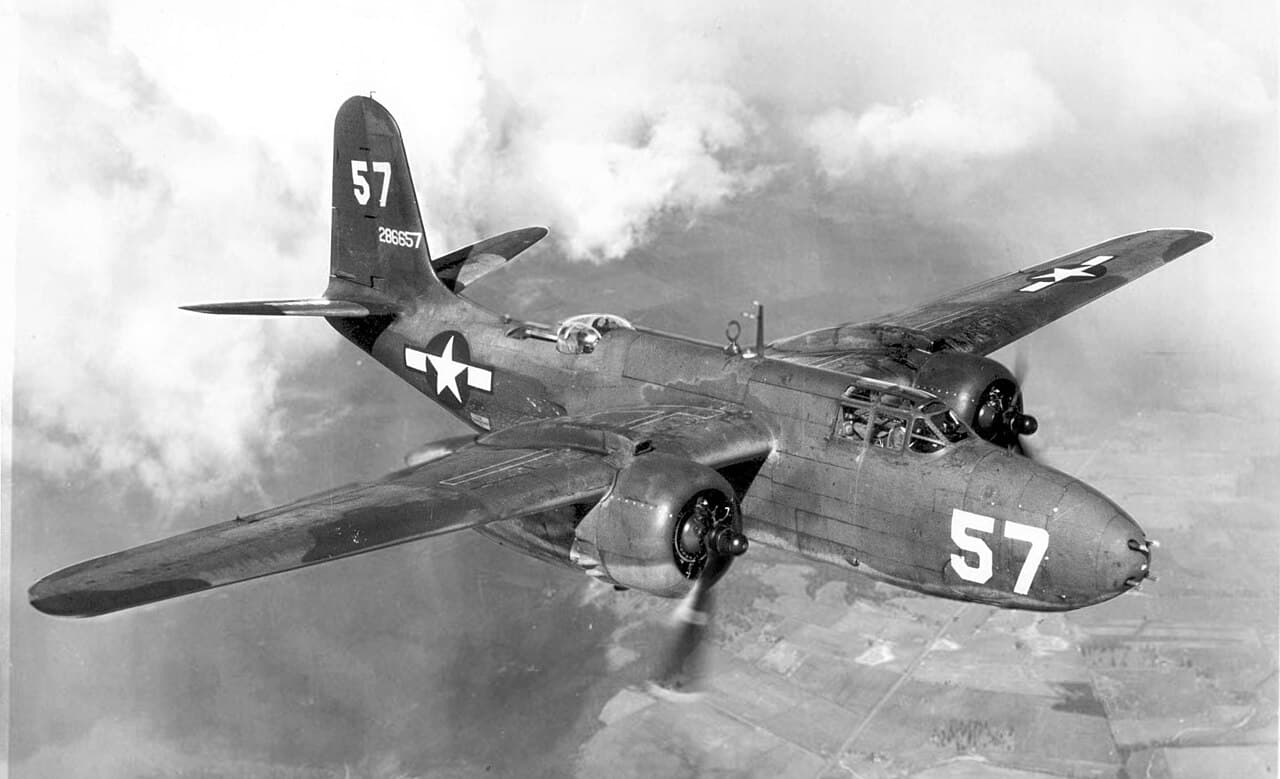
Douglas A-20G Havoc
Douglas Aircraft Company
How does the A-20G stack up?
CompareOverview
The Douglas A-20 Havoc was one of the most important yet least recognized attack aircraft of World War II. Fast, well-armed, and rugged, the A-20 served as the USAAF's primary light bomber and attack aircraft during the middle years of the war, bridging the gap between the obsolescent types available in 1941 and the arrival of the A-26 Invader in 1944. It was also one of the most internationally distributed American aircraft, serving with the air forces of over a dozen nations.
The A-20G, the most-produced variant, was a dedicated low-level attack aircraft with a solid nose containing six .50-caliber machine guns, replacing the glazed bombardier's nose of earlier variants. This configuration made it a devastating ground-attack and ship-strafing platform. Combined with a 4,000-pound bomb load and speeds approaching 340 mph, the A-20G could strike fast, hit hard, and get out before defenses could react.
The Soviet Union was the A-20's largest operator after the United States, receiving over 3,000 aircraft under Lend-Lease. Soviet crews used the Havoc extensively on the Eastern Front as both a bomber and attack aircraft, and it was one of the most valued Lend-Lease types. The versatility of the A-20 design was demonstrated by its service in roles ranging from night fighter (as the P-70) to torpedo bomber, gunship, and high-speed reconnaissance platform.
Performance Profile
Max Speed
339 mph
at 12,400 ft
Range
1,090 miles
normal
Service Ceiling
25,800 ft
Rate of Climb
2,000 ft/min
Armament
8 guns
6x .50 BMG, 2x .50 BMG
Crew
3
Engine
Wright R-2600-23 Cyclone 14
1600 hp radial
Development History
The A-20 originated from Douglas Aircraft's Model 7B, designed by Ed Heinemann, Robert Donovan, and Ted Smith in 1937 as a private venture to meet an anticipated Army requirement for a high-speed attack bomber. The design featured a shoulder-mounted wing, tricycle landing gear (advanced for the era), and twin engines. The prototype first flew on October 26, 1938, and immediately attracted international attention for its speed and handling.
France was the first customer, ordering 100 DB-7 export versions in February 1939 before the Army Air Corps had placed its own order. When France fell in 1940, surviving French DB-7s were taken over by the RAF, which designated them the "Boston" (bomber) and "Havoc" (night fighter/intruder). The Army Air Corps ordered the A-20 in May 1939, and deliveries of the A-20A began in 1941.
The A-20 went through numerous variants. The A-20A had Allison V-1710 engines but was primarily used as a trainer. The A-20B introduced the Wright R-2600 radial, which became standard. The A-20C was a Lend-Lease variant for the RAF and Soviet Union. The A-20G, entering production in early 1943, was the first variant designed specifically as a gunship attack aircraft with the solid nose containing six .50-caliber guns. It became the most-produced variant with 2,850 built.
The P-70, a night fighter conversion of early A-20s, was the USAAF's first purpose-configured night fighter, serving in the Pacific until P-61 Black Widows became available. The reconnaissance variant, the F-3, was used for night photo missions over Europe and the Pacific.
Combat History
The A-20 first saw American combat in the Southwest Pacific, where the 3rd Bombardment Group flew A-20As on strafing and skip-bombing missions against Japanese shipping and airfields in New Guinea from 1942 onward. The 3rd BG, under Colonel John "Big Jim" Davies and later the legendary Colonel Paul "Pappy" Gunn, became experts at low-level attack, developing skip-bombing techniques that the A-20's speed and maneuverability were perfectly suited for.
In Europe, A-20 Havocs of the Ninth Air Force provided tactical air support from the North African campaign through the invasion of Normandy and into Germany. The 416th Bombardment Group and other Ninth Air Force A-20 units flew medium-altitude bombing missions against marshaling yards, airfields, bridges, and supply dumps. During the D-Day invasion, A-20s attacked German positions along the Normandy coast. The aircraft proved particularly effective in the interdiction role, cutting supply lines and disrupting German logistics.
The Soviet Air Force was the A-20's most enthusiastic operator. Over 3,000 Havocs were delivered under Lend-Lease, and Soviet crews used them extensively on the Eastern Front. The Soviets valued the A-20 for its speed, bomb load, and the survivability provided by its twin-engine configuration. Soviet A-20 units participated in every major Eastern Front campaign from Stalingrad to Berlin, and the aircraft was one of the highest-rated Lend-Lease types among Soviet aircrews.
The A-20 also served with the RAAF's No. 22 Squadron in New Guinea, the Free French Air Forces in the Mediterranean and Western Europe, and the South African Air Force in the Mediterranean. By the time production ended in September 1944, the A-20 had seen combat on every front of the global conflict.
Variants
| Designation | Key Differences | Produced |
|---|---|---|
| DB-7 / Boston I-III | Export versions for France and RAF, various engine configurations, glazed nose | 1,960 |
| A-20B | First USAAF combat variant with Wright R-2600 engines | 999 |
| A-20G | Solid nose with six .50 cal guns, R-2600-23, dedicated attack variant, most-produced | 2,850 |
| A-20H | R-2600-29 engines (1,700 hp), improved performance, otherwise similar to A-20G | 412 |
| A-20J/K | Glazed bombardier nose for lead ship role, fewer forward guns | 850 |
| P-70 | Night fighter conversion, AI radar, first USAAF night fighter | 105 |
Strengths & Weaknesses
+Strengths
- High speed for a light bomber, allowing it to outrun many fighters at low altitude
- Devastating forward firepower in the A-20G solid-nose configuration with six .50-caliber guns
- Twin-engine reliability and survivability; could fly home on one engine
- Excellent low-level handling qualities made it ideal for strafing and skip-bombing
- Rugged construction absorbed significant battle damage
-Weaknesses
- Relatively light bomb load of 4,000 pounds limited its heavy bombing capability
- Limited range restricted its use on long-distance missions without auxiliary fuel tanks
- Cramped crew compartments, especially for the gunner in the rear position
- Gradually overshadowed by the faster and more capable A-26 Invader from 1944
Pilot Voices
“The A-20 was fast and it was honest. You came in low and fast, hit the target, and got out before they knew what happened.”
“We loved the Havoc. It was the fastest thing at low level and those six nose guns would chew up anything on the ground.”
Did You Know?
France ordered the DB-7 export version of the A-20 before the US Army Air Corps placed its own order, making a foreign power the first customer for what became a key American combat aircraft.
The Soviet Union received over 3,000 A-20 Havocs under Lend-Lease, making it the largest operator of the type after the United States.
The P-70 night fighter variant of the A-20 was the USAAF's first radar-equipped night fighter, serving in the Pacific until the P-61 Black Widow became available.
Ed Heinemann, who designed both the SBD Dauntless and the A-20 Havoc, later designed the A-4 Skyhawk, making him perhaps the most prolific attack aircraft designer in American history.

