
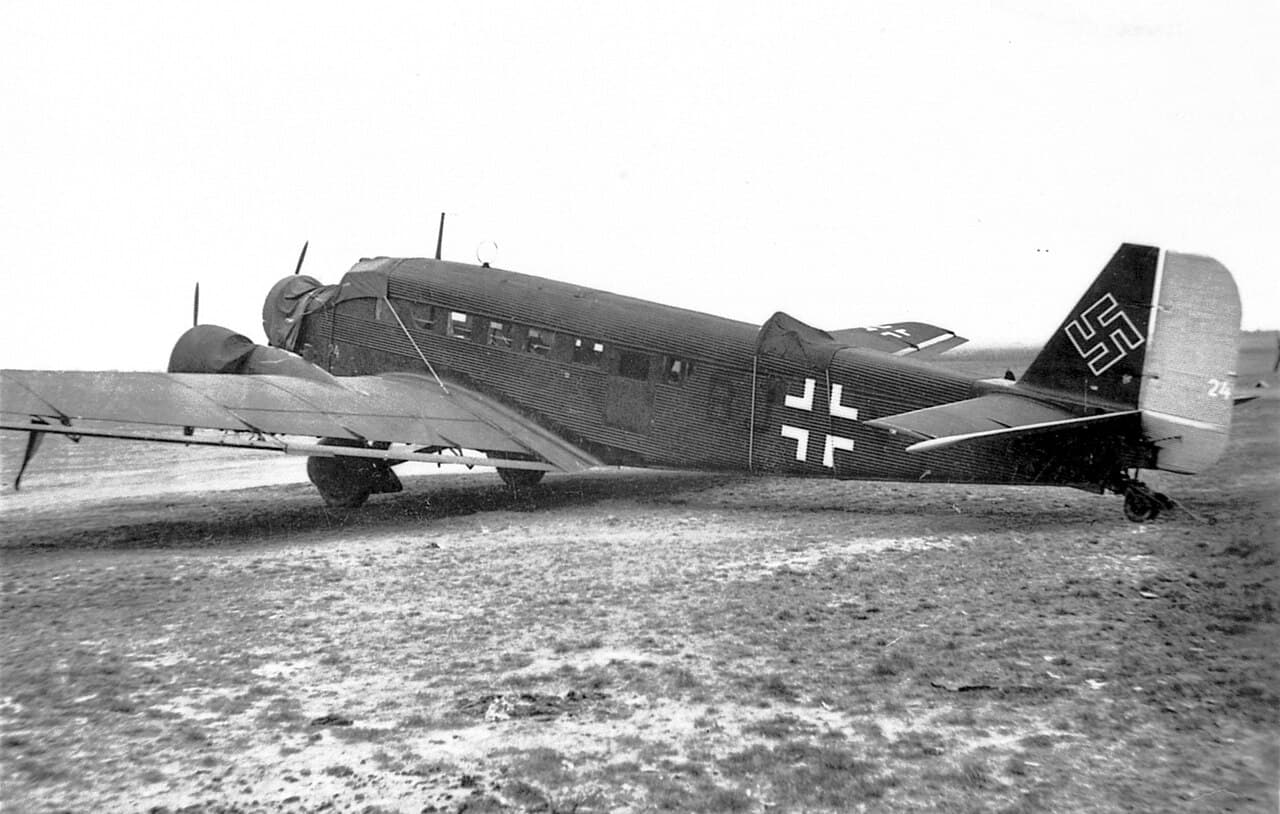
Junkers Ju 52/3m
Junkers
How does the Ju 52/3m stack up?
CompareOverview
The Junkers Ju 52/3m, universally known as "Tante Ju" (Aunt Ju) to the German soldiers who relied on her, was one of the most important transport aircraft of World War II and arguably the most recognizable German aircraft after the Bf 109 and Stuka. With its distinctive corrugated duralumin skin, fixed landing gear, and three radial engines, the Ju 52 was already obsolescent when the war began. But like many great military workhorses, its virtues, ruggedness, reliability, and the ability to operate from the most primitive airstrips, made it indispensable.
The Ju 52 carried the German paratroops to their victories in Norway, the Netherlands, and Crete. It flew the Stalingrad airlift, and died in huge numbers doing so. It dropped supplies, evacuated wounded, towed gliders, and landed troops on dirt strips, frozen lakes, and beach sand from the Arctic to North Africa. Every major German airborne and airlift operation of the war depended on the Ju 52, and its losses in these operations, particularly at Crete and Stalingrad, were devastating and irreplaceable.
Over 4,800 Ju 52/3m aircraft were built, and they served with air forces on every continent. The type remained in military and commercial service long after the war, French-built AAC.1 Toucans flew in Indochina and Algeria, Spanish CASA 352s served into the 1970s, and Swiss Ju 52s carried passengers commercially until 1982. Tante Ju earned her nickname through decades of faithful service.
Performance Profile
Max Speed
168 mph
at 2,950 ft
Range
568 miles
normal
Service Ceiling
18,045 ft
Rate of Climb
689 ft/min
Armament
2 guns
2x 7.92mm MG 15
Crew
3
Engine
BMW 132T
830 hp radial
Development History
Hugo Junkers' company first flew the single-engined Ju 52 in October 1930. The three-engined Ju 52/3m variant, with its distinctive nose-mounted and wing-mounted BMW radial engines, followed in 1932 and quickly became Lufthansa's standard airliner. The aircraft's corrugated duralumin skin, a Junkers trademark, provided exceptional structural strength with minimal internal framing, allowing a spacious cargo/passenger cabin that could accommodate 17 passengers or equivalent freight.
The Ju 52/3m's military potential was recognized early. During the Spanish Civil War (1936-39), Ju 52s of the Condor Legion served as both bombers and transports, infamously participating in the bombing of Guernica. Their bombing role was short-lived, the aircraft was too slow and vulnerable for combat, but the transport missions demonstrated the Ju 52's value for military logistics and airborne operations.
By 1939, the Ju 52/3m was already old technology. Its fixed landing gear, corrugated skin, and relatively low power produced a cruising speed of barely 150 mph, a figure that contemporary fighters could triple. But the aircraft's virtues were perfectly suited to the transport role: it could operate from unpaved strips, grass fields, sand, snow, and even frozen lakes. Its low landing speed and robust undercarriage allowed operations from surfaces that would destroy more modern aircraft.
Throughout the war, Junkers continued production of the Ju 52 with only minor modifications. The BMW 132T engines remained standard, though some late-production aircraft received the slightly more powerful BMW 132Z. Defensive armament was progressively improved from a single dorsal MG 15 to include beam guns and a ventral weapon, but the Ju 52 was never anything more than a token defender against fighter attack. Its survival depended entirely on fighter escort, timing, or luck.
Combat History
The Ju 52's first major wartime operation was the invasion of Norway in April 1940, where over 500 transport sorties delivered paratroopers and airborne infantry to seize key airfields. The campaign demonstrated both the Ju 52's capability and its vulnerability, losses to ground fire and Norwegian fighters were significant, but the operations achieved their objectives.
The Netherlands and Belgium fell next, with Ju 52s dropping paratroopers at Rotterdam, The Hague, and key bridge crossings. Losses were again heavy, over 200 Ju 52s were destroyed or damaged in the Dutch campaign alone, many caught on the ground by defending forces. But the airborne concept was proven spectacularly successful.
The Battle of Crete in May 1941 was the Ju 52's finest and most costly hour. Over 500 Ju 52s dropped the entire 7th Flieger Division and 5th Mountain Division onto the island, taking massive losses from the alerted defenders. Over 170 Ju 52s were destroyed and many more damaged, losses so severe that Hitler forbade any further large-scale airborne operations for the rest of the war. The transport fleet would never fully recover.
At Stalingrad (November 1942 - February 1943), the Ju 52 faced its greatest test and most tragic failure. Goering's promise to supply the encircled 6th Army by air required 300 tons per day, a figure the available transport fleet could never achieve. Ju 52s flew into a cauldron of Soviet fighters, anti-aircraft fire, and brutal winter weather, delivering a fraction of what was needed while suffering appalling losses. Over 266 Ju 52s were lost during the Stalingrad airlift, along with irreplaceable experienced transport crews. The loss of so many transports crippled the Luftwaffe's airlift capability for the remainder of the war.
Variants
| Designation | Key Differences | Produced |
|---|---|---|
| Ju 52/3m g3e | Standard military transport variant with BMW 132A engines (660 hp each), provision for dorsal MG 15, and floor strengthened for military cargo. Early war workhorse. | 1,070 |
| Ju 52/3m g7e | Improved variant with BMW 132T engines (830 hp each), autopilot, larger cabin door for easier paratroop exits, and improved radio equipment. Most common wartime variant. | 887 |
| Ju 52/3m g14e | Late-war variant with BMW 132Z engines, improved armor protection for crew, additional beam-mounted MG 131 defensive guns, and glider-towing equipment. | 1,200 |
| Ju 52/3m (See) | Floatplane variant fitted with twin Edo-type floats for water operations. Used for coastal patrol, air-sea rescue, and transport in coastal areas. Significantly reduced performance. | 53 |
| CASA 352 / AAC.1 Toucan | Postwar licensed production variants built in Spain (CASA 352) and France (AAC.1 Toucan). Toucans saw combat service in French Indochina and Algeria. CASA 352s served in Spain until the 1970s. | - |
Strengths & Weaknesses
+Strengths
- Exceptional ruggedness, corrugated duralumin skin and robust undercarriage could handle the roughest field conditions
- Could operate from virtually any surface including unpaved strips, grass, sand, snow, and frozen lakes
- Simple, reliable design with minimal maintenance requirements and long service life
- Excellent short-field performance with low stall speed, enabling operations from confined airstrips
-Weaknesses
- Hopelessly slow, cruising speed of 152 mph made it easy prey for any fighter aircraft
- Minimal defensive armament provided token protection at best against fighter attack
- Fixed landing gear created permanent drag penalty, further limiting already modest performance
- Limited cargo capacity compared to later transport designs like the Me 323 or Allied C-47/C-54
Pilot Voices
“Tante Ju was like an old grandmother, slow, reliable, and she always got you home. She was not fast or glamorous, but when the weather was terrible and the field was a mudhole, she was the only aircraft that could do the job.”
“Flying into Stalingrad was like flying into hell. Searchlights, tracers, fighters, and we lumbered through it all at 150 miles per hour in our old Junkers, praying the engines would keep running.”
Did You Know?
The Ju 52's corrugated skin was a Junkers trademark dating back to World War I. While it added drag, the corrugations provided remarkable structural strength, similar to the principle of corrugated cardboard, allowing a lighter internal frame and more useful cabin volume.
During the invasion of Crete, over 170 Ju 52s were destroyed in a single operation. The losses were so devastating that Germany never again attempted a large-scale airborne assault, despite having proved the concept at enormous cost.
The last commercial Ju 52 passenger flights were operated by Ju-Air in Switzerland using original 1930s airframes. These flights finally ended in 2018 after a fatal crash, closing a commercial career that spanned 86 years.
A single Ju 52 pilot, Hauptmann Hans-Georg Batcher, flew 242 supply missions into the Stalingrad pocket during the winter of 1942-43, an extraordinary record of endurance under nearly suicidal conditions.
