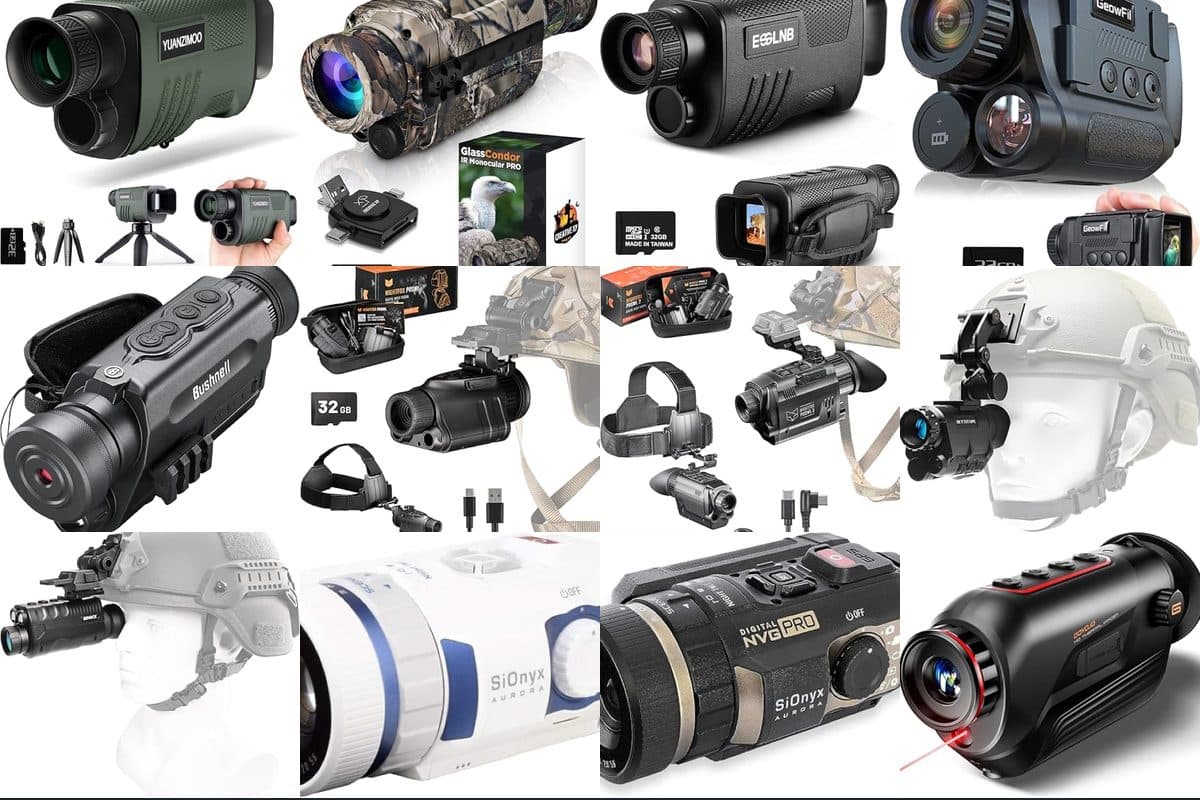

Night vision used to mean choosing between a $50 toy that could barely see across a backyard or a $3,000 Gen 3 tube that required a government end-user certificate. That gap has collapsed. Digital night vision sensors, paired with infrared illuminators and high-resolution OLED displays, now deliver usable darkness-piercing capability starting under $60. At the top end, full-color night vision and thermal imaging have dropped below $500 for the first time.
We evaluated 18 monoculars across four categories: budget digital units for casual use, mid-range digital devices with better sensors and build quality, premium optics with helmet-mount capability and color night vision, and dedicated thermal imagers. Every pick includes an honest assessment of where it falls short, because night vision marketing is full of inflated claims and misleading spec sheets. Whether you are scanning for coyotes at the tree line, running night hikes, or just want to see what is rustling around your property after dark, this guide covers the full range from $16 accessories to $850 professional-grade color night vision.
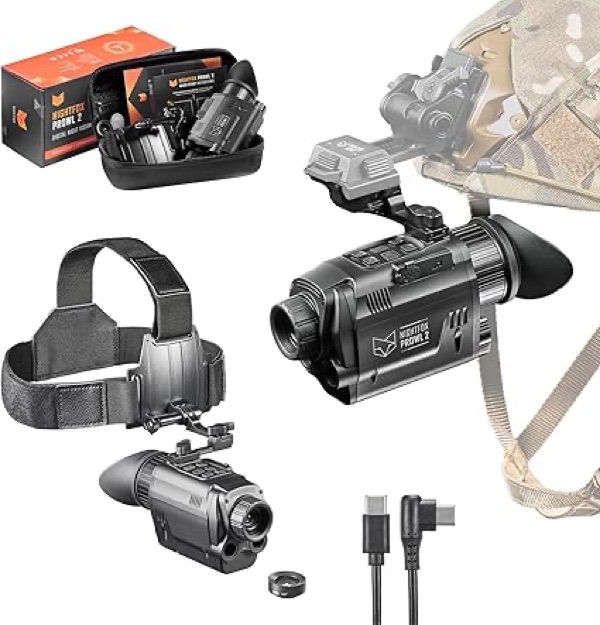
Nightfox Prowl 2
~$250


ESSLNB 6x32 Night Vision Monocular
$90 on Amazon
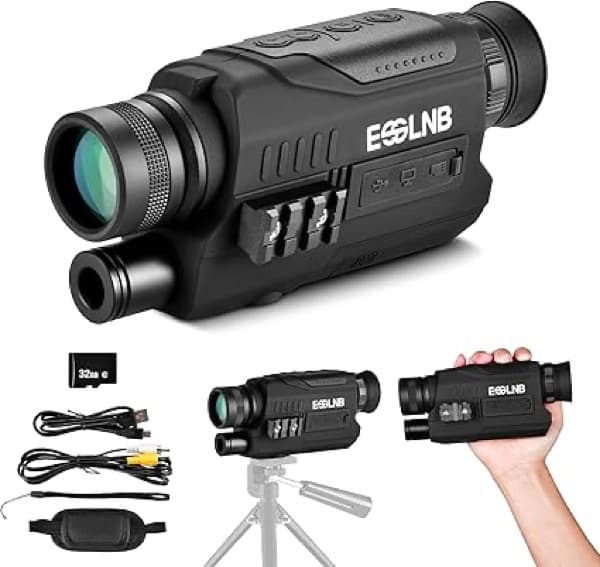
ESSLNB's 6x32 model sits in an unusual position: priced like a budget unit but featuring a large 32mm objective lens and 6x optical zoom that give it more raw light-gathering capability than most competitors under $150.
Budget Digital Night Vision ($55 - $110)
Budget digital monoculars all work the same way: a CMOS sensor captures light (including infrared from a built-in IR illuminator), processes it digitally, and displays the image on a small internal LCD or OLED screen. At this price point, expect 200 to 300 yard detection range in total darkness with IR on, some image grain at max zoom, and battery life between 4 and 8 hours. These are not tactical tools. They are solid starter optics for property scanning, wildlife observation, and getting a feel for how night vision works before spending real money.
1. YUANZIMOO Digital Night Vision Monocular
~$59 on Amazon
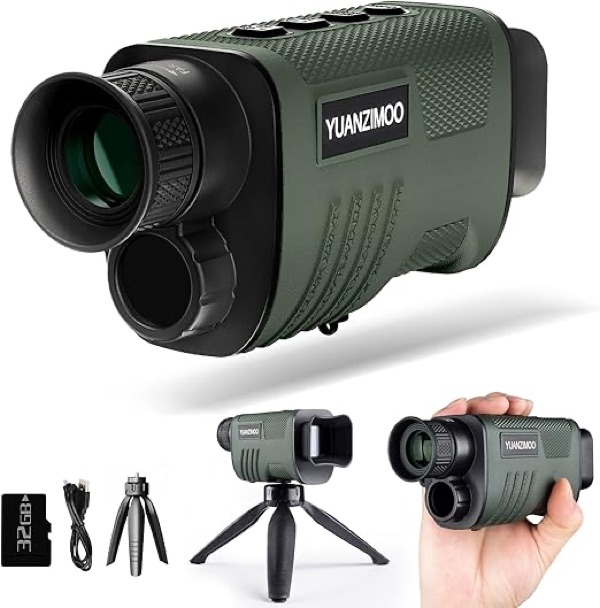
At under $60, the YUANZIMOO is one of the cheapest functional night vision monoculars available. It pairs a basic CMOS sensor with a 7-level IR illuminator, shoots 1080p video, and runs on a rechargeable battery that lasts roughly 6 hours.
Best for: First-time night vision buyers, backyard wildlife watching, and anyone who wants to try digital NV without a significant financial commitment
For the price of a decent dinner out, the YUANZIMOO delivers a surprisingly functional night vision experience. The sensor picks up enough ambient light at dusk to produce a reasonably clear image without IR, and once the illuminator kicks on in full darkness, you can identify animals and objects out to around 200 yards. The 1080p recording works through a micro SD card slot, and the built-in 2-inch display is bright enough to use comfortably. Build quality is where the budget shows. The plastic housing feels hollow, the buttons are mushy, and the lens cap is held on by friction alone. There is also noticeable image lag when panning quickly, which rules it out for any kind of tracking use. Think of this as a proof-of-concept device, not a field tool. If you enjoy what night vision offers, you will outgrow it fast and want to step up to the CREATIVE XP or Nightfox range.
2. CREATIVE XP Camo Pro
~$70 on Amazon
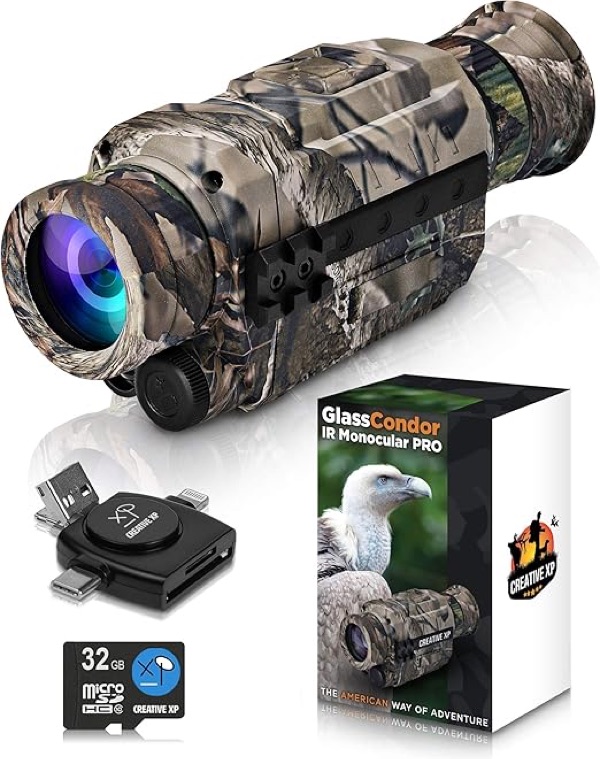
The Camo Pro separates itself from the budget pack with one critical feature: a 940nm "no-glow" IR illuminator. Most cheap monoculars use 850nm LEDs that emit a faint red glow visible to animals and people. The 940nm emitter is completely invisible to the naked eye, making this a much better choice for hunting and surveillance.
Best for: Hunters, property surveillance, and anyone who needs invisible IR illumination at a budget price
CREATIVE XP built a strong reputation in the budget night vision space by focusing on the features that actually matter instead of inflating spec sheets. The 940nm IR illuminator is the headline feature, and it works exactly as advertised. Animals cannot detect it, and other people won't see a telltale red glow giving away your position. Image quality in total darkness is noticeably cleaner than the YUANZIMOO above, with less grain and better contrast at the 150 to 200 yard range. The unit records 1080p video with timestamp overlay, and the interface is intuitive enough to operate in the dark after a few minutes of practice. The downside is the display. It is a small TFT LCD rather than OLED, which means blacks look more like dark gray, and the viewing experience is not as immersive as higher-end units. Eye relief is also tight, making it uncomfortable if you wear glasses. Still, for $70 with no-glow IR, this is the budget pick to beat.
3. ESSLNB Compact Night Vision Monocular
~$65 on Amazon
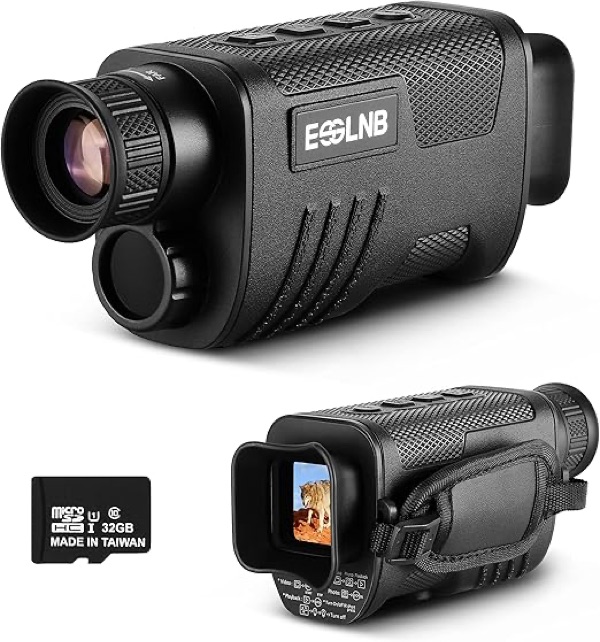
ESSLNB's compact monocular prioritizes portability over range. It is noticeably smaller and lighter than most competitors at this price, fitting comfortably in a jacket pocket and weighing just under 8 ounces with battery.
Best for: Hikers, campers, and anyone who wants a pocket-sized night vision device for trail use
Where other budget monoculars try to pack in every feature, ESSLNB went the opposite direction and made something you will actually carry. The compact form factor slips into cargo pockets and jacket pockets without the bulk you get from units like the YUANZIMOO. Image quality is comparable to others in this price tier, with a decent picture out to about 150 yards using the IR illuminator. The button layout is simplified, and the device boots up in about 3 seconds, making it quick to deploy when you hear something outside. The trade-off for that small size is a weaker IR emitter and shorter detection range. In total darkness, you will struggle to make out detail beyond 150 yards, and the 850nm IR does produce a faint red glow visible at close range. The small display also fatigues the eye during extended viewing sessions. If portability is your top priority, this is the right choice. If range matters more, spend the extra $5 on the CREATIVE XP.
4. GeowFiiTech 4K Night Vision Monocular
~$110 on Amazon
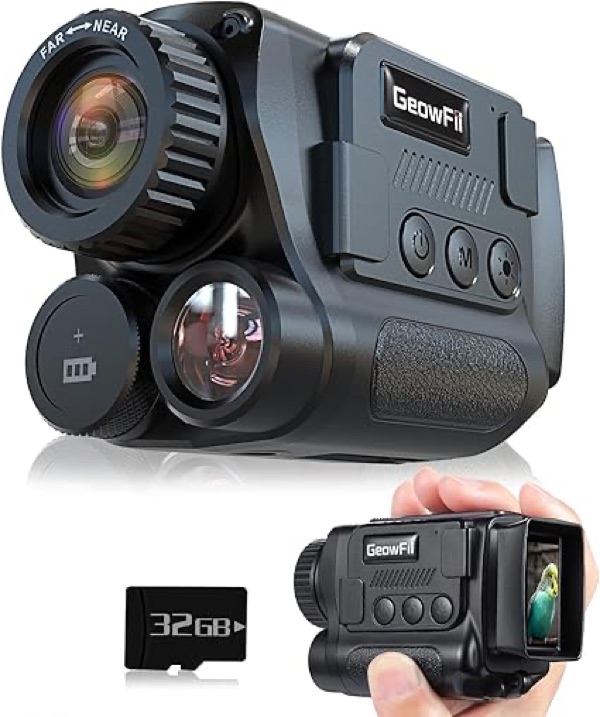
GeowFiiTech bridges the gap between budget and mid-range with a 4K recording sensor, longer IR range, and a larger 3-inch display. It costs roughly double the cheapest options, but the jump in image clarity is immediately visible.
Best for: Wildlife photographers who want usable night footage, property owners who need clear identification at range
The 4K label on budget electronics usually means very little, but GeowFiiTech's sensor does produce noticeably sharper recordings than the 1080p units below it. Daytime video is crisp, and the night footage captures more detail at range, making it useful for reviewing wildlife activity or documenting what triggered a motion sensor. The 3-inch display is a significant upgrade over the tiny screens on sub-$80 models, reducing eye strain during extended sessions. A 9-level adjustable IR illuminator lets you dial in the intensity for different ranges, and the unit accepts standard micro SD cards up to 256GB. Where it disappoints is in the sensor's low-light noise handling. At maximum IR range (around 300 yards), the image gets grainy fast, and the 4K resolution works against you because it preserves all that noise in high definition. Battery life also drops noticeably when recording in 4K, so keep a spare charged. At $110, it outperforms anything cheaper, but it sits in an awkward zone where spending another $70 gets you into the Bushnell Equinox tier with military-grade optics heritage.
Mid-Range Digital Night Vision ($90 - $300)
Moving into the $150 to $300 range brings significant upgrades: better sensors with lower noise floors, stronger IR illuminators, more robust housings, and features like WiFi streaming and helmet compatibility. These are working tools, not gadgets. Hunters, property managers, and outdoor enthusiasts who use night vision regularly will appreciate the difference in image quality and durability over the budget tier.
5. Bushnell Equinox X650
~$176 on Amazon
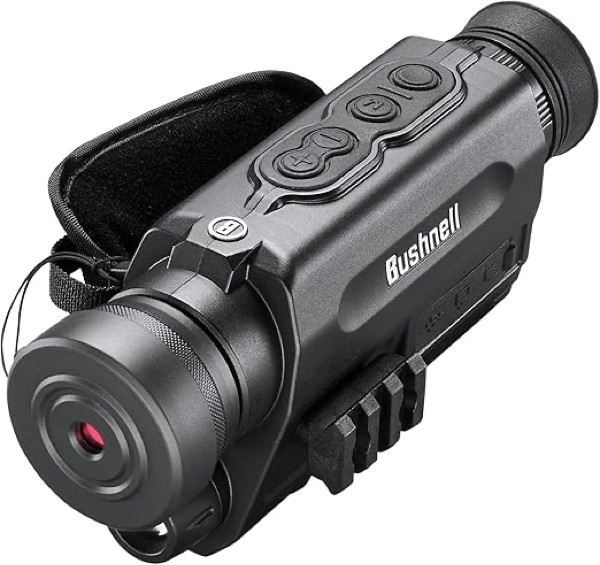
Bushnell brings decades of sports optics engineering to the digital night vision space with the Equinox X650. It features a glass objective lens (not plastic like most budget units), WiFi streaming to your phone, and a 650-yard detection range that leads this price class.
Best for: Hunters who need reliable long-range detection, users who want phone connectivity for sharing footage
Bushnell is one of the few established optics companies making digital night vision, and the Equinox X650 reflects that pedigree. The glass objective lens produces a sharper, more color-accurate image in low light compared to the plastic lenses on cheaper units. WiFi connectivity lets you stream the live view to your phone and record directly to your camera roll, which is convenient for sharing footage without pulling a micro SD card. The 650-yard detection range is optimistic (that is detection, not identification), but real-world usable range in full darkness sits around 250 to 300 yards for identifying shapes and around 150 for clear detail. Build quality is solid with a rubberized armor coating and a tripod-mountable base. The weakness is battery life. Running WiFi and IR simultaneously drains the internal battery in about 3 to 4 hours, and the battery is not user-replaceable. You will need a USB power bank for extended sessions, which adds bulk and cable management to your setup.
6. Nightfox Prowl Original
~$185 on Amazon
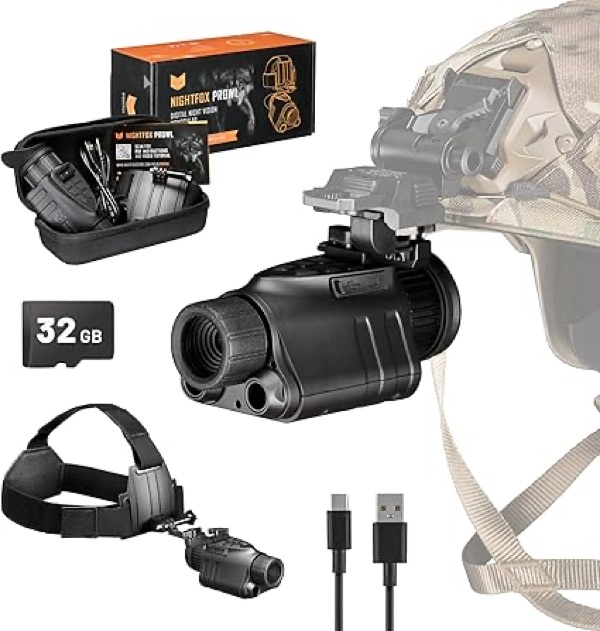
Nightfox designed the Prowl specifically for head-mounted use, borrowing the form factor of military PVS-14 monoculars. It comes with a head mount included in the box, and its lightweight design (under 10 ounces) makes it comfortable for hands-free use during extended walks or hunts.
Best for: Hands-free night hiking, hog hunting from vehicles, and anyone who wants a head-mountable unit without paying $400+
Nightfox nailed the form factor. While most digital monoculars are shaped like small camcorders, the Prowl mimics the cylindrical PVS-14 profile used by military forces worldwide. That shape is not just aesthetics: it positions the eyepiece naturally for both handheld and head-mounted use. The included head mount is basic but functional, and the unit clips onto standard J-arm adapters for helmet mounting. At under 10 ounces, neck fatigue is minimal during hour-long sessions. The 940nm no-glow IR emitter keeps you invisible, and the sensor produces a clean image in the 100 to 200 yard range. Recording at 1080p captures decent footage for documentation. The limitation is refresh rate. The original Prowl runs at approximately 30 frames per second, which creates noticeable motion blur and a slightly choppy image when you turn your head quickly. This makes it workable for walking but less ideal for fast scanning. If that refresh rate bothers you, the Prowl 2 below doubles it to 60fps for an additional $65.
7. Nightfox Prowl 2
~$250 on Amazon
The Prowl 2 addresses every shortcoming of the original. Nightfox upgraded the display to a 0.39-inch OLED with 60fps refresh rate, added a longer-range IR illuminator, improved the sensor, and includes a more robust helmet mount adapter in the box. This is the sweet spot of the entire guide for most users.
Best for: Hunters, nighttime hikers, property security, and anyone who wants smooth head-mounted night vision under $300
Jumping from 30fps to 60fps sounds like a spec sheet detail, but in practice it transforms the head-mounted experience. The original Prowl's motion blur made fast head turns feel disorienting. The Prowl 2 eliminates that almost entirely, delivering a smooth, natural viewing experience that feels closer to actual night-adapted vision. The OLED display produces true blacks instead of the washed-out grays you get from LCD screens, and the image quality at 150 to 250 yards is clean enough to distinguish between a deer and a coyote. Nightfox also strengthened the IR illuminator for better performance at extended range. The helmet mount adapter works with standard Rhino/J-arm setups, and the unit still weighs under 10 ounces. Recording capability carries over from the original. The main weakness is that the field of view is relatively narrow compared to the NVG30 below, so you see less of your surroundings while head-mounted. For the price, though, nothing else in the sub-$300 category delivers this combination of display quality, refresh rate, and mounting versatility.
8. ESSLNB 6x32 Night Vision Monocular
~$90 on Amazon
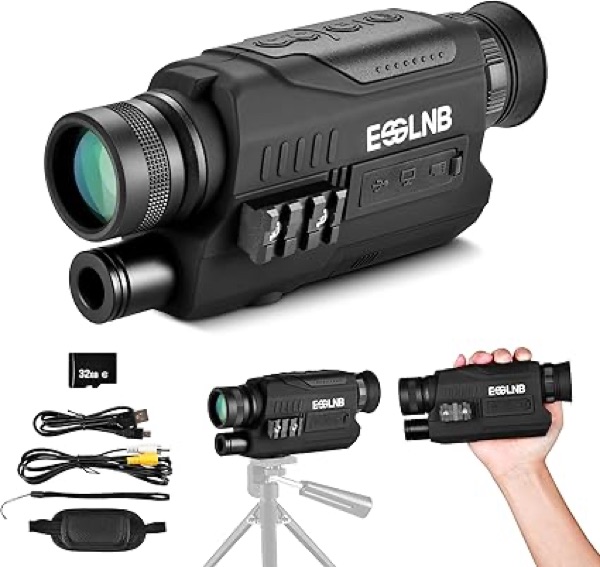
ESSLNB's 6x32 model sits in an unusual position: priced like a budget unit but featuring a large 32mm objective lens and 6x optical zoom that give it more raw light-gathering capability than most competitors under $150.
Best for: Stationary observation, tripod-mounted wildlife watching, users who need higher magnification at an entry-level price
Most budget digital monoculars top out at 3x or 4x magnification. ESSLNB's 6x32 pushes to 6x optical with additional digital zoom, and the larger 32mm objective lens gathers more light than the typical 25mm found on competitors. The result is a brighter, more detailed image at extended range, especially during twilight conditions when there is still some ambient light to work with. In total darkness with IR, the extra glass helps pull in more of the illuminated scene. At $90, it punches above its weight class for stationary observation. The downside is bulk. This is not a pocket-sized device. The larger objective lens and housing make it heavier and less comfortable for handheld use during extended sessions. There is no head-mount option, and the 6x magnification amplifies hand shake, so a tripod or stable rest is practically required for serious use. If you plan to walk around with your night vision, look at the Nightfox Prowl instead. If you want to sit on a porch or in a blind and watch a field, this is hard to beat for $90.
Premium Digital and Color Night Vision ($380 - $850)
Above $350, digital night vision takes a significant leap. You get OLED displays, PVS-14 compatible form factors for helmet mounting, wider fields of view, and in the case of SiOnyx, full-color night vision that produces images in actual color instead of the traditional green or black-and-white. These devices are used by airsoft players, hog hunters, search and rescue teams, and hobbyists who want the closest civilian equivalent to military-grade night optics.
9. NVG30 Night Vision Monocular
~$430 on Amazon
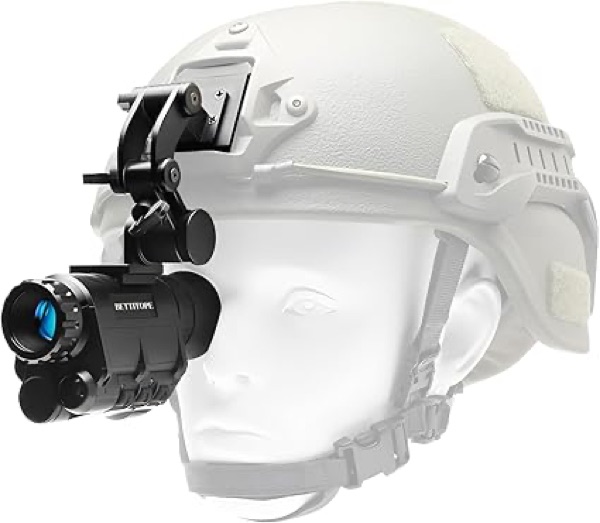
The NVG30 is the breakout hit of the digital night vision market. It replicates the PVS-14 form factor used by military forces worldwide, features a high-resolution OLED display with adjustable green or white phosphor simulation, and accepts standard helmet mounting hardware out of the box.
Best for: Helmet-mounted night operations, hog hunting, airsoft, and users who want the closest thing to military NVGs without spending $2,000+
What makes the NVG30 special is not any single spec but how everything works together. The PVS-14 form factor means it accepts the entire ecosystem of military night vision accessories: J-arms, bridge mounts, dovetail adapters, and helmet shrouds. The OLED display is sharp with deep blacks, and the option to switch between green phosphor and white phosphor viewing modes lets you choose what is most comfortable for your eyes. Field of view at 40 degrees is wider than the Nightfox Prowl 2, giving you better situational awareness when head-mounted. IR illumination is strong enough for indoor and close-range outdoor work, though you will want an external IR illuminator (like the Pulsar 805 listed in accessories below) for longer-range use in open terrain. The weakness is that it is still a digital sensor, not a true image intensifier tube. In very low ambient light with no IR, the image is noticeably noisier and less detailed than even a Gen 2 tube device. You are also dependent on battery power in a way that analog tubes are not. Battery life runs around 4 to 5 hours with IR active, so carry spares for longer outings.
10. BINOCK NVG40 Pro
~$475 on Amazon
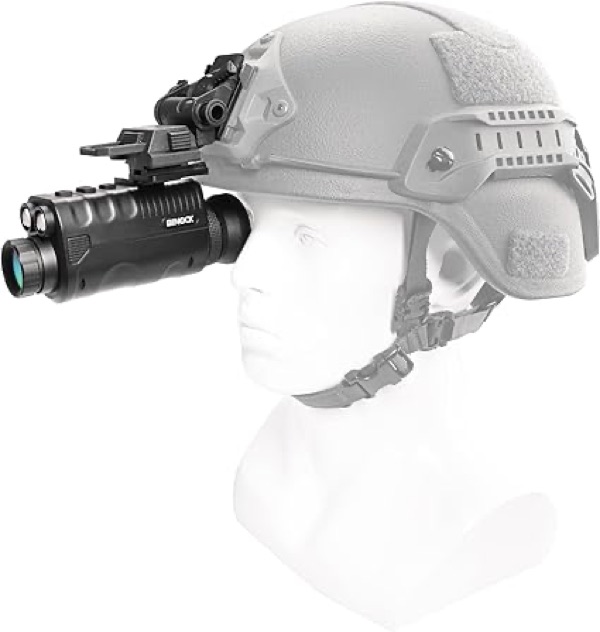
BINOCK positions the NVG40 Pro as a step up from the NVG30, adding a 4K sensor, dual IR illuminators (850nm and 940nm), and a wider OLED display. It maintains PVS-14 compatibility while pushing the recording and display specifications higher.
Best for: Users who want the best digital recording quality in a helmet-mountable package, content creators filming night hunts
Having both 850nm and 940nm illuminators in one unit is a practical advantage most competitors lack. The 850nm LED pushes more light and extends your effective range, while the 940nm no-glow mode keeps you invisible when stealth matters. Switching between them is a button press away, and the 4K sensor captures significantly more detail than the 1080p units in the mid-range tier. The OLED display is slightly larger than the NVG30's, and color reproduction in the phosphor simulation modes is well-tuned. For content creators filming nighttime hunts or wildlife, the 4K footage is a noticeable upgrade. The catch is that BINOCK is a newer brand without the track record of established manufacturers. Firmware updates have been infrequent, and some users report occasional software glitches like the display freezing momentarily during mode switches. The unit also runs warmer than the NVG30 during extended use, which can cause discomfort when helmet-mounted against your forehead for hours. If recording quality is your priority, the NVG40 Pro justifies the $45 premium over the NVG30. If reliability and community support matter more, the NVG30's larger user base and accessory ecosystem tip the scales back.
11. SiOnyx Aurora Sport
~$380 on Amazon
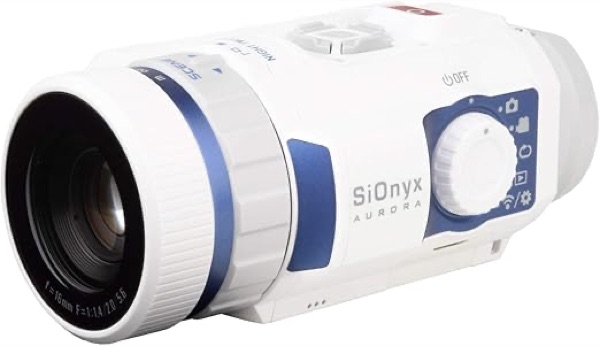
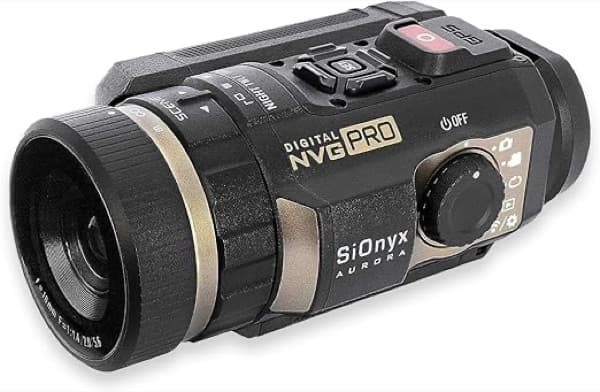
SiOnyx does something no other monocular on this list can: it produces full-color images in near-total darkness. Using a proprietary ultra-low-light CMOS sensor, the Aurora Sport captures usable color video under starlight and moonlight conditions where every other digital device shows only green or grayscale.
Best for: Users who want color night vision for the first time, marine navigation, wildlife observation where color ID matters
Seeing color at night changes the experience completely. Instead of trying to distinguish shapes in shades of green, you can identify the brown of a deer, the orange of a safety vest, or the red of a taillight. SiOnyx's sensor technology was originally developed for military applications and has been adapted for the civilian market. The Aurora Sport is IP67 waterproof, which means it handles rain, splashes, and brief submersion, making it a favorite among boaters for nighttime navigation. WiFi connectivity lets you stream to a phone or tablet, and the onboard GPS tags every recording with location data. The weakness is significant: the Aurora Sport needs some ambient light to produce color images. Under a half moon or clear starlit sky, the color performance is practically useful. In overcast, no-moon darkness, it falls back to a grainy grayscale that is actually worse than a good IR-based digital monocular. It also lacks an IR illuminator entirely in the Sport model, so total darkness means minimal functionality. If your use case involves any amount of ambient moonlight or starlight, the color capability is worth the premium. If you operate in pitch-black conditions, a traditional IR monocular will serve you better.
12. SiOnyx Aurora Pro
~$850 on Amazon
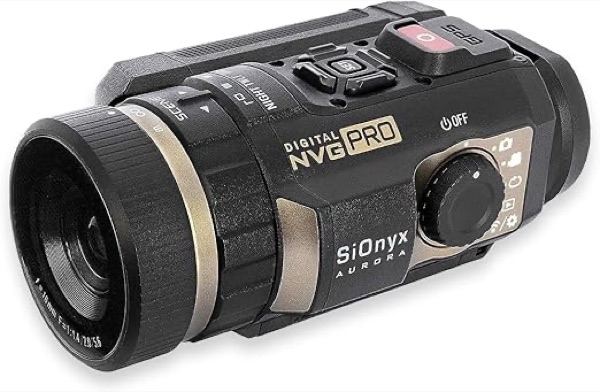
The Aurora Pro is SiOnyx's top-tier color night vision camera, upgrading the Sport with a more sensitive sensor, built-in IR illuminator, improved image stabilization, and longer battery life. It is the most capable civilian color night vision device available under $1,000.
Best for: Professional wildlife documentarians, search and rescue teams, marine operators, and anyone who needs the best color night vision available
Everything the Aurora Sport does, the Pro does better, and the addition of a built-in IR illuminator fixes the Sport's biggest limitation. When ambient light is not enough for color imaging, the IR kicks in and provides a usable grayscale image out to around 150 yards. Under moonlight, the Pro's upgraded sensor produces cleaner, more vibrant color images with less noise than the Sport, and the image stabilization smooths out hand tremor for steadier video. Battery life extends to roughly 5 hours of active use, and the unit retains the IP67 waterproof rating and GPS tagging. The Pro also supports Picatinny rail mounting and works with standard action camera accessories. The weakness is price-to-performance ratio. At $850, you are paying a steep premium for color capability that only works well under certain lighting conditions. A $430 NVG30 with a $50 external IR illuminator will outperform the Aurora Pro in total darkness for raw detection capability. The Pro's value proposition is specifically in situations where color information matters: identifying animals by species color markings, reading colored signals at sea, or producing watchable nighttime documentary footage. If those use cases do not match yours, the NVG30 is the smarter investment.
Thermal Monoculars ($350 - $450)
Thermal monoculars detect heat radiation instead of visible or infrared light, which means they work in complete darkness, through smoke, and in fog where optical and digital night vision fail completely. The trade-off is resolution. Thermal sensors at this price range produce 256x192 or 384x288 pixel images, which is enough to detect and identify warm bodies but not enough to read signs or recognize faces at distance. They are best used alongside a digital monocular rather than as a replacement.
13. GOYOJO Thermal Monocular
~$349 on Amazon
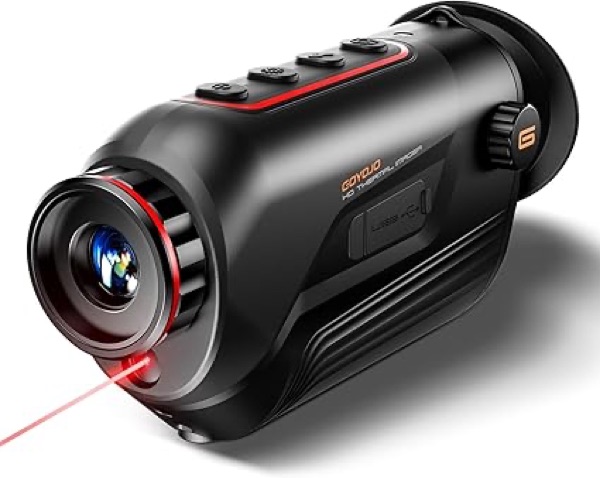
GOYOJO's thermal monocular brings thermal imaging below $350 with a 256x192 sensor, multiple color palettes (white hot, black hot, red hot, iron), and a claimed detection range of 1,300 yards for vehicle-sized heat sources.
Best for: Budget-conscious hunters who need thermal detection capability, property owners checking for intruders in all weather conditions
Sub-$500 thermal imaging was nearly impossible two years ago, and GOYOJO is among the brands making it accessible. The 256x192 sensor detects heat signatures reliably, and the multiple color palette options let you choose the visualization that works best for your environment. White hot mode works well in wooded areas where warm animals stand out against cool vegetation, while iron mode provides more gradual temperature differentiation. The 25Hz refresh rate is smooth enough for scanning and panning without choppiness. Real-world detection range for human-sized heat sources is closer to 400 yards than the advertised 1,300, but that is typical for the thermal category where marketing numbers assume ideal conditions and large targets. The weakness is the 256x192 resolution itself. At range, animals and people are just blobs of heat without distinguishing features. You can see that something warm is there, but identifying whether it is a deer, a dog, or a person requires getting much closer. If you need identification-level detail, look at thermal units above $1,000 with 384x288 or 640x512 sensors. At this price, detection is the realistic expectation.
14. TOPDON TS004 Thermal Monocular
~$430 on Amazon
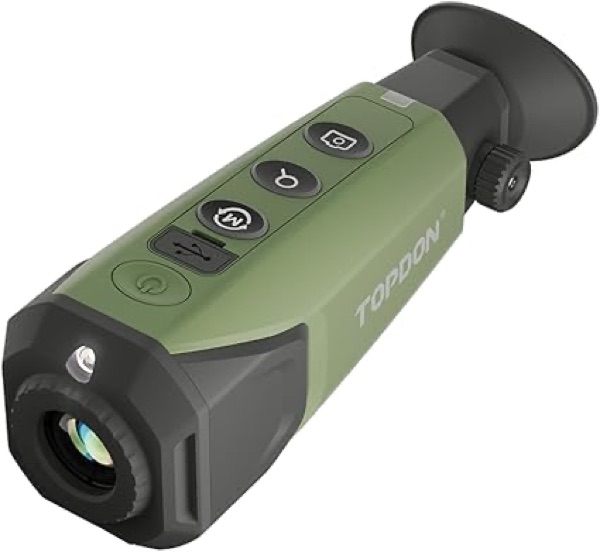
TOPDON's TS004 differentiates itself with a massive 11-hour battery life that outlasts every competitor in this price range by a factor of two to three. It also upgrades to a 384x288 sensor for noticeably more detail than the 256x192 units.
Best for: All-night hunting sits, extended surveillance operations, users who need thermal capability without constantly swapping batteries
Battery anxiety kills the usefulness of most portable thermal devices. When you are sitting in a blind waiting for hogs and your thermal monocular dies at hour three, the rest of the night is wasted. TOPDON solved this with a battery that actually lasts through an entire night of intermittent use and still has charge left in the morning. The 384x288 sensor is a real upgrade over the 256x192 found in the GOYOJO and other budget thermals. You get roughly twice the pixel count, which translates to being able to identify shapes at meaningfully longer ranges. At 200 yards, a deer-sized heat signature shows enough detail to distinguish it from other animals, where the 256x192 units would show only a warm blob. WiFi streaming to a phone is included, which is useful for sharing the live view with a hunting partner. The weakness is weight and size. That 11-hour battery adds bulk, and the unit is noticeably heavier than competitors. It is not something you want to carry handheld for hours. Pair it with a tripod or window mount for best results. The interface software can also be sluggish when navigating menus, though TOPDON has improved this through firmware updates.
Essential Accessories
The right accessories can significantly expand what your night vision monocular can do. A helmet mount turns a handheld device into a hands-free tool. An external IR illuminator extends your effective range well beyond the built-in emitter. And a fast micro SD card prevents dropped frames when recording 4K footage in the field.
15. PVS-14 Dual Bridge Mount
~$40 on Amazon
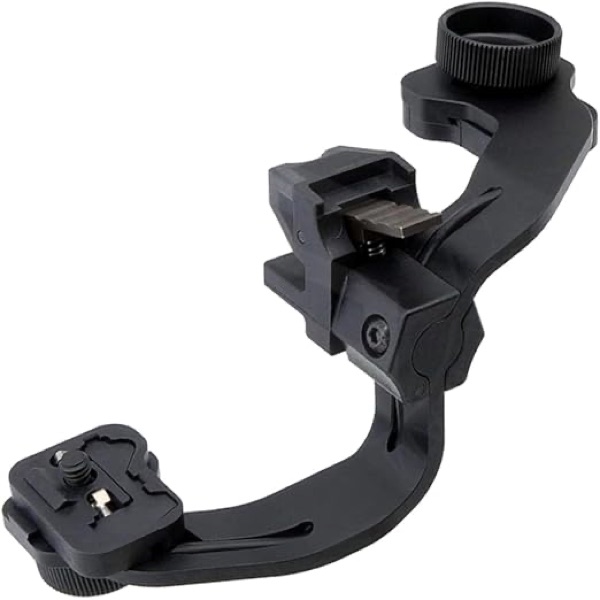
This dual bridge mount lets you run two PVS-14 style monoculars side by side for pseudo-binocular night vision. It accepts the NVG30, BINOCK NVG40 Pro, Nightfox Prowl, and most other PVS-14 form factor devices.
Best for: Users with two PVS-14 style monoculars who want binocular-style depth perception and wider field of view
Running dual night vision monoculars gives you binocular vision and depth perception that a single unit cannot provide. This bridge mount holds two PVS-14 form factor devices with adjustable interpupillary distance and tilt, allowing you to align both eyepieces comfortably regardless of your face shape. The aluminum construction is rigid enough to hold alignment without flexing, and the mount interfaces with standard J-arm and dovetail helmet adapters. For NVG30 owners who want to eventually upgrade to a dual setup, this mount is the bridge that gets you there. The weakness is weight. Two monoculars plus the bridge mount pushes total head-mounted weight past one pound, which causes noticeable neck fatigue during use beyond 30 to 45 minutes. You will need a properly counterweighted helmet setup to make extended dual NVG sessions comfortable.
16. FAST/MICH Helmet NVG Mount
~$20 on Amazon
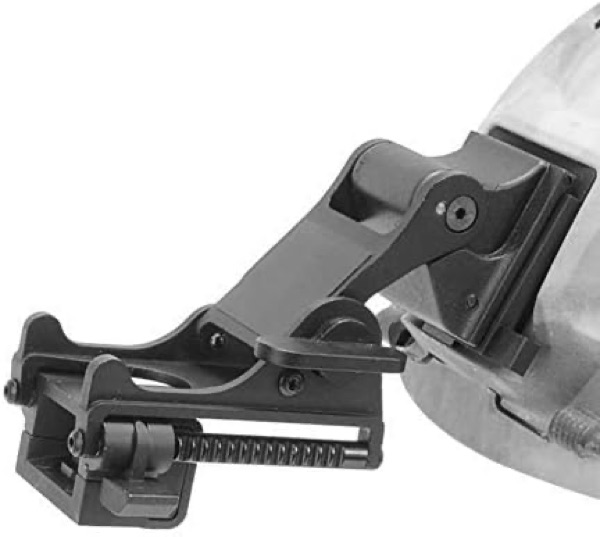
A basic but functional helmet shroud and mount that attaches to FAST, MICH, and ACH style helmets. This provides the mounting point needed to attach J-arms and NVG devices to any compatible tactical helmet.
Best for: Airsoft players, helmet-based NVG setups, anyone building a night operations kit on a budget
If you already own a tactical helmet and a PVS-14 style monocular, this $20 mount is the missing piece that connects them. Installation requires drilling holes in the helmet shell (templates and hardware included), and the aluminum shroud provides a solid mounting point for Rhino-style arms and NVG mounts. For airsoft and recreational use, the build quality is more than adequate. The trade-off is that budget mounts like this lack the precision machining of $100+ options from Wilcox and Norotos. There is slightly more play in the articulation, and the detent positions are less crisp. For actual tactical use where your life depends on NVG alignment holding under stress, invest in a quality mount. For weekend airsoft, night hikes, and hog hunting from a truck, this gets the job done at a fraction of the price.
17. Pulsar 805nm IR Flashlight
~$50 on Amazon
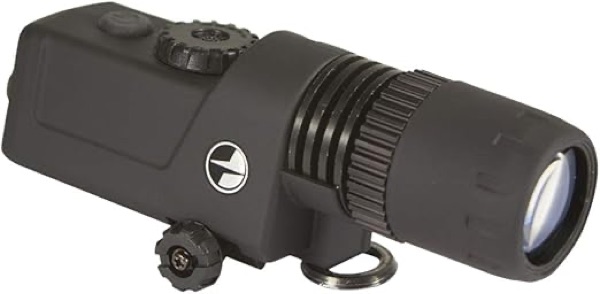
Pulsar's dedicated IR flashlight significantly extends the effective range of any digital night vision monocular. The focused 805nm beam reaches well beyond what built-in IR illuminators can achieve, turning a 200-yard monocular into a 400+ yard setup.
Best for: NVG30 and Nightfox Prowl owners who need extended detection range, anyone scanning open fields or large properties at night
Built-in IR illuminators on digital monoculars are limited by size and power constraints. They work fine for close-range use, but beyond 150 to 200 yards, the illumination falls off and the image goes dark. The Pulsar 805nm IR flashlight solves this with a dedicated, high-output IR beam that you can focus from flood to spot depending on whether you need wide-area coverage or long-range reach. In spot mode, it can illuminate targets beyond 400 yards that your monocular's sensor can resolve. The adjustable focus is smooth and precise, and the flashlight accepts standard weapon mount rings for hands-free use on a rail. The trade-off is that 805nm is not invisible. While far less visible than a standard flashlight, 805nm IR produces a faint red glow at the emitter that is visible to the naked eye at close range. Animals with good night vision (like coyotes) may notice it. For truly covert operations, you would need a 940nm IR illuminator, though those sacrifice significant range. For most hunting and observation use, the 805nm offers the best balance of range and concealment.
18. SanDisk 128GB MicroSD (A2 V30)
~$16 on Amazon
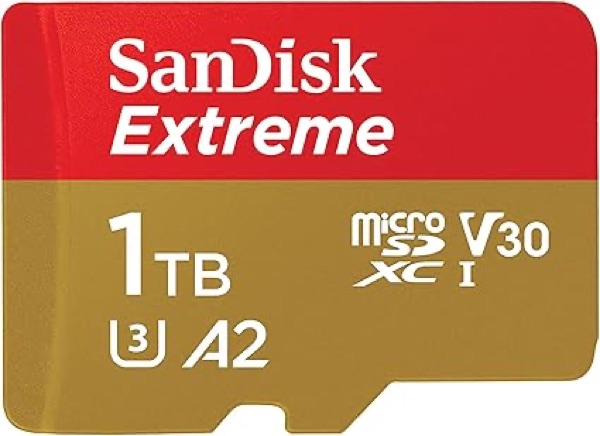
Most night vision monoculars require a micro SD card for recording, and cheap cards are the number one cause of dropped frames and failed recordings. The SanDisk Extreme 128GB is rated A2/V30 with 160MB/s read speeds, fast enough for continuous 4K recording.
Best for: Any monocular on this list that records video, especially the 4K-capable models like the GeowFiiTech and BINOCK NVG40 Pro
Recording night vision footage requires a card that can sustain continuous write speeds without buffering. The V30 rating on the SanDisk Extreme guarantees a minimum 30MB/s sustained write speed, which handles 4K video from the NVG40 Pro and GeowFiiTech without dropped frames. The A2 application rating also means the card performs well when the monocular needs to read and write simultaneously, such as when switching between playback and recording modes. At 128GB, you get roughly 6 hours of 4K recording or 12+ hours of 1080p, enough for most multi-night outings without needing to offload footage. The weakness is that micro SD cards are fragile in field conditions. They can be knocked loose by impacts, they are nearly impossible to handle with gloves, and they are easy to lose in the dark. Keep the card inserted and use WiFi transfer where available. If you are running a 1080p-only monocular, a 64GB version of the same card costs $10 and provides ample storage without the price premium.
Digital vs Gen 1/2/3 vs Thermal: What's the Difference?
Night vision technology falls into three fundamentally different categories, and understanding how each one works will save you from buying the wrong device for your use case.
Digital Night Vision (Everything on This List Except Thermal)
Digital night vision uses a CMOS sensor (the same type of chip in your phone camera, but optimized for low light) paired with an infrared LED illuminator. The sensor captures light, including invisible IR light, processes it electronically, and displays the result on a small screen. This is the technology behind every monocular in the budget, mid-range, and premium digital categories above.
Advantages: Affordable ($55 to $850), records video natively, can be used in daylight without damage, immune to bright light sources, displays can show different color modes. Disadvantages: Requires battery power, has digital processing lag (even at 60fps), image quality depends entirely on the IR illuminator in total darkness, and the viewing experience is looking at a screen rather than through optics.
Gen 1, Gen 2, and Gen 3 Image Intensifier Tubes
Traditional "analog" night vision uses a photocathode tube that amplifies available light (moonlight, starlight, ambient glow) through a chemical and electrical process. Gen 1 tubes amplify light roughly 1,000x, Gen 2 adds a microchannel plate for 20,000x gain, and Gen 3 uses gallium arsenide photocathodes for 30,000 to 50,000x amplification. Military PVS-14 and PVS-31 devices use Gen 3 tubes.
Advantages: No processing delay (you see light in real-time through the tube), works without IR in low ambient light, battle-proven reliability, and the viewing experience is natural and immersive because you are looking through optics, not at a screen. Disadvantages: Gen 3 costs $2,500+ for a single tube, Gen 2 starts around $1,200, tubes can be permanently damaged by bright light, they cannot record video without additional equipment, and Gen 3 devices are export-controlled under ITAR regulations.
Thermal Imaging
Thermal devices detect infrared radiation emitted by objects based on their temperature. They do not need any light at all, including IR illumination. A warm body shows up against a cool background regardless of how dark it is, and thermal sees through smoke, light fog, and camouflage that defeats optical night vision.
Advantages: Works in zero light, sees through smoke and light fog, detects hidden warm objects, unaffected by camouflage or concealment. Disadvantages: Low resolution at this price point (256x192 is standard under $500), cannot read text or identify faces at distance, cannot see through glass, images are heat maps rather than recognizable scenes, and battery life is typically shorter due to sensor power demands.
Which Should You Buy?
For most civilian users, digital night vision is the right starting point. It covers the widest range of use cases, records video, works in daylight, and costs a fraction of traditional tube-based NV. If you regularly operate in total darkness and need to detect hidden targets, add a thermal monocular as a complementary scanning tool rather than a replacement. Gen 2 and Gen 3 tube devices are best reserved for users who have already used digital NV extensively and find its limitations unacceptable, particularly the processing lag and screen-based viewing experience.
Night Vision Monocular Comparison
| Model | Type | Price | IR | Display | Helmet Mount | Best For |
|---|---|---|---|---|---|---|
| YUANZIMOO Digital | Digital | ~$59 | 850nm | LCD | No | Entry-level |
| CREATIVE XP Camo Pro | Digital | ~$70 | 940nm | LCD | No | Budget hunting |
| ESSLNB Compact | Digital | ~$65 | 850nm | LCD | No | Portability |
| GeowFiiTech 4K | Digital | ~$110 | 850nm | LCD | No | Recording quality |
| Bushnell Equinox X650 | Digital | ~$176 | 850nm | LCD | No | Long-range detection |
| Nightfox Prowl | Digital | ~$185 | 940nm | LCD | Yes | Head-mounted NV |
| Nightfox Prowl 2 | Digital | ~$250 | 940nm | OLED | Yes | Smooth head-mounted |
| ESSLNB 6x32 | Digital | ~$90 | 850nm | LCD | No | High magnification |
| NVG30 | Digital | ~$430 | Built-in | OLED | Yes | Military-style NVG |
| BINOCK NVG40 Pro | Digital | ~$475 | 850/940nm | OLED | Yes | 4K recording + NVG |
| SiOnyx Aurora Sport | Color NV | ~$380 | None | LCD | No | Color night vision |
| SiOnyx Aurora Pro | Color NV | ~$850 | Built-in | LCD | Rail | Pro color NV |
| GOYOJO Thermal | Thermal | ~$349 | N/A | LCD | No | Budget thermal |
| TOPDON TS004 | Thermal | ~$430 | N/A | LCD | No | All-night thermal |
Legal Considerations
Night vision ownership in the United States is straightforward for civilians. There are no federal laws prohibiting the purchase, possession, or use of night vision devices, including Gen 3 military-grade tubes. You can buy, own, and use any generation of night vision for hunting, surveillance, wildlife observation, or any other lawful purpose.
The key restriction is export. Gen 3 and certain Gen 2 image intensifier tubes are classified under ITAR (International Traffic in Arms Regulations), which means you cannot export them outside the United States without a State Department license. This applies to taking them across borders, shipping them internationally, or selling them to non-US persons. Digital night vision devices (everything in this guide except theoretical tube-based units) are generally not ITAR-restricted, but check current regulations before traveling internationally with any night vision device.
For hunting, night vision legality varies by state. Most states allow night vision for predator hunting (coyotes, feral hogs, raccoons) but restrict or prohibit its use for game animals (deer, elk, turkey). Some states have specific regulations about using artificial light sources, which may include IR illuminators. Check your state's fish and wildlife regulations before using night vision while hunting. A good starting point is your state's wildlife agency website, which will have current regulations for the species you plan to hunt.
California, for example, prohibits using any electronic viewing device while hunting most game species but allows it for depredation permits on feral hogs. Texas has some of the most permissive night hunting laws, allowing night vision and thermal for feral hogs and coyotes year-round with a hunting license. Always verify current regulations, as these laws change periodically.
Frequently Asked Questions
Is digital night vision as good as Gen 3?
No. Gen 3 image intensifier tubes produce a brighter, sharper, zero-latency image with a more natural viewing experience. Digital night vision at the $400 to $500 price point delivers roughly 60 to 70 percent of the practical capability of Gen 3 at about 15 percent of the cost. For most civilian uses like hunting, property security, and wildlife observation, digital NV is more than sufficient. The gap narrows significantly with the addition of a good external IR illuminator.
What does 940nm "no-glow" IR mean?
Standard IR illuminators operate at 850nm, which produces a faint red glow visible to the naked eye at close range. Animals with good low-light vision, like coyotes, can sometimes detect this glow. A 940nm illuminator is completely invisible, but it produces less light output, which reduces your effective detection range by roughly 20 to 30 percent compared to an 850nm emitter at the same power. For hunting and surveillance where stealth matters, 940nm is the better choice despite the range trade-off.
Can I mount these on a helmet?
Only devices with a PVS-14 form factor or a dedicated head/helmet mount are designed for head-mounted use. From this guide, the Nightfox Prowl, Nightfox Prowl 2, NVG30, and BINOCK NVG40 Pro all support helmet mounting. The Prowl models include head mounts in the box, while the NVG30 and NVG40 Pro require a J-arm and helmet shroud (see the accessories section). Do not attempt to strap a handheld monocular to a helmet with tape or improvised mounts, as the weight distribution will be wrong and the device will not stay aligned.
Do I need an external IR illuminator?
For ranges under 150 yards, built-in IR illuminators on mid-range and premium monoculars are sufficient. Beyond that, an external IR flashlight like the Pulsar 805 dramatically extends your usable range. If you plan to scan open fields, large properties, or clearings wider than 200 yards, budget an extra $50 for a dedicated IR illuminator. It is the single biggest performance upgrade you can add to any digital night vision monocular.
What is the difference between thermal and night vision?
Night vision (digital or tube) amplifies light to produce a recognizable image of your surroundings. Thermal detects heat radiation, producing a heat map that shows warm objects against cool backgrounds. Night vision gives you detail and scene recognition. Thermal gives you detection capability through darkness, smoke, and concealment. Many experienced users carry both: thermal to scan and detect targets, then night vision to identify what they found.
Will bright lights damage digital night vision?
No. Digital sensors handle bright light sources without damage, which is a significant advantage over Gen 2 and Gen 3 tubes that can be permanently burned by exposure to bright light. You can use digital night vision during daytime, transition from dark to lit areas, and look at car headlights without worrying about damaging the device. The screen may wash out temporarily, but no permanent harm occurs.
How long do batteries last in night vision monoculars?
Battery life ranges from 3 hours (Bushnell Equinox X650 with WiFi active) to 11 hours (TOPDON TS004 thermal). Most digital monoculars last 4 to 6 hours with IR on and recording active. Using WiFi streaming cuts battery life by roughly 30 to 40 percent. Budget devices tend to have longer battery life because their sensors and displays draw less power. Always carry a USB power bank for extended sessions, and choose a monocular with a user-replaceable battery or USB-C charging if runtime is critical for your use case.
Are night vision monoculars legal to own in the US?
Yes. There are no federal restrictions on owning any generation of night vision devices in the United States. You can purchase Gen 1, Gen 2, Gen 3, digital, and thermal devices without any special permits or licenses. The only restriction is on exporting Gen 3 (and certain Gen 2) tube devices outside the US under ITAR regulations. State hunting laws may restrict when and how you can use night vision in the field, so check local regulations before hunting with NV.
Related Guides
Looking for more tactical and outdoor gear? Check out our Father's Day Gifts for Military Enthusiasts guide for more gift ideas, or browse our Best Tactical Backpacks and EDC Gear roundup for packs, flashlights, and everyday carry essentials that pair well with a night vision setup.