Skip to content
April 28:Execution of Benito Mussolini81yr ago

What the F-22 Raptor Has Actually Done in Combat (It's More Than You Think)

Michael Trent · · 10 min read
Save
Share:
F-22 Raptor in flight during a combat deployment, seen from a trailing aircraft against a clear sky
Michael Trent
Michael Trent

Defense Systems Analyst

Michael Trent covers military aircraft, weapons systems, and defense technology with an emphasis on cost, maintenance, and real-world performance. He focuses less on specifications and more on how systems hold up once they are deployed, maintained, and operated at scale.

Ask most people what the F-22 Raptor has done in combat, and you'll get a blank stare. The world's most advanced air superiority fighter, a $334 million aircraft designed to dominate any adversary in the sky, has a reputation for being all potential and no action. A show car that never left the garage.

That reputation is wrong. The F-22 has been actively deployed in combat operations since September 2014. It has dropped hundreds of precision-guided munitions across Syria and Iraq, flown thousands of combat hours, deterred hundreds of enemy aircraft from entering protected airspace, and scored what is likely the highest-altitude air-to-air kill in recorded history. The Raptor's combat record isn't classified, it's just overlooked, because the missions it excels at don't produce the kind of footage that goes viral.

Here's what the F-22 has actually done in combat, and why its real-world performance tells us more about modern air power than any exercise score ever could.

September 2014: First Blood Over Syria

On the night of September 22, 2014, F-22 Raptors from the 27th Fighter Squadron, 1st Fighter Wing, Joint Base Langley-Eustis, Virginia, conducted their first-ever combat sorties as part of Operation Inherent Resolve, the American-led campaign against the Islamic State in Syria.

The Raptors had deployed to Al Dhafra Air Base in the United Arab Emirates months earlier. When the strike order came, they were tasked with some of the opening blows: precision strikes using 1,000-pound GPS-guided JDAMs against ISIS command and control facilities near Tishrin Dam in northern Syria. Before-and-after imagery confirmed the targets were destroyed.

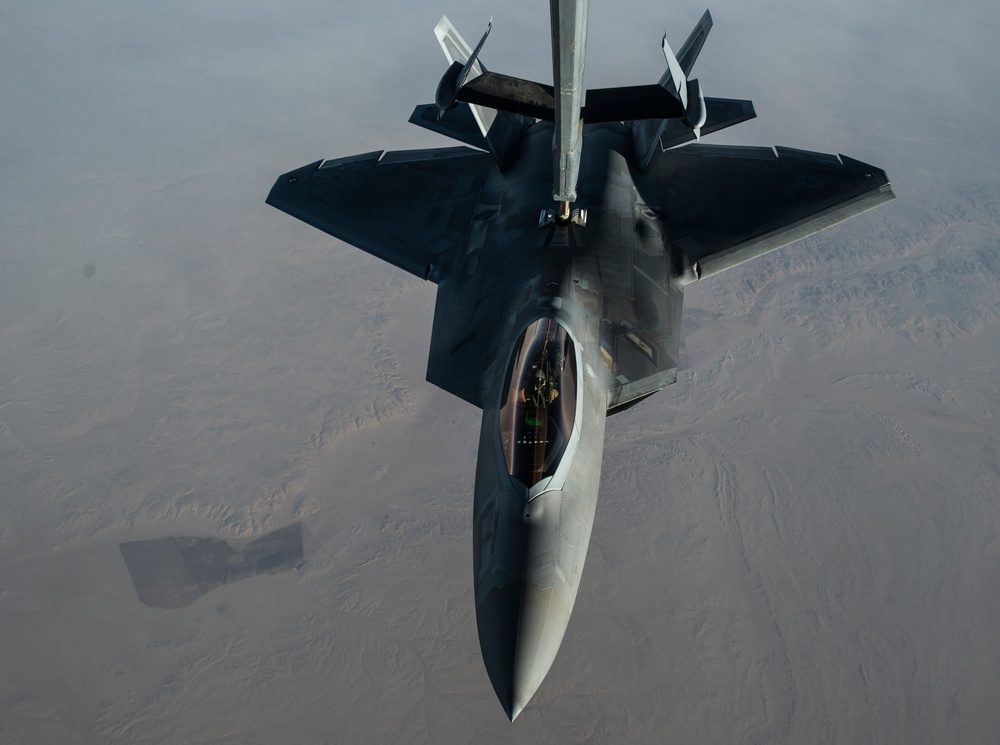
F-22 Raptor receiving aerial refueling from a KC-10 Extender tanker aircraft over the skies of Iraq during Operation Inherent Resolve
An F-22 Raptor refuels from a KC-10 Extender while conducting combat operations over Iraq and Syria during Operation Inherent Resolve. Aerial refueling allowed the Raptors to maintain extended patrols deep inside Syrian airspace.

The choice to use the F-22 for opening strikes was deliberate. Syria maintained one of the densest integrated air defense networks in the Middle East, including Russian-supplied S-200 and S-300 systems. The Raptor's stealth characteristics allowed it to operate inside that threat envelope without triggering Syrian air defenses, something that would have required dedicated suppression-of-enemy-air-defenses (SEAD) packages for any fourth-generation aircraft.

Between September 2014 and July 2015, F-22s flew 204 combat sorties over Syria, dropping 270 precision-guided munitions at approximately 60 target locations. Those numbers are modest compared to the F-15E Strike Eagles and F-16s that flew the bulk of Inherent Resolve sorties, but they miss the point. The F-22 wasn't there to be a bomb truck. It was there because it could go places other aircraft couldn't.

The Quarterback Role: Why Commanders Won't Send a Package Without Raptors

By 2015, the F-22's primary contribution to combat operations had evolved beyond dropping ordnance. General Hawk Carlisle, then commander of Air Combat Command, described the Raptor as the "quarterback" of the air war over Syria. He stated publicly that he would not send a strike package into contested Syrian airspace without an F-22 escort.

That's an extraordinary statement. It means the most senior air combat commander in the U.S. military considered the Raptor not as a luxury but as a prerequisite for operations in a medium-threat environment. The reason comes down to what the F-22 provides beyond its own weapons: situational awareness for the entire formation.

Weapons loading crew preparing ordnance for an F-22 Raptor on the flight line, with precision-guided munitions visible on a loading cart
Ground crews prepare precision-guided munitions for an F-22 Raptor. Despite being designed primarily for air superiority, the Raptor regularly carried and delivered JDAMs during combat operations over Syria and Iraq.

The AN/APG-77 radar, combined with the ALR-94 passive sensor suite, allows a single F-22 to build a comprehensive picture of the electromagnetic environment across hundreds of miles. Through the Intra-Flight Data Link (IFDL), that picture is shared instantaneously with other Raptors in the formation. The F-22 sees threats that other aircraft can't detect, surface-to-air missile radars, airborne interceptors, electronic warfare emitters, and uses that information to route the strike package around dangers or cue defensive reactions before anyone else knows the threat exists.

In practical terms, the F-22 flying escort over Syria wasn't just protecting the formation from enemy fighters. It was providing real-time intelligence, surveillance, and reconnaissance that made every other aircraft in the package more effective and more survivable.

The 94th Fighter Squadron's Combat Surge: 587 Aircraft Deterred

In 2018, the 94th Fighter Squadron from Langley-Eustis conducted what the Air Force described as the "first-ever F-22 Raptor combat surge" from Al Dhafra Air Base. The results were staggering in a way that doesn't translate easily to headlines.

Over the course of their deployment, the 94th's Raptors flew 590 individual flights totaling 4,600 flight hours. They dropped 4,250 pounds of ordnance. But the most revealing statistic was this: during their deployment, F-22s deterred 587 enemy aircraft.

That number deserves unpacking. "Deterred" in this context means that 587 times, aircraft from adversary or non-coalition forces, including Russian and Syrian military aircraft, changed course, turned away, or otherwise altered their flight paths after encountering or detecting F-22 presence in the airspace. These weren't engagements in the traditional sense. No missiles were fired. No guns were employed. The adversary aircraft simply chose not to enter or remain in airspace where Raptors were operating.

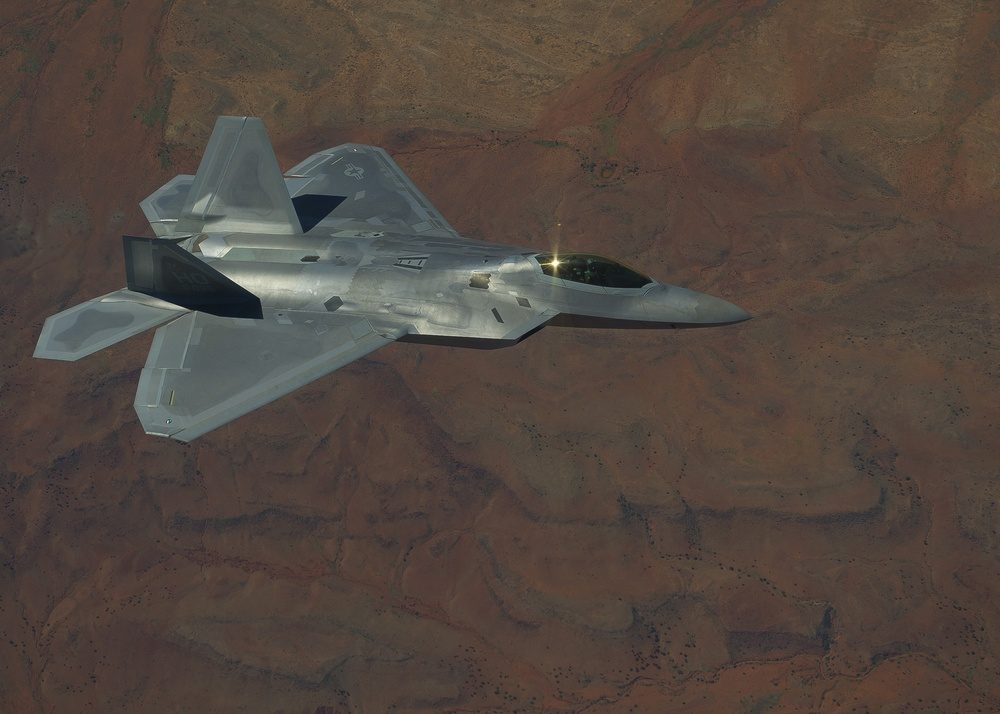
F-22 Raptor in a banking turn during flight, showing its distinctive diamond-shaped wing planform and twin vertical stabilizers
The F-22's stealth profile and advanced sensors allow it to control airspace without ever engaging. During the 94th Fighter Squadron's 2018 combat surge, Raptors deterred 587 enemy aircraft from entering coalition-controlled airspace over Syria.

This is what deterrence looks like operationally. It doesn't produce gun camera footage. It doesn't generate kill counts. But it means that coalition strike aircraft, ISR platforms, and ground forces operated under an air umbrella that enemy forces refused to contest. Russian Su-35 Flankers, Syrian MiG-29s, and Iranian-backed aircraft all encountered the Raptor's presence and made the rational calculation that pressing the issue wasn't worth the risk.

There were tense moments. In one documented incident, two Russian Su-25 attack aircraft crossed into coordinated coalition airspace on the east side of the Euphrates River deconfliction line. F-22 pilots attempted to de-escalate by releasing flares and making radio calls on the international emergency frequency. One of the Russian jets flew close enough to an F-22 that the American pilot had to execute an aggressive turn to avoid a midair collision. The Russians eventually departed. No shots were fired.

That interaction captures the F-22's operational reality in Syria perfectly. The jet's most valuable capability isn't its ability to kill, it's its ability to make killing unnecessary.

February 2023: History's Most Ironic Air-to-Air Kill

On February 4, 2023, an F-22 Raptor from the 1st Fighter Wing at Joint Base Langley-Eustis scored the aircraft type's first confirmed air-to-air kill. The target was a Chinese high-altitude surveillance balloon.

The irony was immediately apparent to everyone in the defense community. The most lethal air-to-air fighter ever built, an aircraft designed to engage supersonic, maneuvering targets at extreme ranges, had its first kill against a balloon drifting at approximately 60,000 feet. The internet had a field day.

But the operational details reveal something more interesting than the jokes suggest. The F-22 fired a single AIM-9X Sidewinder heat-seeking missile from an altitude of approximately 58,000 feet while traveling at Mach 1.3. The missile struck the balloon at an estimated altitude of 60,000 to 65,000 feet. If confirmed, this would be the highest-altitude air-to-air kill in recorded history, and the first shootdown of an aircraft over U.S. territory since World War II.

The F-22 was chosen for the mission precisely because of its high-altitude performance. The balloon was operating well above the service ceiling of most fighter aircraft. The Raptor's twin F119 engines and low-drag airframe allow it to operate effectively at altitudes where other fighters struggle to maneuver or employ weapons. No other fighter in the American inventory could have executed the shot with the same margin of safety.

In the weeks that followed, F-22s shot down two additional unidentified aerial objects, one over northern Canada on February 11 and another over Lake Huron on February 12. Both engagements used AIM-9X missiles. The F-22 had gone from zero air-to-air kills across its entire operational history to three in eight days.

Ongoing Deployments: The Raptor as a Persistent Presence

The Chinese balloon engagement drew the most public attention, but the F-22's deployments to the Middle East have continued with far less fanfare. In June 2023, the Air Force sent F-22s back to the region specifically to counter increasingly aggressive behavior by Russian pilots operating over Syria. Russian jets had been conducting unsafe intercepts of American MQ-9 Reaper drones and flying dangerously close to manned coalition aircraft. The Raptor deployment was a direct message: the airspace over northeastern Syria remained under American protection, and the platform enforcing that protection was one that Russian fighters had consistently chosen not to challenge.

The pattern repeated across multiple rotations. F-22s deployed to Al Dhafra Air Base in the UAE, flew combat air patrol missions over Syria and Iraq, provided escort for ISR platforms and strike packages, and deterred adversary aircraft through their presence alone. Each deployment generated statistics similar to the 94th Fighter Squadron's surge, hundreds of sorties, thousands of flight hours, and a consistent record of adversary aircraft choosing to disengage rather than contest the Raptor's airspace.

These deployments also served a secondary purpose: they provided real-world combat data on the F-22's systems, maintenance requirements, and operational limitations in austere desert environments. The radar-absorbent materials that maintain the Raptor's stealth characteristics are notoriously sensitive to heat, humidity, and sand, conditions that are unavoidable in Middle Eastern deployments. Every rotation generated maintenance data that informed the Air Force's sustainment strategies and helped identify modifications to improve the aircraft's operational readiness rates in forward-deployed conditions.

What the Combat Record Actually Tells Us

The F-22's combat history doesn't read like a traditional fighter's resume. There are no dogfights, no dramatic engagements against peer adversaries, no aces. The jet's combat record is defined by missions that worked so well that nothing dramatic happened, strike packages that penetrated uncontested, airspace that enemy fighters refused to enter, threats that were identified and avoided before they became engagements.

F-22 Raptor parked on a flight line ramp at a deployed location with maintenance equipment visible around the aircraft
An F-22 Raptor sits on the ramp during a forward deployment. The aircraft's operational availability rates have been a persistent challenge, but when deployed, Raptors have consistently proven their value as force multipliers across the battlespace.

This is exactly what the F-22 was designed to do. Air superiority isn't about shooting down enemy aircraft, it's about establishing conditions where friendly forces can operate freely and enemy forces cannot. By that measure, the Raptor's combat performance has been extraordinary. Every mission where a strike package hit its target without interference, every patrol where adversary aircraft turned away, every ISR platform that collected intelligence unmolested, all of those outcomes trace back to the F-22's presence.

The 587 deterred aircraft statistic from the 94th Fighter Squadron's deployment might be the most important data point in the F-22's operational history. It quantifies something that air power theorists have argued about for decades: the measurable value of a fighter so dominant that adversaries choose not to fight. Each of those 587 instances represents a potential escalation that didn't happen, a potential loss of a coalition aircraft that was avoided, a potential disruption of ground operations that never materialized.

Critics point out that the F-22 has never been tested against a genuine peer adversary in combat, no engagement against a Russian Su-57 or Chinese J-20. That's true. But the same critics often miss what the F-22 has demonstrated in actual combat: that a fighter capable of dominating the airspace can reshape the entire operational environment without firing a shot. When your very presence changes the enemy's calculus, you don't need a kill count to prove your worth.

The F-22 Raptor has been at war for over a decade. Its combat record isn't empty, it's just written in a language that most people don't know how to read.

Share this article

Share:

Recommended

Ace of The Skies: Can You Identify These Military Aircraft Throughout The Years?
Test Yourself

Ace of The Skies: Can You Identify These Military Aircraft Throughout The Years?

Can you identify these aircraft?

Take the Quiz

On This Day in Military History

April 8

Fall of Baghdad (2003)

U.S. Army forces from the 3rd Infantry Division seized key government buildings, Saddam Hussein's palaces, and the Green Zone in central Baghdad following dramatic "Thunder Run" armored thrusts. The fall of the Iraqi capital effectively ended organized military resistance after just three weeks of combat.

1864, Battle of Mansfield (Sabine Crossroads)

1865, Lee's Retreat Cut Off Near Appomattox

See all 11 events on April 8

Get Military News & History in Your Inbox

Join thousands of readers receiving our weekly digest of military technology, history, and analysis.

Test Your Knowledge