Alex Carter writes about modern warfare, emerging military technology, and how doctrine adapts to new tools. His work focuses on what changes in practice -- command, control, targeting, and risk -- when systems like drones and autonomous platforms become routine.
In January 2024, as Houthi forces in Yemen launched waves of drones and missiles at commercial shipping in the Red Sea, US Navy destroyers responded with surface-to-air missiles that cost millions of dollars per shot. The carriers themselves stayed further back, their aircraft conducting strikes against launch sites. The episode illustrated something that defense analysts and naval professionals understand well: protecting a carrier is not about any single system. It is about layers, coordination, and managing risk across hundreds of miles of ocean.
Aircraft carriers are often described as the most powerful warships ever built, and the description is accurate. A single Nimitz-class carrier displaces over 100,000 tons, carries more than 60 aircraft, and projects power across thousands of miles. But that power comes with an uncomfortable reality. Carriers are also enormous targets, visible from space, and potentially vulnerable to a growing array of threats ranging from anti-ship missiles to submarines to drone swarms. The question of how carriers are defended is really a question about how the US Navy organizes entire formations, distributes capabilities across multiple platforms, and accepts that no defense is ever complete.
Understanding carrier defense requires moving beyond the assumption that any single weapon or ship provides protection. Defense is a system problem, not an equipment problem. The carrier does not defend itself in isolation. It operates as part of a carrier strike group, which in turn operates within a broader naval and joint force structure. Each layer of defense serves a purpose, each has limitations, and the whole architecture depends on detection, coordination, and the ability to engage threats before they reach their target.
This article explains how that architecture works in practice, from early warning systems detecting threats hundreds of miles away to close-in weapons designed to destroy missiles in the final seconds before impact. The goal is not to declare carriers invincible or vulnerable, but to describe the systems, tradeoffs, and operational realities that define modern carrier defense.
The logic of layered defense starts with a simple observation: no single defensive system works against all threats, and even excellent systems can fail or be overwhelmed. Designing carrier defense around multiple overlapping layers means that a threat penetrating one layer faces additional barriers. It also means that different systems can address different threat types, from aircraft to missiles to submarines.
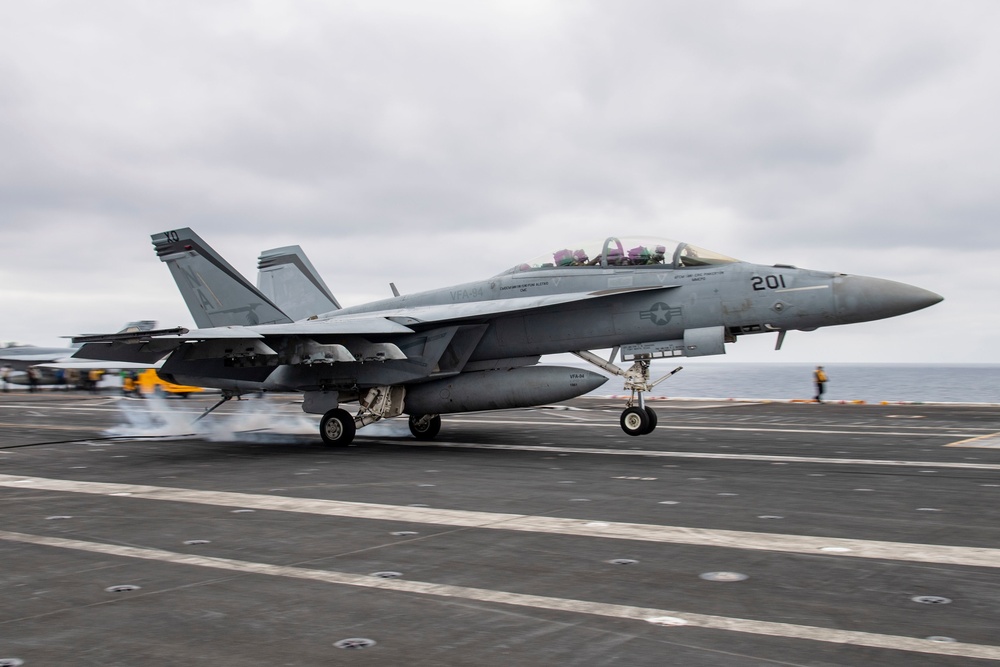
Flight deck operations aboard a US Navy aircraft carrier. The carrier's embarked air wing provides both offensive capability and the outermost layer of defense. (Photo: US Navy)
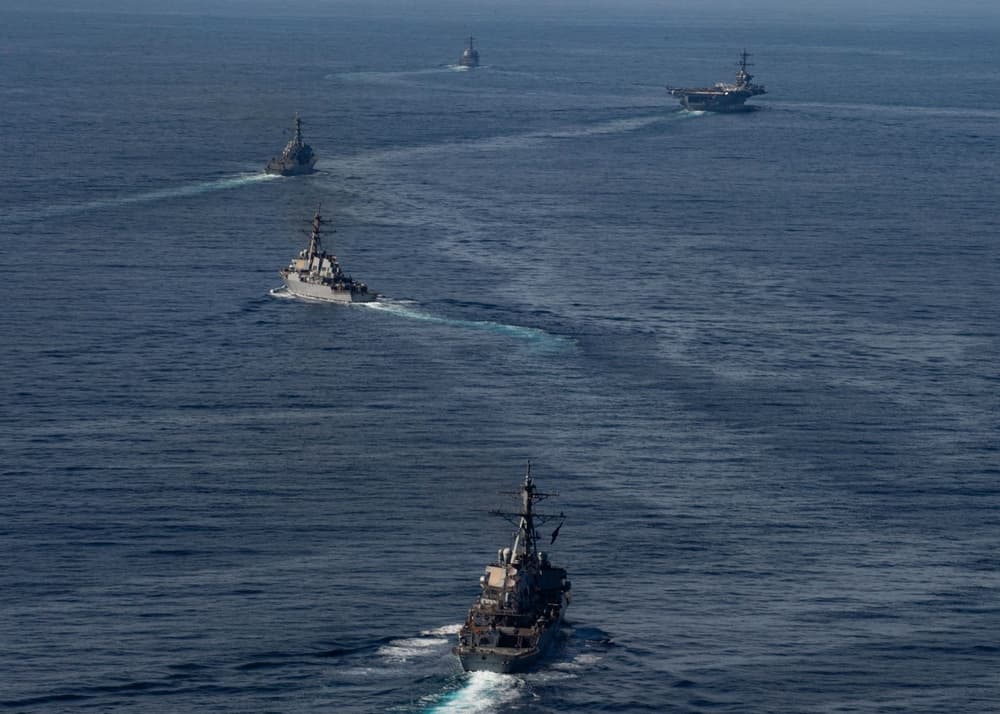
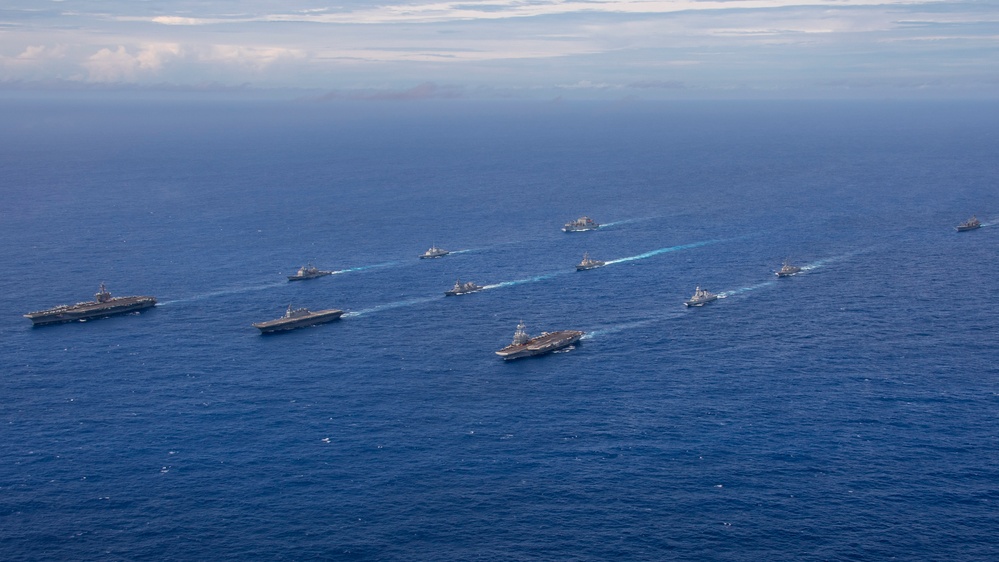
The carrier strike group is the organizational expression of this philosophy. A typical group includes the carrier itself, a Ticonderoga-class guided missile cruiser, several Arleigh Burke-class guided missile destroyers, one or two attack submarines, and a logistics ship for resupply. Each vessel contributes different capabilities. The cruiser and destroyers carry Aegis combat systems with surface-to-air missiles. The submarines provide undersea surveillance and can engage enemy submarines or surface ships. The carrier's aircraft extend the defensive perimeter out to hundreds of miles.
The layered approach also reflects the physics of naval warfare. Ship-based radars cannot see over the horizon, which limits detection range for low-flying missiles. Airborne radar extends that range dramatically. Different missiles have different engagement envelopes, requiring systems optimized for long-range, medium-range, and close-in defense. Submarines operate in an entirely different domain, requiring dedicated anti-submarine assets.
Perhaps most importantly, layered defense acknowledges that saturation attacks, where an adversary launches many missiles simultaneously, can overwhelm any single system. If an attacker launches 20 missiles and a destroyer can engage 10 simultaneously, having multiple destroyers and cruisers with overlapping coverage changes the math. Adding fighter aircraft with air-to-air missiles shifts it further. The goal is not perfection but sufficient capability to impose unacceptable attrition on attacking forces.
This architecture imposes significant costs. Operating a carrier strike group costs millions of dollars per day. The missiles carried by escorts cost hundreds of thousands to millions of dollars each. Training crews to operate these integrated systems requires years. But the alternative, relying on a single line of defense, leaves too many gaps and accepts too much risk for a platform as valuable as a carrier.
The Outer Layer: Early Warning and Forward Defense
Carrier defense begins not with weapons but with sensors. Detecting threats at maximum range provides time to identify them, coordinate a response, and engage before they reach the strike group. The US Navy has invested heavily in systems that extend awareness hundreds of miles from the carrier.
Fighter aircraft provide the active component of outer-layer defense, flying combat air patrol patterns to intercept threats before they reach the strike group. (Photo: US Navy)
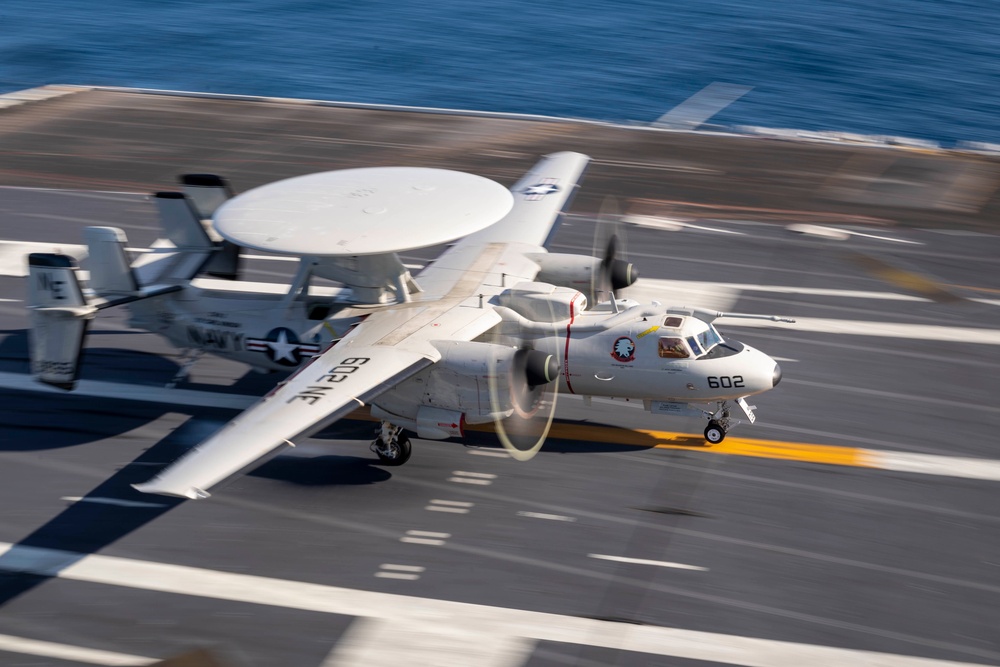
The E-2D Advanced Hawkeye is central to this mission. This propeller-driven aircraft, recognizable by its large rotating radar dome, provides airborne early warning and control. The AN/APY-9 radar can detect aircraft and cruise missiles at ranges exceeding 300 nautical miles, far beyond what ship-based systems can see. Equally important, the E-2D can track surface contacts, detect electronic emissions, and provide command and control for the entire defensive effort.
The Hawkeye's value lies not just in its radar but in its position. A ship radar mounted 100 feet above the water has a horizon of roughly 12 nautical miles for a sea-skimming missile. The same radar at 25,000 feet sees over 200 miles. This geometry explains why airborne early warning is non-negotiable for carrier defense. Without it, low-flying threats would have minimal reaction time against the group.
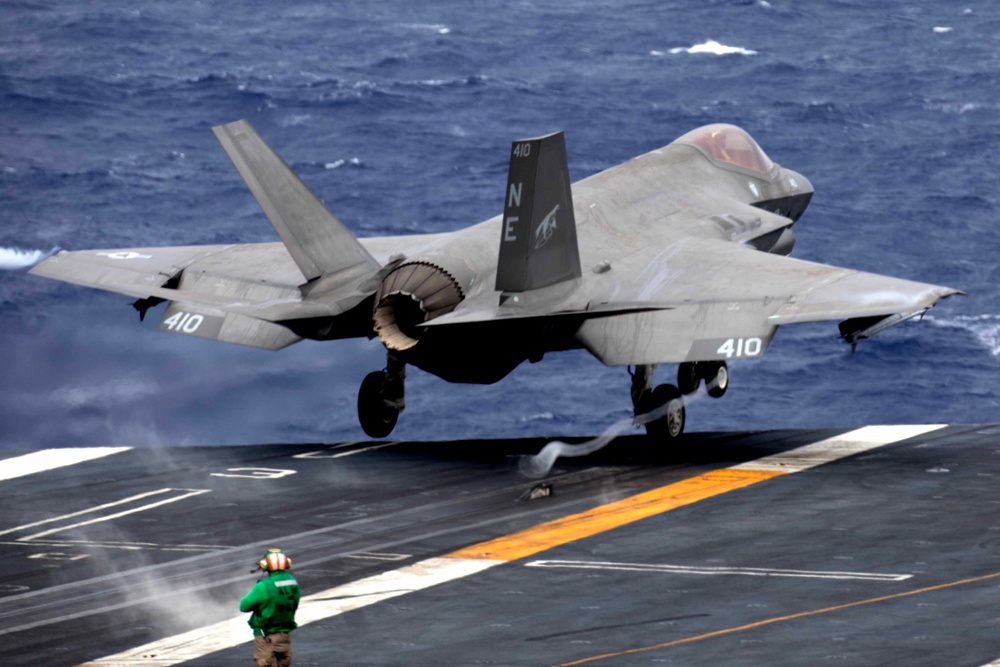
Fighter aircraft provide the active component of outer-layer defense. F/A-18E/F Super Hornets or F-35C Lightning IIs fly combat air patrol (CAP) patterns directed by the E-2D. These aircraft carry AIM-120 AMRAAM missiles that can engage enemy aircraft and cruise missiles at ranges exceeding 80 nautical miles. Positioned 100 or more miles from the carrier, CAP fighters can intercept threats before they come within missile range of the escorts.
The outer layer also includes attack submarines, which operate in ways that are rarely discussed publicly. Submarines can position ahead of the strike group to detect and track enemy surface ships and submarines. They can engage threats with torpedoes or cruise missiles while remaining undetected. Their presence complicates any adversary's planning, forcing attackers to consider submarine threats in addition to surface and air defenses.
The USS Arizona in her December 7, 1941 configuration. 1,048 parts across 34 sprues, 4 photoetch sheets, metal gun barrels, and two Vought Kingfisher floatplanes. Full hull or waterline display options. Over 3.5 feet long when complete.
E-2D Hawkeye early warning, F/A-18 combat air patrols
Attack submarines (SSN), fighter aircraft
Mid-Range
50-200 nm
SM-2/SM-6 Standard Missiles, ESSM
Aegis cruisers (CG), destroyers (DDG)
Inner
0-50 nm
CIWS Phalanx, RAM, SeaRAM
Carrier (CVN), escort vessels
Distances are approximate and vary based on threat environment. Escort vessels are positioned throughout these zones to provide overlapping coverage.
Electronic warfare adds another dimension to outer-layer defense. EA-18G Growler aircraft can jam enemy radar and communications, disrupting the sensor networks that would guide attacks against the carrier. Surface ships carry electronic countermeasures that can deceive missile guidance systems. In an era where adversaries rely increasingly on networked sensors and precision guidance, electronic attack degrades their ability to find, track, and target the carrier.
Intelligence also shapes outer-layer operations. Satellites, signals intelligence, and information from other military and intelligence assets help the strike group understand what threats exist and where they might come from. This awareness influences how the group positions itself, where CAP fighters patrol, and how escorts array themselves around the carrier.
Mid-Range Defense: Aegis and Surface-to-Air Missiles
When threats penetrate the outer layer, or when aircraft and submarines cannot engage them, surface ships provide the next line of defense. The Aegis Combat System, installed on Ticonderoga-class cruisers and Arleigh Burke-class destroyers, is the backbone of this capability.
An Aegis-equipped destroyer serves as the backbone of mid-range carrier defense, capable of detecting, tracking, and engaging multiple threats simultaneously. (Photo: US Navy)
Aegis integrates the AN/SPY-1 phased-array radar with fire control computers and vertical launching systems. The SPY-1 radar continuously scans the sky, tracking hundreds of contacts simultaneously. When a threat is identified, the system can assign missiles and guide them to intercept. A single Aegis ship can engage multiple targets at once, a capability essential for defending against coordinated attacks.
The missiles themselves come in several varieties. The Standard Missile-2 (SM-2) has been the workhorse of naval air defense for decades, effective against aircraft and cruise missiles at ranges up to about 90 nautical miles. The SM-6 extends that range to 150+ nautical miles and adds the ability to engage ballistic missiles in their terminal phase. Importantly, the SM-6 uses an active radar seeker, allowing it to engage targets beyond the launching ship's radar horizon when provided targeting data from other sources.
Cooperative Engagement Capability (CEC) makes this possible. CEC creates a real-time network linking Aegis ships, E-2D Hawkeyes, and other platforms. A missile launched from one ship can use targeting data from another ship's radar or from an aircraft. This dramatically expands the engagement envelope. If an E-2D detects a missile 200 miles away and feeds that data to a destroyer, the destroyer can launch an SM-6 and guide it to intercept using the Hawkeye's targeting information.
Carrier Strike Group Composition
Platform
Type
Key Details
Aircraft Carrier (CVN)
Nimitz / Ford-class
~65 aircraft, 5,000+ crew. Center of the formation.
Guided Missile Cruiser (CG)
Ticonderoga-class
122 VLS cells. Air defense command ship.
Guided Missile Destroyers (DDG)
Arleigh Burke-class
90-96 VLS cells each. Multiple ships in screen.
Attack Submarine (SSN)
Los Angeles / Virginia-class
Operates ahead at variable position.
Combat Logistics Ship
T-AO / T-AKE
Provides underway replenishment.
E-2D Hawkeye
Airborne early warning
Long-range radar surveillance overhead.
F/A-18 Super Hornets
Combat air patrol
Fighter escort and intercept capability.
MH-60R Seahawk
ASW helicopter
Anti-submarine warfare patrols.
Positions are notional and change based on threat environment and operational requirements.
The Evolved Sea Sparrow Missile (ESSM) fills the medium-range engagement band. With a range of approximately 30 nautical miles, ESSM is optimized for engaging anti-ship cruise missiles. Ships carry ESSM in quad-packed cells, meaning four missiles fit in the space of one Standard Missile. This increases the total number of defensive missiles available, important for countering saturation attacks.
Escort positioning reflects the physics of radar and missiles. In peacetime or low-threat environments, destroyers might operate within 10-20 nautical miles of the carrier. In contested waters, they spread out significantly, creating a wider defensive screen that forces attackers to penetrate multiple overlapping engagement zones. A missile coming from the north might face engagement from an eastern destroyer first, then a northern destroyer, then the carrier's own defenses.
The challenge of mid-range defense is magazine depth. Aegis cruisers carry 122 vertical launch system (VLS) cells, destroyers carry 90-96. Not all cells contain air defense missiles; some hold Tomahawk cruise missiles, anti-submarine rockets, or other weapons. A determined saturation attack could theoretically exhaust a ship's defensive missiles, which is why the outer layer's ability to thin attacking waves matters so much.
Close-In Defense: The Last Line
If a threat penetrates the outer and mid-range layers, close-in weapon systems provide final defense. These systems are designed to destroy missiles and aircraft in the last seconds before impact, operating at ranges measured in hundreds of meters rather than miles.
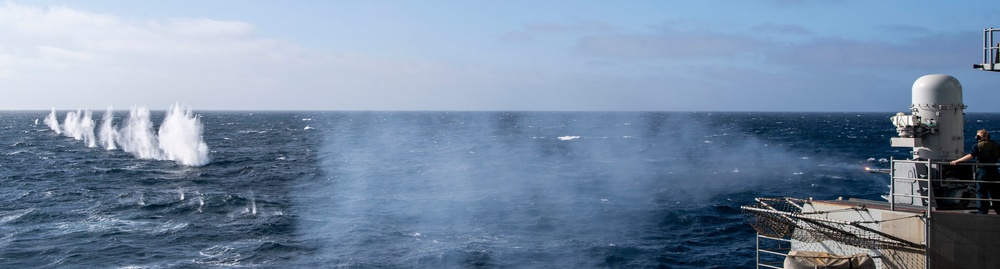
Close-in weapon systems provide last-ditch defense against incoming missiles and aircraft, operating autonomously to engage threats in the final seconds before impact. (Photo: US Navy)
The Phalanx Close-In Weapon System (CIWS), instantly recognizable by its white dome and R2-D2-like appearance, has protected US Navy ships since the 1980s. Phalanx combines a 20mm Vulcan cannon firing 4,500 rounds per minute with its own search and track radar. The system operates autonomously, detecting, tracking, and engaging threats without human intervention. This autonomy is necessary because the engagement window is so brief, often less than 10 seconds from detection to impact.
The Rolling Airframe Missile (RAM) supplements Phalanx with a guided missile solution. RAM launchers carry 21 missiles that use a combination of infrared and radar homing to intercept incoming threats. With greater range than Phalanx, typically 5-10 kilometers, RAM can engage missiles slightly earlier and has better capability against maneuvering targets. SeaRAM combines the RAM missile with the Phalanx mount, creating a more compact system.
Threat Engagement Ranges and Systems
System
Range
Role
CIWS Phalanx / RAM
1-2 nm
Close-in defense, last line of engagement
ESSM (Evolved Sea Sparrow)
~30 nm
Medium-range anti-cruise-missile defense
SM-2 / SM-6 Standard Missile
90-150+ nm
Long-range area air defense
F/A-18 CAP (AIM-120)
100+ nm
Combat air patrol, intercept before missile launch
E-2D Hawkeye
300+ nm
Airborne early warning and detection
Multiple systems provide overlapping coverage, ensuring threats face engagement at every phase of approach. 1 nm = 1.15 statute miles = 1.85 km.
The carrier itself carries these close-in systems. Nimitz-class carriers mount three or four Phalanx CIWS and two RAM launchers. But carriers also carry ESSM missiles in dedicated launchers, providing medium-range self-defense capability. The Gerald R. Ford class adds dual-band radar that improves detection of low-flying and small targets.
Close-in defense represents a calculated acceptance of risk. These systems exist because outer and mid-range defenses will sometimes fail. A missile might evade radar detection by hugging the waves. Electronic warfare might defeat guidance on earlier intercept attempts. One missile in a salvo of 20 might get through. Close-in systems are the insurance policy, the last opportunity to prevent damage.
A compact desk-sized F-22 with the 1st Fighter Wing paint scheme. Die-cast metal body with a plastic display stand included. Around 4 inches nose to tail at 1:145 scale.
The inherent limitation is time. A missile traveling at Mach 2 covers a mile in less than three seconds. Phalanx or RAM must detect, track, compute a firing solution, and hit a small maneuvering target in seconds. Against supersonic missiles, engagement windows shrink further. Against hypersonic missiles, currently under development by several nations, the challenge intensifies significantly.
Soft-kill measures complement hard-kill systems. Chaff, metal strips that create false radar returns, can confuse radar-guided missiles. Infrared decoys and flares can distract heat-seeking missiles. Electronic countermeasures can break missile guidance locks. The SLQ-32 electronic warfare system, installed on most US Navy surface combatants, provides detection and jamming capabilities. NULKA, a hovering rocket-propelled decoy, creates a radar signature that draws missiles away from the ship.
Undersea Defense: The Hidden Threat
Submarines represent a fundamentally different threat than aircraft or missiles. They are difficult to detect, can launch torpedoes or anti-ship missiles, and can position themselves in the path of a carrier strike group. Anti-submarine warfare (ASW) has been a naval priority since World War I and remains one of the most challenging domains of carrier defense.
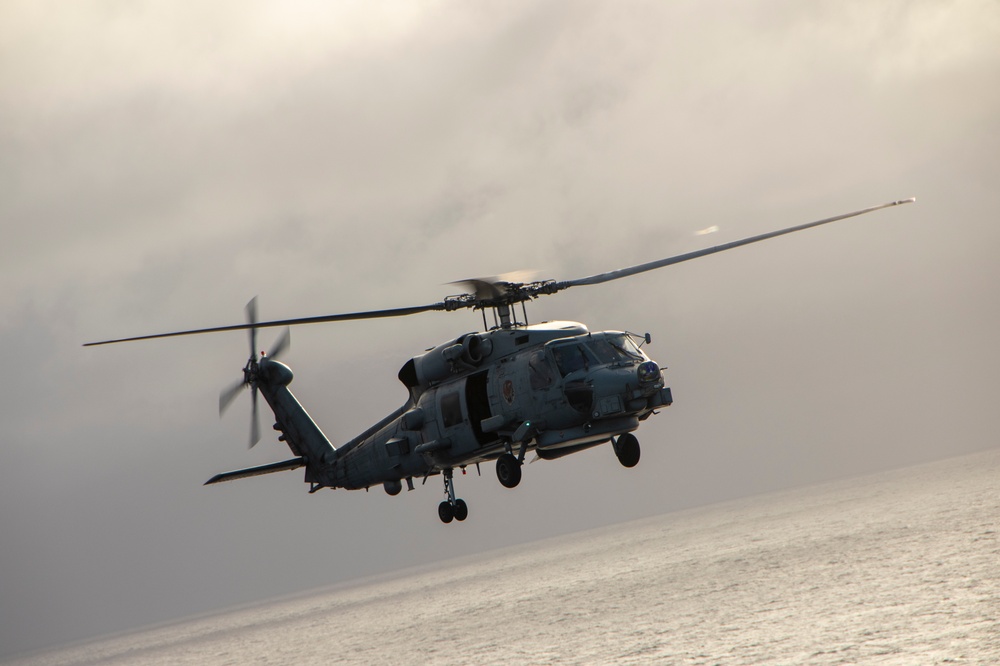
Helicopters provide mobile anti-submarine warfare capability, carrying dipping sonar and sonobuoys to detect submarines and lightweight torpedoes to engage them. (Photo: US Navy)
Attack submarines assigned to carrier strike groups serve as the first line of undersea defense. Operating ahead of the surface formation, these submarines can detect enemy submarines at ranges the surface ships cannot match. Their passive sonar arrays, combined with the ability to move silently and remain undetected, make them ideal for screening duties. If an enemy submarine is detected, the attack submarine can engage with torpedoes.
MH-60R Seahawk helicopters provide the mobile ASW capability organic to the strike group. These helicopters carry dipping sonar, which can be lowered into the water to search for submarines, and sonobuoys, which are dropped to create a wider detection network. The MH-60R also carries lightweight torpedoes to engage contacts. Operating from both the carrier and escorts, these helicopters can prosecute submarine contacts across a wide area.
Surface ships contribute their own ASW sensors and weapons. Most escorts carry hull-mounted sonar for close-range detection and towed array sonar for longer-range detection. Towed arrays trail behind the ship on cables up to a mile long, escaping the noise generated by the ship itself. Surface ships carry the Mk 32 torpedo tube system for launching lightweight torpedoes and can fire the RUM-139 VL-ASROC, which carries a torpedo to a location miles away and drops it into the water.
The challenge of ASW is that the ocean favors the submarine. Water temperature layers, salinity variations, and other factors create conditions where sound propagates unpredictably. A submarine in the right thermal layer might be invisible to sonar just a few miles away. Modern diesel-electric submarines running on batteries are extremely quiet, harder to detect than nuclear submarines in some conditions.
Geography constrains options. In the open ocean, a carrier strike group has room to maneuver and can use speed to its advantage. In confined waters like straits or near coastlines, maneuvering is limited and submarines have more places to hide. The Red Sea operations of 2024, for example, forced surface ships to operate in restricted waters where threat geometry was unfavorable.
Torpedo defense is the underwater equivalent of close-in weapon systems. If a torpedo is launched at a ship, the AN/SLQ-25 Nixie towed decoy can be deployed. Nixie generates acoustic signals that attract the torpedo away from the ship. Surface Ship Torpedo Defense (SSTD), a program in development, would add the ability to detect incoming torpedoes and potentially intercept them with countermeasures or anti-torpedo torpedoes.
Electronic and Information Warfare
Modern threats depend on sensors and networks. Anti-ship missiles need radar or infrared sensors to find their targets. Command systems need communications to coordinate attacks. Disrupting these systems is as important as destroying the missiles themselves. Electronic warfare and information operations form a layer of defense that is invisible but essential.
Electronic warfare capabilities allow the strike group to detect, jam, and deceive enemy sensors and communications, forming an invisible but essential layer of defense. (Photo: US Navy)
The EA-18G Growler is the carrier's dedicated electronic attack aircraft. Derived from the Super Hornet, the Growler carries jamming pods and missiles that can suppress or destroy enemy radar systems. Operating with the air wing, Growlers can blind enemy sensors, prevent targeting, and protect strike packages. For carrier defense, they can jam the radar seekers on incoming missiles or the fire control radars that would guide an attack.
Surface ships carry the SLQ-32 electronic warfare system in various configurations. SLQ-32 can detect radar emissions, identify the type of radar, and determine if the ship is being targeted. More capable versions can jam incoming missiles, breaking the radar lock that guides them to the ship. The system also integrates with decoy launchers, automatically deploying chaff or NULKA decoys when a threat is detected.
Cyber warfare and information operations extend the electronic warfare domain. Adversary networks that coordinate attacks might be disrupted or fed false information. Satellite links that provide targeting data might be jammed or spoofed. The details of offensive cyber operations remain classified, but it is clear that the ability to attack enemy networks has become part of the overall defensive concept.
The challenge is that electronic warfare is a constant competition. If the Navy develops a jammer effective against a particular missile seeker, adversaries will develop counter-countermeasures. New missiles might use multiple guidance modes, switching from radar to infrared if jammed. Networked attacks might be resilient to interference. The electronic warfare layer requires continuous investment and adaptation.
Emissions control (EMCON) is another aspect of information warfare. By limiting or eliminating radar and radio transmissions, a carrier strike group can reduce its detectability. But EMCON involves tradeoffs; you cannot use your radar to detect threats if you are not transmitting. Managing the balance between concealment and awareness is an operational art that commanders must exercise continuously.
Emerging Threats and Adaptations
The defensive architecture described above evolved to counter Cold War Soviet threats: swarms of long-range bombers carrying anti-ship missiles, nuclear-powered submarines with wake-homing torpedoes, and coordinated saturation attacks. Today's threats include those legacy capabilities plus new challenges that test existing defenses.
Anti-ship ballistic missiles, most notably China's DF-21D and DF-26, represent a new threat category. These missiles approach from high altitude at hypersonic speeds, presenting much shorter engagement windows than cruise missiles. Whether current defenses can reliably intercept these missiles is debated. The Navy is investing in improved radar discrimination, faster engagement timelines, and potentially new interceptor missiles optimized for ballistic threats.
Hypersonic cruise missiles, which fly at speeds above Mach 5 while maneuvering in the atmosphere, combine the challenges of ballistic and cruise missiles. Russia and China have both demonstrated hypersonic weapons. The US Navy is developing responses including upgraded sensors, new missile variants, and potentially directed-energy weapons that could engage at the speed of light.
Drone swarms present a different challenge: overwhelming defenses with large numbers of cheap, expendable platforms. Current systems like CIWS and RAM were designed to engage individual missiles, not hundreds of small drones. The Navy is testing counter-drone systems including lasers, high-powered microwaves, and electronic warfare systems designed specifically for this threat. Cost exchange ratios matter here; using a million-dollar missile against a thousand-dollar drone is not sustainable.
The growing role of space-based sensors affects carrier defense planning. Adversary satellites can track carrier movements and provide targeting data. Carrier operations now must consider space situational awareness, potential anti-satellite operations, and the need to operate without assuming space assets will be available in a conflict.
Meng's World War Toons line takes real WW2 vehicles and reimagines them in a stylized, cartoonish proportion. This Sherman kit snaps together without glue and requires no painting, making it a zero-barrier entry point into armor modeling.
Distributed maritime operations, a concept the Navy is developing, would spread offensive and defensive capabilities across more platforms rather than concentrating them around carriers. This could include unmanned surface vessels, missiles launched from logistics ships or submarines, and greater integration with Marine Corps ship-killing missiles. The goal is to present adversaries with more targets and complicate their attack planning.
Risk, Acceptance, and Reality
No defense is perfect. The architecture of carrier defense is designed to reduce risk to acceptable levels, not to eliminate it. Understanding this requires moving beyond binary thinking where carriers are either invincible or sitting ducks.
The historical record shows that carriers can be damaged. During World War II, numerous carriers were sunk or heavily damaged by aircraft and submarines. Since then, improved damage control, nuclear propulsion enabling sustained high speeds, and increasingly sophisticated defenses have improved survivability. No US carrier has been attacked in combat since 1945. But absence of attacks does not mean absence of vulnerability.
War games and exercises reveal both capabilities and gaps. The 2002 Millennium Challenge exercise showed that a determined adversary using unconventional tactics could inflict serious losses. But exercises are not predictions; they are designed to stress systems and identify weaknesses. The Navy has spent decades addressing the shortcomings revealed in exercises and developing new capabilities.
Cost matters in assessing carrier defense. The investment in a carrier strike group, over $20 billion in platforms alone, justifies significant defensive expenditure. But there are limits. An adversary that can force the US to expend millions in defensive missiles against threats costing thousands creates an unfavorable exchange. Managing this asymmetry is a strategic challenge.
Deterrence is the ultimate defense. If potential adversaries believe that attacking a carrier would fail and trigger devastating retaliation, they are less likely to attempt it. The defensive capabilities described in this article contribute to deterrence by raising the cost and lowering the probability of a successful attack. Whether that deterrence holds in a crisis is unknowable until tested.
The operational reality is that carriers continue to deploy worldwide, conducting missions ranging from combat operations to humanitarian assistance. The Red Sea operations of 2024 demonstrated both the utility of carrier airpower and the stress it places on escort resources. Carriers remain the most flexible and powerful projection platforms available, and the Navy continues to invest billions in their defense.
Understanding carrier defense ultimately requires accepting complexity and uncertainty. The systems work together. Each has limitations. Adversaries adapt. Technology advances. The Navy will never declare carriers invulnerable because they are not. But the layered, integrated, continuously evolving architecture of carrier defense represents one of the most sophisticated military protection systems ever developed, designed not for theoretical perfection but for operational reality in a dangerous world.
Frequently Asked Questions
How are aircraft carriers defended?
Aircraft carriers are defended through layered defense systems including: early warning aircraft (E-2 Hawkeye), fighter aircraft combat air patrols, Aegis-equipped cruisers and destroyers with surface-to-air missiles, close-in weapon systems (CIWS), electronic warfare, and anti-submarine warfare assets including attack submarines and helicopters.
What is a carrier strike group?
A carrier strike group (CSG) is a formation of ships and aircraft centered on an aircraft carrier. A typical US Navy CSG includes one aircraft carrier, one Ticonderoga-class guided missile cruiser, two to four Arleigh Burke-class destroyers, one or two attack submarines, and a supply ship. Together these vessels provide layered defense and offensive capability.
Can aircraft carriers be sunk by missiles?
Modern anti-ship missiles pose a theoretical threat to carriers, but no US aircraft carrier has been attacked in combat since World War II. Carrier defense relies on detecting and engaging threats at long range before missiles can reach the carrier. Multiple defense layers -- from fighter aircraft to surface missiles to close-in weapons -- provide redundancy against missile attacks.
What is the Aegis Combat System?
The Aegis Combat System is an integrated naval weapons system that combines radar, computers, and missiles to detect, track, and engage multiple air and missile threats simultaneously. Aegis-equipped cruisers and destroyers form the primary surface-based air defense for carrier strike groups, using missiles like the SM-2 and SM-6 to engage threats at ranges up to 150+ nautical miles.
What is CIWS and how does it work?
CIWS (Close-In Weapon System) is a last-ditch point defense against incoming missiles and aircraft. The Phalanx CIWS uses a 20mm Gatling gun firing 4,500 rounds per minute, guided by integrated radar. It automatically detects, tracks, and engages threats within about 1.5 nautical miles. Rolling Airframe Missile (RAM) and SeaRAM provide similar close-in protection using guided missiles.
How do carriers defend against submarines?
Anti-submarine warfare (ASW) around carriers involves multiple assets: attack submarines operating ahead of the group to detect enemy submarines, MH-60R Seahawk helicopters with dipping sonar and sonobuoys, surface ship towed array sonars, and hull-mounted sonars. The layered approach aims to detect submarines before they reach torpedo or missile range.
What is the E-2 Hawkeye's role in carrier defense?
The E-2D Advanced Hawkeye is the carrier's airborne early warning and control aircraft. Its powerful radar can detect aircraft and missiles at ranges exceeding 300 nautical miles, providing critical early warning. The E-2D also coordinates fighter aircraft, guides missiles, and provides command and control for the entire battle space around the carrier.
How many aircraft are on a US aircraft carrier?
A US Navy Nimitz-class or Gerald R. Ford-class carrier typically embarks a Carrier Air Wing of approximately 65-75 aircraft. This includes about 44 F/A-18E/F Super Hornets or F-35C fighters, 4-5 E-2D Hawkeyes, 4-5 EA-18G Growlers for electronic warfare, and various helicopters for search and rescue, logistics, and anti-submarine warfare.
What missiles do carrier escort ships carry?
Aegis cruisers and destroyers carry Standard Missiles (SM-2, SM-3, SM-6) for air and missile defense, Evolved Sea Sparrow Missiles (ESSM) for medium-range threats, and Tomahawk cruise missiles for land attack. A Ticonderoga-class cruiser has 122 vertical launch system (VLS) cells, while Arleigh Burke destroyers have 90-96 cells.
Can carriers defend against hypersonic missiles?
Hypersonic missiles present challenges due to their speed and maneuverability. The US Navy is developing countermeasures including upgraded SM-6 missiles, improved sensors, and new interceptor concepts. The layered defense approach remains relevant -- detecting and engaging launch platforms before missiles are fired, using electronic warfare to disrupt guidance, and engaging missiles as early as possible in flight.
What is electronic warfare's role in carrier defense?
Electronic warfare is essential for carrier defense. EA-18G Growler aircraft jam enemy radar and communications. Ships carry electronic countermeasures to deceive incoming missiles. The SLQ-32 shipboard system detects threats and can deploy decoys or jamming. Electronic warfare can blind enemy sensors, break missile guidance locks, and create false targets to confuse attackers.
How far from a carrier do escorts operate?
Escort positioning varies based on threat environment and mission. In peacetime or low-threat areas, escorts may operate within 5-10 nautical miles of the carrier. In contested environments, the screen expands significantly -- destroyers may position 20-50+ miles out to intercept threats earlier. Submarines operate even further out, often 50-100+ miles ahead.
Do aircraft carriers have their own weapons?
Yes, carriers have self-defense weapons including: Sea Sparrow or ESSM missiles for air defense, Rolling Airframe Missiles (RAM) for close-in protection, and Phalanx CIWS. However, the carrier's primary offensive and defensive capability comes from its embarked aircraft. The escort ships provide the bulk of missile defense.
How do carriers defend against drone swarms?
Drone swarms are an emerging threat requiring new defenses. Current approaches include using CIWS and RAM against small drones, developing directed energy weapons (lasers) for cost-effective engagement, improving radar to detect small targets, and developing counter-swarm tactics. The Navy is actively testing laser weapons and electronic warfare systems specifically for drone defense.
What is the SM-6 missile?
The Standard Missile-6 (SM-6) is the US Navy's most capable surface-to-air missile. It combines the airframe and propulsion of the SM-2 with the active radar seeker from the AIM-120 air-to-air missile. SM-6 can engage aircraft, cruise missiles, and ballistic missiles at ranges exceeding 150 nautical miles. It can also be used against surface ships.
How does Cooperative Engagement Capability work?
Cooperative Engagement Capability (CEC) networks ships and aircraft to share sensor data in real time. This means a missile launched from one ship can use targeting data from another ship's radar or an E-2D Hawkeye. CEC dramatically extends engagement range and allows ships to engage threats beyond their own radar horizon, multiplying the effectiveness of the entire group.
What role do attack submarines play in carrier defense?
Attack submarines (SSNs) operating with carrier groups serve as forward scouts, detecting and tracking enemy submarines and surface ships before they can threaten the carrier. Submarines can engage threats with torpedoes and cruise missiles while remaining hidden. Their stealth makes them valuable for intelligence gathering and clearing paths through contested waters. For more on the submarines performing this mission, see our ranking of the most powerful attack submarines in 2026.
How are carriers defended against torpedoes?
Torpedo defense involves detecting enemy submarines before they can launch, using ASW helicopters, submarines, and ship sonars. If a torpedo is launched, surface ships carry torpedo countermeasures like the AN/SLQ-25 Nixie -- a towed decoy that attracts torpedoes away from the ship. Some ships have anti-torpedo torpedoes under development.
What is the combat air patrol and how does it protect carriers?
Combat Air Patrol (CAP) consists of fighter aircraft -- typically F/A-18E/F Super Hornets or F-35Cs -- flying defensive patterns around the carrier group. CAP fighters, directed by E-2D Hawkeyes, intercept enemy aircraft and shoot down cruise missiles before they reach the group. CAP provides the longest-range active defense, engaging threats 100+ miles from the carrier.
Has a US carrier ever been sunk?
No US aircraft carrier has been sunk in combat since World War II. Several carriers were lost in WWII, including USS Lexington, USS Yorktown, and USS Hornet. Since then, improved damage control, nuclear propulsion enabling higher speeds, and increasingly capable defensive systems have protected carriers. The retired carrier USS America was deliberately sunk in 2005 for damage testing.
How does radar horizon affect carrier defense?
Ship-based radars are limited by the horizon -- they cannot see targets below the curve of the Earth. For a ship radar at 100 feet height, the horizon is about 12 nautical miles. This is why airborne radar (E-2 Hawkeye) and Cooperative Engagement Capability are essential -- they extend detection beyond the horizon, providing crucial early warning against sea-skimming missiles.
What is the biggest threat to aircraft carriers today?
Modern threats include anti-ship ballistic missiles like China's DF-21D, hypersonic missiles, advanced cruise missiles, and quiet diesel-electric submarines. Large-scale saturation attacks -- launching many missiles simultaneously to overwhelm defenses -- remain a concern. However, layered defense, electronic warfare, and engaging threats at range are designed to counter these risks.
How much does it cost to operate a carrier strike group?
Operating a carrier strike group costs approximately $6-8 million per day when deployed, including fuel, personnel, aircraft operations, and maintenance. A full deployment cycle covering training, deployment, and maintenance costs roughly $1 billion annually. The carrier itself costs about $13 billion to build, with escorts adding billions more.
Can carriers launch missiles themselves?
US carriers carry defensive missiles only -- Sea Sparrow/ESSM and RAM for air defense. They do not carry offensive cruise missiles like Tomahawk. The carrier's offensive power comes from its aircraft, which can deliver precision-guided bombs, cruise missiles, and anti-ship weapons at much greater range and flexibility than ship-launched missiles.
What is the Integrated Air and Missile Defense?
Integrated Air and Missile Defense (IAMD) is the coordinated approach to defending against aircraft, cruise missiles, and ballistic missiles using all available sensors and weapons. Naval IAMD combines Aegis ships, E-2D aircraft, fighter CAP, and shore-based assets when available, all networked together to provide comprehensive detection and engagement across the entire threat spectrum.