Skip to content
April 22:First Poison Gas Attack at Ypres111yr ago

The K2 Black Panther: Inside South Korea's Advanced Battle Tank

Marcus Webb · · 14 min read
Save
Share:
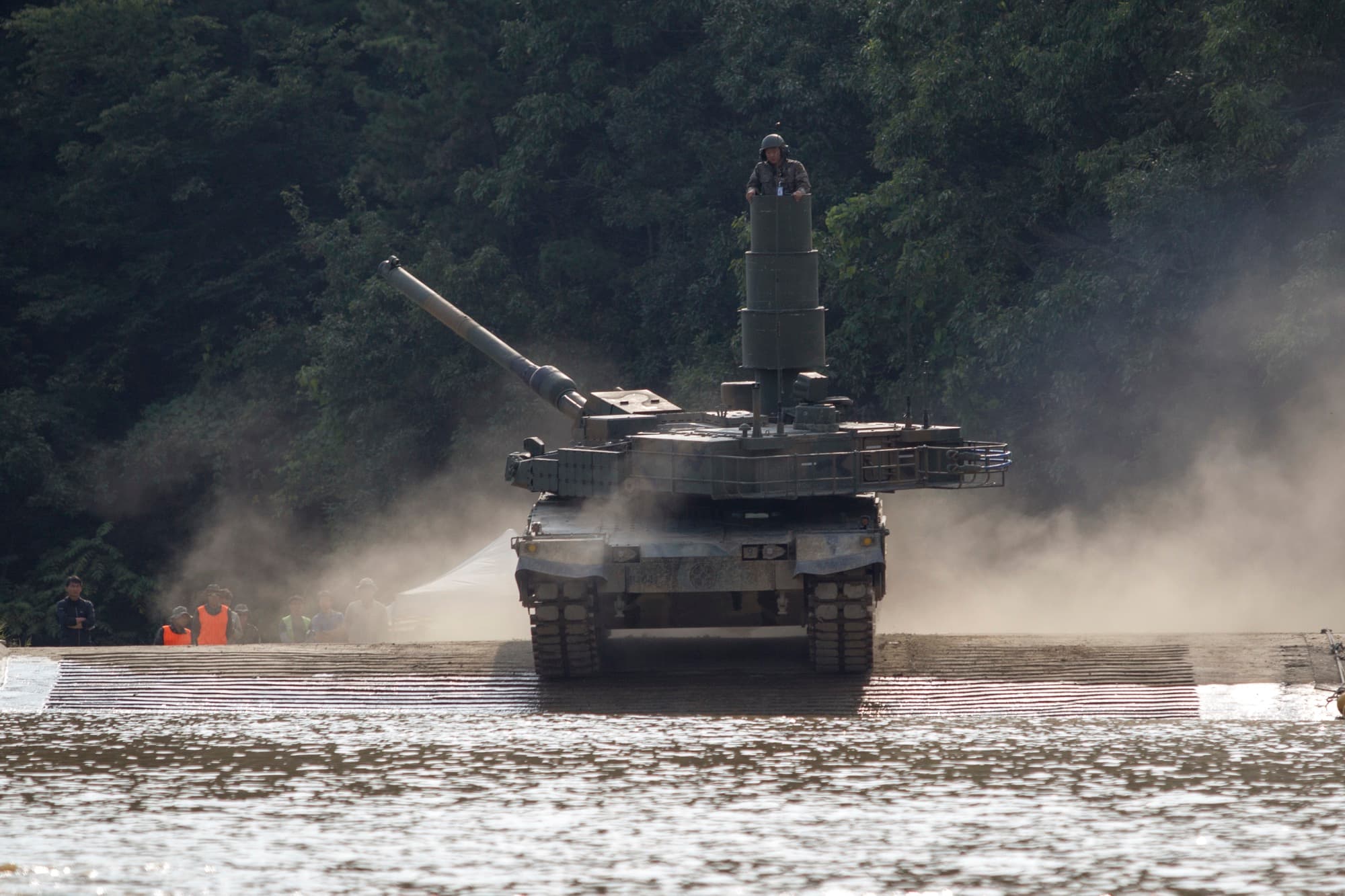
K2 Black Panther main battle tank driving at speed through terrain during an exercise
Marcus Webb
Marcus Webb

Military Vehicles & Ground Systems Contributor

Marcus Webb writes about military ground vehicles, armored platforms, and the logistics of land warfare. His work covers everything from MRAPs and infantry carriers to the training pipelines that keep ground forces operational in contested environments.

The K2 Black Panther is one of those machines that looks like it was designed by engineers who were told to check every box on the modern tank requirements list and then add a few more. It has an autoloader that eliminates the fourth crew member. It has an active protection system that can intercept incoming missiles and RPGs. It has a hydropneumatic suspension that adjusts ground clearance on the fly and can tilt the entire hull for hull-down firing positions. And it has a 120mm smoothbore gun with programmable airburst ammunition. South Korea built a tank that arguably out-specifications every Western main battle tank on paper — and then sold over a thousand of them to Poland. That export deal transformed the K2 from an impressive national defense program into a global competitor challenging Leopard 2s and Abrams for market share.

Why South Korea Built Its Own Tank

South Korea's armored forces had relied on a progression of American-designed and domestically produced tanks: M48 Pattons, license-built K1s (based on the Chrysler XM1 design that competed with the M1 Abrams), and the improved K1A1 with a 120mm gun. These tanks were adequate for defending the Korean Peninsula's mountainous terrain, but by the early 2000s, South Korea wanted a next-generation tank that incorporated technologies that its existing fleet lacked — particularly an autoloader, active protection, and the kind of fire control system that would give it a decisive edge against North Korea's numerically superior but technologically outdated armored forces.

The K2 development program was initiated by the Agency for Defense Development (ADD) in the mid-1990s, with Hyundai Rotem as the prime contractor. Development was long and troubled — engine problems, integration challenges, and budget overruns pushed the program timeline repeatedly. The first prototype was completed in 2007, but the K2 did not enter South Korean Army service until 2014, nearly two decades after development began.

Much of the delay centered on the powerpack. South Korea originally intended to equip the K2 with a fully indigenous engine and transmission. The Doosan Infracore DV27K diesel engine and the S&T Dynamics EST15K transmission were developed domestically, but both experienced reliability problems during testing. The first production batch of K2s was ultimately equipped with the German MTU MT 883 Ka-501 diesel engine paired with a Renk HSWL 295TM transmission — the same powerpack combination used in upgraded Leopard 2 variants. Later production batches transitioned to the domestic powerpack after further development.

Firepower: The 120mm Gun and Autoloader

The K2's main armament is a Hyundai WIA CN08 120mm/L55 smoothbore gun — the same caliber and barrel length as the Rheinmetall L55 used in the Leopard 2A6. The longer L55 barrel provides higher muzzle velocity compared to the shorter L44 guns on earlier Western tanks, translating directly to better armor penetration at range.

What sets the K2 apart from most Western tanks is its autoloader. The bustle-mounted autoloading system stores ammunition in the turret rear and feeds rounds to the breech mechanically, allowing a rate of fire of up to 10 rounds per minute. This eliminates the need for a human loader, reducing the crew from four to three: commander, gunner, and driver.

Autoloaders are controversial in Western tank doctrine. The Abrams deliberately retains a fourth crew member, arguing that the loader provides additional maintenance capability, security during halts, and redundancy if crew members are wounded. Russian tanks have used autoloaders since the T-64, but their carousel-type designs — which store ammunition below the crew — have proven catastrophically vulnerable, as demonstrated repeatedly in Ukraine. The K2's bustle autoloader stores ammunition behind blow-out panels in the turret rear, which direct explosion energy away from the crew compartment if the ammunition is hit. It is a fundamentally safer design than the Soviet approach.

The K2 can fire all standard NATO 120mm ammunition, plus the Korean-developed KSTAM — a top-attack smart munition that can be fired from the main gun and uses a sensor to search for and strike the thin top armor of enemy tanks. The tank also mounts a coaxial 7.62mm machine gun and a roof-mounted K6 12.7mm heavy machine gun that can be operated from inside the turret under armor.

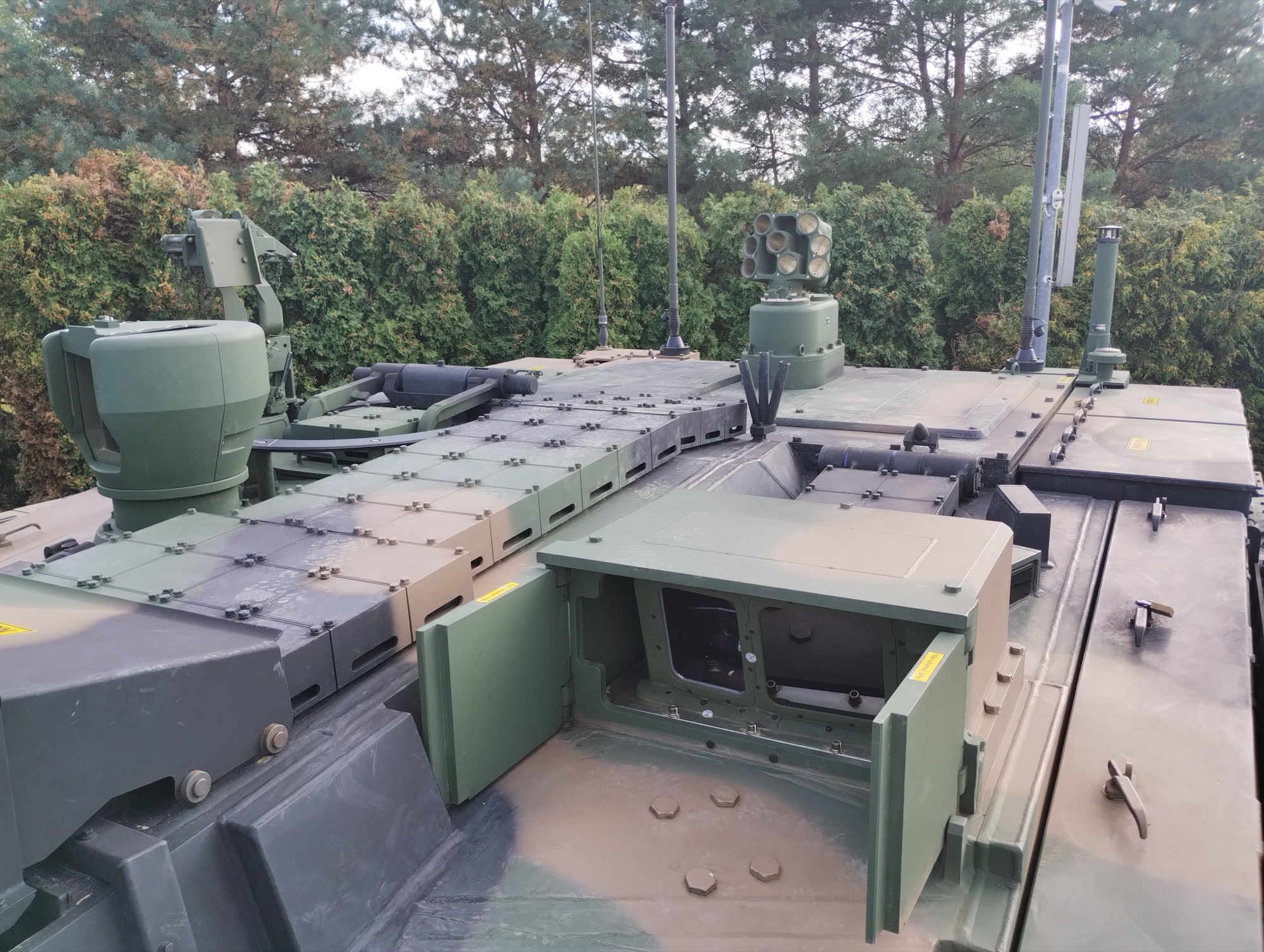
K2 Black Panther tank turret showing the 120mm L55 main gun and sensor suite
The K2's turret houses a 120mm L55 smoothbore gun with an autoloader, hunter-killer fire control system, and the KAPS active protection launchers. The bustle-mounted autoloader allows a sustained rate of fire of up to 10 rounds per minute. (Republic of Korea Army)

Fire Control: See First, Shoot First

The K2's fire control system is a hunter-killer configuration — meaning the commander and gunner can independently search for and engage targets. The commander identifies a target through the panoramic sight, designates it, and the turret automatically slews to engage while the commander is already searching for the next target. This dramatically reduces the time between engagements and allows a single K2 to prosecute multiple targets in rapid succession.

The commander's independent viewer integrates a thermal imaging camera, daylight TV camera, and laser rangefinder. The gunner's primary sight includes a thermal imager, daylight channel, and laser rangefinder with automatic target tracking. A millimeter-wave radar mounted on the turret roof provides additional target detection capability in adverse weather conditions — a feature that few other main battle tanks offer.

The fire control computer accounts for barrel wear, crosswind, air temperature, ammunition type, and target motion, providing a first-round hit probability that South Korea claims exceeds 90 percent against moving targets at combat ranges. The system can engage targets while the tank is moving at speed — a capability called fire-on-the-move that was once rare but has become standard for modern MBTs.

Active Protection: KAPS

The Korean Active Protection System (KAPS) is a hard-kill system designed to intercept incoming anti-tank missiles and rocket-propelled grenades before they reach the vehicle. KAPS uses a radar to detect and track incoming threats, then launches an interceptor projectile to destroy the threat in flight — similar in concept to Israel's Trophy APS used on the Merkava and some Abrams variants.

The system also includes soft-kill components: radar warning receivers, laser warning receivers, and smoke grenade launchers that can deploy multispectral smoke screens to defeat laser-guided and infrared-guided threats. The combination of hard-kill and soft-kill measures provides layered protection against the most common anti-tank weapons.

Active protection has become increasingly important as anti-tank guided missiles have proliferated. Ukraine's conflict has demonstrated that even modern tanks without APS are vulnerable to relatively inexpensive guided weapons. The K2's inclusion of KAPS from the outset — rather than as a retrofit — reflects South Korea's recognition that passive armor alone is no longer sufficient.

The Hydropneumatic Suspension

The K2's most unusual feature is its In-Arm Semi-Active Suspension Unit (ISU) hydropneumatic suspension, developed by the Korean ADD. Unlike conventional torsion bar suspensions that provide a fixed ride height, the hydropneumatic system allows the driver to adjust the tank's ground clearance and attitude in real time.

The practical applications are significant. The K2 can raise its suspension to cross obstacles or ford deeper water. It can lower itself to reduce its profile when moving through open terrain. Most impressively, it can tilt the entire hull forward or backward to increase the gun's elevation or depression angles — effectively allowing the tank to "kneel" behind a ridge and fire from a hull-down position with only the turret exposed.

In South Korea's mountainous terrain, where tanks frequently fight from defilade positions behind ridgelines, this capability provides a decisive tactical advantage. A K2 can drive up to a reverse slope, lower its front suspension to depress the gun beyond its normal range, engage targets in the valley below, and withdraw behind the ridge — all without exposing the hull to return fire. The Japanese Type 10 tank uses a similar hydropneumatic suspension, but the K2's system is generally considered more capable in its range of adjustment.

Specifications

Weight 55 tons (combat loaded)
Engine MTU MT 883 Ka-501 (Batch 1) / Doosan DV27K (later batches)
Power 1,500 hp
Max Speed 70 km/h (43 mph) on road
Range 450 km (280 mi)
Main Armament 120mm CN08 L/55 smoothbore (autoloaded)
Secondary Armament 1× 12.7mm K6 HMG, 1× 7.62mm coaxial MG
Crew 3 (commander, gunner, driver)
Protection Composite armor + ERA + KAPS active protection
Suspension In-arm hydropneumatic (adjustable)

The Poland Deal: A Thousand Tanks

The K2's transformation from a national defense program to a global export success began in 2022, when Poland signed a framework agreement to acquire approximately 1,000 K2 tanks from Hyundai Rotem. The first batch of 180 K2s would be delivered in the standard Korean configuration, with subsequent batches produced as the K2PL — a Polonized variant incorporating Polish-specific requirements, potentially including a longer-barrel 130mm gun, enhanced armor packages, and integration with Polish command-and-control systems.

Poland's decision was driven by urgency. The country had donated hundreds of its Soviet-era T-72 tanks to Ukraine and needed to rapidly rebuild its armored forces with modern Western-standard equipment. The K2 offered something that European manufacturers could not: immediate availability. While the Leopard 2 production line had been dormant and would take years to restart to full capacity, Hyundai Rotem could begin delivering K2s almost immediately from its existing production facilities.

The first K2 tanks arrived in Poland in late 2022, making Poland the K2's first export customer and establishing South Korea as a serious competitor in the global tank market. The deal's scale — potentially exceeding $15 billion for all batches — made it one of the largest armored vehicle export contracts in history.

Turkey also licensed K2 technology for its own indigenous Altay main battle tank program, using the K2's design as a starting point for an MBT tailored to Turkish requirements. The technology transfer included elements of the powerpack, fire control system, and armor design.

How It Compares

On paper, the K2 Black Panther is competitive with or superior to every Western main battle tank in several key metrics. Against the M1A2 Abrams, the K2 is lighter (55 tons versus 73 tons for the SEPv3), faster, and features both an autoloader and active protection as standard. The Abrams counters with heavier armor — particularly the depleted uranium mesh in the frontal arc — and a combat-proven track record spanning four decades.

Against the Leopard 2A7, the matchup is closer. Both use 120mm L55 guns, both have excellent fire control systems, and both are in the 55-65 ton weight class. The K2's advantages are its autoloader, hydropneumatic suspension, and integrated active protection. The Leopard 2A7's advantages are its more mature production infrastructure, extensive combat data from user nations, and modular armor upgrade path.

The K2's real competitive advantage is not any single specification — it is the package. An autoloader, active protection, adjustable suspension, hunter-killer fire control, smart munitions, and 1,500 horsepower in a 55-ton platform. Few tanks offer all of these features in a single vehicle, and none offer them at the K2's price point combined with South Korea's willingness to provide rapid delivery and generous technology transfer terms.

The K2 Black Panther may not have the Abrams' combat pedigree or the Leopard 2's decades of institutional trust in NATO armies. But it has something those tanks cannot easily match: a combination of technology, availability, and export flexibility that has already won it the largest tank order of the 21st century. South Korea built the K2 to defend the Korean Peninsula. It turned out to be good enough to rearm Europe.

Share this article

Share:

Recommended

Ace of The Skies: Can You Identify These Military Aircraft Throughout The Years?
Test Yourself

Ace of The Skies: Can You Identify These Military Aircraft Throughout The Years?

Can you identify these aircraft?

Take the Quiz

On This Day in Military History

March 12

The Truman Doctrine: America Commits to Containing Communism (1947)

President Harry S. Truman addressed a joint session of Congress and requested $400 million in military and economic aid for Greece and Turkey to resist communist insurgencies and Soviet pressure. His declaration — "it must be the policy of the United States to support free peoples who are resisting attempted subjugation" — launched the Cold War strategy of containment that would define American military policy for the next four decades.

1938The Anschluss: Germany Annexes Austria Without a Shot

1940Moscow Peace Treaty Ends the Winter War

1999Poland, Hungary, and Czech Republic Join NATO

See all 10 events on March 12

Get Military News & History in Your Inbox

Join thousands of readers receiving our weekly digest of military technology, history, and analysis.

Test Your Knowledge