Skip to content
April 21:Battle of San Jacinto190yr ago

Russia's S-70 Okhotnik: A Heavy Stealth Combat Drone

Alex Carter · · 13 min read
Save
Share:
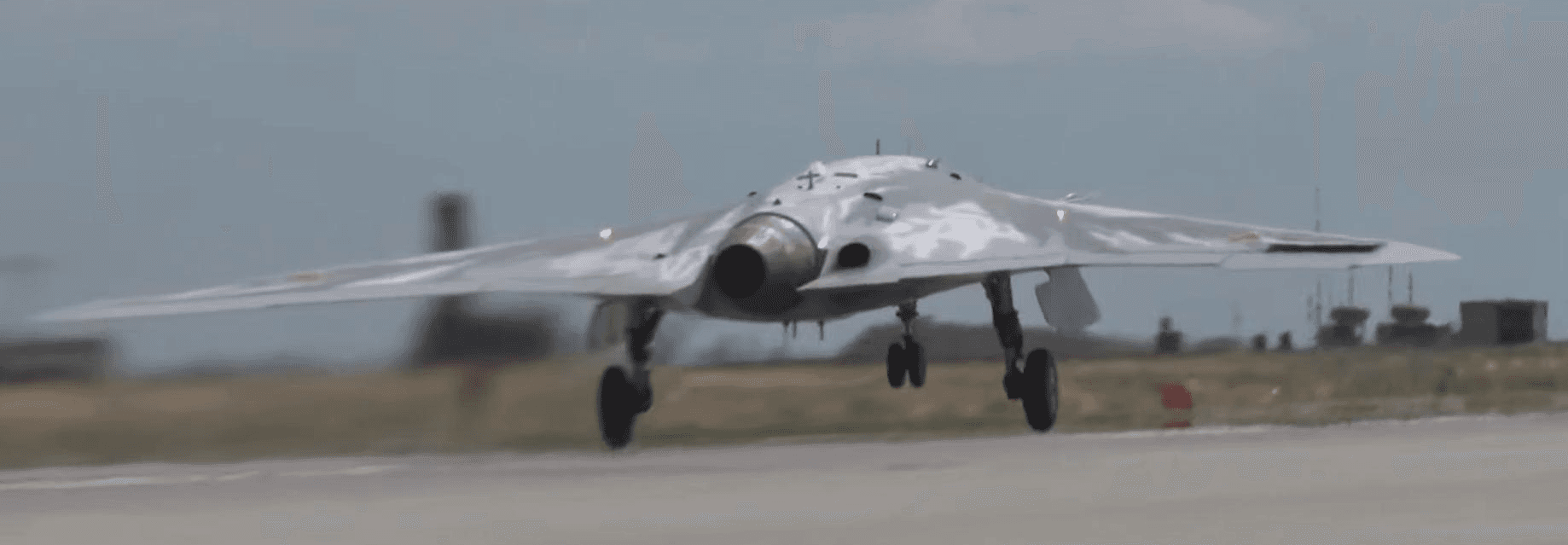
Sukhoi S-70 Okhotnik stealth combat drone in flight showing flying wing design
Alex Carter
Alex Carter

Modern Warfare & Defense Technology Contributor

Alex Carter writes about modern warfare, emerging military technology, and how doctrine adapts to new tools. His work focuses on what changes in practice -- command, control, targeting, and risk -- when systems like drones and autonomous platforms become routine.

Most combat drones weigh a few hundred kilograms and carry a handful of guided munitions. Russia's S-70 Okhotnik — Russian for "Hunter" — weighs 20 tons, has a wingspan of 65 feet, and is designed to carry precision-guided bombs in an internal weapons bay while flying alongside the Su-57 stealth fighter as an autonomous wingman. It is the heaviest and most ambitious combat drone currently in development anywhere in the world. It is also one of the most troubled, with repeated production delays and a dramatic combat loss over Ukraine that revealed both its capabilities and its limitations.

Origins: From Skat to Okhotnik

The Okhotnik's lineage traces back to the Mikoyan Skat, a flying wing unmanned combat aerial vehicle (UCAV) concept unveiled by MiG at the 2007 MAKS air show. The Skat was a full-scale mockup that demonstrated Russia's interest in stealth drone technology, but the program never progressed beyond the concept stage under MiG. When the Russian defense ministry decided to pursue a heavy UCAV in earnest, the project was transferred to Sukhoi — which had the institutional knowledge from the Su-57 fifth-generation fighter program and the manufacturing capacity at the Novosibirsk Chkalov Aviation Plant.

Development began in earnest around 2012, with assembly of the first experimental airframe completing at the Novosibirsk plant in mid-2018. The S-70 made its maiden flight on August 3, 2019, staying aloft for approximately 20 minutes. The flight was conducted alongside a Su-57 chase aircraft — a pairing that foreshadowed the drone's intended operational role.

Design and Engineering

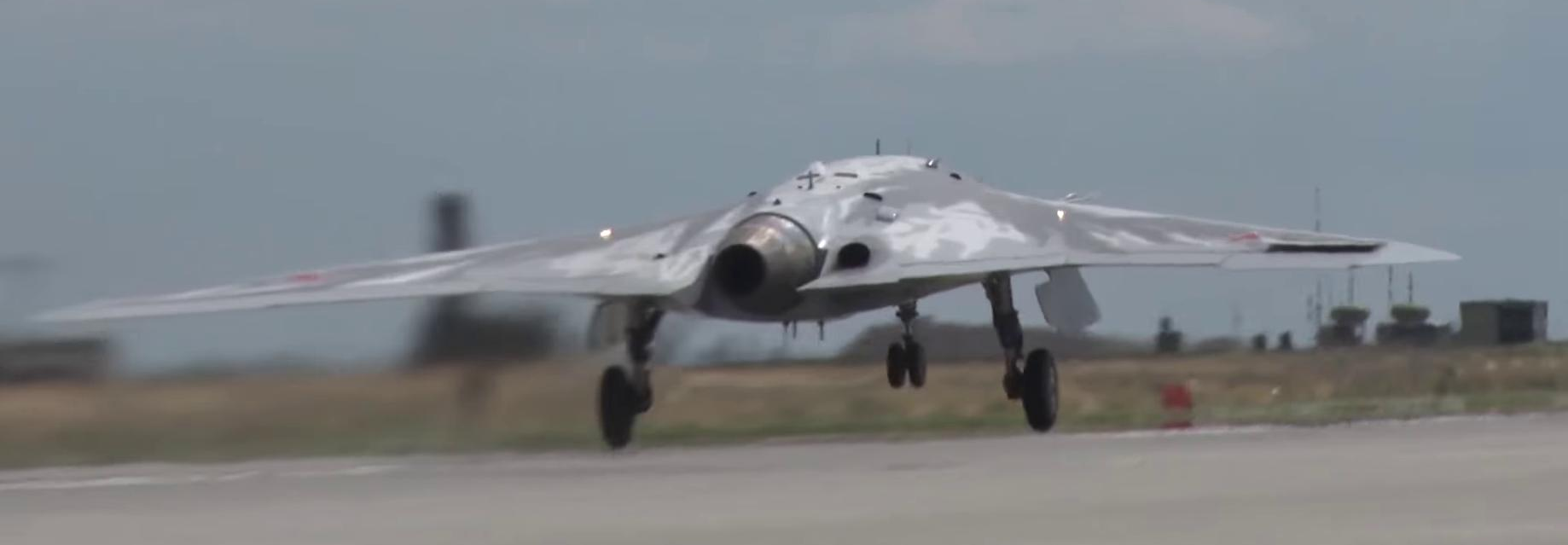
The Okhotnik is a tailless flying wing — the same basic configuration used by the American B-2 Spirit bomber and the more recent B-21 Raider. The flying wing shape minimizes radar cross-section by eliminating vertical surfaces that create strong radar returns. Every major surface is blended into a smooth, continuous planform that deflects radar energy away from the transmitter rather than back toward it.

The airframe makes extensive use of composite materials coated with radar-absorbing materials (RAM), further reducing its radar signature. The combination of the flying wing shape and RAM coatings is intended to allow the Okhotnik to penetrate air defenses that would detect and engage conventional drones. Whether it achieves genuine low-observable performance comparable to Western stealth aircraft remains an open question — the wreckage recovered from Ukraine provided some clues but no definitive answers.

Power comes from a single turbofan engine — either an AL-31F, the same powerplant used on the Su-27 Flanker family, or an improved AL-41F derivative from the Su-35S and Su-57 programs. The engine gives the Okhotnik a maximum speed of approximately 1,000 km/h (620 mph) — subsonic, but significantly faster than propeller-driven drones like the MQ-9 Reaper or the Bayraktar TB2. The operational range is estimated at 6,000 km (3,700 miles), giving it strategic reach that far exceeds any other drone in its class.

The aircraft shares main landing gear assemblies with the Su-57, a practical engineering decision that simplifies logistics and leverages existing tooling. At approximately 14 meters (46 feet) in length with that 20-meter (65-foot) wingspan, the Okhotnik is roughly the size of a manned fighter aircraft — making it one of the largest operational drones in the world.

S-70 Okhotnik drone showing its flying wing planform from above during a test flight
The S-70 Okhotnik's flying wing configuration eliminates the vertical tail surfaces that create strong radar returns on conventional aircraft. The design philosophy mirrors Western stealth platforms like the B-2 Spirit. (Russian Ministry of Defense)

Weapons and Sensors

The Okhotnik carries its weapons internally — a critical feature for maintaining its stealth profile. Two internal weapons bays can accommodate a combined payload of approximately 2.8 tons (6,170 pounds) of precision-guided munitions. The bays are reportedly sized to accept the same weapon types used by the Su-57, including air-to-ground missiles and guided bombs.

The wreckage recovered from the October 2024 shootdown over Ukraine confirmed at least one specific weapon type: the UMPB D-30SN, a precision-guided glide bomb that uses inertial and satellite navigation for terminal guidance. The D-30SN is conceptually similar to the American GBU-39 Small Diameter Bomb — a compact, GPS-guided weapon designed for precision strikes with reduced collateral damage.

The sensor suite is less well documented than the weapons capability, but the Okhotnik is expected to carry a suite of electro-optical and infrared sensors for intelligence, surveillance, and reconnaissance (ISR) missions, along with synthetic aperture radar for all-weather ground mapping. The drone's large internal volume — a benefit of the flying wing configuration — provides ample space for mission-specific sensor packages.

The Loyal Wingman Concept

The Okhotnik's primary operational concept is manned-unmanned teaming (MUM-T) with the Su-57. In this configuration, the Su-57 pilot controls the drone through a secure datalink, directing it to scout ahead into heavily defended airspace, designate targets, jam enemy radars, or deliver weapons — all while the manned fighter stays at a safe distance.

This concept is not unique to Russia. The United States is pursuing a similar approach with the Collaborative Combat Aircraft (CCA) program, and Australia has developed the MQ-28 Ghost Bat for the same role. But the Okhotnik differs from these Western programs in scale. At 20 tons, it is far heavier than the XQ-58 Valkyrie (2.7 tons) or the Ghost Bat (estimated at around 3 tons). This mass allows for greater payload, longer range, and more sophisticated sensors — but it also means each Okhotnik costs far more than an expendable wingman drone.

The loyal wingman concept potentially transforms the economics of air combat. A single Su-57 controlling two or three Okhotniks effectively triples the number of weapons it can deliver while keeping the pilot out of the most dangerous airspace. If the drone is shot down, the loss is significant but not catastrophic — no pilot is lost, and the manned aircraft survives to fight again.

The Ukraine Shootdown

On October 5, 2024, an S-70 Okhotnik was shot down over the Donetsk region of Ukraine — but not by Ukrainian forces. Video footage captured the moment a Russian Su-57 fired a missile at the drone, destroying it in midair. The Okhotnik crashed near Kostyantynivka in Ukrainian-held territory.

The most likely explanation is that the drone lost its datalink connection with the controlling Su-57 and began flying autonomously along a preprogrammed route that would have taken it into Ukrainian-held territory. Rather than allow the advanced stealth drone to be captured intact, the Su-57 pilot shot it down. Russia reportedly attempted to destroy the wreckage with a subsequent missile strike, but enough of the aircraft survived for Ukrainian forces to recover and analyze it.

The recovered wreckage included a large, fairly intact wing section, burned components of a UMPB D-30SN glide bomb, and parts of the turbofan engine. The fact that the drone was armed confirmed that this was not merely a test flight — the Okhotnik was conducting operational trials that included prosecuting Ukrainian targets. It was likely the first combat deployment of the type.

For Russia, the incident was an intelligence disaster. The wreckage provided Western and Ukrainian analysts with their first detailed look at the Okhotnik's construction, materials, and internal systems. For the broader defense community, it demonstrated both the promise and the risk of autonomous combat drones: when the datalink breaks, the system has to make decisions on its own — or be destroyed by its own side.

How It Compares

The Okhotnik occupies a unique position in the global drone landscape. It is not comparable to the tactical drones that have dominated recent conflicts.

Specification S-70 Okhotnik MQ-9 Reaper XQ-58 Valkyrie Bayraktar TB2
Max Takeoff Weight 25,000 kg 4,760 kg 2,722 kg 650 kg
Max Speed 1,000 km/h 482 km/h 1,048 km/h 222 km/h
Range 6,000 km 1,850 km 5,600 km 300 km
Payload 2,800 kg 1,746 kg ~270 kg ~55 kg
Stealth Yes (flying wing) No Low observable No
Internal Weapons Bay Yes No Yes No

The Reaper and TB2 are designed for permissive or semi-permissive environments — airspace where the operator has air superiority or at least air parity. They are slow, non-stealthy, and vulnerable to modern air defenses. The Okhotnik, like the XQ-58 Valkyrie, is designed to survive in contested airspace where those drones would be shot down immediately.

The key difference between the Okhotnik and the Valkyrie is philosophy. The XQ-58 is deliberately inexpensive and semi-expendable — designed to be fielded in numbers and accepted as attritable. The Okhotnik is expensive, complex, and not expendable. Each lost Okhotnik represents a significant material and intelligence loss, as the Ukraine incident demonstrated.

Production Status and What Comes Next

The Okhotnik program has experienced repeated production delays. Originally targeted for serial production in 2023, the timeline slipped to 2024, then to 2025. At least four prototypes have been built or are under construction at the Novosibirsk Chkalov Aviation Plant: the original P0 that first flew in 2019, a modified second prototype, and third and fourth prototypes that are reportedly identical to the planned serial production configuration.

Russia has offered the Okhotnik as part of a combined export package with the Su-57E — the export variant of the Su-57 fighter. The pitch to India includes both aircraft in a manned-unmanned teaming configuration, with Russia suggesting India could serve as both a buyer and a regional manufacturing hub for the system. Whether India or any other country commits to the package remains uncertain, particularly given the Su-57's own limited production numbers — estimated at only 20 to 30 operational aircraft as of mid-2025.

The Okhotnik represents Russia's most serious attempt to enter the autonomous combat aircraft domain. Its size, range, and stealth design place it in a category that no other country's operational drone currently occupies. But the gap between prototypes and a fielded operational fleet remains enormous — and the October 2024 shootdown illustrated that the system is still working through fundamental challenges in autonomous operation and datalink reliability. The Hunter has demonstrated that it can fly, carry weapons, and survive in some level of contested airspace. Whether it can do so reliably, at scale, and at a cost Russia can sustain is the question that the next several years will answer.

Share this article

Share:

Recommended

Ace of The Skies: Can You Identify These Military Aircraft Throughout The Years?
Test Yourself

Ace of The Skies: Can You Identify These Military Aircraft Throughout The Years?

Can you identify these aircraft?

Take the Quiz

On This Day in Military History

March 12

The Truman Doctrine: America Commits to Containing Communism (1947)

President Harry S. Truman addressed a joint session of Congress and requested $400 million in military and economic aid for Greece and Turkey to resist communist insurgencies and Soviet pressure. His declaration — "it must be the policy of the United States to support free peoples who are resisting attempted subjugation" — launched the Cold War strategy of containment that would define American military policy for the next four decades.

1938The Anschluss: Germany Annexes Austria Without a Shot

1940Moscow Peace Treaty Ends the Winter War

1999Poland, Hungary, and Czech Republic Join NATO

See all 10 events on March 12

Get Military News & History in Your Inbox

Join thousands of readers receiving our weekly digest of military technology, history, and analysis.

Test Your Knowledge