Skip to content
April 18:The Doolittle Raid on Tokyo84yr ago

F-35 vs Su-57: How America and Russia's Stealth Fighters Compare

Michael Trent · · 18 min read
Save
Share:
F-35 Lightning II and Su-57 Felon in a side-by-side comparison graphic
Michael Trent
Michael Trent

Defense Systems Analyst

Michael Trent covers military aircraft, weapons systems, and defense technology with an emphasis on cost, maintenance, and real-world performance. He focuses less on specifications and more on how systems hold up once they are deployed, maintained, and operated at scale.

The Lockheed Martin F-35 Lightning II and the Sukhoi Su-57 Felon are both fifth-generation fighters, but they share about as much design philosophy as a scalpel and a broadsword. The F-35 was built to see without being seen — a stealthy, networked sensor platform designed to make every other asset on the battlefield more effective. The Su-57 was built to dominate airspace through speed, maneuverability, range, and reach. Understanding why they are so different is more revealing than arguing which one is "better."

At a Glance: Quick Verdict

F-35 Lightning II Advantages

  • Superior all-aspect stealth (~0.005 m² RCS)
  • Best-in-class sensor fusion and situational awareness
  • Networked data-sharing across the entire force
  • 1,300+ aircraft delivered across 20 nations
  • Largest integrated weapons catalog of any fighter
  • Three variants (CTOL, STOVL, carrier)

Su-57 Felon Advantages

  • Mach 2.0 top speed with true supercruise at Mach 1.3
  • 3D thrust vectoring for super-maneuverability
  • 270-degree multi-array radar coverage
  • Longer range and higher service ceiling
  • R-37M missile with 400 km engagement range
  • Larger internal weapons bays

The F-35 was designed to find you before you find it, share that information with everyone, and make the entire force more lethal.

The Su-57 was designed to outfly, outrange, and outshoot anything in its path through raw kinematic performance and long-range weapons.

Design Philosophy: Two Different Visions of Air Power

The F-35: The Networked Sensor Platform

The F-35 was conceived in the 1990s as the affordable, stealthy, multirole replacement for four different aircraft: the F-16, A-10, AV-8B Harrier, and F/A-18 Hornet. The requirement to serve all these roles across three services and two dozen allied nations drove a design that prioritized versatility, stealth, and information over pure speed or agility.

The F-35's defining innovation is sensor fusion. Six infrared cameras (the Distributed Aperture System) provide 360-degree coverage. The AN/APG-81 AESA radar, the AAQ-40 electro-optical targeting system, and the ASQ-239 electronic warfare suite all feed into a central processor that automatically correlates everything into a single tactical picture displayed in the pilot's helmet. The pilot does not interpret individual sensor feeds — the aircraft does that for them.

Critically, the F-35 also functions as a network node. Multiple F-35s automatically share their sensor pictures without pilot intervention, and this data can be pushed to fourth-generation fighters, AWACS aircraft, ships, and ground-based command centers. This networking capability is often cited as the F-35's most transformative feature — it makes every platform on the battlefield more effective.

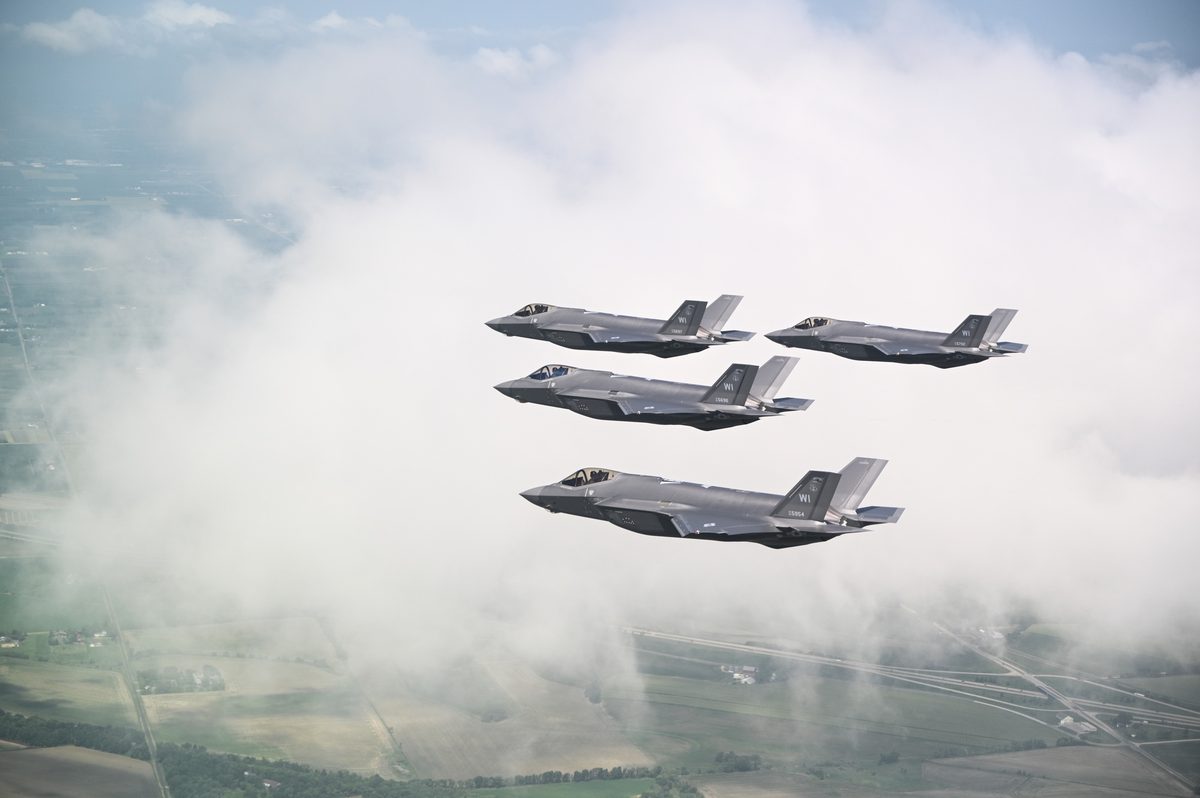
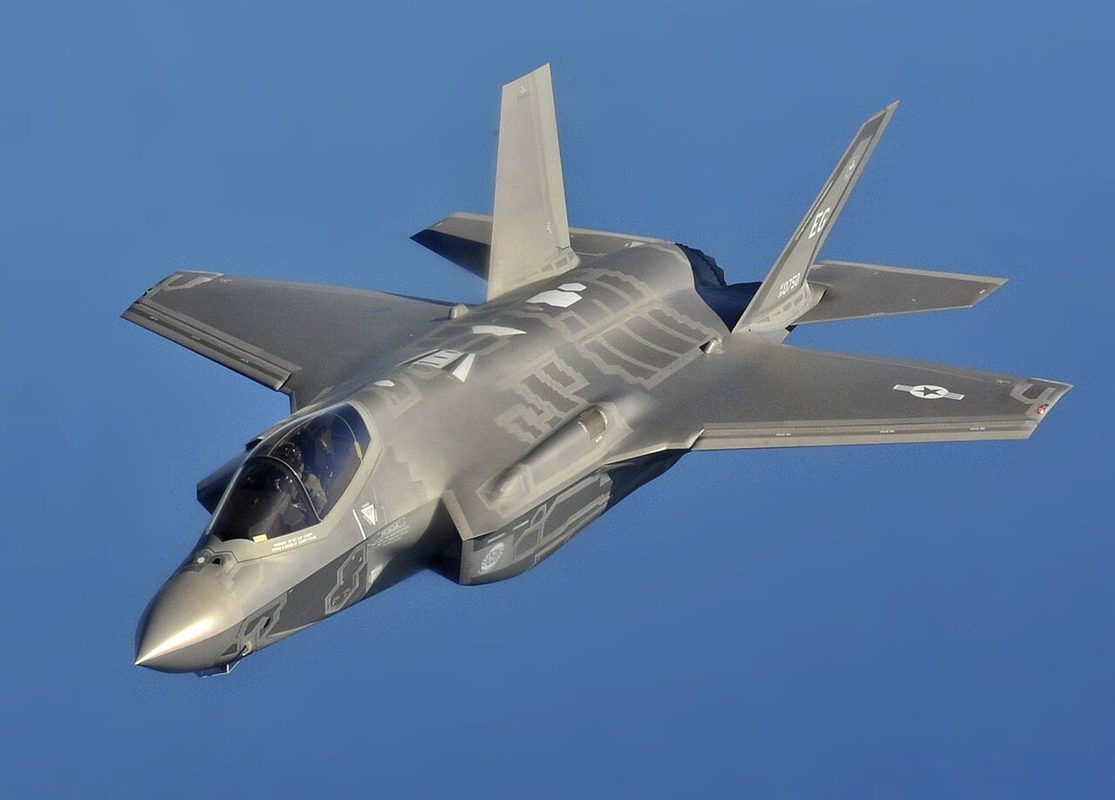
F-35A Lightning II in flight showing its clean stealth profile
The F-35A Lightning II was designed from the ground up with radar cross-section reduction as a primary driver of every shaping decision. Its compact, clean profile minimizes radar returns from all angles. (U.S. Air Force photo)

The Su-57: The Air Superiority Fighter

The Su-57 descends from Russia's tradition of powerful air-superiority fighters in the Flanker lineage. Where the F-35 subordinated speed and maneuverability to stealth, the Su-57 balances stealth with kinematic dominance. It supercruises at Mach 1.3 without afterburner, reaches Mach 2.0 with afterburner, climbs to 65,000 feet, and uses three-dimensional thrust vectoring for extreme maneuvering at any speed.

The Su-57's sensor approach is also different. Rather than a single forward-facing radar, it uses a multi-array system: a main AESA radar in the nose plus two side-facing arrays for a combined 270-degree coverage. The aircraft also carries the 101KS Atoll electro-optical suite, which includes a unique feature: an active laser countermeasure system (DIRCM) designed to blind incoming missile seekers.

Russia's philosophy is to dominate large volumes of airspace through speed, reach, and raw sensor coverage — the ability to detect threats in a wide arc, engage them at extreme range with missiles like the R-37M (400 km engagement range), and outmaneuver anything that gets close. Stealth is incorporated as a force multiplier, not as the central organizing principle.

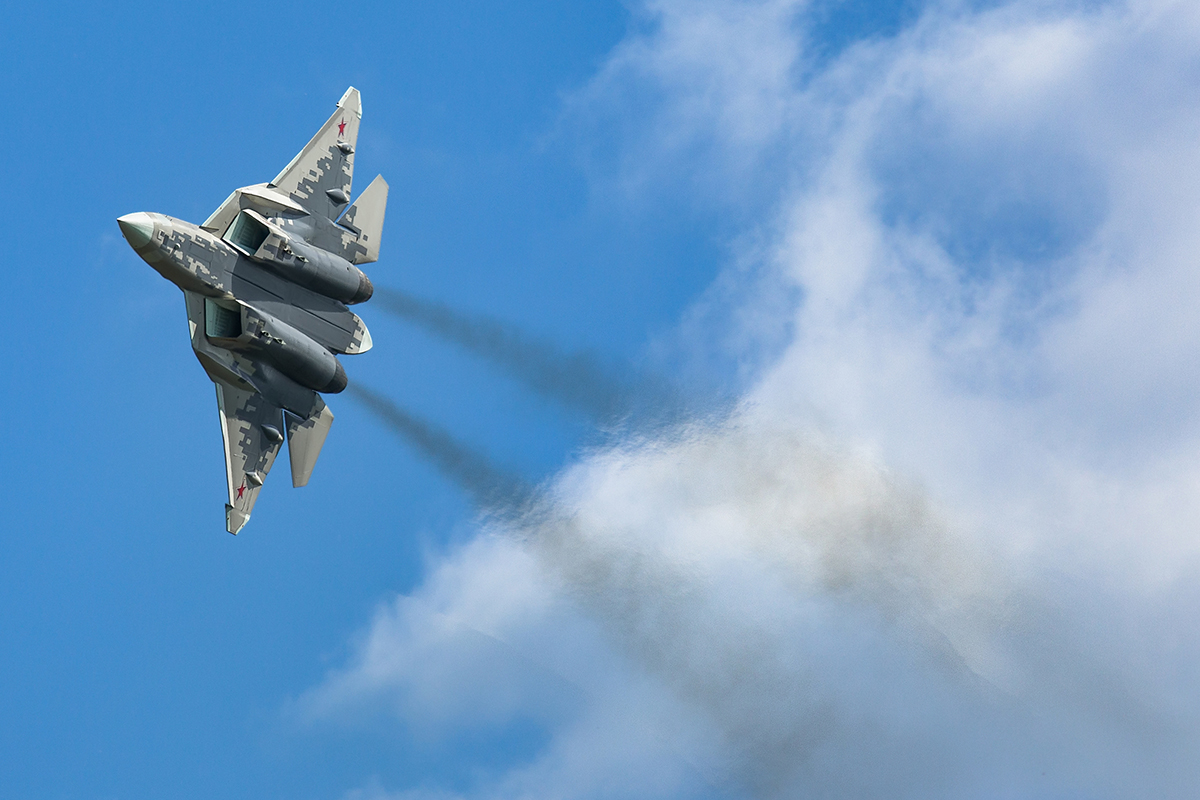
Su-57 Felon in flight showing its large airframe and twin-engine layout
The Su-57 Felon is significantly larger than the F-35, with nearly double the wing area and twin engines providing 3D thrust vectoring for extreme maneuverability. (Russian Ministry of Defense)

Stealth: The Biggest Difference

Stealth is where these two aircraft diverge most dramatically. The F-35 was designed from the ground up with radar cross-section reduction as the primary driver of every shaping decision. Every panel edge, door, inlet, and surface curvature was subordinated to minimizing radar returns. The result is an estimated frontal RCS of approximately 0.005 m² — comparable to a golf ball.

The Su-57 incorporated stealth features — radar-absorbing materials, canted vertical stabilizers, radar blockers in the intake ducts — but these are balanced against other priorities. Western analysts estimate the Su-57's RCS at approximately 0.1 to 0.5 m², with the signature being significantly larger from the sides and rear. The practical implication is that radars can detect the Su-57 at roughly 6 to 10 times the range at which they can detect the F-35.

This matters enormously. In modern air combat, detection range translates directly into engagement advantage. The aircraft that sees first generally shoots first, and the aircraft that is harder to see has more time to make decisions. The F-35's stealth advantage means it is far more likely to control when and where an engagement begins.

Sensors and Radar

Sensor F-35 Su-57
Primary Radar AN/APG-81 AESA (1,676 T/R modules) N036 Byelka AESA (1,514 front + 808 side = 2,322 total T/R modules)
Radar Coverage ~120° forward arc ~270° (front + side arrays)
IRST AAQ-40 EOTS (built into fuselage) 101KS-V infrared search and track
Spherical Awareness AAQ-37 DAS (six IR cameras, 360° coverage) 101KS-U UV missile warning sensors
Active Countermeasures ASQ-239 EW suite 101KS-O DIRCM laser (blinds missile seekers)
Sensor Fusion Fully integrated — all sensors feed one unified picture Present but assessed as less mature

The Su-57 actually carries more total radar transmit/receive modules and covers a wider angular arc — 270 degrees compared to the F-35's roughly 120-degree forward cone. On raw hardware, the Su-57's sensor suite is arguably more capable in several dimensions.

The F-35's advantage is integration. Every sensor — radar, six DAS cameras, EOTS, electronic warfare suite, datalinks — feeds into a central processor that builds one unified picture. The pilot does not need to switch between sensor feeds or mentally correlate information from different sources. The system does it automatically and presents a single tactical display. This level of fusion is what transforms the F-35 from a fighter into an airborne command node.

Speed, Range, and Performance

Metric F-35A Su-57
Length 51.4 ft (15.7 m) 65.9 ft (20.1 m)
Wingspan 35 ft (10.7 m) 46.3 ft (14.1 m)
Empty Weight 29,300 lb (13,300 kg) 40,786 lb (18,500 kg)
Max Takeoff Weight 70,000 lb (31,800 kg) 77,162 lb (35,000 kg)
Engines 1× P&W F135 (43,000 lbf) 2× Saturn AL-41F1 (28,400 lbf each / 56,800 total)
Max Speed Mach 1.6 Mach 2.0
Supercruise Limited (Mach 1.2 dash) Mach 1.3 (true supercruise without afterburner)
Combat Radius 590 nmi (1,093 km) ~675 nmi (~1,250 km)
Service Ceiling 50,000 ft (15,240 m) 65,616 ft (20,000 m)
Thrust Vectoring No Yes (3D)

The Su-57 holds clear advantages in every traditional performance metric: faster, higher ceiling, longer range, true supercruise, and three-dimensional thrust vectoring for extreme maneuvering. It is a larger aircraft with nearly double the wing area and 32 percent more total thrust.

The F-35 was never designed to win on these metrics. Its single F135 engine — the most powerful fighter engine ever built — produces enormous thrust, but the aircraft was aerodynamically optimized for subsonic cruise efficiency and low radar signature rather than sustained supersonic performance. The F-35's philosophy is that seeing the enemy first and engaging before being detected matters more than being faster or more maneuverable.

Weapons

Both aircraft carry weapons internally for stealth operations and can add external pylons for maximum loadout when stealth is not required.

Category F-35A Su-57
Internal Bays 2 bays 4 bays (2 main tandem + 2 side)
Internal Air-to-Air 4× AIM-120 AMRAAM (upgrading to 6) 4× R-77M + 2× R-74M2
Max Total Payload 22,000 lb (10,000 kg) 22,000 lb (10,000 kg)
Standout Weapon AIM-120D (180+ km range) R-37M (400 km range, Mach 6)
Weapons Diversity Largest catalog of any fighter (all NATO munitions) Growing but limited to Russian-origin weapons

The Su-57's physically larger internal bays can accommodate bigger weapons, including the R-37M — a very-long-range air-to-air missile with a 400 km engagement range and Mach 6 speed that has no direct Western equivalent. The F-35 counters with the broadest weapons integration of any fighter in history, covering air-to-air, air-to-ground, anti-ship, and electronic attack munitions from multiple NATO nations.

Production: A Chasm

This is where the comparison becomes most stark.

Metric F-35 Su-57
Total Delivered 1,300+ ~30-32
Annual Production Rate ~190/year Single digits
Operating Nations 20+ 1 (Russia only)
Export Orders Hundreds across allied nations 14 (Algeria, undelivered)
Unit Cost ~$82.5M flyaway ~$35-50M (estimated)

The F-35 program has delivered more than 40 times as many aircraft and produces at a rate roughly 20 to 30 times faster. This reflects not just industrial capacity but the multinational supply chain backing the F-35 — components are manufactured across the US, UK, Italy, Netherlands, Australia, Japan, and other partner nations.

The Su-57's production challenges are significant. Russia's defense industrial base has been strained, and the target Izdeliye 30 engine — intended to replace the interim AL-41F1 powerplant — has been repeatedly delayed. The original plan to deliver 76 aircraft by 2027-2028 appears increasingly unlikely to be met on schedule.

The Su-57's lower unit cost looks attractive on paper, but context matters. Russian labor and material costs are inherently lower, the low production volume means per-unit costs may be higher than official figures suggest, and the F-35's price includes a level of sensor fusion and software sophistication that carries substantial engineering cost. The F-35A has achieved remarkable cost reduction — dropping from over $150 million early in the program to approximately $82.5 million in recent lots.

Row of F-35 Lightning II aircraft on the production line at Lockheed Martin's Fort Worth facility
F-35 production at Lockheed Martin's Fort Worth, Texas facility. The program delivered a record 191 aircraft in 2025, with more than 1,300 total delivered to 20 nations. (Lockheed Martin)

Maneuverability: A Generational Debate

The Su-57 is the more maneuverable aircraft by every traditional measure. Its three-dimensional thrust vectoring allows extreme post-stall maneuvers — Pugachev's Cobra, the Kulbit, and other high-angle-of-attack aerobatics that look spectacular at airshows and demonstrate exceptional low-speed handling qualities.

Whether this advantage matters in modern air combat is one of the most debated questions in military aviation. The F-35 community argues that the era of dogfighting is largely over — that engagements will be decided at beyond-visual range by the aircraft with better sensors and stealth. The Russian approach counters that maneuverability remains essential for defensive maneuvering, missile evasion, and the close-range engagements that can still occur when beyond-visual-range weapons fail or are depleted.

The reality is that both arguments have merit. The F-35 will almost certainly see an Su-57 before the reverse is true, giving it the first-shot advantage. But if that first shot misses, or if the engagement moves closer, the Su-57's kinematic advantages become increasingly relevant.

The Verdict: Different Answers to Different Questions

The F-35 and Su-57 are not really competing to be the same thing. The F-35 is a networked multirole platform built for coalition warfare — designed to be the affordable, interoperable backbone of allied air power. The Su-57 is a high-performance air superiority fighter built to defend Russian airspace against technologically advanced opponents.

The F-35 excels in stealth, sensor fusion, networking, weapons diversity, production scale, and allied interoperability. The Su-57 excels in speed, range, maneuverability, ceiling, radar coverage, and long-range engagement reach. Each aircraft reflects its nation's strategic priorities and industrial capabilities.

Where the balance tips is in maturity and scale. The F-35 is a proven, mass-produced platform operating across 20 nations with continuous capability upgrades. The Su-57 remains a limited-production aircraft that has not yet achieved the engine, the production numbers, or the operational experience to fulfill its potential. As an engineering design, the Su-57 is genuinely impressive. As a force-shaping military asset, it has not yet arrived at the scale needed to matter.

Both aircraft represent their nations' best efforts at fifth-generation design. They simply define "best" very differently — and that difference tells you more about the future of air power than any spec sheet ever could.

Frequently Asked Questions

Which is faster, the F-35 or Su-57?

The Su-57 is faster, with a top speed of Mach 2.0 compared to the F-35A's Mach 1.6. The Su-57 can also supercruise at Mach 1.3 without afterburner, while the F-35 has only limited supersonic dash capability.

Which is stealthier, the F-35 or Su-57?

The F-35 is significantly stealthier. Its radar cross-section is estimated at approximately 0.005 m², while the Su-57's is estimated at 0.1 to 0.5 m². This means radars can typically detect the Su-57 at 6 to 10 times the range at which they can detect the F-35.

How many F-35s and Su-57s have been built?

As of early 2026, more than 1,300 F-35s have been delivered to 20 nations. Approximately 30-32 Su-57s have been delivered to the Russian Aerospace Forces. The production gap reflects the F-35's multinational industrial base compared to Russia's more limited manufacturing capacity.

How much do the F-35 and Su-57 cost?

The F-35A costs approximately $82.5 million per unit in recent production lots, down from over $150 million early in the program. The Su-57 is estimated at $35-50 million per unit, though the low production volume makes accurate cost comparisons difficult.

Does the Su-57 have thrust vectoring?

Yes. The Su-57 features three-dimensional thrust vectoring on both engines, allowing the exhaust nozzles to redirect thrust in any direction. This gives the Su-57 exceptional maneuverability, especially at low speeds and high angles of attack. The F-35 does not have thrust vectoring.

Which countries operate the F-35?

As of 2026, the F-35 is operated or on order by more than 20 nations including the United States, United Kingdom, Italy, Norway, Netherlands, Denmark, Belgium, Poland, Finland, Japan, Australia, Israel, South Korea, Germany, Singapore, Greece, Czech Republic, Romania, and Canada. The Su-57 is operated only by Russia, with a reported order from Algeria for 14 aircraft.

Share this article

Share:

Recommended

Ace of The Skies: Can You Identify These Military Aircraft Throughout The Years?
Test Yourself

Ace of The Skies: Can You Identify These Military Aircraft Throughout The Years?

Can you identify these aircraft?

Take the Quiz

On This Day in Military History

March 9

USS Monitor vs. CSS Virginia: The First Ironclad Battle (1862)

The USS Monitor and CSS Virginia fought the first battle between ironclad warships at Hampton Roads, Virginia. The four-hour duel ended inconclusively — neither could penetrate the other's armor — but it revolutionized naval warfare worldwide, rendering every wooden warship on earth obsolete overnight. Britain and France immediately halted construction of wooden-hulled warships.

1916Pancho Villa Raids Columbus, New Mexico

1945Tokyo Firebombing: Operation Meetinghouse Launched

1847Siege of Veracruz: First Large-Scale American Amphibious Assault

See all 10 events on March 9

Get Military News & History in Your Inbox

Join thousands of readers receiving our weekly digest of military technology, history, and analysis.

Test Your Knowledge