Skip to content
April 18:The Doolittle Raid on Tokyo84yr ago

The KF-21 Boramae: South Korea's First Indigenous Fighter Jet

Alex Carter · · 14 min read
Save
Share:
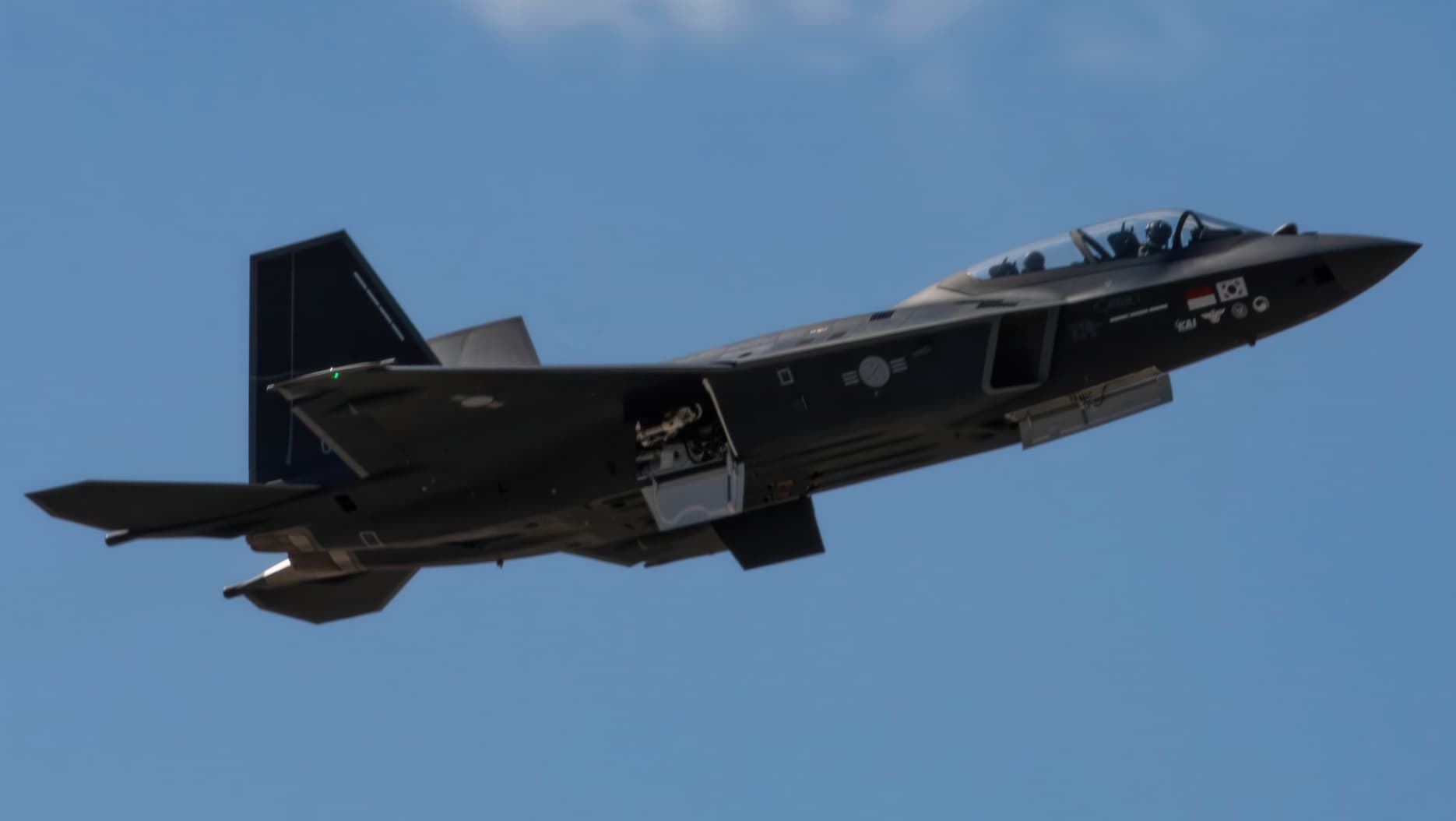
KF-21 Boramae fighter jet in flight during testing over South Korea
Alex Carter
Alex Carter

Modern Warfare & Defense Technology Contributor

Alex Carter writes about modern warfare, emerging military technology, and how doctrine adapts to new tools. His work focuses on what changes in practice -- command, control, targeting, and risk -- when systems like drones and autonomous platforms become routine.

In 2015, South Korea set out to do something that only a handful of nations have ever accomplished: design and build a modern fighter jet from the ground up. Less than a decade later, the KF-21 Boramae — Korean for "Young Hawk" — completed its flight test program, entered low-rate initial production, and began attracting serious interest from defense buyers around the world.

The KF-21 is not trying to be an F-35. It is not a fifth-generation stealth fighter with internal weapons bays and all-aspect low observability. Instead, it occupies a deliberate sweet spot: more capable than the F-16 Fighting Falcon it replaces, less expensive than the F-35, and designed from day one for the export market. That positioning may prove to be the smartest decision in the entire program.

Origins: Why South Korea Built Its Own Fighter

South Korea's fighter ambitions go back to the 1990s with the KTX-2 program, which eventually produced the T-50 Golden Eagle supersonic trainer in partnership with Lockheed Martin. That project gave Korea Aerospace Industries (KAI) the engineering experience and industrial base it needed. But the T-50 was a trainer. The real goal was always a frontline combat aircraft.

The Korea Fighter eXperimental (KF-X) program was formally launched in 2001, though it went through several restarts and redesigns before gaining serious momentum. Indonesia signed on as a 20 percent cost-sharing partner in 2010, and by 2015 the program entered full-scale development. The total development cost reached approximately $7.9 billion — a fraction of what the F-35 program consumed, but still a massive investment for a nation that had never built a fighter jet.

KAI served as the prime contractor, with significant technology transfer from the United States. The airframe, flight control system, and overall aerodynamic design are indigenous Korean developments. General Electric supplied the F414-GE-400K engines — the same engine family that powers the F/A-18E/F Super Hornet — and a range of European and American suppliers contributed subsystems. But the integration, the software, and the manufacturing are Korean.

KF-21 Boramae prototype during rollout ceremony at Korea Aerospace Industries facility
The KF-21 Boramae during its public rollout. The twin-engine, single-seat design reflects South Korea's ambition to join the exclusive club of nations capable of producing advanced combat aircraft. (Korea Aerospace Industries)

Design and Specifications

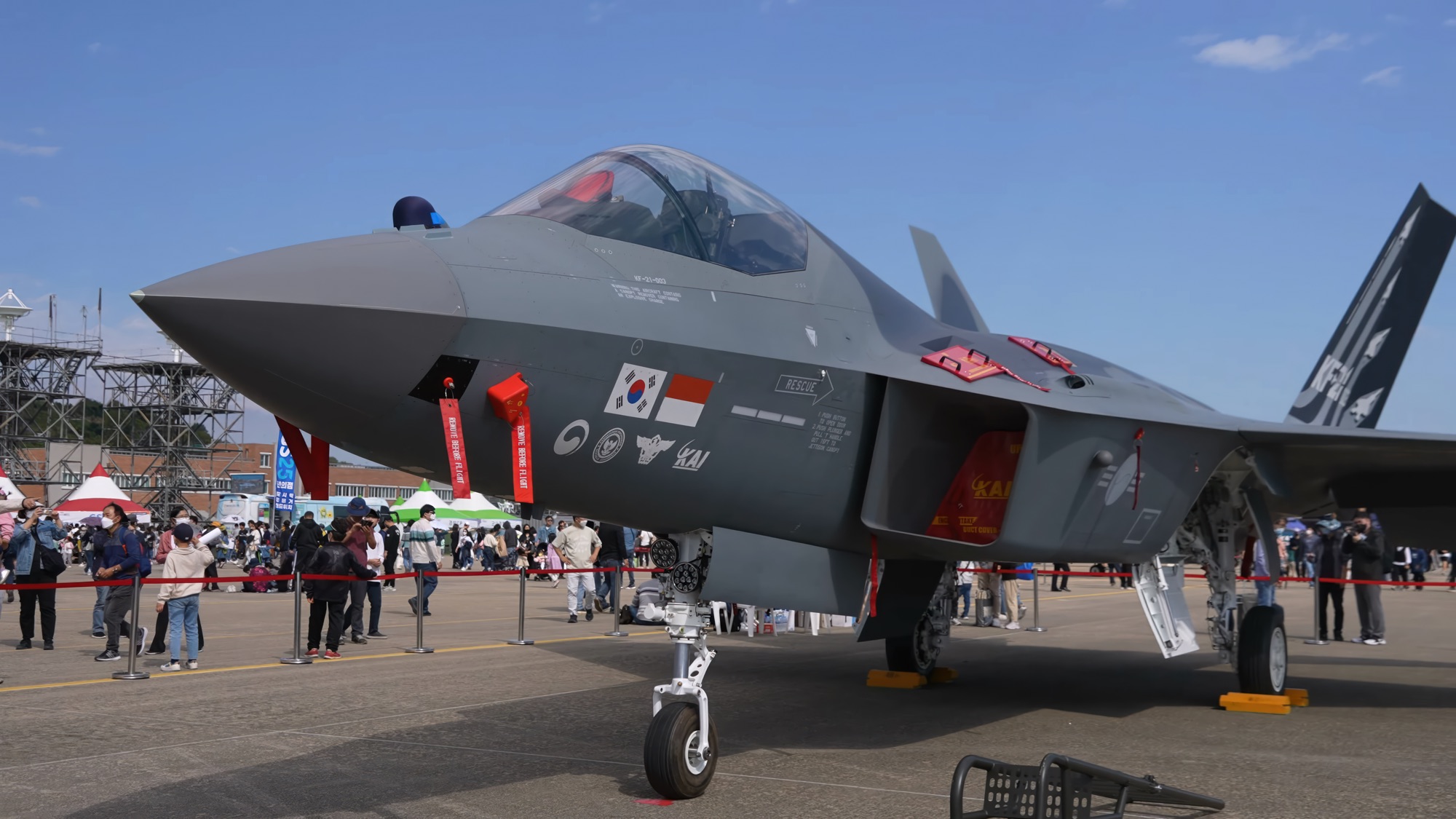
The KF-21 is a twin-engine, single-seat multirole fighter with a conventional layout that draws visual comparisons to the F-22 Raptor and F-35 Lightning II. The resemblance is not coincidental — KAI studied both programs extensively — but the Boramae charts its own path in several important ways.

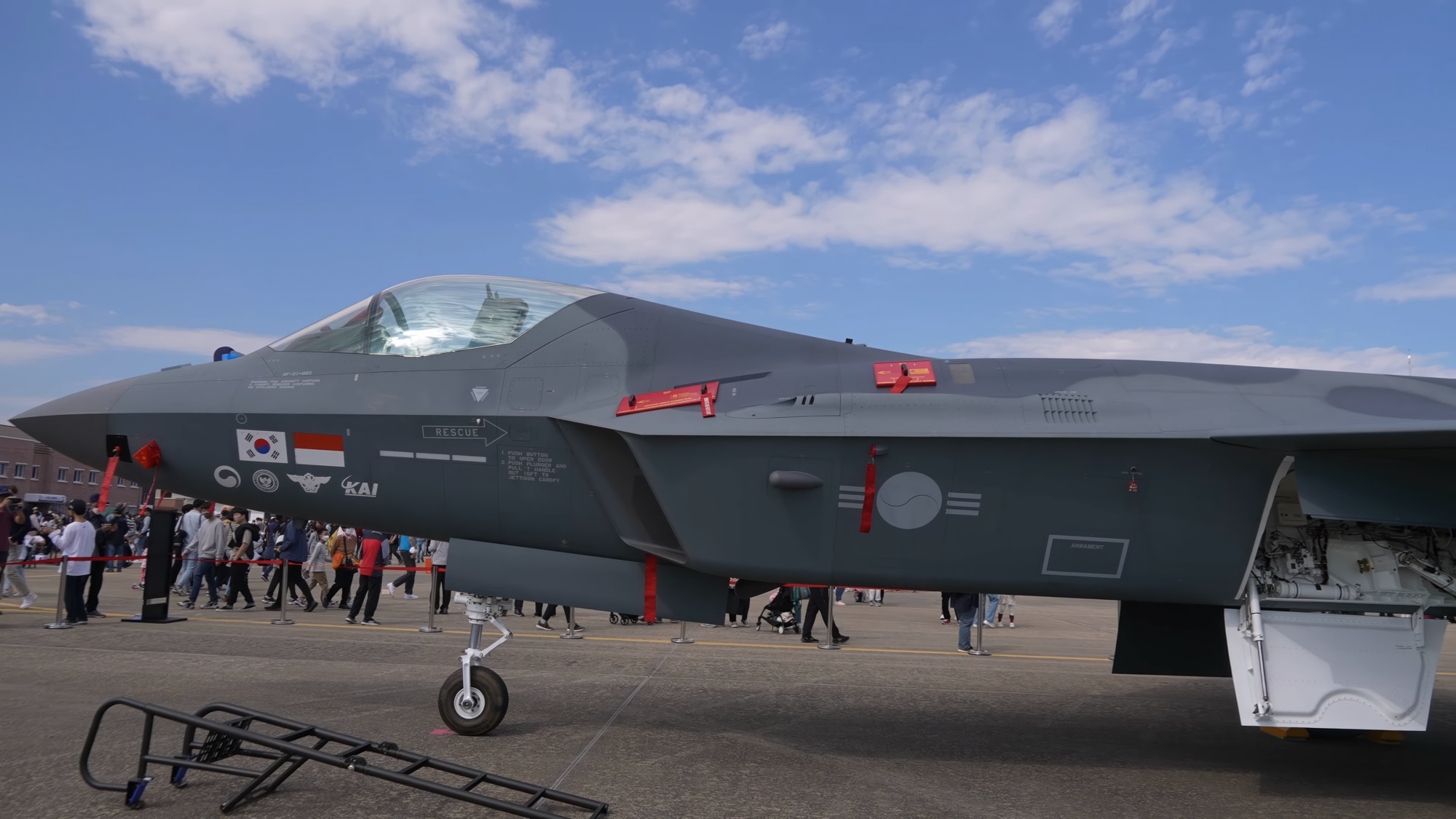
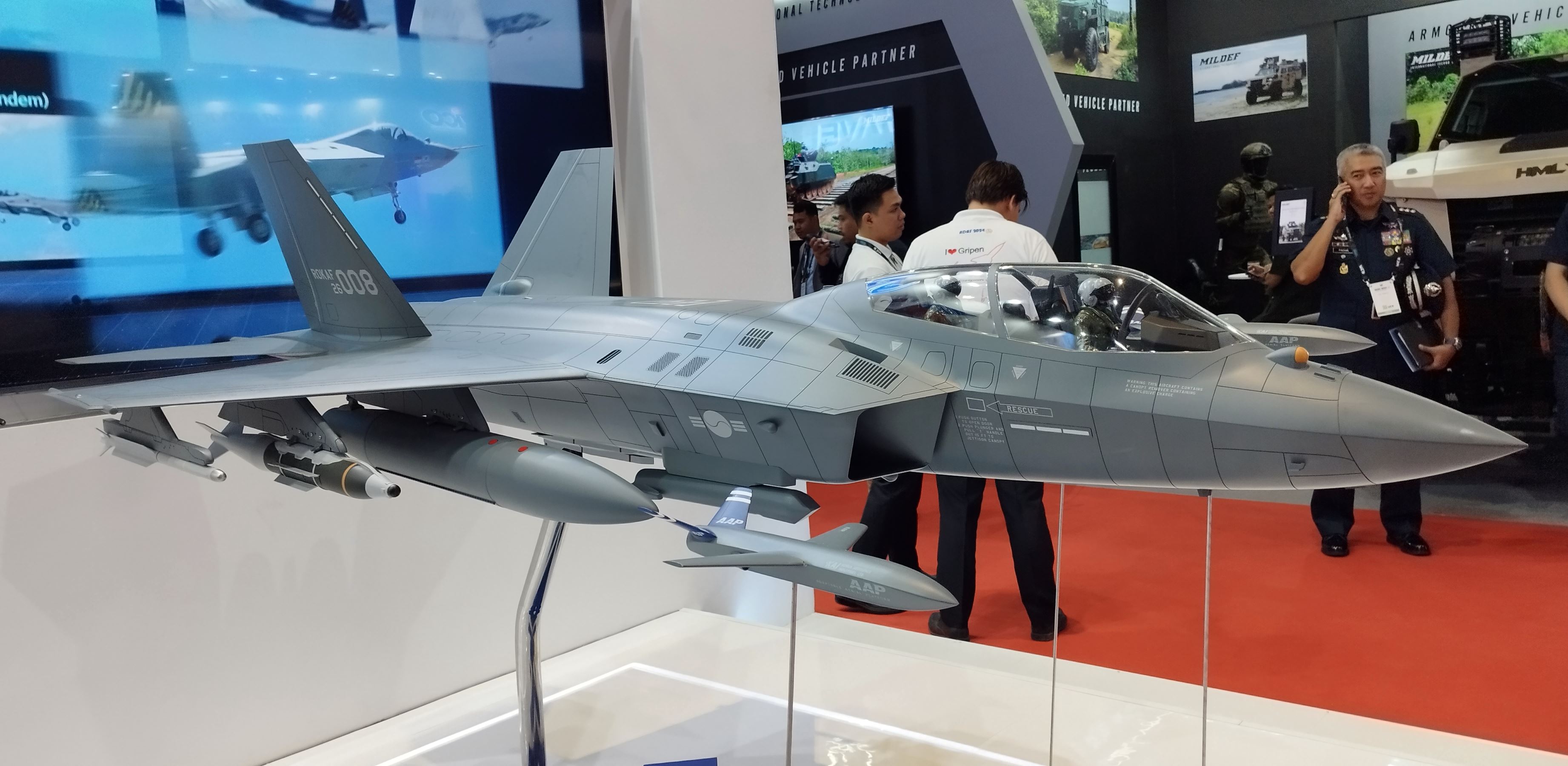
The aircraft is classified as a "4.5-generation" fighter, sometimes described as "4.5+" by Korean officials. Its most distinctive design choice is the decision to use semi-recessed conformal weapons carriage on initial production blocks rather than fully internal weapons bays. Missiles sit in shallow recesses along the fuselage belly, partially shielded from radar but not fully enclosed. This approach reduces radar cross-section compared to traditional external pylons while keeping the airframe simpler and lighter than a full internal bay design. Later blocks are expected to incorporate fully internal weapons bays, bringing the KF-21 closer to true fifth-generation capability.

Performance

Two General Electric F414-GE-400K afterburning turbofan engines produce a combined 39,600 pounds of thrust in afterburner, giving the KF-21 a maximum speed of Mach 1.81 and a top altitude of approximately 55,000 feet. The aircraft has a combat radius of roughly 800 kilometers (500 miles) on internal fuel, extendable with external tanks and air refueling. Maximum takeoff weight is approximately 25,600 kilograms (56,400 pounds).

The airframe measures 16.9 meters (55.4 feet) in length with a wingspan of 11.2 meters (36.7 feet). The overall dimensions place it between the F-16 and the F/A-18E/F Super Hornet in size — large enough to carry significant weapons loads and fuel, but not so large that it becomes expensive to operate or difficult to export.

Avionics and Sensors

The KF-21 carries a Hanwha Systems AESA (Active Electronically Scanned Array) radar as its primary sensor. South Korea developed this radar domestically, marking another first for the country's defense industry. The AESA radar provides simultaneous air-to-air and air-to-ground capability with electronic warfare functions. An infrared search-and-track (IRST) system supplements the radar for passive detection.

The cockpit features a large-area wide-angle head-up display and multiple multifunction displays. The pilot interface draws on lessons learned from the F-16 and F/A-18 programs but incorporates Korean-developed mission software. A helmet-mounted display system allows off-boresight targeting with short-range infrared missiles.

Weapons

The KF-21's weapons capability is designed around both Korean and Western munitions. The aircraft can carry AIM-120 AMRAAM medium-range air-to-air missiles, AIM-9X Sidewinder short-range missiles, and the IRIS-T European infrared missile. For air-to-ground missions, it is being integrated with JDAM GPS-guided bombs, the KEPD 350 Taurus cruise missile, and indigenous Korean precision munitions including the Korean Air-to-Surface Missile (KASM).

Block I production aircraft carry weapons on six semi-recessed fuselage stations and additional underwing pylons. The total weapons capacity exceeds 7,700 kilograms (17,000 pounds) across all stations. An internal 20mm cannon is mounted in the left wing root.

KF-21 Boramae displaying its weapons loadout including missiles and precision munitions
The KF-21 can carry a diverse array of Western and Korean-developed munitions across semi-recessed fuselage stations and underwing pylons. (Korea Aerospace Industries)

Flight Testing and Development

The KF-21 prototype made its first flight on July 19, 2022, from Sacheon Air Base in South Korea. The maiden flight lasted approximately 33 minutes and was declared a complete success. KAI ultimately built six flight test prototypes, each dedicated to different aspects of the test program: flight envelope expansion, avionics integration, weapons separation, structural loads, and systems reliability.

By mid-2024, the test fleet had accumulated over 2,000 flight hours. The program reached a significant milestone when the KF-21 successfully fired an AIM-120 AMRAAM in a live-fire test, demonstrating that the radar, fire control system, and weapons integration all functioned as designed. Supersonic flight was achieved early in the test program, and the aircraft reportedly handled well across the flight envelope with no major aerodynamic surprises.

The test program moved remarkably fast by international standards. For comparison, the Eurofighter Typhoon took nearly a decade from first flight to initial operational capability. The KF-21 is on track to achieve IOC with the Republic of Korea Air Force (ROKAF) by 2026-2027 — roughly four to five years after first flight.

Production and Procurement

The ROKAF plans to acquire 120 KF-21 Boramae fighters in two main production blocks. Block I aircraft, now entering low-rate initial production, focus on air-to-air and basic air-to-ground capability. Block II aircraft, expected from the late 2020s, will add fully internal weapons bays, enhanced stealth features, and expanded air-to-ground capabilities including standoff cruise missiles.

The unit cost is estimated at approximately $65-80 million per aircraft in full-rate production — significantly less than the F-35A's approximately $80-82 million flyaway cost, and far less than the Eurofighter Typhoon or Dassault Rafale. This price point is central to the KF-21's export strategy.

The Export Market: Where the KF-21 Gets Interesting

South Korea is not building the KF-21 just for its own air force. From the beginning, the program was designed with exports in mind. KAI and the South Korean government have been actively marketing the Boramae to nations that need a modern, capable fighter but cannot afford or obtain the F-35.

The potential customer list is substantial. Countries currently operating aging F-16s, F-5s, or Soviet-era fighters are the primary targets. Poland has expressed interest as part of its broader defense relationship with South Korea, which already includes K2 Black Panther tanks and K9 Thunder self-propelled howitzers. Iraq, Peru, Malaysia, the Philippines, and several Middle Eastern nations have also been mentioned in connection with the program.

The KF-21's export pitch is straightforward: it offers 90 percent of the F-16 Block 70's capability at a competitive price, with a growth path toward fifth-generation features. For nations that are not F-35 partner countries — or that cannot wait years in the F-35 delivery queue — the Boramae represents a compelling alternative.

Indonesia's role as a development partner has been complicated by payment disputes, but the Indonesian Air Force still plans to acquire 50 KF-21 aircraft under a revised agreement. If that deal holds, it would make Indonesia the first export customer and validate the program's international viability.

How the KF-21 Compares

The global fighter market in the 2020s is crowded, but the KF-21 occupies a unique niche. Against the F-16 Block 70/72, the KF-21 offers twin-engine reliability, a larger airframe with more growth potential, and a modern AESA radar designed from scratch rather than retrofitted. Against the Saab Gripen E, it offers more power, more weapons capacity, and a larger radar aperture, though the Gripen counters with lower operating costs and a proven combat record.

Against the F-35, the KF-21 cannot compete on stealth or sensor fusion. But it can compete on price, availability, and the absence of the political strings that often accompany American weapons sales. Some nations may prefer a South Korean fighter precisely because it comes with fewer conditions on how and where it can be used.

The closest comparison may be to the European fighters — Typhoon, Rafale, and Gripen — that have dominated the "not quite fifth-gen but very capable" market segment for two decades. The KF-21 is the first serious Asian competitor in this space, and its price advantage could be significant.

Two KF-21 Boramae prototypes flying in formation over South Korean countryside
Two KF-21 prototypes in formation flight during the test campaign. The aircraft's clean lines and twin-engine layout give it a distinctly modern appearance. (Korea Aerospace Industries)

What the KF-21 Means for South Korea

Beyond the aircraft itself, the KF-21 program represents a transformation of South Korea's defense industry. Twenty years ago, South Korea was a buyer of fighter jets. Today, it designs and builds them. The industrial base created by the KF-21 program — advanced composite manufacturing, AESA radar production, flight control software development, systems integration — positions South Korea as one of perhaps eight nations in the world capable of producing a modern combat aircraft.

That capability has value far beyond the Boramae itself. It means South Korea can maintain, upgrade, and modify its own fighter fleet without depending on foreign suppliers. It means Korean engineers and technicians gain experience that feeds into future programs. And it means South Korea has a product to sell — not just the aircraft, but the technology transfer, training, and industrial partnerships that go with it.

South Korea's defense export strategy has been remarkably successful in recent years. The K9 Thunder self-propelled howitzer is used by a dozen countries. The K2 Black Panther tank won Poland's next-generation tank competition. The FA-50 light fighter/trainer has been exported across Asia and Europe. The KF-21 is the next step in that progression — and potentially the biggest.

Looking Ahead

The KF-21 Boramae's story is still in its early chapters. Block I production is underway, with the first operational aircraft expected to reach ROKAF squadrons in 2026-2027. Block II development, with internal weapons bays and enhanced stealth, will follow in the late 2020s. A two-seat variant for electronic warfare or weapons system officer missions has been discussed but not confirmed.

The true test will come on the export market. If the KF-21 can capture even a fraction of the global demand for F-16 replacements — a market estimated at several hundred aircraft over the next two decades — it will validate South Korea's gamble on indigenous fighter development. If it succeeds, the Boramae will not just be an impressive aircraft. It will be proof that the global fighter jet market is no longer the exclusive domain of the United States, Europe, and Russia.

Frequently Asked Questions

What does "Boramae" mean?

Boramae is a Korean word meaning "Young Hawk." It refers specifically to a young hawk that is being trained for falconry, symbolizing the aircraft's potential and the growth of South Korea's aerospace capabilities.

Is the KF-21 a stealth fighter?

The KF-21 incorporates some stealth features including radar-absorbing materials, canted vertical tails, and a reduced radar cross-section design. However, Block I aircraft use semi-recessed weapons carriage rather than fully internal weapons bays, so it is not considered a full fifth-generation stealth fighter. Block II versions are expected to add internal weapons bays for improved stealth.

How much does the KF-21 cost?

The estimated unit cost is approximately $65-80 million per aircraft in full-rate production. This is competitive with the F-35A Lightning II and significantly less expensive than the Eurofighter Typhoon or Dassault Rafale.

What engine does the KF-21 use?

The KF-21 is powered by two General Electric F414-GE-400K afterburning turbofan engines. Each engine produces approximately 22,000 pounds of thrust in afterburner. This is the same engine family used by the F/A-18E/F Super Hornet, adapted for the KF-21 airframe.

Which countries are interested in buying the KF-21?

Indonesia is a development partner and plans to acquire 50 aircraft. Poland, Iraq, Peru, Malaysia, the Philippines, and several Middle Eastern nations have expressed interest. The KF-21 targets countries that need to replace aging F-16s or Soviet-era fighters but cannot obtain or afford the F-35.

How does the KF-21 compare to the F-35?

The F-35 is superior in stealth, sensor fusion, and networked warfare capability. The KF-21 counters with competitive pricing, twin-engine reliability, and availability without the political restrictions that often accompany American weapons sales. They serve different market segments: the F-35 for nations seeking cutting-edge fifth-generation capability, and the KF-21 for nations wanting a modern, affordable multirole fighter.

Share this article

Share:

Recommended

Ace of The Skies: Can You Identify These Military Aircraft Throughout The Years?
Test Yourself

Ace of The Skies: Can You Identify These Military Aircraft Throughout The Years?

Can you identify these aircraft?

Take the Quiz

On This Day in Military History

March 9

USS Monitor vs. CSS Virginia: The First Ironclad Battle (1862)

The USS Monitor and CSS Virginia fought the first battle between ironclad warships at Hampton Roads, Virginia. The four-hour duel ended inconclusively — neither could penetrate the other's armor — but it revolutionized naval warfare worldwide, rendering every wooden warship on earth obsolete overnight. Britain and France immediately halted construction of wooden-hulled warships.

1916Pancho Villa Raids Columbus, New Mexico

1945Tokyo Firebombing: Operation Meetinghouse Launched

1847Siege of Veracruz: First Large-Scale American Amphibious Assault

See all 10 events on March 9

Get Military News & History in Your Inbox

Join thousands of readers receiving our weekly digest of military technology, history, and analysis.

Test Your Knowledge