Michael Trent covers military aircraft, weapons systems, and defense technology with an emphasis on cost, maintenance, and real-world performance. He focuses less on specifications and more on how systems hold up once they are deployed, maintained, and operated at scale.
Stealth aircraft are not invisible. That is the single most important thing to understand about low-observable technology, and it is the thing most people get wrong. No aircraft in existence can fly through a radar field and leave zero trace. What stealth does is reduce the amount of radar energy that returns to the receiver, making the aircraft harder to detect, harder to track, and harder to engage with guided weapons. The physics behind this are elegant, the engineering is brutally difficult, and the results have reshaped how air wars are fought.
The core challenge of stealth is straightforward: radar works by transmitting electromagnetic energy toward a target and measuring the energy that bounces back. Reduce the returned energy below the threshold where the radar can distinguish it from background noise, and the target effectively disappears from the operator's screen. In practice, achieving this requires mastery of three disciplines: shaping, materials, and detail management, all working in concert across every square inch of the aircraft's surface.
This article breaks down exactly how each of those disciplines works, traces the history of stealth from a Soviet mathematician's obscure 1964 paper to the B-21 Raider, and addresses the real limitations that stealth technology faces against modern defenses.
Radar Cross Section: The Measure of Visibility
Before understanding how stealth works, you need to understand what it's trying to reduce. Radar cross section (RCS) is the measure of how detectable an object is to radar. It is expressed in square meters, but it does not correspond to the physical size of the object. As the MIT Lincoln Laboratory's radar fundamentals handbook explains, RCS measures the effective area that reflects radar energy back toward the transmitter, and it depends on the object's shape, material composition, and orientation relative to the radar beam.
A flat metal plate oriented perpendicular to a radar beam will have an enormous RCS, far larger than its physical area, because it acts as a near-perfect reflector bouncing energy directly back at the source. A sphere of the same physical cross-sectional area will have a much smaller RCS because it scatters energy in all directions, with only a small fraction returning to the receiver. A carefully shaped stealth aircraft takes this principle to its extreme, directing reflected energy away from the transmitter along predictable paths.
The F-22's frontal RCS is frequently compared to a marble or a steel ball bearing. According to Air Force public affairs statements, the difference between a conventional fighter and a fifth-generation stealth aircraft is not a few percentage points. It spans five orders of magnitude. That gap is what makes modern integrated air defense systems, designed to detect and engage conventional aircraft at 200+ kilometers, struggle to acquire a stealth aircraft until it is dangerously close.
RCS is also aspect-dependent. An aircraft might have an extremely low frontal RCS but a substantially larger signature from the side or rear. One of the defining features of top-tier stealth designs like the F-22 is all-aspect low observability: a small RCS from every direction, not just head-on.
Radar cross section varies enormously between conventional and stealth designs. A fourth-generation fighter might have an RCS 100,000 times larger than a fifth-generation stealth aircraft.
Shaping: The Most Important Factor
Airframe shaping is the single most effective stealth technique. Materials and coatings matter, but they are secondary to geometry. If the basic shape of the aircraft sends large amounts of radar energy back toward the transmitter, no amount of radar-absorbent coating will fix the problem. Shaping must come first.
The physics is rooted in specular reflection, the same principle that governs a flashlight beam hitting a mirror. When a radar wave strikes a flat surface at a perpendicular angle, it reflects directly back toward the transmitter with maximum intensity. Stealth shaping ensures that no surface on the aircraft is perpendicular to likely radar illumination angles. Instead, surfaces are angled to deflect energy away from the transmitter, scattering it into space where no receiver is listening.
Planform Alignment
The most distinctive shaping technique in modern stealth is planform alignment, also called edge alignment. On a conventional aircraft, the leading edges of the wings, the tail surfaces, the engine inlets, and the control surfaces all point in different directions. Each edge acts as a radar reflector, and because they are oriented at many different angles, they scatter energy in many directions, including back toward the radar.
In a stealth design, all major edges are aligned to just a few common angles. Look at the F-22 from above and you will see that the leading edges of the wings, the trailing edges, the canted tail fins, the inlet lips, and even the panel lines all share a small set of sweep angles. This concentrates reflected energy into a few narrow "spikes" rather than distributing it uniformly. As long as the radar is not positioned exactly along one of those spike directions, the return is extremely low.
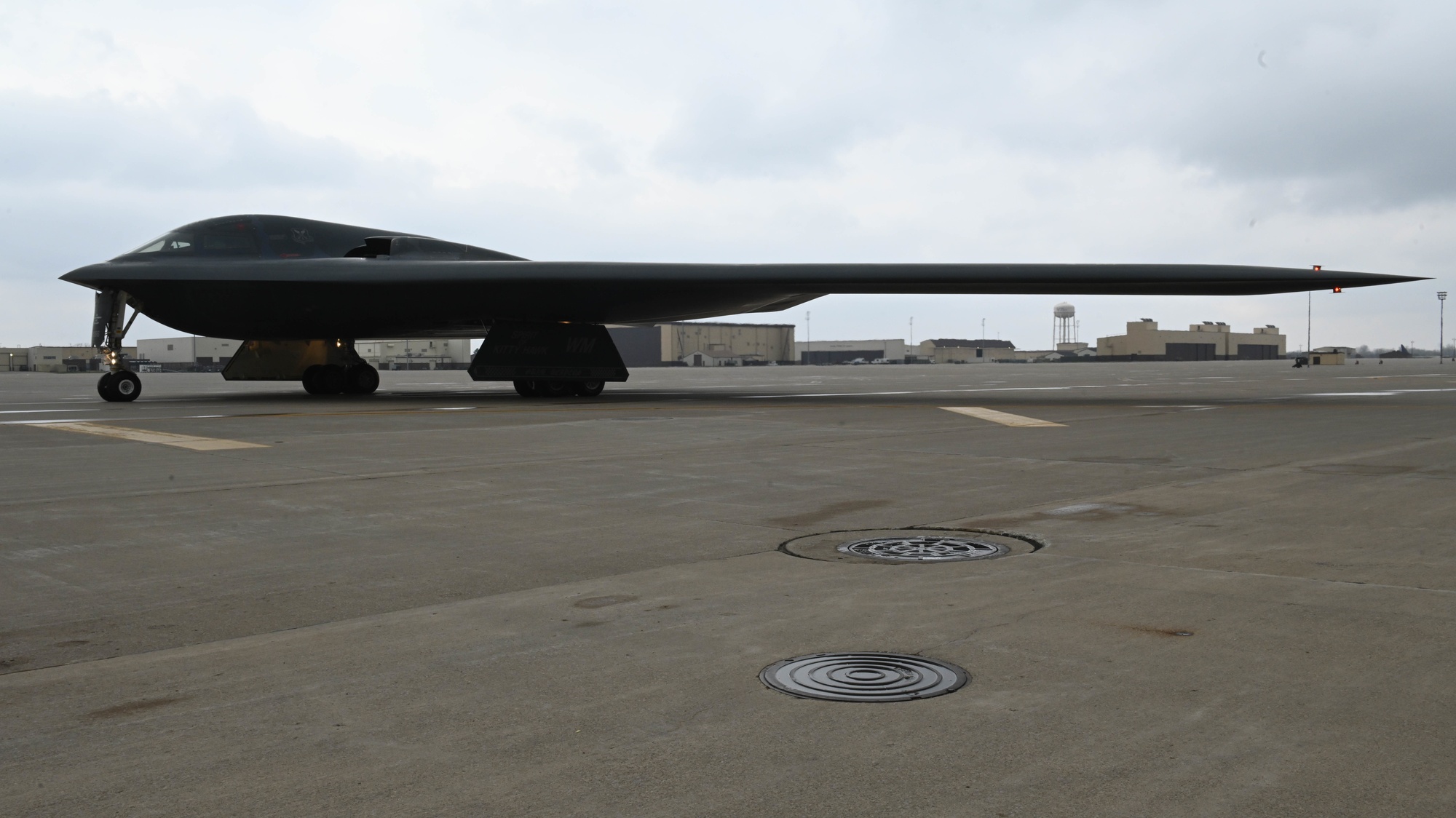
The B-2 Spirit and B-21 Raider take this further by using a flying wing configuration with no vertical tail surfaces at all. Every significant edge on the aircraft shares the same sweep angle. The result is a planform that produces only two major reflection spikes, both directed far to the sides of the aircraft's direction of flight. From the front (the most tactically relevant angle) the return approaches zero.
Eliminating Corner Reflectors
A corner reflector is formed wherever two surfaces meet at a right angle. The incoming radar wave bounces off the first surface into the second, which redirects it straight back toward the source. Corner reflectors are so effective at returning radar energy that they are deliberately used as radar calibration targets and on lifeboats to enhance their visibility to search radars.
Conventional aircraft are full of corner reflectors. The junction between a vertical tail and the fuselage, the inside angles of engine inlets, the wheel wells, the gaps between control surfaces: all of these create right-angle geometries that produce strong, consistent radar returns.
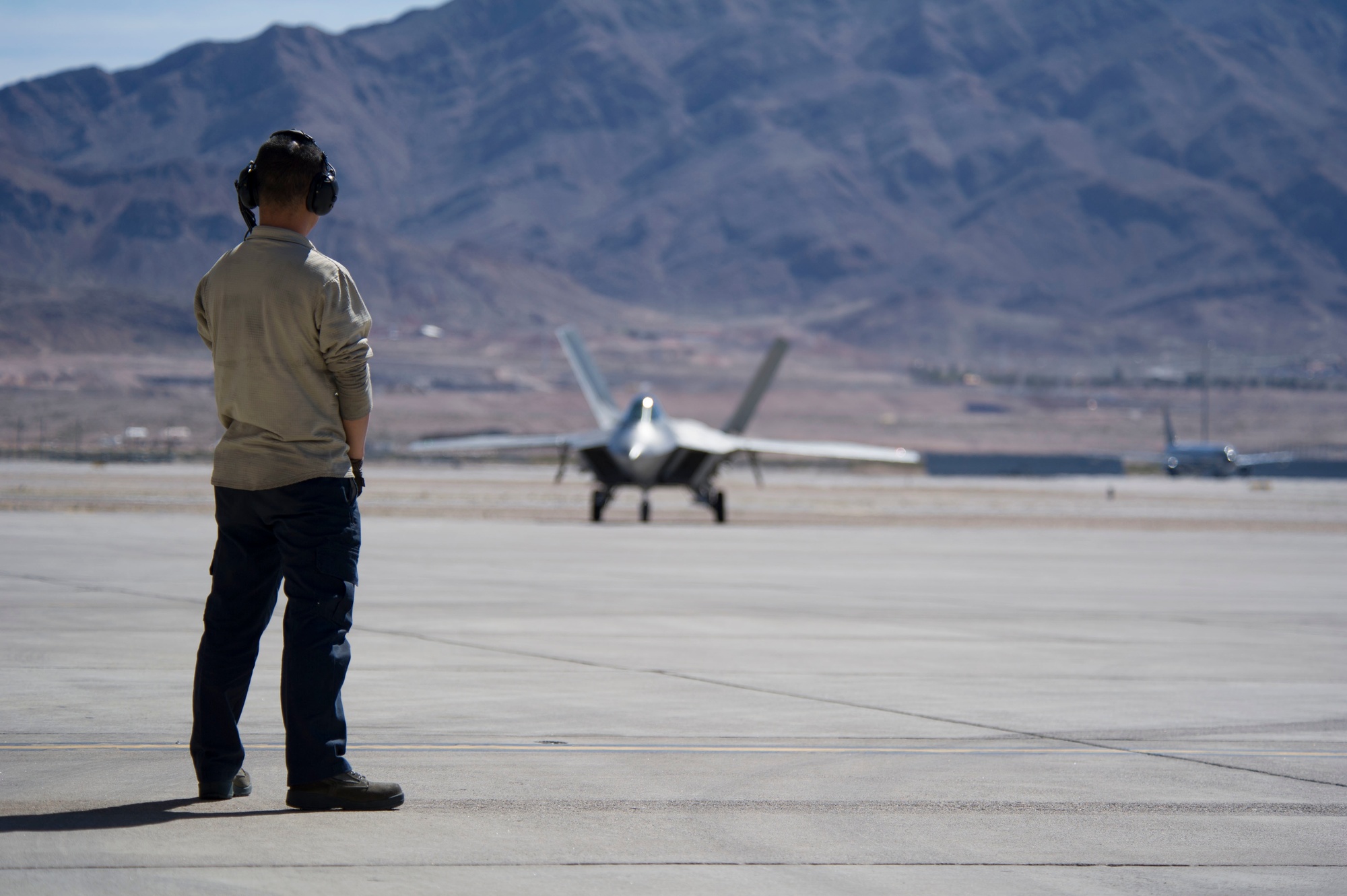
Stealth aircraft eliminate corner reflectors systematically. The F-22's twin tails are canted outward at approximately 28 degrees, destroying the right-angle junction with the fuselage. The F-117 Nighthawk's entire airframe was composed of flat faceted panels, all angled to avoid creating any perpendicular geometry relative to expected threat radars. Even the F-35's landing gear doors are serrated to break up the rectangular outline that would otherwise form a partial corner reflector when the door edge meets the fuselage.
One of the largest radar reflectors on any aircraft is the engine compressor face, the spinning fan blades at the front of the jet engine. These curved metal surfaces are essentially a radar antenna pointing forward, efficiently catching and returning electromagnetic energy. On a conventional fighter, you can look directly into the engine inlet and see the compressor face. So can a radar.
Stealth aircraft solve this with S-shaped inlet ducts. The inlet opening is offset from the engine face by a curving duct that blocks line-of-sight. Radar energy entering the inlet hits the duct walls and is absorbed or reflected through multiple bounces before reaching the compressor, losing energy at each bounce. By the time any energy makes it back out the inlet, its strength is negligible.
The F-22's inlets curve through an S-shaped path that completely hides the engine face from any external angle. According to Lockheed Martin's published design briefs, the F-35 uses a diverterless supersonic inlet (DSI) with a bump-shaped compression surface that both manages supersonic airflow and contributes to radar signature reduction. The B-2 and B-21, with their top-mounted inlets, use the entire upper fuselage as a shield against ground-based radar looking upward.
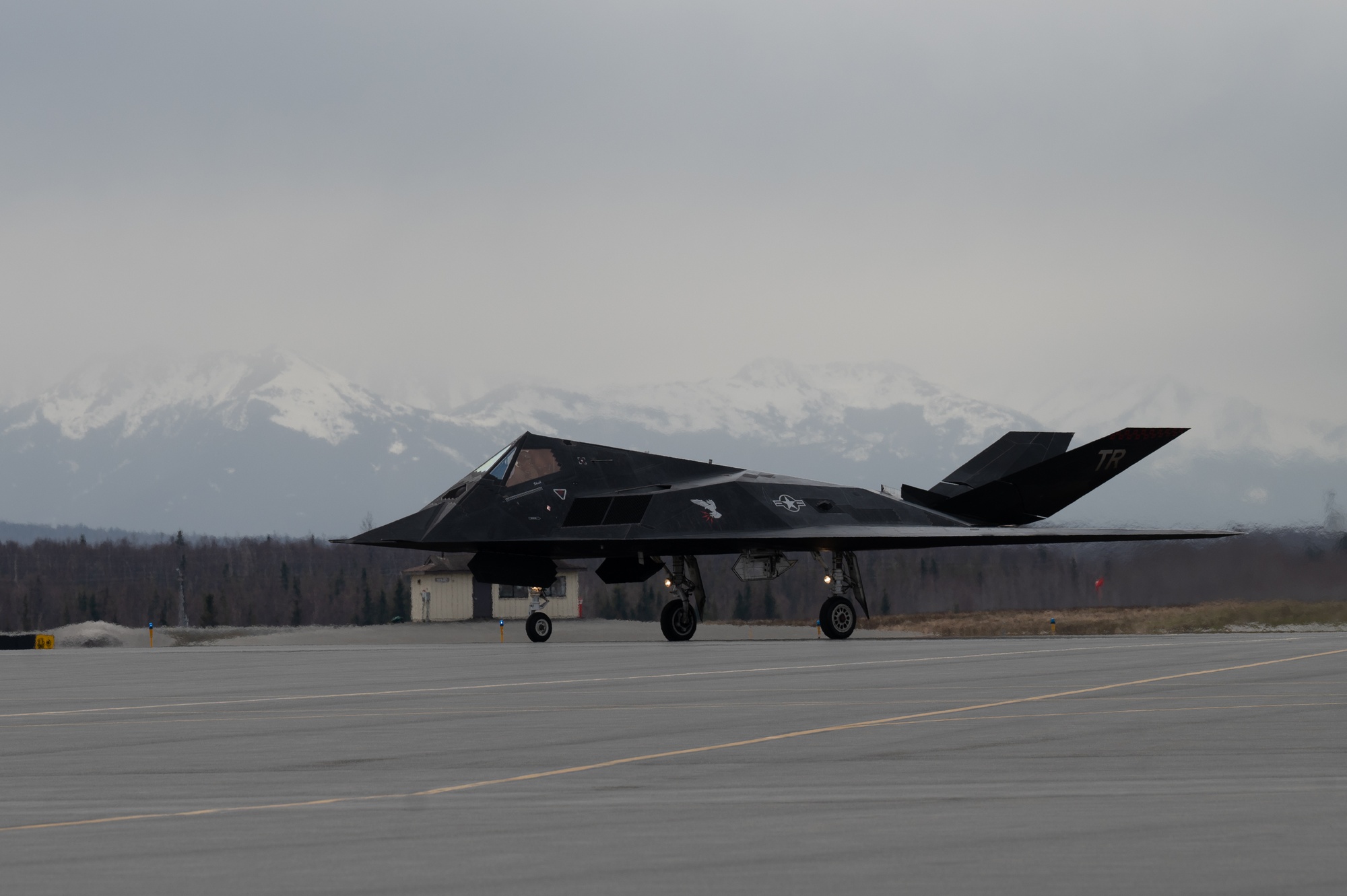
The F-117 Nighthawk's flat faceted panels were the first operational application of stealth shaping. Every surface angle was calculated to redirect radar energy away from ground-based transmitters. (U.S. Air Force photo)
Radar-Absorbent Materials: Turning Energy into Heat
After shaping has deflected as much radar energy as possible away from the receiver, the remaining signature is addressed through radar-absorbent materials (RAM) and radar-absorbent structures (RAS). These materials convert incoming electromagnetic energy into tiny amounts of heat instead of reflecting it.
How RAM Works
RAM typically consists of materials with high electrical loss properties, substances that absorb electromagnetic energy and dissipate it as thermal energy through resistive and magnetic losses. The most common types include:
Iron ball paint: Microscopic iron spheres suspended in a paint-like binder. When radar waves penetrate the coating, they induce currents in the iron particles, which resist the current flow and convert the energy to heat. This was among the earliest RAM types and is still used in various formulations.
Carbon-loaded composites: Carbon fibers or carbon particles embedded in polymer matrices. Carbon is a lossy conductor that absorbs radar energy across a broad frequency range. These composites can serve double duty as structural material and radar absorber.
Magnetic absorbers: Materials containing ferrite or other magnetic compounds that absorb energy through magnetic hysteresis. The energy is lost as magnetic domains in the material are forced to realign with the oscillating radar wave.
Impedance-matched multilayer absorbers: Multiple layers of different materials, each with carefully tuned electromagnetic properties, designed to gradually transition from the impedance of free space (air) to the impedance of the aircraft skin. This gradient matching reduces the amount of energy reflected at the outer surface and traps it within the absorbing layers.
The most effective RAM is tuned to specific frequency ranges, particularly the frequencies used by the radars most likely to threaten the aircraft. This is one of the reasons stealth aircraft programs are so heavily classified: the RAM formulations reveal which enemy radar frequencies the designers were most concerned about, which in turn reveals intelligence assessments of enemy air defense capabilities.
The Maintenance Problem
RAM coatings are the Achilles' heel of stealth maintenance. Early formulations, particularly those used on the B-2 Spirit and F-117 Nighthawk, were notoriously fragile. According to Government Accountability Office reports on B-2 sustainment, the bomber's low-observable coatings degrade when exposed to moisture, temperature extremes, UV radiation, and the physical stresses of supersonic flight. Each B-2 requires storage in a climate-controlled hangar at Whiteman Air Force Base, and maintenance crews spend extraordinary hours inspecting, repairing, and reapplying coatings after every mission cycle.
The F-117 was similarly maintenance-intensive. Ground crews used specialized tape to cover panel seams and access doors, and the aircraft required frequent recoating. The maintenance burden was so extreme that the F-117's mission-capable rate (the percentage of the fleet ready to fly at any given time) was consistently lower than conventional fighters.
Each successive generation of stealth aircraft has improved RAM durability. The F-22's coatings are more robust than the F-117's and B-2's, though they still demand significant attention. The F-35 made a further leap. Lockheed Martin specifically designed the coatings for operational-level maintenance rather than depot-level, meaning line mechanics at forward air bases can handle routine stealth repairs without specialized facilities. The B-21 Raider reportedly uses the most durable stealth coatings yet, eliminating the requirement for climate-controlled hangars entirely.
Detail Management: Where Stealth Gets Obsessive
Shaping handles the macro geometry. RAM handles residual reflections from surfaces. But stealth also demands obsessive attention to every small detail on the aircraft, because a single overlooked feature can undo millions of dollars' worth of shaping and coating work.
Canopy Coatings
The cockpit canopy is a significant radar issue. The canopy itself is transparent to radar, which means the radar energy passes through the glass and reflects off the cockpit interior: the pilot's helmet, the instrument panel, the ejection seat rails. This internal cavity acts as a corner reflector, producing a strong, consistent radar return.
Stealth aircraft solve this with a thin metallic coating on the canopy, typically a layer of indium tin oxide (ITO) or a gold-based film. This coating is thin enough to be optically transparent (the pilot can see through it) but electrically conductive enough to reflect radar energy at the canopy surface before it can enter the cockpit. The canopy effectively becomes a smooth, shaped radar reflector that conforms to the aircraft's overall shaping scheme rather than a window into a radar-bright cavity.
Ferdinand Porsche's military VW Beetle adaptation, produced in over 50,000 examples. 507 reviews at 4.6 stars. Roughly 80 parts, buildable in a single evening, at around $21.
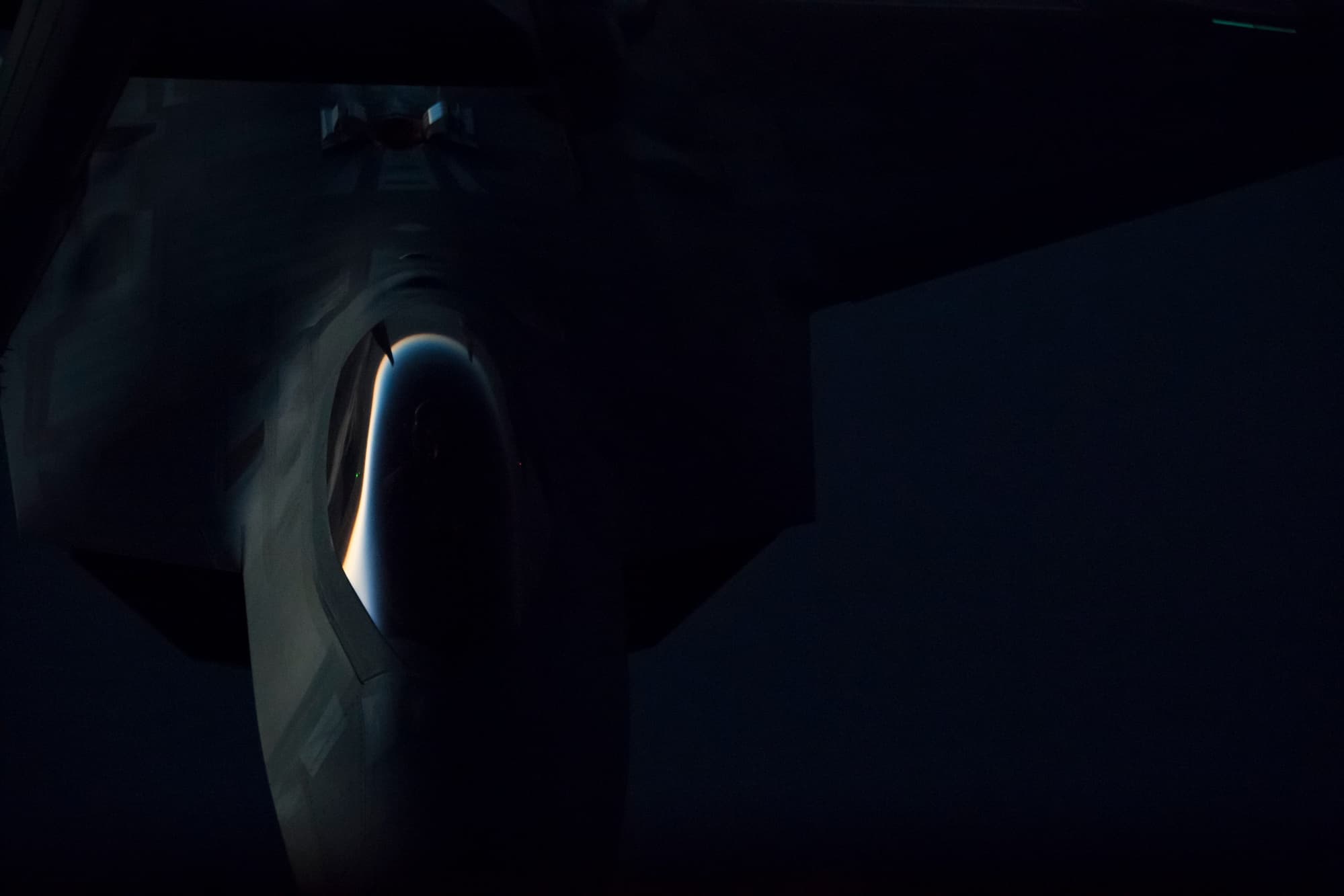
The distinctive gold tint of the F-22 Raptor's canopy comes from this metallic coating. It is one of the few stealth features visible to the naked eye.
Internal Weapons Bays
External weapons are a stealth disaster. Per Air Force weapons integration data, a single AIM-120 AMRAAM missile hanging on a wing pylon has an RCS roughly comparable to the entire rest of an F-22 airframe. Bombs, missiles, fuel tanks, and targeting pods hung on external hardpoints add enormous radar returns that obliterate whatever signature reduction the airframe provides.
Every dedicated stealth aircraft uses internal weapons bays, enclosed compartments that hold weapons behind closed doors during flight. The weapons are deployed only at the moment of launch: the bay doors open, the weapon is released or ejected, and the doors close again. The aircraft is radar-bright for only a fraction of a second.
The tradeoff is capacity. Internal bays are physically limited by the volume of the fuselage, which is why stealth fighters carry fewer weapons than their conventional counterparts. The F-22 carries six AIM-120 missiles and two AIM-9 Sidewinders internally. An F-15 can carry twelve or more missiles on external pylons. But the F-15 doing so has a radar cross section orders of magnitude larger than the clean F-22.
Panel Gaps, Fasteners, and Serrations
At stealth-relevant radar frequencies, even small discontinuities on the aircraft surface (panel edges, access doors, fastener heads, antennas) scatter energy and contribute to the overall RCS. Stealth design addresses these with several techniques:
Serrated edges: Access panels, bay doors, and exhaust nozzles on stealth aircraft feature saw-toothed (serrated) edges instead of straight lines. Serrations scatter reflected energy across a wide angular range rather than producing a single coherent return. Look closely at photographs of the F-22, F-35, or B-2, and you will see serrations on nearly every panel edge, inlet lip, and door perimeter.
Flush fasteners: Every screw, rivet, and bolt on the exterior surface is flush-mounted or covered. Even a protruding screw head a few millimeters tall can be a radar target at X-band frequencies.
Conductive gap fillers: Gaps between panels are filled with conductive caulk or tape that maintains electrical continuity across the surface, preventing the gap from acting as a slot antenna that reradiates energy.
Aligned panel edges: Like the major planform edges, panel seams are aligned to the same few angles used by the wings and tail, ensuring that any residual scattering from seams reinforces the aircraft's designed reflection pattern rather than creating new return spikes.
The B-2 Spirit's trailing edge serrations and exhaust treatment demonstrate the obsessive detail management required for broadband stealth. Every edge and gap contributes to or detracts from the overall signature. (U.S. Air Force photo)
Engine Exhaust and Infrared Signature
Stealth is not limited to radar. Infrared search and track (IRST) systems detect the heat emitted by jet engines and hot exhaust gases. Reducing infrared signature requires managing both the temperature and the visibility of the exhaust.
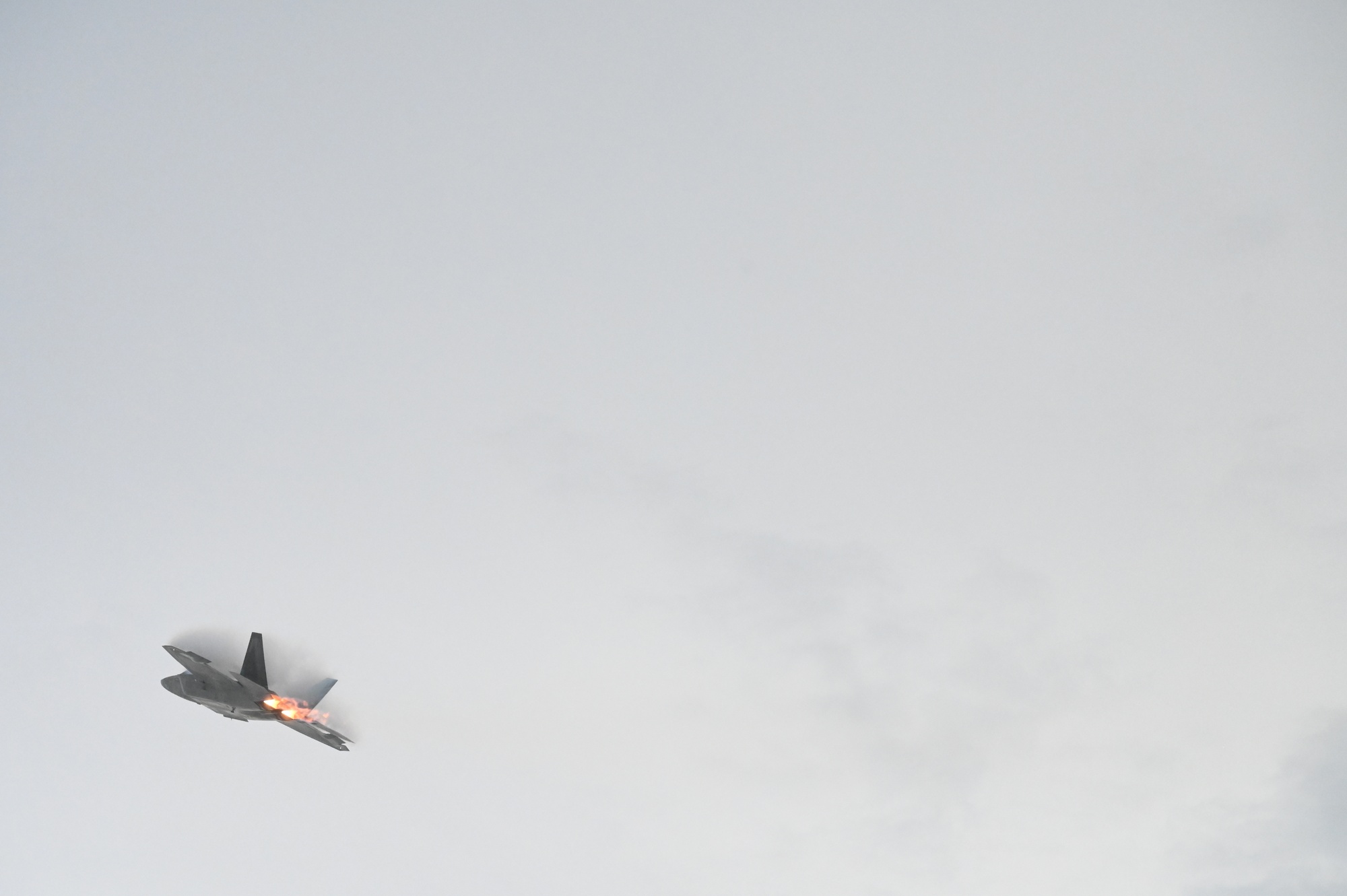
Per Northrop Grumman's program briefings, the B-2's exhaust is routed through flattened trenches on the upper surface of the flying wing, mixing hot exhaust gases with cool ambient air before they exit the aircraft. This dramatically reduces the exhaust temperature visible from below, the most relevant angle for ground-based IR sensors. The F-22 uses two-dimensional (flat) thrust-vectoring nozzles that spread the exhaust plume into a thin, wide sheet, cooling it faster and reducing the concentrated heat source that IR sensors look for.
The F-117 took a simpler approach: narrow, slit-like exhaust openings shielded by the aircraft's flat rear surfaces. This worked well enough for a subsonic attack aircraft but would not suffice for a high-performance fighter generating more thrust and heat.
The History: From Soviet Theory to American Dominance
The story of stealth technology is one of the most remarkable sequences in military history: a fundamental breakthrough published openly by a Soviet scientist, ignored by the Soviet military establishment, picked up by American engineers, and turned into a generational advantage that reshaped the balance of airpower.
Ufimtsev's Paper
In 1964, a Soviet mathematician and physicist named Pyotr Ufimtsev published a paper titled "Method of Edge Waves in the Physical Theory of Diffraction" in a Soviet technical journal. The paper extended earlier work in electromagnetic scattering theory, specifically providing equations for predicting how electromagnetic waves diffract around the edges of geometric shapes. Ufimtsev's work made it mathematically possible, for the first time, to calculate the radar cross section of complex shapes with reasonable accuracy.
The Soviet technical establishment regarded the paper as a purely theoretical exercise with no practical military value. It was declassified and made available to Western researchers without restriction. That decision would prove to be one of the most consequential intelligence oversights of the Cold War.
Lockheed Skunk Works and the Origins of Have Blue
In the early 1970s, Lockheed's legendary Skunk Works division, the Advanced Development Programs unit responsible for the U-2, SR-71, and other classified projects, became aware of Ufimtsev's translated paper. As Ben Rich detailed in his memoir Skunk Works: A Personal Memoir of My Years at Lockheed, mathematician Denys Overholser recognized that Ufimtsev's equations could be inverted: instead of predicting the RCS of a given shape, they could be used to design a shape that minimized RCS.
A 1:72 F-14A in the VF-84 Jolly Rogers high-visibility scheme. Features variable-sweep wings that actually move, removable Phoenix missiles, and a metal display stand.
Overholser wrote a computer program called "Echo 1" that could calculate the RCS of flat-faceted shapes. The key insight was that computing RCS for curved surfaces was intractable with 1970s computing power, but flat panels were mathematically simple. By approximating an aircraft's surface as a collection of flat triangular and trapezoidal panels, each angled to redirect radar energy away from the transmitter, the program could optimize a shape for minimum signature.
The result was an aircraft that looked like no airplane anyone had ever seen: an angular, faceted diamond shape that aerodynamicists initially called "the hopeless diamond" because it appeared unflyable. But the RCS calculations showed it worked. The radar return was astonishingly small.
Have Blue: Proof of Concept
The Defense Advanced Research Projects Agency (DARPA) funded two subscale prototypes under the code name "Have Blue." These small, single-seat technology demonstrators, roughly 60% the size of the eventual production aircraft, first flew in December 1977 at Groom Lake (Area 51) in the Nevada desert.
Both Have Blue prototypes crashed during the test program (one due to a landing gear malfunction, the other to an engine fire), but not before they had validated the stealth concept. Pole-mounted RCS measurements and flight tests against operational radar systems confirmed that the faceted design achieved signature levels far below anything previously thought possible. The program was considered an unqualified success.
F-117 Nighthawk: Stealth Goes Operational
The success of Have Blue led directly to the F-117 Nighthawk program. Lockheed received a full-scale development contract in 1978, and the first F-117A flew on June 18, 1981. The aircraft was operational in secret by October 1983, a development timeline that seems almost impossible by modern procurement standards.
The F-117 retained the faceted design of Have Blue, refined for a larger airframe carrying two 2,000-pound laser-guided bombs. It was subsonic, had no radar of its own (to avoid emitting detectable signals), and was designed exclusively for night precision-strike missions against high-value targets. The Air Force kept its existence classified until November 1988, by which point the 4450th Tactical Group had been flying operational missions from Tonopah Test Range Airport for five years.
The F-117's combat debut came during Operation Just Cause in Panama (December 1989) and its defining moment during Operation Desert Storm (January 1991). According to the Gulf War Air Power Survey commissioned by the Air Force, F-117s flew 1,271 combat sorties during Desert Storm, striking the most heavily defended targets in Iraq: command bunkers, communications centers, air defense nodes. They did so without a single aircraft being hit by enemy fire. The 2% of coalition aircraft that were F-117s struck approximately 40% of the strategic targets.
Stealth Timeline
Year
Event
Significance
1964
Ufimtsev publishes diffraction theory paper
Mathematical foundation for predicting and minimizing RCS
1975
Lockheed's "Echo 1" program developed
First software capable of designing shapes for minimum radar signature
1977
Have Blue first flight
First flight of a purpose-built stealth aircraft
1981
F-117 Nighthawk first flight
First operational stealth combat aircraft
1989
B-2 Spirit first flight
Flying wing stealth bomber with curved surfaces (beyond faceted design)
1991
F-117 dominates Desert Storm
Stealth proven in high-intensity combat against integrated air defenses
1997
F-22 Raptor first flight
First stealth air superiority fighter; all-aspect low observability
1999
F-117 shot down over Serbia
First (and only) stealth aircraft lost to enemy fire; exposed tactical limitations
2006
F-35 Lightning II first flight
Affordable, mass-produced stealth with improved maintainability
2011
China's J-20 first flight
First non-Western stealth fighter to fly
2023
B-21 Raider first flight
Next-generation stealth bomber with improved coatings, broadband signature reduction
The Limits of Stealth
Stealth is not a magic cloak. It has real, well-understood limitations, and adversaries have been working for decades to exploit them. Understanding these limitations is just as important as understanding the technology itself.
Low-Frequency Radar
Stealth shaping is most effective against radar systems operating in the X-band (8-12 GHz) and higher frequencies, the bands used by most fire-control radars and missile seekers. At these wavelengths, the features of a stealth aircraft (edges, inlets, panel gaps) are large relative to the wavelength, and shaping can precisely control how energy reflects.
At lower frequencies in the VHF band (30-300 MHz) and UHF band (300 MHz-1 GHz), the wavelengths are comparable to or larger than many features on the aircraft. When this happens, the electromagnetic energy diffracts around the structure rather than reflecting off surfaces in predictable ways. Shaping becomes less effective, and the aircraft's overall physical dimensions begin to dominate the RCS. A stealth aircraft that is nearly invisible at X-band may present a detectable signature at VHF.
Russia, China, and other nations have invested heavily in VHF and L-band radar systems for precisely this reason. The Congressional Research Service noted in its assessments of advanced air defense threats that Russia's Nebo-M radar complex, China's JY-27A, and similar systems operate at frequencies chosen specifically to counter stealth. These radars can detect stealth aircraft at useful ranges, potentially cueing fighters or surface-to-air missiles to the approximate area.
The catch is resolution. Low-frequency radars can detect a stealth aircraft, but their long wavelengths produce imprecise position data, more of a detection "blob" than a precise track point. This makes them effective for early warning and general cueing but insufficient for guiding a missile to terminal intercept. A fire-control radar operating at X-band or higher is still needed for the final engagement phase, and at those frequencies, stealth shaping reasserts its advantage.
The F-117 Shootdown: March 27, 1999
On the third night of NATO's Operation Allied Force against Serbia, an F-117A Nighthawk (call sign Vega 31, piloted by Lt. Col. Dale Zelko) was shot down by a Serbian SA-3 Neva (NATO designation: SA-3 Goa) surface-to-air missile. It remains the only stealth aircraft ever lost to enemy fire.
The shootdown was not a failure of stealth physics. It was a failure of tactics compounded by Serbian ingenuity. The Serbian 250th Air Defense Missile Brigade, commanded by Colonel Zoltan Dani, exploited several factors:
Predictable routing: NATO planners flew F-117s along the same ingress corridors on multiple consecutive nights. Dani positioned his battery along the expected flight path and waited.
Modified radar tactics: As Dani later described in interviews with international media, he modified his P-18 early warning radar to operate at a lower frequency (VHF band) and limited his radar emissions to short bursts, just long enough to acquire a target without allowing NATO's HARM anti-radiation missiles to lock onto his position.
Bomb bay doors open: Some accounts suggest the missile engagement occurred during or shortly after the F-117 opened its weapons bay doors, briefly increasing its radar signature.
No escort or electronic warfare support: The F-117 was flying without jamming support or fighter escort, relying entirely on stealth for survival. The shootdown exposed this doctrinal vulnerability.
Dani's battery fired two missiles. One struck the F-117, and Zelko ejected safely, later rescued by a combat search and rescue team. The wreckage was a propaganda coup for Serbia, and pieces of the aircraft are now displayed at the Museum of Aviation in Belgrade.
The lesson was not that stealth doesn't work. The other 1,270 F-117 sorties in Desert Storm and thousands in Allied Force went untouched. The lesson was that stealth is a component of survivability, not the whole answer. When combined with poor tactics, predictable routing, and no supporting electronic warfare, even a stealth aircraft can be found and killed.
Cost and Maintenance
Stealth imposes significant cost in acquisition, maintenance, and operational constraints. According to Congressional Budget Office analyses, the B-2's estimated $2.1 billion per-unit cost (including development) limited procurement to 21 aircraft, not enough to sustain a bombing campaign of any duration. The F-22's roughly $350 million all-in cost per aircraft contributed to the decision to cap production at 187 frames.
Maintenance hours per flight hour tell the operational story. The B-2 requires roughly 50-60 maintenance hours per flight hour, with a significant fraction devoted to stealth coating upkeep. The F-22 is better but still demanding. The F-35 made significant progress toward affordable stealth maintenance, and the B-21 promises to go further, but even the newest stealth aircraft require substantially more maintenance than their non-stealth counterparts.
This maintenance burden affects sortie generation, meaning how many combat missions an aircraft can fly per day. In a sustained conflict, a fleet of stealth aircraft that can each fly one sortie per day generates far less combat power than a fleet of conventional aircraft flying three. The calculus works only if the stealth aircraft's survivability in high-threat environments compensates for the reduced sortie rate. Against a peer adversary with modern air defenses, it does.
Maintaining a stealth aircraft's low-observable coatings is labor-intensive and demands specialized training. RAM repairs are among the most time-consuming tasks in stealth aircraft maintenance. (U.S. Air Force photo)
The Future of Stealth
Stealth technology is not standing still. As adversary detection capabilities improve through networked sensors, low-frequency radar, passive detection, and infrared search and track, the stealth community is developing new countermeasures and entirely new approaches.
Metamaterials
Metamaterials are artificially engineered structures with electromagnetic properties that do not occur in nature. By arranging tiny structures (smaller than the wavelength of the target radar frequency) in precise patterns, metamaterials can bend electromagnetic waves around an object, absorb them with extreme efficiency, or redirect them in ways that conventional materials cannot.
Research into metamaterial-based stealth is active but mostly classified. The Air Force Research Laboratory has published broad overviews describing concepts that include broadband absorbers effective across a much wider range of frequencies than current RAM, and surfaces that can dynamically change their electromagnetic properties in response to the threat environment. The goal is to move beyond passive, fixed-frequency absorption toward adaptive, tunable stealth coatings.
Active Cancellation
Active cancellation, sometimes called active stealth or coherent cancellation, takes a fundamentally different approach. Instead of passively absorbing or deflecting radar energy, the aircraft detects the incoming radar signal, analyzes its frequency and phase, and emits a precisely timed counter-signal that is 180 degrees out of phase. When the counter-signal combines with the reflected radar return, the two cancel each other out through destructive interference, reducing the net signal received by the radar.
In theory, active cancellation could make an aircraft of any shape radar-invisible without requiring specialized shaping or coatings. In practice, the engineering challenges are enormous. The counter-signal must exactly match the amplitude, frequency, and phase of the reflected return across all angles simultaneously, in real time, against multiple radar systems operating on different frequencies. Even a slight mismatch produces a stronger combined signal, making the aircraft more visible rather than less.
Flagship of Vice Admiral Nagumo's Kido Butai, the carrier that launched the first wave against Pearl Harbor. 84 reviews at 4.6 stars. Hasegawa's 1/700 waterline kit builds into a roughly 15-inch model.
Active cancellation components have been rumored in several programs, including the B-21 Raider, but nothing has been publicly confirmed. The technology likely works best as a supplement to passive stealth, handling residual returns that shaping and RAM cannot eliminate, rather than as a standalone replacement.
Broadband Stealth and the B-21 Approach
The B-21 Raider represents the current state of the art. While its exact capabilities remain classified, the Air Force has stated publicly that the aircraft was designed to defeat "the full spectrum of current and anticipated threat systems." This language implies broadband stealth, meaning signature reduction effective across a wide range of frequencies, including the lower bands that challenge earlier stealth designs.
Achieving broadband stealth likely requires advances in all three pillars simultaneously: shaping optimized for multiple frequency regimes, RAM effective across a wider bandwidth, and potentially active components for the most challenging threat bands. The B-21's open-system architecture also suggests that its stealth capabilities can be upgraded over the aircraft's lifetime as new threats emerge and new materials become available.
Why Stealth Still Matters
Despite predictions of stealth's obsolescence that have recurred since the F-117 shootdown in 1999, every major military power continues to invest heavily in stealth aircraft. The United States fields the F-22, F-35, and B-2, with the B-21 entering service and the F-47 sixth-generation fighter in development. China has deployed the J-20 and is testing the J-35. Russia's Su-57 incorporates stealth features. South Korea, Japan, Turkey, and several European nations are developing stealth combat aircraft.
The reason is simple: nothing else provides comparable survivability against modern integrated air defense systems. Electronic warfare can jam specific radars but cannot eliminate all sensors in a networked defense. Speed and altitude worked during the SR-71 era but are insufficient against modern missile kinematic envelopes. Numbers and saturation are effective but extraordinarily expensive in aircraft and aircrew.
Stealth does not make aircraft invulnerable. What it does is shift the engagement timeline decisively in the stealth aircraft's favor. A stealth aircraft detects the enemy before the enemy detects it. It enters weapons range before the enemy can launch. It completes its mission and departs before the enemy can organize a response. Across thousands of combat sorties since 1989, that advantage has proven not just theoretical but overwhelmingly practical.
The physics of controlling where electromagnetic energy goes remains the foundation of modern airpower. The math started with Ufimtsev. The engineering started with Skunk Works. The evolution continues with every new generation of materials, computation, and threat analysis. Stealth is not going away. It is getting harder to build, harder to beat, and more important than ever.
Frequently Asked Questions
Can stealth aircraft be detected by radar?
Yes. Stealth aircraft are not invisible to radar. They are designed to minimize the amount of radar energy returned to the receiver, making detection harder and engagement ranges shorter. Low-frequency radars (VHF/UHF band) can detect stealth aircraft at useful ranges because their long wavelengths interact with the aircraft's overall dimensions rather than its shaping details. However, these radars typically lack the precision needed to guide a missile to intercept.
What is the most important factor in making an aircraft stealthy?
Airframe shaping. The geometry of the aircraft determines how radar energy reflects, and no amount of radar-absorbent material can compensate for a shape that directs large radar returns back toward the transmitter. Planform alignment, elimination of corner reflectors, and S-ducted engine inlets are the primary shaping techniques. RAM coatings and detail management address the residual signature that shaping alone cannot eliminate.
Why was only one stealth aircraft ever shot down?
The F-117 Nighthawk shot down over Serbia in 1999 was lost due to a combination of predictable flight routing, lack of electronic warfare support, and skilled Serbian air defense tactics, not a fundamental failure of stealth technology. The same F-117 fleet flew over 1,270 sorties during Desert Storm without a single loss. Stealth dramatically reduces the probability of detection and engagement, but it is not absolute, and it must be employed with sound tactics and supporting capabilities.
How much does it cost to maintain stealth coatings?
Maintenance costs vary significantly by generation. The B-2 Spirit requires roughly 50-60 maintenance hours per flight hour, with stealth coating upkeep accounting for a substantial portion. The F-22 improved on this but remains maintenance-intensive. The F-35 made a major leap by designing coatings for field-level maintenance rather than depot-level. The B-21 Raider reportedly uses the most durable coatings yet, eliminating the requirement for climate-controlled hangars.
What is radar cross section and how is it measured?
Radar cross section (RCS) is a measure of how detectable an object is to radar, expressed in square meters. It does not correspond to the object's physical size. It represents the effective area that reflects radar energy back toward the transmitter. RCS is measured on outdoor test ranges using pole-mounted models or full-scale aircraft, with calibrated radar systems recording the reflected signal strength from multiple angles. RCS figures for operational stealth aircraft are among the most closely guarded military secrets.
Will stealth technology become obsolete?
Predictions of stealth's obsolescence have circulated since the 1990s, yet every major military power continues to invest heavily in stealth aircraft. While detection technology is advancing through networked sensors, low-frequency radar, passive detection, and infrared systems, stealth technology is also evolving through metamaterials, broadband signature reduction, and potentially active cancellation. The cat-and-mouse dynamic between stealth and detection will continue, but low observability remains the most effective survivability tool against modern integrated air defenses.