Michael Trent covers military aircraft, weapons systems, and defense technology with an emphasis on cost, maintenance, and real-world performance. He focuses less on specifications and more on how systems hold up once they are deployed, maintained, and operated at scale.
In June 2025, the U.S. Navy announced that Boeing had been selected to design and build the F/A-XX, the service's next-generation carrier-based fighter. The decision ended years of speculation about which contractor would take on one of the most consequential fighter programs in decades. The F/A-XX is intended to replace the F/A-18E/F Super Hornet fleet and give the Navy an aircraft capable of operating in the vast, contested spaces of the Indo-Pacific, where range, survivability, and networked lethality matter more than ever.
The program sits at the center of a fundamental question facing American naval aviation: can the carrier air wing remain relevant against adversaries fielding long-range anti-ship missiles, advanced integrated air defense systems, and fifth-generation fighters of their own? The F/A-XX is the Navy's answer. But to understand why this aircraft matters, you need to understand the problem it is designed to solve.
This article covers what has been publicly confirmed about the F/A-XX program, what remains speculative, and why the Navy's requirements differ so significantly from the Air Force's own next-generation fighter effort.
Why the Navy Needs a New Fighter
The Super Hornet's Service Life Problem
The F/A-18E/F Super Hornet entered fleet service in 1999 and has been the backbone of carrier air wing strike-fighter squadrons for over two decades. It is a capable, versatile aircraft that has flown combat missions in Iraq, Afghanistan, Syria, and Libya. But it is reaching the limits of what the platform can deliver.
The Super Hornet was designed for a post-Cold War threat environment where the United States enjoyed overwhelming air superiority. According to Navy fact sheets, its combat radius sits at roughly 390 nautical miles unrefueled in a typical strike configuration, which was adequate when the primary adversaries lacked the ability to threaten carriers at long range. That assumption no longer holds.
Structurally, the oldest Super Hornets in the fleet are approaching their designed service life limits. The Navy has pursued Service Life Extension Programs (SLEP) to keep them flying, but airframe fatigue is a physics problem that engineering can only delay, not eliminate. As Vice Adm. Carl Chebi, then-commander of Naval Air Systems Command, told the House Armed Services Committee in 2024, the service planned to begin retiring Super Hornets in the late 2020s, with the bulk of the fleet transitioning out through the 2030s. Without a replacement, the carrier air wing faces a fighter gap.
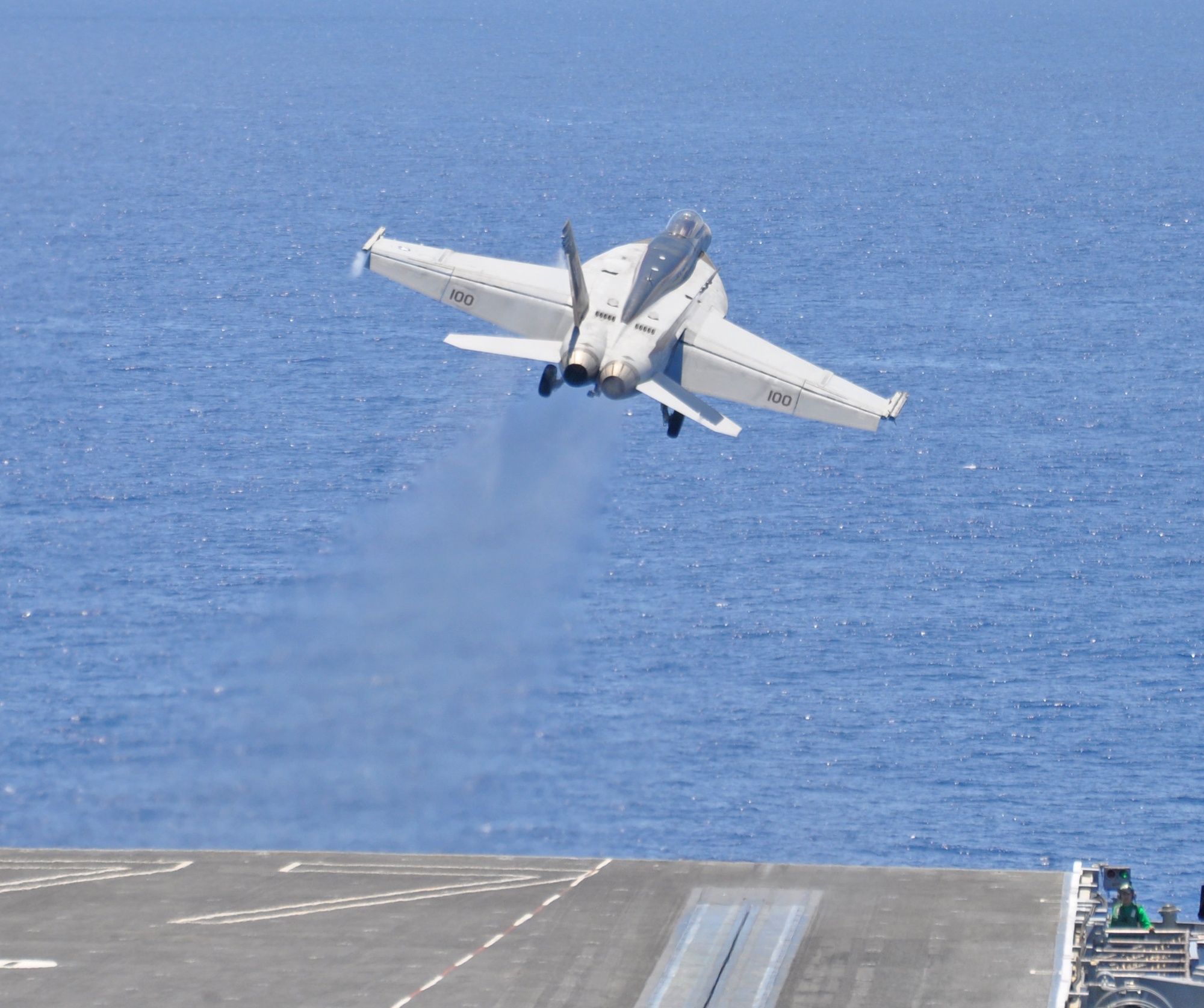
An F/A-18E Super Hornet launches from a carrier deck. The type has served as the Navy's primary strike fighter since 1999, but airframe fatigue and evolving threats demand a successor. (U.S. Navy photo)
The Pacific Range Problem
Range is the single biggest driver behind the F/A-XX, and this is where the numbers become uncomfortable for current carrier aviation.
In the European theater, key distances are measured in hundreds of miles. A carrier operating in the Norwegian Sea can cover significant portions of the Scandinavian landmass within the combat radius of its air wing. The Pacific is a different matter entirely. The distances between potential operating areas in the Western Pacific (the Philippine Sea, the South China Sea, the waters around Taiwan) are measured in thousands of miles. The Pentagon's annual China Military Power Report has repeatedly highlighted Chinese anti-ship ballistic missiles like the DF-21D and DF-26, which are designed to push carriers back from contested areas and could force them to operate 1,000 nautical miles or more from their targets.
At those standoff distances, a Super Hornet with a combat radius of 390 nautical miles simply cannot reach the fight. Even with aerial refueling from MQ-25 Stingray tanker drones, which themselves are range-limited, the current air wing struggles to project power deep into the threat envelope that a peer adversary like China can create.
The Navy has studied this range gap extensively. A Congressional Research Service report on Navy carrier air wing capabilities noted that the service views significantly extended range as the single most important requirement for the new fighter. Defense analysts at the Center for Strategic and Budgetary Assessments (CSBA) have estimated the Navy needs at least 50 to 100 percent more combat radius than the Super Hornet provides to operate effectively in a contested Western Pacific scenario.
The F/A-XX Program: What Is Confirmed
Boeing Wins the Contract
In June 2025, the Department of the Navy announced the selection of Boeing as the prime contractor for the F/A-XX program. The decision came after a competitive process that also involved Lockheed Martin, which had been widely expected to compete aggressively for the contract given its experience with the F-35 and the Air Force's own next-generation fighter.
Boeing's selection was significant for several reasons. The company has a long history of building carrier-based aircraft: the F/A-18 Hornet, the F/A-18E/F Super Hornet, and the EA-18G Growler all came off Boeing production lines. Boeing also built the T-7A Red Hawk trainer for the Air Force and the MQ-25 Stingray unmanned tanker for the Navy. The F/A-XX award gave Boeing a critical win in the tactical aircraft market after losing the Air Force's NGAD competition to Lockheed Martin.
The initial contract covers the Engineering and Manufacturing Development (EMD) phase of the program. Per the Navy's FY2026 budget justification documents, the total program cost will depend on production quantities and the final configuration, but the F/A-XX is expected to be a multi-billion-dollar acquisition effort.
Core Requirements
While the Navy has not publicly released a detailed requirements document, official statements, budget submissions, and Congressional testimony have established the program's key parameters:
Carrier-compatible: The aircraft must operate from Nimitz-class and Ford-class aircraft carriers, meeting catapult launch and arrested recovery requirements, as well as fitting within existing hangar deck and elevator dimensions
Extended range: Significantly greater combat radius than the F/A-18E/F, driven by the Pacific theater's operational distances and the anti-access/area denial (A2/AD) threat
Air superiority capability: The ability to defeat advanced threat aircraft in contested airspace, including Chinese fifth-generation fighters such as the J-20 and the carrier-based J-35
Multi-mission flexibility: Unlike a pure air superiority fighter, the F/A-XX must also conduct strike and other missions, reflecting the limited number of aircraft a carrier can embark
Advanced survivability: Low-observable (stealth) characteristics appropriate for operation against advanced integrated air defense systems
Network integration: The ability to serve as a node in a broader kill web, sharing sensor data and coordinating with other manned and unmanned platforms
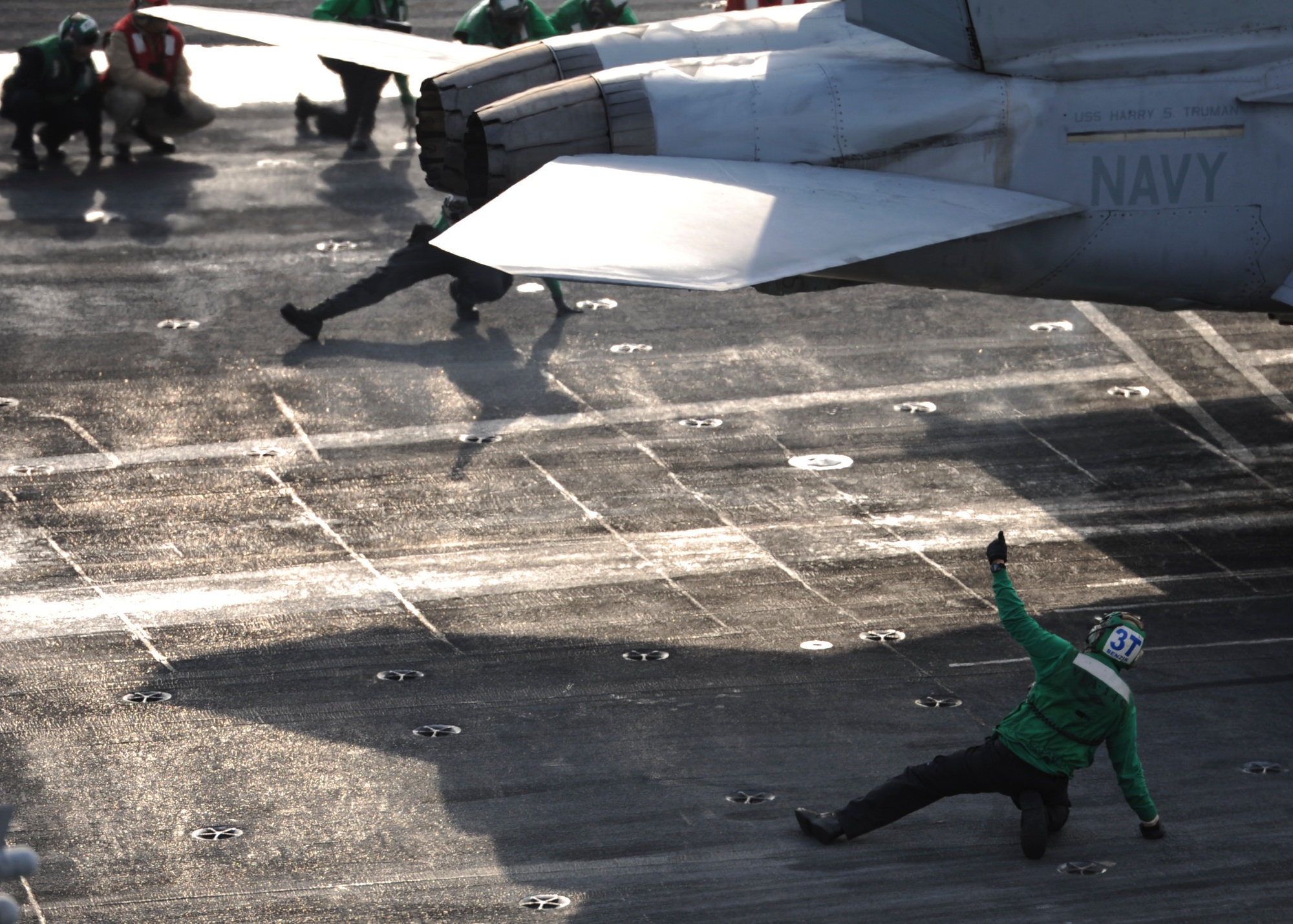
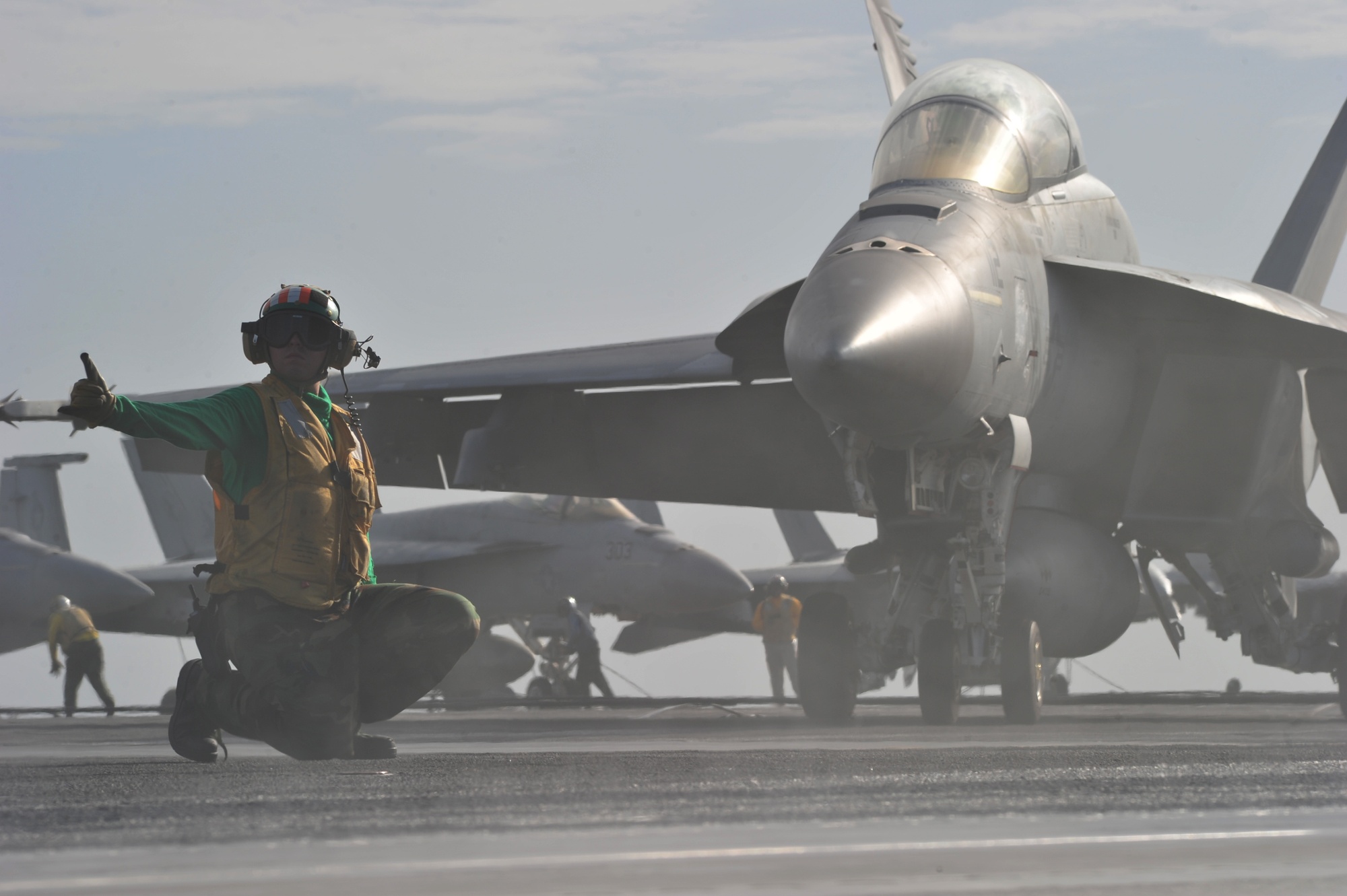
A U.S. carrier conducts flight operations in the Pacific. The vast distances of the Indo-Pacific theater demand fighters with significantly greater range than current aircraft provide. (U.S. Navy photo)
What the F/A-XX Is Not
The F/A-XX is not a direct replacement for the F-35C. The Lightning II will continue to serve in carrier air wings alongside the new fighter. The F-35C handles the low-observable strike and sensor node roles, while the F/A-XX is expected to complement it with greater range, payload capacity, and air-to-air capability. The two types will operate together, not in competition.
The F/A-XX is also not an unmanned aircraft. While the program will integrate closely with unmanned platforms, the fighter itself will be crewed. Navy leadership has stated that the complexity and lethality of the air superiority mission still requires human judgment in the cockpit for the foreseeable future.
F/A-XX vs. the Air Force's F-47: Two Different Problems
One of the most common points of confusion in defense media is the relationship between the Navy's F/A-XX and the Air Force's own next-generation fighter. Both programs were often grouped under the broad "Next Generation Air Dominance" (NGAD) label, but they are separate programs with different requirements, different contractors, and different timelines.
In December 2024, the Air Force announced the selection of Lockheed Martin to build its next-generation fighter, which received the designation F-47. The Air Force's program prioritizes air superiority in contested airspace, with an emphasis on speed, altitude, and sensor capability to defeat advanced threats over land.
The Navy's requirements diverge from the Air Force's in several fundamental ways:
Carrier operations: The F/A-XX must withstand the structural stresses of catapult launches and arrested landings, which impose significant weight and design constraints that land-based fighters avoid
Corrosion resistance: Operating in a maritime environment requires materials and coatings that resist saltwater corrosion, adding weight and maintenance considerations
Range priority: While the Air Force values range, the Navy's Pacific-driven requirement for extended combat radius is arguably the single most defining characteristic of the F/A-XX program
Size constraints: The aircraft must fit on carrier elevators, in hangar bays, and on a crowded flight deck, which places limits on wingspan and overall dimensions that land-based fighters do not face
Multi-mission emphasis: Carriers embark a limited number of aircraft, so each type must handle multiple roles. The Air Force can afford more specialized platforms because it operates from dispersed land bases with larger inventories
The two programs share some technological goals, including advanced sensor fusion, low-observable design, and integration with unmanned wingmen. But the airframes themselves will be substantially different aircraft optimized for fundamentally different operating environments.
Collaborative Combat Aircraft: The Drone Wingman Factor
A defining feature of both the F/A-XX and F-47 programs is their planned integration with Collaborative Combat Aircraft (CCA), which are autonomous or semi-autonomous drone wingmen designed to extend the reach and capability of manned fighters.
The CCA concept envisions a manned fighter controlling one or more unmanned platforms that carry sensors, weapons, or electronic warfare payloads. The drones would fly ahead of or alongside the manned aircraft, expanding the formation's sensor coverage, providing additional weapons capacity, and accepting risk that would be unacceptable for a crewed platform.
For the Navy, CCA integration with the F/A-XX addresses several operational challenges:
Magazine depth: Carrier-based fighters can only carry a limited number of weapons internally. CCA platforms could carry additional missiles, effectively multiplying the air wing's total weapons capacity
Sensor extension: Drones pushed forward of the manned fighter can detect threats at greater range without exposing the pilot to danger
Attritable mass: In a high-intensity conflict, losses are expected. Unmanned platforms that cost a fraction of a manned fighter can absorb attrition that would be devastating to a crewed fleet
Deck space efficiency: If CCAs are designed to be smaller than manned fighters, a carrier could embark more total combat platforms than it could with an all-manned air wing
The Navy has not disclosed specific CCA platforms designated for carrier operations, and the technical challenges are substantial. Carrier-based drones must handle catapult launches, arrested recoveries, and the crowded flight deck environment. The MQ-25 Stingray demonstrates that carrier-capable unmanned aircraft are feasible, but a combat CCA operating in contested airspace represents a far harder engineering problem.
The F/A-XX will operate alongside unmanned Collaborative Combat Aircraft, extending the reach and lethality of the carrier air wing. Conceptual illustration.
Key Technologies
Advanced Sensors and Networking
The F/A-XX will feature a next-generation sensor suite designed for the information-centric warfare environment the Pentagon calls Joint All-Domain Command and Control (JADC2). This means the aircraft will function not just as a weapons platform but as a sensor and communications node in a broader network.
Specific sensor capabilities remain classified, but the general direction is clear from Navy budget justification documents and program briefings: advanced active electronically scanned array (AESA) radar with increased range and resolution, infrared search and track (IRST) systems, electronic warfare suites, and the data links necessary to share information across the fleet in real time.
The networking requirement is especially important for CCA operations. The manned fighter must be able to command and coordinate multiple unmanned platforms simultaneously while also maintaining situational awareness of the broader battlespace. That demands processing power and communications bandwidth that exceed anything in current fighters.
Propulsion
The engine choice for the F/A-XX has not been publicly confirmed as of early 2026, but the program's range requirements suggest the aircraft will need powerplants that are significantly more fuel-efficient than current fighter engines. The Navy has invested in adaptive engine technology through the Adaptive Engine Transition Program (AETP), which produced the GE XA100 and Pratt & Whitney XA101 variable-cycle engines.
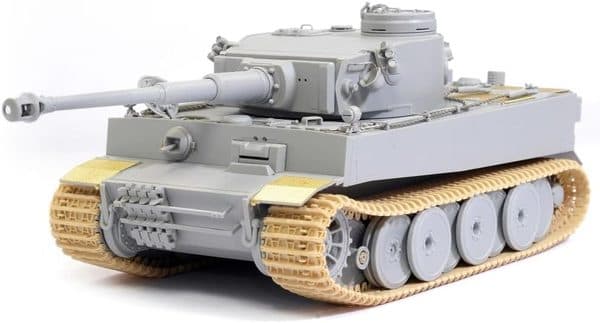
Dragon's "Smart Kit" line pushes 1/35 armor detail further than any competitor. This early-production Tiger I features weld seams, Feifel air filters, and surface detail that makes Tamiya's Tiger look like a toy. 5.0 stars, expert builders love this kit.
Adaptive cycle engines can adjust their bypass ratio during flight, operating like a low-bypass turbofan for high-thrust combat performance and switching to a higher bypass ratio for fuel-efficient cruise. According to General Electric's published program data, this technology could provide a 25 to 30 percent improvement in fuel consumption without sacrificing the thrust needed for carrier operations and combat maneuvering. That is exactly the kind of gain the Navy's range goals demand.
Whether the F/A-XX will use an AETP-derived engine or a different powerplant remains to be seen. The engine selection is one of the most consequential decisions in the program, as it fundamentally determines the aircraft's range, performance envelope, and operating costs.
Survivability and Stealth
The F/A-XX will incorporate low-observable design features, though the Navy has not disclosed the specific level of stealth performance targeted. The aircraft must be survivable against advanced Chinese and Russian air defense systems, including long-range surface-to-air missiles and airborne interceptors equipped with modern radars.
The carrier environment creates unique stealth challenges that land-based programs do not face. Saltwater corrosion degrades radar-absorbent materials. The structural reinforcements needed for arrested landings add weight and may constrain the optimal stealth shaping. Maintenance of low-observable coatings aboard ship, in a high-humidity, salt-spray environment, is more demanding than at a land base. These factors may mean the F/A-XX achieves a different stealth profile than the land-based F-47, one optimized for the maritime reality rather than theoretical perfection.
Comparison: F/A-XX Requirements vs. F/A-18E/F Super Hornet
The following table compares publicly reported F/A-XX requirements against known F/A-18E/F Super Hornet specifications. Note that F/A-XX figures are based on publicly stated requirements and informed analysis, not confirmed specifications.
Attribute
F/A-18E/F Super Hornet
F/A-XX (Projected Requirements)
Role
Multirole strike fighter
Air superiority + multirole
Combat Radius
~390 nm (typical strike config)
Significantly greater; likely 600+ nm
Stealth
Reduced RCS (not stealth-optimized)
Low-observable design from the outset
Engines
2x GE F414 turbofans
Likely adaptive cycle engines (TBD)
Weapons Carriage
External pylons (11 stations)
Internal weapons bays + external options
Sensor Suite
APG-79 AESA radar, ATFLIR pod
Next-gen AESA, integrated IRST, EW suite
CCA Integration
Not designed for drone teaming
Core requirement from the outset
Networking
Link 16, MADL (limited)
Advanced JADC2 integration
First Flight
1995
Expected early 2030s (estimated)
IOC
1999
Mid-to-late 2030s (estimated)
Note: F/A-XX specifications are projections based on publicly stated requirements, Congressional testimony, and informed analysis. Actual specifications may differ. Combat radius figures for both aircraft vary significantly depending on mission profile, weapons loadout, and flight profile.
Timeline and Cost
Development Timeline
The F/A-XX program is in its Engineering and Manufacturing Development phase following Boeing's June 2025 contract award. Based on typical fighter development timelines and the Navy's public budget projections, the program's milestones are expected to proceed roughly as follows:
EMD phase (2025-early 2030s): Detailed design, prototyping, ground testing, and preparation for first flight
First flight: Projected for the early 2030s, though schedules in major defense programs frequently shift
Flight testing and evaluation: Several years of developmental and operational testing
Initial Operational Capability (IOC): Broadly estimated in the mid-to-late 2030s
Full-rate production: Late 2030s to 2040s, with deliveries continuing as Super Hornets are retired
These timelines carry significant uncertainty. Major fighter programs in the United States have historically experienced schedule delays and cost growth. The Congressional Research Service has documented that the F-35 program took roughly 15 years from contract award to IOC for the Marine Corps variant, and longer for the Navy's F-35C. If the F/A-XX follows a similar trajectory, IOC in the late 2030s would be optimistic but not unrealistic.
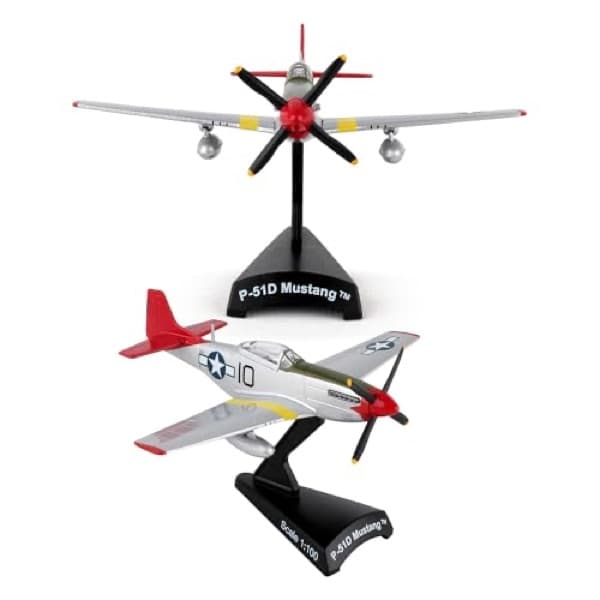
The "Red Tail" P-51D in 332nd Fighter Group markings. 1:100 scale puts it at roughly 4 inches long with the distinctive red tail section and nose spinner.
Specific per-unit cost figures for the F/A-XX have not been publicly released, but several reference points provide context. According to the Department of Defense's Selected Acquisition Reports, the F/A-18E/F Super Hornet costs roughly $67 million per aircraft in recent production lots. The F-35C runs approximately $100 million per unit. Defense analysts at Aviation Week and Bloomberg have reported that the Air Force's F-47 is expected to be significantly more expensive than the F-35, with some estimates placing it above $200 million per aircraft.
The F/A-XX will almost certainly cost more per unit than the Super Hornet it replaces. Stealth design, advanced sensors, adaptive cycle engines, and CCA integration capabilities all drive unit cost upward. The total program cost, including development, testing, and a full production run, will likely be measured in tens of billions of dollars.
Affordability is a stated Navy priority. Chief of Naval Operations Adm. Lisa Franchetti has emphasized that the F/A-XX must be producible in sufficient quantities to equip carrier air wings fleet-wide. An aircraft so expensive that only small numbers can be purchased would defeat the purpose of the program. This tension between capability and cost will define many of the design trade-offs Boeing must navigate.
The Strategic Stakes
The F/A-XX is not just another fighter program. It represents the Navy's answer to the most serious challenge American naval aviation has faced since the Cold War: maintaining the relevance of the carrier air wing against a peer adversary with the means to contest access to the Western Pacific.
As the DoD's 2024 China Military Power Report detailed, China's People's Liberation Army Navy is fielding its own carrier-based fighters, including the J-35, a twin-engine stealth aircraft designed for carrier operations. China's land-based J-20 fifth-generation fighter is already operational. Chinese integrated air defense systems are among the most advanced in the world. And the DF-21D and DF-26 anti-ship ballistic missiles create a threat envelope that pushes American carriers far from the areas they need to influence.
In this context, the F/A-XX must do three things simultaneously: reach the fight from the standoff distances that carrier survivability demands, win the air-to-air engagement against advanced threat aircraft, and deliver weapons against surface and land targets when required. It must do this while operating from a ship at sea, far from the logistics infrastructure that land-based forces enjoy.
If the F/A-XX succeeds, the carrier air wing remains a credible instrument of American power projection for decades to come. If it fails, whether through cost overruns that limit production, schedule delays that leave capability gaps, or design compromises that fall short of requirements, the long-term viability of carrier aviation in a peer conflict comes into serious question.
What Remains Unknown
For all that has been confirmed about the F/A-XX, significant details remain classified or undecided:
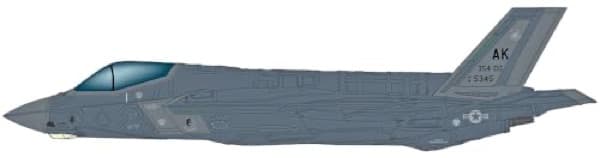
The USAF's fifth-generation stealth fighter in 1:72 scale. Features opening weapons bay doors, removable ordnance, and the low-observable RAM coating finish that Hobby Master recreates with a matte grey paint scheme.
Aircraft configuration: Boeing has not publicly revealed the F/A-XX's design. Whether it is a tailless flying wing, a more conventional tailed design, or something in between remains unknown
Engine selection: The specific powerplant has not been publicly confirmed
Weapons integration: The internal weapons bay configuration and the specific missiles the aircraft will carry are not public
Stealth performance: The specific RCS targets and low-observable approach are classified
Production quantity: How many F/A-XX aircraft the Navy will ultimately procure depends on cost, performance, and evolving threat assessments
CCA specifics: Which unmanned platforms will operate with the F/A-XX from carriers, and in what configuration, is still in development
Directed energy weapons: Some speculation exists about the integration of laser or directed-energy systems, but nothing has been confirmed for the F/A-XX
This is normal for a program at this stage of development. The EMD phase is where these details get resolved, and public disclosure typically follows well behind actual engineering decisions.
The Bottom Line
The F/A-XX represents a generational leap for carrier aviation. It is being designed to solve a specific, urgent problem: the inability of current carrier-based fighters to project power at the distances the Pacific theater demands, against an adversary with the technology to contest every mile.
Boeing's selection brings decades of carrier aviation experience to the program. The integration of CCA drone wingmen could fundamentally change how carrier air wings fight. And the advanced technologies being developed for sensors, networking, and propulsion will define naval air combat for the next 40 years.
But the program also carries the risks inherent in any major defense acquisition: cost growth, schedule delays, and the possibility that requirements outpace what engineering can deliver on time and on budget. The Navy, Boeing, and Congress will need to manage those risks carefully to ensure the F/A-XX delivers on its promise.
The threat is growing, the Super Hornet fleet is aging out, and the Navy has placed its bet on the future of carrier-based air power. The next decade will determine whether that bet pays off.
Frequently Asked Questions
What is the F/A-XX?
The F/A-XX is the U.S. Navy's next-generation carrier-based fighter aircraft program. Boeing was selected as the prime contractor in June 2025. The aircraft is designed to replace the F/A-18E/F Super Hornet and provide the Navy with a long-range, survivable, networked fighter capable of operating in the contested Indo-Pacific theater.
How is the F/A-XX different from the Air Force's F-47?
The F/A-XX and F-47 are separate programs built by different contractors (Boeing and Lockheed Martin, respectively) for different services. The F/A-XX must operate from aircraft carriers, which imposes unique structural, size, and corrosion-resistance requirements. Its design also prioritizes extended range for Pacific operations. The F-47 is a land-based aircraft with its own set of air superiority requirements. They share some technological goals but are substantially different aircraft.
When will the F/A-XX enter service?
No official Initial Operational Capability date has been announced. Based on the program's current phase and historical fighter development timelines, IOC is broadly estimated in the mid-to-late 2030s. However, major fighter programs frequently experience schedule delays, so this should be treated as an approximation rather than a firm commitment.
How much will the F/A-XX cost?
Specific per-unit costs have not been publicly disclosed. Given the advanced technologies involved, including stealth design, next-generation sensors, potential adaptive cycle engines, and CCA integration, the F/A-XX will almost certainly cost more per aircraft than the Super Hornet (approximately $67 million) and likely more than the F-35C (approximately $100 million). The total program cost is expected to reach tens of billions of dollars.
Will the F/A-XX replace the F-35C?
No. The F/A-XX is designed to replace the F/A-18E/F Super Hornet, not the F-35C. Both the F/A-XX and F-35C are expected to serve in carrier air wings simultaneously, with complementary roles. The F-35C provides low-observable strike and sensor capability, while the F/A-XX is expected to emphasize air superiority, extended range, and greater weapons capacity.
What are Collaborative Combat Aircraft, and how do they relate to the F/A-XX?
Collaborative Combat Aircraft (CCA) are autonomous or semi-autonomous drone wingmen designed to operate alongside manned fighters. The F/A-XX is being designed from the outset to control and coordinate CCA platforms, which could carry additional sensors, weapons, or electronic warfare payloads. This represents a fundamental shift in how carrier air wings will fight, extending the manned fighter's reach and lethality while distributing risk across manned and unmanned platforms.