Alex Carter writes about modern warfare, emerging military technology, and how doctrine adapts to new tools. His work focuses on what changes in practice -- command, control, targeting, and risk -- when systems like drones and autonomous platforms become routine.
The drone that is reshaping ground warfare is not a classified Pentagon project. It is a racing quadcopter, the same type hobbyists fly through parking garages at 100 kilometers per hour, modified with a warhead and sent on a one-way mission. Total cost: roughly $400 to $500. The engineering behind it is straightforward, the components are commercially available, and a competent pilot can be trained in weeks. That combination of simplicity, affordability, and lethality is what makes the first-person-view drone the most consequential small-arms development since the RPG.
Most coverage of FPV drones in Ukraine and elsewhere focuses on what they destroy. This article takes a different approach. It explains how the technology actually works: the components, the electronics, the video systems, the radio links, the pilot training pipeline, and the cost structure that makes mass production possible. Understanding the engineering is essential for understanding why these weapons are so difficult to counter and why every military on earth is now scrambling to field them.
What "First Person View" Actually Means
The term FPV (first person view) describes a method of flying a drone where the pilot wears video goggles that display a live camera feed from the aircraft. The pilot sees exactly what the drone sees, in real time, as though sitting in a cockpit. This is fundamentally different from line-of-sight flying (where the pilot watches the drone from the ground) or GPS-waypoint flying (where the drone follows a pre-programmed route).
FPV flying originated in the civilian drone-racing community in the early 2010s. Pilots discovered that strapping a small camera and video transmitter to a racing quadcopter, then viewing the feed through goggles, allowed them to fly at high speed through obstacles with a level of precision that line-of-sight control could never match. The technology spread rapidly through hobbyist communities worldwide, driven by cheap electronics from Shenzhen and open-source flight controller software.
The military application was, in hindsight, obvious. An FPV pilot can guide a small drone directly into a target with precision measured in centimeters. The pilot maintains manual control throughout the flight, adjusting for wind, obstacles, and target movement. No GPS guidance, no inertial navigation, no terminal seeker. Just a human flying a camera into a target at 120 kilometers per hour. As open-source intelligence analysts have documented across thousands of verified strike videos, that simplicity is exactly what makes the weapon so effective.
The complete component set for a typical 5-inch FPV drone. Every part is commercially available, and the entire assembly can be built in a few hours by a trained technician.
The Anatomy of an FPV Attack Drone
A military FPV drone is assembled from seven core subsystems. Each one is commercially available, mass-produced, and well-understood by the global hobbyist and racing communities. That is the key insight: there is no secret technology here. The weapon exists because the drone-racing supply chain already built every piece of it.
Frame
The airframe is typically a 5-inch or 7-inch carbon-fiber racing frame, with "5-inch" referring to the propeller diameter. These frames weigh between 100 and 300 grams and are manufactured by dozens of companies worldwide. A 5-inch frame is the most common for anti-personnel and light anti-vehicle work. Larger 7-inch and 10-inch frames carry heavier payloads, including shaped-charge warheads capable of penetrating armored vehicles. According to defense analysts at the Royal United Services Institute (RUSI), some Ukrainian units have adopted custom-designed frames optimized for payload capacity rather than racing agility, but the basic X-pattern quadcopter layout remains standard.
Flight Controller
The flight controller (FC) is a small circuit board, roughly 30 by 30 millimeters, that serves as the drone's brain. It contains a gyroscope, accelerometer, and microprocessor that read sensor data thousands of times per second and adjust motor speeds to keep the aircraft stable. Most military FPV drones run Betaflight, an open-source firmware originally developed for drone racing. Some operators use iNav, which adds GPS-waypoint capability for longer-range missions, or ArduPilot for more complex autonomous behaviors.
The flight controller accepts input from the pilot's radio transmitter, interprets the stick commands, and translates them into precise motor-speed adjustments. Modern FCs process this loop at 8 kHz or higher (eight thousand corrections per second), which is what allows an FPV drone to remain stable while carrying an asymmetric payload like a warhead strapped to one side.
Electronic Speed Controllers (ESCs)
Four ESCs (one per motor) convert the flight controller's commands into the variable electrical currents that spin each motor at the correct speed. In most modern builds, the four ESCs are integrated onto a single "4-in-1" board that stacks directly beneath the flight controller. ESC firmware, typically BLHeli_S or BLHeli_32, runs its own control loop to manage motor timing and responsiveness. The ESC stack and flight controller together weigh roughly 20 to 30 grams.
Motors and Propellers
FPV drones use brushless DC motors, the same high-efficiency motors found in everything from hard drives to electric vehicles. A typical 5-inch build uses four motors rated around 2,306 size (23mm stator diameter, 6mm stator height) with a KV rating between 1,700 and 2,400. The KV number indicates RPM per volt. Higher KV means higher top speed; lower KV means more torque for heavier payloads. Military builds often use lower-KV motors than racing builds to handle the additional weight of munitions.
Propellers are injection-molded nylon or polycarbonate, typically two or three-bladed. They cost less than a dollar each and are treated as consumable items. A tri-blade 5-inch propeller generates roughly 800 to 1,200 grams of thrust per motor, giving a four-motor drone a total thrust of 3.2 to 4.8 kilograms, well above the 1 to 2 kilogram all-up weight of most armed builds.
Camera and Video Transmitter
The FPV camera captures a live video feed that the pilot uses to fly. The video transmitter (VTX) broadcasts that feed to the pilot's goggles. These two components are, in many ways, the most critical parts of the system. They are the pilot's eyes, and if they fail, the drone is lost.
Video systems divide into two categories: analog and digital.
Analog video transmits a standard-definition signal (typically 600–700 TVL resolution) on the 5.8 GHz band. Analog systems have been the standard in FPV racing for over a decade. Their chief advantage for military use is latency: the delay between the camera capturing an image and the pilot seeing it in their goggles is roughly 10 to 20 milliseconds, virtually imperceptible. Analog systems are also cheap (camera and VTX together cost $20 to $40), lightweight, and robust. The downside is low image quality, particularly at range, where the signal degrades into static before cutting out entirely.
Digital video systems, primarily DJI O3, HDZero, and Walksnail Avatar, transmit a high-definition compressed video signal that provides vastly better image quality. DJI's system, the most widely used in military FPV drones according to reporting by defense technology outlet The War Zone, delivers 720p to 1080p video with remarkable clarity. Digital systems allow pilots to identify targets at greater distances and in more varied lighting conditions. The tradeoff is higher latency (typically 25 to 40 milliseconds for DJI, lower for HDZero) and higher cost ($80 to $200 for the airside components, plus $300 to $500 for DJI goggles). Digital systems are also heavier and draw more power.
In practice, both analog and digital systems are used on the battlefield. Per reporting from defense analysts at RUSI, many Ukrainian and Russian units have standardized on DJI digital video for its superior image quality, accepting the higher cost per airframe. Units operating on tighter budgets or in heavily jammed environments sometimes prefer analog for its simplicity and lower latency.
Radio Control Link
The radio control (RC) link is the two-way communication channel between the pilot's handheld transmitter and the drone's receiver. The pilot's stick inputs travel from the transmitter to the receiver; in some systems, telemetry data (battery voltage, signal strength) travels back. If this link is severed by distance, obstacles, or electronic jamming, the pilot loses control.
Two open-source RC protocols dominate military FPV:
ExpressLRS (ELRS) is an open-source, long-range protocol that operates on the 868 MHz or 915 MHz bands (lower frequencies penetrate obstacles and terrain better than 2.4 GHz). ELRS offers excellent range, reaching 10 kilometers or more with a standard setup and 30+ kilometers with directional antennas, at very low latency. It is free, open-source, and supported by inexpensive hardware. Ukrainian drone warfare units have confirmed that ELRS has become the dominant control link protocol for military FPV, largely because its open-source nature allows operators to modify firmware for anti-jamming measures.
TBS Crossfire, made by Team BlackSheep, is a commercial long-range system operating at 868/915 MHz. Crossfire predates ELRS and was the original long-range FPV control link. It remains in use but has been largely supplanted by ELRS in military applications due to ELRS's lower cost and open-source flexibility.
Some military units also use custom or proprietary control links operating on non-standard frequencies to avoid predictable jamming. The ongoing electronic warfare battle between drone operators and jammers has driven continuous evolution in control link technology.
FPV drones use lithium-polymer (Li-Po) batteries, the same high-energy-density cells found in smartphones and electric vehicles. A typical military FPV build uses a 4S or 6S Li-Po (14.8V or 22.2V nominal) with a capacity between 1,100 and 1,800 milliamp-hours. These batteries weigh 150 to 300 grams and provide 4 to 10 minutes of flight time depending on throttle management, payload weight, and wind conditions.
Flight time is the binding constraint on range. A 5-inch FPV drone cruising at 80 km/h on a 6-minute battery has a maximum one-way range of about 8 kilometers, though in practice operators typically launch within 3 to 7 kilometers of targets to allow margin for maneuvering and target acquisition. Larger builds with higher-capacity batteries extend this range, but at the cost of reduced agility.
The ground station equipment (radio transmitter, FPV goggles, charging equipment, and antennas) is reusable across hundreds of flights and costs between $500 and $1,500 for a complete setup. This means the per-mission cost is dominated by the expendable drone and its warhead. At scale production, Ukrainian manufacturers have driven the per-unit drone cost (excluding warhead) below $300, according to Ukrainian government disclosures.
The Warhead: Where Racing Drone Meets Weapon
The component that transforms a racing drone into a weapon is the munition it carries. The most common warheads used on FPV drones fall into three categories.
Shaped charges, typically derived from RPG-7 warheads or purpose-built equivalents, are used against armored vehicles. A shaped charge uses a cone of copper or other ductile metal, backed by explosive, to produce a superplastic jet of metal upon detonation. This jet can penetrate 200 to 300 millimeters of rolled homogeneous armor, far more than enough to defeat the roof, side, or rear armor of most armored vehicles. Footage verified by conflict monitors shows that the RPG-7 PG-7V warhead, widely available in former Soviet stockpiles, has become a standard FPV payload for anti-armor work.
Fragmentation munitions, including hand grenades, mortar rounds, and purpose-built fragmentation sleeves, are used against personnel and soft-skinned vehicles. These payloads are lighter than shaped charges and allow the use of smaller, faster drones.
Thermobaric and incendiary payloads are used for specific tactical applications, particularly against enclosed positions like trenches, bunkers, and buildings.
Warhead integration ranges from crude (zip ties and electrical tape securing a grenade to the airframe) to sophisticated (3D-printed or injection-molded payload cradles with integrated fuzing). The fuzing mechanism, meaning the system that detonates the warhead on impact, is typically a simple impact switch or piezoelectric fuze wired to a detonator. Some more advanced builds use electronic fuzing with arming sequences to prevent accidental detonation during handling and launch.
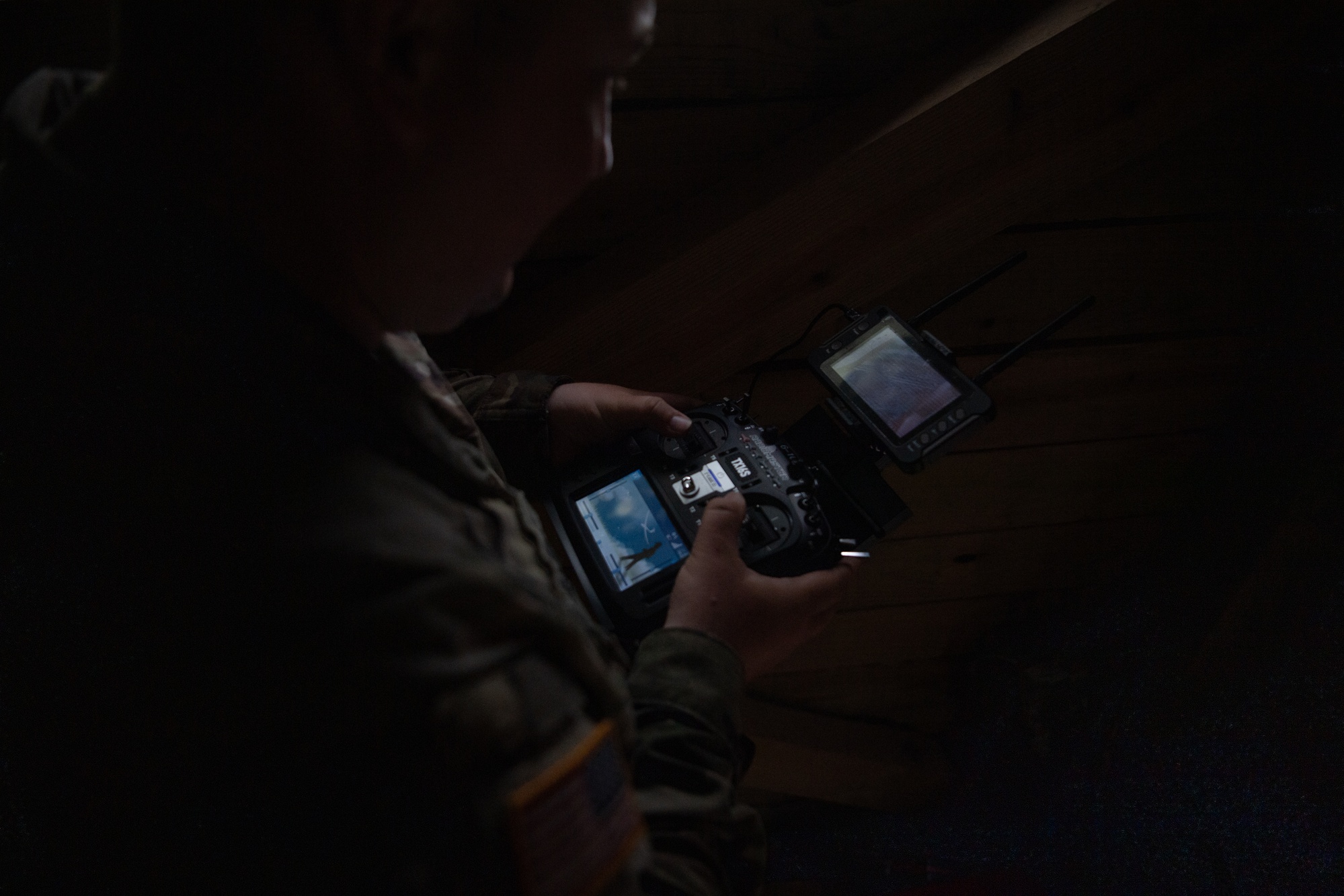
An FPV pilot in the field with goggles and transmitter. The pilot maintains manual control of the drone through its entire flight, guiding it visually into the target.
How Pilots Are Trained
An FPV attack drone requires a skilled human pilot for every mission. Unlike a guided missile that locks onto a target and navigates autonomously, the FPV drone is hand-flown from launch to impact. Pilot skill is the single largest variable in whether a given mission succeeds or fails. Training programs have accordingly become a strategic priority for any military fielding these weapons.
Simulator Training
Nearly all FPV pilot training begins in a software simulator. Programs like Liftoff, Velocidrone, and Uncrashed provide physics-accurate flight models that replicate the feel of flying an FPV drone, including the distinctive "acro mode" control scheme where the drone does not self-level and the pilot must actively manage attitude at all times. Trainees connect a real radio transmitter to a computer and practice in virtual environments for hours each day.
Simulator training is remarkably effective. Because FPV flying is fundamentally a motor-skill task, analogous to learning a musical instrument or a video game, the neural pathways developed in simulation transfer directly to real flight. Instructors in Ukrainian training programs report that students who put in 40 to 60 hours on a simulator can fly a real drone competently on their first attempt. The simulator removes the cost of crashing real drones during the learning phase, which is critical when each airframe costs several hundred dollars.
Live Flying Practice
After simulator proficiency, trainees transition to live flying with unarmed drones. The initial exercises focus on basic control: taking off, hovering, flying circuits, and landing. Trainees then progress to flying through obstacles, flying at speed in open terrain, and practicing the specific maneuvers used in attack missions. These include rapid low-altitude approaches, last-second dive corrections, and precise terminal guidance onto stationary and moving targets.
Practice targets are typically marked vehicles, mannequins, or designated structures. Trainees fly repeated attack runs, and their video feeds are reviewed by instructors to evaluate approach angles, target tracking stability, and impact precision. The Ukrainian military's drone warfare instructors have reported that the standard is consistent impacts within a 30-centimeter radius on a stationary target at full speed.
Training Timeline
Ukrainian training programs have demonstrated that a motivated trainee with no prior drone experience can become a field-capable FPV attack pilot in four to eight weeks: two to three weeks of intensive simulator practice followed by two to five weeks of live flying. Trainees with prior gaming or drone-racing experience often progress faster. By comparison, training a competent anti-tank guided missile operator typically takes months, and training a fighter pilot takes years.
This compressed training timeline is one of the most strategically significant aspects of FPV warfare. It means a military can scale its precision-strike capacity by training thousands of operators in parallel, using inexpensive simulators and consumer-grade hardware, rather than investing years in training pipelines for conventional weapons systems.
Range, Speed, and Performance Envelope
The performance characteristics of a military FPV drone are determined by its physical configuration, battery capacity, and radio systems. Typical specifications for a 5-inch armed build include:
Top speed: 100 to 160 km/h (depending on payload weight and motor configuration)
Cruise speed: 60 to 100 km/h (for maximum range)
Flight time: 4 to 10 minutes (payload-dependent)
Practical one-way range: 3 to 10 km (limited by battery and video link)
Maximum control-link range: 10 to 30+ km (with directional antennas on ELRS/Crossfire)
Payload capacity: 300 g to 1.5 kg (depending on frame size and motor power)
All-up weight: 800 g to 2.5 kg (with warhead)
Larger platforms (7-inch and 10-inch builds, sometimes called "bombers") sacrifice speed and agility for payload capacity and range. These can carry warheads weighing 2 to 5 kilograms and fly 15 to 20 kilometers, though they are less maneuverable and easier to spot visually and on radar.
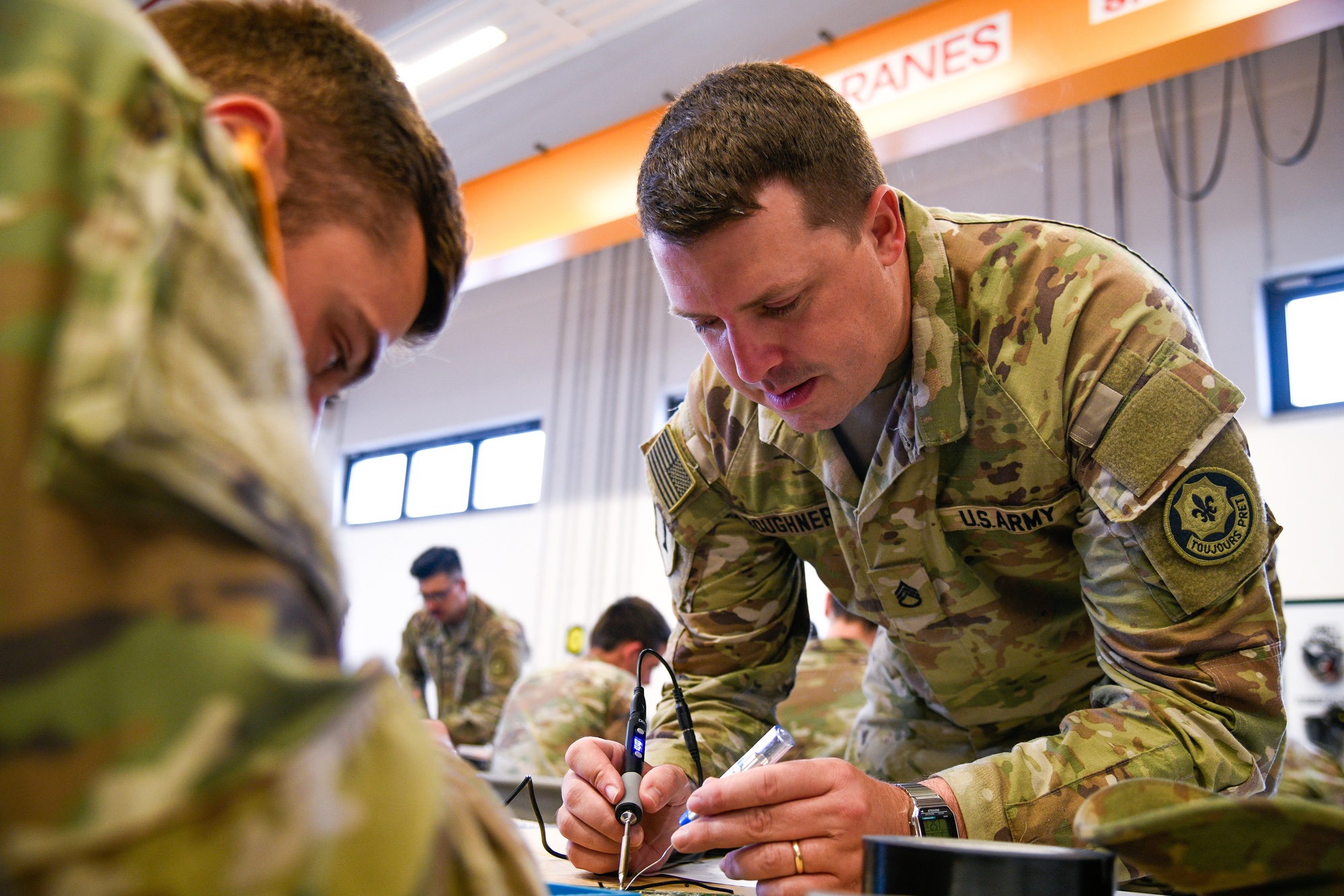
FPV attack drones being assembled at a production workshop. Mass production has been decentralized across hundreds of small facilities, making the supply chain resilient to disruption.
The Jamming Problem and the Fiber-Optic Solution
The single greatest vulnerability of an FPV drone is its radio link. The drone depends on a continuous radio connection for both pilot control (RC link) and pilot vision (video link). If either link is jammed, overwhelmed by a more powerful radio signal on the same frequency, the pilot loses control, the drone crashes or flies off course, and the mission fails.
Electronic warfare (EW) systems designed to counter FPV drones have become a major factor on the battlefield. According to the Pentagon's Ukraine battlefield assessment, both Russian and Ukrainian forces deploy vehicle-mounted and portable jammers that broadcast high-power interference across the frequency bands used by FPV control and video systems. Effective EW coverage can create "drone dead zones" hundreds of meters or even several kilometers wide where FPV operations become unreliable or impossible.
Drone operators have responded with a series of countermeasures: frequency-hopping spread-spectrum protocols that rapidly switch between frequencies to avoid narrowband jamming, directional antennas that concentrate signal strength toward the drone and away from jammers, and custom firmware that increases resistance to specific jamming waveforms. Defense industry sources indicate that the EW contest between drone operators and jammers is an ongoing technical arms race, with each side iterating on timescales measured in weeks rather than years.
The most radical solution to the jamming problem is the fiber-optic FPV drone. Instead of a radio link, the drone trails a thin fiber-optic cable (thinner than a human hair) that carries both the control signal and the video feed. Fiber-optic links are immune to radio-frequency jamming because the signal travels through glass, not through the electromagnetic spectrum. The drone is physically tethered to a spool of fiber that unwinds as it flies.
Fiber-optic guided munitions are not a new concept. The SACLOS-guided missiles of the Cold War era used wire guidance on similar principles. But applying fiber-optic guidance to cheap FPV drones is a recent innovation. Ukrainian and Chinese manufacturers have demonstrated fiber-optic FPV systems with ranges of 10 to 20 kilometers, as documented by defense analysts tracking procurement records and battlefield footage. The tradeoff is added weight and complexity from the fiber spool, a fixed maximum range determined by the length of cable, and a flight path constrained by the need to avoid snagging the fiber on obstacles. Nevertheless, fiber-optic FPV drones represent a direct counter to the EW systems that have become the primary defense against radio-linked drones.
From Hobby to Industrial Scale
The most remarkable aspect of FPV drone warfare may not be the technology itself, but the speed at which it scaled from a hobbyist experiment to an industrial weapons program.
In early 2022, Ukrainian FPV drones were built by volunteers in garages and hackerspaces, using components ordered from Banggood and AliExpress. By mid-2023, Ukraine had established organized production facilities turning out thousands of units per month. By late 2025, Ukrainian government and volunteer organizations were producing an estimated 50,000 or more FPV drones per month, according to assessments by RUSI and Ukrainian government disclosures. Some estimates run considerably higher.
Russian FPV production scaled on a similar trajectory, starting later but ramping aggressively through 2024 and 2025. According to the Institute for the Study of War, Russian units were consuming thousands of FPV drones per week across the front by late 2025.
This production model is fundamentally different from conventional weapons manufacturing. FPV drone assembly does not require precision machining, clean rooms, or multi-year supply chains. It requires soldering stations, 3D printers, and technicians who can be trained in weeks. Production can be distributed across hundreds of small workshops, a model that is inherently resilient to the kind of strikes that can disable a centralized munitions factory.
The global drone-racing supply chain provides the raw material. Shenzhen-based electronics manufacturers produce flight controllers, ESCs, motors, cameras, and video transmitters at enormous scale for the civilian market. The military demand layer sits on top of this existing commercial supply chain, sourcing identical or nearly identical components. That is why FPV drone production can scale so fast: the manufacturing infrastructure already exists. It just was not built for weapons.
What Changes in Practice
The FPV drone does not replace any single existing weapon. It creates a new category: an ultra-cheap, human-guided, expendable precision munition that can be produced and deployed at industrial scale by operators trained in weeks. That combination changes several things at the practical level.
It compresses the sensor-to-shooter loop to a single person. The FPV pilot is simultaneously the reconnaissance asset, the fire-control system, and the weapon operator. There is no call for fire, no target handoff, no coordination chain. One person with goggles and a transmitter identifies a target and strikes it within minutes of detection.
It creates extreme cost asymmetry. A $400 drone can destroy vehicles, equipment, and positions worth thousands to millions of times more. Even at modest hit rates, the exchange ratio overwhelmingly favors the attacker. The Pentagon's Ukraine assessment has noted that this asymmetry is what makes FPV drones a strategic problem, not just a tactical nuisance.
It democratizes precision strike. Before FPV drones, precision-guided munitions were expensive, technically sophisticated, and restricted to advanced militaries. FPV drones can be built by any organization with access to a commercial electronics supply chain and a few weeks of training time. This has implications well beyond the current Ukraine conflict.
It accelerates the electronic warfare arms race. Because the radio link is the drone's critical vulnerability, every improvement in FPV technology drives a corresponding investment in jamming, and every jamming advance drives countermeasures from the drone side. This EW competition is now the fastest-moving technology arms race in modern warfare, iterating on cycles measured in weeks.
Understanding the engineering behind FPV drones is not just a matter of technical curiosity. It explains why these weapons are proliferating so rapidly, why they are so difficult to counter, and why their impact on ground warfare is likely permanent. The components are too cheap, the supply chain too distributed, and the concept too effective to be uninvented. Every military that expects to fight on land will need to account for a battlefield saturated with small, cheap, human-guided precision munitions, and the engineering to counter them.
Frequently Asked Questions
What does FPV stand for in military drone terminology?
FPV stands for "first person view." It describes a flight method where the pilot wears video goggles displaying a live camera feed from the drone, effectively seeing through the drone's camera in real time. The technology originated in civilian drone racing and was adapted for military use beginning in 2022 during the Ukraine conflict.
How much does a military FPV drone cost to build?
A complete FPV attack drone, including airframe, electronics, and warhead, typically costs between $300 and $550 depending on components. Builds using analog video systems are cheaper ($200 to $400), while those using digital video (such as DJI) cost $300 to $550. At industrial scale, the per-unit cost (excluding warhead) has been driven below $300 by major manufacturers.
How long does it take to train an FPV drone pilot?
Ukrainian training programs have demonstrated that a trainee with no prior drone experience can become a field-capable FPV attack pilot in four to eight weeks: two to three weeks of intensive simulator practice followed by two to five weeks of live flying. Trainees with gaming or drone-racing backgrounds often progress faster. This is vastly shorter than training timelines for conventional precision weapons operators.
What is the range of an FPV attack drone?
Most military FPV drones have a practical one-way range of 3 to 10 kilometers, limited primarily by battery life and video-link range. The radio control link itself can reach 10 to 30+ kilometers with directional antennas, but battery capacity typically limits how far the drone can actually fly. Larger platforms with bigger batteries can reach 15 to 20 kilometers.
What software do military FPV drones run?
Most military FPV drones run Betaflight, an open-source flight controller firmware originally developed for drone racing. Some operators use iNav (which adds GPS-waypoint navigation) or ArduPilot (for more complex autonomous behaviors). The radio control link typically uses ExpressLRS (ELRS), an open-source long-range protocol. All of this software is freely available and community-maintained.
How do militaries defend against FPV drones?
The primary defense is electronic warfare: jamming the drone's radio control and video links to sever the connection between pilot and aircraft. Other defenses include directed-energy weapons, counter-drone interceptors, small-caliber air defense guns, and physical countermeasures like cage armor. The ongoing arms race between FPV operators and EW systems is driving innovations on both sides, including fiber-optic drones that are immune to radio-frequency jamming.