Alex Carter writes about modern warfare, emerging military technology, and how doctrine adapts to new tools. His work focuses on what changes in practice -- command, control, targeting, and risk -- when systems like drones and autonomous platforms become routine.
Drones have become the defining weapon of the 2020s. From the cheap FPV kamikaze quadcopters saturating the battlefields of Ukraine to the Iranian-designed Shahed one-way attack drones striking cities hundreds of kilometers behind the front lines, unmanned aerial systems now inflict more damage on ground forces than any other single class of weapon. Every military on earth is racing to solve the counter-drone problem, and so far, nobody has cracked it completely.
The urgency is not theoretical. By early 2026, Ukrainian and Russian forces are collectively launching an estimated 5,000 to 10,000 drones per week in offensive operations. That figure includes everything from $400 FPV racing drones modified with shaped-charge warheads to $20,000 Shahed-pattern loitering munitions to sophisticated medium-altitude platforms like the Turkish Bayraktar TB2. Against this volume, traditional air defense systems designed to intercept fighter jets and cruise missiles are overmatched not by capability but by economics: a $120,000 Stinger missile fired at a $400 quadcopter is a trade no military can sustain.
What follows is a comprehensive look at the counter-drone technologies being developed and deployed by militaries worldwide, the strengths and limitations of each approach, the lessons from Ukraine's unprecedented counter-drone laboratory, and the autonomous arms race that lies ahead.
The Threat
Counter-drone weapons are only as useful as their ability to address the full spectrum of unmanned threats, and that spectrum has expanded dramatically in just a few years. Understanding what militaries must now defend against is the starting point for evaluating every solution that follows.
FPV kamikaze drones. The smallest, cheapest, and most numerous threat on the modern battlefield. These are modified racing quadcopters weighing 1 to 3 kilograms, flown by an operator wearing first-person-view goggles directly into the target. They carry shaped-charge warheads capable of destroying tanks, armored vehicles, and fortified positions. Their small size, high speed (100 to 150 km/h), and negligible radar cross-section make them extraordinarily difficult to detect and engage. Ukraine and Russia together are fielding hundreds of thousands per year. For a deeper look at how these weapons have upended armored warfare, see our analysis of how FPV drones are destroying tanks.
Commercial surveillance drones. Modified off-the-shelf quadcopters, most commonly DJI Mavic and Matrice series, used for reconnaissance, artillery spotting, and grenade drops. These are ubiquitous on both sides in Ukraine, operating at altitudes of 100 to 500 meters and providing real-time intelligence that directs artillery fire onto targets within minutes. Defeating the surveillance drone is often more important than stopping the attack drone, because the observation platform is what makes everything else lethal.
One-way attack drones (Group 3). Medium-sized systems like the Iranian Shahed-136 (Russian designation Geran-2), the Israeli Harop, and the American Switchblade 600. These fly autonomously on pre-programmed routes to strike targets at ranges of hundreds or thousands of kilometers. The Shahed-136, with its simple jet engine and GPS/inertial guidance, costs an estimated $20,000 to $50,000 and has been launched in salvos of dozens against Ukrainian cities and critical infrastructure. Their low speed (roughly 185 km/h) and larger size relative to FPV drones make them easier to detect, but their numbers overwhelm conventional air defenses.
Future swarms. The threat that keeps defense planners awake at night is the coordinated autonomous drone swarm: dozens or hundreds of cheap drones launched simultaneously, sharing sensor data and coordinating their approach to overwhelm defenses through sheer numbers. True swarm autonomy, where drones communicate and coordinate without human direction, remains largely experimental, but crude versions of multi-drone saturation attacks are already occurring in Ukraine. China has demonstrated increasingly sophisticated swarm exercises in the Pacific theater. A defensive system that can stop one drone at a time is useless against fifty arriving simultaneously from multiple vectors.
The counter-drone challenge spans a vast threat spectrum, from $400 FPV quadcopters to one-way attack drones like the Shahed-136. No single defensive system can address all categories effectively.
Electronic Warfare and Jamming
Electronic warfare is the first line of defense against drones and, in Ukraine, the most widely used counter-drone approach in the conflict. The principle is straightforward: most drones depend on radio frequency (RF) links for command and control, video transmission, and GPS navigation. Disrupt those links, and the drone becomes uncontrollable. It may crash, return to its launch point, or drift aimlessly until its battery dies.
RF jamming works by broadcasting powerful signals on the same frequencies used by the drone's control and video links, overwhelming the legitimate signal with noise. GPS spoofing takes a different approach, broadcasting false GPS signals that trick the drone's navigation system into thinking it is somewhere else, potentially diverting it off course or causing it to land in a safe area. Both techniques have been employed extensively by all sides in Ukraine, creating a dense and constantly shifting electromagnetic battlefield.
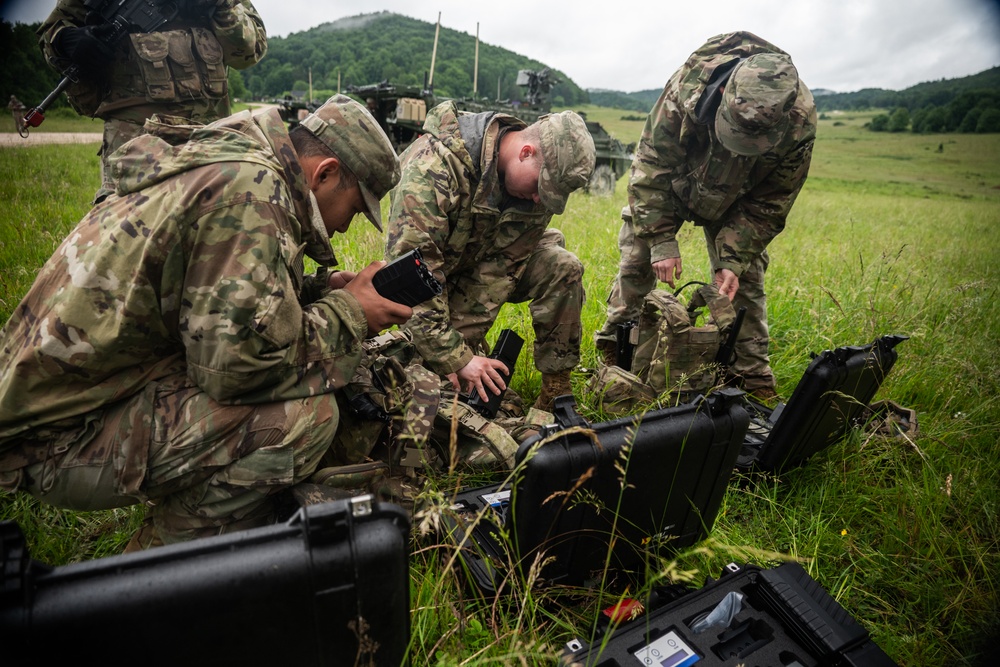
Handheld jammers. The most visible counter-drone systems are rifle-shaped devices that an individual soldier can point at an incoming drone. DroneShield's DroneGun Tactical, manufactured in Australia and widely exported, is the best-known example. It emits directional RF jamming across multiple frequency bands, typically 2.4 GHz and 5.8 GHz for control links and L1/L2 bands for GPS, at effective ranges up to 1 to 2 kilometers. The operator aims the device at the drone and activates the jammer. Ukrainian and allied forces have deployed DroneGun systems extensively along the front lines. The limitation is that handheld systems require a soldier to visually acquire the drone, aim accurately, and maintain the beam on target, all while potentially under fire from other threats.
Vehicle-mounted and area-denial systems. For broader coverage, militaries deploy vehicle-mounted and fixed-site EW systems that create jamming bubbles across a defined area. The L3Harris VAMPIRE (Vehicle-Agnostic Modular Palletized ISR Rocket Equipment) system, provided to Ukraine by the United States, mounts on a standard pickup truck and combines an electro-optical targeting system with small guided rockets for kinetic engagement. While VAMPIRE is primarily a kinetic system, it represents the broader trend toward palletized, rapidly deployable counter-drone packages that can be bolted onto almost any vehicle in the inventory.
Russian EW systems. Russia entered the war with some of the most sophisticated electronic warfare capabilities of any military, and this has shaped the counter-drone fight from the beginning. The Krasukha-4 is a truck-mounted system designed to jam airborne radars and communication links at ranges of up to 300 kilometers. The Zhitel (R-330Zh) targets satellite communications and GPS signals across wide areas. At the tactical level, Russia has deployed numerous smaller jammers, including vehicle-mounted systems like the Volnorez and Lesochek, specifically designed to disrupt FPV drone control links within a few hundred meters of the vehicle. By 2025, both sides in Ukraine had developed a dense, overlapping electronic warfare environment that forced constant adaptation in drone design and operating procedures, with new jamming techniques and counter-techniques appearing on cycles measured in weeks.
A handheld RF jammer designed to disrupt drone control and GPS signals. These devices are effective against remotely piloted drones but cannot stop autonomous systems that do not rely on a continuous radio link.
The critical limitation: autonomy defeats jamming. Electronic warfare is effective against drones that depend on continuous radio links, but the technology is already being overtaken by the threat. Both Ukrainian and Russian developers are building drones with fiber-optic tethered control links that are immune to RF jamming, autonomous navigation using onboard machine vision and inertial measurement, and pre-programmed GPS waypoint flight that does not require a continuous control signal after launch. An autonomous drone that navigates by visual recognition of terrain and targets cannot be stopped by a jammer at any power level. This fundamental limitation is driving the counter-drone community toward kinetic and directed-energy solutions that physically destroy the drone rather than merely disrupting its communications.
Directed Energy and Laser Weapons
If electronic warfare is the first line of defense, directed energy weapons are increasingly seen as the most promising second line. Military laser weapons offer two advantages that no other counter-drone technology can match: near-zero cost per shot and effectively unlimited magazine depth. A laser weapon can engage target after target for as long as it has electrical power, at a cost of roughly $1 to $10 per shot in electricity, compared to $50,000 or more for a surface-to-air missile.
DE-SHORAD (U.S. Army). The Directed Energy Short Range Air Defense system mounts a 50kW-class high-energy laser on a Stryker armored vehicle. Developed by Raytheon (now RTX) with KBR providing the power and thermal management subsystem, DE-SHORAD is designed to detect, track, and destroy small drones, rockets, and mortar rounds at short range. The system has successfully engaged and destroyed a variety of unmanned aircraft and mortar surrogate targets during testing at White Sands Missile Range, New Mexico. The Army began delivering pre-production units to the 4th Infantry Division in 2024, with fielding to additional combat formations planned through 2025 and 2026. DE-SHORAD represents the most advanced ground-based counter-drone laser weapon in Western inventories.
HELIOS (U.S. Navy). The High Energy Laser with Integrated Optical-dazzler and Surveillance is a 60kW-class system built by Lockheed Martin, installed on the Arleigh Burke-class destroyer USS Preble (DDG-88). HELIOS integrates directly into the Aegis Combat System, giving the crew the option to engage aerial targets with directed energy alongside conventional weapons like the Phalanx CIWS or SM-2 missiles. While HELIOS was designed primarily for threats to surface combatants, its counter-drone capability is a critical part of the Navy's layered defense architecture. The system has also demonstrated an optical dazzler mode that can blind or confuse the sensors on incoming drones without destroying them, preserving higher-power shots for threats that require a hard kill.
Iron Beam (Israel). Developed by Rafael Advanced Defense Systems, Iron Beam is a ground-based high-energy laser designed to complement the Iron Dome missile defense system by handling the cheaper end of the threat spectrum: short-range rockets, mortar rounds, and drones that currently consume expensive Tamir interceptor missiles. Rafael has stated that the cost per engagement is approximately $3.50 in electricity, a figure that represents a cost reduction of roughly four orders of magnitude compared to a Tamir missile. The Israeli Ministry of Defense announced successful intercepts of rockets, mortars, and drones in testing, and initial operational deployment reportedly began in 2025, potentially making Iron Beam the first laser weapon system used in active defense of civilian populations against real incoming fire.
Advantages. The economics are transformative. When a $400 drone can force a defender to spend $120,000 on a Stinger missile, the attacker wins the cost exchange even when every intercept succeeds. Lasers invert that ratio entirely. They also eliminate the logistical burden of resupplying missile canisters in a combat zone, a problem that Ukraine has highlighted repeatedly as one of the most pressing challenges in sustained counter-drone operations. The "deep magazine" characteristic means a laser can continue engaging indefinitely, limited only by electrical power and thermal management rather than by a finite number of interceptors.
Limitations. Laser weapons are degraded by rain, fog, dust, and smoke, precisely the conditions common on active battlefields. They require sustained "dwell time" on the target, typically several seconds of continuous focused beam, to burn through an airframe or detonate a warhead, which limits the rate at which they can engage multiple incoming drones. Power generation and thermal management are significant engineering challenges, particularly for ground vehicles with limited electrical and cooling capacity. And at current power levels of 50 to 60 kilowatts, effective engagement ranges are generally measured in single-digit kilometers. These constraints mean that directed energy will be one layer in a multi-layered defense, not a standalone solution. For the full picture of where laser weapons stand in 2026, see our detailed analysis of the directed energy revolution.
When electronic warfare fails and lasers are unavailable or impractical, militaries fall back on the oldest approach to air defense: shooting drones down with physical projectiles. This category spans everything from purpose-built interceptor drones to Cold War-era anti-aircraft guns pressed back into service, and it remains the most mature and proven counter-drone method available.
MADIS (U.S. Marine Corps). The Marine Air Defense Integrated System is a vehicle-mounted counter-drone package that combines radar, electronic warfare, and kinetic weapons on a Joint Light Tactical Vehicle (JLTV). MADIS can detect and classify drones using its integrated radar and electro-optical sensors, attempt electronic disruption first, and if jamming fails, engage kinetically with a 30mm autocannon or Stinger missiles. The layered approach, electronic warfare first with kinetic kill as backup, reflects the Marines' hard-won experience with counter-drone operations in the Middle East and represents the kind of integrated thinking that defense planners believe will define the next generation of mobile air defense.
Coyote Block 3 (Raytheon/RTX). One of the most innovative counter-drone weapons is itself a drone. The Coyote Block 3 is a small, expendable interceptor drone designed specifically to hunt and destroy other drones. Launched from a tube, Coyote uses a combination of radar guidance and an autonomous seeker to locate its target and fly into it, destroying the hostile drone through kinetic impact or a proximity-fused warhead. Each Coyote costs approximately $100,000, which is expensive relative to the FPV drones it targets but cheap compared to a conventional surface-to-air missile. The Coyote is paired with the KuRFS (Ku-band Radio Frequency System) radar as part of the Army's counter-small unmanned aircraft system architecture, providing a detect-to-engage kill chain purpose-built for the drone threat.
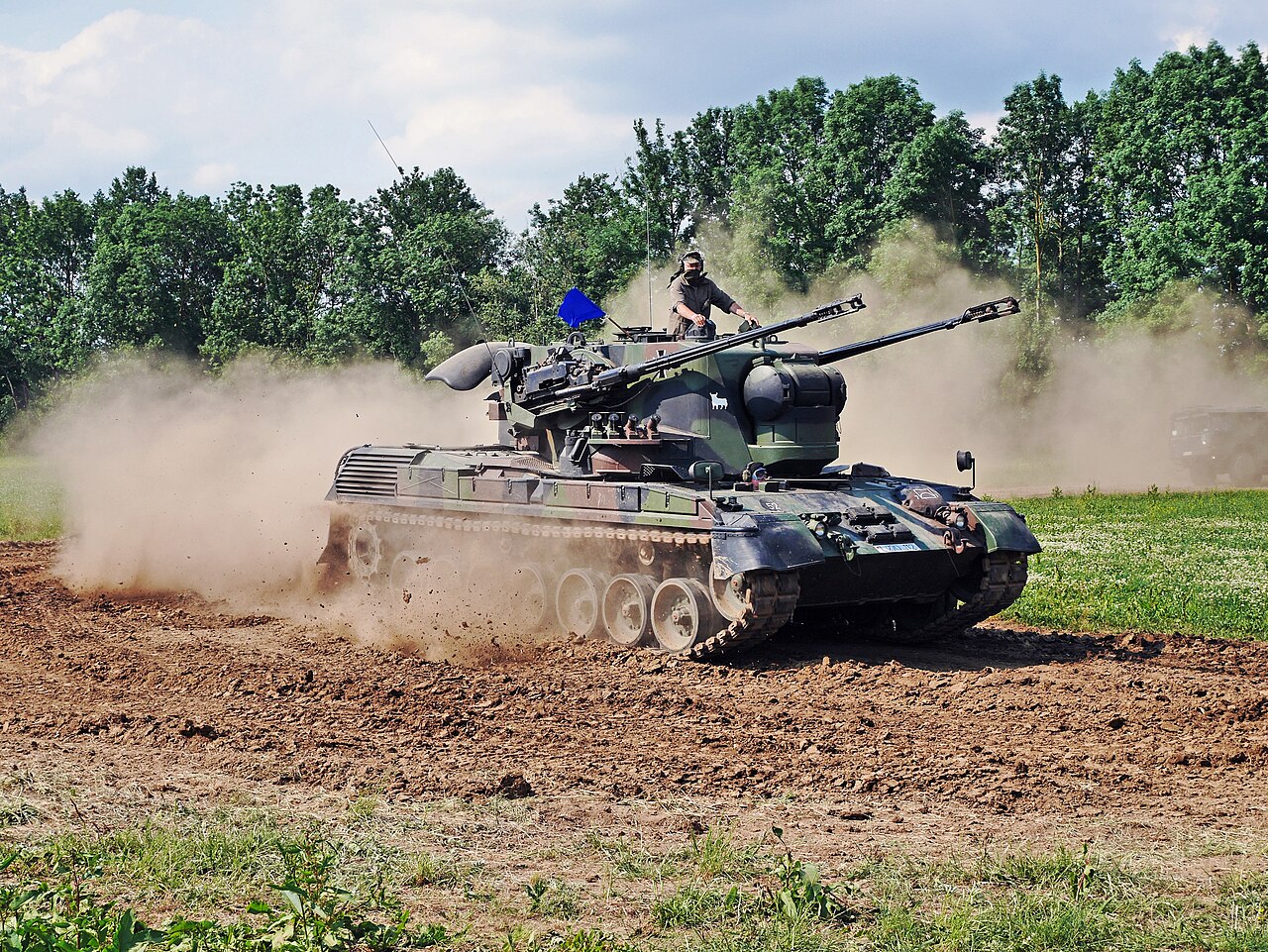
Adapted conventional air defense. Some of the most effective counter-drone weapons in Ukraine are decades-old systems repurposed for a mission their designers never imagined. Germany donated Gepard self-propelled anti-aircraft guns, Cold War-era platforms armed with twin 35mm autocannons and radar-directed fire control. Originally designed to shoot down low-flying Soviet attack aircraft and helicopters, the Gepard has proven devastatingly effective against Shahed-136 drones. Its high rate of fire, 550 rounds per minute per barrel, and radar-guided tracking can shred a slow-moving drone at ranges of several kilometers. Ukraine has used Gepards to intercept hundreds of Shaheds, making the system one of the most successful counter-drone weapons of the entire war.
A Gepard self-propelled anti-aircraft gun, originally designed during the Cold War to engage low-flying aircraft. In Ukraine, Gepards have become one of the most effective kinetic systems against Shahed-pattern one-way attack drones.
The cost exchange problem. Kinetic intercept works, but the economics are brutal. A Coyote Block 3 interceptor costs roughly $100,000. A Stinger missile costs $120,000. Even 35mm ammunition for the Gepard is not cheap, with each round costing several hundred dollars and many rounds typically expended per engagement. Against a $400 FPV drone, every kinetic interceptor represents a lopsided cost exchange that overwhelmingly favors the attacker. This is the central dilemma of counter-drone defense: the weapons that most reliably destroy drones are vastly more expensive than the drones themselves. As analysts at the Center for Strategic and International Studies (CSIS) have noted, a defender who spends $100,000 to destroy a $400 drone wins the tactical engagement but loses the economic war.
Shotgun-based last-resort systems. At the closest ranges, some forces have adopted decidedly low-tech solutions. Shotguns loaded with birdshot or buckshot have been used against FPV drones at ranges under 50 meters. The U.S. Marine Corps has tested 12-gauge shotgun shells loaded with specialized anti-drone rounds. Several countries have explored net-capture systems, either launched from the ground or deployed by interceptor drones, that physically entangle the target's rotors. These are niche solutions for terminal defense, not systematic counter-drone architectures, but they reflect the desperation of units facing drone threats without dedicated counter-drone weapons and the reality that any defense is better than none.
AI-Guided Detection and Response
Perhaps the most important counter-drone technology is not a weapon at all but the sensor and software systems that detect, classify, and track drones in the first place. A counter-drone weapon is useless if it cannot find its target, and finding small drones is extraordinarily difficult.
Small FPV drones have a radar cross-section roughly equivalent to a bird. They fly at low altitudes, often below tree-line level, and their composite and plastic construction provides minimal radar return. Traditional military radars, designed to track fighter jets and cruise missiles at long range, frequently cannot reliably detect a 2-kilogram quadcopter at tactically relevant distances. This detection gap is the single biggest vulnerability in current counter-drone defenses and the area where AI is making the fastest progress.
AI-powered sensor fusion. The solution being pursued by virtually every major defense contractor involves combining multiple sensor types, radar, electro-optical cameras, infrared sensors, and acoustic detectors, and using artificial intelligence to fuse their data into a coherent picture. Each sensor type has strengths and weaknesses: radar provides range and velocity data but struggles with small targets against ground clutter; electro-optical cameras can identify and classify drones visually but are limited by weather and darkness; infrared sensors detect the heat signature of a drone's motors and batteries; acoustic sensors detect the distinctive sound of propellers at short range. AI algorithms process all of these inputs simultaneously, correlating detections across sensor types to identify, classify, and track targets that any single sensor would miss. Companies like Anduril, Northrop Grumman, and Rafael have developed AI-driven command-and-control platforms that automate the detection-to-engagement chain, presenting operators with a fused picture of the airspace and recommending engagement options in near real time.
Autonomous engagement systems. The logical next step, and one that raises significant ethical and legal questions, is removing the human from the engagement loop entirely. When a swarm of fifty drones arrives simultaneously and the defender has seconds to react, a human operator cannot make fifty individual engagement decisions fast enough. Autonomous counter-drone systems that detect, classify, and engage targets without waiting for human authorization are under development by multiple nations. The U.S. Department of Defense maintains that a human must remain "in the loop" or "on the loop" for lethal engagements, but the practical pressure to automate the counter-drone response is intense and growing with every increase in drone attack volume.
Drone-on-drone intercept. One of the most promising detection and engagement concepts involves using AI-guided interceptor drones to autonomously hunt and destroy hostile drones. Unlike ground-based weapons that must detect and engage from a fixed position, interceptor drones can be deployed as a defensive screen, loitering in the airspace around a defended position and autonomously pursuing any detected threat. Anduril's Anvil interceptor uses onboard sensors and AI to detect, track, and physically ram incoming drones at high speed. Fortem Technologies' DroneHunter uses a radar-guided interceptor that captures targets in a tethered net. Both systems can operate with minimal human oversight, enabling a platoon-level counter-drone capability that would be impossible with traditional missile-based systems.
DARPA programs. The Defense Advanced Research Projects Agency has launched multiple programs aimed at the counter-drone challenge. The System of Systems Enhanced Small Unit (Sprint) concept envisions a platoon-level autonomous defense architecture where small ground units are protected by an integrated web of sensors, electronic warfare systems, and kinetic interceptors, all managed by AI that can process threats and coordinate responses at machine speed. DARPA's broader portfolio includes research into cognitive electronic warfare that adapts jamming in real time, AI-powered radar that can distinguish drones from birds and ground clutter with high confidence, and autonomous swarm-on-swarm defense concepts. These programs aim to push counter-drone capability down to the lowest tactical levels, where individual squads and platoons face drone threats daily without the support of dedicated air defense units.
Passive Defenses
Not every counter-drone measure involves destroying or disabling the drone. In many cases, the most effective defense is simply avoiding detection in the first place. Passive defenses, measures that reduce a unit's vulnerability without actively engaging the threat, have become essential survival skills on the modern battlefield.
Camouflage and concealment. The oldest military technique in the world has taken on new urgency in the age of persistent drone surveillance. Forces in Ukraine have learned that any position visible from the air will be found and targeted, often within hours. Traditional camouflage netting remains valuable against visual-spectrum cameras, but modern drones increasingly carry thermal imaging sensors that can detect the heat signatures of vehicles, generators, and even human bodies beneath standard camouflage. Specialized thermal camouflage materials, including insulated covers and heat-dissipating fabrics, are under development by multiple NATO countries but are not yet widely available at the scale needed.
Electronic signature management. Every military unit radiates electronic signals: radio communications, radar emissions, cell phone signals, and the electromagnetic noise of vehicle electronics. Drones equipped with electronic surveillance receivers can detect and geolocate these emissions, cueing strike assets onto their sources. Disciplined emissions control, including strict radio silence protocols, signal-masking techniques, and the prohibition of personal cell phones in forward areas, has become a survival imperative. Both Ukrainian and Russian forces have reported numerous cases where cell phone signals or improperly managed radio communications led directly to devastating drone or artillery strikes on command posts and assembly areas.
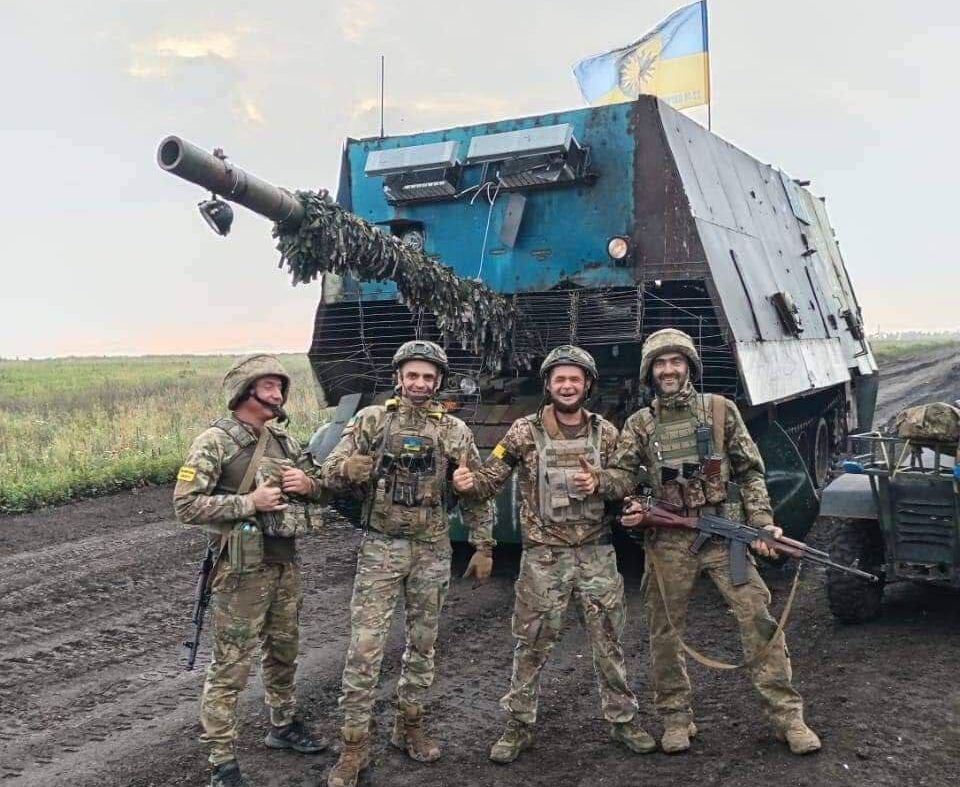
A Russian "turtle tank" covered in improvised cage armor and metal sheeting. These modifications attempt to prematurely detonate FPV drone warheads before they reach the vehicle's main armor, with mixed but non-trivial results.
Cage armor and turtle tanks. Russian forces in Ukraine have pioneered the improvised physical modification of vehicles to survive drone attacks. The now-iconic "turtle tanks," T-72s and other armored vehicles covered in welded metal sheets and cage armor designed to prematurely detonate shaped-charge warheads from FPV drones, have become ubiquitous on the front lines. The effectiveness of these modifications is debated among analysts. While cage armor may cause some warheads to detonate at a suboptimal standoff distance from the main armor, many FPV strikes have penetrated improvised protection with apparent ease. Still, any reduction in the hit rate translates directly into vehicles and crews saved, and the practice has spread to both sides. For a broader look at how active and passive protection systems are evolving to counter this threat, see our analysis of active protection systems like Trophy APS.
Dispersal and deception. Concentrating forces creates lucrative targets for drone operators. Both sides in Ukraine have learned to disperse vehicles and personnel as widely as terrain and tactical requirements allow, reducing the payoff of any single drone strike. Decoy vehicles, inflatable tanks, and other deception measures can waste enemy drone sorties on false targets. Some units have experimented with deploying cheap consumer drones of their own as decoys to draw enemy interceptors and electronic warfare attention away from actual operations. The ancient military arts of dispersion, concealment, and deception are enjoying a forced renaissance driven by the omnipresence of drone surveillance and the lethal consequences of being found.
What Ukraine Has Taught Us
The war in Ukraine is the most intensive counter-drone laboratory in human history. More counter-drone engagements have occurred there since February 2022 than in all other conflicts in history combined. The lessons emerging from this experience are reshaping how every military on earth thinks about air defense, and several conclusions have become unavoidable.
No single solution works. This is the most important lesson and the one that some militaries have been slowest to internalize. Electronic warfare is effective against piloted drones but useless against autonomous ones. Lasers work in clear weather but degrade in rain and fog. Kinetic interceptors kill drones reliably but at unsustainable cost. Passive measures reduce vulnerability but cannot prevent attacks. Every counter-drone technology has a gap, and adversaries find and exploit those gaps with startling speed. The only viable approach is layered defense: multiple complementary systems operating together so that what one layer misses, another catches. Analysts at the Royal United Services Institute (RUSI) have described this as "the defining lesson" of Ukraine's counter-drone experience.
Electronic warfare is the first line, but it is eroding. In the early months of widespread drone use, RF jamming was devastatingly effective. It could disable the majority of incoming drones with minimal cost and effort. But drone developers adapted. Frequency-hopping radios, fiber-optic control tethers, and increasingly autonomous navigation have progressively reduced the effectiveness of jamming. The EW-versus-drone contest in Ukraine has become a rapid-cycling arms race measured in weeks, not years. A new jammer that works today may be defeated by a firmware update next month. The West Point Modern War Institute has documented how this cycle accelerates faster than traditional procurement systems can respond.
The cost exchange ratio matters most. The defining metric of counter-drone effectiveness is not the probability of kill but the cost exchange ratio. A system that kills 90 percent of incoming drones is unsustainable if each engagement costs 100 times more than the drone it destroys. Sustainable counter-drone defense requires bringing the cost per engagement down to the same order of magnitude as the cost of the threat. This is why directed energy and cheap autonomous interceptor drones are attracting the heaviest investment: they are the only approaches that can plausibly close the cost gap. Reports from both RUSI and the Center for Strategic and International Studies have emphasized that the cost exchange ratio, not any single technical metric, will determine which counter-drone strategies succeed at scale.
Speed of adaptation matters as much as technology. The counter-drone fight in Ukraine moves at software speed, not hardware speed. Both sides iterate on drone designs, electronic warfare techniques, and counter-tactics on cycles measured in weeks. A counter-drone system that takes five years to develop and field will be obsolete before it arrives. This has driven intense interest in modular, software-defined systems that can be updated in the field, and in commercial off-the-shelf solutions that can be procured and deployed rapidly. The Defense News has reported extensively on how Western procurement systems are struggling to keep pace with the speed of adaptation that Ukraine's counter-drone arms race demands.
The Arms Race Ahead
The counter-drone problem is not going to be solved. It is going to be managed, in a perpetual arms race between drone capabilities and counter-drone defenses that will define military technology development for the next several decades. The trajectories of both sides of this contest are becoming clear.
Autonomous drones versus autonomous counter-drone AI. The single most consequential trend is the shift toward autonomy on both sides of the equation. As attack drones become capable of navigating and targeting without any human control, electronic warfare loses its primary advantage: the ability to sever the link between pilot and aircraft. The counter to an autonomous drone is not a jammer but an autonomous defense system that can detect, classify, and engage faster than the drone can reach its target. This leads directly to a future where AI fights AI at speeds no human can match, with human operators setting rules of engagement and monitoring outcomes rather than making individual engagement decisions. The ethical, legal, and strategic implications of this trajectory are profound and largely unresolved, but the military logic driving it is powerful: the side that automates its counter-drone response faster will survive.
Swarm versus swarm. If the future of attack drones is the coordinated swarm, the future of counter-drone defense may be the counter-swarm: a defensive cloud of cheap interceptor drones that autonomously patrol protected airspace and engage incoming threats. Rather than relying on expensive ground-based systems to shoot down each individual drone, a defended position would launch its own swarm of interceptors that collectively detect, track, and destroy anything hostile that enters their zone. DARPA, the U.S. Navy, and several allied nations are actively funding research into defensive swarm concepts. The swarm-versus-swarm scenario is no longer a theoretical exercise; it is a funded research priority with prototype demonstrations already underway.
Integration of C-UAS into every vehicle. Today, counter-drone capability is concentrated in dedicated air defense units that cannot be everywhere at once. The overwhelming lesson from Ukraine is that every vehicle, from main battle tanks to logistics trucks to infantry fighting vehicles, needs some level of organic counter-drone protection. This is driving the integration of small EW jammers, laser warning receivers, and even miniature hard-kill systems into platforms across the entire force structure. The U.S. Army's next-generation combat vehicles are being designed with integrated counter-drone capability from the outset. Israel is already fielding vehicle-mounted systems that can engage both anti-tank missiles and FPV drones. The goal is a force where counter-drone defense is as ubiquitous as armor protection, not a specialized capability concentrated in a few units.
The drone revolution has upended the economics of air defense, the tactics of ground warfare, and the assumptions that underpin decades of military doctrine. The counter-drone revolution is the inevitable response. It will not produce a single wonder weapon that neutralizes the drone threat. Instead, it will produce an ecosystem of layered, integrated, increasingly autonomous defenses that evolve continuously alongside the threats they face. The military that masters this integration, fielding affordable, adaptable, multi-layered counter-drone systems at scale, will hold a decisive advantage in every conflict of the coming decades. The one that fails to adapt will find its most expensive platforms destroyed by weapons that cost less than a used car. As one senior Breaking Defense analyst put it, "The counter-drone problem is now the air defense problem. They are the same thing."
Effective counter-drone defense requires a layered architecture: electronic warfare as the first ring, directed energy as the second, and kinetic interceptors as the final backstop. No single layer is sufficient on its own.
Frequently Asked Questions
What is the most effective counter-drone system currently in use?
There is no single most effective system because the drone threat spans such a wide spectrum. Electronic warfare jammers are the most widely deployed first line of defense. The German-supplied Gepard self-propelled anti-aircraft gun has proven one of the most successful kinetic systems against Shahed-pattern one-way attack drones in Ukraine. Directed energy weapons like the U.S. Army's DE-SHORAD and Israel's Iron Beam are transitioning to operational deployment and are expected to become the most cost-effective solutions once widely fielded. The consensus among military analysts is that layered defense, combining electronic warfare, directed energy, and kinetic interceptors, is the only approach that addresses the full range of drone threats.
How much does it cost to shoot down a drone?
Costs vary enormously depending on the system used. A directed energy weapon engagement costs an estimated $1 to $10 in electricity. An RF jammer engagement costs effectively nothing beyond the system's operating power. A 35mm Gepard engagement may cost several thousand dollars in ammunition. A Coyote Block 3 interceptor drone costs roughly $100,000. A Stinger missile costs approximately $120,000. Against FPV drones that cost $400 to $2,000, the cost exchange ratio heavily favors the attacker when conventional kinetic interceptors are used, which is the primary driver of investment in directed energy and cheap autonomous interceptors.
Can electronic warfare stop autonomous drones?
Traditional RF jamming is ineffective against fully autonomous drones that navigate using onboard sensors, machine vision, or pre-programmed GPS waypoints without requiring a continuous radio link to an operator. This is one of the most significant limitations of electronic warfare as a counter-drone approach. As drones become increasingly autonomous, the effectiveness of jamming-based defenses will continue to decline, driving greater reliance on kinetic and directed energy systems that physically destroy the drone regardless of how it navigates.
What is the U.S. military doing about the drone threat?
The U.S. military is pursuing counter-drone capability across all services. The Army is fielding the DE-SHORAD laser weapon on Stryker vehicles and the Coyote Block 3 interceptor drone. The Marine Corps has deployed MADIS, a vehicle-mounted system combining sensors, electronic warfare, and kinetic weapons. The Navy has installed the HELIOS laser on a destroyer. DARPA is funding research into AI-guided detection and autonomous engagement systems through programs like Sprint. The Pentagon's broader Replicator initiative aims to field thousands of autonomous systems, including counter-drone platforms, and the fiscal year 2026 defense budget includes over $3 billion specifically for counter-drone capabilities.
Will counter-drone technology make drones obsolete?
Almost certainly not. Military history consistently shows that new defensive technologies spark an arms race rather than rendering the offensive weapon obsolete. Just as tanks survived the introduction of anti-tank missiles and aircraft survived the development of surface-to-air missiles, drones will evolve in response to counter-drone defenses. They will become more autonomous, defeating electronic warfare; more numerous, overwhelming kinetic defenses; more stealthy, evading detection; and more varied in their attack profiles. The result will be a continuous competition between drone and counter-drone technology, with neither side achieving permanent dominance.