Michael Trent covers military aircraft, weapons systems, and defense technology with an emphasis on cost, maintenance, and real-world performance. He focuses less on specifications and more on how systems hold up once they are deployed, maintained, and operated at scale.
The weapons entering service between now and 2030 represent the biggest generational shift in military technology since stealth aircraft debuted in the 1980s. Sixth-generation fighters, AI-controlled drone wingmen, hypersonic missiles that outrun every existing defense, lasers that shoot for pennies a round, tanks redesigned from scratch for the drone age, submarines that will patrol for half a century without refueling, and disposable drones that cost less than a used car but can kill a main battle tank. These are not concepts on a whiteboard. They are in flight testing, sea trials, or active combat right now.
The seven weapons on this list were selected using a simple criterion: each system is either operational or in advanced testing, and each represents a fundamental change in how its domain of warfare will be fought. We are not ranking paper designs or press releases. Every weapon here has hardware in the real world, funding in a defense budget, and a timeline measured in years, not decades. Together, they paint a picture of a battlefield that is faster, more autonomous, more networked, and far more lethal than anything that came before.
This article serves as an overview of the systems reshaping military competition in 2026. For deep dives into each weapon, follow the links to our full-length analyses. For broader context on how these technologies fit into the global balance of power, see our coverage of China's military buildup and the best fighter jets currently in service.
1. Boeing F-47 Sixth-Generation Fighter
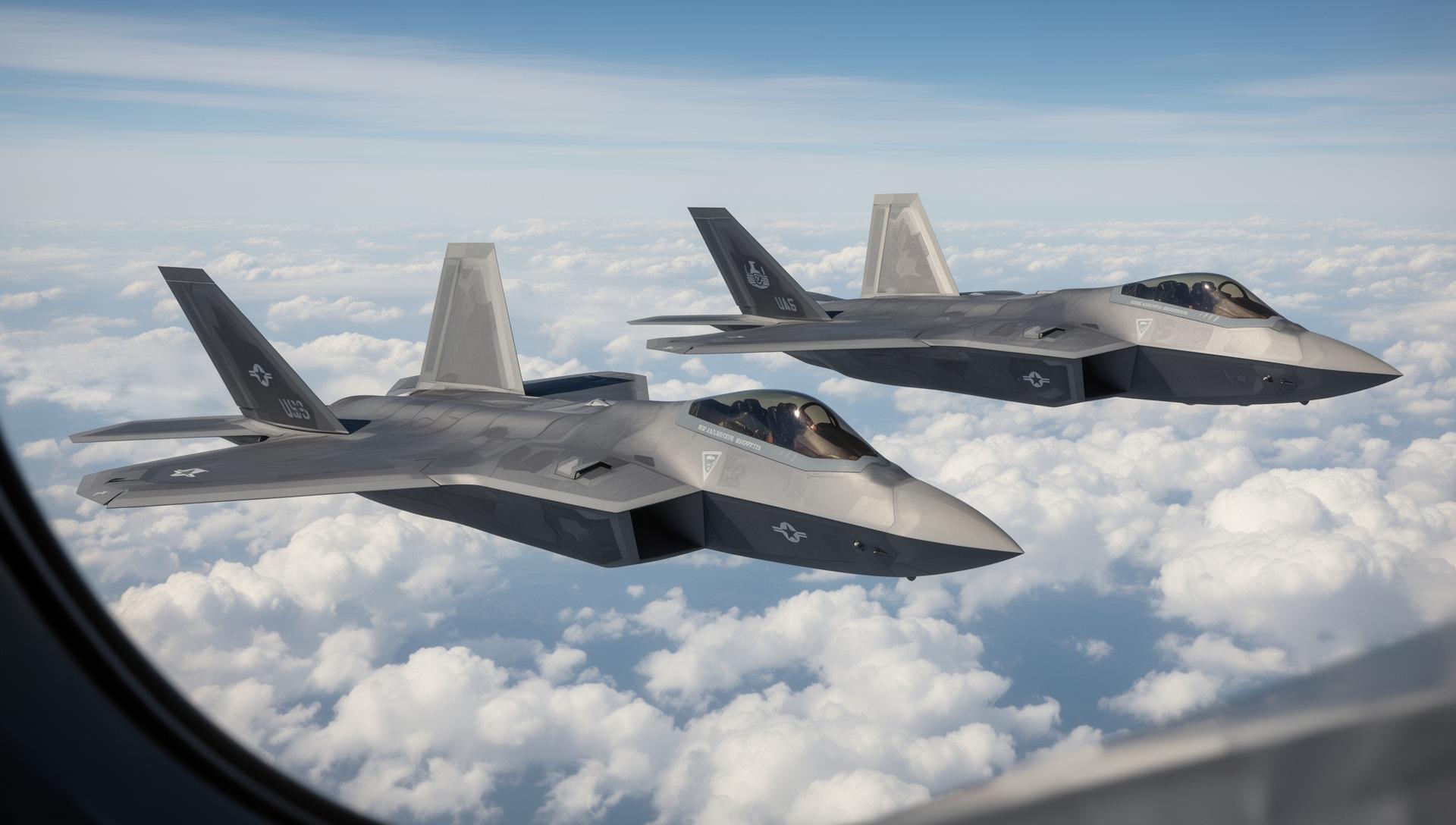
The Boeing F-47 is the first sixth-generation fighter ever awarded to a manufacturer. It will anchor American air superiority for the next four decades (concept illustration based on USAF briefings).
On March 21, 2025, President Trump announced that Boeing had won the contract to build the United States Air Force's Next Generation Air Dominance fighter, designated the F-47. It was the first time a new American air superiority fighter had been selected since the F-22 Raptor over three decades earlier. The decision ended a competition that had been running since at least 2015, survived a budget-driven near-cancellation in 2024, and produced classified experimental aircraft that flew for years before the public ever learned of them. Boeing's demonstrator first flew in 2019 under a DARPA-funded program; Lockheed Martin's followed in 2022.
The F-47 is designed for a specific strategic problem: projecting air superiority across the vast distances of the Pacific theater against a near-peer adversary. The Indo-Pacific region demands combat range that current fighters cannot match. The F-22's unrefueled combat radius of approximately 500 nautical miles is insufficient for operations from dispersed island bases across the western Pacific. Congressional budget documents and Air Force statements indicate the F-47 will have a combat radius exceeding 1,000 nautical miles, enabling it to reach contested airspace without depending entirely on tanker support that would itself be vulnerable to Chinese long-range missiles.
What makes the F-47 a generational leap rather than an incremental upgrade goes beyond range. The aircraft is being designed from the outset to command Collaborative Combat Aircraft, AI-controlled drone wingmen that will fly alongside it in mixed formations. This is not an afterthought capability bolted onto an existing airframe. The F-47's entire mission systems architecture is built around the concept of a human pilot directing autonomous platforms in real time, extending the fighter's sensor coverage, weapons capacity, and survivability without adding more crewed aircraft. The pilot becomes an orchestrator of a formation rather than a lone operator.
The stealth characteristics of the F-47 are expected to surpass those of the F-22 and F-35, incorporating lessons learned from three decades of stealth operations and maintenance. The Air Force has described the F-47 as achieving levels of low observability optimized against modern sensor threats including advanced radar networks, infrared search-and-track systems, and passive electronic detection. The contract is worth at least $20 billion for engineering and manufacturing development, according to Breaking Defense, with production orders potentially valued in the hundreds of billions over the program's lifetime. First flight is targeted for 2028, with initial operational capability by 2029. For a detailed comparison of how the F-47 stacks up against its predecessors, see our F-47 vs. F-22 vs. F-35 breakdown.
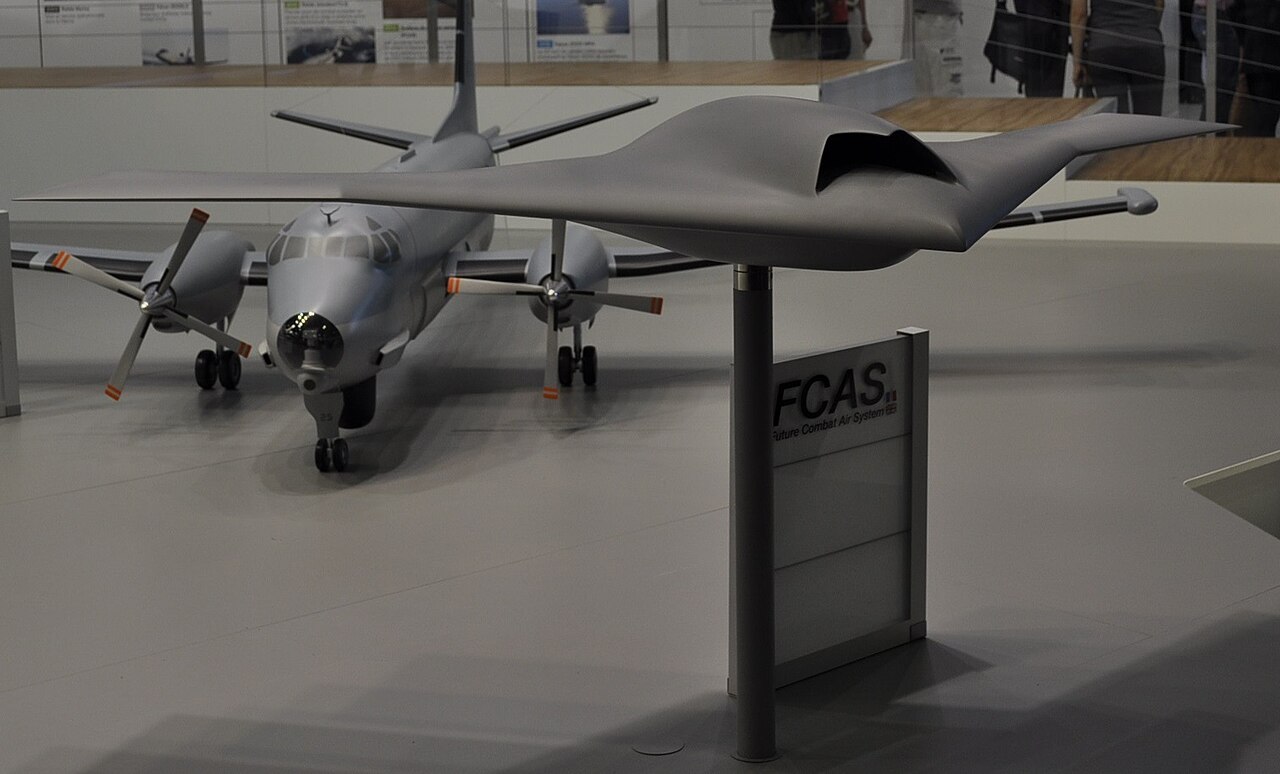
Collaborative Combat Aircraft are designed to fly as autonomous wingmen alongside crewed fighters, absorbing risk and extending combat capability at a fraction of the cost (USAF concept illustration).
If the F-47 represents the next generation of what a fighter can be, the Collaborative Combat Aircraft program represents the next generation of how fighters will fight. The CCA concept is straightforward in principle and revolutionary in practice: pair every crewed fighter with two or more AI-controlled unmanned aircraft that carry sensors, weapons, and electronic warfare systems. The human pilot commands the formation. The drones execute. The concept is sometimes called "loyal wingman," and it represents the most significant shift in American air combat doctrine since the introduction of stealth.
The Air Force has selected two companies to build the first CCAs: Anduril Industries, a defense technology startup founded in 2017, and General Atomics Aeronautical Systems, the company behind the MQ-9 Reaper. Both are building stealthy, jet-powered unmanned aircraft in the $3 million to $10 million price range, cheap enough that the Pentagon uses the term "attritable," meaning commanders can accept losing them in combat without the loss being strategically significant. For comparison, an F-35A costs approximately $80 million. Losing an $8 million CCA is a budget line item. Losing an F-35 and its trained pilot is a strategic event.
The math changes everything. The Air Force plans to procure over a thousand CCAs, enough to pair two or more with every F-35A and F-47 in the fleet. At those numbers, the total combat mass of the force expands dramatically without a proportional increase in cost or, critically, in the number of human pilots required. A squadron of 24 crewed fighters with 48 CCAs has three times the platforms of a traditional squadron, with most of the added capability residing in expendable assets that can absorb enemy fire or fly into the most dangerous threat zones so the crewed jets do not have to.
CCAs are designed to perform multiple mission sets depending on their configuration: forward sensor platforms that extend detection range far beyond the crewed fighter's own radar horizon, additional weapons trucks that increase the formation's total missile count, electronic warfare jammers that suppress enemy air defenses, and decoys that absorb enemy missiles. The AI systems controlling them are being developed to operate with varying degrees of autonomy, from tightly supervised modes where the human pilot approves every action to more autonomous modes where the CCA reacts to threats faster than a human could direct it.
The selection of Anduril alongside General Atomics also signals a deliberate Pentagon strategy to bring non-traditional defense companies into the fighter aviation supply chain. Both prototypes are expected to fly in 2025-2026, with production deliveries beginning by 2028. The implications extend well beyond the Air Force. The same manned-unmanned teaming concept is being applied to naval aviation, ground combat vehicles, and autonomous warfare across every domain. How the CCA program performs will shape military aviation worldwide for decades.
3. Hypersonic Weapons
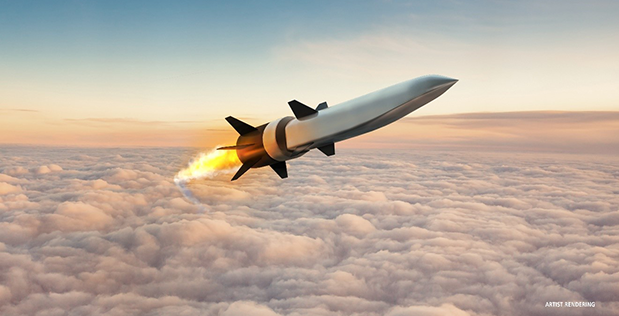
Hypersonic weapons travel at Mach 5 or greater while maneuvering unpredictably, compressing defender reaction times from minutes to seconds (concept illustration based on DoD graphics).
For most of the missile age, defenders could count on time. A ballistic missile followed a predictable arc, giving radars minutes to track, calculate, and launch an interceptor. A cruise missile flew low and slow enough that layered defenses could engage it across multiple opportunities. Hypersonic weapons shatter both assumptions. Flying at speeds exceeding Mach 5, roughly 3,800 miles per hour at sea level, while maneuvering unpredictably during flight, these weapons compress engagement timelines from minutes to seconds and defeat the trajectory-prediction algorithms that underpin every existing missile defense system.
The hypersonic race is a three-way competition, and the United States is not in the lead. Russia claims to have deployed the Avangard hypersonic glide vehicle operationally, a strategic weapon mounted on ICBMs that reportedly reaches Mach 27 during its glide phase. Russia has also fielded the 3M22 Zircon, an anti-ship hypersonic cruise missile deployed on frigates and submarines, and claims to have used the Kinzhal air-launched ballistic missile in combat in Ukraine. China has tested and reportedly deployed the DF-17, a medium-range ballistic missile carrying a hypersonic glide vehicle aimed at Taiwan contingencies. China's broader hypersonic testing program has been described by former Vice Chairman of the Joint Chiefs General John Hyten as proceeding at a pace that "stunned" American intelligence officials.
The United States, despite spending more on defense than Russia and China combined, has struggled to field its own hypersonic weapons. The Army's Long-Range Hypersonic Weapon (LRHW), also known as Dark Eagle, suffered multiple test failures before achieving a successful flight in mid-2025. The Air Force's AGM-183A Air-launched Rapid Response Weapon (ARRW) was canceled in 2024 after its own troubled test program. The Navy's Conventional Prompt Strike program, sharing the same common glide body as the Army's LRHW, is progressing but behind schedule. The most promising American effort is the Hypersonic Attack Cruise Missile (HACM), a scramjet-powered weapon being developed by Raytheon, expected to reach initial operational capability in the late 2020s. The Congressional Research Service reported in 2025 that the Pentagon allocated over $6.3 billion for hypersonic research in a single fiscal year.
What makes hypersonic weapons transformative is not just their speed but their strategic implications. A conventional hypersonic weapon can strike time-sensitive targets such as mobile missile launchers, command posts, and ships at sea, with minimal warning and without crossing the nuclear threshold. That capability changes the calculus of deterrence. It also creates an urgent defensive problem: the Missile Defense Agency is investing in space-based sensor layers and next-generation interceptors specifically designed for hypersonic threats, but those systems are years behind the offensive weapons they are meant to counter. The nation that masters both hypersonic strike and hypersonic defense will hold a significant edge in any great power conflict. For how these weapons affect naval operations, see our analysis of how aircraft carriers are defended.
4. High-Energy Laser Weapons
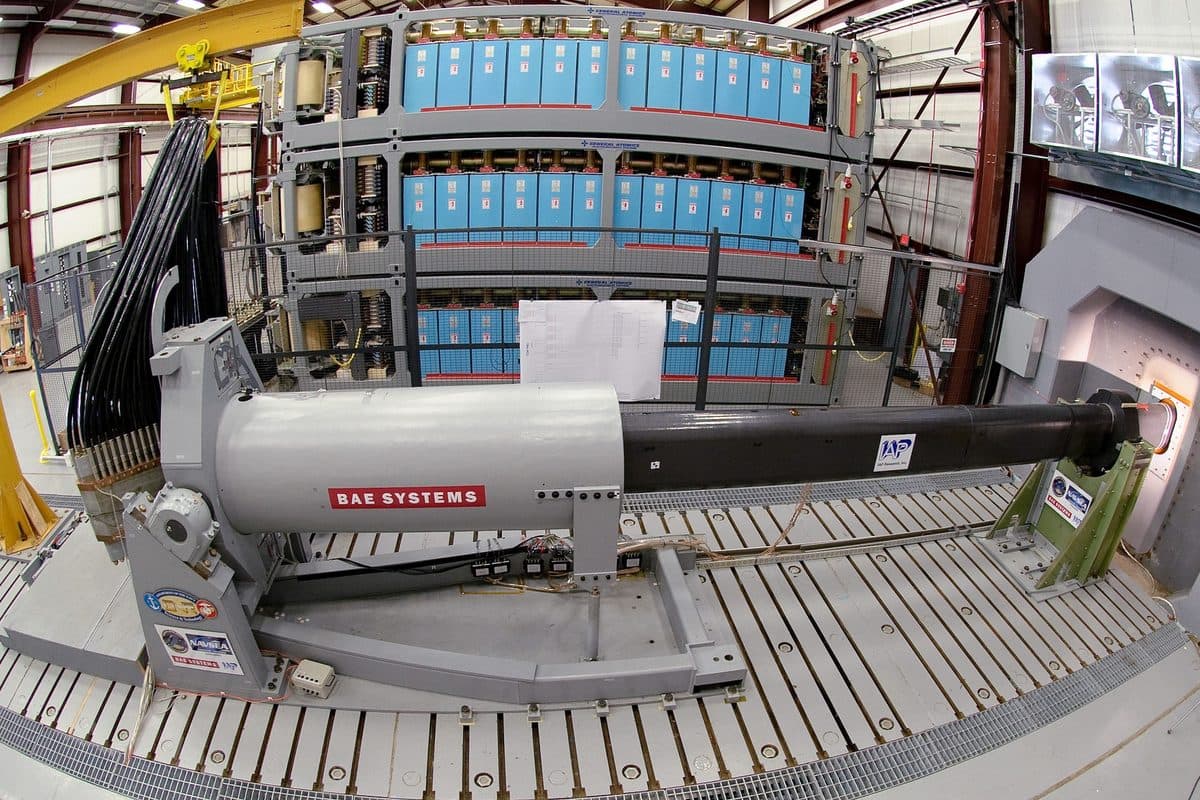
Directed energy weapons like the Navy's HELIOS system engage targets at the speed of light with a cost per shot measured in single-digit dollars (U.S. Navy concept image).
The math problem driving directed energy weapons into operational service is brutally simple: a $50,000 drone can force a defender to spend a $2 million missile to shoot it down. When the attacker can field those drones by the thousands, the defender runs out of interceptors long before the attacker runs out of drones. High-energy lasers flip that equation. Their cost per shot is approximately one dollar, the cost of the electricity to generate the beam. Their magazine is limited only by available power. And they engage targets at the speed of light, roughly 186,000 miles per second, eliminating the flight-time calculations that complicate every kinetic air defense system.
The U.S. Navy's HELIOS system, short for High Energy Laser with Integrated Optical-dazzler and Surveillance, is a 60-kilowatt-class laser now installed on Arleigh Burke-class destroyers. The system has been deployed aboard the USS Preble and is designed to counter small boats, unmanned aerial vehicles, and intelligence-gathering drones. HELIOS can also dazzle the electro-optical sensors on incoming anti-ship missiles, degrading their terminal guidance without needing to physically destroy them. The Navy is developing more powerful follow-on systems targeting 150 kilowatts and beyond.
On land, the Army's DE-SHORAD system mounts a 50-kilowatt laser on a Stryker armored vehicle. DE-SHORAD is designed specifically to counter the drone and cruise missile threats that have proliferated in Ukraine and the Middle East. The system completed successful shoot-downs in testing and is being prepared for fielding with short-range air defense units. The Army is also developing a 300-kilowatt laser under the IFPC-HEL program, powerful enough to engage cruise missiles, rockets, and artillery shells at operationally useful distances. In early February 2026, the FAA closed airspace over El Paso, Texas for military counter-drone laser testing, a signal that directed energy weapons are moving from controlled test ranges to realistic training environments.
Israel is pursuing the most ambitious timeline of any nation. The Iron Beam system, developed by Rafael, uses a laser to intercept rockets and drones that currently require Iron Dome interceptor missiles costing roughly $50,000 each. With Hamas and Hezbollah capable of launching thousands of rockets in saturation attacks, Israel cannot afford $50,000 per interception indefinitely. Iron Beam is expected to reach initial operational capability in 2025, making it potentially the first operational laser air defense system in the world.
Lasers are not a silver bullet. They are degraded by rain, fog, dust, and atmospheric turbulence. They require sustained dwell time on a target, meaning they engage threats one at a time rather than in salvos. Current power levels limit effective range to a few kilometers for hard kills. But against the drone swarms and cheap precision munitions that define the emerging battlefield, directed energy weapons offer a cost curve that no kinetic interceptor can match. The technology that once seemed like pure science fiction is now a line item in the defense budget.
5. M1E3 Abrams Next-Generation Tank
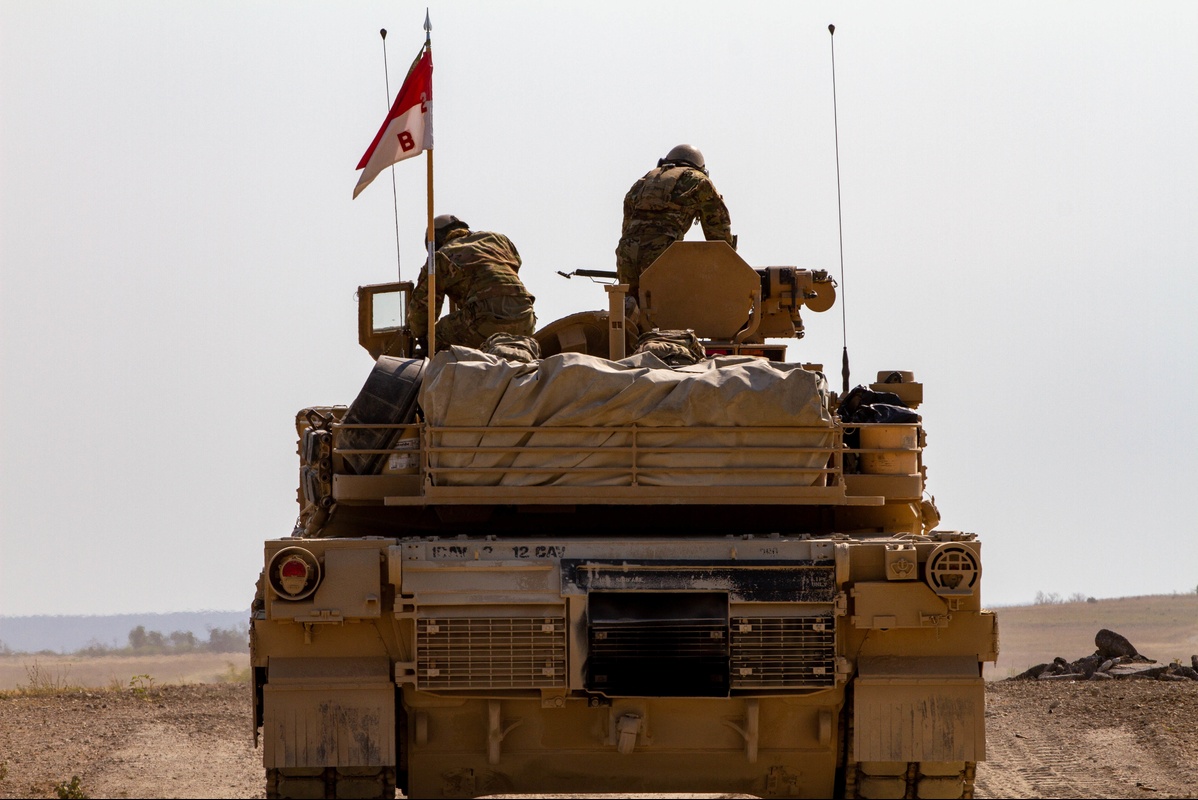
The M1E3 Abrams represents the most significant redesign of America's main battle tank in four decades, built from the ground up for the drone-era battlefield (General Dynamics Land Systems).
The M1 Abrams has been the world's benchmark main battle tank for over 40 years. But the tank that General Dynamics first delivered in 1980 was designed for open-desert warfare against Soviet armored columns, a world that no longer exists. The battlefield of 2026 is dominated by $400 FPV drones destroying million-dollar armored vehicles, precision-guided top-attack missiles, and loitering munitions hunting from above. The war in Ukraine demonstrated these threats with devastating clarity: M1A1 Abrams tanks provided to Ukraine saw combat in 2024 and 2025, and while they performed well in many engagements, several were damaged or destroyed by Russian drones and anti-tank guided missiles. The U.S. Army's response is the M1E3, the most ambitious Abrams redesign since the original.
The M1E3's headline change is weight. The current M1A2 SEPv3 weighs approximately 73 tons, making it difficult to transport by air, punishing on bridges, and limited in where it can operate. The M1E3 targets roughly 60 tons, a reduction of nearly 20 percent, achieved through lighter composite armor, a redesigned hull, and potentially an unmanned or reduced-crew turret. Losing 13 tons while maintaining survivability requires fundamentally rethinking how a tank protects itself: less reliance on passive steel and more reliance on active protection systems that detect and intercept incoming projectiles and drones before they hit.
The propulsion system is a clean break from the Abrams' defining feature. The current tank uses a Honeywell AGT1500 gas turbine engine that produces 1,500 horsepower but consumes fuel at a rate that creates enormous logistical burdens. The Abrams drinks roughly two gallons per mile. The M1E3 will use a hybrid-electric drive system, pairing a diesel engine with electric motors and a high-capacity battery pack. This configuration reduces fuel consumption dramatically, extends operational range, and enables a "silent watch" mode where the tank sits with all sensors active on battery power alone, invisible to thermal detection and inaudible to acoustic sensors. For armored forces operating in contested territory where fuel convoys themselves become targets, that efficiency is not a luxury; it is a survival advantage.
The most debated feature is the potential for an unmanned turret. Removing the crew from the turret would reduce the vehicle's profile, create space for integrated counter-drone systems, and lower risk to the crew. General Dynamics Land Systems unveiled the M1E3 prototype at the Detroit Auto Show in January 2026 and announced an accelerated timeline putting prototypes into soldiers' hands by summer 2026, five years ahead of the original schedule. For context on how the M1E3 stacks up against the global competition, see our ranking of the best main battle tanks in the world. The evolution of tank warfare has always been driven by the interplay between offense and defense; the M1E3 is the latest chapter.
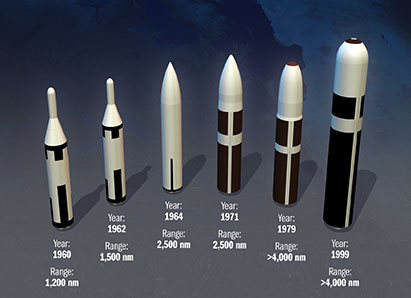
The Columbia-class will replace the aging Ohio-class as the backbone of America's sea-based nuclear deterrent, carrying approximately 70 percent of deployed U.S. nuclear warheads through the 2080s (U.S. Navy rendering).
The Columbia-class submarine program does not generate the headlines that fighter jets and drones attract, but it may be the most consequential weapons program of the decade. At a projected total cost exceeding $130 billion for 12 boats, it is the most expensive weapons acquisition effort in United States Navy history, and the Department of Defense's number one acquisition priority, a status unchanged across multiple administrations. The reason is existential: Ohio-class submarines carry approximately 70 percent of America's deployed nuclear warheads, and those submarines are running out of service life.
The urgency is not theoretical. The first Ohio-class boat, USS Ohio, was commissioned in 1981 with a designed service life of 30 years. That life has already been extended to 42 years, pushing these submarines well beyond their original engineering limits. Unlike every other class of nuclear submarine in the U.S. fleet, the Ohio-class reactors cannot be refueled. When the reactor fuel is spent, the boat is done. The oldest Ohios will begin mandatory retirement in the early 2030s whether their replacements are ready or not. If the Columbia-class boats are not delivered on schedule, the United States faces a gap in its sea-based nuclear deterrent for the first time since the Cold War, at precisely the time when China is expanding its nuclear arsenal and Russia is modernizing its own submarine force.
The Columbia-class incorporates several generational advances. Its S1B nuclear reactor is a life-of-ship design that will never require refueling over the submarine's planned 42-year service life, eliminating the multi-year, multi-billion-dollar mid-life refueling overhaul that other submarine classes require. This single design decision keeps boats on deterrent patrol rather than sitting in dry dock for years. The propulsion system uses an electric-drive system rather than the traditional mechanical-drive reduction gears of the Ohio-class, a change that makes the Columbia significantly quieter, a critical advantage for a submarine whose survival depends entirely on remaining undetected beneath hundreds of feet of ocean.
Each Columbia-class submarine will carry 16 Trident II D5LE ballistic missiles, down from the Ohio-class's 24 tubes. The reduction was a deliberate design choice: 16 tubes are sufficient for the required warhead count under current arms control frameworks, and the freed space and weight budget went to quieting, survivability, and the larger reactor. The common missile compartment was designed jointly with the United Kingdom for their Dreadnought-class submarines, a rare example of binational nuclear weapons cooperation at the hardware level.
Construction of the lead boat, USS District of Columbia (SSBN-826), is underway at General Dynamics Electric Boat in Groton, Connecticut, with first patrol scheduled for 2031. Senior Navy officials have described the program's schedule as having "zero margin" for delay. For a full side-by-side comparison of old and new, read our Columbia-class vs. Ohio-class analysis, and for how the world's submarine forces compare more broadly, see our ranking of the best attack submarines in 2026.
7. FPV Combat Drones
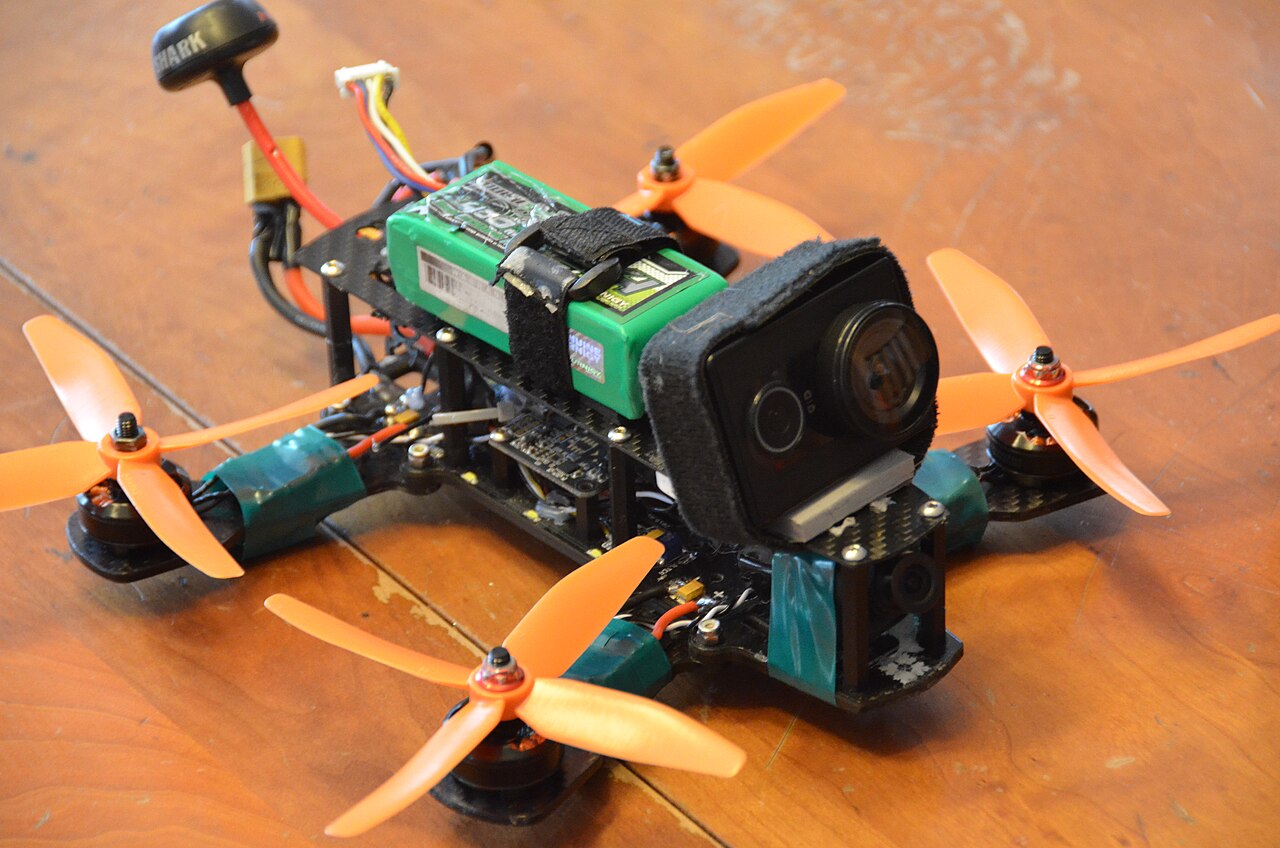
A military FPV drone carrying a shaped-charge warhead. These drones cost a few hundred dollars and have become one of the most effective anti-armor weapons in the history of warfare.
Every other weapon on this list costs millions or billions of dollars and was designed by defense contractors with decades of experience. This one costs about $400, can be assembled in a garage, and it may be the most consequential entry on the list. The first-person-view combat drone is, at its core, a racing quadcopter modified for war. It weighs between 1 and 3 kilograms, flies at 100 to 150 kilometers per hour, carries a shaped-charge warhead derived from an RPG round, and is guided by a human operator wearing FPV goggles who sees what the drone sees in real time. Its range is roughly 5 to 15 kilometers. Its flight time is 5 to 10 minutes. It is a one-way weapon, and it has rewritten the economics of armored warfare more profoundly than any system since the anti-tank guided missile.
The war in Ukraine pioneered FPV drone warfare at industrial scale. What began as a volunteer experiment with modified racing drones in late 2022 has grown into an entire weapons ecosystem. By late 2025, Ukrainian forces alone were producing an estimated 50,000 or more FPV drones per month, according to reporting by the Royal United Services Institute. Russia ramped up its own FPV programs in parallel. By 2026, FPV drones account for what military analysts estimate is the single largest category of armored vehicle kills on both sides of the conflict. The West Point Modern War Institute has called the development "the most significant tactical innovation of the war."
The economics are what make this weapon transformative. A $400 drone destroying an $8 million M1 Abrams or a $4.5 million T-90M is not an anomaly; it is the new arithmetic of the modern battlefield. The cost-exchange ratio is so lopsided that it challenges fundamental assumptions about the value of heavy armor. The key components, a flight controller, four brushless motors, a camera, a video transmitter, and a radio receiver, are all commercially available. Warheads are fashioned from existing anti-armor munitions and attached with zip ties or 3D-printed mounts. The simplicity is the point: these are weapons produced at the speed of commercial manufacturing, not traditional defense procurement.
The ripple effects extend far beyond Ukraine. Every military on earth is grappling with how to defend against cheap, mass-produced, precision-guided munitions that can be built by soldiers with weeks of training. The response is driving innovation across multiple domains simultaneously: active protection systems on armored vehicles, electronic warfare jammers to sever drone control links, counter-drone weapons from interceptor drones to directed energy, and the M1E3 Abrams redesigned in part because the current tank was not built for a world where the primary threat comes from above at $400 a shot. FPV drones also foreshadow what comes next: the current generation requires a human pilot for each drone, but both Ukrainian and Russian developers are actively integrating AI-assisted navigation and targeting that will allow a single operator to direct multiple drones simultaneously. When that transition happens, the volume of precision strikes will multiply again.
These seven weapons come from different domains: air, land, sea, and the electromagnetic spectrum. They range in cost from $400 to $130 billion. Some are crewed, some are autonomous, and some blur the line. But they share a set of characteristics that reveal where warfare is heading, and understanding those shared traits matters more than understanding any single weapon in isolation.
Autonomy and artificial intelligence. The F-47 is designed to command AI wingmen. CCAs fly themselves. FPV drones are evolving toward autonomous targeting. Even the Columbia-class submarine relies on AI-assisted systems for signature management and reactor monitoring. The human role across every domain is shifting from operator to supervisor, from pulling the trigger to setting the conditions under which machines act. This does not mean humans are leaving the battlefield; it means each human is commanding more machines across a wider area than was previously possible.
Network-centric operations. None of these weapons is designed to fight alone. The F-47 is part of a family of systems. CCAs are meaningless without a crewed fighter to direct them. Hypersonic weapons require networked kill chains spanning satellites, submarines, and surface ships. Laser defense systems must integrate with existing air defense networks to prioritize threats. The evolution of tanks from isolated fighting vehicles to networked nodes in a combined-arms system mirrors this broader trend. The weapon that cannot share data is the weapon that loses.
Reduced crew and expendability. CCAs are designed to be lost in combat. FPV drones are designed to be expended on every mission. The M1E3 may reduce its crew from four to three. The Columbia-class reactor was engineered to eliminate the need for refueling crews and the years of downtime they require. Across every domain, the trend runs toward systems that need fewer people to operate and put fewer people at risk when things go wrong. This is not pacifism. It is arithmetic. Trained personnel are the scarcest resource on the modern battlefield, and every system on this list is designed to extend what each person can accomplish.
Cost asymmetry as strategy. The $400 FPV drone and the $1-per-shot laser represent a deliberate strategy to exploit cost imbalances. The CCA program is explicitly designed to provide mass at a price point where attrition is acceptable. Even the $130 billion Columbia-class is, per deployed warhead per year of service, a more cost-effective deterrent than maintaining aging Ohio-class boats that require increasingly expensive life extensions. The militaries that master cost-exchange ratios, spending less per effect than their adversaries, will sustain combat power longer in a protracted conflict.
Designed for contested, anti-access environments. Every weapon on this list was shaped by the return of great power competition and the anti-access/area-denial (A2/AD) strategies that define it. The F-47 exists because the Pacific is too big for current fighters to cover. Hypersonic weapons exist because traditional cruise missiles are too slow to survive modern air defenses. Lasers exist because drone swarms overwhelm finite missile inventories. The M1E3 exists because legacy tanks are too vulnerable to modern precision weapons. The Chinese military buildup is the strategic backdrop against which most of these programs were funded and designed, and every system reflects the geographic and technological realities of that competition.
The generational shift happening right now is not about any single platform. It is about the convergence of autonomy, networking, and affordability across every domain simultaneously. The military that integrates these capabilities into a coherent system of systems, where fighters, drones, submarines, tanks, lasers, and hypersonic weapons share information and coordinate effects in real time, will hold a decisive advantage in the conflicts of the next two decades. The ones that cling to legacy platforms and industrial-age procurement timelines will not. The future of warfare is not arriving in 2040 or on some Pentagon slideshow timeline. It is arriving now.
Frequently Asked Questions
What is the most advanced weapon in the world in 2026?
In terms of raw technological sophistication, the Boeing F-47 sixth-generation fighter and the AI systems powering the Collaborative Combat Aircraft program represent the cutting edge of military engineering. However, "most advanced" depends on the metric. Hypersonic glide vehicles like Russia's Avangard achieve the highest speeds. The Columbia-class submarine's life-of-ship reactor represents the most advanced nuclear propulsion engineering. High-energy lasers represent a fundamentally new category of weapon based on directed energy rather than kinetic force. The broader trend is that the most advanced capabilities increasingly reside not in any single platform but in the networks connecting these systems: the data links, AI algorithms, and sensor fusion architectures that allow disparate weapons to function as a coordinated whole. For a look at military technology that once seemed impossible, see our article on sci-fi military tech that is now real.
Which country has the best military technology in 2026?
The United States maintains a significant overall lead in military technology, particularly in stealth aircraft, sensor fusion, nuclear submarine design, and the integration of artificial intelligence into combat systems. However, the lead is not uniform. Russia has deployed operational hypersonic weapons before the United States. China has demonstrated a pace of military modernization spanning fifth-generation fighters, hypersonic missiles, advanced naval vessels, and space-based systems, and it has narrowed the gap faster than most Western analysts predicted a decade ago. China's military buildup is the most rapid in modern history. Israel leads in certain categories of missile defense and directed energy. No single country dominates every domain, which is precisely what makes the current era of military competition so consequential and unpredictable.
Are drones making tanks obsolete?
No, but they are forcing tanks to evolve faster than at any point since the introduction of anti-tank guided missiles in the 1970s. The war in Ukraine has demonstrated that unprotected armored vehicles are acutely vulnerable to cheap FPV drones and loitering munitions. But the response is not to abandon tanks. It is to adapt them. The M1E3 Abrams incorporates active protection systems, reduced weight for improved mobility, hybrid-electric propulsion for reduced detectability, and integrated counter-drone capabilities designed specifically to address these threats. Tanks still provide capabilities no other platform can match: direct fire support, protected mobility for combined-arms maneuver, and the psychological impact of heavy armor on both enemy forces and friendly troops. What is changing is that tanks can no longer operate without robust counter-drone and electronic warfare protection. The best tanks of 2026 are the ones designed with that reality built in.
Can hypersonic missiles be stopped?
As of early 2026, no operational missile defense system has been publicly demonstrated to reliably intercept a maneuvering hypersonic glide vehicle during its glide phase. The combination of extreme speed (above Mach 5), unpredictable maneuverability, and a flight altitude that falls between the coverage zones of space-based and ground-based sensors creates what analysts call the "glide-phase gap." However, significant investment is being directed at the problem. The Missile Defense Agency's Glide Phase Interceptor (GPI) program aims to develop a missile specifically designed to engage hypersonic threats. New space-based sensor layers are being developed to provide continuous tracking through the detection gaps that current ground-based radars cannot cover. And directed energy weapons are being studied as a potential future layer of defense. The honest answer is that hypersonic defense is years behind hypersonic offense, and closing that gap is one of the most urgent and technically demanding challenges in modern defense technology. For the full technical picture, see our comprehensive guide to hypersonic weapons.