Alex Carter writes about modern warfare, emerging military technology, and how doctrine adapts to new tools. His work focuses on what changes in practice -- command, control, targeting, and risk -- when systems like drones and autonomous platforms become routine.
Updated April 2026
This article was originally published in February 2026. The following section reflects the latest developments in global hypersonic weapons programs as of April 2026.
2026 Update: Where Every Nation's Program Actually Stands
Since this article was first published in February, several significant developments have reshaped the global hypersonic landscape. The United States finally completed a successful joint Army-Navy hypersonic missile test in late 2024, but then missed its own fielding deadline. China continues to expand its operational arsenal quietly. Russia's combat use of hypersonic weapons in Ukraine has provided real-world data on both their effectiveness and their limitations. And ARRW, the Air Force program we reported as cancelled, has received new funding. Here is where every major program stands as of April 2026.
United States: Progress, But Still Behind
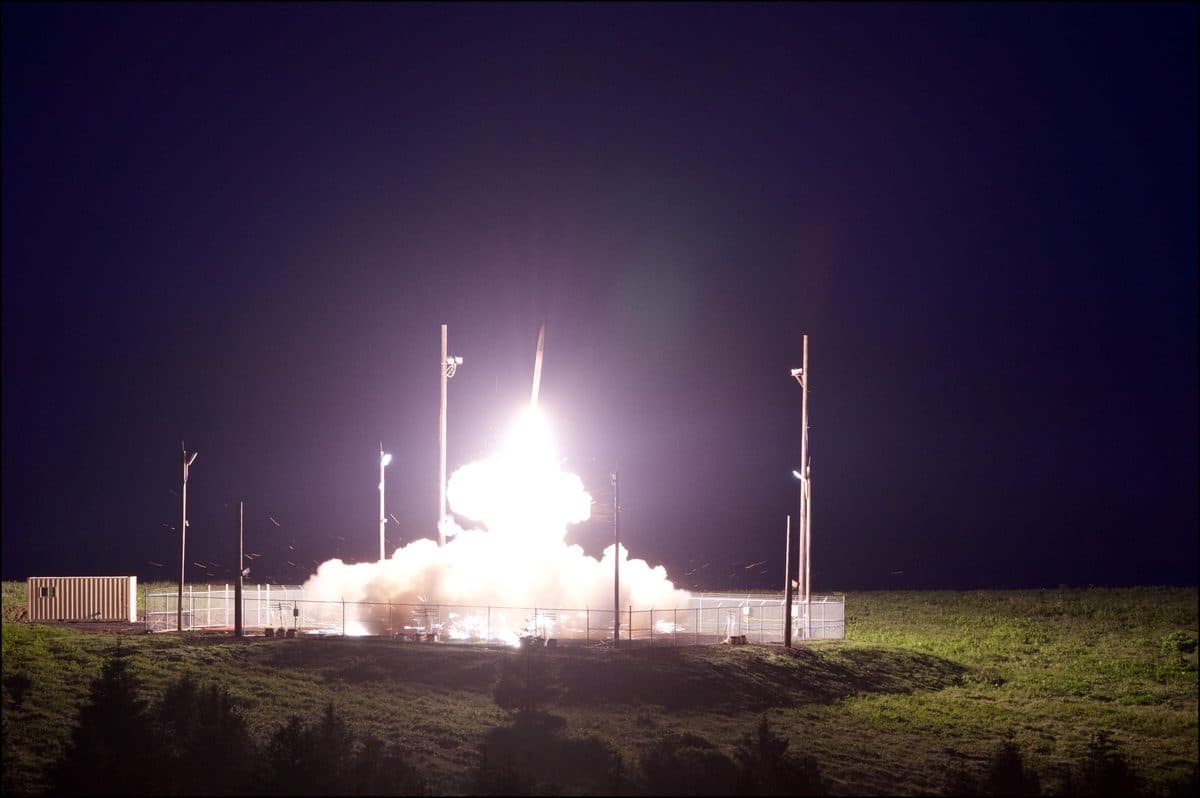
The biggest US development came in December 2024, when the Army and Navy successfully conducted their second joint hypersonic missile flight test, following an earlier success in mid-2024. Both tests validated the Common-Hypersonic Glide Body (C-HGB) that underpins the Army's Dark Eagle (LRHW) and the Navy's Conventional Prompt Strike (CPS) programs. The glide body performed as designed, reaching hypersonic speeds and maneuvering during its glide phase.
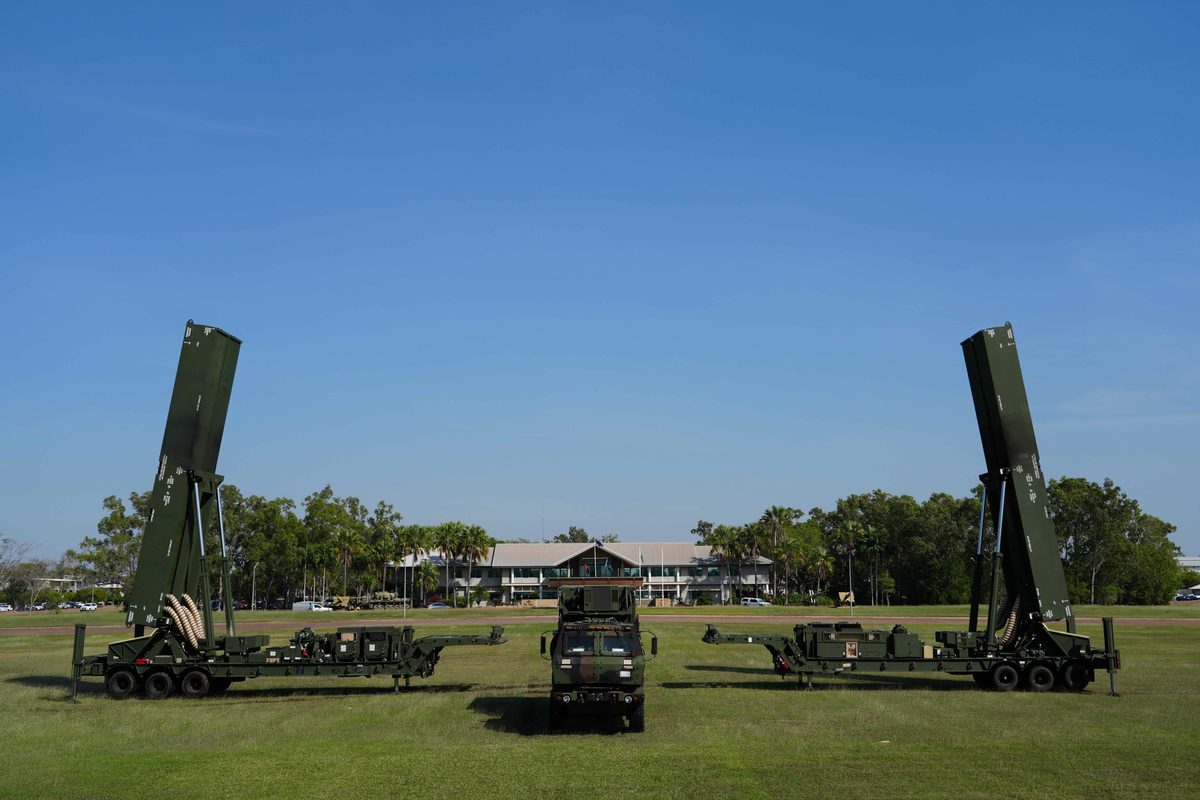
However, these test successes have not translated to operational fielding on schedule. The Army planned to declare Dark Eagle operational by the end of 2025, but acknowledged in January 2026 that it missed that deadline. The prototype battery at Joint Base Lewis-McChord has the launchers and support equipment, but the weapon system has not yet completed the full qualification testing required for operational status. Dark Eagle did deploy outside the continental United States for the first time during Exercise Talisman Sabre 25 in Australia in July 2025 -- a significant milestone for demonstrating transportability, but not the same as combat readiness.
The Dark Eagle LRHW system was deployed to Australia for Exercise Talisman Sabre 25 in July 2025, marking its first operational employment outside the continental United States. The system has yet to achieve full operational capability. (U.S. Army photo)
The Air Force's HACM (Hypersonic Attack Cruise Missile), built by Raytheon, has faced its own delays. First flight was expected by October 2025, but slipped into fiscal year 2026. The Air Force requested $802.8 million for HACM in the FY2026 budget, signaling continued commitment. Meanwhile, in a surprise reversal, Air Force Chief of Staff Gen. David Allvin told Congress in June 2025 that the FY2026 budget would include $387.1 million for the AGM-183A ARRW -- the boost-glide weapon previously considered cancelled. The Air Force appears to have concluded that abandoning ARRW entirely would leave a capability gap while HACM continues development.
The Navy's CPS program remains tied to the Zumwalt-class destroyers, with USS Zumwalt undergoing modifications to accommodate the missile. Integration is expected by 2027, though the timeline depends on continued successful C-HGB testing.
Russia: Combat Data, Mixed Results
Russia's continued use of Kinzhal missiles in Ukraine has provided unprecedented real-world data on hypersonic weapons in combat -- and the results are mixed. While Kinzhal strikes have demonstrated the weapon's speed and difficulty of interception, Ukraine has claimed multiple successful intercepts using Patriot air defense systems, including a widely reported shootdown in May 2023. These claims, while not independently verified, suggest that the Kinzhal -- which many Western analysts classify as an aeroballistic missile rather than a true maneuvering hypersonic weapon -- may be more vulnerable to advanced air defenses than Russian marketing implied.
The Avangard HGV remains operationally deployed on UR-100N ICBMs, but planned integration onto the RS-28 Sarmat ICBM has been delayed by Sarmat's troubled development. The Zircon anti-ship missile has been deployed on Admiral Gorshkov-class frigates and is expected on Yasen-M submarines, though production rates appear limited.
China: Quietly Expanding
China continues to maintain the largest and most diverse hypersonic development program. The DF-17 remains operational, and the Pentagon's latest assessment estimates the PLARF has increased its DF-17 launcher inventory. The DF-27, an intermediate-range system with an HGV payload, has reportedly completed development testing and may be nearing operational status. China has also tested the WZ-8, a high-altitude supersonic/hypersonic reconnaissance drone designed to provide targeting data for anti-ship operations in the Western Pacific -- a system that could work in concert with hypersonic anti-ship missiles.
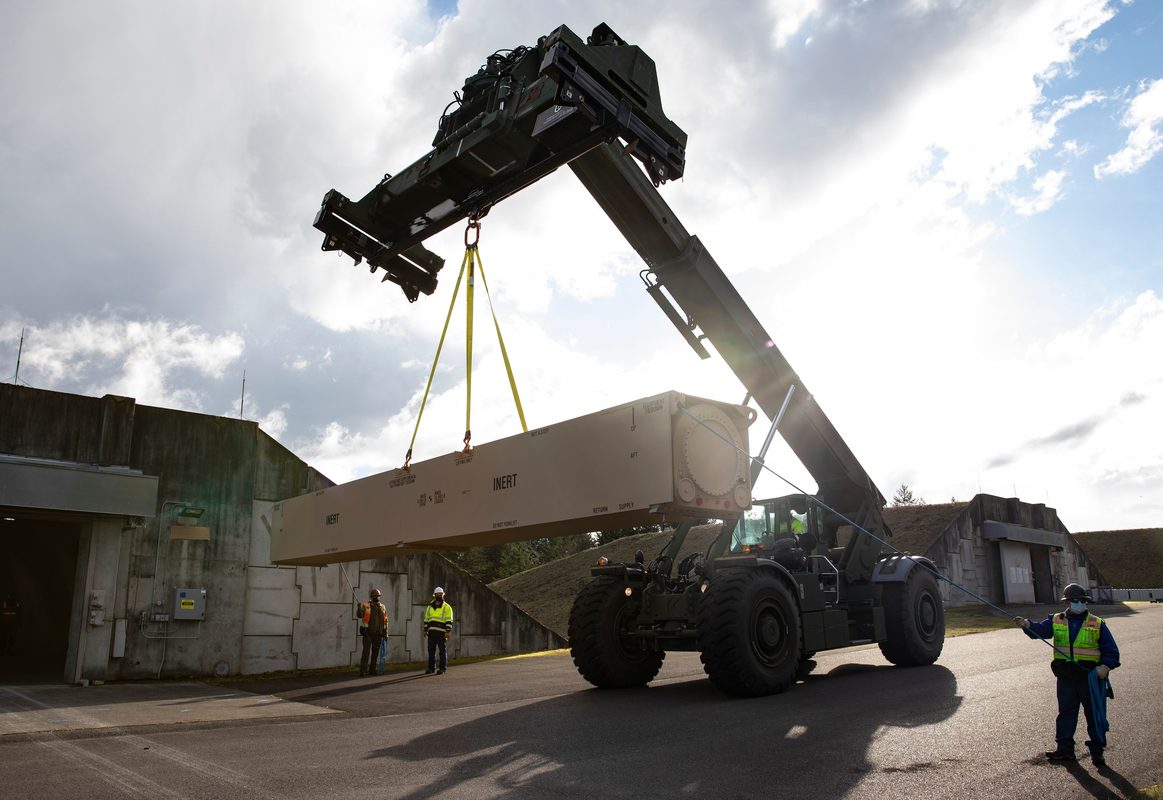
Hypersonic weapon components being transported to a US military installation. The logistics of fielding these complex systems -- from specialized launchers to temperature-controlled storage -- present challenges that test victories alone do not resolve. (U.S. Army photo)
Emerging Players
North Korea's Hwasong-16B, tested in 2024, demonstrated a medium-range ballistic missile with what Pyongyang claims is a hypersonic maneuvering warhead. South Korean and Japanese assessments gave the test mixed reviews, suggesting partial success. India's BrahMos-II hypersonic cruise missile program continues in partnership with Russia, though timelines have slipped. The AUKUS partnership between the UK, US, and Australia includes hypersonic weapons cooperation, with a focus on both offensive development and defensive countermeasures -- DARPA's Glide Breaker program, which aims to develop an interceptor capable of defeating hypersonic glide vehicles, is a key element of this effort.
The Emerging Defense Side
Perhaps the most significant development of 2025 was the successful Missile Defense Agency test in March 2025, when USS Pinckney used the Sea Based Terminal (SBT) Increment 3 capability to detect, track, and conduct a simulated engagement of a maneuvering hypersonic target. While this was a tracking and fire-control test rather than an actual intercept, it marked the first time a Navy ship demonstrated the ability to engage a hypersonic threat from a standard surface combatant. If SBT technology matures, it could fundamentally change the calculus that has driven hypersonic weapons development -- the assumption that these weapons are effectively unstoppable.
For most of the missile age, defenders could count on time. A ballistic missile followed a predictable arc through space, giving ground-based radars minutes to track it, calculate its trajectory, and launch an interceptor. A cruise missile flew low and slow enough that layered air defenses could engage it across multiple opportunities. The fundamental assumption underlying decades of missile defense investment was that defenders would have enough warning, enough tracking data, and enough reaction time to mount a credible response.
Hypersonic weapons challenge every part of that assumption. Flying at speeds of Mach 5 or greater -- five times the speed of sound, roughly 3,800 miles per hour at sea level -- these weapons compress engagement timelines from minutes to seconds. But speed alone is not what makes them dangerous. What distinguishes hypersonic weapons from the ballistic missiles that have traveled even faster for decades is their combination of extreme velocity with the ability to maneuver unpredictably during flight. A ballistic warhead is fast but follows physics; its trajectory can be calculated. A hypersonic glide vehicle is fast and steers, making its final destination uncertain until the last moments before impact.
This combination has triggered an arms race that now spans at least three major powers and several aspiring ones. Russia claims to have deployed hypersonic weapons operationally and used them in combat. China has tested systems that reportedly surprised American intelligence agencies. The United States, despite spending more on defense than any other nation, has struggled to field its own hypersonic weapons and is widely considered to be behind both rivals. Understanding why these weapons matter, who has them, and whether they can be stopped requires examining the technology, the geopolitics, and the defense implications with precision rather than hype.
The term "hypersonic" refers to speeds exceeding Mach 5 -- five times the speed of sound. At sea level, that translates to approximately 3,836 miles per hour or roughly one mile per second. At higher altitudes where temperatures and air density differ, the absolute speed varies, but the Mach 5 threshold remains the defining benchmark. By this strict definition, intercontinental ballistic missiles (ICBMs) have been hypersonic since the 1960s, reaching speeds above Mach 20 during their terminal phase. What makes modern hypersonic weapons a distinct category is not speed alone but the combination of speed with sustained atmospheric flight and maneuverability.
Two types of hypersonic weapons dominate current development: hypersonic glide vehicles (HGVs) and hypersonic cruise missiles (HCMs). They achieve their speed through fundamentally different means, and each presents different challenges for defenders.
Hypersonic Glide Vehicles (HGVs)
An HGV uses a conventional rocket booster to reach high altitude, typically 40 to 100 kilometers above the Earth's surface. At this point, the vehicle separates from the booster and begins an unpowered glide through the upper atmosphere, using aerodynamic lift to sustain flight at hypersonic speeds over thousands of kilometers. Unlike a traditional ballistic warhead, which arcs through space on a predictable parabolic trajectory, an HGV remains within the atmosphere and can maneuver laterally -- changing course, adjusting altitude, and performing evasive turns during its glide phase.
This maneuverability is what makes HGVs so difficult to defend against. A ballistic missile's trajectory can be predicted within minutes of launch, allowing defenders to calculate the impact point and position interceptors accordingly. An HGV's trajectory cannot be predicted because the vehicle can alter its course continuously. Defenders must track the vehicle in real time and react to its maneuvers, a task that current missile defense architectures were not designed to perform.
Hypersonic Cruise Missiles (HCMs)
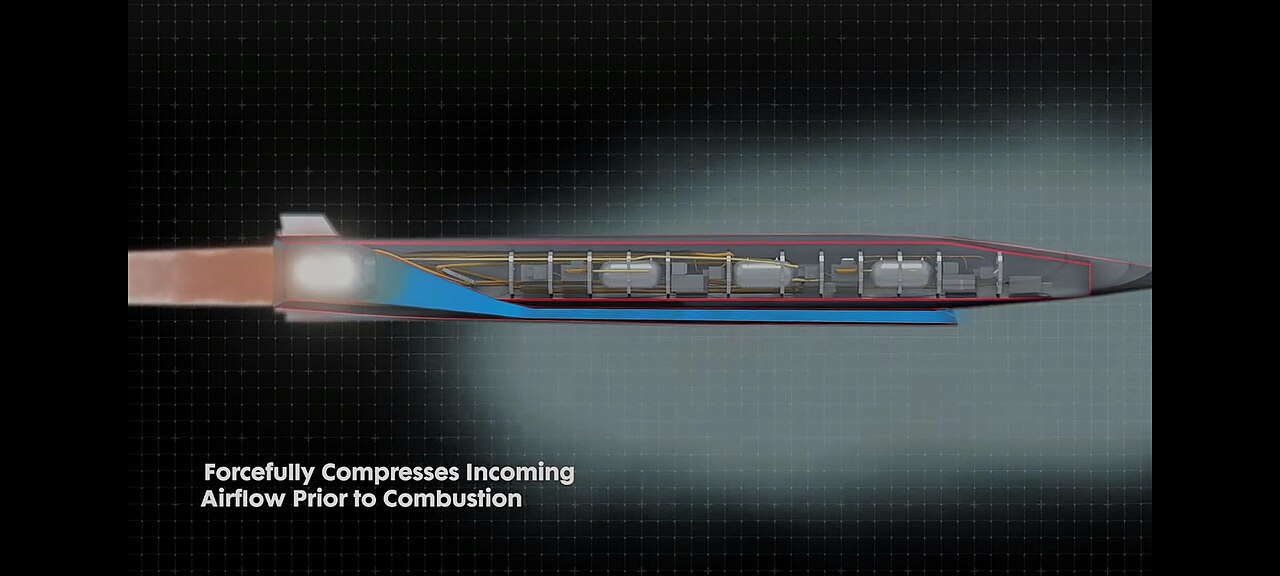
An HCM is a powered vehicle that sustains hypersonic flight using an air-breathing engine, specifically a scramjet (supersonic combustion ramjet). Unlike an HGV, which is launched to high altitude and glides downward, an HCM flies at lower altitudes -- potentially within the upper troposphere or lower stratosphere -- under sustained engine power. Scramjets compress incoming air at supersonic speeds without the need for rotating compressor blades, ignite fuel in the supersonic airflow, and produce thrust that maintains flight above Mach 5.
Scramjet technology is extraordinarily demanding. The engine must manage airflows at thousands of miles per hour, combustion temperatures that can exceed 3,500 degrees Fahrenheit, and structural loads that push the limits of known materials. Sustaining scramjet combustion for more than brief periods remains one of the hardest engineering problems in aerospace. As a result, operational HCMs are less mature than HGVs, though several nations have active development programs.
Why Hypersonic Weapons Are Hard to Intercept
Three characteristics make hypersonic weapons exceptionally challenging for existing defenses. First, their speed compresses reaction time. A hypersonic weapon traveling at Mach 8 covers approximately 100 kilometers in less than 50 seconds. Defensive systems designed around subsonic or low-supersonic cruise missiles have engagement windows measured in minutes; against hypersonic threats, those windows shrink to seconds.
Second, their maneuverability defeats prediction. Current missile defense systems rely heavily on tracking an incoming threat, predicting its trajectory, and launching an interceptor to a calculated intercept point. Against a maneuvering hypersonic vehicle, that prediction becomes unreliable. Defenders must continuously update their intercept solution as the target changes course, a challenge that strains existing sensor networks and fire-control algorithms.
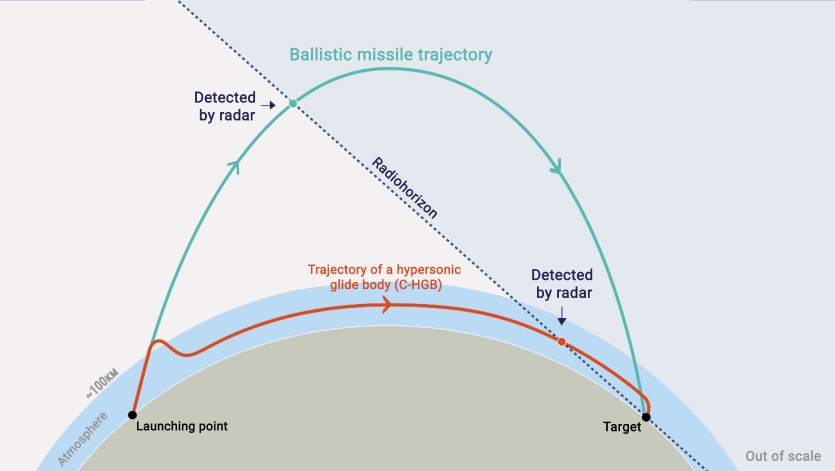
Third, HGVs fly at altitudes that create a detection gap. They operate below the altitude where space-based sensors optimized for ballistic missile tracking perform best, but above the altitude where ground-based air defense radars provide reliable coverage. This seam between existing sensor layers -- sometimes called the "glide-phase gap" -- means that HGVs may not be continuously tracked during the portion of flight where they are most maneuverable.
Hypersonic glide vehicles fly lower than traditional ballistic missiles but higher and faster than cruise missiles, exploiting a gap in existing sensor coverage. (Illustration based on CRS/CSIS analysis)
Russia: First to Deploy
Russia became the first nation to declare an operational hypersonic weapon when it announced in December 2019 that the Avangard hypersonic glide vehicle had entered combat duty with the Strategic Rocket Forces. Russia has since claimed to have used another hypersonic-class weapon in combat in Ukraine, and it has deployed a third system on naval platforms. Each system serves a different strategic purpose, and each warrants careful assessment.
Avangard HGV
The Avangard is a strategic hypersonic glide vehicle designed to be launched atop an ICBM -- initially the UR-100N UTTKh (SS-19 Stiletto), with planned integration onto the RS-28 Sarmat (SS-X-30 Satan II). Russian officials have claimed the Avangard can reach speeds up to Mach 27 and perform evasive maneuvers during its glide phase, making it effectively immune to current missile defense systems. The system is designed to carry a nuclear warhead.
The Avangard's strategic significance lies in its ability to circumvent American missile defenses. While the US Ground-based Midcourse Defense (GMD) system is designed to intercept ballistic warheads following predictable trajectories through space, the Avangard's maneuvering flight path would make GMD intercepts extremely difficult. Whether the Avangard performs exactly as Russian officials claim is impossible to verify from open sources, but US officials have acknowledged the system as a genuine capability. A US delegation observed an Avangard test under the New START treaty's inspection provisions before the treaty's inspection regime was suspended.
Kinzhal Air-Launched Ballistic Missile
The Kh-47M2 Kinzhal ("Dagger") is an air-launched ballistic missile carried by modified MiG-31K interceptors and, reportedly, Tu-22M3 bombers. Russia claims the Kinzhal can reach speeds of Mach 10 and has a range of approximately 2,000 kilometers when launched from an aircraft. Russia used the Kinzhal operationally against targets in Ukraine beginning in March 2022, marking the first claimed combat use of a hypersonic weapon.
Whether the Kinzhal qualifies as a true hypersonic weapon is debated among Western analysts. The system appears to be a modification of the ground-launched Iskander short-range ballistic missile, adapted for air launch. While it achieves hypersonic speeds during its terminal phase, it may follow a largely ballistic trajectory with limited maneuvering capability compared to purpose-built HGVs. Some analysts classify it as an aeroballistic missile rather than a hypersonic weapon in the HGV or HCM sense. Ukraine claimed in May 2023 that its Patriot air defense system successfully intercepted a Kinzhal, which, if confirmed, would suggest the weapon is more vulnerable to existing defenses than Russian claims implied.
Zircon Anti-Ship Missile
The 3M22 Zircon (also transliterated as Tsirkon) is a ship-launched hypersonic cruise missile designed for anti-ship and land-attack missions. Russia has reported speeds of Mach 8 to Mach 9 and a range of approximately 1,000 kilometers. The Zircon has been test-fired from the Admiral Gorshkov frigate and from submarine platforms, and Russia announced its operational deployment on the Admiral Gorshkov in early 2023. The weapon is expected to be carried by Yasen-M class submarines, which would allow Russia's most capable attack submarines to threaten surface ships with a weapon that current naval defenses may struggle to intercept.
The Zircon's propulsion system has not been confirmed publicly, but analysts believe it may use a scramjet engine, which would make it one of the first operational hypersonic cruise missiles. If the claimed performance figures are accurate, the Zircon would represent a significant threat to carrier strike groups and other high-value surface formations, compressing defensive engagement timelines to a degree that existing shipboard systems were not designed to handle.
China: The Quiet Leader
While Russia has been the most vocal about its hypersonic achievements, many analysts consider China's hypersonic program to be the most advanced in terms of testing volume, production scale, and technological maturity. China has conducted more hypersonic tests than the United States and Russia combined, according to assessments from the Congressional Research Service and other open-source analyses.
DF-17 Hypersonic Glide Vehicle
The DF-17 is a medium-range ballistic missile equipped with a hypersonic glide vehicle. First displayed publicly during the October 2019 National Day military parade, the DF-17 is assessed to have been operational since 2020. The system has an estimated range of 1,800 to 2,500 kilometers, placing targets throughout the Western Pacific -- including US military facilities on Guam and in Japan -- within reach.
The DF-17's HGV payload distinguishes it from China's conventional ballistic missiles. While the DF-21D "carrier killer" anti-ship ballistic missile follows a largely ballistic trajectory with terminal maneuvering, the DF-17's glide vehicle can sustain maneuvering flight throughout a much longer portion of its trajectory. The Pentagon's annual report on Chinese military power has estimated that the People's Liberation Army Rocket Force (PLARF) fields more than 100 DF-17 launchers, a number that has likely grown.
DF-27 and Longer-Range Systems
The DF-27 is an intermediate-range system believed to carry an HGV payload with a range exceeding 5,000 kilometers, potentially reaching 8,000 kilometers. This range would allow China to hold at risk targets across the entire Indo-Pacific region, including US bases in Australia, Diego Garcia, and Hawaii. Details remain limited, but the DF-27 appears to represent a bridge between the DF-17's regional capability and a potential intercontinental hypersonic system.
Multiple nations are pursuing hypersonic weapons programs. Russia and China have fielded operational systems, while the United States and others are in advanced testing stages. (Graphic based on CSIS Missile Defense Project data)
The July 2021 Orbital Test
In July 2021, China conducted a test that the Financial Times reported "caught US intelligence off guard." The test involved a fractional orbital bombardment system (FOBS) paired with a hypersonic glide vehicle -- a combination that would allow the weapon to approach its target from any direction, including over the South Pole, rather than along the predictable north-polar routes that US early-warning radars are oriented to detect. General Mark Milley, then Chairman of the Joint Chiefs of Staff, described the test as "very close to a Sputnik moment."
China's Foreign Ministry stated the test involved a reusable spacecraft, not a weapon. Regardless of the official characterization, the demonstrated capability -- launching a vehicle into a partial orbit and then releasing a maneuvering glide vehicle -- represents a technical achievement that complicates American missile defense planning. The test demonstrated that China's military modernization extends to capabilities that were previously considered beyond its near-term reach.
United States: Playing Catch-Up
The United States pioneered early hypersonic research -- the X-15 rocket plane exceeded Mach 6 in the 1960s, and DARPA's Falcon HTV-2 program tested hypersonic glide in 2010 and 2011. But the US chose not to pursue operational hypersonic weapons during the post-Cold War period, focusing instead on precision-guided conventional weapons and missile defense. By the time China and Russia demonstrated operational or near-operational systems around 2019-2020, the United States found itself in the unfamiliar position of trailing its primary competitors in a critical weapons technology.
LRHW / Dark Eagle (Army)
The Long-Range Hypersonic Weapon (LRHW), also known as Dark Eagle, is the Army's ground-launched hypersonic system. It uses a Common-Hypersonic Glide Body (C-HGB) -- a joint Army-Navy design -- atop a two-stage rocket booster. The C-HGB is designed to achieve speeds exceeding Mach 5 and strike targets at ranges beyond 1,725 miles (2,775 kilometers). The LRHW was originally planned for an initial operational capability in fiscal year 2023, but testing delays have pushed that timeline. A prototype battery was delivered to the 5th Battalion, 3rd Field Artillery Regiment at Joint Base Lewis-McChord in 2023, but the system had not yet completed a fully successful flight test as of mid-2025.
CPS / Conventional Prompt Strike (Navy)
The Navy's Conventional Prompt Strike (CPS) system uses the same C-HGB as the Army's LRHW but launches from Zumwalt-class destroyers and Virginia-class submarines. CPS is designed to give naval commanders the ability to strike time-sensitive targets at long range without relying on aircraft or cruise missiles. The Navy has planned to integrate CPS onto all three Zumwalt-class destroyers, converting the ships from their original land-attack mission to a hypersonic strike role. CPS has faced the same testing challenges as the LRHW, since both share the common glide body.
HACM (Air Force)
The Hypersonic Attack Cruise Missile (HACM) is the Air Force's air-breathing hypersonic weapon, developed by Raytheon under a contract awarded in 2022. Unlike the boost-glide systems used by the Army and Navy, HACM uses a scramjet engine to sustain powered flight at hypersonic speeds. HACM is designed to be launched from fighter aircraft, giving it a different operational profile than the larger ground- and sea-launched systems. The Air Force has described HACM as a priority program, and it is expected to enter service later this decade.
AGM-183A ARRW: A Cautionary Tale
The Air Force's AGM-183A Air-Launched Rapid Response Weapon (ARRW) was intended to be the first US air-launched hypersonic weapon. However, the program suffered multiple test failures -- including booster ignition failures and separation problems -- that delayed the schedule repeatedly. In March 2023, the Air Force announced it would not seek further procurement funding for ARRW, effectively canceling the program in favor of the HACM. The ARRW experience illustrates the technical difficulty of hypersonic weapons development and underscores why the United States has struggled to match the pace set by Russia and China. As with other ambitious weapons programs, the gap between concept and reliable hardware proved wider than anticipated.
Hypersonic Weapons Programs: Key Systems by Country
Country
System
Type
Status
Russia
Avangard
HGV (ICBM-launched)
Operational (Dec 2019)
Russia
Kinzhal (Kh-47M2)
Air-launched ballistic
Operational; used in Ukraine
Russia
Zircon (3M22)
Ship-launched HCM
Operational (2023)
China
DF-17
HGV (medium-range)
Operational (~2020)
China
DF-27
HGV (intermediate-range)
Testing / near-operational
United States
LRHW / Dark Eagle
HGV (ground-launched)
Testing; IOC delayed
United States
CPS
HGV (sea-launched)
Testing; planned for Zumwalt
United States
HACM
Air-breathing HCM
Development (Raytheon)
North Korea
Hwasong-16B
HGV (medium-range)
Tested (2024)
Status assessments are based on publicly available reporting from CRS, CSIS, and DoD sources as of early 2026. Performance claims from Russia and China cannot be independently verified.
Other Nations Developing Hypersonic Weapons
The hypersonic competition is not limited to the three major powers. Several other nations have active development programs at various stages of maturity.
North Korea tested what it described as the Hwasong-16B, a medium-range ballistic missile with a hypersonic glide vehicle, in April 2024. South Korean and Japanese assessments suggested the test was partially successful. North Korea's ability to develop a functioning HGV with limited resources and testing infrastructure is debated, but the program demonstrates Pyongyang's ambition to acquire weapons that could evade regional missile defenses -- a capability with direct implications for South Korea, Japan, and US forces in the Pacific.
India is developing the BrahMos-II hypersonic cruise missile in collaboration with Russia. India has also conducted independent tests of a hypersonic technology demonstrator vehicle (HSTDV) using scramjet propulsion. India's program is motivated by both strategic competition with China and Pakistan and by a desire to establish itself as a leading defense technology power.
Australia is co-developing the Southern Cross Integrated Flight Research Experiment (SCIFiRE) with the United States under the AUKUS trilateral security agreement. SCIFiRE is an air-breathing hypersonic cruise missile program that draws on decades of Australian scramjet research, including the HIFiRE series of experimental flights conducted with the United States.
Japan is developing hypersonic weapons as part of its broader effort to acquire counterstrike capabilities. The Hyper Velocity Gliding Projectile (HVGP) is a boost-glide system intended for island defense, while a separate scramjet-powered anti-ship missile is under development. Both programs reflect Japan's growing concern about China's military buildup across the East China Sea.
France has tested the V-MAX (Vehicule Manoeuvrant Experimental) hypersonic glide demonstrator under the direction of the DGA (French defense procurement agency), and the UK has invested in hypersonic technology research, though neither has announced a timeline for operational deployment. The proliferation of hypersonic programs across multiple continents underscores that this is not a temporary trend but a structural shift in how nations think about strike capability and deterrence.
Why Hypersonic Weapons Change the Strategic Balance
The significance of hypersonic weapons extends beyond their technical performance. They alter strategic calculations in ways that affect deterrence, crisis stability, and the balance between offensive and defensive capabilities. Alongside other emerging technologies, hypersonic weapons are reshaping how military planners think about the future of conflict.
Collapsing Decision-Making Time
The most immediate strategic effect of hypersonic weapons is the compression of decision timelines. A conventional cruise missile traveling at Mach 0.8 gives defenders tens of minutes to detect, track, identify, and engage it. A hypersonic weapon traveling at Mach 8 across the same distance reduces that window to a fraction of the time. Political leaders and military commanders would have less time to assess whether an incoming strike is conventional or nuclear, to communicate with allies, or to authorize a response. This time compression increases the risk of miscalculation during a crisis, particularly if either side operates under a launch-on-warning posture.
Threatening High-Value Targets
Hypersonic weapons are specifically designed to hold high-value, defended targets at risk -- aircraft carriers, command centers, air bases, and critical infrastructure that are currently protected by layered air and missile defense systems. A hypersonic anti-ship missile like the Zircon could threaten carrier strike groups in ways that existing shipboard defenses may not be able to counter. This does not make carriers obsolete, but it complicates the operational calculus for commanders who must weigh the risk of positioning these assets within an adversary's hypersonic engagement envelope.
Complicating Missile Defense
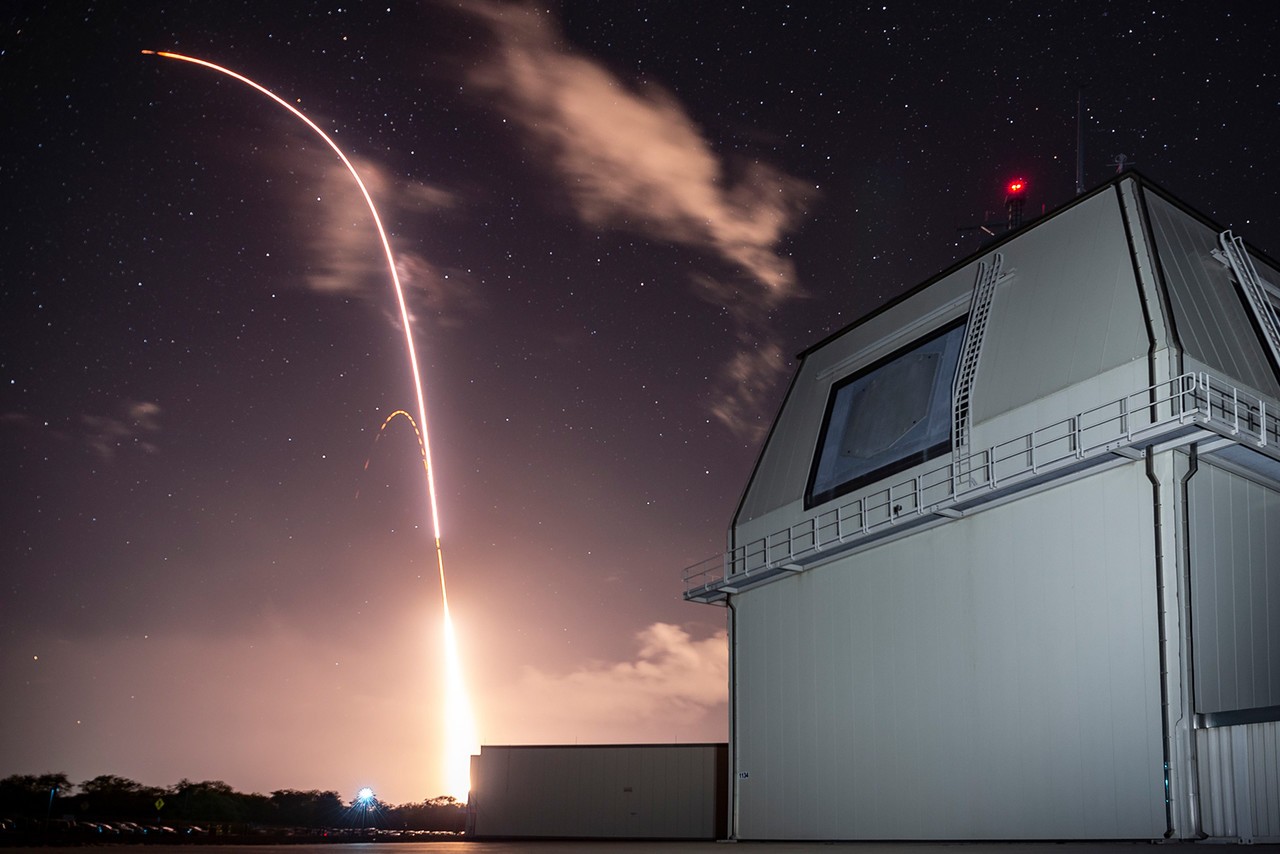
Hypersonic weapons exploit gaps in current missile defense architectures. Systems like Aegis BMD and THAAD were designed to intercept ballistic warheads following predictable trajectories. They were not optimized for maneuvering targets flying at hypersonic speeds within the atmosphere. While upgrades are underway, the physics of the problem -- intercepting a fast, maneuvering target with limited warning time -- favor the offense. This offensive advantage is not unique to hypersonic weapons, but the combination of speed and maneuverability intensifies it.
Current missile defense systems like Aegis BMD were designed to counter ballistic trajectories, not maneuvering hypersonic glide vehicles. Adapting defenses to the hypersonic threat remains a major technical challenge. (Photo: US Navy / Missile Defense Agency)
First-Strike Instability
Arms control scholars have raised concerns about first-strike instability -- the risk that hypersonic weapons create incentives to strike first during a crisis rather than wait. If a nation believes its adversary could use hypersonic weapons to destroy command-and-control systems or nuclear forces before a response could be organized, that nation faces pressure to use its own forces preemptively -- a classic "use it or lose it" dynamic. This concern is amplified by the difficulty of distinguishing conventional hypersonic weapons from nuclear-armed ones. A defender detecting an incoming hypersonic strike may not know whether it carries a conventional or nuclear warhead, yet must decide how to respond in minutes or seconds.
This ambiguity is a feature of hypersonic weapons that many analysts consider deeply destabilizing. As with any technology that compresses the detect-to-decide timeline, hypersonic weapons place a premium on speed of decision -- and speed and deliberation are often in tension.
Can They Be Stopped?
The honest answer, as of early 2026, is: not reliably. Existing missile defense systems were not designed for the hypersonic threat, and the programs intended to address the gap are still in development. But "not reliably" does not mean "never," and the defense community is investing significant resources in closing the gap.
Current Limitations
Ground-based and sea-based missile defense radars are optimized to detect objects at high altitudes following ballistic paths. HGVs fly lower and maneuver, potentially remaining below the radar horizon of ship-based systems until late in their flight. Even when detected, the combination of speed and unpredictable trajectory makes calculating an intercept solution extremely difficult. The SM-6, the Navy's most versatile interceptor, has some capability against maneuvering targets, but it was not designed specifically for the hypersonic glide-phase problem.
Glide Phase Interceptor (GPI)
The Missile Defense Agency's Glide Phase Interceptor (GPI) program, awarded to Northrop Grumman in 2024, is designed specifically to engage hypersonic weapons during their glide phase. GPI is intended for integration with the Aegis combat system aboard Navy destroyers and cruisers, giving the fleet a purpose-built counter-hypersonic capability. However, the program is in its early stages, and initial operational capability is not expected until the late 2020s at the earliest. The technical challenges -- building an interceptor fast and agile enough to hit a maneuvering target at hypersonic speeds -- are formidable.
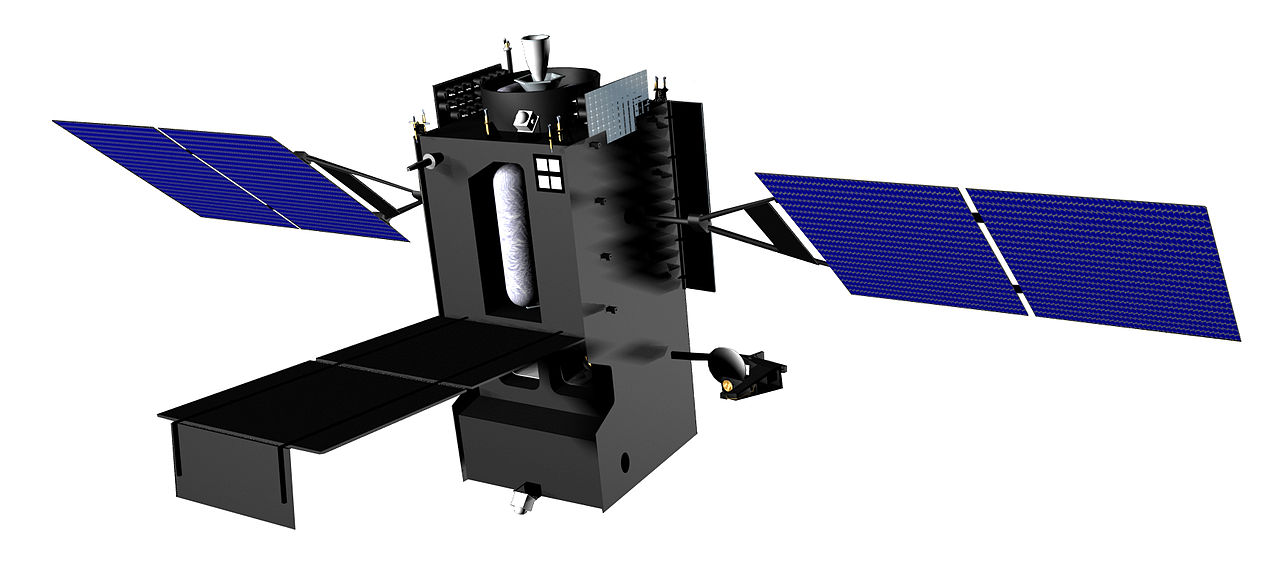
Tracking hypersonic weapons requires sensors that can maintain continuous coverage at the altitudes where HGVs operate. The Hypersonic and Ballistic Tracking Space Sensor (HBTSS), developed by the Space Development Agency and Missile Defense Agency, is a constellation of satellites in low Earth orbit designed to detect and track hypersonic weapons from space. HBTSS uses infrared sensors to maintain track on heat-generating vehicles against the cold background of space. Early demonstration satellites were launched in 2023, and the constellation is being built out as part of the broader Proliferated Warfighter Space Architecture (PWSA). When fully operational, HBTSS would provide the persistent tracking data needed to guide interceptors like GPI.
Directed Energy and Future Concepts
High-energy laser weapons and high-powered microwave systems are sometimes discussed as potential counter-hypersonic technologies. In theory, a directed-energy weapon could engage a target at the speed of light, eliminating the reaction-time disadvantage inherent in kinetic interceptors. In practice, significant technical hurdles remain. Current laser systems lack the power, range, and beam quality needed to damage a hypersonic vehicle at militarily relevant distances. Atmospheric effects -- turbulence, moisture, and particulates -- degrade beam performance, particularly at the low altitudes and long ranges involved. Directed energy may eventually contribute to hypersonic defense, but it is not a near-term solution.
The most realistic near-term approach to hypersonic defense may not be intercept at all, but rather a combination of "left of launch" options -- destroying launch platforms before they fire, disrupting kill chains through electronic warfare and cyber operations, and dispersing and hardening potential targets to reduce the payoff of a hypersonic strike. As with many military challenges, the answer is likely not a single technological solution but a combination of offensive, defensive, and resilience measures.
The Hypersonic and Ballistic Tracking Space Sensor (HBTSS) constellation is designed to provide persistent infrared tracking of hypersonic weapons from low Earth orbit, closing the sensor gap that current architectures leave exposed. (Illustration: Missile Defense Agency)
What Comes Next
The hypersonic competition is accelerating, not stabilizing. Russia, China, and the United States are all expanding their programs. Smaller nations are acquiring or developing their own capabilities. No arms control framework currently addresses hypersonic weapons, and the technical characteristics of these systems -- their dual-use potential, the difficulty of distinguishing conventional from nuclear payloads, the challenge of verification -- make them particularly difficult to regulate.
For military planners, the implications are concrete. Naval operations must account for the possibility that adversary hypersonic missiles can threaten surface ships at ranges and speeds that existing defenses cannot reliably counter. Air base planning must consider that runways and hardened shelters can be struck with minimal warning. Command-and-control architectures must be resilient enough to function even if key nodes are destroyed in the opening minutes of a conflict. Technologies that once seemed speculative are now shaping real-world force posture decisions.
For policymakers, the challenge is broader. Hypersonic weapons intensify the security dilemma: one nation's investment in hypersonic strike capability motivates its adversaries to invest in both their own hypersonic weapons and defenses against them, driving an action-reaction cycle that increases costs and risks for all participants. Without diplomatic frameworks to manage this competition, the proliferation of hypersonic weapons is likely to continue, with uncertain consequences for strategic stability.
The fundamental question is not whether hypersonic weapons work -- they do, or soon will, for multiple nations. The question is whether the strategic environment they create will be more stable or less stable than the one they are replacing. The answer depends not only on technology but on the decisions that governments make about how to deploy, posture, and eventually regulate these weapons. That conversation is only beginning.
Frequently Asked Questions
What is a hypersonic weapon?
A hypersonic weapon is a missile or glide vehicle that flies at speeds exceeding Mach 5 -- five times the speed of sound, or approximately 3,836 miles per hour at sea level. What distinguishes modern hypersonic weapons from traditional ballistic missiles (which also reach hypersonic speeds) is their ability to maneuver during flight, making their trajectories unpredictable and far harder to intercept with current missile defense systems.
Which countries have operational hypersonic weapons?
As of early 2026, Russia and China have deployed operational hypersonic weapons. Russia's Avangard HGV entered service in December 2019, and its Zircon anti-ship cruise missile was deployed in 2023. China's DF-17 medium-range HGV has been operational since approximately 2020. The United States has multiple programs in testing but has not yet fielded an operational hypersonic weapon. North Korea, India, Japan, Australia, and France have active development or testing programs at earlier stages.
Why are hypersonic weapons so difficult to defend against?
Three factors combine to make defense extremely challenging. First, their speed compresses reaction time -- a weapon traveling at Mach 8 covers 100 kilometers in under 50 seconds. Second, their ability to maneuver during flight means defenders cannot predict the weapon's trajectory and pre-position an interceptor. Third, hypersonic glide vehicles fly at altitudes that fall between the coverage of space-based sensors (designed for high-altitude ballistic tracks) and ground-based air defense radars (designed for lower-altitude targets), creating a sensor gap.
What is the difference between a hypersonic glide vehicle and a hypersonic cruise missile?
A hypersonic glide vehicle (HGV) is launched to high altitude by a rocket booster, then separates and glides through the atmosphere at hypersonic speeds using aerodynamic lift -- it has no engine during the glide phase. A hypersonic cruise missile (HCM) uses a scramjet (supersonic combustion ramjet) engine to sustain powered hypersonic flight within the atmosphere. HGVs are more mature technologically, while HCMs are more technically demanding but potentially more flexible in their flight profiles.
Can current missile defense systems stop hypersonic weapons?
Current systems were not designed for the hypersonic threat and have significant limitations against maneuvering targets at these speeds. The SM-6 missile and upgraded Aegis systems provide some capability, and Ukraine has claimed a Patriot intercept of a Russian Kinzhal. However, purpose-built counter-hypersonic systems like the Glide Phase Interceptor (GPI) and space-based tracking sensors (HBTSS) are still in development, with initial capability expected in the late 2020s. Left-of-launch options -- destroying launchers before they fire and disrupting kill chains through electronic warfare -- may be more immediately effective.