Alex Carter writes about modern warfare, emerging military technology, and how doctrine adapts to new tools. His work focuses on what changes in practice -- command, control, targeting, and risk -- when systems like drones and autonomous platforms become routine.
In early February 2026, the Federal Aviation Administration closed a swath of airspace over El Paso, Texas for what officials described as military counter-drone laser testing. The notice, first reported by CNN, sent the message that was difficult to miss: the United States military is now testing directed energy weapons against unmanned aircraft over American soil. For decades, military lasers lived in the realm of science fiction and PowerPoint briefings. That era is over. Directed energy weapons are here, they are being fielded on warships and armored vehicles, and they are about to reshape how militaries defend against the fastest-growing threat on the modern battlefield.
The convergence of cheap, mass-produced drones and expensive, finite missile interceptors has created an urgent economic problem for every advanced military. A $50,000 drone can force a defender to spend $2 million on a surface-to-air missile. That math does not hold. Directed energy weapons, particularly high-energy lasers, offer a way out. Their cost per shot is measured in single-digit dollars. Their magazines are limited only by available electrical power. And they engage targets at the speed of light, eliminating the flight-time calculations that complicate traditional air defense.
What follows is a comprehensive look at where military laser weapons stand in 2026: the physics behind them, the systems already deployed or nearing deployment across the U.S. Navy, Army, and Air Force, the Israeli parallel effort, the economics that make them compelling, and the real limitations that keep them from being a silver bullet.
How Military Lasers Work
A military high-energy laser, or HEL, operates on the same fundamental principle as the laser pointer in a conference room, just scaled up by a factor of roughly ten million. The word "laser" stands for Light Amplification by Stimulated Emission of Radiation, and the core physics have not changed since Theodore Maiman demonstrated the first working laser in 1960. What has changed is the ability to generate enormous amounts of coherent light and focus it precisely on a target at operationally useful distances.
Modern military lasers are overwhelmingly solid-state systems, specifically fiber lasers or slab lasers. These have replaced the chemical lasers of earlier decades, which required toxic chemical fuels like deuterium fluoride and were bulky, dangerous, and logistically impractical. Solid-state lasers convert electrical energy directly into laser light using arrays of optical fibers or solid gain media. They are powered by generators, batteries, or a vehicle's existing electrical system. No special fuel. No hazardous chemicals. Just electricity.
The critical metric is power output, measured in kilowatts. Current operational and near-operational military lasers range from roughly 50 kilowatts to 300 kilowatts. To put that in context, a 50kW laser delivers enough energy to burn through the skin of a small drone or detonate its warhead in a few seconds of sustained focus. A 300kW system can engage larger, faster, and more distant targets with shorter dwell times. The Department of Defense has publicly stated that 300kW-class weapons are the near-term goal for robust air defense applications.
But raw power is only part of the system. A high-energy laser weapon has three essential subsystems. First, the laser source itself, which generates the beam. Second, a beam director, which is essentially a precision telescope in reverse. It shapes and focuses the beam and steers it onto the target using fast-slewing mirrors. Third, a tracking and fire control system that identifies, classifies, and tracks targets using radar, electro-optical sensors, or both, then holds the beam on the aimpoint long enough to achieve the desired effect.
The engagement sequence is startlingly fast. Once a target is identified and tracked, the laser can engage at the speed of light, roughly 186,000 miles per second. There is no lead angle to compute, no missile flight time to account for, no ballistic arc. The beam arrives at the target instantaneously. Against a drone flying at 100 knots, this is an enormous advantage over kinetic interceptors that must fly out to meet the threat.
Perhaps the most strategically significant feature is magazine depth. A conventional air defense system carries a finite number of interceptor missiles. When those are gone, it must be reloaded, a process that can take hours or days depending on logistics. A laser weapon can fire as long as it has electrical power. On a naval vessel with gas turbine generators producing megawatts of electricity, that translates to hundreds or thousands of shots without reloading. This "deep magazine" characteristic is what makes lasers so compelling against the drone swarm threat, where adversaries can launch cheap unmanned systems faster than defenders can reload missile canisters.
The Navy: HELIOS and ODIN
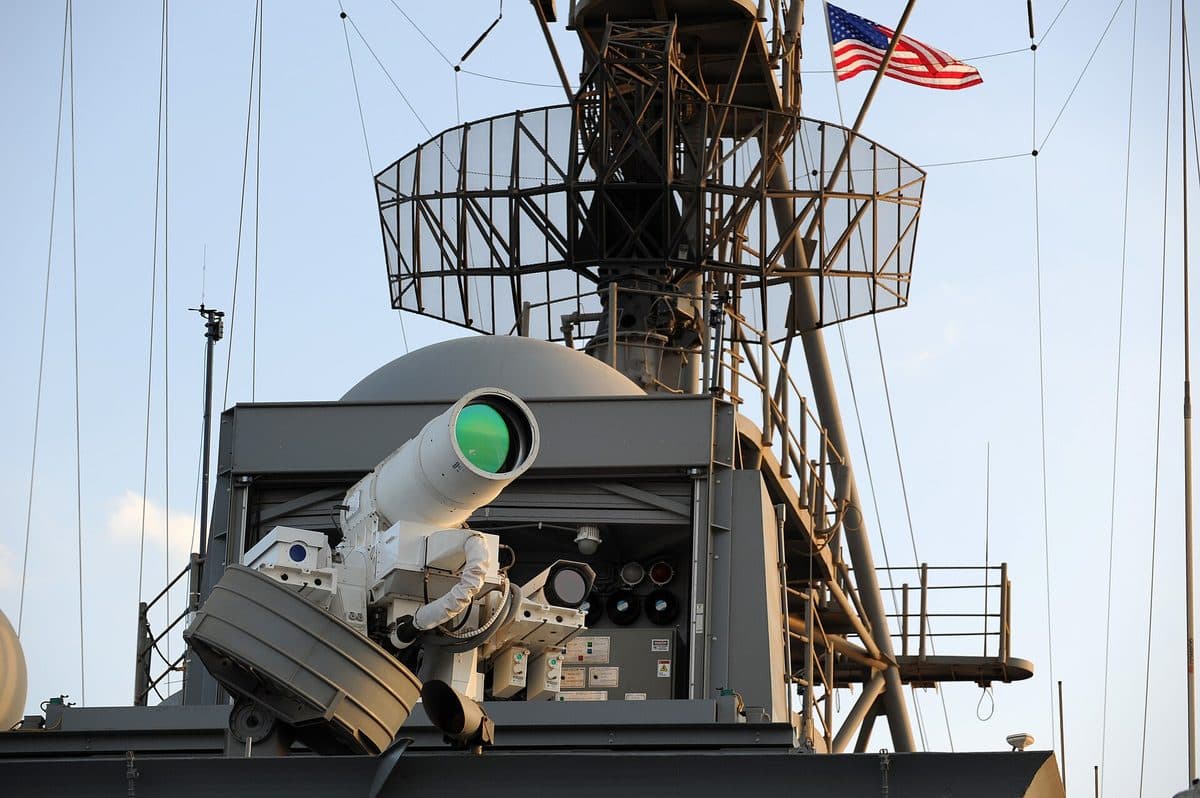
The U.S. Navy has led the American military in deploying operational laser weapons, driven by the service's acute vulnerability to drone swarms, anti-ship cruise missiles, and fast-attack craft. The Navy's journey began in 2014 when the Laser Weapon System (LaWS), a 30kW prototype, was installed on the amphibious transport dock USS Ponce in the Persian Gulf. LaWS successfully engaged targets during its deployment, proving that a shipboard laser could operate in a harsh maritime environment. But 30 kilowatts was a demonstrator, not a weapon with real combat utility.
The follow-on system is HELIOS: High Energy Laser with Integrated Optical-dazzler and Surveillance. Built by Lockheed Martin, HELIOS is a 60kW-class laser weapon that was installed on the Arleigh Burke-class destroyer USS Preble (DDG-88) in 2022, making it the first high-energy laser weapon integrated into the Aegis Combat System on a frontline warship. HELIOS is not a standalone gadget bolted onto the deck. It feeds directly into the ship's combat management system, giving the crew the ability to select laser engagement alongside traditional weapons like the Phalanx CIWS or SM-2 missiles.
During testing, HELIOS demonstrated the ability to shoot down unmanned aerial targets. Reports from the Congressional Research Service indicate that the system successfully engaged and destroyed drones in at least four separate test events. Equally important is HELIOS's secondary capability: the optical dazzler. At lower power settings, the laser can blind or confuse the electro-optical sensors on incoming missiles or surveillance drones without destroying them outright, providing a non-kinetic engagement option that preserves the ship's higher-power shots for targets that require destruction.
Operating alongside HELIOS is ODIN, the Optical Dazzling Interdictor, Navy. ODIN is a lower-power system focused primarily on counter-surveillance and sensor disruption rather than hard-kill. Multiple ODIN units have been installed on Arleigh Burke destroyers, and the system has been deployed operationally. While ODIN lacks the destructive power of HELIOS, it addresses a critical gap: the ability to defeat the targeting sensors of incoming threats without expending missiles.
The Navy's roadmap calls for progressively more powerful laser systems. The Surface Navy Laser Weapon System (SNLWS) Increment 1, based on HELIOS, is the current standard. Future increments are expected to reach 150kW and eventually 300kW or beyond, providing the power needed to engage faster, more hardened targets including anti-ship cruise missiles. For a deeper look at the layered defenses that protect carrier strike groups, see our overview of how aircraft carriers are defended.
The HELIOS high-energy laser weapon system integrates into the Aegis Combat System aboard Arleigh Burke-class destroyers, providing a new layer of defense against drones and small boats (Lockheed Martin).
The Army: DE-SHORAD
While the Navy protects ships at sea, the Army faces an equally pressing directed energy challenge on the ground. Small drones, rockets, artillery shells, and mortar rounds threaten forward-deployed forces in ways that traditional short-range air defense systems were never designed to counter. The Army's answer is DE-SHORAD: Directed Energy Short Range Air Defense.
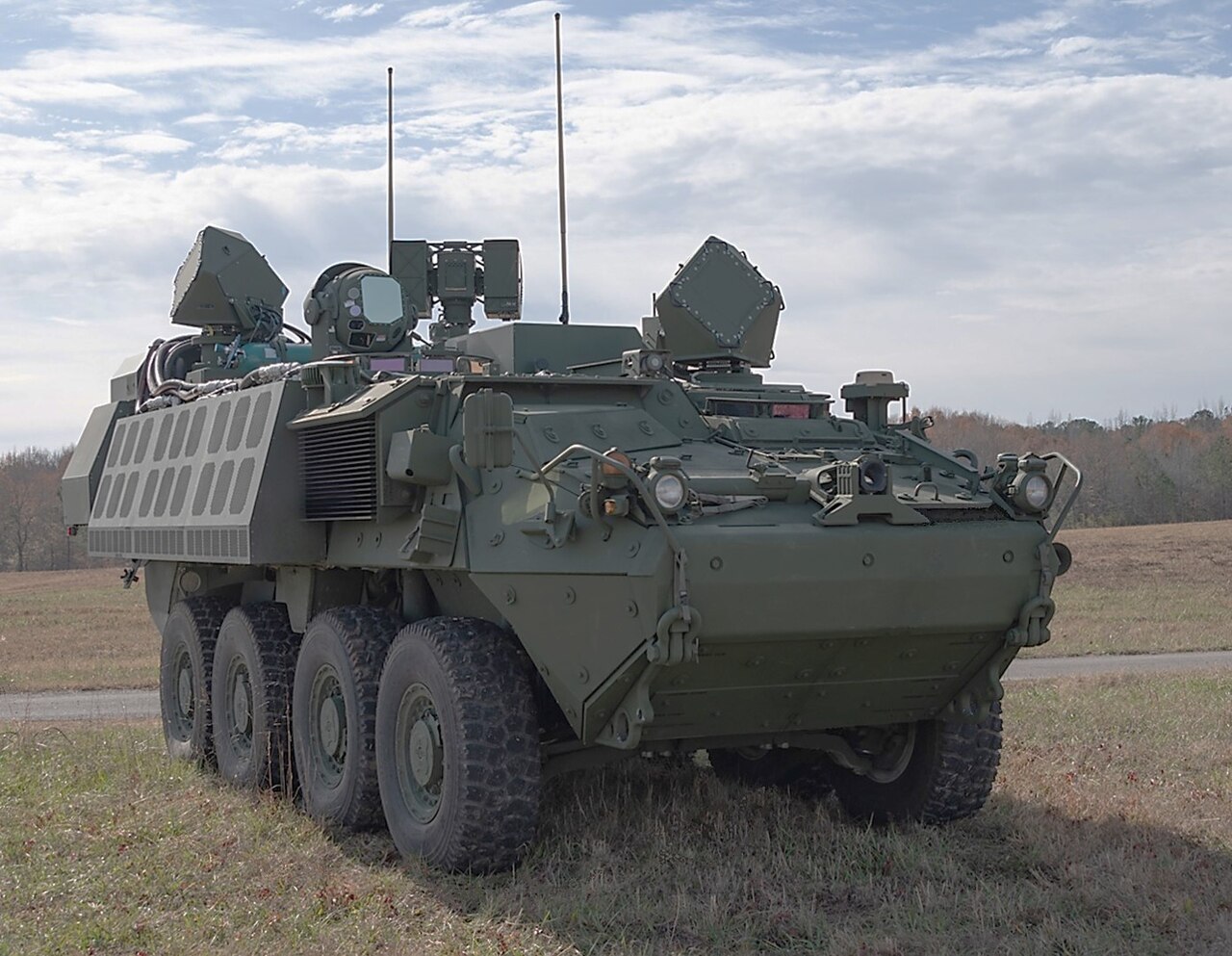
DE-SHORAD mounts a 50kW-class high-energy laser on a Stryker armored vehicle, one of the most common platforms in the Army's fleet. The system, developed by Raytheon (now RTX) in partnership with KBR for the power and thermal management subsystem, is designed to detect, track, and destroy unmanned aircraft systems, rockets, artillery, and mortars at short range. It provides the kind of persistent, low-cost air defense coverage that mobile ground forces desperately need but cannot get from expensive missile-based systems.
The rationale is straightforward. A Stinger missile, the Army's current man-portable air defense weapon, costs roughly $120,000 per round. Each launcher carries a limited number. Against a salvo of cheap drones or a barrage of mortar rounds, a Stinger-based defense runs out of interceptors quickly and expensively. DE-SHORAD's laser can engage target after target for as long as the Stryker's generator has fuel. At an estimated cost of roughly $1 to $10 per shot in electricity, the economics are transformative.
Testing at White Sands Missile Range in New Mexico has been extensive. DE-SHORAD prototypes have successfully engaged and destroyed a variety of unmanned aircraft and mortar surrogate targets in realistic scenarios. The Army began delivering pre-production systems to operational units in 2024, with fielding to combat formations planned through 2025 and 2026. The 4th Infantry Division's 4th Battalion, 60th Air Defense Artillery Regiment has been identified as one of the first units to receive the system.
DE-SHORAD is not intended to replace missile-based air defense. Instead, it adds a lower tier to the Army's layered defense architecture. Patriot and THAAD handle ballistic missiles at long range. The National Advanced Surface-to-Air Missile System (NASAMS) covers medium range. DE-SHORAD fills the gap at short range, where the volume of threats is highest and the cost-per-engagement problem is most acute. For context on the drone threat that DE-SHORAD is designed to counter, see our analysis of FPV drones destroying tanks on the modern battlefield.
The Air Force: SHIELD and Airborne Lasers
The U.S. Air Force's directed energy ambitions are perhaps the most technically demanding of any service, because putting a laser weapon on an aircraft introduces weight, power, cooling, and aerodynamic challenges that ground and naval platforms do not face. The Air Force's current flagship effort is SHiELD: Self-protect High Energy Laser Demonstrator.
SHiELD aims to develop a pod-mounted laser system that a fighter aircraft like the F-15 or F-16 could carry externally, using it to defend against incoming air-to-air or surface-to-air missiles. The concept is defensive rather than offensive: the laser would not shoot down enemy fighters but would disable or destroy the missiles targeting the host aircraft. Lockheed Martin is the prime contractor, and ground testing of the laser subsystem has demonstrated the ability to shoot down multiple air-launched missiles in sequence.
Flight testing has proven more difficult. The challenges of generating sufficient laser power from a fighter-sized aircraft, managing the immense heat output in a confined pod, and maintaining beam quality through the turbulent airflow around a fast-moving jet are formidable. The Air Force has described SHiELD as a technology maturation program rather than an acquisition program, meaning it is intended to prove feasibility and inform future systems rather than produce an immediate fielded weapon.
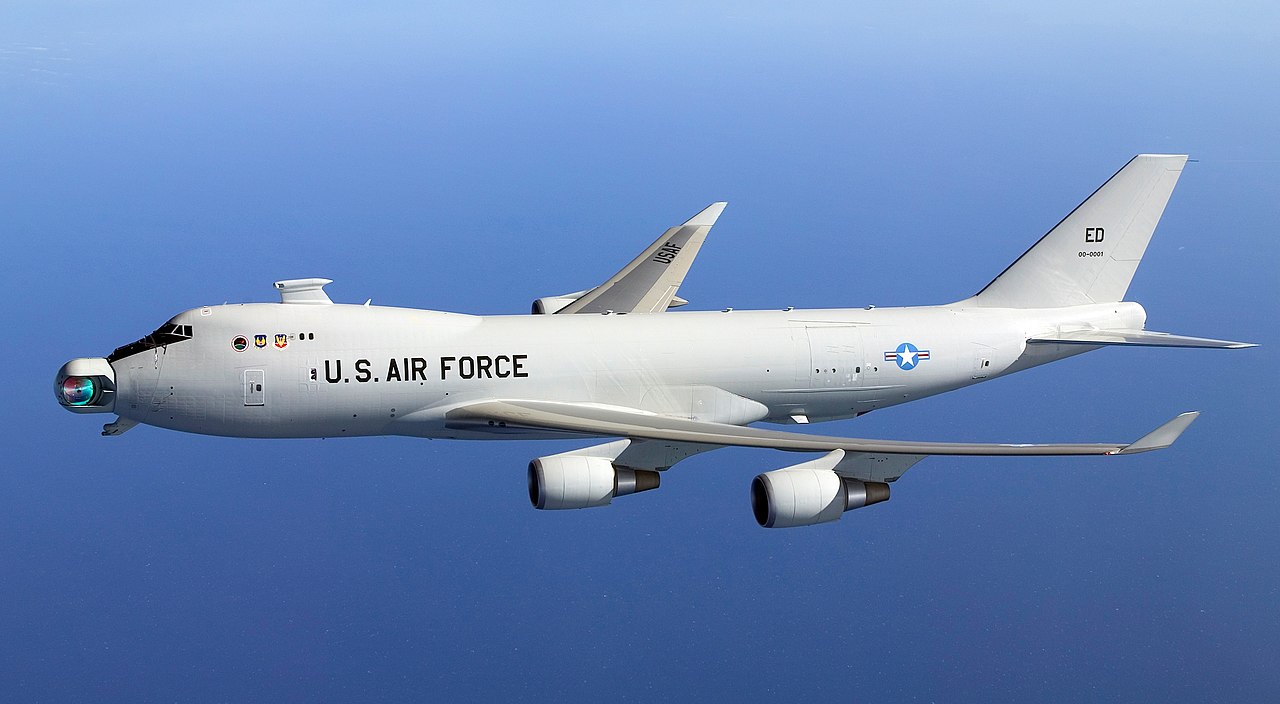
The Air Force has been down this road before, with cautionary lessons. The YAL-1 Airborne Laser, a megawatt-class chemical oxygen iodine laser mounted in a modified Boeing 747, was the most ambitious airborne directed energy program in history. Developed during the 2000s to shoot down ballistic missiles in their boost phase, the YAL-1 successfully destroyed a ballistic missile target in a 2010 test. But the program was cancelled in 2012 due to insurmountable practical problems: the chemical laser was too large, too expensive to operate, and required the 747 to fly dangerously close to enemy launch sites to achieve effective range. The program consumed roughly $5 billion before cancellation.
The lessons from YAL-1 directly shaped SHiELD. The new program uses solid-state laser technology that is smaller, lighter, and electrically powered rather than chemically fueled. Power levels are lower (tens of kilowatts rather than megawatts) but the missions are defensive rather than the long-range boost-phase intercept that doomed the YAL-1 concept. For more on ambitious weapons programs that failed to deliver, see our piece on failed military technology.
An artist's concept of a self-protect laser pod mounted on a tactical fighter aircraft. The SHiELD program aims to give fighter jets a directed energy defense against incoming missiles (U.S. Air Force Research Laboratory).
Israel's Iron Beam
While the United States has invested billions in directed energy research, Israel may be the first nation to deploy a laser weapon in an active combat zone against real-world threats. Iron Beam, developed by Rafael Advanced Defense Systems, is a ground-based high-energy laser designed to complement the Iron Dome missile defense system that has defended Israeli cities against rocket attacks since 2011.
The logic behind Iron Beam is economic. Iron Dome works. It has intercepted thousands of rockets and short-range ballistic threats with a success rate reportedly above 90 percent. But each Tamir interceptor missile costs approximately $50,000, and some estimates place the figure higher. During intense barrages, Iron Dome batteries can expend dozens of interceptors in minutes. Against adversaries who can manufacture or acquire cheap rockets for a few hundred dollars each, the cost exchange rate is unsustainable over prolonged conflicts.
Iron Beam is designed to handle the lower end of the threat spectrum: short-range rockets, mortar rounds, drones, and other projectiles that currently consume expensive Tamir interceptors. Rafael has stated that the cost per engagement for Iron Beam is approximately $3.50 in electricity, a figure that, even if somewhat optimistic, represents a cost reduction of roughly four orders of magnitude compared to a Tamir missile. By handling cheaper, simpler threats with the laser, Iron Beam frees Iron Dome's finite missile inventory for the larger, more sophisticated threats that require a kinetic interceptor.
The Israeli Ministry of Defense announced in 2022 that Iron Beam had successfully intercepted rockets, mortars, and drones in testing. Prime Minister Benjamin Netanyahu stated in early 2024 that the system would be deployed operationally, and multiple Israeli defense sources have indicated that initial deployment occurred in 2025. If confirmed, this would make Iron Beam the first laser weapon system used in active defense of civilian populations against real incoming fire, a milestone in military technology.
Iron Beam's development has been partially funded by the United States under bilateral defense cooperation agreements, and the system's performance data is being closely watched by American planners considering similar architectures for U.S. forward operating bases and installations.
The Economics of Directed Energy
The most compelling argument for laser weapons is not technological but economic. Modern warfare has created a cost asymmetry that favors attackers in ways that traditional air defense cannot overcome. Understanding this asymmetry explains why every major military power is investing heavily in directed energy.
Consider the current cost spectrum for defeating aerial threats. A shoulder-fired Stinger missile costs around $120,000. An AIM-120 AMRAAM air-to-air missile runs about $1 million. A Standard Missile-6 (SM-6) used by the Navy costs approximately $4.3 million. A Patriot PAC-3 MSE interceptor costs roughly $4 million. These are the weapons that Western militaries use to shoot down incoming threats.
Now consider what those interceptors are being fired at. A commercial-grade quadcopter drone modified for reconnaissance or attack can cost as little as $500. An Iranian-designed Shahed-136 one-way attack drone costs an estimated $20,000 to $50,000. A basic 122mm Grad rocket costs a few hundred dollars. Even at the higher end, most of the aerial threats proliferating on modern battlefields cost a tiny fraction of the interceptors used to defeat them.
This is the cost-exchange problem. When a defender spends $1 million to destroy a $20,000 drone, the attacker wins the economic war even when the defender wins every tactical engagement. Over a sustained conflict, this dynamic drains missile stocks, strains defense budgets, and limits the number of threats a defender can engage before running out of interceptors.
Directed energy weapons fundamentally alter this calculus. At an estimated $1 to $10 per shot in electrical costs, a laser weapon inverts the cost exchange. Now the defender is spending pennies to defeat threats that cost the attacker thousands. The "infinite magazine" characteristic means the defender can continue engaging for as long as the power supply lasts, without the logistical burden of resupplying missile canisters in a combat zone.
The catch is upfront investment. Laser weapon systems are not cheap to develop, produce, or integrate. The HELIOS system cost approximately $150 million to develop and install on USS Preble. DE-SHORAD systems are expected to cost several million dollars per vehicle. But these are one-time capital costs that amortize over thousands of engagements, each at near-zero marginal cost. The total cost of ownership over a system's lifetime is projected to be dramatically lower than an equivalent missile-based defense.
Power generation is the new limiting factor, replacing the traditional constraint of magazine depth. A Navy destroyer's gas turbine generators produce far more electrical power than current laser weapons consume, so the constraint is thermal management rather than raw power. On a Stryker vehicle, the power and cooling demands of a 50kW laser required a dedicated subsystem from KBR that is itself a significant engineering achievement. For ground forces, ensuring that forward-deployed vehicles have sufficient generator capacity to feed a laser weapon while also running communications, sensors, and other systems is a logistics challenge that replaces the old challenge of hauling missile resupply forward.
For all their promise, directed energy weapons have real limitations that prevent them from replacing conventional weapons outright. Honest analysis requires confronting these constraints rather than allowing the technology's genuine strengths to obscure its current weaknesses.
Weather and atmospheric effects. Laser beams are degraded by rain, fog, dust, smoke, and humidity. Water droplets scatter and absorb laser energy, reducing the amount of power that reaches the target. In heavy rain or dense fog, a laser weapon's effective range can be cut by half or more. Desert environments present dust and sand that have similar effects. This is not a theoretical concern: naval vessels operate in maritime environments where fog and salt spray are routine, and ground forces fight in conditions ranging from sandstorms to monsoons. A weapon that works brilliantly on a clear day but struggles in bad weather has an obvious operational limitation.
Range limitations at current power levels. While laser beams travel at the speed of light, beam quality degrades over distance due to atmospheric turbulence, thermal blooming (where the beam heats the air it passes through, causing the beam to defocus), and diffraction. At 50kW, effective engagement ranges are generally measured in single-digit kilometers for hard-kill effects. Higher power levels extend range, but even at 300kW, current systems do not match the engagement ranges of medium- to long-range missile systems. Lasers are short-range weapons for the foreseeable future, which means they complement rather than replace missiles.
Dwell time. Unlike a missile that delivers its energy in a single explosive impact, a laser must hold its beam on the target for a sustained period, typically several seconds, to achieve a kill. This "dwell time" limits the rate at which a laser can engage multiple targets. Against a single drone, this is manageable. Against a swarm of dozens arriving simultaneously, a laser must cycle through targets sequentially, and each second spent on one target is a second not spent on others. Faster engagement requires higher power (shorter dwell time per target), which requires more electrical generation and better thermal management.
Ineffectiveness against hardened targets. Lasers defeat targets by heating them until something fails: a structural component melts, a fuel tank ignites, an explosive warhead detonates, or an electronic sensor is blinded. Targets that are armored, heat-resistant, or reflective present serious challenges. A ballistic missile warhead with an ablative heat shield, designed to survive atmospheric reentry at thousands of degrees, is unlikely to be bothered by a 50kW laser. Even at higher power levels, hardened military targets may require impractically long dwell times. Lasers excel against soft targets like drones, thin-skinned rockets, and sensor systems. They are poor choices against tanks, bunkers, or hardened warheads.
Thermal management. High-energy lasers generate enormous amounts of waste heat. A 50kW laser with 30 percent wall-plug efficiency consumes roughly 167kW of electrical power and dumps approximately 117kW of that as heat into the weapon system. That heat must be removed continuously, or the laser degrades and eventually shuts down. On a large naval vessel with seawater cooling, this is manageable. On a Stryker vehicle in a desert, it is a significant engineering challenge. Thermal management ultimately determines how long a laser can sustain continuous fire, a metric as important as magazine depth for a missile system.
Countermeasures. Adversaries are not passive. Simple countermeasures like spinning a drone (to distribute laser energy across a larger area), applying reflective or ablative coatings, using smoke or obscurants, or attacking during adverse weather conditions can all reduce laser weapon effectiveness. More sophisticated countermeasures are certainly under development. The directed energy community is aware of these threats, but the countermeasure-countermeasure cycle is just beginning for lasers in ways it has matured for radar and missiles.
A DE-SHORAD prototype mounted on a Stryker armored vehicle during testing at White Sands Missile Range. Ground-based lasers face unique thermal management and power generation challenges (U.S. Army photo).
What Comes Next
The directed energy systems fielded today are first-generation weapons. They work, they are operationally useful, and they solve real problems, but they represent the beginning of a capability trajectory rather than its endpoint. The next decade will see significant expansion in power, platform integration, and mission scope.
300kW and beyond. The Department of Defense's Indirect Fires Protection Capability-High Energy Laser (IFPC-HEL) program aims to field a 300kW-class laser for base and area defense. At that power level, the weapon can engage faster targets at greater range with shorter dwell times, potentially including cruise missiles and large unmanned aircraft that are beyond the reach of current 50-60kW systems. Lockheed Martin, Raytheon, and other defense firms have demonstrated 300kW-class lasers in ground tests, and the transition to fieldable systems is a matter of engineering and integration rather than fundamental physics.
Next-generation vehicle and ship integration. Future combat vehicles are being designed from the outset to accommodate directed energy weapons. The Army's Optionally Manned Fighting Vehicle and the Navy's DDG(X) next-generation destroyer both include power and thermal management provisions for laser weapons. Designing laser integration into a platform from the start, rather than retrofitting it onto an existing vehicle, eliminates many of the power and cooling compromises that limit current systems.
Counter-hypersonic concepts. As hypersonic weapons proliferate, the speed-of-light engagement offered by lasers becomes even more valuable. A kinetic interceptor struggles to maneuver against a target traveling at Mach 5 or above. A laser beam does not need to maneuver. While current power levels are insufficient to destroy a hypersonic glide vehicle, higher-power lasers or laser systems integrated with other sensors could potentially contribute to a layered defense against hypersonic threats, at minimum by damaging sensors or guidance systems.
Space-based directed energy. The most ambitious long-term concepts involve laser weapons deployed on satellites. Above the atmosphere, there is no weather degradation, no thermal blooming, and no atmospheric absorption. A space-based laser could theoretically engage targets across vast distances with full beam quality. The engineering challenges are immense, including power generation in orbit, thermal management in vacuum, and the cost of launching heavy systems to space, but multiple nations are investing in space-based directed energy research. The Missile Defense Agency has studied space-based interceptor concepts that include directed energy options.
Combined arms integration. Perhaps the most important near-term development is not any single laser system but the integration of directed energy into combined arms operations. A platoon defended by DE-SHORAD on a Stryker, supported by electronic warfare jammers and backed by missile-based air defense, presents a layered defense that is far more resilient than any single system. The Army, Navy, and Marine Corps are all developing doctrine for employing lasers alongside conventional weapons, electronic warfare, and decoys. This integration will determine how effectively directed energy reshapes the battlefield. For a broader look at the weapons defining future warfare, see our companion analysis.
Directed energy weapons are not a wonder weapon. They will not replace missiles, guns, or electronic warfare. But they fill a critical gap that no other technology can address: affordable, sustainable, speed-of-light defense against the growing mass of cheap, numerous aerial threats that define modern combat. The revolution is not coming. It is here, mounted on destroyers and Strykers, and it is only the beginning.
For an earlier look at how directed energy first entered military service, see our profile of the Boeing Laser Avenger, one of the pioneering systems that proved the concept. For the full picture of technologies that made the leap from laboratory to battlefield, see 7 military technologies that sound like science fiction but are already in use. And for a comprehensive look at how lasers, jammers, and kinetic interceptors are being combined to address the drone revolution, read our analysis of counter-drone weapons.
Frequently Asked Questions
Can military lasers shoot down missiles, or just drones?
Current 50-60kW systems are most effective against small drones, rockets, and mortar rounds. They can damage or destroy these targets at short range. Shooting down larger, faster cruise missiles requires higher power levels, typically 150kW or above, which are under development but not yet widely fielded. Ballistic missiles with hardened warheads are currently beyond the practical capability of laser weapons. The Department of Defense's roadmap envisions 300kW-class systems that could engage cruise missiles, with more advanced future concepts potentially contributing to defense against hypersonic threats.
How much does it cost to fire a military laser weapon?
Estimates for the marginal cost per shot range from roughly $1 to $10 in electricity, depending on the system and engagement duration. Israel has cited approximately $3.50 per engagement for its Iron Beam system. This compares to $50,000 or more for an Iron Dome Tamir interceptor, $120,000 for a Stinger missile, and $1 million or more for an AMRAAM or SM-6. The dramatic cost reduction is the primary economic argument for directed energy weapons, though the upfront development and procurement costs of the laser systems themselves remain substantial.
Do laser weapons work in bad weather?
Performance is degraded by rain, fog, dust, smoke, and high humidity, all of which scatter and absorb laser energy. In heavy rain or dense fog, effective range can be significantly reduced. This is one of the most important practical limitations of directed energy weapons and is why military planners view lasers as one layer in a multi-layered defense rather than a standalone solution. Clear weather provides the best performance, but systems are designed to operate across a range of atmospheric conditions, albeit with reduced effectiveness.
Which countries have operational laser weapons in 2026?
The United States has the most systems deployed or in advanced testing, including the Navy's HELIOS (installed on USS Preble), ODIN (on multiple destroyers), and the Army's DE-SHORAD (being fielded to air defense units). Israel has announced operational deployment of Iron Beam for homeland defense. The United Kingdom has tested its DragonFire laser demonstrator. China and Russia have both claimed directed energy programs, though details are limited. Turkey, France, Germany, and several other nations have active directed energy research programs at various stages of maturity.