Michael Trent covers military aircraft, weapons systems, and defense technology with an emphasis on cost, maintenance, and real-world performance. He focuses less on specifications and more on how systems hold up once they are deployed, maintained, and operated at scale.
For the first time since the 1970s, when the F-15 Eagle and F-16 Fighting Falcon entered service alongside the still-operational F-4 Phantom, the United States Air Force will operate three distinct stealth fighter platforms simultaneously. The F-22 Raptor, the F-35 Lightning II, and the Boeing F-47 each represent a different era of design philosophy, a different set of priorities, and a different answer to the question of what air dominance means. They were not designed to compete with one another. They were designed to complement one another against threats that no single aircraft can handle alone.
Understanding how these three fighters compare requires looking beyond raw specifications. Each was built for a different threat environment, a different operational concept, and a different set of geographic constraints. What follows is a detailed, side-by-side analysis based on publicly available information, with appropriate hedging where F-47 details remain classified.
Three Fighters, Three Missions
The simplest way to understand these three aircraft is to look at when they were designed and what problem each was built to solve.
The F-22 Raptor emerged from the Cold War. Its Advanced Tactical Fighter program began in 1981, and the aircraft first flew in 1997. It entered service in 2005. The F-22 was designed to achieve air superiority against Soviet fourth-generation fighters and their successors. Everything about it, the twin engines producing 70,000 pounds of combined thrust, the thrust vectoring nozzles, the supercruise capability, the all-aspect stealth shaping, was optimized for one mission: defeating enemy aircraft in both beyond-visual-range and within-visual-range combat. It remains the most capable air superiority fighter ever built.
The F-35 Lightning II was conceived in the 1990s, after the Cold War ended. The Joint Strike Fighter program sought a single affordable stealth platform that could replace the F-16, A-10, F/A-18, and AV-8B across three services and more than a dozen allied nations. The F-35 first flew in 2006 and achieved initial operational capability with the Marine Corps in 2015 and the Air Force in 2016. Its defining capability is not speed or maneuverability but sensor fusion: the ability to combine data from radar, infrared, electronic warfare, and datalink systems into a single coherent picture of the battlespace. The F-35 is less a traditional fighter and more a flying sensor node that happens to carry weapons.
The F-47 was designed for the 2030s and beyond. Awarded to Boeing in March 2025 under the Next Generation Air Dominance program, it is the first sixth-generation fighter ever built. The F-47 was designed for a specific strategic problem: projecting air power across the vast distances of the Pacific theater against China's increasingly sophisticated integrated air defense network. It combines the air superiority focus of the F-22 with the networked awareness of the F-35, adds dramatically more range, and introduces a capability neither predecessor possesses: the ability to command autonomous drone wingmen in combat.
These three aircraft do not replace each other. They form layers of a force structure designed for a threat environment far more complex than anything the United States has faced since the Cold War.
Head-to-Head Specifications
The following table compiles known specifications for the F-22 and F-35A alongside estimated or confirmed parameters for the F-47. Where F-47 data is classified, estimates are drawn from official Air Force statements, congressional budget documents, and credible defense reporting. All estimates are noted as such.
Specification
F-22 Raptor
F-35A Lightning II
F-47 (est.)
Role
Air superiority
Multirole strike fighter
Air dominance / CCA command
Manufacturer
Lockheed Martin / Boeing
Lockheed Martin
Boeing
First flight
1997
2006
Classified (demonstrator ~2019)
IOC
2005
2016 (USAF)
~2030 (est.)
Generation
5th
5th
6th
Max speed
Mach 2.25
Mach 1.6
Mach 2+ (confirmed by USAF)
Combat radius
~590 nmi
~670 nmi
1,000+ nmi (confirmed by USAF)
Supercruise
Yes (Mach 1.5+)
No
Likely (adaptive cycle engines)
Stealth
Excellent (all-aspect)
Very good (frontal emphasis)
"All-aspect, broadband" (per USAF)
Internal weapons
6x AIM-120 + 2x AIM-9
4x AIM-120 (A variant)
Classified (likely expanded bays)
Crew
1
1
1 (+ CCA control)
Engines
2x Pratt & Whitney F119
1x Pratt & Whitney F135
2x next-gen adaptive cycle (NGAP)
Unit cost
~$150M (flyaway) / $334M (w/ R&D)
~$80M (Lot 17 flyaway)
Classified (~$200-300M est.)
Total built / planned
187 (production ended 2011)
3,100+ planned globally
~185 planned
Sources: Lockheed Martin, Boeing, U.S. Air Force fact sheets, Air & Space Forces Magazine, The War Zone, congressional budget documents. F-47 combat radius and speed confirmed by General David Allvin in May 2025 per The War Zone.
The F-22 Raptor: Still the King of Air Combat
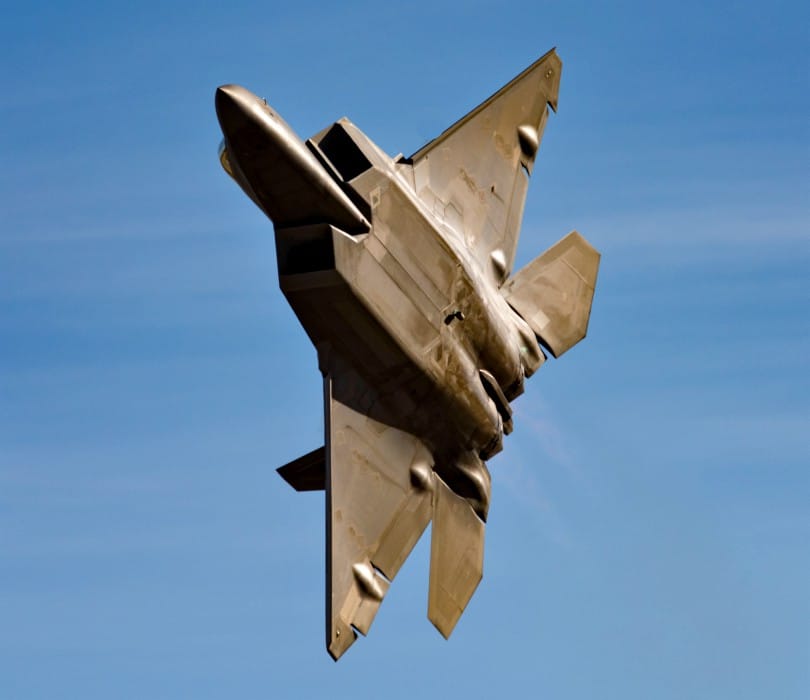
The F-22 Raptor remains the world's most capable air superiority fighter more than two decades after entering service. (U.S. Air Force photo)
Twenty years after reaching initial operational capability, the F-22 remains unmatched in the mission it was designed for. No fighter in any nation's inventory can match its combination of stealth, speed, maneuverability, and situational awareness in an air-to-air engagement.
The Raptor's twin Pratt & Whitney F119 engines produce approximately 70,000 pounds of combined thrust, enabling supercruise above Mach 1.5 without afterburner. That means the F-22 can fly supersonic while conserving fuel and minimizing its infrared signature, a capability the F-35 lacks entirely. When afterburners are engaged, the F-22 exceeds Mach 2.25. Two-dimensional thrust vectoring nozzles allow the aircraft to point its nose independently of its flight path, enabling maneuvers that no conventional fighter can replicate.
The AN/APG-77 radar can detect targets at ranges exceeding 125 miles while maintaining a low probability of intercept, meaning enemy aircraft may not realize they are being tracked. In a hypothetical dogfight against the F-35, the F-22 holds decisive advantages in speed, climb rate, and turning performance. But as we will see, dogfighting is not what modern air combat is about.
Where the Raptor Falls Short
The F-22's limitations are real and increasingly relevant. Its avionics architecture dates to the 1990s. While upgraded over the years, it lacks the deep sensor fusion that defines the F-35. The F-22's radar, electronic warfare, and infrared systems present information separately; the pilot must mentally integrate them. The F-35 does that integration automatically.
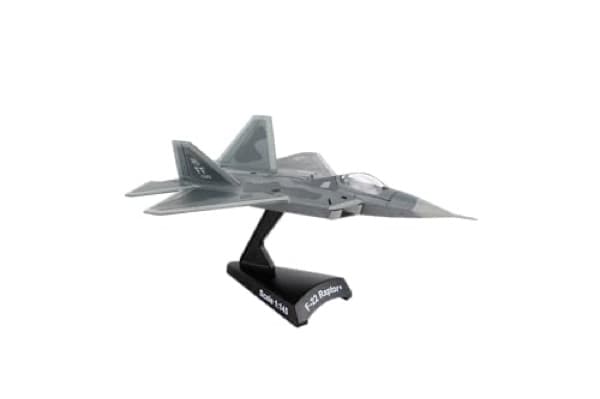
A compact desk-sized F-22 with the 1st Fighter Wing paint scheme. Die-cast metal body with a plastic display stand included. Around 4 inches nose to tail at 1:145 scale.
Networking is another weakness. The F-22 uses the Intra-Flight Data Link for communication between Raptors and Link 16 for broader connectivity, but its ability to share data with other platforms has historically been limited compared to the F-35's Multifunction Advanced Data Link. Upgrades have narrowed this gap, but the architecture was not designed for the networked warfare concept from the outset.
The most significant limitation is numbers. Only 187 operational F-22s were built before production ended in 2011, a consequence of soaring costs and post-Cold War budget realities. The original requirement was 750 aircraft. The Obey Amendment prohibits export sales, meaning no allied nation operates the Raptor. With a fleet that small and an airframe that cannot be replaced, every F-22 lost in combat or accident is irreplaceable.
The F-22's combat radius of approximately 590 nautical miles also poses challenges in the Pacific theater, where distances between bases and potential conflict zones can exceed 1,500 nautical miles. Operating the Raptor over the Western Pacific requires extensive tanker support, and those tankers are themselves vulnerable to long-range Chinese missiles.
The F-35 Lightning II: The Swiss Army Knife
F-35 Lightning II aircraft in formation. The F-35 program spans three variants and more than 20 allied nations. (U.S. Department of Defense photo)
The F-35 is the most produced stealth aircraft in history, with over 1,000 delivered worldwide and a planned global fleet exceeding 3,100. It is operated by the U.S. Air Force, Navy, and Marine Corps, plus more than 20 allied nations from the United Kingdom and Australia to Japan and South Korea. No other combat aircraft in history has achieved this scale of international adoption.
The Lightning II's defining innovation is not any single specification but its sensor fusion architecture. The AN/APG-81 AESA radar, the AAQ-37 Distributed Aperture System (six infrared cameras providing 360-degree coverage), the AAQ-40 Electro-Optical Targeting System, and the ASQ-239 Barracuda electronic warfare suite all feed into a central processor that fuses their data into a single tactical picture. The pilot does not look at separate radar, infrared, and electronic warfare displays. Instead, the aircraft presents a unified view of every threat, friendly asset, and terrain feature in the battlespace.
This matters because in modern air combat, the pilot who understands the situation first usually wins. The F-35 was designed to ensure its pilot always understands the situation better than the adversary. As retired Air Force General Mark Kelly has described it, the F-35 pilot "knows more, sooner, than anyone else on the battlefield."
The F-35 comes in three variants. The F-35A is the conventional takeoff and landing version for the Air Force. The F-35B features short takeoff and vertical landing capability for the Marines, allowing operation from amphibious assault ships and austere airfields. The F-35C has larger wings and reinforced landing gear for Navy carrier operations. All three share the same sensor fusion core.
Where the Lightning Falls Short
The F-35 is slower than the F-22, maxing out at Mach 1.6 compared to the Raptor's Mach 2.25. It cannot supercruise. Its single Pratt & Whitney F135 engine, while the most powerful fighter engine ever built at 43,000 pounds of thrust, means the F-35 has less raw power and no redundancy compared to the twin-engine F-22 and F-47.
In a close-range dogfight, the F-35 is outmatched by the F-22. It lacks thrust vectoring, has a lower thrust-to-weight ratio, and was simply not designed for the turning, climbing, and energy management that define within-visual-range combat. But as the Air Force has repeatedly emphasized, the goal of modern air combat is to never reach that point. The "first look, first shot" doctrine means the F-35's sensor advantage should allow it to detect, engage, and destroy threats before a dogfight ever develops.
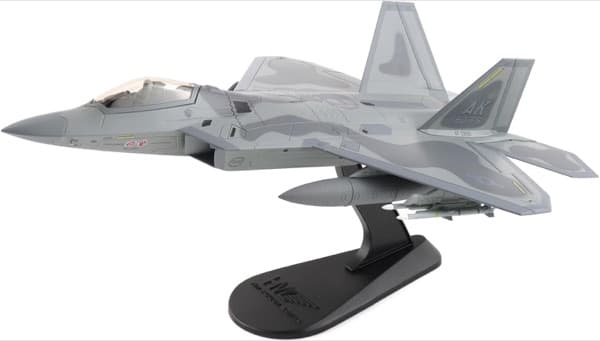
An anniversary-edition F-22A at 1:72 scale with special tail flash markings, opening weapons bays, removable ordnance, and optional landing gear configurations. Limited production run.
The F-35's combat radius of approximately 670 nautical miles is better than the F-22's but still insufficient for unrefueled operations across the Pacific. Like the Raptor, the Lightning depends on tankers for extended-range missions, a vulnerability that the F-47 was specifically designed to address.
The F-47: Built for the Pacific
Artist rendering of the F-47 released by the U.S. Air Force in March 2025. The tailless, blended wing-body configuration prioritizes stealth and range over traditional fighter agility. (U.S. Air Force image)
The F-47 exists because of geography. The European theater that shaped Cold War fighter design features relatively short distances. From bases in Germany, an F-22 or F-35 can reach most potential conflict zones without tanker support. The Pacific theater is fundamentally different. From Guam to Taiwan is roughly 1,500 nautical miles. From mainland Japan to the South China Sea is over 1,200 nautical miles. From Darwin, Australia, to contested waters near the Philippines is nearly 2,000 nautical miles.
Neither the F-22 nor the F-35 can cover these distances without extensive tanker support. And in a conflict with China, those tankers would be operating within range of PLA long-range missiles, anti-satellite weapons, and electronic warfare systems. The tanker fleet, which America's tactical aviation depends on, becomes a critical vulnerability.
The F-47 was designed to solve this problem. In May 2025, Air Force Chief of Staff General David Allvin confirmed the aircraft will have a combat radius exceeding 1,000 nautical miles and a top speed above Mach 2, as reported by The War Zone. That combat radius is nearly 70 percent greater than the F-22's and roughly 50 percent greater than the F-35A's. An F-47 based in Guam or Japan could reach Taiwan or the South China Sea without tanker support, or with tankers positioned much farther from Chinese missile threats.
Stealth Beyond Fifth Generation
The Air Force has described the F-47's signature reduction as "all-aspect, broadband low-observability," meaning reduced radar and infrared signatures from every angle and across multiple radar frequency bands. Some defense analysts have described the aircraft's shaping as "bomber-like," noting the tailless, blended wing-body configuration visible in the official rendering. This design prioritizes signature reduction from all aspects, including the sides and rear, areas where fifth-generation fighters have larger radar returns.
The broadband element is significant. Fifth-generation stealth was primarily optimized against X-band fire control radars. Adversaries have since invested heavily in lower-frequency radars (L-band, VHF) that can detect stealth aircraft at longer ranges, though with less precision. The F-47's broadband stealth is designed to reduce detection across these frequencies as well, making it harder to find with any type of radar.
Commanding the Drone Wingmen
Perhaps the most revolutionary aspect of the F-47 is its role as a command node for Collaborative Combat Aircraft. Each F-47 is designed to control two or more autonomous drone wingmen that handle sensor coverage, weapons delivery, electronic warfare, or decoy missions. Two CCA designs are in development: the General Atomics YFQ-42A, which completed its first flight in August 2025, and the Anduril YFQ-44A "Fury," which flew semi-autonomously on October 31, 2025.
A flight of four F-47s with eight CCAs creates a twelve-platform formation sharing data across a distributed network. The CCAs can be sent into the most dangerous threat environments first, absorbing risk that would otherwise fall on the crewed fighter and its pilot. If a CCA is destroyed, the loss is measured in dollars, not in human life.
The Department of Defense has allocated $8.9 billion between 2025 and 2029 for CCA development, with plans to procure more than 1,000 drones. This manned-unmanned teaming concept fundamentally changes the math of air combat. One F-47 pilot effectively commands a small air force.
The F-47 is expected to use next-generation adaptive cycle engines from the NGAP program. Both General Electric (XA102) and Pratt & Whitney (XA103) are building prototypes. These "three-stream" engines can dynamically switch between a high-thrust combat mode and a high-efficiency cruise mode, promising roughly 30 percent more range and double the thermal management capacity compared to current engines.
The thermal management capacity is not a footnote. Sixth-generation aircraft generate enormous heat from their sensors, computers, electronic warfare systems, and directed energy weapons. Managing that heat without degrading performance or creating a detectable infrared signature is one of the defining engineering challenges of this generation. NGAP program delays of more than two years due to supply chain challenges were reported by Breaking Defense in July 2025.
How They Work Together
The three fighters are designed to operate as an integrated force, not as interchangeable units. Each fills a specific role that the others cannot.
F-22 Raptor
High-end air superiority. The Raptor's speed, maneuverability, and stealth make it the first choice for clearing contested airspace of enemy fighters. In a Pacific conflict, F-22s would establish air dominance over specific corridors, creating safe zones for other aircraft to operate.
F-35 Lightning II
The backbone multirole fleet. F-35s handle strike, suppression of enemy air defenses, intelligence gathering, electronic warfare, and close air support. Their sensor fusion feeds the network that all platforms depend on. Sheer numbers (2,400+ planned for the U.S. alone) provide the scale no other stealth fighter can match.
F-47 + CCAs
Long-range penetration and distributed combat. F-47s push deep into contested airspace where neither the F-22 nor F-35 can reach without tankers. CCA wingmen multiply the formation's sensors, weapons, and survivability. The F-47 fights in the spaces too dangerous and too distant for anything else.
The concept that ties these platforms together is sometimes called a "combat cloud," a networked architecture where every aircraft, drone, ship, satellite, and ground station shares data in real time. The F-35 pioneered this concept with its MADL datalink and sensor fusion. The F-47 extends it by adding autonomous platforms to the network. The F-22, with ongoing upgrades, contributes its air superiority capabilities to the same shared picture.
In practice, a Pacific air operation might look like this: F-47s with CCA wingmen push deep into Chinese-contested airspace, their long range allowing them to operate without tankers in threat zones. F-35s, operating closer to friendly bases, provide the sensor backbone and conduct strikes against integrated air defense systems. F-22s patrol critical corridors, ensuring no enemy fighters can threaten the tankers, AWACS, and other support aircraft that the broader force depends on.
No single fighter can fill all three roles. That is why the Air Force is investing in all three simultaneously.
The Cost Question
Cost is where the comparison gets uncomfortable. The F-22's story is a cautionary tale. The Air Force originally planned to buy 750 Raptors. Rising costs and post-Cold War budget pressure cut the order to 381, then 278, then the final 187. Each cut increased the per-unit cost, which in turn made the program look more expensive, which invited further cuts. This "death spiral" left the Air Force with a brilliant fighter it could not afford to buy in the numbers it needed.
The F-35 learned from that lesson. By designing the program as a joint service, multinational effort with three variants sharing a common core, the F-35 achieved production scale that drove costs down dramatically. The F-35A's flyaway cost has dropped from over $220 million for early production lots to approximately $80 million at Lot 17, a price competitive with advanced fourth-generation fighters. More than 20 allied nations buying the aircraft means fixed costs are spread across thousands of units.
The F-47 faces the same cost pressures that killed the F-22's production run. Estimates place the per-unit cost near $300 million, roughly three to four times an F-35A. The planned fleet of approximately 185 aircraft invites direct comparison to the F-22's 187. Multiple congressional analyses have flagged the risk of another death spiral.
Cost Metric
F-22 Raptor
F-35A Lightning II
F-47 (est.)
Flyaway unit cost
~$150M
~$80M (Lot 17)
~$200-300M (est.)
Program unit cost (w/ R&D)
~$334M
~$100M
Classified
Cost per flight hour
~$80,000
~$33,000 (target)
Classified
Total planned fleet (U.S.)
187
2,456
~185
Export potential
None (Obey Amendment)
20+ nations
Unlikely near-term
The Air Force's counterargument centers on the CCA concept. If each F-47 operates with two affordable CCAs costing a fraction of a crewed fighter, the cost per combat-relevant platform drops significantly. One F-47 with two CCAs might deliver comparable combat power to two or three F-35s at a similar total price, while operating at ranges the F-35 cannot reach. Whether that math holds over the program's lifetime will determine whether the F-47 avoids the F-22's fate.
The FY2025 NDAA cut $30.9 million from the NGAD budget, and the Senate Appropriations Committee recommended redirecting $557.1 million toward CCA development. But the One Big Beautiful Bill Act passed in July 2025 provided $400 million specifically to accelerate F-47 production. Congressional support remains mixed but viable.
Which One Is "Best"?
The question is understandable but ultimately the wrong one to ask. There is no single "best" fighter because there is no single mission. Each of these aircraft dominates a different operational niche.
Best For Each Mission
1
Air superiority / dogfight: The F-22 Raptor. Its speed, thrust vectoring, and supercruise make it unmatched in air-to-air combat. If the mission is to own the sky over a defined area, the Raptor is the tool.
2
Multirole strike and network-centric operations: The F-35 Lightning II. Its sensor fusion, international interoperability, three-variant flexibility, and massive production scale make it the backbone of allied air power for the next 40 years.
3
Long-range penetration into contested A2/AD environments: The F-47. Its 1,000+ nautical mile combat radius, next-generation stealth, and CCA wingmen make it the only platform designed to fight deep inside a peer adversary's defense network without tanker dependence.
The Panzer IV was the workhorse of the German armored divisions, and Tamiya's 1/35 kit captures the Ausf. H variant with its characteristic Schurzen side skirts and long-barrel 75mm gun.
The F-22 cannot do what the F-35 does. It lacks the sensor fusion, the ground attack versatility, the international interoperability, and the production numbers. The F-35 cannot do what the F-22 does. It cannot supercruise, cannot match the Raptor's maneuverability, and was not optimized for the most demanding air-to-air scenarios. Neither can do what the F-47 is designed to do. They lack the range, the CCA command capability, and the broadband stealth needed to survive deep inside Chinese-contested airspace.
The real question is not which fighter is best. It is whether the United States can afford to build, maintain, and operate all three simultaneously while the threat environment continues to evolve.
The Bigger Picture
The United States is not the only country building sixth-generation fighters. China's J-36, a tailless three-engine flying wing that reportedly features a side-by-side cockpit for managing drone wingmen, first flew in late 2024 and may reach operational capability by the mid-2030s. The GCAP program (United Kingdom, Italy, Japan) targets 2035. The European FCAS program (France, Germany, Spain) has slipped toward 2045 and faces uncertain futures.
What all these programs share is a common conclusion: fifth-generation fighters alone will not be sufficient against the air defense networks of the 2030s and beyond. Range, stealth across all frequencies, AI-driven decision making, and manned-unmanned teaming are not optional upgrades. They are the baseline for survival in contested airspace.
The F-22 was America's answer to Soviet fighters. The F-35 was America's answer to post-Cold War complexity. The F-47 is America's answer to China's anti-access/area denial strategy and the tyranny of Pacific distances. Together, they represent the most capable tactical aviation force ever assembled. Whether they will be assembled in sufficient numbers, at acceptable cost, and on a timeline that matches the threat remains the question that will define American air power for the next generation.
Frequently Asked Questions
Will the F-47 replace the F-22?
Yes. The F-47 is designed to succeed the F-22 Raptor in the air dominance role. The Air Force has indicated that F-22s will begin phasing out as F-47s enter service, though no firm retirement date has been set. The F-22 fleet of 187 aircraft is aging and increasingly expensive to maintain, and its production line closed in 2011 with no possibility of restart.
Can the F-47 dogfight like the F-22?
The F-47's maneuvering capabilities are classified, but its "bomber-like" stealth shaping suggests it prioritizes signature reduction and range over the close-range agility that defines the F-22. The F-47 is designed to kill threats at long range or delegate close-in engagement to CCA wingmen. The era of designing fighters primarily for dogfighting may be over.
Why does the U.S. need three stealth fighters at the same time?
Each aircraft fills a different role. The F-22 provides high-end air superiority. The F-35 provides affordable, versatile, multinational multirole capability at scale. The F-47 provides the long-range, deep-penetration capability needed for Pacific operations against China's integrated air defenses. No single design can optimize for all three missions.
How much does each fighter cost?
The F-35A costs approximately $80 million at current production rates (Lot 17). The F-22's unit cost was approximately $150 million (flyaway) or $334 million including R&D amortization. The F-47's cost is classified, with estimates ranging from $200 million to $300 million per aircraft. The F-35's lower cost reflects production scale: over 3,100 planned globally versus 187 F-22s and roughly 185 F-47s.
What are Collaborative Combat Aircraft and why do they matter?
CCAs are autonomous drones designed to fly alongside crewed fighters as "loyal wingmen." The F-47 will command two or more CCAs per sortie, using them for sensor coverage, weapons delivery, electronic warfare, and decoy missions. CCAs absorb risk that would otherwise fall on the crewed fighter and its pilot. The Air Force plans to buy over 1,000 CCAs at a fraction of the cost of crewed aircraft, fundamentally changing the economics and risk calculus of air combat.