James Holloway writes about military readiness, logistics, and the practical limits of modern forces. His work focuses on how training, sustainment, and organizational decisions shape what militaries can actually do -- not just what they are designed to do on paper.
For more than four decades, the M1 Abrams has been the undisputed king of the battlefield, a 73-ton symbol of American armored dominance. But the tank that rolled off the General Dynamics production line in 1980 was designed for a world that no longer exists. The threats have changed. The battlefields have changed. And after years of incremental upgrades, the United States Army has finally decided that the Abrams needs more than a refresh, it needs a revolution. Enter the M1E3, the most ambitious redesign of America's main battle tank since the original M1 replaced the M60 nearly half a century ago.
Unveiled in prototype form at the Detroit Auto Show in January 2026 by General Dynamics Land Systems (GDLS), the M1E3 represents a clean-sheet rethinking of what an American tank should be. It is lighter, smarter, more fuel-efficient, and purpose-built to survive in a battlefield dominated by armed drones, precision-guided munitions, and electronic warfare. Most remarkably, the Army plans to put prototypes into soldiers' hands by summer 2026, five years ahead of the original schedule.
Here is everything publicly known about the M1E3: what it is, why the Army needs it, and what it means for the future of armored warfare.
Why the Army Needs a New Tank
The case for a next-generation Abrams was building for years, but the war in Ukraine turned theoretical concerns into urgent operational realities. Since Russia's full-scale invasion in February 2022, the conflict has provided the most intensive proving ground for modern armor since the Gulf War, and the lessons have been sobering.
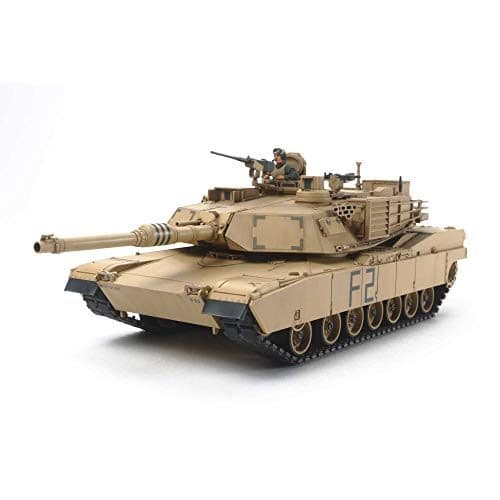
Tamiya's 1/48 Abrams packs serious detail into a smaller footprint. Around 130 parts, excellent fit, and the smaller scale means a faster build and less shelf space. A solid first "real" armor kit for someone stepping up from snap-fits.
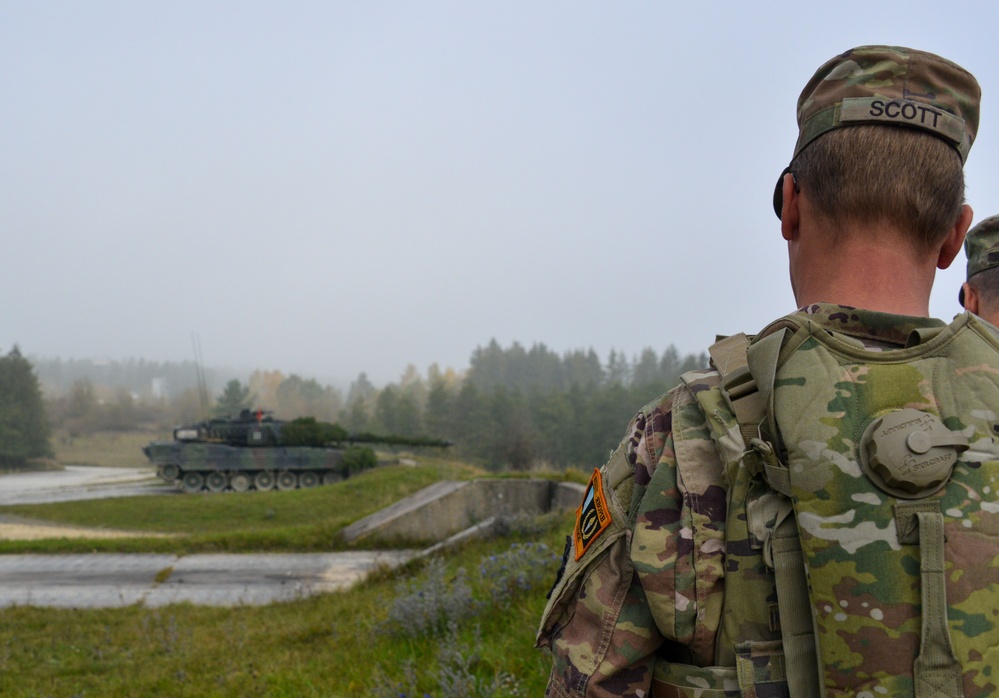
The war in Ukraine has demonstrated the acute vulnerability of legacy armored vehicles to FPV drones and modern anti-tank guided missiles. (Photo: via Defense Visual Information Distribution Service)
First-person-view (FPV) kamikaze drones, cheap, commercially derived quadcopters fitted with shaped-charge warheads, have emerged as one of the most effective anti-armor weapons in history. Both Ukrainian and Russian forces have used FPV drones to destroy hundreds of tanks and armored vehicles, often attacking from above where armor is thinnest. A drone costing a few hundred dollars can disable or destroy a vehicle worth millions. The economics are devastating for the defender.
The M1A1 Abrams tanks provided to Ukraine saw combat in 2024 and 2025, and while they performed admirably in many engagements, they were not immune to these new threats. Several were damaged or destroyed by Russian anti-tank guided missiles (ATGMs) and drone strikes, losses that made international headlines and underscored the vulnerability of even the world's most capable tanks to modern top-attack weapons.
Beyond survivability, the logistics burden of the current Abrams fleet has become a strategic liability. The M1A2 SEPv4, the latest production variant, weighs over 73 tons with its full armor package. That weight creates cascading problems: it limits which bridges the tank can cross, which roads it can travel, and which aircraft can transport it. The Abrams' gas-turbine engine, while powerful, is notoriously fuel-thirsty, consuming roughly 300 gallons of JP-8 fuel to travel 100 miles cross-country. In a contested logistics environment, that fuel consumption becomes a vulnerability in its own right.
The Army also recognized that the Abrams' thermal imaging systems, fire control computers, and networking capabilities, while upgraded repeatedly, were reaching the limits of what could be bolted onto a 1970s-era hull design. The tank needed a new foundation, not another renovation.
"We can't keep putting additions on a 40-year-old house," a senior Army acquisition official told reporters at the Association of the United States Army (AUSA) conference in 2025. "At some point, you need to build a new one."
What Is the M1E3?
The designation "M1E3" is significant and worth unpacking. In U.S. Army nomenclature, the "E" stands for experimental. This is not an M1A3, not simply the next incremental upgrade in the Abrams family. The E designation signals that this is a developmental prototype exploring fundamental design changes. If the M1E3 proves successful in testing, it would likely receive a production designation, potentially M1A3 or even an entirely new designation, before entering full-rate production.
The M1E3 is being developed by General Dynamics Land Systems (GDLS), the same company that has built every Abrams tank since the original. GDLS' Lima, Ohio production facility, the only tank factory in the United States, is the center of the M1E3 program. The company has been working on next-generation Abrams concepts for several years, but the program was dramatically accelerated beginning in 2024 after senior Army leaders decided that the lessons from Ukraine and the Middle East demanded faster action.
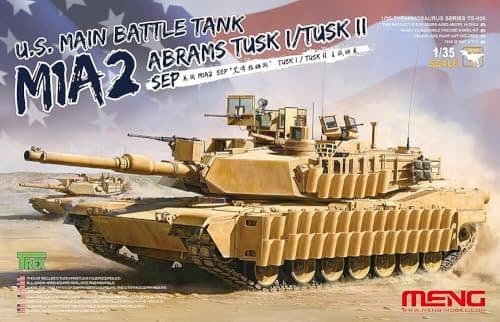
Meng's Abrams includes parts for both TUSK I and TUSK II configurations, which adds explosive reactive armor, a CROWS remote weapon station, and loader's armored gun shield. Sharper detail than Tamiya's version, with workable individual track links.
According to reporting from Breaking Defense and Defense News, the Army originally planned to begin M1E3 prototype deliveries around 2031. The revised timeline moves that to summer 2026, an acceleration of approximately five years. This is an extraordinary pace for a major ground combat vehicle program, reflecting the urgency Army leaders feel about modernizing the armored force.
The M1E3 is not a modification of existing Abrams hulls. It is a clean-sheet redesign that retains the Abrams name and some design DNA, notably the 120mm main gun caliber, while reimagining nearly everything else: the power plant, the suspension, the crew layout, the turret design, and the protection scheme. Think of it as the relationship between the F-15 Eagle and the F-15EX Eagle II, the same lineage, but a fundamentally different machine.
Hybrid-Electric Drive: A Revolution Under the Hood
Perhaps the single most transformative feature of the M1E3 is its hybrid-electric drive train, replacing the Honeywell AGT1500 gas turbine engine that has powered the Abrams since 1980.
The M1E3's hybrid-electric drive train is expected to dramatically reduce fuel consumption and enable silent watch operations. (Illustration: General Dynamics Land Systems)
The AGT1500 turbine is legendarily powerful, producing 1,500 horsepower and giving the Abrams its distinctive jet-engine whine, but it is also legendarily thirsty. The engine burns fuel at an extraordinary rate even when the tank is stationary and idling, which it must do to keep its electronics and turret systems powered. Logistics planners have long noted that fuel for the Abrams fleet consumes a disproportionate share of the Army's supply chain capacity.
The M1E3's hybrid-electric system pairs a conventional diesel or multi-fuel engine with an electric drive motor and battery storage. The benefits are substantial:
Silent watch capability: The tank can operate on battery power alone for extended periods, running its sensors, communications, and weapon systems without the engine running. This makes the tank dramatically quieter, and harder for enemy acoustic and thermal sensors to detect.
Reduced fuel consumption: Estimates from Army briefings suggest the hybrid drive could reduce fuel consumption by 30 to 50 percent compared to the AGT1500, depending on operating conditions. In a prolonged conflict, this translates to hundreds fewer fuel trucks on the road, and fewer logistics convoys vulnerable to enemy interdiction.
Exportable power: The electric drive train generates substantial surplus electrical power, which can be used to run future directed-energy weapons, advanced electronic warfare systems, and high-powered sensors. The Army has explicitly stated that the M1E3's power architecture is designed to accommodate directed-energy weapon systems as they mature.
Improved acceleration and torque: Electric motors deliver peak torque instantaneously. The hybrid system is expected to give the M1E3 comparable or better acceleration than the current Abrams despite the lighter overall vehicle weight.
The shift to hybrid-electric power also reflects broader trends in military vehicle design. The Army's Optionally Manned Fighting Vehicle (OMFV) program and several international tank programs, including the Franco-German Main Ground Combat System (MGCS), are also exploring hybrid-electric architectures. The M1E3 positions the United States at the forefront of this transition.
Lighter, Faster, Harder to Hit
One of the most striking changes in the M1E3 is its weight. The current M1A2 SEPv4, loaded with its Explosive Reactive Armor (ERA) tiles and Trophy active protection system, tips the scales at over 73 tons. The M1E3 is expected to weigh approximately 60 tons, a reduction of roughly 13 tons, or about 18 percent.
That 13-ton diet has enormous implications for strategic and tactical mobility:
Air transportability: The C-5 Galaxy can carry two M1A2 tanks, but only barely, and the C-17 Globemaster III can carry one with little margin. At 60 tons, the M1E3 gives transport aircraft more comfortable margins and potentially opens options for moving tanks by rail and road over infrastructure that cannot support 73-ton loads.
Bridge classification: Many bridges in Europe and the Indo-Pacific, the two theaters the Army considers most likely for armored conflict, have weight limits below the current Abrams' combat weight. A lighter tank can cross more bridges, use more routes, and maintain tempo during offensive operations.
New suspension: The M1E3 features a new, advanced suspension system, reportedly moving away from the torsion-bar suspension used since the original M1 to a more modern hydropneumatic or in-arm unit design. This provides better ride quality at speed, improved cross-country performance, and the ability to adjust ride height for different tactical situations, including lowering the vehicle's profile to reduce its signature.
The weight reduction does not come at the expense of protection, at least, that is the Army's intent. Rather, the M1E3 achieves its lighter weight through a combination of more efficient structural design, a lighter power plant, the removal of the human loader (and associated turret space), and advanced composite and ceramic armor materials that provide equivalent or better protection at reduced weight. The Army has been deliberately vague about specific armor composition, which is among the most closely guarded details of any tank program.
For context on why weight matters in armored warfare, the evolution of tank design over the last century has been a constant tension between protection, firepower, and mobility. The M1E3 represents the Army's attempt to rebalance that equation for the modern era.
Unmanned Turret and Autoloader
The M1E3 is widely reported to feature an unmanned turret, meaning that the turret operates without any crew members inside it. All crew would sit in the hull, protected by the thickest armor on the vehicle, while the turret is controlled remotely from the crew compartment.
The M1E3's unmanned turret and autoloader reduce the crew to three, a departure from the four-person crew the Abrams has used since inception. (Rendering: GDLS concept)
This design change has cascading consequences. The most immediate is the incorporation of an autoloader, a mechanical system that loads rounds into the main gun's breech, replacing the human loader who has been the fourth member of every Abrams crew since 1980. The M1 Abrams has long been renowned for its four-person crew and the rapid rate of fire that a well-trained human loader can sustain, so this is a culturally significant shift for the armored force.
The advantages of the unmanned turret and autoloader include:
Reduced crew to three: Commander, gunner, and driver. Eliminating the loader position means the Army needs fewer tankers to man the same number of tanks, a significant consideration given persistent recruiting challenges.
Lower turret profile: Without the need to accommodate standing crew members, the turret can be made smaller and lower. A lower profile means a smaller target for enemy gunners and a reduced radar and visual signature.
Improved survivability: Moving all crew to the hull puts them below the turret ring, behind the thickest armor. If the turret takes a penetrating hit, historically the most common type of tank kill, the crew has a better chance of survival because they are physically separated from the ammunition and turret equipment.
Ammunition isolation: Modern autoloader designs can incorporate blow-out panels and ammunition compartment isolation more effectively than designs where a crew member works directly with stored rounds.
It is worth noting that autoloaders are not new to tank design. Russian tanks, including the T-72 and T-90, have used autoloaders for decades, though their carousel-type autoloaders have been criticized for contributing to catastrophic ammunition detonations (the infamous "jack-in-the-box" effect seen extensively in Ukraine). The M1E3's autoloader is expected to use a bustle-type design, with ammunition stored in the rear of the turret behind blast-resistant doors, similar to the approach used in the South Korean K2 Black Panther and the Japanese Type 10.
When comparing the M1E3 to other Western tanks, the design philosophy aligns it more closely with cutting-edge platforms. For a broader look at how it stacks up, see our ranking of the best main battle tanks in 2026.
Surviving the Drone Age
If any single factor drove the acceleration of the M1E3 program, it was the drone threat. The proliferation of cheap, capable FPV kamikaze drones, and the devastating toll they have taken on armored vehicles in Ukraine, forced the Army to fundamentally rethink tank survivability.
The current M1A2 SEPv4 already carries the Israeli-developed Trophy active protection system (APS), which uses radar to detect incoming anti-tank missiles and rockets, then fires a shotgun-like blast to destroy them before impact. Trophy has proven highly effective in Israeli service and has been integrated onto U.S. Abrams tanks deployed in Europe. However, Trophy was designed primarily to counter anti-tank guided missiles and rocket-propelled grenades, it was not optimized against the small, fast, top-attacking FPV drones that have become ubiquitous in Ukraine.
The M1E3 is being designed from the ground up with a layered survivability architecture that goes beyond what can be retrofitted onto existing tanks:
Integrated active protection: Rather than bolting an APS onto a tank designed without one, the M1E3 incorporates active protection into its base design. This means the radar arrays, launchers, and control systems are integrated into the vehicle's structure, reducing weight, improving coverage angles, and eliminating the awkward external mounting brackets visible on current Trophy-equipped Abrams tanks. For more on how these systems work, read our deep dive on active protection systems and Trophy APS.
Counter-UAS capability: The M1E3 is expected to incorporate electronic warfare systems capable of jamming or disrupting drone control links and GPS navigation. Some reporting suggests the tank may also feature a dedicated counter-drone weapon, potentially a remote weapon station with a high rate of fire optimized for engaging small, slow-moving aerial targets.
Enhanced top armor: The M1E3's unmanned turret design allows for improved armor on the turret roof and upper surfaces, the areas most vulnerable to top-attack weapons, including FPV drones, Javelin-type ATGMs, and loitering munitions like the Switchblade 600 and Lancet.
Modular armor scheme: The M1E3 is designed with a modular armor architecture, allowing armor panels to be swapped or upgraded without returning the tank to depot. This is crucial for responding to evolving threats, if a new type of warhead appears on the battlefield, new armor modules can be developed and fielded without redesigning the entire vehicle.
Reduced thermal and acoustic signature: The hybrid-electric drive dramatically reduces the tank's thermal and acoustic signature, making it harder to detect with both human senses and remote sensors. In silent watch mode, the M1E3 could be nearly invisible to the thermal and acoustic detection methods that drone operators and artillery spotters use to locate targets.
The Army has been clear that no single technology will make tanks invulnerable to drones. Instead, survivability in the drone age requires a systems-of-systems approach, combining the tank's onboard defenses with electronic warfare support from other vehicles, air defense coverage from dedicated counter-UAS platforms, and tactical concealment techniques developed from hard-won lessons in Ukraine.
Firepower: The 120mm Main Gun and Beyond
The M1E3 retains a 120mm smoothbore main gun, maintaining compatibility with the vast stockpile of 120mm ammunition already in the U.S. and NATO inventory. While some analysts had speculated that the next Abrams might adopt a larger caliber, such as the 130mm gun being developed for the European MGCS program, the Army appears to have concluded that the 120mm platform still has significant growth potential, particularly with new ammunition types.
Advanced kinetic energy penetrators using next-generation materials, programmable airburst rounds for engaging drones and infantry in defilade, and improved multi-purpose high-explosive rounds are all in development for the 120mm platform. The autoloader also enables consistent, mechanical precision in loading, potentially improving rate of fire and reducing the variability that comes with human loaders during extended engagements or under extreme fatigue.
Tamiya's 1/35 Panther Ausf. G is a traditional styrene kit with excellent fit and clear instructions. At this scale, the finished model is roughly 25cm long with good surface detail and working suspension.
The M1E3 is also expected to feature an upgraded fire control system incorporating artificial intelligence for target identification and prioritization, an improved commander's independent thermal viewer, and networking capabilities that allow the tank to receive and share targeting data with other vehicles, drones, and command nodes in real time. This aligns with the Army's broader Project Convergence initiative to create a networked force where every sensor and shooter is connected.
The M1 Abrams vs. Leopard 2 comparison will look very different once the M1E3 enters service, as the American tank will leapfrog its German counterpart in several technological areas, unless the Leopard 2A8 or MGCS closes the gap.
Timeline and What Comes Next
The M1E3 program is moving at a pace rarely seen in Army acquisition. Here is the publicly known timeline:
January 2026: Prototype unveiled at the Detroit Auto Show, marking the first public display of the M1E3 in physical form. General Dynamics used the high-profile civilian venue to generate public awareness and signal confidence in the design.
Summer 2026: Prototype vehicles are scheduled for delivery to the Army for soldier touchpoint evaluations. These are not combat-ready tanks, they are engineering prototypes designed to let soldiers interact with the vehicle, provide feedback on ergonomics, crew station layout, and operational concepts.
2026-2028 (estimated): Developmental testing at Aberdeen Proving Ground (Maryland) and Yuma Proving Ground (Arizona). This phase will evaluate the vehicle's mechanical reliability, automotive performance, weapons accuracy, protection levels, and electronics integration under controlled conditions.
2028-2029 (estimated): Operational testing with Army units, evaluating the tank in realistic tactical scenarios. This is where the M1E3 will face its toughest test, proving it can perform in the hands of regular Army crews, not just test engineers.
2030+ (projected): Low-rate initial production (LRIP) decision, followed by full-rate production if the tank meets requirements. The Army has not publicly committed to a specific initial operational capability (IOC) date.
It is important to note that these timelines are ambitious by historical standards. Major armored vehicle programs frequently experience delays, the Army's previous attempt to replace the Abrams, the Future Combat Systems (FCS) program, was canceled in 2009 after spending over $18 billion without producing a fielded vehicle. The M1E3 program has been structured to avoid the FCS trap by building on proven Abrams technology and manufacturing infrastructure rather than attempting to develop entirely new systems from scratch.
Congressional support appears strong. The Congressional Research Service has identified Abrams modernization as a priority in its ground forces assessment, and DoD budget justification documents for fiscal years 2026 and 2027 include significant funding for the M1E3 program. Bipartisan support for the Lima, Ohio tank plant, which is located in a politically important state, provides additional political resilience.
The M1E3 program also has implications for the legacy of the Abrams name itself. General Creighton Abrams, the tank's namesake, commanded armored forces in World War II and led U.S. forces in Vietnam. The M1E3 ensures that his name will remain on America's premier fighting vehicle for decades to come.
What the M1E3 Means for the Future of Armored Warfare
The M1E3 is more than a new tank, it is a statement about the future of ground combat. At a time when some analysts have declared the tank obsolete, the U.S. Army is making a multi-billion-dollar bet that armored vehicles remain essential to winning wars. But the Army is also acknowledging, through the M1E3's design, that the tank must evolve dramatically to remain relevant.
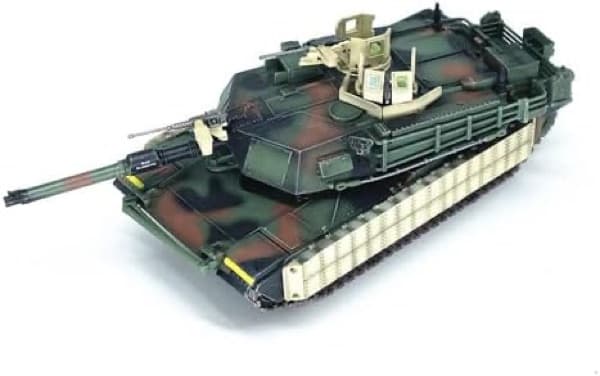
A 1:72 M1A1 Abrams in desert MERDC camouflage. Panzerkampf specializes in modern armor, and the Abrams is their flagship product. Rotating turret with elevating main gun.
The hybrid-electric drive, the unmanned turret, the integrated active protection, the counter-drone systems, these are not incremental improvements. They represent a generational shift in how the Army thinks about armored warfare. The M1E3 is designed not just to fight other tanks, but to survive and fight in a battlespace saturated with drones, precision munitions, and electronic warfare.
Whether the M1E3 lives up to its promise will depend on execution, on whether GDLS and the Army can deliver the technology on time, on budget, and at the performance levels soldiers need. The program's accelerated timeline adds both urgency and risk. But if the M1E3 succeeds, it will ensure that the Abrams remains the most feared tank on the planet for another generation.
The tank is not dead. It is being reborn.
Frequently Asked Questions
What does the "E" in M1E3 stand for?
The "E" stands for experimental. In U.S. Army nomenclature, the E designation indicates a prototype or developmental vehicle undergoing testing. If the M1E3 is approved for production, it will likely receive a new designation such as M1A3. The M1E3 is the third experimental variant in the Abrams family and represents the most significant design departure since the original M1.
When will the M1E3 enter service?
Prototypes are scheduled to be delivered to soldiers for evaluation by summer 2026. However, full operational service is still several years away. Developmental and operational testing is expected to run through approximately 2028-2029, with a low-rate initial production decision likely around 2030. The Army has not announced a specific initial operational capability (IOC) date.
Will the M1E3 replace the M1A2 Abrams?
The M1E3 is intended to eventually replace the current M1A2 SEPv4 as the Army's primary main battle tank. However, the transition will take many years. The Army operates thousands of Abrams tanks, and even at full-rate production, replacing the entire fleet would take well over a decade. The M1A2 SEPv4 will likely remain in frontline service into the 2030s alongside early M1E3 production vehicles.
How does the M1E3 compare to the Russian T-14 Armata?
Both the M1E3 and the Russian T-14 Armata feature unmanned turrets and autoloaders. However, the T-14 has faced severe production problems and has not been deployed in significant numbers, even during the war in Ukraine. The M1E3's hybrid-electric drive, integrated active protection, and the industrial capacity of the United States to produce it at scale represent significant advantages over the troubled Armata program.
Is the Abrams tank obsolete because of drones?
No. While drones have proven devastating against tanks that lack countermeasures, the M1E3 is specifically designed to address the drone threat with integrated active protection systems, electronic warfare countermeasures, and reduced signatures. The lesson from Ukraine is not that tanks are obsolete, it is that tanks without modern protection systems and proper combined-arms support are vulnerable. The M1E3 is the Army's answer to that lesson.