Skip to content
April 26:The Bombing of Guernica89yr ago

Why the Navy's Electromagnetic Railgun Failed After $500 Million, and What Replaced It

Ryan Caldwell · · 10 min read
Save
Share:
US Navy electromagnetic railgun firing a projectile at the Naval Surface Warfare Center Dahlgren with a bright muzzle flash
Ryan Caldwell
Ryan Caldwell

Defense Analysis Editor

Ryan Caldwell writes about military decision-making, failed programs, and the tradeoffs behind major defense choices. His work is focused on understanding why systems succeed or fail beyond headlines, promises, and initial expectations.

The railgun worked. It fired a projectile at Mach 6, seven times the speed of sound, using nothing but electromagnetic force. No propellant. No explosive charge. No chemical reaction of any kind. Just two parallel rails, a massive electrical current, and the Lorentz force accelerating a metal slug to speeds that would make a bullet envious. The physics worked exactly as predicted. The engineering destroyed itself every time it fired. After $500 million and more than 15 years of development, the Navy cancelled the electromagnetic railgun program in 2021. But the story doesn't end there, because the most useful thing the railgun produced wasn't the gun. It was the bullet.

How a Railgun Works
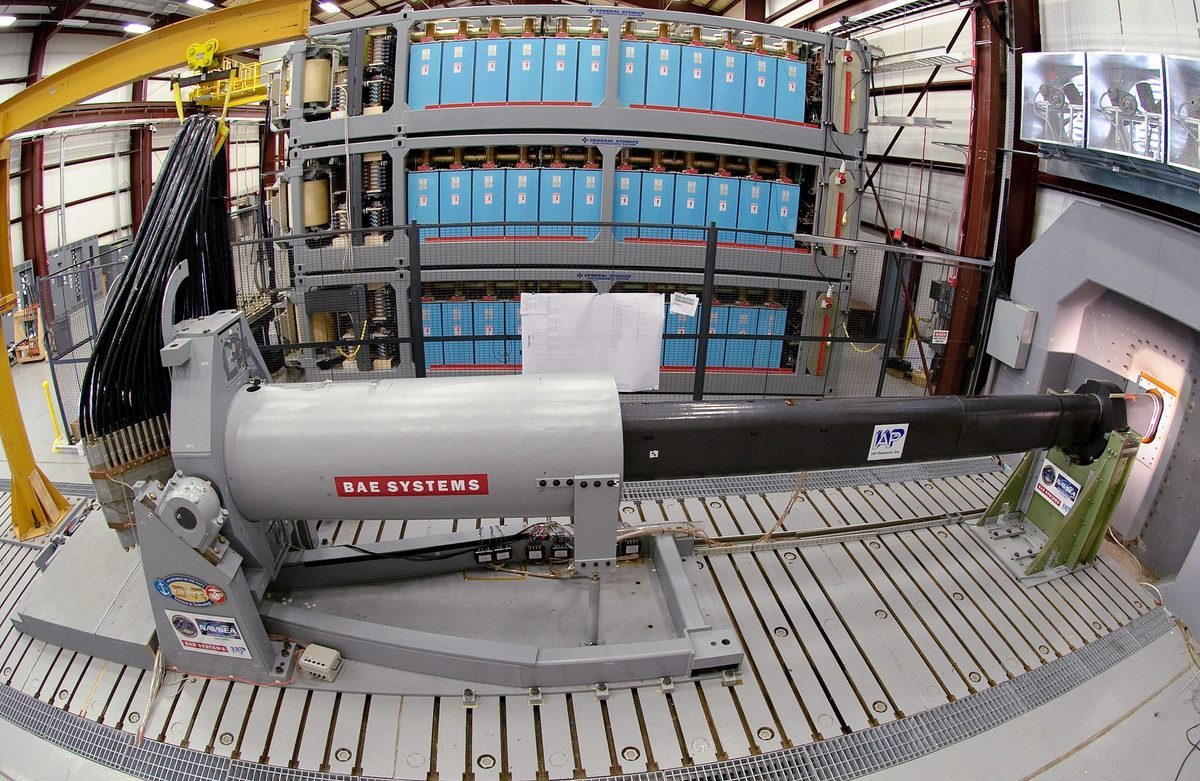
Diagram showing the electromagnetic railgun operating principle with parallel rails, armature, and current flow creating Lorentz force
The railgun principle: massive current flows through parallel rails and a conductive armature, generating a Lorentz force that accelerates the projectile to hypersonic speeds. No propellant required. (Illustration)

The concept is elegant in its simplicity. Two parallel metal rails, each several meters long, are connected to a massive power supply. A conductive armature sits between the rails, touching both. When current flows through the circuit, into one rail, across the armature, and back through the other rail, it creates a magnetic field between the rails. That magnetic field, interacting with the current flowing through the armature, produces a force (the Lorentz force) that pushes the armature down the length of the rails at extraordinary speed. Place a projectile in front of the armature, and you have a gun that fires without any chemical propellant.

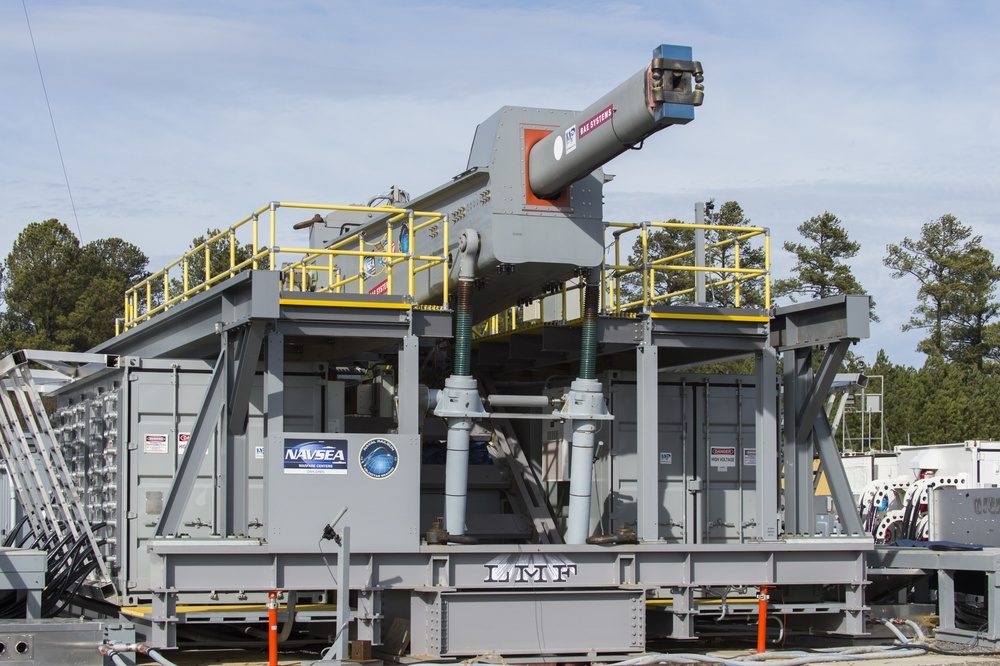
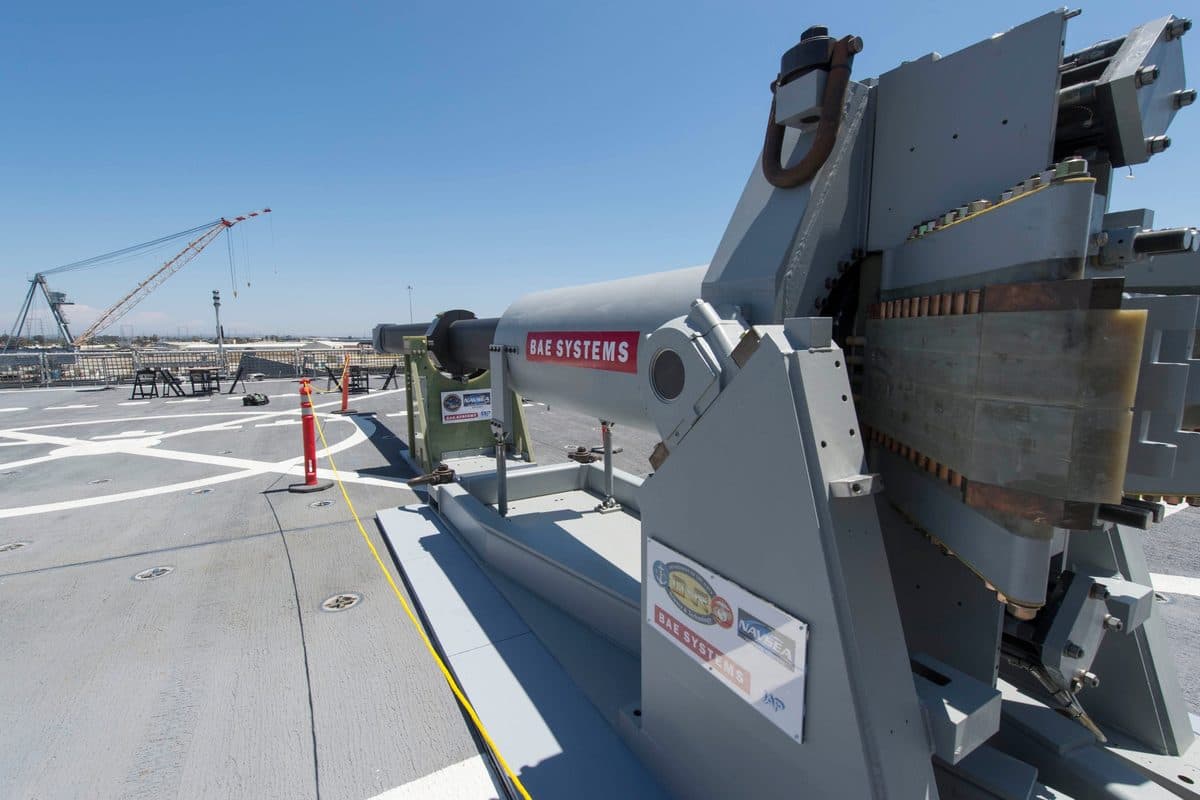
The Navy's railgun prototype, developed primarily by BAE Systems and General Atomics, achieved muzzle energies of 32 megajoules, roughly three times the muzzle energy of the Mark 45 5-inch gun currently mounted on Navy destroyers. The projectile left the barrel at approximately Mach 6, with a theoretical range exceeding 100 nautical miles. At that speed, the kinetic energy of the projectile alone, no explosive warhead needed, would be devastating on impact. And the cost per shot was projected at roughly $25,000, compared to $1 million or more for a cruise missile.

The Promise: Why the Navy Wanted It

The railgun promised to solve several problems simultaneously. First, magazine depth: a destroyer carries a finite number of missiles in its vertical launch cells, and once they're expended, the ship must return to port to reload. A railgun's ammunition is inert metal, no explosive propellant, no volatile warheads, which means it can be stored safely in much larger quantities. A ship might carry hundreds or thousands of railgun rounds in the space occupied by a few dozen missiles.

Second, cost per engagement: using a $1 million missile to destroy a $50,000 target is an exchange ratio that favors the attacker. A $25,000 railgun round changes that calculus entirely. Against swarm attacks, dozens of small boats or drones approaching simultaneously, the railgun's rapid fire and low cost per shot would be transformative.

Third, speed of response: a Mach 6 projectile reaches a target 100 miles away in roughly 90 seconds. There is no practical defense against something moving that fast. No countermeasure, no decoy, no jamming can stop a solid metal slug traveling at 4,500 miles per hour. The target either moves before the shot is fired or it doesn't, there's no intercepting the round in flight.

What Went Wrong: The Barrel Problem

Close-up of electromagnetic railgun barrel rails showing severe erosion and pitting damage from electromagnetic forces and extreme heat
Railgun barrel erosion after repeated firings. The extreme temperatures and electromagnetic forces stripped material from the rails with every shot, requiring barrel replacement every 100-400 rounds. (U.S. Navy photo)

The railgun's fundamental problem was that firing it was an act of self-destruction. Every time the gun fired, the enormous current flowing through the rails, millions of amperes, generated extreme electromagnetic forces, intense heat (the armature contact points reached temperatures that vaporized metal), and a violent plasma arc that stripped material from the rail surfaces. This erosion meant the barrel needed replacement after somewhere between 100 and 400 shots, depending on the power setting.

For context, a conventional 5-inch naval gun barrel lasts thousands of rounds. The Mark 45 can fire its entire ready magazine and reload multiple times before barrel replacement is necessary. A railgun barrel that needed replacement every few hundred shots was operationally unacceptable, not because the replacement was difficult, but because it meant a ship in combat would effectively run out of gun before it ran out of ammunition. The barrel erosion problem proved resistant to every material science solution the program attempted. Exotic alloys, ceramic liners, segmented rail designs, all slowed the erosion rate but none solved it.

What Went Wrong: The Power Problem

A 32-megajoule railgun requires roughly 25 megawatts of pulsed electrical power, more than most warships generate for their entire electrical load. This power must be stored in capacitor banks (or similar energy storage systems) and discharged in milliseconds. The energy storage and power conditioning equipment required to fire the railgun at tactically useful rates occupied a significant portion of any ship's available space and weight margin.

This is why the USS Zumwalt was considered the ideal platform: its Integrated Power System (IPS) generates 78 megawatts of electrical power, enough, in theory, to power the ship's systems and a railgun simultaneously. The Zumwalt was designed from the keel up with excess electrical capacity specifically to accommodate directed energy weapons and the railgun. No other surface combatant in the Navy's fleet had enough power to operate the system.

But even the Zumwalt's power wasn't free. Firing the railgun would require diverting significant electrical power from other ship systems, potentially affecting radar performance, propulsion, or other weapons during the charging cycle. The thermal management challenge, dissipating the heat generated by repeated firings, added another layer of engineering complexity that was never fully resolved.

What Went Wrong: The Guidance Problem

A railgun fires an inert metal slug at Mach 6. At ranges of 100 miles, even small aiming errors translate to misses measured in hundreds of meters. Against stationary targets, buildings, bunkers, parked equipment, unguided rounds might be acceptable. Against moving targets, ships, vehicles, missile launchers, some form of terminal guidance is essential.

But here's the problem: the projectile exits the barrel surrounded by a plasma sheath at temperatures exceeding 10,000 degrees Fahrenheit. Any guidance electronics in the projectile must survive the electromagnetic pulse of launch (millions of amperes flowing through the rails), the extreme G-forces of acceleration (tens of thousands of g's), and the plasma and heat environment during barrel transit. Building guidance electronics that survive these conditions is a materials science challenge comparable to the barrel erosion problem, and the program never fully solved it either.

The Cancellation and What Came After

The Office of Naval Research officially ended the railgun program in 2021, redirecting funding to other priorities. The decision was less dramatic than it sounds, the program had been losing momentum and funding for years as the technical challenges proved more stubborn than expected. But the cancellation was not a complete loss, because the railgun program had produced something unexpectedly valuable: the Hypervelocity Projectile (HVP).

The HVP was originally designed as the railgun's guided projectile, a dart-shaped round with a tungsten penetrator, aerodynamic sabot, and miniaturized GPS/INS guidance electronics hardened to survive the railgun's launch environment. But someone at the Naval Surface Warfare Center had a critical insight: if the HVP's electronics could survive a railgun launch, they could certainly survive being fired from a conventional gun. And a guided, aerodynamic projectile fired from a 5-inch naval gun at Mach 3 would still be transformative, not as fast as a railgun round, but far faster and cheaper than a missile.

The HVP fired from a standard Mark 45 5-inch gun reaches approximately Mach 3, with a range of roughly 40 nautical miles, double the range of conventional 5-inch ammunition. Against incoming cruise missiles and drones, the HVP at $85,000-$100,000 per round is dramatically cheaper than a $2 million Standard Missile or $1 million ESSM. A destroyer's magazine could carry hundreds of HVP rounds for the cost of a few dozen missiles, fundamentally changing the economics of air defense.

The Lesson: When Physics Works but Engineering Doesn't

The electromagnetic railgun is a case study in the gap between scientific proof-of-concept and deployable weapon system. The physics always worked, the Lorentz force will accelerate a conductor between two rails exactly as the equations predict. The problem was everything around the physics: the materials that couldn't survive the forces, the power systems that couldn't sustain the demand, the guidance electronics that couldn't survive the environment, and the barrels that consumed themselves with every shot.

This happens more often in military technology than the public realizes. The history of weapons development is littered with concepts that worked in the laboratory and failed in the fleet. The railgun joins the Zumwalt's cancelled Advanced Gun System, the FCS (Future Combat Systems) program, and numerous other ambitious projects that were technically brilliant and practically impossible, at least with current materials and engineering.

But the railgun's failure produced the HVP, and the HVP may prove more useful than the railgun ever would have been. A $100,000 guided projectile that can be fired from every 5-inch gun in the fleet is arguably a better capability than a $500 million gun that can only be mounted on one class of ship. Sometimes the most valuable thing a failed program produces isn't the system it was trying to build, it's the piece that works when you put it somewhere else.

Share this article

Share:

Recommended

Ace of The Skies: Can You Identify These Military Aircraft Throughout The Years?
Test Yourself

Ace of The Skies: Can You Identify These Military Aircraft Throughout The Years?

Can you identify these aircraft?

Take the Quiz

On This Day in Military History

April 26

The Bombing of Guernica (1937)

German Condor Legion and Italian bombers attacked the Basque market town of Guernica during the Spanish Civil War, killing an estimated 150-300 civilians in one of the first deliberate terror bombings of an undefended town. The attack inspired Picasso's masterwork and became the world's most powerful symbol of aerial bombardment against civilians.

1865, Johnston Surrenders the Army of Tennessee

See all 11 events on April 26

Get Military News & History in Your Inbox

Join thousands of readers receiving our weekly digest of military technology, history, and analysis.

Test Your Knowledge