
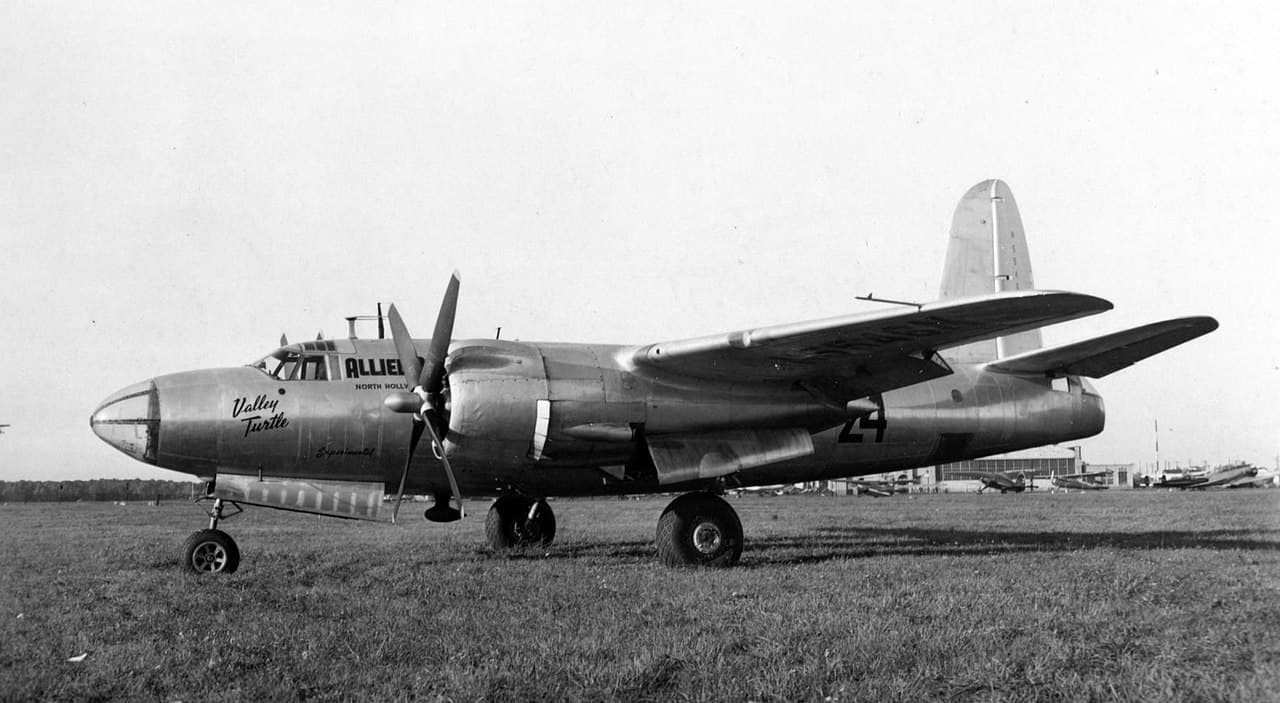
Martin B-26B Marauder
Glenn L. Martin Company
How does the B-26B stack up?
CompareOverview
The Martin B-26 Marauder was one of the most controversial aircraft of World War II, a medium bomber with a reputation as a "widow maker" that ultimately achieved the lowest combat loss rate of any American bomber in the European theater. Designed around a high wing loading that gave it outstanding speed but treacherous handling at low speeds, the B-26 terrified student pilots in training but proved devastatingly effective in combat once crews learned to fly it properly.
The Marauder's journey from "the Baltimore Whore" and "one a day in Tampa Bay" (references to its training accident rate) to the safest bomber in the Ninth Air Force is one of the most remarkable rehabilitation stories in aviation history. Under the leadership of commanders who insisted on proper training and disciplined flying, the B-26 compiled a combat record that silenced its critics: in the ETO, it achieved a loss rate of less than 0.5% per sortie, the lowest of any American bomber.
The B-26B, with its enlarged wing and more powerful engines, was the variant that redeemed the Marauder's reputation. Flying from bases in England and France, Ninth Air Force B-26 groups struck bridges, marshaling yards, V-weapon sites, and troop concentrations across northern France, the Low Countries, and Germany. The Marauder proved that a "hot" airplane, properly handled, could be the most effective weapon in the inventory.
Performance Profile
Max Speed
283 mph
at 15,000 ft
Range
1,150 miles
normal
Service Ceiling
21,000 ft
Rate of Climb
1,000 ft/min
Armament
11 guns
11x .50 BMG
Crew
7
Engine
Pratt & Whitney R-2800-43 Double Wasp
1920 hp radial
Development History
The B-26 was designed by Peyton Magruder of the Glenn L. Martin Company in response to a January 1939 Army Air Corps specification for a high-speed medium bomber. Magruder's design prioritized speed over ease of handling, featuring a circular cross-section fuselage, relatively small wings with high wing loading, and a tricycle landing gear. The design was so promising on paper that the Army ordered 201 aircraft directly off the drawing board, before the prototype had even flown.
The XB-26 prototype first flew on November 25, 1940, and immediately demonstrated the speed that had attracted the Army: it was the fastest medium bomber in the world. But the small wing and high wing loading resulted in a landing speed of 135 mph, terrifyingly fast for the era, and a stalling speed that left little margin for error. The aircraft was unforgiving of any pilot who allowed the speed to decay.
Training casualties mounted alarmingly. The B-26 had the highest training accident rate of any Army Air Forces aircraft, earning it the deadly nicknames "the Widowmaker," "the Flying Coffin," and "one a day in Tampa Bay" at MacDill Field in Florida. A congressional investigation in 1943 nearly resulted in the cancellation of the entire B-26 program. Colonel Jimmy Doolittle's personal intervention, he flew a B-26 to demonstrate that it could fly safely on one engine, helped save the aircraft.
The B-26B introduced crucial improvements: the wingspan was increased from 65 to 71 feet to reduce wing loading, more powerful R-2800-43 engines were installed, armor protection was increased, and the armament was upgraded. The B-26B-10 and later sub-variants also featured an enlarged vertical tail and finlets on the horizontal stabilizer for improved directional stability. These changes transformed the Marauder from a dangerous handful into a stable, effective combat aircraft.
Combat History
The B-26 first saw combat in the Pacific in April 1942, when the 22nd Bombardment Group flew missions from Australia against Japanese targets in New Guinea and the Dutch East Indies. Four B-26s even made torpedo attacks against the Japanese fleet during the Battle of Midway on June 4, 1942, pressing home their attacks at mast height in the face of withering anti-aircraft fire. Two of the four were shot down, and the survivors were so badly damaged that the torpedo-attack role was abandoned.
The B-26's true calling was in the European theater, where the Ninth Air Force employed it as the primary medium bomber for the tactical air campaign. The first European missions in May 1943 were disastrous, a low-level attack on a power plant near IJmuiden, Netherlands, resulted in the loss of one entire squadron, but the groups quickly switched to medium-altitude bombing with much better results. B-26 groups became specialists in precision attacks on bridges, rail junctions, and V-1 launch sites.
During the D-Day invasion on June 6, 1944, B-26 Marauders of the Ninth Air Force were among the first aircraft over the beaches, bombing German defensive positions at Utah Beach with remarkable accuracy. In the weeks following, B-26 groups systematically destroyed bridges across northern France to isolate the battlefield. The 323rd, 386th, 387th, 391st, 394th, and 397th Bomb Groups all compiled outstanding records.
By war's end, Ninth Air Force B-26 groups had flown over 129,000 sorties and dropped more than 169,000 tons of bombs. The Marauder's combat loss rate of 0.47% per sortie was the lowest of any American bomber in the ETO, a stunning vindication for an aircraft that had nearly been cancelled as too dangerous to fly.
Variants
| Designation | Key Differences | Produced |
|---|---|---|
| B-26 | Initial production, 65-foot wingspan, R-2800-5 engines, high accident rate in training | 201 |
| B-26A | Provision for torpedo carriage, minor improvements | 139 |
| B-26B | Enlarged 71-foot wingspan, R-2800-43 engines, increased armor and armament | 1,883 |
| B-26C | Identical to late B-26B, built at Martin's Omaha plant | 1,210 |
| B-26F | Increased wing incidence angle for better takeoff performance | 300 |
| B-26G | Final production variant, further increased wing incidence, minor refinements | 893 |
Strengths & Weaknesses
+Strengths
- Lowest combat loss rate of any American bomber in the ETO (0.47% per sortie)
- Excellent speed for a medium bomber, making it harder for fighters to intercept
- Precision bombing capability; B-26 groups achieved outstanding accuracy on bridge and rail targets
- Rugged construction could absorb considerable battle damage
- Effective at medium altitude where flak was less dense than at the low altitudes used by the B-25
-Weaknesses
- Extremely high training accident rate earned it deadly nicknames and nearly caused cancellation
- High landing speed (130+ mph) and stall characteristics were unforgiving of pilot error
- High wing loading in early variants made it dangerous in single-engine situations
- Required longer runways than other medium bombers due to high takeoff and landing speeds
Pilot Voices
“The B-26 would fly on one engine, if you knew what you were doing. The trouble was, too many guys in training didn't know what they were doing yet.”
“Once you learned to fly the Marauder, it was a beautiful airplane. It was honest, it just didn't suffer fools.”
Did You Know?
The B-26 was ordered directly off the drawing board, 201 aircraft were contracted before the prototype ever flew, an unprecedented level of confidence in an unproven design.
The training accident rate was so high that a congressional committee investigated whether to cancel the program. Jimmy Doolittle personally flew a B-26 single-engine to prove it could be done safely.
Despite its "widow maker" reputation, the B-26 ended the war with the lowest combat loss rate of any American bomber in the European theater at 0.47% per sortie.
Four B-26 Marauders made torpedo attacks against the Japanese fleet at the Battle of Midway, one of the boldest air attacks of the Pacific war.

