
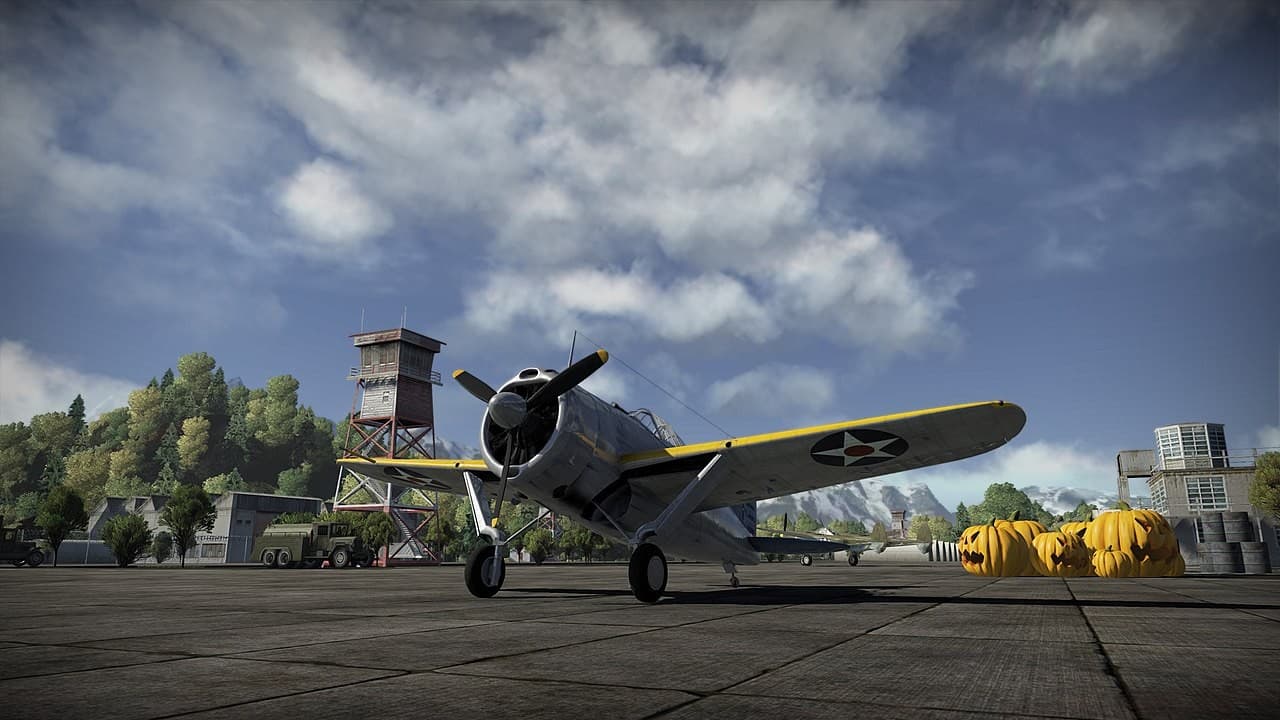
Brewster B-239 Buffalo
Brewster Aeronautical
How does the B-239 stack up?
CompareOverview
The Brewster Buffalo occupies one of the most paradoxical positions in WW2 aviation history. In American, British, and Dutch service in the Pacific and Southeast Asia, it was a catastrophic failure, hopelessly outclassed by the Mitsubishi A6M Zero and slaughtered in combat at Midway, Malaya, and the Dutch East Indies. Yet in Finnish service during the Continuation War against the Soviet Union, the very same basic aircraft achieved one of the most extraordinary combat records of any fighter in any air force: a kill ratio exceeding 26:1.
The explanation for this staggering disparity lies not in the aircraft itself, but in the circumstances of its employment. The Finnish B-239 variants were lighter than their Pacific counterparts, stripped of naval equipment, armor, and self-sealing fuel tanks, giving them sprightly performance at the low altitudes where Eastern Front combat occurred. Finnish pilots were superbly trained, intimately familiar with their aircraft, and fighting over home territory against Soviet opponents who, in the early years, often lacked comparable skill.
The Buffalo's story is a powerful reminder that aircraft performance cannot be evaluated in isolation from the conditions of combat, the quality of the pilots, and the nature of the opposition. The same machine that was a death trap over Midway was a weapon of extraordinary effectiveness over Karelia.
Performance Profile
Max Speed
297 mph
at 13,100 ft
Range
650 miles
normal
Service Ceiling
33,200 ft
Rate of Climb
2,720 ft/min
Armament
4 guns
4x 12.7mm M2 Browning
Crew
1
Engine
Wright R-1820-G5 Cyclone
950 hp radial
Development History
The Brewster Buffalo originated from a 1935 US Navy competition for a new carrier-based monoplane fighter to replace the biplane Grumman F3F. The Brewster Aeronautical Corporation, a small company with limited aircraft manufacturing experience, won the competition with their Model 139, which first flew on December 2, 1937. The stubby, barrel-fuselage design was powered by a Wright R-1820 Cyclone radial engine and featured retractable landing gear and an enclosed cockpit.
The US Navy ordered 54 as the F2A-1, making the Buffalo the first monoplane fighter to equip an American carrier squadron. However, the Navy's enthusiasm cooled rapidly as the Grumman F4F Wildcat proved more suitable for carrier operations, and most F2A-1s were diverted to Finland in 1939 as the B-239 export variant. The Navy continued development with the F2A-2 and F2A-3, each adding weight in the form of armor, self-sealing tanks, and additional equipment that progressively degraded the aircraft's performance without meaningfully improving its survivability.
Finland's acquisition of 44 B-239s in early 1940 was a stroke of extraordinary fortune. Finnish engineers immediately set about tailoring the aircraft to their needs, removing unnecessary naval equipment and reducing weight wherever possible. The resulting aircraft weighed roughly 600 pounds less than the American naval version and performed correspondingly better, with a lower wing loading and improved power-to-weight ratio that made it a nimble dogfighter at low and medium altitudes.
Britain, the Netherlands, and Australia also received Buffalo variants, the heavier B-339 and B-439 export models with the upgraded Wright R-1820-G105A engine. These aircraft, burdened with additional weight and operating in tropical conditions that further degraded engine performance, proved disastrously inadequate against the Japanese fighters they encountered in Malaya, Burma, and the Dutch East Indies.
Combat History
The Brewster Buffalo's combat history splits into two dramatically different narratives. In the Pacific and Southeast Asia, it was a disaster. During the Battle of Midway on June 4, 1942, Marine Fighting Squadron VMF-221, equipped with F2A-3 Buffalos, attacked the incoming Japanese strike force and was annihilated, 13 of 20 Buffalos were shot down, and the surviving pilots unanimously condemned the aircraft. Captain Philip White reported that "any commander who orders pilots out for combat in an F2A-3 should consider the pilots as already lost."
In Malaya and the Dutch East Indies, RAF and Commonwealth Buffalo squadrons were overwhelmed by Japanese fighters in late 1941 and early 1942. The overweight tropical variants could not match the Zero or the Nakajima Ki-43 Oscar in speed, climb, or maneuverability, and their inadequate self-sealing fuel tanks made them fatally vulnerable. The Buffalo was rapidly withdrawn from Pacific service and replaced by P-40s, Hurricanes, and Spitfires.
Finland's experience was the mirror opposite. When the Continuation War began on June 25, 1941, the Finnish Air Force's Lentolaivue 24 (Fighter Squadron 24) was equipped with 44 B-239 Buffalos, and over the next three years these aircraft achieved a staggering record of 477 confirmed aerial victories against only 15 combat losses, a kill ratio of 32:1. Individual Finnish aces compiled extraordinary tallies: Hans Wind scored 39 of his 75 total victories in the Buffalo, while Ilmari Juutilainen, Finland's all-time top ace with 94 kills, scored 34 in the type.
The Finnish Buffalo excelled because conditions aligned perfectly: light aircraft weight, low-altitude combat where its short-range agility shone, superbly experienced pilots, and Soviet opponents who often flew with inferior tactics during 1941-43. Finnish ground crews maintained the Buffalos meticulously, keeping serviceability rates high despite harsh winter conditions. The B-239 remained in Finnish frontline service until 1944, when it was finally replaced by Bf 109Gs, but by then the stubby Brewster had compiled one of the most remarkable combat records of the entire war.
Variants
| Designation | Key Differences | Produced |
|---|---|---|
| F2A-1 | Initial US Navy carrier fighter variant with Wright R-1820-34 engine (940 hp). 11 retained by USN; 44 diverted to Finland as B-239. | 55 |
| B-239 (Finnish) | Export variant for Finland, stripped of carrier equipment and arresting hook. Lighter weight gave superior performance. Finland's most successful WW2 fighter. | 44 |
| F2A-2 | Improved US Navy variant with R-1820-40 engine (1,200 hp), improved propeller, and redesigned cowl flaps. Weight increased significantly. | 43 |
| F2A-3 | Final US Navy variant with additional armor, self-sealing tanks, and increased fuel capacity. Heaviest variant at 6,321 lbs loaded, critically overweight for the airframe. | 108 |
| B-339E (RAF) | British export variant for Malaya and Burma. Wright R-1820-G105A engine. Tropical conditions degraded performance further. Proved disastrously inadequate against Japanese fighters. | 170 |
Strengths & Weaknesses
+Strengths
- In lightened Finnish configuration, exceptional maneuverability and agility at low to medium altitudes
- Robust radial engine was reliable in extreme cold, critical advantage in Finnish winter conditions
- Compact airframe presented a small target and accelerated well in a dive
- Good cockpit visibility from the raised seating position and generous greenhouse canopy
-Weaknesses
- Later variants critically overweight, F2A-3 was nearly 1,500 lbs heavier than the B-239 on the same basic airframe
- Hopelessly outclassed by the A6M Zero in Pacific service due to inferior speed, climb, and armament weight
- Brewster Aeronautical's poor quality control led to structural inconsistencies and unreliable equipment
- No self-sealing fuel tanks on early variants, and added tanks on later models increased weight without adequately improving survivability
Pilot Voices
“It was a fine aircraft, easy to fly and very maneuverable. Against the Russians at low altitude, there was nothing better.”
“Any commander who orders pilots out for combat in an F2A-3 should consider the pilots as already lost.”
“The Buffalo was a sweet-flying little airplane, but it just could not compete against the Zero. We were sitting ducks.”
Did You Know?
Finnish B-239 Buffalos achieved an astonishing kill ratio of at least 26:1 (some sources claim 32:1), making it one of the most successful fighter types operated by any nation in WW2 when measured by kill-to-loss ratio.
Brewster Aeronautical was so poorly managed that the US Navy eventually seized the company's factory in 1944 under wartime emergency powers, one of the only instances of the US government taking over a defense contractor during WW2.
Finnish ace Hans Wind scored 39 of his 75 total aerial victories in the Buffalo, calling it "a fine aircraft", a judgment that would have baffled the American Marines who died flying the type at Midway.
The same B-239 fuselage that Finnish pilots adored was originally designed as a carrier aircraft, the retractable landing gear wells, even with the hook removed, gave it a distinctive pudgy profile.

