
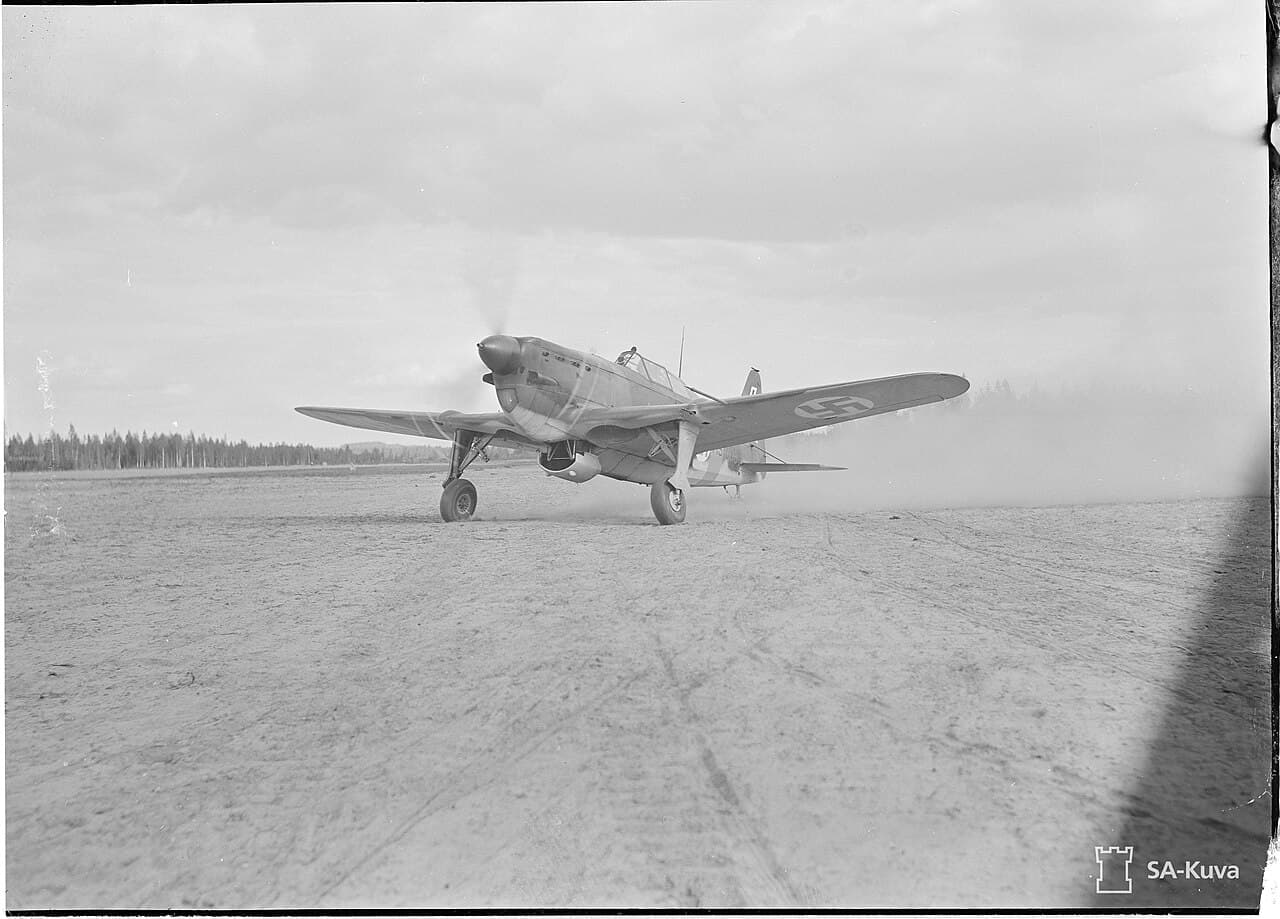
Morane-Saulnier MS.406
Morane-Saulnier
How does the MS.406 stack up?
CompareOverview
The Morane-Saulnier MS.406 was the most numerous French fighter in service during the Battle of France in May-June 1940, and the first modern monoplane fighter to equip the Armee de l'Air in significant numbers. With its enclosed cockpit, retractable landing gear, and 20mm engine-mounted cannon, the MS.406 represented a dramatic modernization of French fighter aviation when it entered service in early 1939, but by the time Germany attacked in May 1940, it was already outclassed by the Messerschmitt Bf 109E in virtually every performance metric.
The MS.406 was not a bad aircraft. It was pleasant to fly, maneuverable at low and medium altitudes, and its 20mm Hispano-Suiza cannon gave it respectable firepower. But its Hispano-Suiza 12Y-31 engine produced a mere 860 horsepower, giving it a top speed of only 302 mph, roughly 50 mph slower than the Bf 109E. French pilots who flew the MS.406 against German fighters knew they were at a significant disadvantage and relied on teamwork, aggressive tactics, and the aircraft's tight turning radius to survive.
Despite its limitations, the MS.406 fought hard during the six weeks of the Battle of France. Equipped with the type, French fighter groups claimed 191 aerial victories against 89 combat losses, a creditable performance for an outclassed aircraft flown by determined pilots. After France's fall, the MS.406 continued to serve with several air forces, most notably Finland, where modified versions known as Morko-Moraani fought effectively against the Soviets.
Performance Profile
Max Speed
302 mph
at 16,400 ft
Range
497 miles
normal
Service Ceiling
30,840 ft
Rate of Climb
2,559 ft/min
Armament
3 guns
1x 20mm Hispano-Suiza HS.404, 2x 7.5mm MAC 1934
Crew
1
Engine
Hispano-Suiza 12Y-31
860 hp inline
Development History
The MS.406 traced its origins to a 1934 French Air Ministry requirement for a modern single-seat fighter capable of 400 km/h. Morane-Saulnier's response, the MS.405, first flew on August 8, 1935, making it one of the earliest low-wing, enclosed-cockpit monoplane fighters in Europe. The design was conventional but sound: a mixed wood-and-metal construction with fabric-covered control surfaces, a retractable main undercarriage, and the engine-mounted 20mm cannon that was becoming a French trademark.
The prototype showed promise but suffered from chronic engine cooling problems and structural issues that delayed development. The French aviation industry's nationalization in 1937 further complicated matters, as Morane-Saulnier's factory was reorganized under the SNCAO (Societe Nationale de Constructions Aeronautiques de l'Ouest). Despite these disruptions, the production version, designated MS.406, received its first orders in 1938, and deliveries began in earnest in early 1939.
By September 1939, approximately 600 MS.406s were in service, making it the backbone of the French fighter force. Production continued into 1940, eventually reaching 1,081 aircraft. However, the MS.406 was already being recognized as inadequate. The engine, which had seemed adequate in 1936, was hopelessly underpowered by 1940 standards. Attempts to install the more powerful Hispano-Suiza 12Y-45 or -51 engines were frustrated by supply shortages, those engines were allocated to the higher-priority D.520 program.
The Swiss Air Force purchased 82 MS.406s (designated D-3800) and license-built a further 207, designated D-3801 with a more powerful engine. Finland received 30 MS.406s and later modified them extensively, fitting captured Soviet Klimov VK-105 engines to create the Morko-Moraani ("Bogy Morane"), which achieved remarkable success against Soviet aircraft on the Finnish Front.
Combat History
When Germany launched its Western offensive on May 10, 1940, the MS.406 equipped the majority of French fighter groups, 16 groupes de chasse flew the type, compared to only 3 with the superior D.520. From the first hours of the battle, MS.406 pilots found themselves at a severe disadvantage against the Bf 109E. The German fighter was faster at all altitudes, climbed better, and dived faster. Only in turning combat at low altitude could the MS.406 compete, and experienced French pilots learned to avoid vertical engagements and drag German fighters into horizontal dogfights where the Morane's lighter wing loading gave it an edge.
Despite these disadvantages, MS.406 units fought with determination and courage. Groupe de Chasse III/1, one of the most experienced MS.406 units, claimed 15 victories in the first week of fighting alone. Individual pilots achieved remarkable results: Sous-Lieutenant Jean-Marie Accart of GC I/5 became one of France's leading aces flying the type, demonstrating that a skilled pilot could extract impressive performance from even an outclassed machine.
The MS.406's combat record during the Battle of France, 191 confirmed victories against 89 aircraft lost in combat, was more respectable than is often acknowledged. French pilots compensated for their aircraft's inferior performance through aggressive tactics, intimate knowledge of local terrain, and the MS.406's one genuine tactical advantage: its ability to out-turn the Bf 109E. Many Luftwaffe pilots reported being surprised by the tenacity of Morane pilots who refused to break off combat even when clearly overmatched.
After France's defeat, the MS.406's most successful second career came in Finnish service. Finnish mechanics, renowned for their ingenuity, modified their Moranes extensively, eventually producing the Morko-Moraani variant with a captured Soviet engine that boosted performance to 326 mph. Finnish aces flew these modified Moranes with exceptional success against Soviet fighters throughout the Continuation War of 1941-44, proving that the basic airframe was better than its engine had ever allowed it to demonstrate.
Variants
| Designation | Key Differences | Produced |
|---|---|---|
| MS.405 | Pre-production prototype series with various engine and armament configurations. Used for testing and evaluation. | 16 |
| MS.406 C.1 | Standard production fighter with Hispano-Suiza 12Y-31 engine, 1x 20mm cannon, 2x 7.5mm machine guns. Main variant during the Battle of France. | 1,081 |
| D-3800 (Swiss) | Swiss-purchased MS.406s. 82 imported from France, used for home defense. | 82 |
| D-3801 (Swiss) | Swiss license-built variant with Hispano-Suiza 12Y-51 engine (1,060 hp), improved armament, and fixed-pitch to constant-speed propeller upgrade. | 207 |
| Morko-Moraani (Finnish) | Finnish modification with captured Soviet Klimov VK-105P engine (1,100 hp), new cowling, improved exhaust system. Boosted top speed to 326 mph. | 41 |
Strengths & Weaknesses
+Strengths
- Excellent maneuverability at low and medium altitudes, could out-turn the Bf 109E in horizontal combat
- Rugged mixed-construction airframe was easy to repair in field conditions with basic tools and materials
- Engine-mounted 20mm HS.404 cannon provided meaningful firepower despite only two rifle-caliber wing guns
- Docile handling characteristics made it easy for average pilots to fly, reducing training accidents
-Weaknesses
- Critically underpowered 860 hp engine left it roughly 50 mph slower than the Bf 109E at all altitudes
- Weak armament overall, only two 7.5mm machine guns supplementing the cannon, with low ammunition capacity
- Fabric-covered rear fuselage and control surfaces were vulnerable to incendiary ammunition
- Inadequate service ceiling of 30,840 feet left it unable to intercept high-altitude reconnaissance aircraft
Pilot Voices
“The Morane was a gentleman's aircraft, pleasant, forgiving, and completely outclassed. We fought because we were French, not because our machine could match the Messerschmitt.”
“Against the 109 you had to fight clever. Get him turning at low altitude and the Morane could stay with him. But if he climbed away, it was over, you could not follow.”
Did You Know?
The Finnish Morko-Moraani ("Bogy Morane") variants powered by captured Soviet engines achieved a 16:1 kill ratio against Soviet aircraft, arguably the most successful foreign modification of any French WW2 fighter.
The MS.406 was one of the few WW2 fighters to use both riveted metal construction in the forward fuselage and fabric covering on the rear fuselage and control surfaces, a transitional design approach.
Switzerland operated its MS.406 variants (D-3800 and D-3801) until 1954, making the Morane one of the longest-serving WW2-era fighters in any air force.
French pilots nicknamed the MS.406 "le Morane" with a mix of affection and resignation, they appreciated its docile handling but knew it was outclassed by German fighters.


