
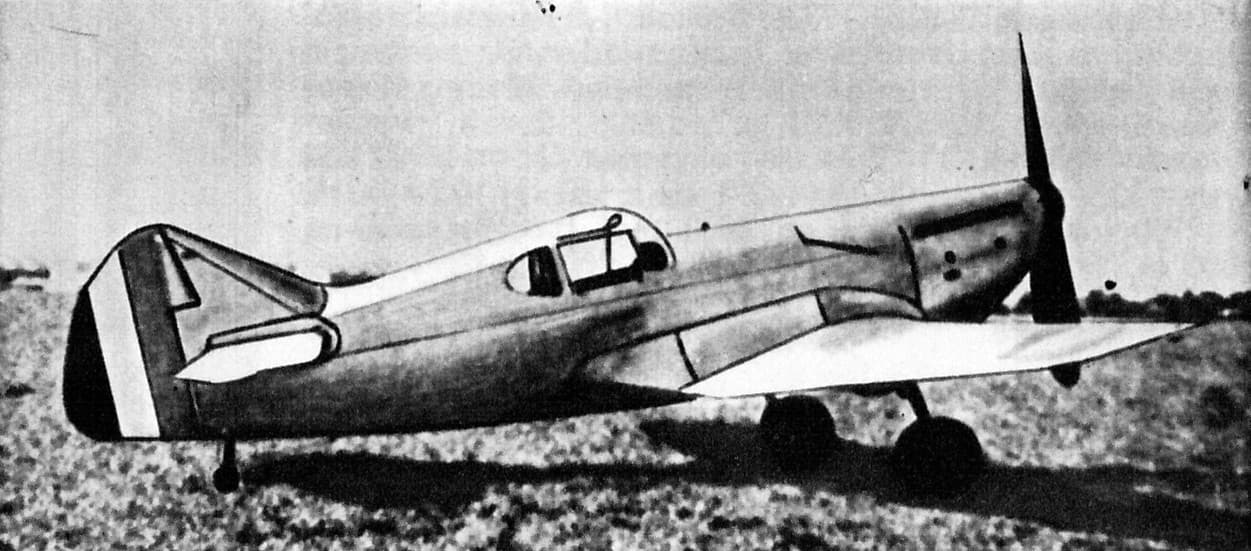
Dewoitine D.520
Dewoitine
How does the D.520 stack up?
CompareOverview
The Dewoitine D.520 was the best fighter available to the French Armee de l'Air during the Battle of France in May-June 1940, and the only French fighter that could meet the Messerschmitt Bf 109E on roughly equal terms. Designed by Emile Dewoitine and his team at the Societe Nationale de Constructions Aeronautiques du Midi (SNCAM), the D.520 combined a clean, modern airframe with a reliable Hispano-Suiza engine and the hard-hitting 20mm HS.404 cannon that was the finest aircraft weapon in its class.
With a top speed of 332 mph and crisp, responsive handling, the D.520 was competitive with the best fighters in the world when it entered service in early 1940. French pilots who had previously flown the sluggish Morane-Saulnier MS.406 were delighted with the D.520's superior performance, and the aircraft quickly proved itself in combat during the desperate six weeks of the Battle of France, claiming 147 confirmed aerial victories against Luftwaffe aircraft.
The D.520's tragedy was one of timing. Only 36 had reached frontline squadrons when Germany attacked on May 10, 1940, and despite a frantic acceleration of deliveries, with factory workers laboring around the clock, fewer than 350 were operational by the armistice on June 25. Had the D.520 been available in the numbers originally planned, the air battle over France might have taken a very different course.
Performance Profile
Max Speed
332 mph
at 18,045 ft
Range
553 miles
normal
Service Ceiling
36,090 ft
Rate of Climb
2,362 ft/min
Armament
5 guns
1x 20mm Hispano-Suiza HS.404, 4x 7.5mm MAC 1934
Crew
1
Engine
Hispano-Suiza 12Y-45
935 hp inline
Development History
The D.520 originated from a 1936 Armee de l'Air specification calling for a modern single-seat fighter capable of 520 km/h (hence the designation). Emile Dewoitine's design team produced a sleek, low-wing monoplane with an enclosed cockpit, retractable landing gear, and a monocoque fuselage that represented a quantum leap over the parasol-winged and open-cockpit fighters that still equipped most French squadrons.
The prototype first flew on October 2, 1938, initially powered by a Hispano-Suiza 12Y-21 engine. Early flights were disappointing, the aircraft failed to reach its design speed due to excessive cooling drag and a host of aerodynamic imperfections. Over the following months, Dewoitine's team undertook an intensive program of refinement, redesigning the cowling, sealing gaps, adjusting the radiator intake, and fitting the more powerful 12Y-45 engine. By April 1939, the D.520 was exceeding 332 mph and demonstrating excellent handling.
Production orders were placed in June 1939, but French aircraft manufacturing was in a state of near-chaos following the nationalization of the aviation industry in 1937. The factories of SNCAM at Toulouse struggled with labor shortages, supply chain disruptions, and the need to set up entirely new production lines. The original plan called for 600 D.520s by April 1940, but by that date only 76 had been completed, and many of those lacked guns, radios, or propellers.
A crash production program in the spring of 1940 dramatically accelerated deliveries, with the factories eventually producing 10 aircraft per day by June. But this heroic effort came too late, the Battle of France was already lost by the time production reached its stride. After the armistice, production continued under Vichy France, eventually reaching a total of 905 aircraft, many of which were seized by Germany and Italy for use as trainers and second-line fighters.
Combat History
The D.520 first saw combat on May 13, 1940, three days after the German invasion, when pilots of Groupe de Chasse I/3 engaged Luftwaffe bombers and fighters over the Meuse River crossings. Despite being heavily outnumbered, D.520 pilots quickly demonstrated that they had an aircraft capable of fighting back. On that first day of combat, Sous-Lieutenant Pomier-Layrargues of GC I/3 scored the type's first confirmed victory by downing a Heinkel He 111.
During the six weeks of the Battle of France, D.520 units claimed 147 confirmed victories and 39 probables against losses of 85 aircraft in combat and 21 on the ground. This kill ratio of roughly 1.7:1 was remarkable given the chaotic conditions, French squadrons were constantly retreating, maintenance was improvised, and pilots often flew four or five sorties per day against an enemy that enjoyed overwhelming numerical superiority and the tactical initiative. The Bf 109E was a formidable opponent, but D.520 pilots found they could fight it on roughly equal terms, with the French aircraft's superior maneuverability partially compensating for the Messerschmitt's advantages in speed and climb.
After the armistice, D.520s equipped Vichy French units that fought against the Allies in Syria in 1941 and during Operation Torch in North Africa in November 1942. In Syria, Vichy D.520s clashed with RAF Hurricanes and Curtiss Tomahawks of the Free French and Australian air forces, one of the war's more tragic episodes of Frenchmen fighting Frenchmen. During Torch, Vichy D.520 pilots briefly engaged American F4F Wildcats and P-40 Warhawks before a ceasefire was arranged.
Germany and Italy subsequently seized hundreds of D.520s for use as advanced trainers and second-line fighters. The Luftwaffe used them at fighter schools, the Regia Aeronautica assigned them to defense units, and Bulgaria and Romania received batches for operational use on the Eastern Front. Free French pilots who had escaped Vichy control flew other types, primarily Spitfires and P-47s, but never again had the chance to fly the D.520 in combat for their own cause.
Variants
| Designation | Key Differences | Produced |
|---|---|---|
| D.520 C.1 | Standard production fighter with Hispano-Suiza 12Y-45 engine, 1x 20mm cannon, and 4x 7.5mm machine guns. Main variant used during the Battle of France. | 775 |
| D.520 DC | Two-seat trainer conversion with a second cockpit for an instructor. Produced after the armistice for Vichy French pilot training. | 30 |
| D.521 | Proposed variant with Rolls-Royce Merlin engine. A single prototype was built but the project was abandoned after the armistice. | - |
| D.523 | Proposed improved variant with Hispano-Suiza 12Y-51 engine (1,100 hp). Several prototypes were under construction when the armistice halted development. | - |
Strengths & Weaknesses
+Strengths
- Best French fighter of 1940, competitive with the Bf 109E in speed, climb, and maneuverability
- Hard-hitting 20mm Hispano-Suiza HS.404 cannon was one of the finest aircraft weapons of the early war period
- Excellent handling qualities with responsive controls and no dangerous vices
- Good structural strength allowed confident maneuvering at high speed and in diving attacks
-Weaknesses
- Hispano-Suiza 12Y-45 engine produced only 935 hp, significantly less than the Bf 109E's DB 601A at 1,175 hp
- Only 60 rounds for the 20mm cannon, limiting the number of firing passes before ammunition was exhausted
- Arrived in desperately insufficient numbers, fewer than 350 operational during the entire Battle of France
- Radio equipment was poor and unreliable, hampering tactical coordination in the chaotic 1940 campaign
Pilot Voices
“Finally we have a fighter that can fight the Messerschmitt. The D.520 handles like a dream, light on the controls, fast, and the cannon hits like a sledgehammer.”
“We were outnumbered five to one, but in the D.520 we could fight back. For the first time, the Boches respected us.”
Did You Know?
The D.520 claimed the highest kill ratio of any French fighter in 1940, with 147 confirmed victories against 85 combat losses, a record that dispels the myth that French pilots failed to fight effectively.
After the war, the "520" designation was long believed to refer to the target speed of 520 km/h. While the aircraft eventually exceeded this speed, the designation was actually assigned during the design phase when the goal was first established.
Bulgaria used D.520s operationally on the Eastern Front, making it one of the few French-designed fighters to see combat against the Soviet Union.
Pierre Le Gloan, flying a D.520, achieved the rare distinction of shooting down aircraft of four different nationalities during WW2: German, Italian, British, and American (the latter during Vichy operations).
Compare With

Bf 109G Gustav
🇩🇪 386 mph

MS.406 MS.406
🇫🇷 302 mph

Hurricane Mk IIC Hurricane
🇬🇧 339 mph

C.202 Folgore
🇮🇹 372 mph