
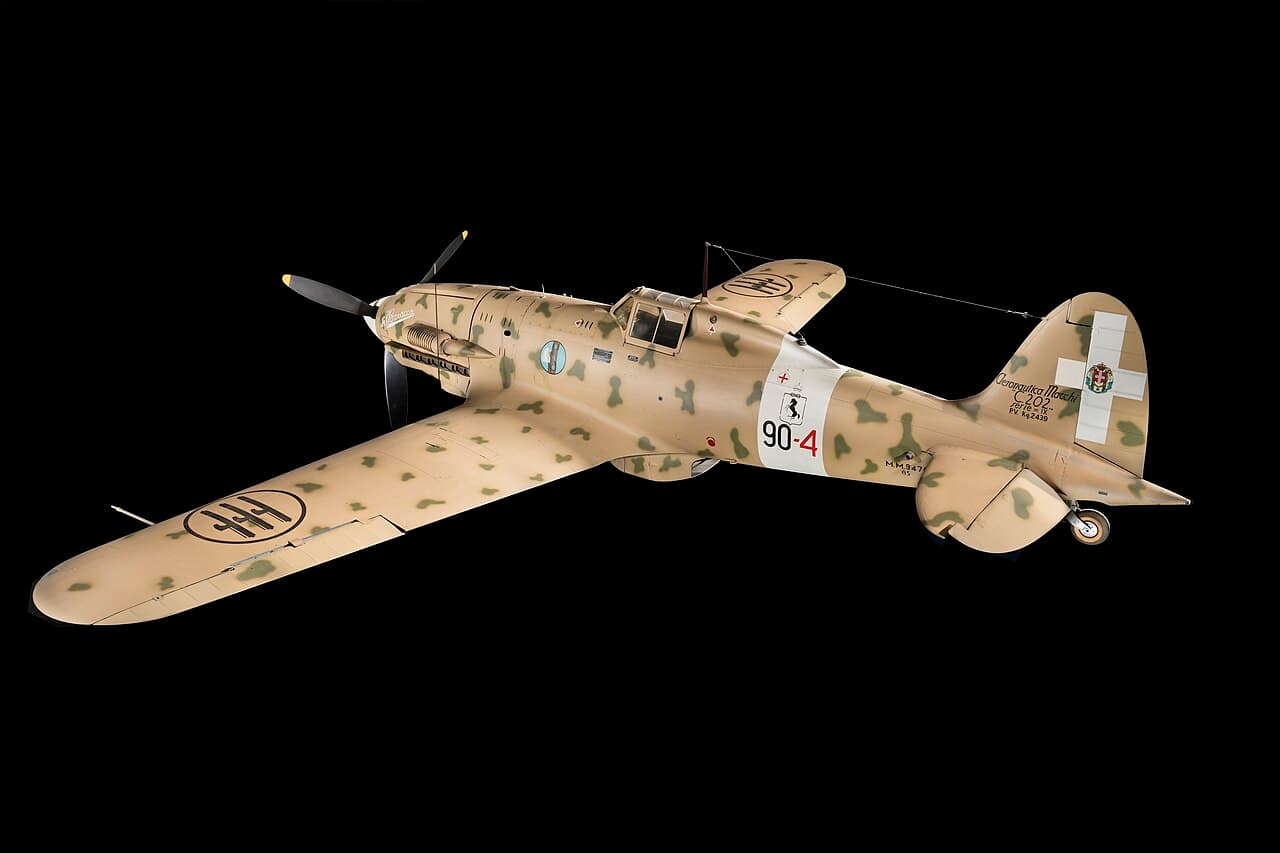
Macchi C.202 Folgore
Macchi
How does the C.202 stack up?
CompareOverview
The Macchi C.202 Folgore (Thunderbolt) was widely regarded as the finest Italian fighter of World War II in terms of combining availability, reliability, and overall combat performance. Powered by a license-built Daimler-Benz DB 601A engine, produced in Italy as the Alfa Romeo RA.1000 Monsone, the Folgore transformed the Regia Aeronautica's fortunes when it entered service over the Mediterranean in mid-1941, giving Italian pilots an aircraft that could fight the Spitfire V and P-40 Warhawk on roughly equal terms for the first time.
The Folgore's airframe was a development of the earlier C.200 Saetta, retaining that design's excellent structural strength and superb handling characteristics while replacing the underpowered Fiat A.74 radial with the far superior inline engine. The result was a beautifully streamlined fighter with outstanding maneuverability and a top speed of 372 mph, competitive with any Allied fighter in the theater during 1941-42.
The Folgore's principal weakness was its armament, which consisted of only two 12.7mm and two 7.7mm machine guns, light by 1942 standards and wholly inadequate for dealing with Allied bombers. Italian industry never managed to produce the Mauser MG 151/20 cannon under license in sufficient quantities, leaving most C.202s stuck with rifle-caliber wing guns throughout their career. Despite this limitation, the Folgore earned the respect of Allied pilots across North Africa and the Mediterranean.
Performance Profile
Max Speed
372 mph
at 16,400 ft
Range
475 miles
normal
Service Ceiling
37,730 ft
Rate of Climb
3,563 ft/min
Armament
4 guns
2x 12.7mm Breda-SAFAT, 2x 7.7mm Breda-SAFAT
Crew
1
Engine
Alfa Romeo RA.1000 RC.41-I Monsone
1175 hp inline
Development History
The C.202 Folgore was born from a recognition that Italian fighter engines were woefully inadequate. The C.200 Saetta, which entered service in 1939, was an agile airframe hobbled by the 870 hp Fiat A.74 radial engine that left it 40-60 mph slower than contemporary British and German fighters. When Italy obtained a Daimler-Benz DB 601A engine in 1940, Macchi chief designer Mario Castoldi immediately set about mating it to an improved C.200 airframe.
The marriage was spectacularly successful. Castoldi redesigned the forward fuselage with a slim, aerodynamically clean cowling that perfectly housed the inverted-V12 engine, and added an enclosed cockpit, earlier C.200s had featured an open cockpit due to pilot preference. The prototype first flew on August 10, 1940, and demonstrated performance that was immediately competitive with the Bf 109E. The Italian Air Ministry placed orders for mass production without hesitation.
Production, however, was plagued by the Achilles heel of Italian aviation: engine availability. The Alfa Romeo factory building the RA.1000 Monsone (the license-built DB 601A) could never produce engines fast enough to keep pace with airframe production. At peak, roughly 50 engines per month were delivered against a demand for over 100. This chronic shortfall meant that many completed C.202 airframes sat engineless in factory hangars, and total production reached only 1,151 aircraft, far fewer than Italy needed.
Later production series introduced minor refinements including a strengthened wing, improved radio equipment, and provisions for underwing bomb racks. An attempt to fit 20mm Mauser MG 151/20 wing cannons produced the C.202AS sub-variant, but the modification was applied to only a small number of airframes due to manufacturing complexity and the ongoing engine shortage that dominated all Italian fighter production decisions.
Combat History
The C.202 Folgore made its combat debut over Libya in November 1941 with the 1 Stormo, and the impact was immediate. For the first time, Italian fighter pilots could engage RAF Hurricanes and P-40 Tomahawks without a significant speed disadvantage. Over the Libyan desert, Folgore pilots from the 4th and 10th Gruppi began scoring regularly against Allied fighters, and the C.202 quickly developed a reputation among Commonwealth pilots as a serious threat, a dramatic change from the relative contempt with which the earlier C.200 and Fiat G.50 had been regarded.
During the critical Malta air battles of 1942, the Folgore was the Regia Aeronautica's primary fighter. Operating from Sicilian airfields, C.202 units escorted bomber formations against the besieged island and tangled with Spitfire Vs flown by some of the RAF's best pilots. The fighting was intense and the Folgore proved itself fully capable of holding its own in dogfights, though its light armament meant that even well-aimed bursts often failed to bring down enemy fighters. Italian ace Teresio Martinoli scored 22 of his victories in the C.202, making him one of the top-scoring Folgore pilots.
In North Africa, the C.202 participated in the climactic battles of El Alamein and the subsequent retreat across Libya and Tunisia. As Allied air superiority grew through late 1942 and into 1943, with increasing numbers of Spitfire IXs and P-38 Lightnings appearing, the Folgore was gradually outclassed, but it remained the best fighter Italy could field in meaningful numbers. When Italy signed the armistice in September 1943, C.202s were serving in both the Co-Belligerent Air Force fighting alongside the Allies in southern Italy and the pro-German Aeronautica Nazionale Repubblicana in the north.
A small number of captured C.202s were evaluated by both Allied and German forces. Luftwaffe test pilots praised the aircraft's handling qualities, noting that it was more pleasant to fly than the Bf 109, though they confirmed that the armament was inadequate by 1943 standards.
Variants
| Designation | Key Differences | Produced |
|---|---|---|
| C.202 Serie I | Initial production batch built by Macchi. Featured original canopy and armament of 2x 12.7mm Breda-SAFAT cowl guns only. | 16 |
| C.202 Serie III-XI | Main production variants with addition of 2x 7.7mm wing guns, improved self-sealing fuel tanks, and refined cowling. Built by Macchi, Breda, and SAI Ambrosini. | 900 |
| C.202AS | Modified variant with 2x 20mm MG 151/20 wing-mounted cannons replacing the 7.7mm machine guns. Only small numbers converted due to supply constraints. | - |
| C.202D | Proposed variant with Daimler-Benz DB 605 engine. Did not enter production as the improved engine was allocated to the C.205 Veltro program. | - |
Strengths & Weaknesses
+Strengths
- Superb handling and maneuverability, widely considered the best-handling Axis fighter by pilots who flew multiple types
- Excellent structural strength allowed aggressive maneuvering and high-speed dives without structural concerns
- Good high-altitude performance with service ceiling over 37,000 feet, competitive with contemporary Spitfires
- Reliable license-built Daimler-Benz engine gave consistent performance once supply issues were managed
-Weaknesses
- Weak armament of only two 12.7mm and two 7.7mm machine guns, insufficient to down bombers and marginal against fighters
- Chronic engine supply shortages from Alfa Romeo limited total production to barely 1,100 aircraft
- No cannon armament on the vast majority of production aircraft, unlike Allied and German contemporaries
- Radio equipment was unreliable and frequently non-functional, severely hampering tactical coordination
Pilot Voices
“The Macchi 202 was a delightful aircraft to fly, responsive and honest in all flight regimes. If only it had carried cannons, it would have been truly formidable.”
“The new Macchi was a different proposition from the fighters we had faced before. It could turn inside a Hurricane and was nearly as fast as our Kittyhawks.”
Did You Know?
The C.202's engine was a license-built copy of the same Daimler-Benz DB 601 that powered the Bf 109E. Italy imported the first few engines directly from Germany before domestic production began.
Allied intelligence initially underestimated the C.202, assuming it was just another variant of the mediocre C.200. When its true performance was revealed in combat, RAF intelligence issued an urgent tactical reassessment.
Macchi test pilot Guido Carestiato reached 404 mph in a diving test of the prototype, a remarkable speed for 1940 that validated Castoldi's aerodynamic design.


