
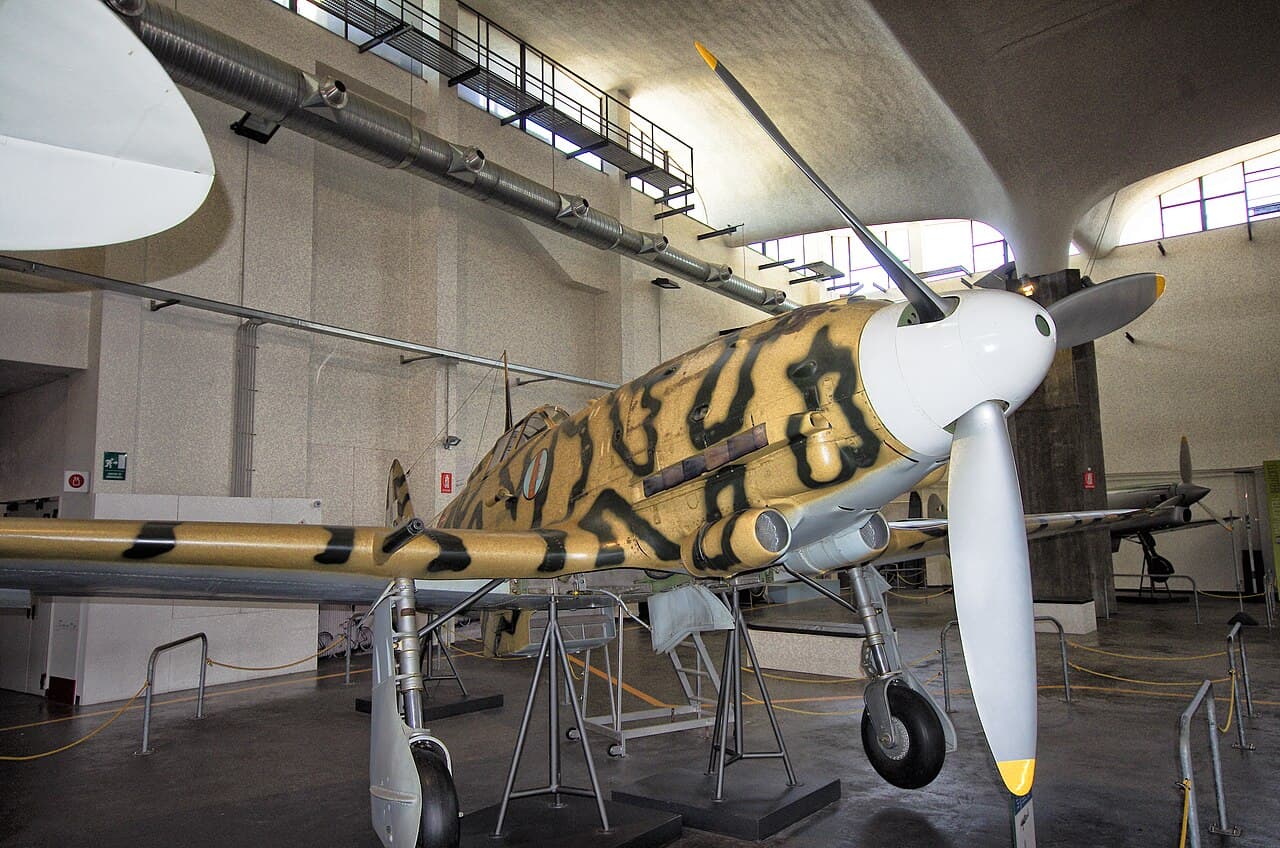
Macchi C.205V Veltro
Macchi
How does the C.205V stack up?
CompareOverview
The Macchi C.205V Veltro (Greyhound) was the ultimate development of Mario Castoldi's brilliant fighter lineage that began with the C.200 Saetta. Powered by a license-built Daimler-Benz DB 605 engine producing 1,475 hp, the same powerplant that drove the Bf 109G, and finally armed with two 20mm MG 151/20 cannons in addition to its twin 12.7mm cowl guns, the Veltro was a world-class fighter that could meet any Allied aircraft on equal or superior terms.
Test pilots who flew the Veltro alongside captured Spitfire IXs and P-51 Mustangs consistently praised its outstanding handling, describing it as one of the finest-flying fighters of the entire war. Its combination of speed, climb rate, maneuverability, and firepower represented everything the C.202 should have been, a fully realized version of Castoldi's aerodynamic vision with adequate armament and a powerplant to match.
Tragically, the C.205V arrived far too late and in far too few numbers to alter Italy's military fortunes. Only 262 were completed before the September 1943 armistice shattered Italy's war effort, and the few Veltros that saw combat demonstrated tantalizing glimpses of what might have been had Italian industry been able to produce the aircraft in quantity two years earlier.
Performance Profile
Max Speed
399 mph
at 24,600 ft
Range
590 miles
normal
Service Ceiling
37,200 ft
Rate of Climb
3,600 ft/min
Armament
4 guns
2x 12.7mm Breda-SAFAT, 2x 20mm MG 151/20
Crew
1
Engine
Fiat RA.1050 RC.58 Tifone
1475 hp inline
Development History
The C.205V Veltro was conceived as a straightforward engine swap, fitting the more powerful Daimler-Benz DB 605 engine (license-built by Fiat as the RA.1050 RC.58 Tifone) into the proven C.202 airframe with minimal structural changes. Mario Castoldi recognized that the C.202's aerodynamically clean design had significant untapped potential that only needed a more powerful engine to realize. The first prototype flew on April 19, 1942, and immediately demonstrated a 27 mph speed increase over the C.202 with dramatically improved climb performance.
The design was an exercise in pragmatic engineering. By retaining the C.202's wing, tail, and basic fuselage structure, Castoldi minimized the tooling changes and production disruption that an entirely new fighter would have required. The forward fuselage was redesigned to accommodate the larger DB 605 engine, and the wing was finally modified to accept the 20mm MG 151/20 cannons that the Folgore had always lacked. The result was a fighter that was both a significant performance improvement and relatively easy to transition into production.
Production authorization came quickly, but execution was painfully slow. The same engine supply bottleneck that had plagued the C.202 was even worse for the C.205V. The Fiat factory producing the RA.1050 Tifone engine was subjected to repeated Allied bombing raids, and Germany, itself short of DB 605 engines for its own Bf 109G production, was reluctant to supply additional powerplants. Only about 60 Veltros had been delivered to frontline units by the time of the armistice.
After September 1943, a small number of additional C.205Vs were completed in German-controlled northern Italy for the Aeronautica Nazionale Repubblicana, while captured examples were briefly evaluated by the Luftwaffe. Total production across all sources reached approximately 262 aircraft, a fraction of what was needed and a testament to the industrial limitations that doomed Italy's air war effort.
Combat History
The C.205V Veltro entered combat in the spring of 1943, just in time for the final phase of the Tunisian campaign and the Allied invasions of Sicily and mainland Italy. The first unit to receive the type was the 1 Stormo's premier gruppo, and the impact was immediate. During the defense of Sicily in July 1943, Veltro pilots engaged P-38 Lightnings, Spitfire IXs, and P-40s over the Strait of Messina, claiming multiple victories and earning grudging respect from Allied pilots who encountered a suddenly far more dangerous Italian fighter.
On July 4, 1943, in one of the most notable engagements of Italy's air war, a formation of C.205Vs from the 1 Stormo intercepted a large force of USAAF P-38 Lightnings escorting bombers over Sicily. In the ensuing dogfight, the Italian pilots claimed several P-38s destroyed while suffering minimal losses, a dramatic reversal of the usual pattern of Italian aerial encounters. American after-action reports confirmed that the new Italian fighter was a significantly more formidable opponent than anything previously encountered from the Regia Aeronautica.
The September 1943 armistice split Italy's surviving C.205V force. Aircraft in the south flew with the Co-Belligerent Air Force alongside the Allies, while those in the north were pressed into service by the Aeronautica Nazionale Repubblicana under German control. Both groups continued to fly the Veltro operationally, though in dwindling numbers as attrition and spare parts shortages took their toll.
After the war, a small number of surviving C.205Vs were sold to Egypt, where they saw brief service with the Egyptian Air Force into the late 1940s. The Veltro's combat record, though limited by its tiny production run, firmly established it as one of the outstanding fighters of the war, an aircraft that arrived too late to change history but proved what Italian aeronautical engineering could achieve when given an adequate engine.
Variants
| Designation | Key Differences | Produced |
|---|---|---|
| C.205V Serie I | Initial production batch with RA.1050 engine, 2x 12.7mm cowl guns, and 2x 7.7mm wing guns. Some later retrofitted with 20mm cannons. | 100 |
| C.205V Serie III | Definitive production variant with 2x 20mm MG 151/20 wing cannons replacing the 7.7mm guns. Improved armor protection and self-sealing tanks. | 150 |
| C.205N Orione | Proposed new-build interceptor variant with redesigned fuselage, wing-mounted 20mm cannons, and engine-mounted 20mm cannon. Only 2 prototypes completed. | - |
Strengths & Weaknesses
+Strengths
- Outstanding overall handling, praised by test pilots as one of the best-flying fighters of the entire war
- Competitive speed and climb rate on par with the Bf 109G and Spitfire IX at all altitudes
- Finally adequate armament with two 20mm cannons and two 12.7mm heavy machine guns
- Excellent visibility from the cockpit and responsive controls made it a superb dogfighter
-Weaknesses
- Catastrophically low production numbers, only 262 built, far too few to have any strategic impact
- Continued dependency on German-designed engines that Italy could never produce in sufficient quantity
- Arrived in service far too late to influence the air war over the Mediterranean
- Spare parts and maintenance support were inadequate due to the small production run and disrupted supply chains
Pilot Voices
“The Veltro was the answer to all our prayers. Fast, well-armed, and a joy to fly. We only wished we had received it two years earlier and in ten times the number.”
“It was truly a magnificent fighter. The controls were perfectly harmonized, and it could turn inside a Spitfire at any altitude.”
Did You Know?
Allied test pilots rated the C.205V as superior in handling to both the Bf 109G and the Spitfire IX, praising its harmonized controls and lack of vicious stall characteristics.
The Veltro was so similar in appearance to the Bf 109G that both Allied and Italian anti-aircraft gunners occasionally mistook one for the other, leading to several friendly-fire incidents.
After the war, Egypt purchased surviving C.205Vs and operated them until the late 1940s, making Egypt one of the last countries to fly Italian WW2 fighters operationally.
Compare With

Spitfire Mk IX Spitfire
🇬🇧 408 mph

Bf 109G Gustav
🇩🇪 386 mph

C.202 Folgore
🇮🇹 372 mph

G.55 Centauro
🇮🇹 391 mph