
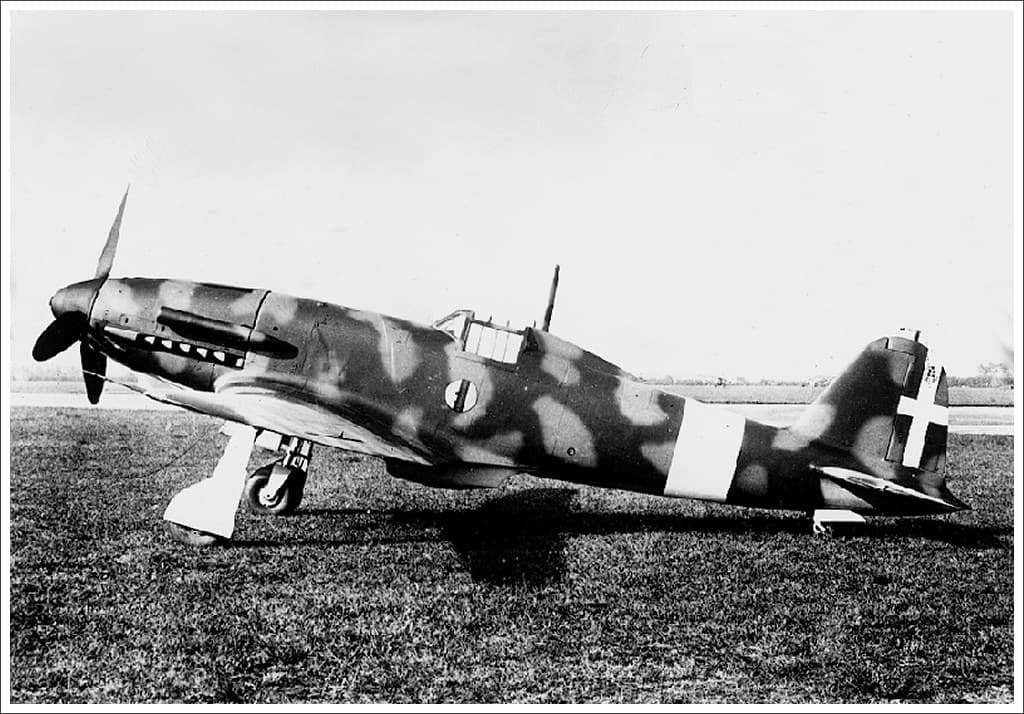
Fiat G.55 Centauro
Fiat
How does the G.55 stack up?
CompareOverview
The Fiat G.55 Centauro (Centaur) was arguably the most formidable Italian fighter of World War II and a strong contender for the best Axis single-engine fighter produced in the Mediterranean theater. A completely new design by Giuseppe Gabrielli, not an evolution of an earlier airframe like the Macchi C.205, the Centauro featured a large, structurally advanced wing and a heavy armament of three 20mm cannons and two 12.7mm machine guns that gave it firepower rivaling the best Allied and German fighters.
Powered by the same Fiat-built DB 605 engine as the C.205V Veltro, the G.55 was slightly slower at low altitude due to its larger wing but compensated with superior high-altitude performance, an outstanding service ceiling of over 42,000 feet, and exceptional range. German evaluation pilots who tested the Centauro were so impressed that they recommended it for Luftwaffe production, the highest compliment a German pilot could pay a foreign design.
Like the C.205, the G.55 was a victim of Italy's industrial collapse. Only 274 were built, almost entirely under German occupation in northern Italy after the September 1943 armistice. Those that saw combat performed superbly, but they were too few and too late to affect the outcome of the air war.
Performance Profile
Max Speed
391 mph
at 22,965 ft
Range
746 miles
normal
Service Ceiling
42,650 ft
Rate of Climb
3,300 ft/min
Armament
5 guns
3x 20mm MG 151/20, 2x 12.7mm Breda-SAFAT
Crew
1
Engine
Fiat RA.1050 RC.58 Tifone
1475 hp inline
Development History
Giuseppe Gabrielli began designing the G.55 in 1940 as a clean-sheet fighter that would remedy the fundamental limitations of Fiat's earlier G.50 Freccia, a rugged but underpowered and underarmed fighter that was clearly outclassed by 1941. Unlike Macchi's approach of evolving the proven C.200 airframe, Gabrielli drew an entirely new aircraft around the DB 605 engine, with a larger wing optimized for high-altitude performance and provisions for heavy cannon armament from the outset.
The prototype first flew on April 30, 1942, just eleven days after the rival C.205V. Flight testing revealed outstanding performance: the G.55 reached 391 mph at 22,965 feet, climbed rapidly, and demonstrated beautiful handling with no vicious characteristics. The larger wing gave it a lower wing loading than the C.205, resulting in a tighter turning circle and better sustained maneuverability at the cost of slightly lower top speed at medium altitudes.
The most remarkable aspect of the G.55's design was its armament. Gabrielli integrated three 20mm MG 151/20 cannons, one firing through the propeller hub and two in the wings, alongside two cowl-mounted 12.7mm Breda-SAFAT machine guns. This gave the Centauro a weight of fire that exceeded the Bf 109G and rivaled the Fw 190A, making it the most heavily armed Italian fighter of the war.
In a comparative evaluation held at Guidonia airfield in early 1943, the G.55, C.205V, and Reggiane Re.2005 Sagittario were tested head-to-head. The results were close, but the G.55 was selected for priority production due to Fiat's larger manufacturing capacity. Production was just ramping up when the armistice struck, and subsequent production under German oversight was slow and hampered by Allied bombing of Fiat's Turin factories.
Combat History
The G.55 Centauro saw limited combat with the Regia Aeronautica before the September 1943 armistice, with only a handful of aircraft reaching operational units during the summer of 1943. Those that flew operationally participated in the defense of Italian airspace against Allied bomber raids, and pilots reported the aircraft's performance as exceptional, particularly its rate of climb and high-altitude handling, which made it well-suited for the interceptor role.
After the armistice, the G.55's combat career continued almost exclusively with the Aeronautica Nazionale Repubblicana (ANR), the air force of Mussolini's German-backed Social Republic in northern Italy. ANR G.55 pilots engaged in a bitter air defense campaign against USAAF strategic bombing raids on northern Italian industrial targets throughout 1944-45. Despite being heavily outnumbered, ANR Centauro units achieved a credible combat record, downing numerous P-47 Thunderbolts, P-38 Lightnings, and P-51 Mustangs in addition to B-17 and B-24 bombers.
The most notable ANR Centauro unit was the 1 Gruppo Caccia, whose pilots flew the G.55 against overwhelming odds in defense of Turin, Milan, and other northern Italian cities. The Centauro's heavy cannon armament proved devastatingly effective against Allied bombers, while its high-altitude performance allowed pilots to engage escort fighters on favorable terms. However, the tiny number of available aircraft and chronic fuel shortages meant these successes were tactically impressive but strategically irrelevant.
A small number of G.55s were also used by the Luftwaffe for evaluation and training purposes. German reports consistently praised the aircraft, with one Luftwaffe evaluation stating that the G.55 was "the best Axis fighter", a judgment that remains debated by aviation historians but reflects the genuine respect the design commanded.
Variants
| Designation | Key Differences | Produced |
|---|---|---|
| G.55 Serie 0 | Pre-production batch with initial armament of 1x engine-mounted 20mm cannon and 4x 12.7mm machine guns. | 19 |
| G.55 Serie I | Main production variant with definitive armament of 3x 20mm MG 151/20 and 2x 12.7mm Breda-SAFAT. Built primarily for the ANR. | 220 |
| G.55S | Proposed torpedo-fighter variant for anti-shipping strikes. Could carry a single torpedo or heavy bomb load. Only a few completed. | - |
| G.55/II | Postwar development with Rolls-Royce Merlin engine. Served as basis for the G.59 trainer used by the postwar Italian Air Force. | - |
Strengths & Weaknesses
+Strengths
- Exceptional high-altitude performance with a service ceiling over 42,000 feet, superior to most contemporaries
- Heavy armament of three 20mm cannons and two 12.7mm guns gave devastating firepower against both fighters and bombers
- Outstanding range of 746 miles, nearly double that of the Bf 109G, gave excellent operational flexibility
- Praised by German test pilots as potentially the best Axis single-engine fighter of the war
-Weaknesses
- Minuscule production run of 274 aircraft rendered it strategically irrelevant despite excellent capabilities
- Same DB 605 engine supply bottleneck that afflicted all Italian Serie 5 fighters
- Slightly slower than the C.205V at medium altitudes due to the larger wing area creating more drag
- Heavy weight fully loaded (over 8,000 lbs) put strain on the landing gear during rough field operations
Pilot Voices
“The Centauro was a beautiful aircraft to fly, stable, powerful, and with more firepower than anything I had flown before. Against the Americans it was formidable, but there were never enough of us.”
“This Italian fighter is superior to the Bf 109G in many respects and deserves to be built in large numbers.”
Did You Know?
A Luftwaffe evaluation team declared the G.55 the "best Axis fighter" after comparative tests against the Bf 109G, Fw 190A, and Macchi C.205V, though this assessment remains debated among historians.
The G.55 was the only Italian fighter designed from the start to carry three 20mm cannons, giving it a weight of fire that exceeded the Bf 109G-6.
After the war, the G.55 was developed into the G.59 trainer with a Rolls-Royce Merlin engine, serving with the Italian Air Force into the 1960s, one of the longest service lives of any WW2 fighter derivative.
Compare With

C.205V Veltro
🇮🇹 399 mph

Bf 109G Gustav
🇩🇪 386 mph

Fw 190A Wurger
🇩🇪 408 mph

Spitfire Mk IX Spitfire
🇬🇧 408 mph