
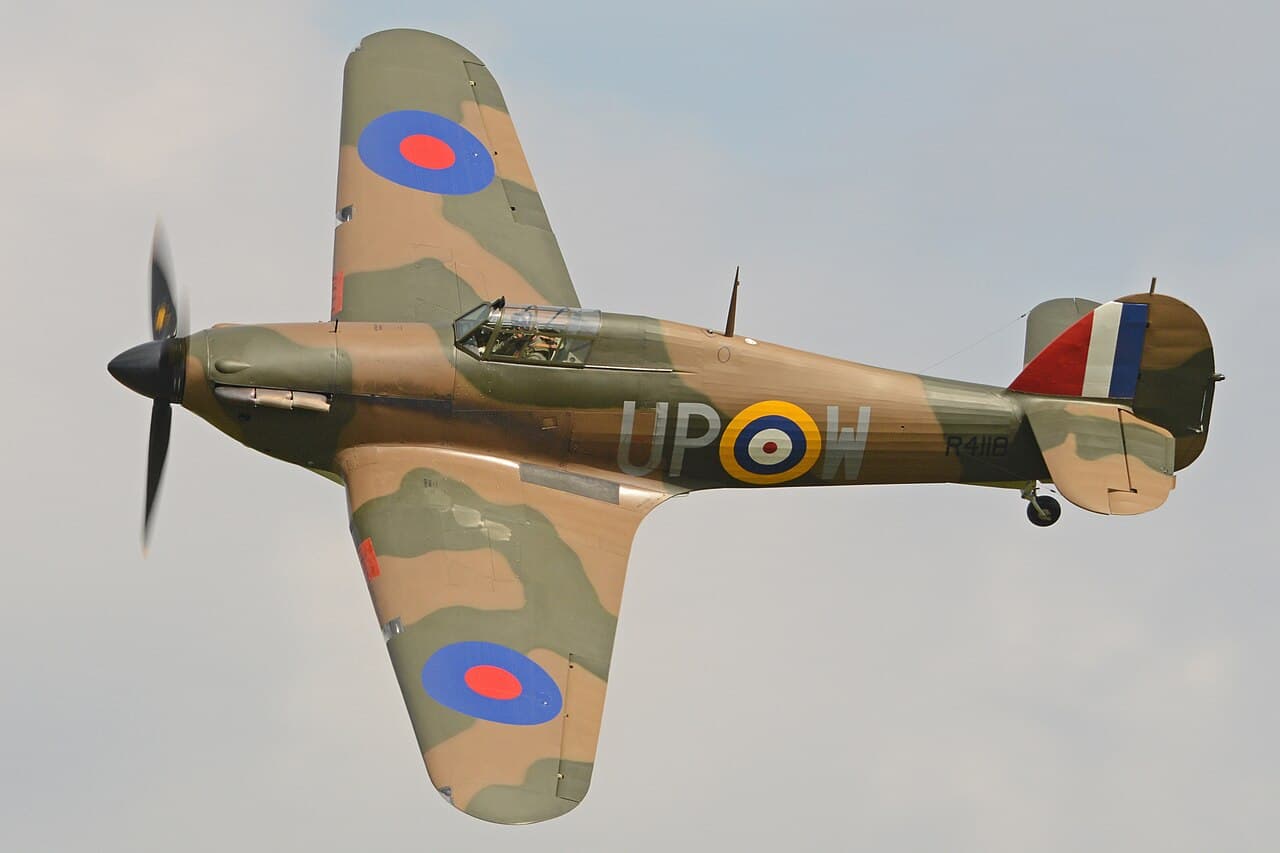
Hawker Hurricane Mk IIC
Hawker Aircraft
How does the Hurricane Mk IIC stack up?
CompareOverview
The Hawker Hurricane Mk IIC was the most heavily armed single-engine fighter of its era, mounting four 20mm Hispano cannon that could shred anything from a Panzer to a locomotive. While the earlier Mk I had won the Battle of Britain by shooting down more enemy aircraft than all other defenses combined, the Mk IIC shifted roles from air-to-air combat to devastating ground attack.
By 1941, the Hurricane could no longer match the latest Luftwaffe fighters at altitude, but its rugged construction, stable gun platform, and massive firepower made it the ideal ground-attack aircraft. The Mk IIC terrorized Axis ground forces across North Africa, Burma, and the Channel coast, earning a reputation as one of the most effective close-support aircraft of the war.
The Hurricane Mk IIC served extensively in the Far East, where it became the primary RAF ground-attack fighter against Japanese forces in Burma, operating from rough jungle airstrips that would have been impossible for more delicate aircraft.
Performance Profile
Max Speed
339 mph
at 18,000 ft
Range
480 miles
normal
Service Ceiling
35,600 ft
Rate of Climb
2,780 ft/min
Armament
4 guns
4x 20mm Hispano Mk II
Crew
1
Engine
Rolls-Royce Merlin XX
1280 hp inline
Development History
Sydney Camm's Hurricane was the RAF's first monoplane fighter, predating the Spitfire into service. The original Mk I with its fabric-covered wings and eight .303 machine guns had proven the concept in the Battle of Britain, but by 1940 it was already being outpaced by the latest Axis fighters.
The Mk II series introduced the more powerful Merlin XX engine with a two-speed supercharger, restoring some of the performance gap. The Mk IIA carried twelve .303 machine guns, while the Mk IIB added four 20mm cannon in a new "universal" wing. The Mk IIC, introduced in June 1941, standardized the four-cannon armament and strengthened the wing to carry bombs.
The decision to pivot the Hurricane toward ground attack rather than trying to keep it competitive as an air superiority fighter was one of the smartest tactical moves of the war. The thick wing that limited its top speed also provided enormous internal volume for weapons and structural strength to absorb battle damage.
Hurricane production continued until 1944, by which time over 14,500 of all marks had been built. The Mk IIC served in every theater, from the Western Desert to the jungles of Burma to the freezing convoys of the Arctic. Canadian-built Hurricanes supplemented British production significantly.
Combat History
The Hurricane Mk IIC first entered combat over the English Channel in mid-1941, conducting "Rhubarb" low-level ground-attack sweeps against targets in occupied France. These dangerous missions involved pairs of Hurricanes attacking trains, vehicles, airfields, and coastal shipping at treetop height, using their devastating four-cannon armament to lethal effect.
In North Africa, Hurricane IICs played a crucial role at El Alamein and during the subsequent pursuit across Libya and Tunisia. Flying as "tank busters" (some with 40mm anti-tank guns as the Mk IID variant), they destroyed hundreds of Axis vehicles. The type also defended Malta during the island's desperate siege, intercepting Axis bombers over the Mediterranean.
The Burma campaign became the Hurricane's final great theater. From 1943 to 1945, Hurricane IICs operated as the backbone of RAF tactical air power in Southeast Asia, flying close-support missions over the Arakan, at Imphal-Kohima, and during the reconquest of Rangoon. Japanese ground forces particularly feared the Hurricane's devastating strafing runs.
Sea Hurricanes, catapulted from merchant ships or flying from escort carriers, also played a vital role in defending Arctic convoys and covering Allied amphibious landings. Though outclassed as a pure fighter by 1942, the Hurricane's sheer versatility and toughness kept it in frontline service through the end of the war.
Variants
| Designation | Key Differences | Produced |
|---|---|---|
| Mk IIA | Eight .303 machine guns with Merlin XX engine; transitional variant from Mk I. | 415 |
| Mk IIB | Twelve .303 Browning machine guns in the "universal" wing; could carry two 250 lb or 500 lb bombs. | 3,071 |
| Mk IIC | Four 20mm Hispano cannon in the universal wing; definitive ground-attack variant. | 4,711 |
| Mk IID | Anti-tank variant with two Vickers S 40mm cannon and two .303 machine guns for sighting; used in North Africa. | 292 |
| Mk IV | Universal wing for interchangeable armament packs including cannon, rockets, or bombs; final production Hurricane. | 524 |
| Sea Hurricane Mk IIC | Navalised with catapult spools, arrester hook, and corrosion protection for carrier operations. | - |
Strengths & Weaknesses
+Strengths
- Devastating four-cannon armament provided unmatched firepower for ground attack
- Extremely rugged airframe could absorb significant battle damage and return home
- Stable gun platform due to wide-track undercarriage and thick wing
- Could operate from rough, unprepared airstrips where other fighters could not
-Weaknesses
- Significantly slower than contemporary fighters like the Fw 190 and later Bf 109 variants
- Fabric-covered rear fuselage and wings were vulnerable to fire
- Limited high-altitude performance compared to Spitfire variants
- Heavy cannon armament reduced already modest performance further
Pilot Voices
“The Hurricane was honest and forgiving. You could do things to it in combat that would have killed you in a Spitfire, and it would bring you home.”
“Four 20mm cannon made the Hurricane IIC a devastating weapon. One short burst would tear a locomotive apart or set a fuel truck ablaze.”
Did You Know?
Hurricanes accounted for 55% of all German aircraft destroyed during the Battle of Britain, more than the Spitfire, yet the Spitfire received most of the public glory.
The Hurricane Mk IID with its 40mm cannon could destroy a tank with a single well-aimed shot, making it one of the first effective airborne anti-tank weapons.
A Hurricane could be repaired far more quickly than a Spitfire because its fabric-covered fuselage could be patched in the field, while aluminum panels required factory-level work.

