
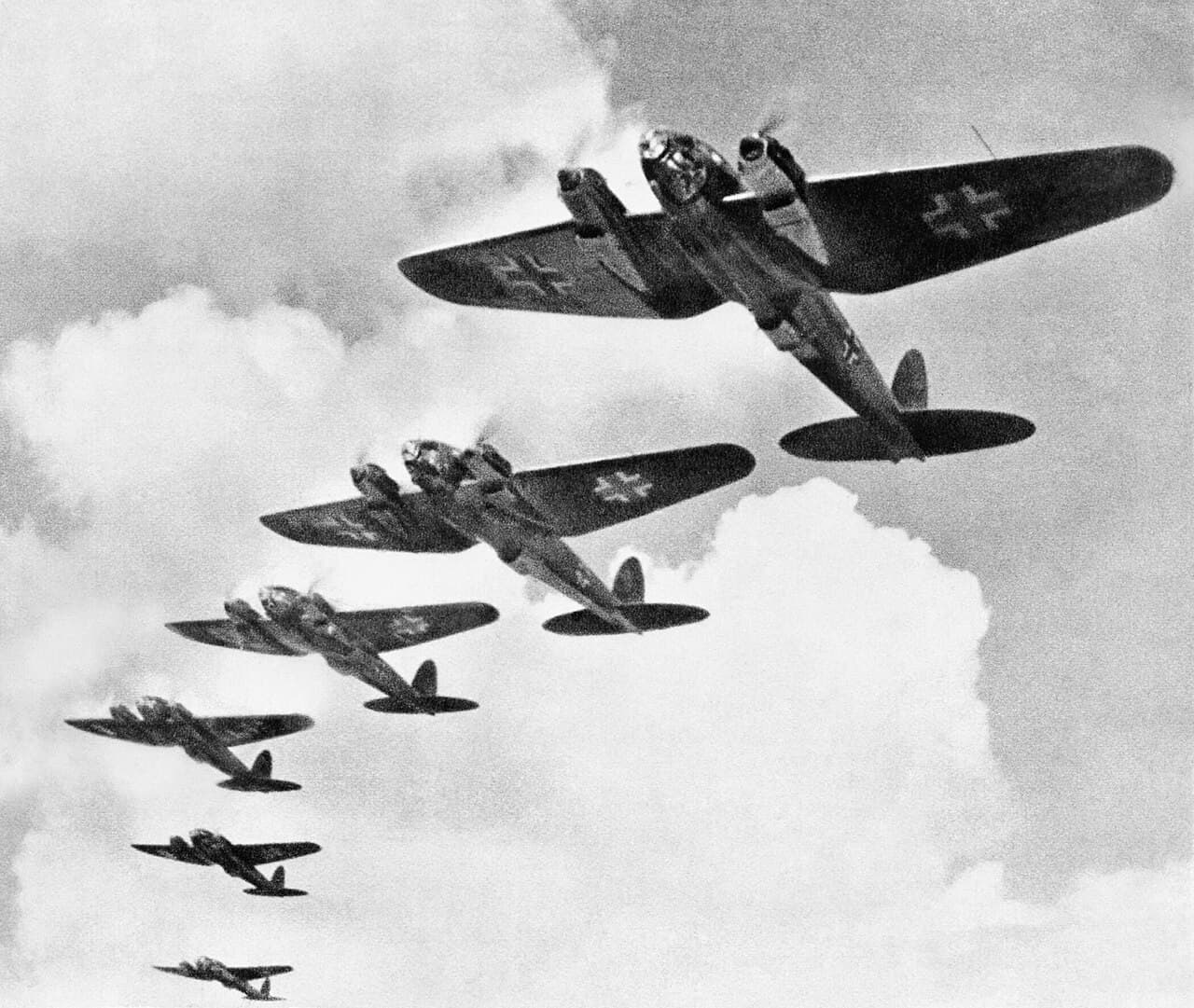
Heinkel He 111H
Heinkel
How does the He 111H stack up?
CompareOverview
The Heinkel He 111 was the backbone medium bomber of the Luftwaffe from the Spanish Civil War through the end of World War II. With its distinctive glazed nose and elliptical wings, it became one of the most recognizable German aircraft of the conflict. The He 111H, powered by Junkers Jumo 211 engines, was the most prolific variant and served in virtually every theater where the Luftwaffe operated.
Originally designed in 1934 as a "high-speed transport", a thin disguise for its true purpose as a bomber in the secretly rearming Luftwaffe, the He 111 was fast and modern when it entered service. By 1939, however, the pace of fighter development had already made it vulnerable, and the Battle of Britain revealed that its defensive armament and speed were woefully inadequate against determined fighter opposition.
Despite its obsolescence, the He 111 soldiered on for the entire war because Germany never developed a successful replacement. The He 177 suffered chronic engine problems, and no other type could fill the He 111's role. The aircraft adapted to missions ranging from conventional level bombing to torpedo attack, V-1 flying bomb launching, and even paratrooper transport. More than 7,300 He 111s of all variants were produced, making it the most-built German bomber of the war.
Performance Profile
Max Speed
273 mph
at 16,400 ft
Range
1,280 miles
normal
Service Ceiling
25,590 ft
Rate of Climb
855 ft/min
Armament
7 guns
1x 20mm MG FF, 1x 13mm MG 131, 5x 7.92mm MG 15 or MG 81
Crew
5
Engine
Junkers Jumo 211F-2
1350 hp inline
Development History
The He 111 was designed by Siegfried and Walter Gunter at Heinkel in 1934, ostensibly as a fast commercial transport for Lufthansa. This cover story was barely credible, the aircraft's bomb bay and military fittings were obvious to any informed observer, but it served its diplomatic purpose during the era when Germany was publicly disavowing rearmament. The twin-engined monoplane was remarkably advanced for its time, with a retractable undercarriage, all-metal construction, and clean aerodynamic lines.
Early variants (A through E) used Daimler-Benz DB 600 engines and saw their baptism of fire during the Spanish Civil War, where they performed well against negligible air opposition. The He 111H variant switched to the Junkers Jumo 211 engine due to DB 600 supply constraints, the Daimler-Benz engines were needed for fighter production. This proved a fortunate change, as the Jumo 211 was more readily available and eventually offered comparable power.
The He 111H underwent continuous modification throughout its production life. The distinctive asymmetric glazed nose replaced the original stepped cockpit of the He 111B/D/E variants, giving the bombardier an unobstructed forward view but creating a cramped, uncomfortable position. Defensive armament was progressively increased from three rifle-caliber machine guns to a mix of 20mm cannon, 13mm heavy machine guns, and multiple 7.92mm weapons, but these additions were never sufficient to make the aircraft survivable against modern fighters.
The He 111H-6, the most important sub-variant, was optimized for torpedo bombing and achieved notable successes against Allied convoys in the Arctic and Mediterranean. Later variants (H-16, H-20, H-22) were adapted for increasingly specialized roles: the H-22 carried a V-1 flying bomb under the wing and launched it against targets in England, while the H-20 served as a paratrooper transport carrying up to 16 troops.
Combat History
The He 111 saw its first significant combat during the Condor Legion's operations in the Spanish Civil War, where it proved effective against minimal air opposition. Its real test came during the 1939-40 campaigns. Over Poland and France, the He 111 performed its tactical and strategic bombing roles effectively, though losses were already concerning when fighters were encountered.
The Battle of Britain exposed the He 111's vulnerability in stark terms. During the daylight raids of August-September 1940, He 111 formations suffered devastating losses to RAF Hurricanes and Spitfires. The aircraft's defensive armament was inadequate, its self-sealing fuel tanks were limited, and its moderate speed left no margin for escape. The switch to night bombing reduced losses but also reduced accuracy, beginning a pattern that would persist for the rest of the war.
On the Eastern Front, the He 111 found somewhat more favorable conditions. In the opening stages of Barbarossa, the Luftwaffe achieved near-total air superiority, allowing He 111 formations to attack Soviet airfields, troop concentrations, and supply lines with relative impunity. As Soviet air power recovered, however, losses mounted. The He 111 remained active on the Eastern Front throughout the war, but increasingly in night operations or in sectors where fighter opposition was weak.
The He 111's most unusual role was as a torpedo bomber in the Arctic and Mediterranean theaters. KG 26, the Luftwaffe's specialist torpedo unit, operated He 111H-6 aircraft against Allied convoys with considerable success. During the disastrous PQ-17 convoy in July 1942, He 111 torpedo bombers helped sink or damage several merchant ships. The aircraft also served as the primary launch platform for the V-1 flying bomb in Operation Rumpelkammer, firing over 1,200 V-1s from He 111H-22 aircraft over the North Sea toward England between July 1944 and January 1945.
Variants
| Designation | Key Differences | Produced |
|---|---|---|
| He 111H-3 | Standard medium bomber variant with external bomb racks for carrying 2,000 kg externally. Introduced 20mm MG FF cannon in nose position for strafing. | 901 |
| He 111H-6 | Torpedo bomber variant with provision for 2x LT F5b torpedoes or 2x 1,000kg bombs under fuselage. Also carried FuG 200 Hohentwiel search radar. Primary KG 26 aircraft. | 1,820 |
| He 111H-16 | Upgraded bomber with Jumo 211F-2 engines, revised defensive armament including powered dorsal turret, and increased armor protection. Standard bomber from late 1942. | 1,150 |
| He 111H-20 | Multi-purpose variant: H-20/R1 was a paratroop transport (16 troops), H-20/R2 was a cargo glider tug, H-20/R3 was a night bomber. | - |
| He 111H-22 | V-1 flying bomb carrier with reinforced starboard wing pylon for Fieseler Fi 103 (V-1). Used operationally by KG 3 and KG 53 for air-launched V-1 attacks on England. | - |
Strengths & Weaknesses
+Strengths
- Robust, forgiving airframe that could absorb significant battle damage and was easy for average pilots to fly
- Excellent forward visibility from glazed nose position enhanced bombing accuracy
- Versatile platform adaptable to bombing, torpedo attack, minelaying, V-1 launching, and transport roles
- Large internal bomb bay supplemented by external racks gave flexible ordnance options
-Weaknesses
- Hopelessly slow by mid-war standards, easy prey for any Allied fighter
- Defensive armament was always inadequate despite continuous upgrades, leaving huge blind spots
- Cramped, glazed nose position left the bombardier extremely vulnerable to head-on fighter attacks
- Relatively small bomb load compared to Allied medium bombers like the B-25 or A-20
Pilot Voices
“The He 111 was an honest aircraft, not fast, not well armed, but reliable and predictable. You always knew what it would do. The problem was that so did the enemy.”
Did You Know?
The He 111Z "Zwilling" (Twin) was created by joining two He 111H fuselages with a common wing section containing a fifth engine. This extraordinary aircraft was designed to tow the massive Me 321 Gigant cargo glider and was one of the most unusual aircraft of the war.
He 111s launched over 1,200 V-1 flying bombs from the air against England in 1944-45. The air launches were less accurate than ground launches but were much harder for the Allies to intercept or suppress.
Spain operated He 111s until 1973, over 30 years after the type first saw combat. Spanish-built CASA 2.111s powered by Rolls-Royce Merlin engines served as the "stars" of the 1969 film Battle of Britain, playing themselves.

