
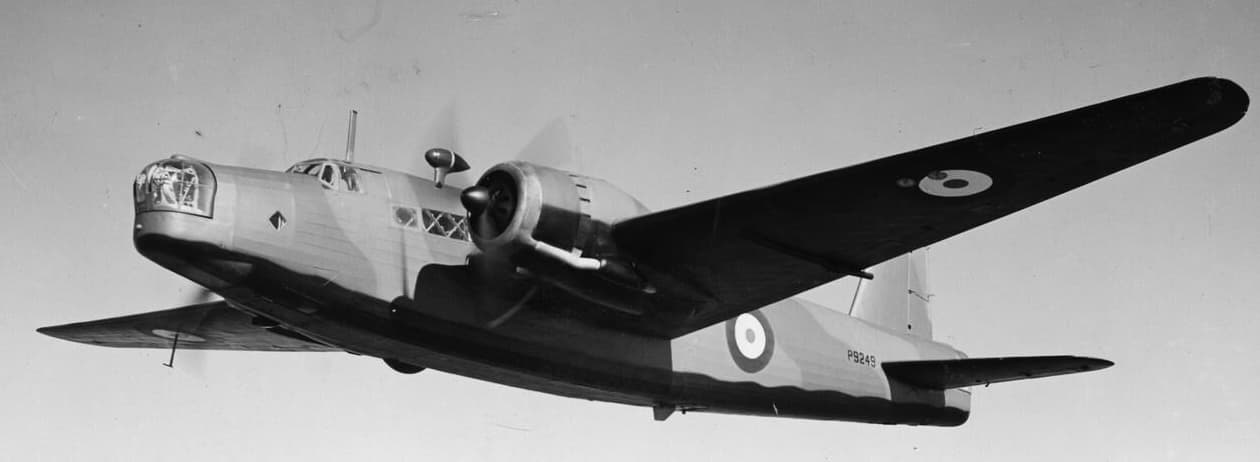
Vickers Wellington Mk III
Vickers-Armstrongs
How does the Wellington Mk III stack up?
CompareOverview
The Vickers Wellington was the backbone of RAF Bomber Command during the critical early years of the war, carrying the fight to Germany when Britain stood alone. Known affectionately as the "Wimpy" after the hamburger-loving character J. Wellington Wimpy from the Popeye cartoons, it was the most important British bomber of 1939-1942 and participated in more Bomber Command operations than any other type.
The Mk III, powered by Bristol Hercules radial engines, was the most numerous and capable of the wartime Wellington bomber variants. It combined the type's legendary structural toughness, derived from Barnes Wallis's revolutionary geodetic construction, with improved engines that addressed the reliability problems of earlier marks.
The Wellington's geodetic airframe, a lattice-like structure of intersecting metal strips, gave it an extraordinary ability to absorb battle damage. Wellingtons returned to base with massive holes in their fuselage and wings, damage that would have destroyed a conventionally constructed aircraft. This resilience, combined with decent range and bomb load, made the Wellington the aircraft that kept the bombing campaign alive until the four-engine heavies arrived in sufficient numbers.
Performance Profile
Max Speed
261 mph
at 12,500 ft
Range
1,540 miles
normal
Service Ceiling
19,000 ft
Rate of Climb
930 ft/min
Armament
6 guns
6x .303 Browning
Crew
6
Engine
Bristol Hercules XI
1500 hp radial
Development History
The Wellington was designed by Barnes Wallis, the brilliant structural engineer who would later create the bouncing bomb used in the Dams Raid. Wallis developed geodetic construction, a basket-weave lattice of duralumin strips that was extraordinarily light yet incredibly strong, first proving the concept in the Wellesley single-engine bomber before scaling it up for the Wellington.
The prototype first flew on June 15, 1936, and the Wellington entered service with No. 9 Squadron in October 1938, just a year before the outbreak of war. The Mk I, powered by Bristol Pegasus engines, was the initial variant, followed by the Mk II with Merlin engines and the Mk III with Hercules radials. Each variant improved performance while retaining the same basic geodetic airframe.
The Mk III, entering service in early 1942, benefited from the powerful and reliable Bristol Hercules XI engines producing 1,500 hp each. The switch to radials improved engine reliability significantly compared to the Merlin-powered Mk II, and the Hercules proved more tolerant of the demanding conditions of night bombing operations.
Total Wellington production reached 11,461 aircraft across all variants, making it the most-produced British bomber of the war. Beyond the bomber role, Wellingtons served with Coastal Command as maritime patrol aircraft, fitted with early airborne radar and the Leigh Light for illuminating surfaced U-boats at night. Specialized variants also served as torpedo bombers in the Mediterranean.
Combat History
The Wellington was blooded in the very first weeks of the war. On September 4, 1939, Wellingtons of No. 9 and No. 149 Squadrons attacked German warships at Brunsbuttel in one of the RAF's first offensive operations. The disastrous daylight raids of December 1939, when unescorted Wellingtons suffered devastating losses to Bf 109 and Bf 110 fighters at Heligoland Bight, forced Bomber Command to abandon daylight raids and adopt the night bombing strategy that would define the rest of the war.
From 1940 to 1942, the Wellington was the heaviest bomber available to Bomber Command in meaningful numbers. Wellingtons carried out the first strategic raids on Berlin, attacked Italian cities from North African bases, and formed the majority of the force for the first Thousand Bomber Raid on Cologne on May 30-31, 1942, when 599 of the 1,047 bombers dispatched were Wellingtons.
The Mk III bore the brunt of the bombing campaign through 1942-1943, operating over Germany, Italy, and occupied France. As the Lancaster and Halifax arrived in increasing numbers, the Wellington was gradually withdrawn from frontline bombing duties, but it continued to serve with Coastal Command and in the Mediterranean and Middle East. Coastal Command Wellingtons with Leigh Lights played a crucial role in the Battle of the Atlantic, sinking or damaging numerous U-boats.
The Wellington's geodetic construction repeatedly proved its worth in combat. Numerous aircraft returned with enormous areas of fabric stripped away, entire panels missing, and structural members severed, yet the geodetic lattice distributed loads so effectively that the aircraft remained flyable. This damage tolerance saved countless crews and gave the Wellington a reputation for toughness that few other aircraft could match.
Variants
| Designation | Key Differences | Produced |
|---|---|---|
| Mk I | Original production variant with Bristol Pegasus XVIII engines (1,000 hp each); early war bomber with beam gun positions. | 2,685 |
| Mk II | Rolls-Royce Merlin X engines (1,145 hp each); improved performance but engine reliability issues in service. | 400 |
| Mk III | Definitive bomber with Bristol Hercules XI engines (1,500 hp each); most numerous wartime variant. | 1,519 |
| Mk X | Hercules VI or XVI engines; used primarily for maritime patrol with Coastal Command. | 3,804 |
| GR Mk VIII | Coastal Command variant with ASV Mk II radar and Leigh Light for night anti-submarine patrol. | - |
| Mk XIV | Final production variant with Hercules XVII engines; used for Coastal Command maritime patrol with centimetric radar. | 841 |
Strengths & Weaknesses
+Strengths
- Barnes Wallis geodetic construction provided extraordinary resistance to battle damage
- Good range of 1,540 miles allowed strikes deep into enemy territory
- Reliable Bristol Hercules engines with air-cooled radial simplicity
- Adaptable airframe served effectively as bomber, maritime patrol, torpedo bomber, and trainer
-Weaknesses
- Modest maximum speed of 261 mph made it increasingly vulnerable to night fighters
- Limited defensive armament of six .303 machine guns was inadequate against cannon-armed fighters
- Bomb load of 4,500 lbs was modest compared to the four-engine heavies that replaced it
- Service ceiling of 19,000 feet left it within range of medium-altitude flak
Pilot Voices
“The Wimpy could take punishment that would have destroyed any other aircraft. I've seen them come back with holes you could drive a car through, and the ground crews would patch them up overnight.”
“She was slow and lumbering, but she got us there and she brought us back. You couldn't ask for more from any aircraft.”
Did You Know?
A Wellington of No. 75 (New Zealand) Squadron returned to base on July 7, 1941, with its rear turret shot away, both rear gunners killed, massive holes in the fuselage, and the geodetic structure visible through stripped fabric, yet it was repaired and flew again within weeks.
Wellingtons formed 57% of the aircraft on the first Thousand Bomber Raid against Cologne on May 30-31, 1942, providing 599 of the 1,047 bombers dispatched.
Barnes Wallis, who designed the Wellington's revolutionary geodetic structure, later used the same engineering principles when designing the bouncing bomb and the Tallboy and Grand Slam earthquake bombs.

