
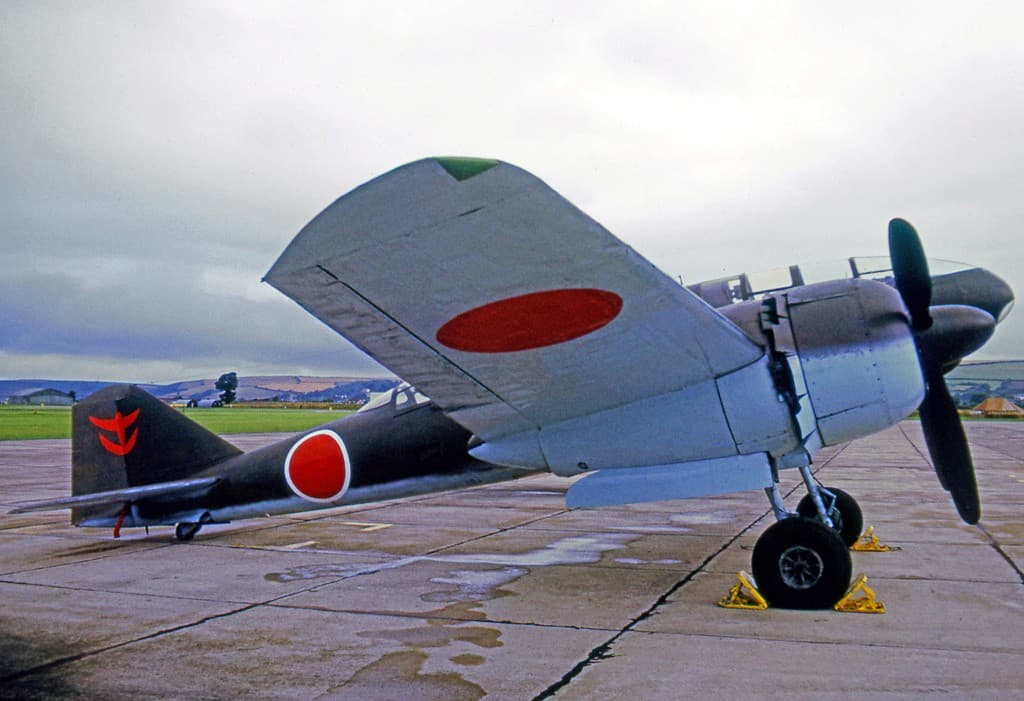
Mitsubishi Ki-46-III Type 100 Command Reconnaissance Plane
Mitsubishi · Allied code name: “Dinah”
How does the Ki-46-III stack up?
CompareOverview
The Mitsubishi Ki-46 was the finest strategic reconnaissance aircraft produced by any nation during World War II, an aircraft so fast and so beautiful that even the enemy grudgingly admired it. Designed from the outset as a pure reconnaissance platform capable of outrunning any fighter it might encounter, the Ki-46 combined stunning aerodynamic elegance with outstanding performance. Allied pilots who encountered the high-flying "Dinah" found it extremely difficult to intercept, as it could cruise above 30,000 feet at speeds that challenged most contemporary fighters.
The Ki-46 represented a rare case of Japanese aircraft design philosophy working perfectly. Its slim, streamlined fuselage, close-fitting engine cowlings, and carefully faired canopy produced one of the lowest-drag airframes of the war. The aircraft was so aerodynamically refined that the Imperial Japanese Army repurposed the Ki-46-III as a home defense interceptor, an extraordinary role for a reconnaissance aircraft, but the airframe's speed and altitude capability made it one of the few Japanese aircraft that could reach B-29 Superfortresses at altitude.
With over 1,700 produced across all variants, the Ki-46 served throughout the war in every theater where Japan fought. Its reconnaissance photographs provided the intelligence foundation for operations from Burma to the Aleutians, and its graceful form earned it a reputation as one of the most aesthetically pleasing aircraft of the entire conflict.
Performance Profile
Max Speed
391 mph
at 19,680 ft
Range
1,537 miles
normal
Service Ceiling
34,450 ft
Rate of Climb
2,360 ft/min
Armament
2 guns
1x 20mm, 1x 7.7mm
Crew
2
Engine
Mitsubishi Ha-112-II
1500 hp radial
Development History
The Ki-46 originated from a 1937 Japanese Army specification calling for a high-speed, long-range strategic reconnaissance aircraft capable of operating beyond the reach of enemy fighters. Mitsubishi's design team, led by Tomio Kubo, created an aircraft of exceptional aerodynamic purity. Every aspect of the design was optimized to minimize drag: the fuselage cross-section was kept to the minimum that could accommodate a crew of two, the engine nacelles were closely faired into the wing, and the canopy was blended seamlessly into the fuselage contour.
The first prototype flew in November 1939, and testing confirmed the aircraft's outstanding speed. The Ki-46-I, powered by two Mitsubishi Ha-26 engines of 900 hp each, could reach 336 mph, faster than many fighters of the era. However, the Army demanded still more speed, leading to the Ki-46-II with Ha-102 engines producing 1,080 hp each, which raised the maximum speed to 375 mph. This variant entered large-scale production and became the primary reconnaissance aircraft of the JAAF from 1941.
The Ki-46-III, which appeared in late 1943, represented the ultimate development of the reconnaissance lineage. It replaced the stepped windscreen of earlier variants with a smooth, faired nose that eliminated the aerodynamic discontinuity and further reduced drag. The Ha-112-II engines producing 1,500 hp each pushed the maximum speed to 391 mph at nearly 20,000 feet. A nose-mounted fuel tank replaced the observer's forward-facing window, with the crew entry redesigned accordingly.
The most unusual Ki-46 variant was the Ki-46-III-KAI interceptor, created by mounting two fixed 20mm Ho-5 cannon in an upward-firing oblique installation (Schrage Musik) behind the cockpit, plus a single 37mm Ho-203 cannon in the nose. This unlikely conversion was intended for use against B-29s, exploiting the reconnaissance aircraft's speed and ceiling to reach the heavy bombers.
Combat History
The Ki-46-II entered combat operations in 1941, flying strategic reconnaissance missions over Malaya, the Dutch East Indies, and the Philippines in the weeks before and during the Japanese offensive. Its speed made it virtually immune to interception, and Ki-46 photographs provided critical intelligence for the Japanese campaigns that swept through Southeast Asia. Reconnaissance flights over northern Australia and the approaches to India continued throughout 1942-43, with Dinahs mapping targets for Japanese planning staffs.
Allied frustration with the Ki-46's elusiveness was profound. Standard interceptors like the P-40 and Hurricane simply could not catch the Dinah at altitude. Only the arrival of Spitfire Mk VIIIs in the CBI theater and the P-38 Lightning in the Pacific gave Allied forces aircraft fast enough to occasionally intercept the reconnaissance machines. Even then, the Ki-46 pilot's standard response was to push the throttles forward and simply outrun the pursuit.
The Ki-46-III proved equally elusive when it entered service in late 1943. Its 391 mph top speed meant that only the latest Allied fighters could hope to intercept it, and then only with a favorable altitude and position advantage. Ki-46-IIIs conducted regular reconnaissance flights over the Mariana Islands before and during the American invasion, photographing the buildup of B-29 bases that would soon devastate the Japanese home islands.
In the final year of the war, the Ki-46-III-KAI interceptor variant saw action against B-29 raids over Japan. The concept of using a reconnaissance aircraft as an interceptor was unusual, but the Ki-46's speed and altitude capability made it more effective in this role than many purpose-built fighters. The obliquely mounted 20mm cannon allowed the pilot to fly beneath a B-29 formation and fire upward into the vulnerable belly, a tactic borrowed from Luftwaffe night fighters. Results were mixed, but the Ki-46-III-KAI scored confirmed kills against the heavy bombers.
Variants
| Designation | Key Differences | Produced |
|---|---|---|
| Ki-46-I | Initial production with Ha-26 engines (900 hp each); maximum speed 336 mph. Limited production. | 34 |
| Ki-46-II | Ha-102 engines (1,080 hp each), 375 mph; primary wartime reconnaissance variant with stepped canopy. | 1,093 |
| Ki-46-III | Ha-112-II engines (1,500 hp each), faired nose, 391 mph; definitive high-speed reconnaissance version. | 609 |
| Ki-46-III-KAI | Interceptor conversion with 37mm nose cannon and two oblique-mounted 20mm cannon for attacking B-29s from below. | 6 |
| Ki-46-IIIb | Ground-attack variant with nose-mounted 20mm cannon and underwing bomb racks; used in defense of the Philippines. | - |
Strengths & Weaknesses
+Strengths
- Exceptional speed made it one of the few aircraft that could consistently evade interception throughout the entire war
- Superb aerodynamic design produced one of the cleanest, lowest-drag airframes of any WW2 aircraft
- Outstanding range of over 1,500 miles allowed deep-penetration reconnaissance missions far behind enemy lines
- Excellent high-altitude performance enabled operation above 30,000 feet where most interceptors could not follow
-Weaknesses
- Minimal defensive armament; the aircraft depended entirely on speed for survival
- No armor or self-sealing tanks meant that any successful interception was likely to be fatal
- Two-man crew was insufficient for simultaneous navigation, photography, and observation on long missions
- Interceptor variant was a makeshift solution with limited ammunition capacity and difficulty aiming the oblique guns
Pilot Voices
“In the Dinah, I felt untouchable. We would fly over enemy territory at 30,000 feet, photograph everything, and return home before they could even scramble fighters to our altitude.”
“We chased a Dinah for twenty minutes across the sky and never closed the distance. It was like trying to catch a ghost. The most frustrating sortie I ever flew.”
Did You Know?
The Ki-46 is widely regarded as the most beautiful Japanese aircraft of World War II. Its flowing lines and perfect proportions have been praised by aviation enthusiasts and designers on both sides of the conflict.
Allied intelligence was so frustrated by the inability to intercept the Ki-46 that shooting one down was considered a notable achievement worth specific mention in combat reports.
The Ki-46-III-KAI interceptor used the same Schrage Musik oblique-firing gun concept as the Luftwaffe's night fighters, mounting cannon at an upward angle to attack bombers from directly below.
After the war, France obtained several Ki-46s and operated them as reconnaissance aircraft in Indochina until 1950, a testament to the aircraft's enduring quality.

