
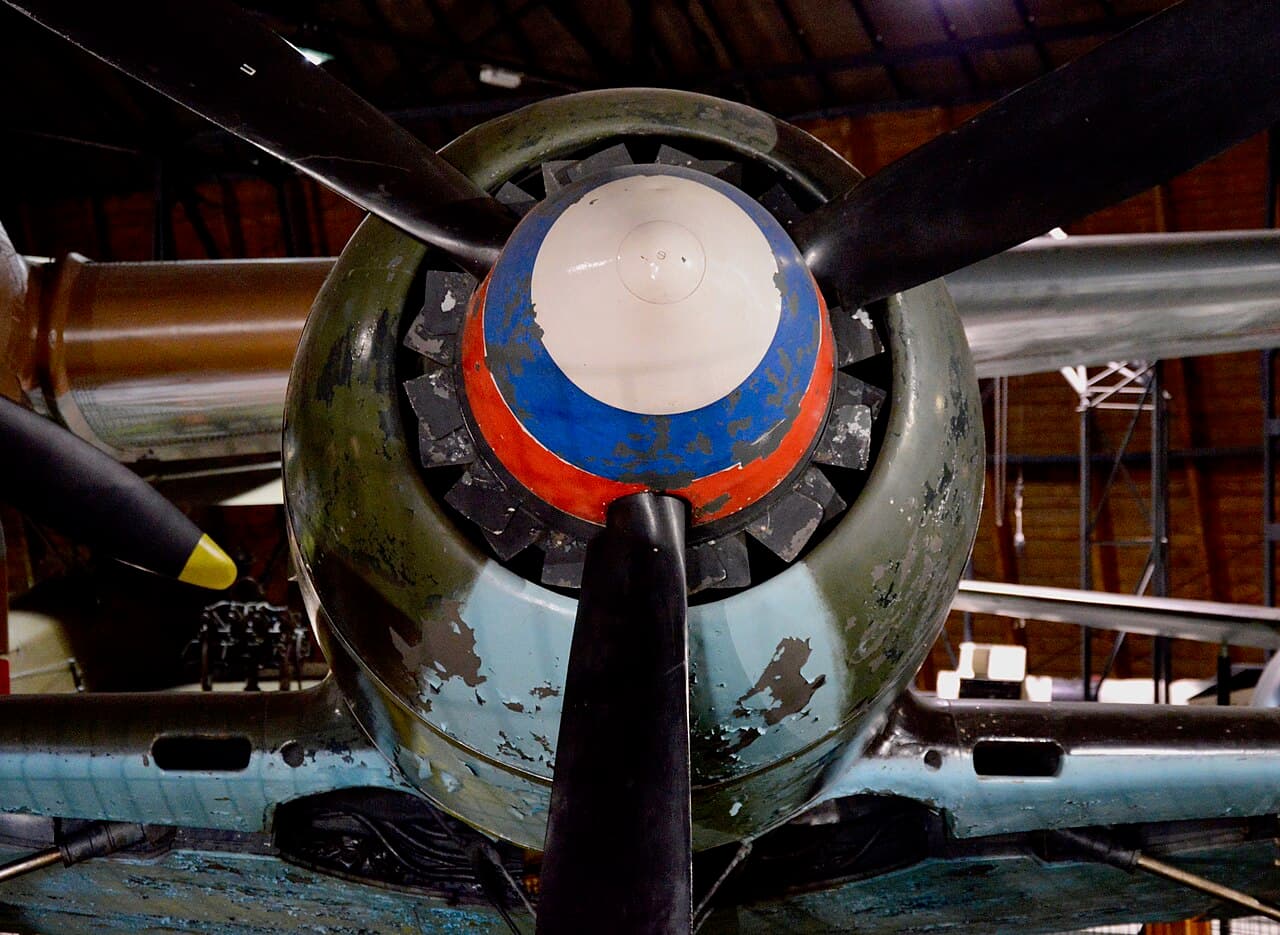
Lavochkin La-7
Lavochkin
How does the La-7 stack up?
CompareOverview
The Lavochkin La-7 was the finest Soviet piston-engined fighter of World War II and one of the best low-to-medium altitude fighters produced by any nation. Representing the ultimate refinement of the La-5 airframe, the La-7 combined extensive aerodynamic cleanup with improved construction to extract every last ounce of performance from the proven ASh-82FN radial engine. The result was an aircraft that could outperform the Bf 109G and Fw 190A in virtually every parameter below 20,000 feet.
Ivan Kozhedub, the highest-scoring Allied ace with 62 confirmed victories, scored his last 17 kills in the La-7, including an Me 262 jet fighter on February 19, 1945, one of the very few propeller-driven fighters to shoot down a jet in combat. Kozhedub never lost a single aircraft to enemy fire throughout his career, a testament both to his extraordinary skill and to the La-7's ability to keep its pilot alive in the most intense air combat of the war.
The La-7 was not a revolutionary design but rather a masterclass in evolutionary refinement. Lavochkin's engineers systematically identified and eliminated every source of unnecessary drag, redesigned the air intake system, sealed gaps in the cowling, and improved the internal ducting, changes that collectively added 10 mph to the La-5FN's top speed while simultaneously improving climb rate and handling. In the world of fighter design, where single-digit speed differences decided life and death, this was a decisive margin.
Performance Profile
Max Speed
411 mph
at 20,505 ft
Range
395 miles
normal
Service Ceiling
34,450 ft
Rate of Climb
3,543 ft/min
Armament
2 guns
2x 20mm ShVAK
Crew
1
Engine
Shvetsov ASh-82FN
1850 hp radial
Development History
Development of what became the La-7 began in mid-1943 as the La-5FN "Standard" project, an initiative to identify and incorporate every possible aerodynamic improvement into the existing airframe. Lavochkin's team conducted extensive wind tunnel testing and discovered that the La-5FN was losing substantial performance to poorly optimized cowl flaps, air intake geometry, and surface gaps. These seemingly minor imperfections were collectively costing the aircraft nearly 25 mph in top speed.
The key change was moving the oil cooler and supercharger air intakes from the cowling top to the wing roots, dramatically cleaning up the engine cowling's aerodynamic profile. The cowl flap mechanism was redesigned for smoother operation, wing-to-fuselage fairings were improved, and every access panel and gap was sealed or faired over. The wing structure itself was refined, with the main spar redesigned for both lighter weight and greater strength using metal rather than wood.
The first La-7 prototype flew in November 1943 and demonstrated the results immediately: maximum speed reached 411 mph at 20,500 feet, a substantial improvement over the La-5FN's 402 mph. Rate of climb improved by nearly 100 feet per minute. Handling qualities were refined, with lighter control forces and more precise response throughout the flight envelope. State acceptance trials confirmed the La-7 as the best Soviet fighter yet tested.
Production began in March 1944 at Factory No. 21 in Gorky (modern Nizhny Novgorod), with combat units receiving their first La-7s in June. A three-cannon variant mounting 3x 20mm B-20 cannons was tested and produced in limited numbers in 1945, and an experimental La-7 with the more powerful ASh-83 engine achieved 428 mph but was not put into production. The ultimate expression of the design was the La-9, an all-metal postwar fighter that represented the final step of the evolutionary chain that began with the wooden LaGG-3 in 1940.
Combat History
The La-7 entered combat in June 1944 during the opening phase of Operation Bagration, the massive Soviet offensive that destroyed Army Group Center. Equipped with the new fighter, elite Guards regiments immediately established air superiority over the battlefield, allowing Il-2 Shturmoviks and Pe-2 dive-bombers to operate with increasing freedom. Luftwaffe pilots who had been accustomed to qualitative superiority over Soviet fighters found the La-7 a deeply unsettling opponent, faster, with better climb, and flown by increasingly experienced Soviet pilots.
The La-7's most celebrated moment came on February 19, 1945, when Ivan Kozhedub, flying La-7 number 27, encountered and shot down a Messerschmitt Me 262 jet fighter over the Oder River. The kill was achieved through superior tactical positioning, Kozhedub ambushed the jet as it was decelerating after a diving attack, catching it at its most vulnerable moment. This victory made Kozhedub one of the very few propeller-driven fighter pilots to destroy a jet aircraft in combat, and it demonstrated that even the most advanced technology could be defeated by skill and tactics.
During the final battles over Germany in April-May 1945, La-7 regiments frequently encountered the remnants of the Luftwaffe's elite fighter units, including veterans with hundreds of victories. The La-7 proved itself in these encounters, and the kill-to-loss ratios achieved by Soviet Guards regiments in the war's final months were the best of the entire Eastern Front war, a stark reversal from the catastrophic ratios of 1941.
The La-7 also saw limited postwar combat service. North Korean Air Force La-7s were used in the opening stages of the Korean War in June-July 1950, though they were quickly swept aside by USAF F-80 Shooting Star jets and even by propeller-driven F-51 Mustangs whose pilots had greater experience and training.
Variants
| Designation | Key Differences | Produced |
|---|---|---|
| La-7 | Standard production fighter with ASh-82FN engine (1,850 hp), 2x 20mm ShVAK cannons (170 rpg). Redesigned cowling, wing-root air intakes, improved aerodynamics over La-5FN. | 5,393 |
| La-7 3xB-20 | Three-cannon variant with 3x 20mm B-20 cannons replacing 2x ShVAK. Lighter Berezin cannons allowed the third weapon without significant weight penalty. Limited late-war production. | 360 |
| La-7R | Experimental rocket-boosted variant with an RD-1KhZ auxiliary liquid-fueled rocket motor in the tail. Intended to provide temporary speed boost for interception. Not produced in quantity. | - |
| La-7UTI | Two-seat trainer conversion with tandem cockpits. Used for operational conversion training of pilots transitioning from other types. | - |
Strengths & Weaknesses
+Strengths
- Best overall low-to-medium altitude performance of any Soviet fighter, faster, better climbing, and more maneuverable than the Bf 109G below 20,000 feet
- Extremely clean aerodynamics extracted maximum performance from the proven ASh-82FN engine, achieving more speed with no additional power
- Rugged air-cooled radial engine could sustain significant battle damage and continue operating, unlike vulnerable liquid-cooled systems
- Excellent rate of climb and energy retention made it superb in the vertical combat maneuvers favored by Soviet aces
-Weaknesses
- Limited range of 395 miles restricted the La-7 to short-radius air superiority missions close to the front lines
- Only two cannons with modest ammunition supply, limited firepower by late-war standards when facing heavy bombers or well-armored ground targets
- Wooden construction in some components remained a maintenance concern, requiring protection from moisture and careful inspection
- Performance above 20,000 feet still lagged behind inline-engined Western fighters like the P-51D and Spitfire XIV
Pilot Voices
“The La-7 was the best propeller aircraft I ever flew. It was responsive, fast, and it climbed beautifully. I trusted it completely, and it never let me down.”
“In the La-7, I finally felt I had an aircraft that was equal to anything the Germans had. Before, we had to fight with courage and numbers. Now we could also fight with quality.”
Did You Know?
Ivan Kozhedub's La-7 number 27 is preserved at the Central Air Force Museum at Monino, Russia, one of the most famous individual aircraft in Soviet aviation history.
Kozhedub shot down an Me 262 jet in his La-7 on February 19, 1945, making him one of the only propeller-driven fighter pilots to destroy a jet in air-to-air combat.
The La-7 was so aerodynamically refined compared to the La-5FN that it gained 10 mph in top speed with the exact same engine, proving that drag reduction was as valuable as adding horsepower.
On one occasion, Kozhedub mistakenly attacked a USAAF P-51 Mustang that fired on him over the Oder. He damaged the P-51, and the incident was quietly covered up by both sides to avoid diplomatic embarrassment.

