
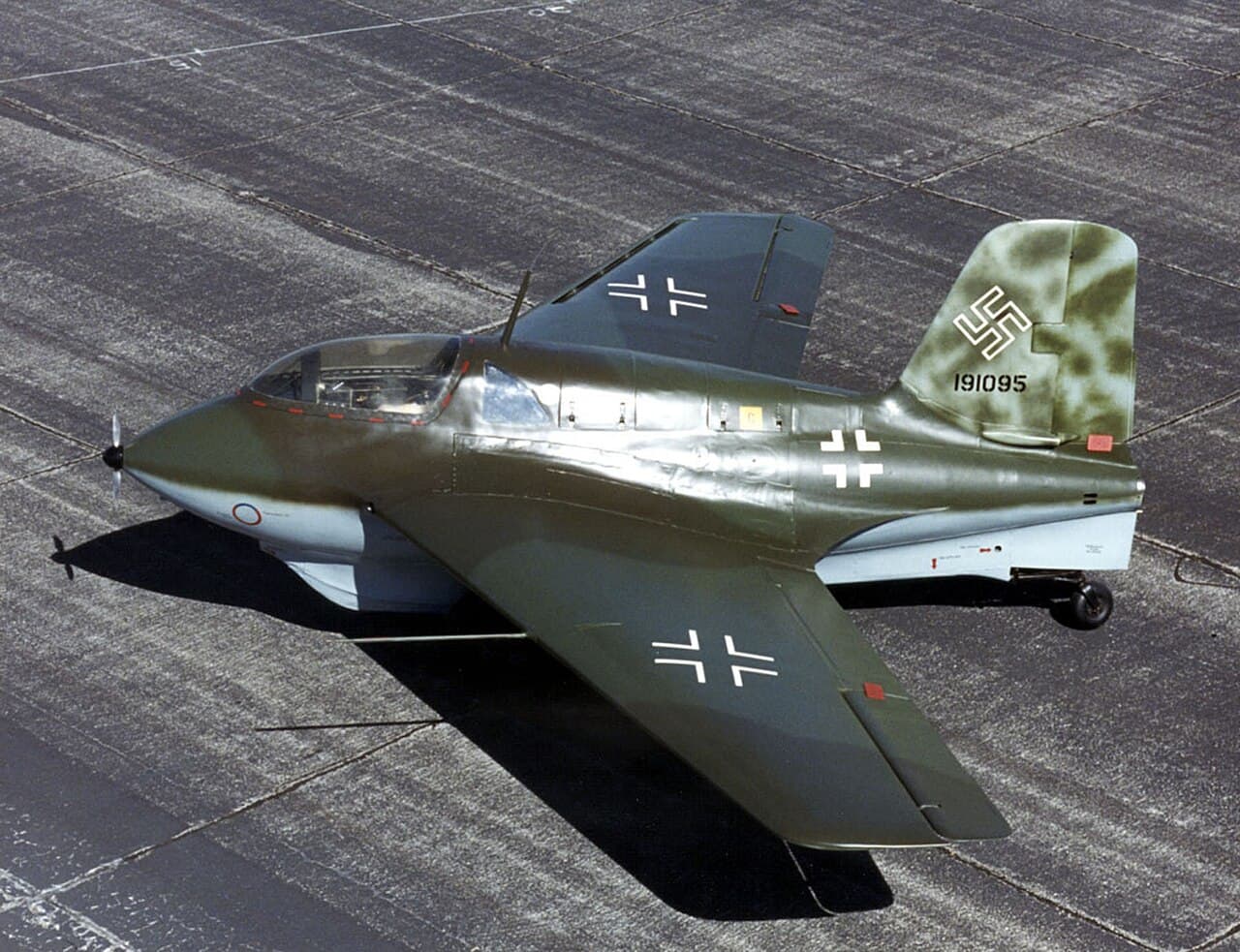
Messerschmitt Me 163B Komet
Messerschmitt
How does the Me 163B stack up?
CompareOverview
The Messerschmitt Me 163B Komet was the only rocket-powered fighter aircraft to enter operational service in aviation history. Capable of reaching 596 mph and climbing to 30,000 feet in under three minutes, the Komet was by far the fastest aircraft of World War II, and one of the most dangerous, though as much to its own pilots as to the enemy. Its volatile combination of T-Stoff (concentrated hydrogen peroxide) and C-Stoff (hydrazine hydrate and methanol) propellants could spontaneously explode on contact, dissolving metal, fabric, and human flesh with equal efficiency.
The Komet was born from Alexander Lippisch's revolutionary tailless glider research and powered by the Walter HWK 109-509 rocket motor. It launched from a wheeled dolly that was jettisoned after takeoff, climbed nearly vertically to altitude, made one or two high-speed passes through a bomber formation, then glided unpowered back to base for a landing on an extendable skid. The entire powered flight lasted barely seven and a half minutes.
Despite its extraordinary speed, the Komet achieved only modest combat results, roughly sixteen confirmed kills against nine aircraft lost. The extreme closing speed made accurate gunnery nearly impossible, the tiny fuel supply left no room for second chances, and the unpowered glide back to base left pilots defenseless against prowling Allied fighters. The Komet remains one of history's most audacious and terrifying flying machines, a desperate technological gamble that pushed the boundaries of what was physically possible in 1944.
Performance Profile
Max Speed
596 mph
at 9,845 ft
Range
50 miles
combat
Service Ceiling
39,370 ft
Rate of Climb
16,080 ft/min
Armament
2 guns
2x 30mm MK 108
Crew
1
Engine
Walter HWK 109-509A-2
3750 hp rocket
Development History
The Me 163's lineage traces back to the late 1920s and Alexander Lippisch's experiments with tailless glider designs at the Deutsche Forschungsanstalt fur Segelflug (German Research Institute for Gliding). His delta-wing and swept-wing gliders progressively refined the aerodynamics of tailless flight. In 1937, Lippisch's team was transferred to Messerschmitt to develop a rocket-powered research aircraft, which became the DFS 194, the direct ancestor of the Me 163.
The DFS 194 first flew under rocket power in August 1940, demonstrating the basic concept. The refined Me 163A prototype took its first powered flight on August 13, 1941, and on October 2, 1941, test pilot Heini Dittmar reached 624 mph (1,004 km/h), an unofficial world speed record that would not be officially surpassed until Chuck Yeager broke the sound barrier in 1947. The Air Ministry was impressed enough to order the operational Me 163B variant.
The Me 163B was substantially larger and heavier than the A-model, with a pressurized cockpit, armored windscreen, and two 30mm MK 108 cannons. The Walter HWK 109-509A rocket motor provided 3,750 pounds of thrust, enough to launch the aircraft to 30,000 feet in about 2.5 minutes. However, the motor consumed its fuel so rapidly that total powered flight time was limited to approximately 7.5 minutes, after which the pilot became a glider pilot whether he wanted to or not.
The propellant combination was spectacularly hazardous. T-Stoff (80% hydrogen peroxide) was a powerful oxidizer that could cause violent decomposition reactions on contact with organic matter, including human skin. C-Stoff (hydrazine hydrate mixed with methanol) was toxic and highly flammable. The two propellants were hypergolic, they ignited spontaneously on contact, meaning any fuel leak was potentially catastrophic. Several Komets and their pilots were lost to fuel-related explosions, both on the ground and in the air.
Combat History
The Me 163B entered combat with JG 400 in May 1944, initially operating from Brandis airfield near Leipzig to defend the Leuna synthetic fuel plants. The first attempted interception occurred on July 28, 1944, when five Komets attacked a formation of B-17s. The pilots discovered immediately what would remain the aircraft's fundamental problem: the extreme closing speed, often exceeding 200 mph differential, left barely two or three seconds of firing time, making accurate gunnery extraordinarily difficult.
Various tactics were tried to solve the firing-time problem. Some pilots throttled back to reduce the speed differential, but this consumed fuel even faster. Others tried diving attacks from above, trading altitude for a more favorable attack angle. The SG 500 Jagdfaust system, a battery of upward-firing 50mm mortar shells triggered by a photocell as the Komet passed beneath a bomber, was developed to remove the gunnery problem entirely, but the war ended before it could be deployed in significant numbers.
The Komet's most successful day came on August 16, 1944, when JG 400 pilots claimed five B-17s shot down. However, USAAF records suggest actual losses to Komets were lower than claimed, a common issue with the chaotic air battles over the Reich. Allied countermeasures evolved quickly: P-51 pilots learned to orbit near known Komet bases and attack them during their unpowered glide home, when they were slow, defenseless, and unable to evade.
In total, JG 400 was the only unit to operate the Komet in combat. The unit never exceeded 50 operational aircraft at any time, and attrition from accidents, particularly fuel-related explosions during landing, when residual propellant could slosh and combine, was actually higher than combat losses. By early 1945, fuel shortages had grounded most Komets, and the remaining aircraft were pushed into dispersal areas to avoid Allied strafing.
Variants
| Designation | Key Differences | Produced |
|---|---|---|
| Me 163A (V-series) | Prototype and research variant with smaller airframe, no armament, and Walter HWK R.II-203b motor. Used for flight testing and speed records. Not combat-capable. | 70 |
| Me 163B-1a | Standard production interceptor with 2x MK 108 30mm cannon, HWK 109-509A-2 motor, pressurized cockpit, and armored windscreen. Primary combat variant. | 327 |
| Me 163B-1a with SG 500 | Experimental variant fitted with SG 500 Jagdfaust system, 10 upward-firing 50mm mortar tubes in wing roots, triggered by photoelectric cell. Designed for pass-beneath attacks on bombers. | - |
| Me 163C | Proposed improved version with lengthened fuselage for additional fuel, bubble canopy, and HWK 109-509C motor with auxiliary cruise chamber for extended endurance. Three prototypes started; none completed before war's end. | - |
Strengths & Weaknesses
+Strengths
- Fastest aircraft of World War II, no Allied fighter could catch or outrun it
- Phenomenal rate of climb allowed interception of bombers at any altitude in minutes
- Tiny size and incredible speed made it extremely difficult for bomber gunners to track and hit
-Weaknesses
- Total powered flight time of only 7.5 minutes left almost no margin for tactical maneuvering
- Extreme closing speed made accurate gunnery nearly impossible against bombers
- Hypergolic propellants were extraordinarily dangerous, fuel leaks caused fatal explosions on the ground and in the air
- Unpowered glide descent left pilots completely defenseless against Allied fighters
- Skid landing on grass fields limited operational bases and frequently damaged airframes
Pilot Voices
“Taking off in the Komet was the most exciting experience of my life. The acceleration pressed you into the seat, the ground fell away as if you were in an elevator, and within two minutes you were higher than any bomber could fly.”
“The closing speed was so great that you barely had time to aim. You would see the bomber grow from a dot to filling your windscreen in seconds, fire a quick burst, and then you were past and climbing away. Whether you hit anything was often a matter of luck.”
Did You Know?
On October 2, 1941, test pilot Heini Dittmar reached 624 mph in an Me 163A, a speed record that stood as the fastest any human had traveled until Chuck Yeager broke the sound barrier in 1947.
The Me 163 took off from a wheeled dolly that was dropped after liftoff, and landed on an extendable skid. If any propellant remained in the tanks during landing, the impact could cause the fuels to mix and detonate, killing the pilot.
T-Stoff (concentrated hydrogen peroxide) was so corrosive that ground crews had to wear special rubberized suits. It could dissolve organic material on contact, and several ground crew members suffered horrific chemical burns.

