
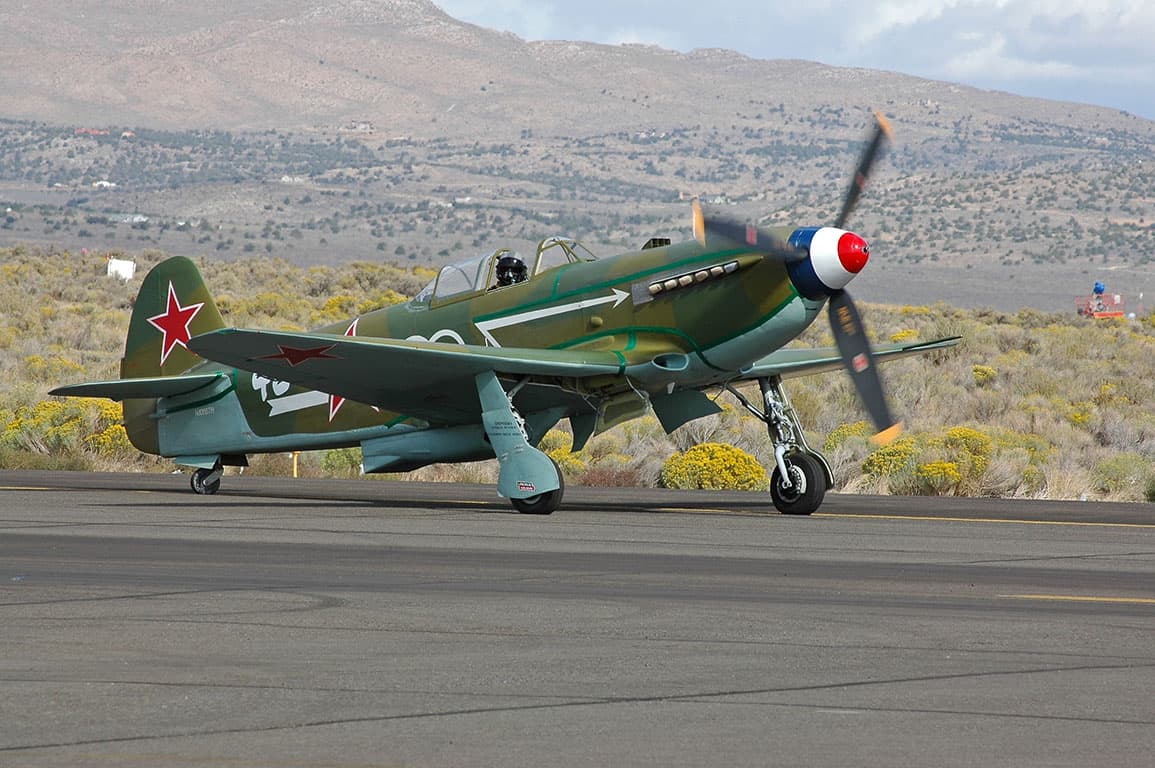
Yakovlev Yak-9
Yakovlev
How does the Yak-9 stack up?
CompareOverview
The Yakovlev Yak-9 was the most-produced Soviet fighter of the war and the workhorse of the VVS from late 1942 to the fall of Berlin. While it lacked the razor-sharp agility of the lighter Yak-3 or the raw power of the La-7, the Yak-9's genius lay in its extraordinary versatility: the basic airframe was adapted into a long-range escort fighter, a tank-buster with a 37mm or 45mm cannon, a fighter-bomber, a high-altitude interceptor, and even a dedicated anti-shipping strike aircraft.
With nearly 17,000 produced across more than a dozen major variants, the Yak-9 was the Eastern Front's equivalent of the P-51 Mustang, not always the best at any single role, but good enough at all of them to be indispensable. Its arrival in large numbers during the winter of 1942-43 marked the turning point when Soviet fighter aviation began to contest and then dominate the skies over the Eastern Front.
The Yak-9's design evolved continuously throughout the war, incorporating more metal construction as aluminum supplies from Allied Lend-Lease improved Soviet material availability. Late-war Yak-9U and Yak-9P variants with the VK-107A engine were genuinely world-class fighters, competitive with the best German, American, and British designs. The type continued in production until 1948 and served in the Korean War with the North Korean Air Force.
Performance Profile
Max Speed
373 mph
at 11,480 ft
Range
537 miles
normal
Service Ceiling
32,808 ft
Rate of Climb
3,050 ft/min
Armament
2 guns
1x 20mm ShVAK, 1x 12.7mm UBS
Crew
1
Engine
Klimov VK-105PF
1180 hp inline
Development History
The Yak-9 evolved directly from the Yak-7B fighter, which was itself a combat adaptation of the Yak-7 two-seat trainer. Alexander Yakovlev's design philosophy for the Yak-9 centered on replacing wooden structural components with metal alloys as Soviet industry gained access to aluminum through Lend-Lease supplies and recovered mining capacity. The result was an aircraft that was structurally lighter than its wooden predecessor while being significantly stronger, freeing up weight capacity for additional fuel, armament, or armor.
The first Yak-9 prototype flew in June 1942 and entered State acceptance trials almost immediately. The basic design was sound, essentially a refined Yak-7B with metal wing spars, a slightly smaller wing, and detail aerodynamic improvements, and was cleared for production with minimal changes. The first serial Yak-9s reached frontline units in October 1942, just in time for the Stalingrad counteroffensive.
Yakovlev's design bureau exploited the Yak-9's adaptable airframe to create a remarkable family of specialized variants. The Yak-9D extended range to 870 miles by adding fuel tanks in the wing, enabling escort missions deep behind enemy lines. The Yak-9T mounted a 37mm NS-37 cannon firing through the propeller hub for anti-tank and anti-shipping work. The Yak-9DD ultra-long-range variant could fly 1,367 miles, allowing it to escort bombers attacking strategic targets far behind the front and to shuttle between Soviet and Allied-held airfields.
The definitive late-war Yak-9U, which first flew in January 1944, was essentially a new aircraft sharing only the Yak-9 designation. Powered by the VK-107A engine producing 1,650 hp, the Yak-9U could reach 434 mph and was superior to the Bf 109G-6 in virtually every performance parameter. However, VK-107A engine reliability remained problematic throughout its service life, and the Yak-9U never fully displaced the VK-105-powered variants in frontline units.
Combat History
The Yak-9 received its baptism of fire during the Battle of Stalingrad in the winter of 1942-43, where it quickly proved itself superior to the older LaGG-3 and Yak-1 fighters it replaced. In the fierce air battles over the city and the subsequent Operation Uranus encirclement, Yak-9 pilots gained the confidence that had been lacking in the disastrous first eighteen months of the war. The aircraft could hold its own against the Bf 109G at low and medium altitudes, though it remained outclassed above 20,000 feet.
The Battle of Kursk in July 1943 saw the Yak-9 deployed in its largest numbers yet, with entire air armies equipped with the type. During the massive air battle over the Prokhorovka salient, Yak-9s flew escort for Il-2 Shturmoviks while simultaneously engaging German fighters in swirling dogfights that sometimes involved hundreds of aircraft. The Yak-9T anti-tank variant also made its combat debut at Kursk, its 37mm cannon proving effective against the side and rear armor of German medium tanks and devastating against trucks and light vehicles.
The Normandie-Niemen regiment initially flew Yak-9s before transitioning to Yak-3s, and French pilots spoke highly of both types. During the long-range escort missions over Romania and Hungary in 1944, Yak-9D and Yak-9DD variants demonstrated that Soviet fighters could now project power far beyond the immediate front lines, a capability that had been utterly absent in 1941-42.
By 1945, the Yak-9 was the most numerous fighter in the VVS, equipping the majority of frontline fighter regiments during the final offensives into Germany. The type participated in the Battle of Berlin, providing air cover for crossing operations over the Oder and the final assault on the German capital. Postwar, Yak-9P fighters served in the opening stages of the Korean War, where North Korean pilots flying them scored several kills against USAF F-51 Mustangs and B-26 Invaders before being overwhelmed by jet-powered F-80 Shooting Stars.
Variants
| Designation | Key Differences | Produced |
|---|---|---|
| Yak-9 | Base production fighter with VK-105PF engine (1,180 hp), 1x 20mm ShVAK cannon and 1x 12.7mm UBS machine gun. Metal wing spars with mixed wood/metal construction. | 2,299 |
| Yak-9T | Anti-tank variant with 37mm NS-37 cannon replacing the 20mm ShVAK. The heavy recoil slowed the aircraft noticeably with each shot. Highly effective against armored vehicles and shipping. | 2,748 |
| Yak-9D | Long-range escort variant with additional fuel tanks in the wing, extending range to 870 miles. Sacrificed some agility for strategic reach. | 3,058 |
| Yak-9DD | Ultra-long-range variant with 1,367-mile range, used for deep escort missions and shuttle flights to Allied-held territory. Heaviest Yak-9 variant. | 399 |
| Yak-9U | Ultimate wartime variant with VK-107A engine (1,650 hp), achieving 434 mph. All-metal construction with revised cowling and improved aerodynamics. Essentially a new aircraft. | 3,921 |
| Yak-9K | Heavy anti-tank variant with 45mm NS-45 cannon. Enormous recoil limited firing to short bursts and made accurate gunnery extremely difficult. | 53 |
Strengths & Weaknesses
+Strengths
- Extraordinary versatility, adapted into fighter, escort, anti-tank, fighter-bomber, and long-range variants from a single basic airframe
- Excellent low-altitude performance with good turn rate and acceleration, ideally suited to Eastern Front combat conditions
- Progressively improved metal construction increased structural strength and reduced maintenance compared to wooden predecessors
- Sufficient range in the Yak-9D/DD variants to conduct deep escort missions, a capability unique among Soviet fighters
-Weaknesses
- Base model armament of one cannon and one machine gun was lighter than most contemporary fighters, limiting lethality per firing pass
- High-altitude performance above 20,000 feet was inferior to the Bf 109G and Fw 190D
- VK-107A engine in the Yak-9U was unreliable, with a service life of only 25 hours, limiting the best variant's operational availability
- Plywood and fabric components in early variants were susceptible to moisture damage and required careful upkeep in field conditions
Pilot Voices
“The Yak-9 was an honest aircraft. It did what you asked, it forgave small mistakes, and it was always ready to fight. Not the fastest, not the most agile, but it was always there when you needed it.”
“With the 37mm cannon, I could feel the entire aircraft shudder with each shot. But one hit on a German tank and it burned. One hit on a locomotive and it stopped. That was worth the shaking.”
Did You Know?
The Yak-9T's 37mm NS-37 cannon was so powerful that it could destroy a locomotive with a single hit. Pilots nicknamed it the "train hunter" and used it to devastating effect against German rail transport.
North Korean Yak-9P fighters scored the first air-to-air kills of the Korean War on June 25, 1950, shooting down a USAF C-54 transport and damaging a B-26 bomber.
With 16,769 produced, the Yak-9 was the most-produced Yakovlev fighter and the second-most-produced Soviet fighter after the Il-2 Shturmovik (which was an attack aircraft, not a true fighter).
The Yak-9DD's ultra-long range of 1,367 miles was used to fly escort for shuttle-bombing missions to Allied-held bases in Italy and Britain, the only Soviet fighter capable of such strategic-range operations.

