#2: T-34: The Tank That Broke the Wehrmacht's Back
When the T-34 first appeared on the Eastern Front in June 1941, panicked German crews reported that their standard 37mm anti-tank guns were "absolutely useless" against it. General Paul Ludwig Ewald von Kleist called it "the finest tank in the world." The Wehrmacht had nothing that could reliably stop it, and the shock triggered an emergency German tank development program that produced the Panther.
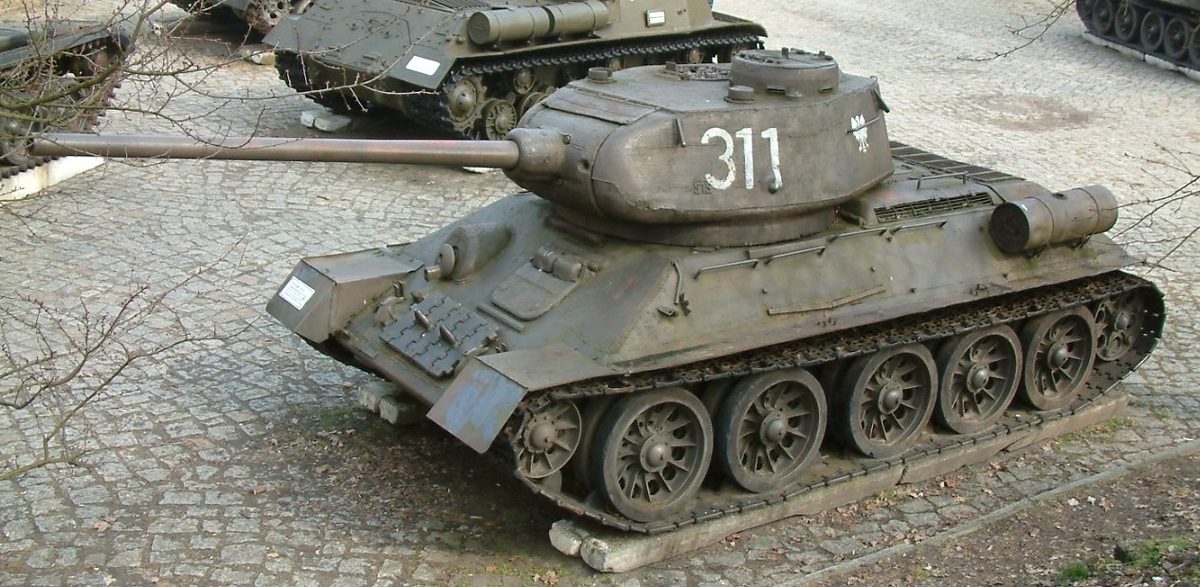
The T-34 combined sloped 45mm armor (equivalent to 90mm effective), a powerful 76mm F-34 gun, a 500-horsepower V-2 diesel engine, and wide Christie suspension tracks into a package that redefined what a medium tank could be. Over 84,000 T-34s were built in all variants, the second-most-produced tank in history behind the T-54/T-55 family. The T-34/85, with its 85mm ZIS-S-53 gun, could engage Tigers and Panthers at medium range and win. At the Battle of Kursk, over 6,000 Soviet tanks, primarily T-34s, clashed with German armor in the largest tank battle in military history. The T-34 was crude inside, ergonomically awful, and the four-man crew was jammed into a space designed for three. But it could be built by untrained workers in factories that had been relocated by rail to the Ural Mountains while under German bombardment. The T-34 didn't just fight in armored warfare, it proved that industrial capacity and design simplicity could defeat engineering excellence. It changed military history forever.