Skip to content
May 5:Battle of Puebla: Cinco de Mayo164yr ago

The A-1 Skyraider: The Prop Plane That Outlasted the Jet Age

Daniel Mercer · · 12 min read
Save
Share:
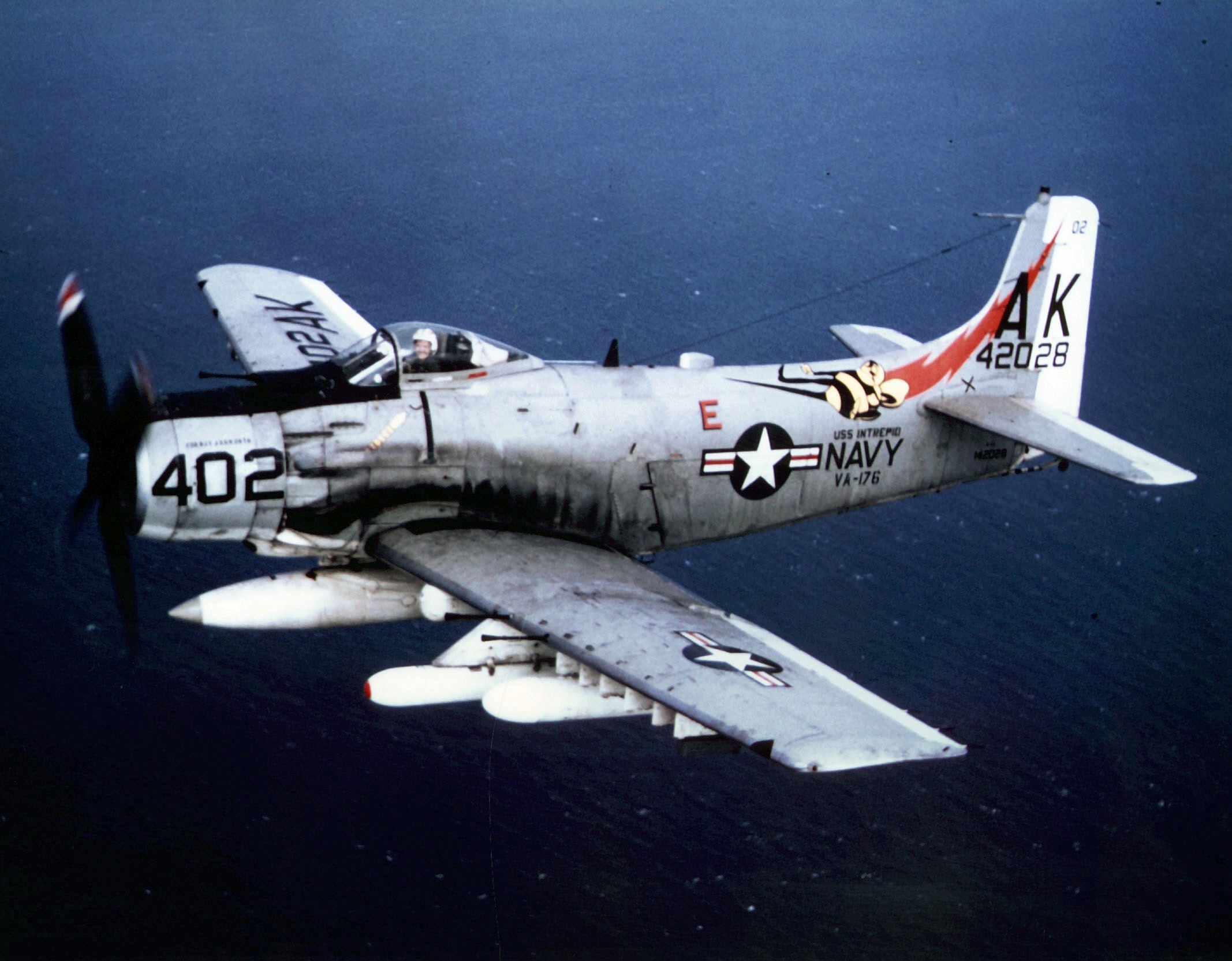
A-1 Skyraider attack aircraft in flight showing its massive radial engine and underwing ordnance load
Daniel Mercer
Daniel Mercer

Military History Editor

Daniel Mercer writes about military history with a focus on the 20th century, including World War II, the Cold War, and Vietnam. His work looks at how decisions made decades ago still influence doctrine, planning, and assumptions today.

The Douglas A-1 Skyraider was designed in 1944 for the final push against Japan. It arrived too late for World War II. By every reasonable prediction, it should have been obsolete within five years, a piston-engine anachronism in the dawning jet age. Instead, the Skyraider fought through the Korean War, then flew combat missions in Vietnam alongside supersonic F-4 Phantoms and F-105 Thunderchiefs, doing things that no jet aircraft in the American inventory could do. Ed Heinemann designed the Skyraider to carry heavy ordnance and bring it back if the mission was scrubbed. What he could not have predicted was that those same qualities (endurance, payload, and the ability to fly low and slow) would make the Skyraider indispensable twenty years after the jet was supposed to have made it extinct.

Heinemann's Design

Ed Heinemann at Douglas Aircraft designed the Skyraider (originally designated the XBT2D-1, later the AD, and finally redesignated A-1 in 1962) around the Wright R-3350 Duplex-Cyclone, an eighteen-cylinder radial engine producing 2,700 horsepower. The aircraft first flew on March 18, 1945. It was designed for carrier-based attack: a single-seat, single-engine machine built to dive-bomb, torpedo, and strafe. The wing carried four 20mm cannons. Fifteen external hardpoints could carry up to 8,000 pounds of ordnance: bombs, rockets, napalm, torpedoes, gun pods, and even a nuclear weapon.

A total of 3,180 Skyraiders were built across 28 variants before production ended in 1957. The airframe was rugged, with armor plate added to later variants to protect the pilot and critical systems from ground fire. The aircraft was designed to absorb punishment and keep flying. A quality that would matter enormously in the low-altitude, high-threat environments where the Skyraider would spend most of its combat career.

Korea: The First War

The Skyraider served extensively in the Korean War with Navy and Marine Corps squadrons, flying ground attack and close air support missions. Its ability to carry a heavy and diverse ordnance load (mixed configurations of bombs, rockets, and napalm) made it the most effective single-engine attack aircraft in the theater. The Skyraider could deliver more ordnance per sortie than any other Navy attack aircraft in Korea, and its dive-bombing accuracy was superior to the jet attack aircraft that were beginning to enter service alongside it.

Korea taught an important lesson that the military would be slow to learn: jets were not automatically better than propeller-driven aircraft for every mission. The early jets burned fuel at prodigious rates, limiting their time over the target. They flew too fast to accurately identify and attack small ground targets. The Skyraider could orbit a target area for hours, deliver ordnance with precision, and return to the carrier with fuel to spare. For close air support. The mission where an aircraft works directly with ground troops to destroy enemy positions meters from friendly forces. The Skyraider was better than any jet in the inventory.

Vietnam: The War That Should Not Have Needed It

By the time American forces escalated their involvement in Vietnam in 1964, the Skyraider should have been retired. The Navy was flying supersonic F-8 Crusaders and F-4 Phantoms. The Air Force had the F-100 Super Sabre and the F-105 Thunderchief. Every one of these jets was faster, could fly higher, and carried sophisticated weapons delivery systems that the Skyraider lacked.

None of them could do what the Skyraider did.

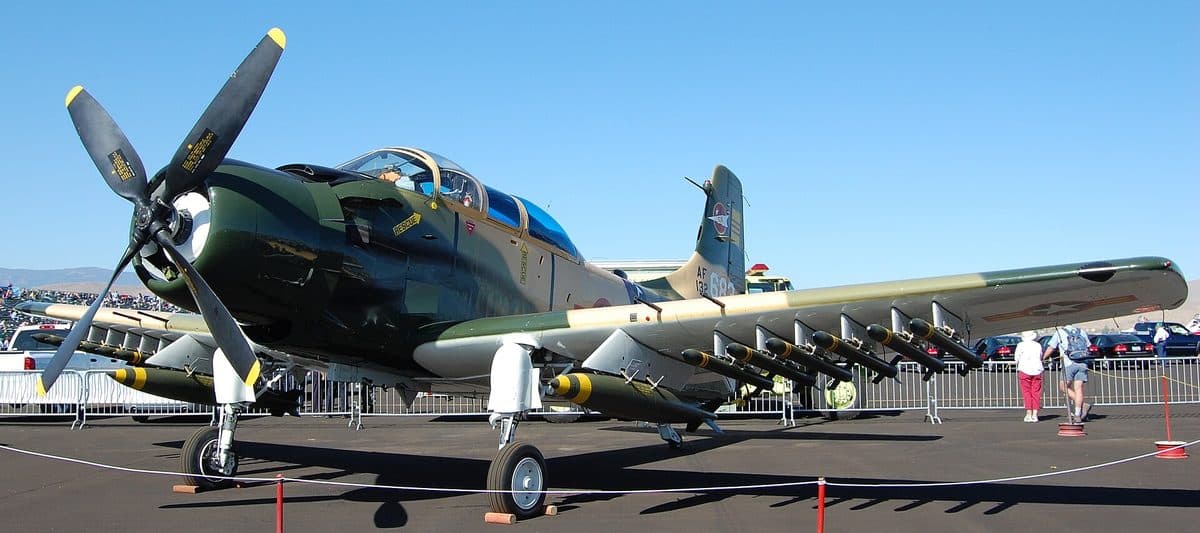
The A-1 could loiter over a battlefield for four or more hours. The F-105 could stay on station for minutes. The Skyraider carried 8,000 pounds of ordnance across 15 hardpoints, a weapons load that rivaled or exceeded many of its jet contemporaries. It could fly low enough and slow enough to accurately identify targets in the jungle canopy, distinguish friendly forces from enemy positions, and deliver ordnance with the precision that close air support demanded. The jets flew too fast for this work. They could not slow down enough to see what they were shooting at.

A-1 Skyraider loaded with ordnance during Vietnam War operations showing the aircraft's massive weapons carrying capability
An A-1 Skyraider armed for a combat mission in Vietnam. The "Spad," named after the World War I fighter, could carry 8,000 pounds of ordnance and loiter over a target for four hours, doing the job that no jet in the inventory could match. (U.S. Navy)

Sandy: The Rescue Missions

The Skyraider's most important role in Vietnam was one that nobody had planned for it. Beginning in 1965, USAF A-1 Skyraiders flew under the callsign "Sandy" as escort for HH-3E Jolly Green Giant rescue helicopters on combat search and rescue missions to recover downed pilots behind enemy lines.

The Sandy mission was brutally dangerous and perfectly suited to the Skyraider's capabilities. A downed pilot might be surrounded by enemy troops in thick jungle, with anti-aircraft guns covering the approaches. The Sandy Skyraiders would arrive first, orbiting the area for hours if necessary, suppressing enemy fire with bombs, rockets, napalm, and 20mm cannon fire while the vulnerable helicopters moved in for the extraction. The Skyraider's ability to absorb ground fire and keep flying, combined with its enormous endurance and ordnance capacity, made it uniquely suited for a mission that no jet could perform. The jets simply could not stay on station long enough.

The Sandy missions saved hundreds of American aircrews who would otherwise have been captured or killed. The Skyraider pilots who flew them operated at treetop height in heavily defended areas, accepting extraordinary risk to protect the rescue helicopters and the men on the ground waiting for them.

Shooting Down MiGs

The Skyraider's most improbable achievement was shooting down jet fighters. On June 20, 1965, four Navy A-1H Skyraiders from VA-25 off USS Midway engaged MiG-17 jet fighters over North Vietnam. Lieutenant Clinton B. Johnson and Lieutenant Charles W. Hartman III were credited with destroying a MiG-17 using 20mm cannon fire. On October 9, 1966, Lieutenant (j.g.) William T. Patton of VA-176 shot down another MiG-17 near Hanoi, a solo kill by a propeller-driven aircraft against a jet fighter, nearly twenty years into the jet age.

The kills were possible because the MiG-17, while far faster in straight-line flight, had to slow down to engage. At low altitude and low speed (the Skyraider's environment) the 20mm cannons of the A-1 were devastating, and the aircraft's maneuverability at those speeds exceeded what the jet could manage. The Skyraider pilots called their aircraft the "Spad," a reference to the World War I SPAD fighter, embracing the absurdity of flying a propeller-driven aircraft into combat against jets and winning.

The South Vietnamese Air Force

The U.S. Navy began transferring Skyraiders to the South Vietnamese Air Force in September 1960. By 1968, the VNAF had received 131 A-1s, and by 1973, all remaining American Skyraiders had been turned over to South Vietnam. The VNAF flew Skyraiders extensively for ground attack throughout the war. The aircraft's ruggedness, simplicity, and ability to operate from austere airfields made it well-suited to South Vietnamese conditions. The Skyraider served with the VNAF until the fall of Saigon in 1975.

Legacy: The A-10's Grandfather

When the Pentagon began designing a new close air support aircraft in the late 1960s, the aircraft that would become the A-10 Thunderbolt II, analyst Pierre Sprey interviewed Skyraider pilots in Vietnam. Their feedback directly shaped the A-10's requirements: long loiter time, low-speed maneuverability, massive firepower, and extreme survivability. The A-10 was explicitly designed to improve on the A-1 Skyraider's close air support capabilities, and it carries forward the Skyraider's design philosophy to this day.

The Skyraider proved something that military planners have been forced to relearn in every conflict since: speed is not always an advantage. The right aircraft for the mission is not always the newest or the fastest. It is the one that can find the target, stay over it long enough to do the job, carry enough weapons to finish it, and survive the ground fire that comes with working at treetop height. Ed Heinemann designed the Skyraider to do all of those things in 1944. It was still doing them thirty years later, long after the jets that were supposed to replace it had come and gone.

Share this article

Share:

Recommended

Ace of The Skies: Can You Identify These Military Aircraft Throughout The Years?
Test Yourself

Ace of The Skies: Can You Identify These Military Aircraft Throughout The Years?

Can you identify these aircraft?

Take the Quiz

On This Day in Military History

March 25

Battle of Fort Stedman, The Confederacy's Last Attack (1865)

In the pre-dawn hours, Major General John B. Gordon led 11,500 Confederate troops in an assault on Fort Stedman in the Petersburg siege lines, the last offensive action of the Army of Northern Virginia. Confederate soldiers posing as deserters overwhelmed Union pickets, and infantry captured the fort and adjacent batteries. But Union counterattacks under Brigadier General Hartranft sealed the breach within four hours. Confederate casualties were devastating: approximately 4,000, including 1,000 captured. Lee wrote that the failure "removed my last hope of any other course than a retreat."

1863, First Medals of Honor Awarded, Andrews' Raiders

1941, Yugoslavia Signs the Tripartite Pact, Then Overthrows Its Government

1945, Final Japanese Attack on Iwo Jima

See all 10 events on March 25

Get Military News & History in Your Inbox

Join thousands of readers receiving our weekly digest of military technology, history, and analysis.

Test Your Knowledge