Skip to content
May 5:Battle of Puebla: Cinco de Mayo164yr ago

The T-90M: Russia's Frontline Battle Tank

Marcus Webb · · 12 min read
Save
Share:
T-90M Proryv main battle tank showing its welded turret and Relikt explosive reactive armor
Marcus Webb
Marcus Webb

Military Vehicles & Ground Systems Contributor

Marcus Webb writes about military ground vehicles, armored platforms, and the logistics of land warfare. His work covers everything from MRAPs and infantry carriers to the training pipelines that keep ground forces operational in contested environments.

The T-90M Proryv, Russian for "Breakthrough", began reaching Russian Army units in 2020 as the most significant upgrade to Russia's main battle tank fleet in a generation. The T-90M carries a new welded turret, the Kalina digital fire control system, third-generation Relikt explosive reactive armor, and the Arena-M hard-kill active protection system. At approximately 46.5 tonnes, it fights at nearly 20 tons lighter than a Western main battle tank, a weight advantage that reflects a fundamentally different philosophy of armored warfare. The T-90M was designed to be produced in large numbers, fight in combined arms formations, and accept individual losses that Western armies would consider unacceptable. The war in Ukraine has tested that philosophy with brutal clarity.

From T-72 to T-90

The T-90 is, at its core, a T-72. The original T-90 was designated the T-72BU before being renamed for political and marketing reasons, the T-72's reputation had been destroyed in the 1991 Gulf War, where Iraqi T-72s were annihilated by American M1A1 Abrams tanks. The renaming was deliberate: export customers who would never buy another T-72 might buy a T-90. The underlying design, hull shape, autoloader, three-man crew, 125mm gun, traces directly back to the T-72 that entered Soviet service in 1973.

The T-90M is several generations removed from that original T-72, with almost every system upgraded or replaced. But it retains the fundamental architecture: a compact hull with a carousel autoloader beneath the turret floor, carrying 22 ready rounds in a ring around the crew compartment. This is the design decision that defines the T-90, and the one that has proven most consequential in combat.

The Gun and the Autoloader

The T-90M is armed with the 2A46M-5 125mm smoothbore gun, a refined version of the weapon that has armed Soviet and Russian tanks since the T-64. The autoloader feeds rounds from the carousel at a rate that matches or exceeds a human loader, and it eliminates the need for a fourth crew member, keeping the turret compact and the tank's overall profile low.

The gun fires a full range of ammunition: APFSDS armor-piercing rounds, HEAT shaped-charge rounds, and high-explosive fragmentation rounds. It can also fire the 9M119 Refleks gun-launched anti-tank guided missile, a laser beam-riding weapon with a tandem shaped-charge warhead effective to 5,000 meters. The ability to launch missiles through the main gun gives the T-90M an engagement range that exceeds the effective range of conventional tank ammunition, allowing it to engage targets before closing to the range where kinetic energy rounds become decisive.

The carousel autoloader's weakness is that it stores ammunition in the crew compartment, beneath and around the crew's feet. If a penetrating round or shaped-charge jet reaches the carousel, the ammunition can detonate catastrophically, producing the violent turret ejections that have become a defining image of Russian tank losses. Western tanks store their ammunition in armored compartments with blow-out panels that vent the explosion away from the crew. The T-90M does not have this feature. The carousel is the price Russia pays for a three-man crew and a compact turret.

Protection: Layers of Defense

The T-90M's protection system is designed in layers, each intended to defeat a different type of threat.

The base armor is a composite of steel and ceramic layers in the turret and hull front. The T-90M's new welded turret, replacing the cast turret of earlier T-90 variants, provides improved ballistic geometry and better protection against kinetic energy penetrators.

Over the base armor sits Relikt, Russia's third-generation explosive reactive armor. Relikt is designed to defeat not only single-warhead HEAT rounds but also tandem-warhead missiles that were specifically engineered to defeat earlier ERA. The Relikt blocks are mounted on the turret and hull front, providing a significant additional layer of protection against shaped-charge weapons.

The Arena-M hard-kill active protection system represents the T-90M's outermost defensive layer. Arena-M detects incoming anti-tank missiles and rockets using radar, then launches a countermeasure that intercepts the incoming projectile before it reaches the tank. The system can engage threats approaching at speeds up to 1,000 meters per second at distances up to 50 meters from the vehicle.

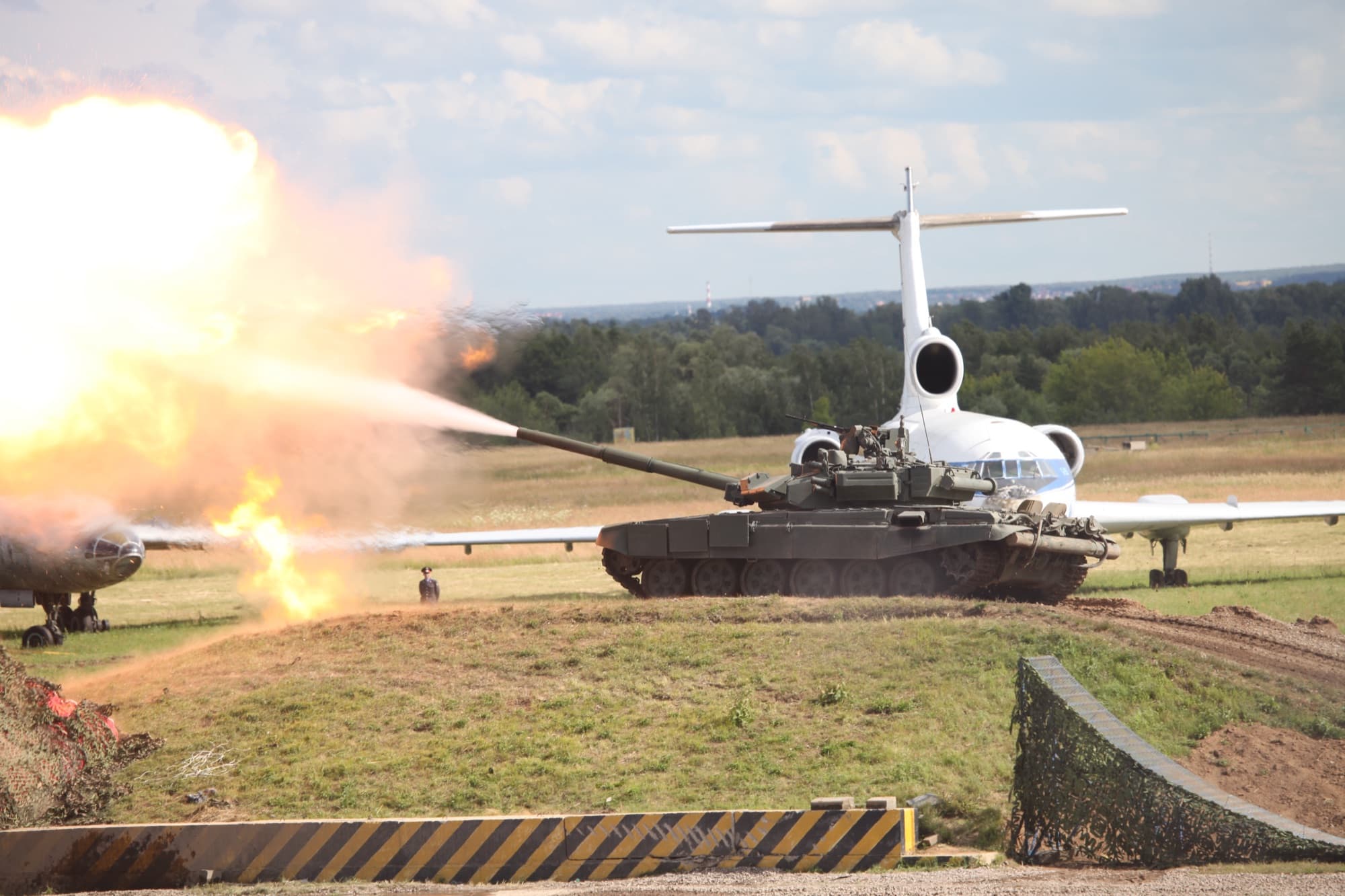
T-90M tank in field conditions showing its Relikt ERA blocks and low-profile turret design
The T-90M's welded turret and Relikt ERA represent significant upgrades over earlier T-90 variants. But the fundamental vulnerability, ammunition stored in the crew compartment, remains unchanged from the original T-72 design. (Russian Ministry of Defence)

Fire Control and Electronics

The Kalina fire control system on the T-90M is a genuine modernization. It provides multi-channel sighting, day optics, thermal imaging, and laser rangefinding, with hunter-killer capability that allows the commander to independently acquire and designate targets while the gunner engages. The system can exchange targeting data with other vehicles in real time, integrating the T-90M into a networked battlefield.

These capabilities bring the T-90M broadly into line with what Western tanks like the Abrams and Leclerc have offered for over a decade. The T-90M's thermal imaging and digital fire control are adequate for modern combat, but they are catching up to Western standards rather than exceeding them.

Ukraine: The Test

The T-90M entered the war in Ukraine as Russia's most capable operational tank. It was expected to perform significantly better than the T-72B3s and T-80s that were absorbing heavy losses in the early months of the conflict. The results have been mixed.

Open-source intelligence tracking has documented over 130 T-90M losses, destroyed, damaged, abandoned, or captured, a number that exceeds the approximately 67 T-90Ms Russia had in active service when the full-scale invasion began in February 2022. Replacement production has kept T-90Ms in the field, with output reportedly increasing from roughly 40 per year pre-war to 60-70 or more per year by 2023.

The T-90M has proven more survivable than the T-72B3, its Relikt ERA has defeated some incoming anti-tank weapons that would have penetrated older tanks, and its improved fire control has allowed crews to engage targets more effectively. But the fundamental vulnerabilities of the Russian tank design philosophy have been exposed with devastating clarity. FPV kamikaze drones, small, cheap, commercially derived quadcopters carrying shaped-charge warheads, have proven capable of destroying T-90Ms by striking the turret roof or engine deck, where neither ERA nor the Arena-M system can reliably protect. Top-attack anti-tank missiles like the Javelin and NLAW strike the thin roof armor that no main battle tank, Russian or Western, is designed to withstand.

At least five T-90Ms have been captured intact by Ukrainian forces, providing Western intelligence with direct access to examine Russia's most advanced tank technology.

Export: India's Bhishma

India is by far the largest export operator of the T-90 family. The Indian Army operates approximately 1,100 T-90S "Bhishma" tanks, 300 purchased directly from Russia and the remainder license-built at the Heavy Vehicles Factory in Avadi. The T-90S is India's primary main battle tank, complementing the indigenous Arjun and the older T-72M1. Algeria, Azerbaijan, Iraq, Vietnam, Turkmenistan, and Uganda also operate T-90 variants.

The Russian Tank Philosophy

The T-90M embodies a philosophy of armored warfare that is fundamentally different from the Western approach. Western tanks, the Abrams at 67 tons, the Leopard 2A7 at 64 tons, the Challenger 2 at 62.5 tons, prioritize crew survivability above all else. They are heavier, more expensive, and produced in smaller numbers because each individual tank and its trained crew represent an investment that Western armies cannot afford to lose.

The Russian philosophy accepts that tanks will be lost. The T-90M at 46.5 tonnes is lighter, cheaper, and faster to produce. Its three-man crew is smaller, and its autoloader allows a more compact design. The tradeoff is that when a T-90M is penetrated, the crew is less likely to survive, the carousel autoloader that enables everything else is also the system most likely to kill them. Russia builds its armored doctrine around mass and replaceability rather than individual survivability.

Ukraine has tested both philosophies under conditions neither side anticipated. The T-90M has proven that it is a capable fighting machine, better protected, better equipped, and more lethal than any previous Russian tank. It has also proven that no amount of reactive armor, active protection, or fire control technology can fully compensate for the fundamental vulnerability at the heart of its design. The carousel autoloader made the T-90M possible. It has also made the T-90M mortal.

Share this article

Share:

Recommended

Ace of The Skies: Can You Identify These Military Aircraft Throughout The Years?
Test Yourself

Ace of The Skies: Can You Identify These Military Aircraft Throughout The Years?

Can you identify these aircraft?

Take the Quiz

On This Day in Military History

March 25

Battle of Fort Stedman, The Confederacy's Last Attack (1865)

In the pre-dawn hours, Major General John B. Gordon led 11,500 Confederate troops in an assault on Fort Stedman in the Petersburg siege lines, the last offensive action of the Army of Northern Virginia. Confederate soldiers posing as deserters overwhelmed Union pickets, and infantry captured the fort and adjacent batteries. But Union counterattacks under Brigadier General Hartranft sealed the breach within four hours. Confederate casualties were devastating: approximately 4,000, including 1,000 captured. Lee wrote that the failure "removed my last hope of any other course than a retreat."

1863, First Medals of Honor Awarded, Andrews' Raiders

1941, Yugoslavia Signs the Tripartite Pact, Then Overthrows Its Government

1945, Final Japanese Attack on Iwo Jima

See all 10 events on March 25

Get Military News & History in Your Inbox

Join thousands of readers receiving our weekly digest of military technology, history, and analysis.

Test Your Knowledge