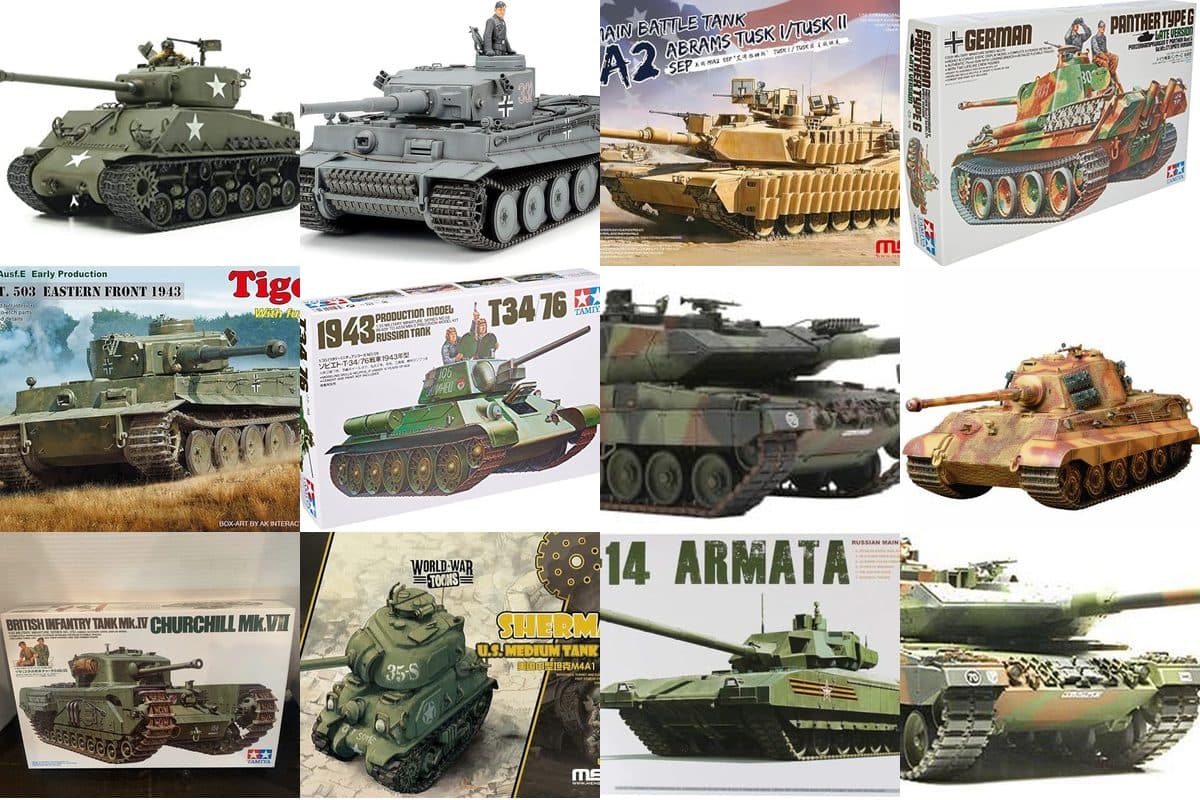

Building a tank model kit is the closest most people will ever get to understanding what goes into a 60-ton armored fighting vehicle. Every hatch, every track link, every periscope guard exists for a reason on the real machine, and assembling a 1/35 replica forces you to notice engineering details that photographs and documentaries gloss over. The hobby has exploded in quality over the past decade. Manufacturers like Tamiya, Meng, Rye Field Model, and Takom are producing kits with detail levels that competition modelers from the 1990s could only dream about.
This guide covers 30 tank model kits and essential supplies, organized by skill level and era. We tested or extensively researched every pick, cross-referencing builder reviews on Scalemates, Amazon, and armor modeling forums. Whether you are buying your first snap-fit kit or hunting for a full-interior Tiger I to enter in competition, there is something here for you. No filler picks, no padding, and honest trade-offs on every product.
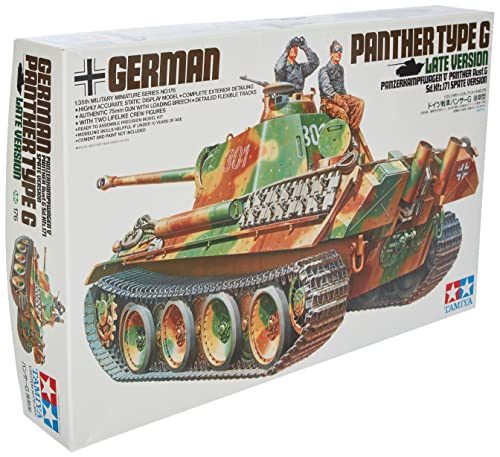
Tamiya Panther Ausf.G
~$22


Tamiya Basic Tool Set (74016)
$28 on Amazon
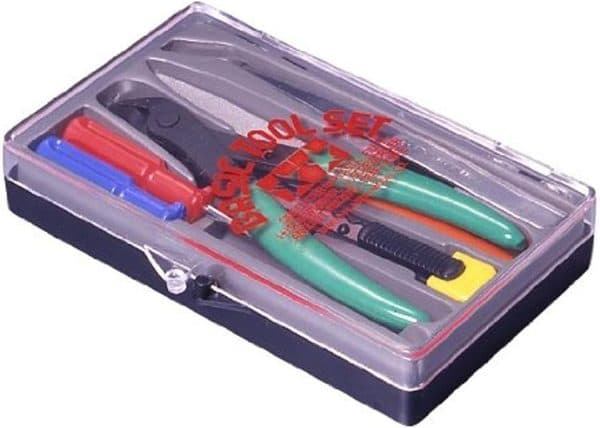
An all-in-one starter tool set from Tamiya containing sprue nippers, a hobby knife, flat and round files, tweezers, and a drill bit. Everything a beginner needs in a single purchase at a fair price.
Beginner Kits ($13 - $33)
Starting armor modeling does not require a $70 kit and a full airbrush setup. These five kits range from snap-fit builds that skip glue entirely to simple cement-assembly kits from Tamiya with low part counts and forgiving fit. If you have never built a scale model before, start here.
1. Meng WWT-002 Sherman (Snap-Fit)
~$18 on Amazon
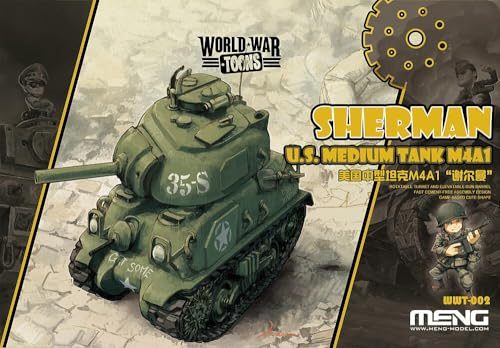
Meng's "World War Toons" line turns real WW2 tanks into charming, cartoon-proportioned snap-fit kits. No glue needed. No paint required. Around 40 parts that click together in under an hour, making this the lowest-barrier entry point into armor modeling.
Best for: Complete beginners, kids 10+, or experienced builders who want a quick palette cleanser between serious projects
Meng's World War Toons Sherman squashes the M4's proportions into something that looks like it rolled out of a Pixar movie. The charm factor is real, and so is the engineering. Parts are designed with alignment pins that lock together without cement, producing a solid little model in about 45 minutes. Pre-colored plastic means you can display it straight from the box, though it also takes paint well if you want to practice brush techniques.
The WWT line has developed a cult following among experienced builders who use them as quick stress-relief projects. They also work well as gifts for kids who want their own tank model but are not ready for hundreds of tiny parts and toxic cement. The trade-off is obvious: you are building a caricature, not a scale replica. There is no interior detail, no individual track links, and the proportions are deliberately exaggerated. But as a gateway into the hobby, nothing else matches the WWT's combination of accessibility and satisfaction.
2. Meng WWT Panzer III (Snap-Fit)
~$18 on Amazon
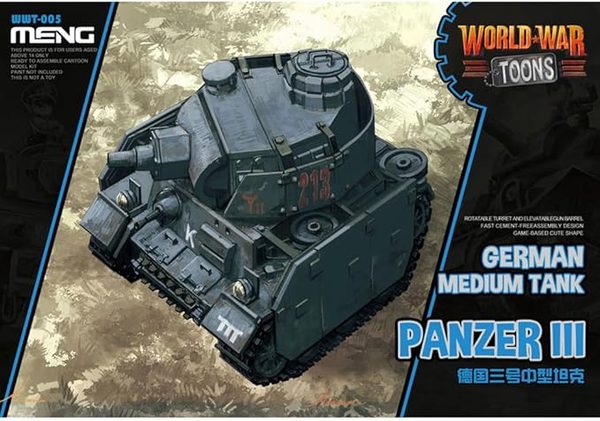
Same snap-fit engineering as the WWT Sherman, now in German gray. The Panzer III's boxy turret and squared-off hull translate well into the cartoon style, and the build is equally fast and frustration-free.
Best for: Beginners who want a German armor subject, or anyone picking up a second WWT kit to build alongside the Sherman
The Panzer III carried the early German blitzkrieg across Poland and France before heavier tanks like the Tiger took the spotlight. Meng's WWT version captures the tank's general shape in a fun, approachable format that assembles without tools or glue. Like all WWT kits, parts come pre-colored, so the finished model looks presentable even if you never pick up a paintbrush.
Pair this with the WWT Sherman above and you have Allied vs. Axis on your shelf for under $40 total. The limitation is the same as every snap-fit: no fine detail, no weathering potential without primer, and the cartoon proportions will not satisfy anyone looking for historical accuracy. Think of it as a test drive for the hobby. If you enjoy snapping this together, you are ready to step up to Tamiya's conventional kits in the next section.
3. Tamiya 1/48 M1A2 Abrams
~$33 on Amazon
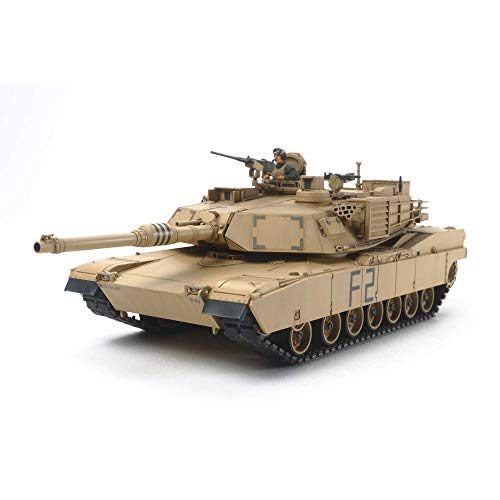
Tamiya's 1/48 Abrams packs serious detail into a smaller footprint. Around 130 parts, excellent fit, and the smaller scale means a faster build and less shelf space. A solid first "real" armor kit for someone stepping up from snap-fits.
Best for: Beginners who want a realistic modern tank without committing to 1/35 scale
The M1 Abrams has been America's main battle tank since 1980, and Tamiya's 1/48 version compresses the vehicle into a kit that is roughly 5 inches long. At this scale, you sacrifice some fine detail compared to 1/35, but you gain speed and simplicity. The turret composite armor arrays, CITV commander's sight, and TUSK-era additions are all represented, just at a scale where individual bolt heads start to disappear.
Tamiya's engineering shines here. Parts fit with almost no gap-filling, the instruction manual walks you through every step clearly, and the assembled model has good proportions from every angle. The limitation of 1/48 armor is aftermarket support. Photo-etch sets, resin upgrades, and individual track links are far less common than in 1/35. If you plan to build multiple armor kits and want the widest range of upgrade options, consider jumping straight to 1/35. But for a self-contained, satisfying build that looks great on a desk, 1/48 delivers without overwhelming a newer builder.
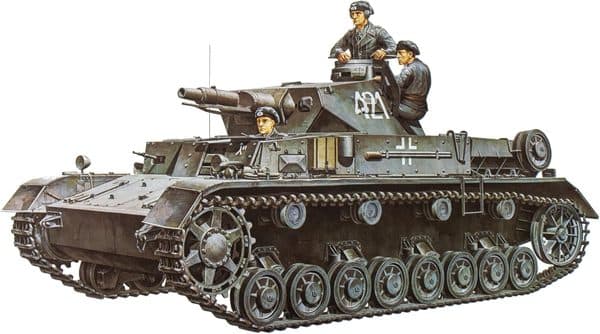
4. Tamiya 1/35 Panzer IV Ausf.D
~$23 on Amazon
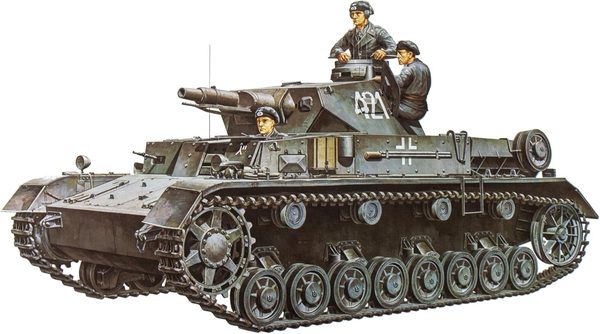
The Panzer IV was the backbone of German armor from 1939 to 1945, and Tamiya's Ausf.D variant captures the early-war configuration with the short-barreled 75mm gun. Low part count, strong fit, and a price that is hard to beat for 1/35 scale.
Best for: Budget-conscious beginners ready for their first 1/35 cement-assembly kit
The Panzer IV saw more combat than any other German tank of the war, serving on every front from the invasion of Poland through the final days in Berlin. Tamiya's Ausf.D models the early-production variant with the short 7.5cm KwK 37 gun, which was designed primarily for infantry support rather than anti-tank work. The kit's relatively low part count makes it approachable for a first-time 1/35 builder.
Assembly moves quickly. The hull goes together in a few steps, the running gear is straightforward, and Tamiya's belt tracks eliminate the tedium of individual link assembly. Turret fit is tight, and the external stowage (tools, spare track links, antenna) adds character without requiring advanced skills. The weakness is age. This is an older Tamiya tooling, so panel lines are raised rather than recessed, and surface detail does not match newer kits from Meng or RFM. For a first build where learning fundamentals matters more than competition-level detail, that trade-off is entirely acceptable.
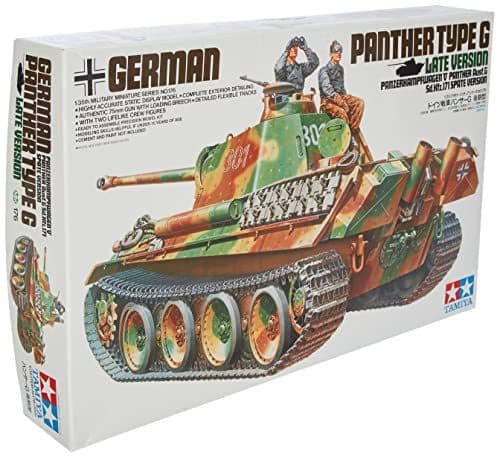
5. Tamiya 1/35 Panther Ausf.G
~$22 on Amazon
Under $25 for a 1/35 Panther is a steal. The Ausf.G was the final and most-produced Panther variant, and Tamiya's kit delivers a satisfying build with clean engineering and a manageable part count.
Best for: Beginners who want a larger, more imposing tank at a rock-bottom price
The Panther is one of the most recognized tanks in history, and at under $25, Tamiya's Ausf.G offers the best price-to-satisfaction ratio in 1/35 armor. The Ausf.G was the final production model, incorporating lessons learned from the troubled Ausf.D debut at Kursk. Tamiya captures the Panther's distinctive sloped hull, the long 75mm KwK 42 gun, and the late-war steel road wheels that replaced earlier rubber-rimmed versions.
The build is forgiving. Belt tracks keep assembly simple, the lower hull and suspension go together logically, and the turret drops into place without alignment headaches. Tamiya includes decals for multiple units, giving you some variety in markings. Where this kit shows its age is in the molding. Raised panel lines, simplified hatch detail, and the belt tracks look noticeably less refined than what you will find on a $60 Meng or RFM Panther. But for learning how to handle cement, clean sprue gates, and practice basic painting, the price makes this an easy recommendation. Upgrade to the RFM Panther with interior once your skills catch up to your ambition.
WW2 Intermediate Kits ($26 - $45)
Once you have a build or two under your belt, these kits open up the full range of WW2 armor subjects. Part counts increase, tracks get more detailed, and the finished models start looking like serious display pieces. Every kit in this section assumes you own basic tools (side cutters, hobby knife, cement) and have assembled at least one simpler model first.
6. Tamiya 1/35 T-34/76 (1943)
~$26 on Amazon
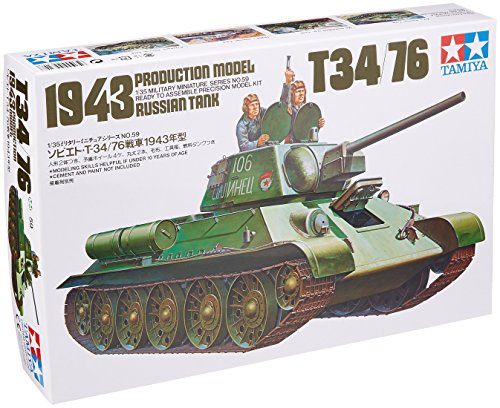
Over 84,000 T-34s were produced during WW2, more than any other tank in history. Tamiya's 1943 version models the hexagonal-turret variant from the critical Stalingrad-to-Kursk period. Fast build, forgiving fit, and a great canvas for weathering practice.
Best for: Intermediate builders who want a quick, rewarding build with plenty of weathering potential
The T-34 changed the course of armored warfare. When German forces first encountered it in 1941, its sloped armor deflected shots that would have punched through any other medium tank, and its wide tracks gave it mobility in mud and snow that left German Panzer IIIs and IVs stuck. Tamiya's 1943 production model captures the hexagonal turret variant from the period when the T-34 was fighting for survival at Stalingrad and pushing back at Kursk.
Part count stays low, which means you can go from box to painted model in a single weekend. The large, flat hull surfaces and simple green color scheme make this an excellent kit for learning weathering techniques: mud splatter on the running gear, chipped paint on the turret edges, exhaust staining around the engine deck. Soviet armor lends itself to heavy, dramatic weathering more than almost any other subject. The downside is that this is an older tooling with simplified running gear and rubber-band tracks. Builders looking for state-of-the-art T-34 detail should look at the newer Zvezda offering, but for a satisfying build at $26, Tamiya still delivers.
7. Tamiya 1/35 M4A3E8 Sherman "Easy Eight"
~$44 on Amazon
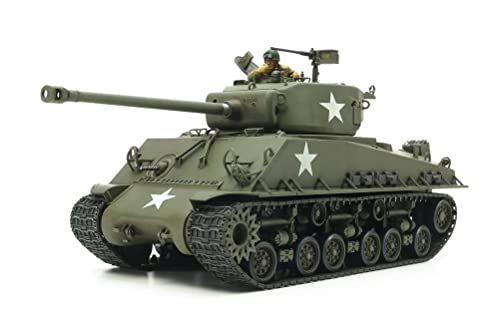
1,388 Amazon reviews and a 4.7-star rating. The Easy Eight is one of the best-selling armor kits in the world for a reason: modern Tamiya tooling, excellent fit, expressive detail, and a subject that served from WW2 through Korea.
Best for: Intermediate builders who want the single best overall tank kit experience
The M4A3E8 was the final evolution of the Sherman platform in WW2, fitted with the horizontal volute spring suspension (HVSS) that finally gave the tank a smooth ride over rough terrain and wider tracks for better ground pressure. The "Easy Eight" designation came from the E8 experimental suspension program, and the variant went on to serve in Korea where it traded shots with T-34/85s along the Pusan Perimeter.
Tamiya's kit represents their best current engineering for WW2 armor. Recessed panel lines, a well-detailed turret interior visible through an optional open hatch, and link-and-length tracks that strike the right balance between detail and build speed. The HVSS suspension assemblies are particularly well done, with each bogie unit capturing the spring arrangement clearly. Over 1,300 Amazon reviews with a 4.7-star average confirm what the modeling community already knows: this is the kit you buy when someone asks "what should I build next?" The only real weakness is that Tamiya's decal sheet is limited. For markings beyond the included options, you will need aftermarket sheets, which are widely available for the Sherman.
8. Tamiya 1/35 Tiger I Early Production
~$45 on Amazon
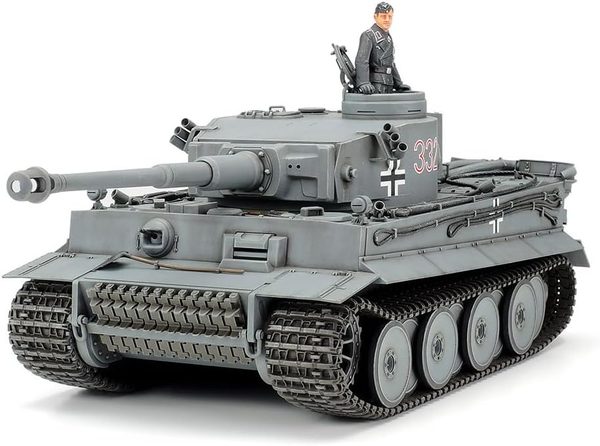
747 Amazon reviews. The Tiger I is the most modeled tank in history, and Tamiya's early-production version has been the go-to kit for over a decade. Perfect fit, clear instructions, and enormous aftermarket support.
Best for: Anyone who wants to build the most famous tank of WW2 with a frustration-free experience
When the Tiger I appeared in Tunisia in late 1942, its 88mm gun and thick armor outclassed everything the Allies had. The early-production variant modeled here features the distinctive drum-shaped commander's cupola, wide rubber-rimmed road wheels in the overlapping arrangement that was a maintenance headache for German crews, and the Feifel air filtration system on the rear hull.
Tamiya's engineering has been refined across multiple production runs, and the result is a kit where parts fit together with almost zero fuss. Instructions are clear, the build sequence makes logical sense, and the level of detail strikes a good balance between box-stock builders and modelers who plan to add aftermarket upgrades. The Tiger I also has the deepest aftermarket ecosystem of any tank subject: metal barrels, photo-etch sets, individual track links, zimmerit decals, and full interior kits are all available from multiple manufacturers. Where Tamiya's Tiger falls short is in out-of-box detail compared to the RFM Tiger I below. Surface texture is simpler, and the kit lacks the turret and hull interior that RFM includes. For a clean, reliable build at $45, Tamiya wins. For competition-level detail, look at RFM.
9. Tamiya 1/35 King Tiger (Production Turret)
~$43 on Amazon
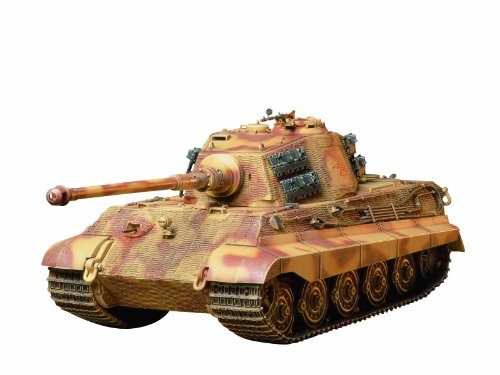
The heaviest tank to see significant WW2 service, the Tiger II "King Tiger" weighed over 68 tons and mounted the devastating 88mm KwK 43. Tamiya's kit captures the massive proportions with the Henschel production turret.
Best for: Intermediate builders who want the biggest, most imposing WW2 tank on their shelf
The Tiger II combined the sloped armor concept of the Panther with firepower that could defeat any Allied tank at ranges exceeding 2,000 meters. Only 489 were built, but the King Tiger's reputation as the most powerful tank of the war is well earned. At 1/35, the finished model stretches nearly 9 inches long and has real presence on a display shelf.
Tamiya keeps the build manageable despite the large size. Link-and-length tracks, a well-engineered turret assembly, and logical hull construction mean this is not significantly harder than the Tiger I above, just bigger. The external detail captures the zimmerit-free late production hull, turret stowage bin, and the massive 88mm barrel with muzzle brake. The weakness is the same as most older Tamiya heavy armor: surface detail is clean but not as crisp as what Takom or RFM put in the box. The tracks, while functional, lack the individual-link precision that competition builders prefer. For a display-quality King Tiger at a reasonable price, Tamiya delivers. For a competition piece, consider supplementing with aftermarket tracks and a metal barrel.
10. Tamiya 1/35 Churchill Mk.VII
~$43 on Amazon
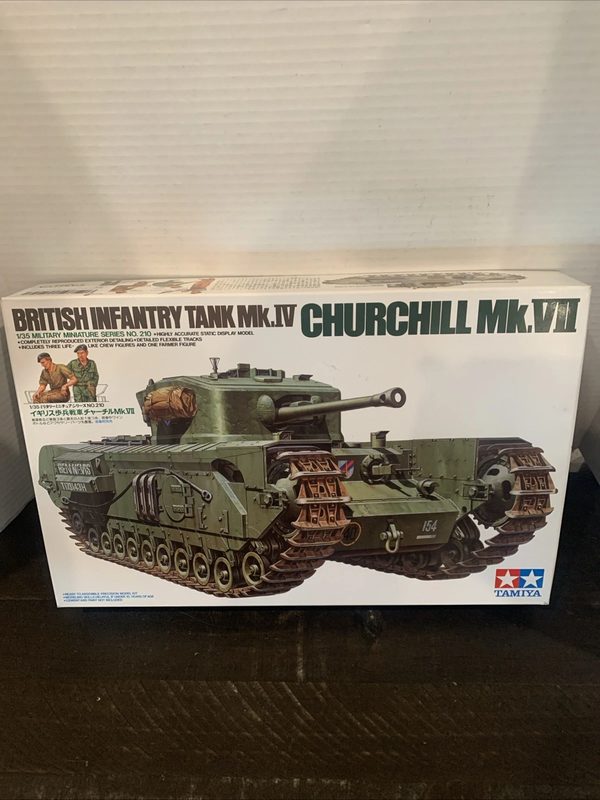
Britain's heavy infantry tank, the Churchill was designed to absorb punishment while supporting advancing troops. The Mk.VII variant carried 152mm of frontal armor, thicker than a Tiger I, making it one of the most heavily protected tanks in the European theater.
Best for: British armor enthusiasts and builders who want something other than the usual Sherman/Tiger picks
The Churchill is one of the most distinctive tanks of WW2. Its long, slab-sided hull and wrap-around tracks give it a silhouette unlike any other tank in the war, more closely resembling a WW1 design philosophy than anything from the 1940s. That shape was deliberate: the Churchill was designed to cross trenches, climb obstacles, and absorb hits while infantry advanced behind it. The Mk.VII upgraded the armor to 152mm on the front, thicker than any other Allied or German tank of comparable weight.
Tamiya captures the Churchill's unique proportions well. The long track run, distinctive exhaust system, and the small turret mounting the 75mm gun are all accurately reproduced. The wrap-around tracks are molded as flexible rubber bands, which is actually a good fit for the Churchill since its tracks are relatively smooth compared to German or American designs. The kit builds cleanly with typical Tamiya precision. Where it falls short is in track and hull detail. The rubber-band tracks lack the link-by-link definition that aftermarket sets provide, and the cast hull texture is somewhat simplified. For builders interested in British armor, this is the best Churchill kit currently available, though it rewards a coat of Tamiya putty along the hull to add casting texture.
Cold War & Modern Kits ($48 - $76)
Modern main battle tanks bristle with composite armor, explosive reactive armor blocks, thermal sights, and active protection systems. These kits have higher part counts and more complex assemblies than WW2 subjects, but the payoff is a finished model that captures the angular, aggressive profiles of today's frontline armor. All kits in this section are 1/35 scale.
11. Tamiya 1/35 T-55A
~$55 on Amazon
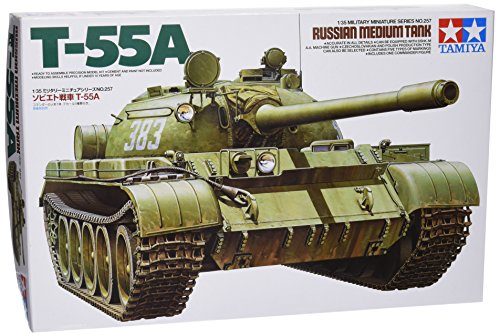
The most widely produced tank of the Cold War era. Over 100,000 T-54/55 variants were built, and they served in conflicts on every continent. Tamiya's T-55A is a clean, straightforward build with accurate proportions and a mushroom-dome turret that is instantly recognizable.
Best for: Cold War enthusiasts and modelers building a Soviet armor collection
No tank has seen more combat in more countries than the T-55. From Vietnam and the Arab-Israeli Wars to Afghanistan and Iraq, the T-55 has been the default armored vehicle for armies that could not afford Western hardware. Its simplicity was both a strength and a limitation: easy to maintain in austere conditions, but outclassed by every NATO tank it faced from the 1970s onward.
Tamiya's kit captures the T-55A, the improved version with NBC protection and updated fire control. The signature hemispherical turret, the long 100mm D-10T gun, and the external fuel drums on the rear hull are all well represented. The build is middle-of-the-road in complexity, with Tamiya's usual excellent fit keeping frustration low. Individual link tracks are included, adding realism but requiring patience during assembly. The kit's main shortcoming is the lack of optional configurations. You get one version of the T-55A with no choice of ERA, dozer blades, or regional modifications. For the many operator-specific variants that make the T-55 such a versatile modeling subject, you will need aftermarket conversion sets.
12. Tamiya 1/35 M1A2 Abrams
~$48 on Amazon
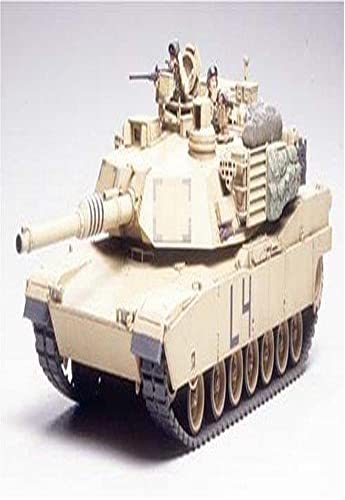
Tamiya's baseline M1A2 models the standard configuration before the TUSK urban warfare package. Clean lines, the distinctive wedge-shaped turret, and Tamiya's signature build quality. A strong pick for anyone who wants a "clean" Abrams without the bolt-on ERA and cage armor.
Best for: Modelers who want a clean, non-TUSK Abrams or a foundation for a custom configuration
The M1A2 Abrams has been the backbone of American armored forces since the early 1990s. Its Chobham composite armor, 120mm smoothbore gun, and gas turbine engine make it one of the most capable tanks ever fielded. Tamiya's 1/35 version captures the baseline M1A2 configuration, which means the clean, angular profile without the bolt-on TUSK urban warfare package that clutters later variants.
Build quality is what you expect from Tamiya: tight fit, logical construction, and instructions that do not leave you guessing. The turret composite armor arrays, commander's independent thermal viewer (CITV), and turret bustle rack are all well represented. The hull underside even captures the belly armor profile. The limitation compared to the Meng M1A2 TUSK below is the detail level. Tamiya's molding is clean but relatively conservative, with smoother surfaces and less fine texture than what Meng or RFM deliver. For a straightforward Abrams build at a moderate price, this is the safe choice. For maximum detail and the TUSK configuration, spend the extra $24 on the Meng.
13. Tamiya 1/35 Leopard 2 A6
~$52 on Amazon
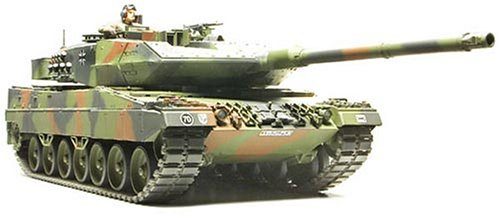
Germany's Leopard 2 has been the benchmark for Western tank design since the 1980s. Tamiya's A6 variant features the distinctive longer L/55 gun barrel that distinguishes it from earlier models. Solid build, accurate proportions, and a distinctive angular turret.
Best for: NATO armor enthusiasts who want something other than an Abrams
The Leopard 2 series equips the armies of over a dozen NATO nations, from Germany and the Netherlands to Greece and Turkey. The A6 variant introduced the longer L/55 gun barrel, which gives the 120mm smoothbore higher muzzle velocity and greater armor penetration at range. The visual difference is easy to spot: the A6's barrel extends noticeably further beyond the turret than on A4 or A5 models.
Tamiya's kit builds predictably well. The flat-panel turret faces go together cleanly, the distinctive wedge-shaped composite armor is accurately shaped, and the running gear captures the torsion-bar suspension with good detail. Rubber-padded tracks come as flexible bands, which keeps build time reasonable. The weak point is the same as the Tamiya Abrams above: surface detail is competent but conservative. If you want the latest Leopard 2 variant with sharper detail, the Meng A7 below costs more but delivers visibly finer molding. For a reliable build of NATO's most widely exported tank, Tamiya remains a solid middle ground.
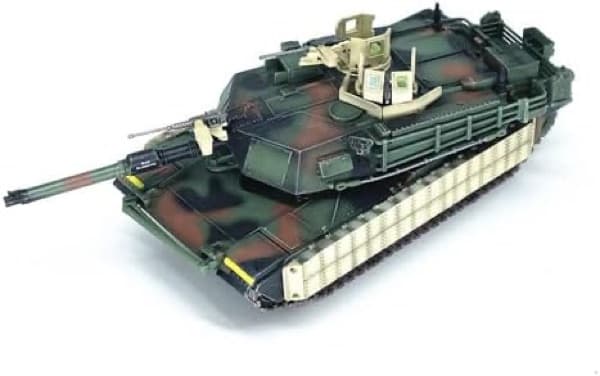
14. Meng 1/35 M1A2 SEP Abrams TUSK I/TUSK II
~$72 on Amazon
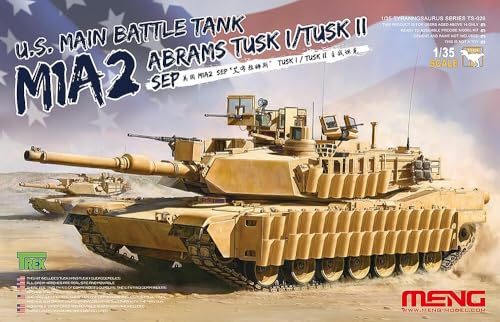
Meng's Abrams includes parts for both TUSK I and TUSK II configurations, which adds explosive reactive armor, a CROWS remote weapon station, and loader's armored gun shield. Sharper detail than Tamiya's version, with workable individual track links.
Best for: Experienced builders who want the most detailed and fully equipped Abrams available
TUSK stands for Tank Urban Survival Kit, and it transforms the already formidable Abrams into a vehicle bristling with add-on armor, a remote weapons station, and additional protection systems designed for close-quarters urban combat. Meng's kit gives you parts for both TUSK I and TUSK II configurations, so you can choose which level of urban protection to depict. The ERA blocks, CROWS station, loader's gun shield, and belly armor are all included.
Meng's molding quality is a noticeable step up from Tamiya's Abrams. Surface texture is crisper, bolt heads are more defined, and the workable individual track links produce a far more realistic track run than Tamiya's rubber bands. The trade-off is complexity. With over 600 parts and dense instruction sheets, this is not a weekend build. Meng's instructions, while improved in recent years, still require more careful study than Tamiya's famously clear diagrams. Expect to spend 30-50 hours from box to display shelf. The other consideration is that the TUSK components, while detailed, create a busy-looking model that can overwhelm painters who are not comfortable with complex multi-material finishes. For maximum visual impact, apply the TUSK and embrace the cluttered, combat-ready look.
15. Meng 1/35 Leopard 2 A7
~$76 on Amazon
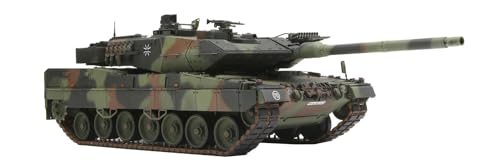
The latest Leopard 2 variant with improved armor, enhanced mine protection, and an air conditioning system for deployment in hot climates. Meng delivers sharper detail and more accurate proportions than Tamiya's A6, with workable tracks and optional configurations.
Best for: Modern armor enthusiasts who want the latest NATO tank with top-tier detail
The Leopard 2 A7 represents the most recent production standard of what many consider the best conventional tank in the world. Compared to earlier variants, the A7 adds improved composite armor wedges on the turret, a mine protection kit for the hull floor, and provisions for operation in extreme heat. Several nations have ordered or expressed interest in the A7, including Germany, Denmark, and Hungary.
Meng captures the A7's distinctive profile with sharp molding throughout. The composite armor wedges on the turret front are accurately shaped with proper edge definition, the independent commander's thermal viewer sits correctly on the turret roof, and the hull side skirts feature the correct armor insert pattern. Individual workable tracks produce realistic sag over the return rollers. Where Meng's kit demands more patience is in the instructions. Diagram clarity has improved over their older releases, but some assembly steps still benefit from studying reference photos before committing cement. The other trade-off compared to Tamiya is price: at $76, this costs roughly $24 more than Tamiya's A6. That premium buys you sharper detail, an updated variant, and better tracks, which is a fair exchange for builders who want the best Leopard 2 on the market.
16. Meng 1/35 T-72B1
~$72 on Amazon
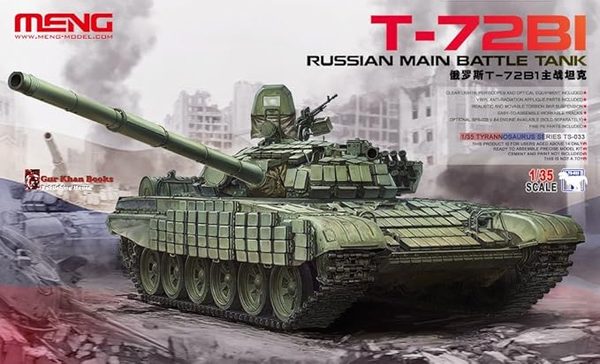
The T-72 is the most widely exported tank of the Cold War era, serving in dozens of armies worldwide. Meng's T-72B1 models the version with Kontakt-1 ERA blocks, giving the tank a dramatically different appearance from the smooth-hulled baseline T-72.
Best for: Soviet/Russian armor fans and builders who want a distinctive ERA-covered subject
The T-72 has fought in more conflicts than any post-WW2 tank: the Iran-Iraq War, both Gulf Wars, Syria, Chechnya, and the ongoing conflict in Ukraine. The B1 variant added Kontakt-1 explosive reactive armor, which transforms the T-72's smooth turret and glacis into a surface covered in small rectangular boxes, each containing a shaped charge designed to disrupt incoming HEAT rounds.
Meng's kit makes the ERA blocks individual parts, which is historically accurate but means assembling and placing dozens of small rectangles across the hull and turret. The process is repetitive but not difficult, and the result is a model with dramatically more visual texture than a clean-hulled tank. Underneath the ERA, the base T-72 is well detailed with accurate turret shape, the distinctive V-shaped splash board on the glacis, and the log beam that Soviet tankers carried for self-recovery from mud. The trade-off is build time. Those ERA blocks add hours to what would otherwise be a straightforward build. Meng's instructions handle the placement reasonably well, but expect to cross-reference photos to get the spacing right. Builders who skip the ERA will have a perfectly good T-72A underneath.
17. Takom 1/35 T-14 Armata
~$60 on Amazon
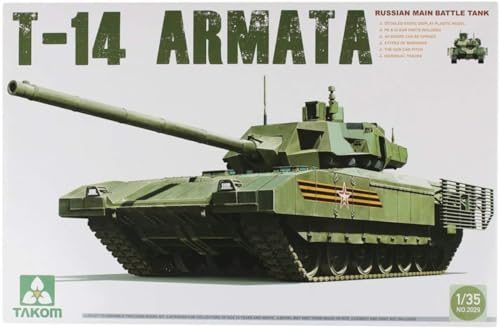
Russia's next-generation tank features an unmanned turret, an armored capsule crew compartment, and the Afghanit active protection system. Takom's kit is currently the best available representation of this unconventional design.
Best for: Builders who want a conversation-starting subject that looks like nothing else in their collection
The T-14 Armata represents a radical departure from conventional tank design. Its unmanned turret houses the 125mm 2A82 gun and autoloader, while the three-man crew sits in an armored capsule in the hull front, completely separated from the ammunition and turret systems. The Afghanit active protection system uses radar to detect and intercept incoming projectiles before they reach the hull.
Takom's kit captures the Armata's angular, futuristic profile. The flat-paneled turret with its prominent sensor arrays, the low-profile hull, and the distinctive seven-wheel running gear are all well represented. Surface detail is sharp, with accurate panel lines and bolt patterns across the hull. The kit includes optional parts for the parade configuration (with anti-debris screens) and combat configuration. Where Takom's Armata struggles is in reference accuracy. The real T-14 has only been shown publicly in limited configurations, and some details remain classified or simply unknown. Modelers working from parade footage may find minor discrepancies with operational photos. Fit also requires more patience than a Tamiya kit, with some parts needing light sanding or filing. But for a subject that generates more shelf-side conversation than almost any other modern tank, the T-14 delivers.
Advanced / Full Interior Kits ($48 - $85)
Full-interior kits include a complete representation of the crew compartment, fighting compartment, engine bay, or all three. These are the most complex armor kits available, with part counts that can exceed 1,000 pieces and build times measured in months rather than weekends. The payoff is a model you can display with hatches open, revealing a fully detailed interior that shows exactly how the crew lived and fought inside these machines.
18. Rye Field Model 1/35 Tiger I w/ Full Interior
~$85 on Amazon
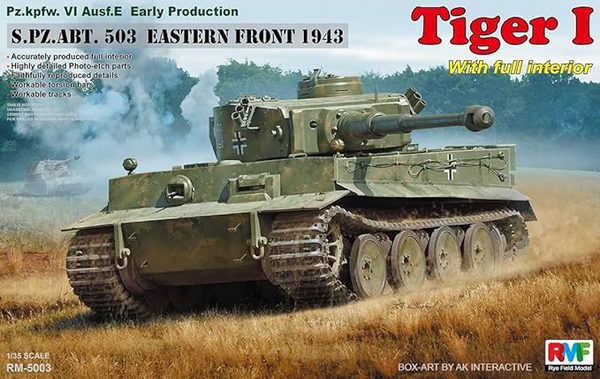
RFM's Tiger I includes a complete interior: driver's position, radio operator's station, turret basket with 88mm breech, ammunition stowage, and engine compartment. Over 1,000 parts produce what many consider the finest Tiger I kit ever manufactured.
Best for: Advanced builders who want a museum-quality Tiger I with every hatch open to reveal internal systems
Rye Field Model (RFM) has become one of the most respected names in armor modeling, and their full-interior Tiger I is the kit that earned that reputation. Every major system inside the Tiger is represented: the Maybach HL230 engine, the transmission, the turret basket with the 88mm KwK 36 breech mechanism, the ammunition racks, the radio equipment, and the individual crew stations for all five crew members. Building this kit is essentially building two models in one, as the interior needs to be assembled, painted, and detailed before the outer hull closes around it.
The exterior matches the interior's quality. Individually molded workable track links, crisp surface detail, and accurate zimmerit texture on the hull and turret. RFM includes photo-etch parts for grilles, fenders, and other thin components that benefit from the added refinement. This is not a kit for beginners. The part count exceeds 1,000, the build sequence requires careful planning (painting the interior before sealing the hull is critical), and some photoetch work is required. Expect 80-120 hours from start to finish. For experienced builders, this is one of the most rewarding projects in the hobby. For everyone else, build the Tamiya Tiger I first and work your way up.
19. Rye Field Model 1/35 Panther Ausf.G w/ Full Interior
~$60 on Amazon
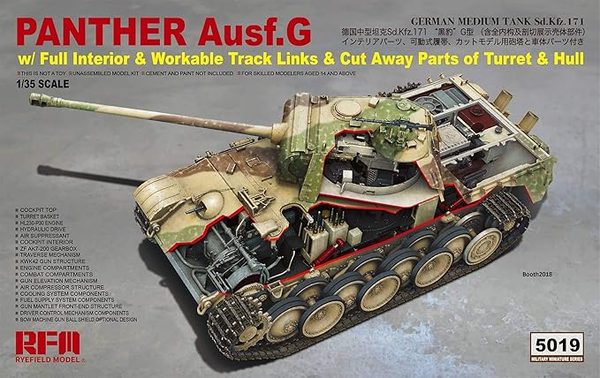
RFM's Panther G includes a fully detailed interior with turret basket, ammunition stowage, driver/radio operator positions, and engine compartment. At $60, it offers full-interior complexity for significantly less than the Tiger I kit.
Best for: Advanced builders who want a full-interior project at a more accessible price point
The Panther Ausf.G was the final production variant of Germany's best all-around tank of the war. Its combination of the high-velocity 75mm KwK 42 gun, well-sloped armor, and reliable (by late-war German standards) drivetrain made it a formidable opponent for any Allied tank it faced. RFM's full-interior version lets you see exactly how the five-man crew operated inside this machine.
The interior detail follows the same philosophy as RFM's Tiger I: turret basket with gun breech, ammunition racks along the hull walls, radio equipment, driver's instruments, and the Maybach HL230 engine in the rear compartment. At roughly 800 parts, it is slightly less complex than the Tiger I, making it a reasonable first full-interior project for builders who have completed several standard kits. The exterior is equally strong, with workable individual tracks, sharp panel lines, and the late-production features specific to the Ausf.G, including the chin-mounted hull machine gun. The primary drawback is planning. You absolutely must paint the interior before closing the hull, which means mapping out your color scheme and masking strategy before a single part goes together. Rushed builders who try to paint through hatches after assembly will regret it.
20. Rye Field Model 1/35 M4A3 Sherman 76(W) w/ Full Interior
~$80 on Amazon
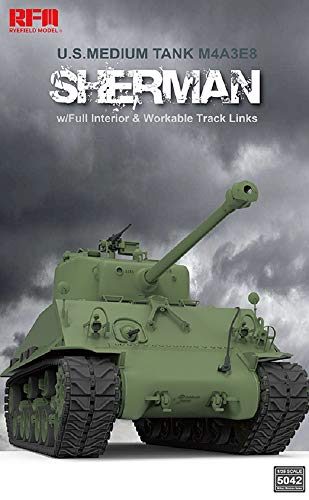
RFM's Sherman includes a complete interior with turret basket, 76mm gun breech, ammunition stowage, and driver/co-driver positions. The only full-interior Sherman in 1/35 that captures the "wet" ammunition stowage system that reduced the Sherman's notorious fire risk.
Best for: Sherman enthusiasts who want to see exactly what the crew dealt with inside America's most important tank
The Sherman is the most important American tank of the war, and RFM's full-interior version lets you understand why the crew experience inside was both cramped and, by WW2 standards, relatively livable compared to many contemporaries. The "wet" stowage designation (the "W" in 76W) refers to the water-jacketed ammunition bins that surrounded the rounds with glycerin solution, dramatically reducing the chance of catastrophic fires that plagued earlier dry-stowage Shermans.
RFM captures that wet stowage system in detail, along with the turret basket, the 76mm gun breech, the driver's station with periscopes and instrument panel, the co-driver's position with hull machine gun, and the Ford GAA V-8 engine. The exterior features individual workable tracks (T66 type), the HVSS suspension for the M4A3E8 variant, and clean surface detail throughout. The limitation compared to RFM's German tank interiors is reference material. The Tiger I and Panther interiors have been exhaustively documented by museums and historians, while Sherman interior details are less comprehensively photographed. Some interior components are based on engineering drawings rather than photographic reference, which purists may notice. For the vast majority of builders, the level of accuracy is more than sufficient to create a museum-quality display piece.
21. Academy 1/35 Merkava Mk.IV LIC
~$48 on Amazon
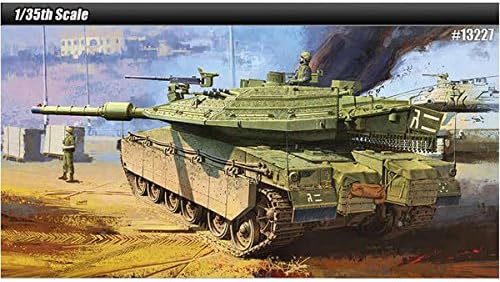
Israel's Merkava is unlike any other tank: engine in the front for crew protection, a rear door for infantry or ammunition resupply, and the Trophy active protection system. Academy's LIC (Low Intensity Conflict) version adds urban warfare modifications including a remote weapon station and additional vision devices.
Best for: Builders who want a unique, unconventional tank that stands out from the NATO/Soviet standard designs
The Merkava's design philosophy is unique in the world of tank engineering. By placing the engine at the front of the hull, Israeli designers created an additional layer of protection between incoming fire and the crew, accepting a trade-off in power-to-weight ratio for survivability. The rear door, originally designed for crew evacuation, also allows the Merkava to carry infantry or receive ammunition resupply under armor. No other main battle tank in service offers this capability.
Academy's Mk.IV LIC adds the modifications Israel developed for urban operations in Lebanon and Gaza: a remote-controlled weapon station for the commander, additional camera and sensor mounts, and the Trophy hard-kill active protection system launchers on the turret flanks. The chain curtains hanging from the turret rear, designed to prematurely detonate RPG warheads, are also included. Build complexity falls between Tamiya and Meng. Fit is generally good, though some parts require light cleanup. The main shortcoming is the instruction manual, which can be ambiguous in places and benefits from studying reference photos of the real vehicle. For a subject that generates real interest from non-modelers ("what is that tank with the engine in front?"), the Merkava is hard to beat.
Essential Tools & Supplies
A great kit deserves the right tools. You do not need to spend hundreds of dollars on equipment before your first build, but having the basics ready prevents frustration and produces noticeably better results. These six items cover everything a new armor modeler needs, from cutting parts off the sprue to applying your first weathering effects.
22. Tamiya Basic Tool Set (74016)
~$27 on Amazon
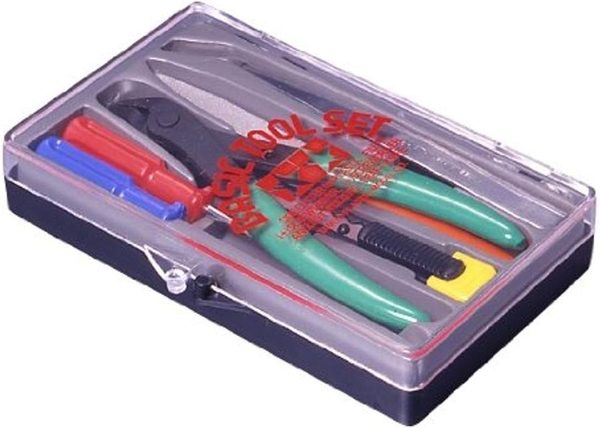
Side cutters, hobby knife with #11 blade, tweezers, file, and screwdriver. These five tools cover 90% of what any armor build requires. Tamiya's quality means the cutters stay sharp and the knife handle does not wobble.
Best for: First-time builders who need everything in one box
Tamiya's Basic Tool Set has been the default recommendation for new modelers for years, and the reason is simple: it works. The side cutters make clean cuts close to the part without crushing the plastic. The hobby knife accepts standard #11 blades available everywhere. The tweezers handle small parts like periscope covers and tool clamps without slipping. Experienced modelers eventually upgrade to specialized nippers, sanding sticks, and pin vises, but this set gets you through your first several builds without any gaps.
The limitation is that Tamiya charges a premium for the brand name. The individual tools are not dramatically better than cheaper alternatives, and the screwdriver included in the set sees almost no use in modern model building. If budget is tight, the BXQINLENX set below offers similar functionality for half the price. But if you want proven quality and the satisfaction of Tamiya-branded tools at your workbench, this is the set to buy.
23. BXQINLENX 8-Piece Model Building Tool Set
~$14 on Amazon
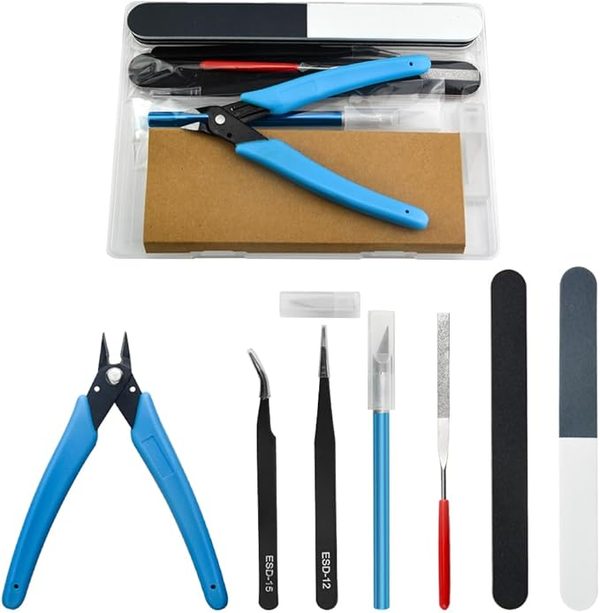
Eight tools for $14: side cutters, hobby knife, tweezers, files, and a ruler. Not Tamiya quality, but perfectly functional for getting started. Thousands of positive reviews confirm these tools handle beginner and intermediate builds without issue.
Best for: Budget-conscious beginners or anyone who wants tools now and will upgrade later
At $14 for eight tools, this set costs less than a single pair of Tamiya nippers. You get side cutters, a hobby knife, curved and straight tweezers, needle files, and a ruler. The quality is a step below Tamiya's branded tools, with the cutters being the most noticeable gap. They leave slightly more plastic nub on the part, requiring a few extra seconds of cleanup with a knife or file. The tweezers are functional, the files do their job, and the knife handle accepts standard blades.
The smart play is to start with this set and upgrade individual tools as you discover which ones matter most to your workflow. Most builders find that a quality pair of side cutters is the first upgrade worth making, followed by a set of fine sanding sticks. Everything else in this set will carry you through multiple builds before needing replacement. The weakness is durability: the cutter blades will dull faster than Tamiya's, and the file surfaces wear down with extended use. For the price of two large coffees, that is a completely fair trade.
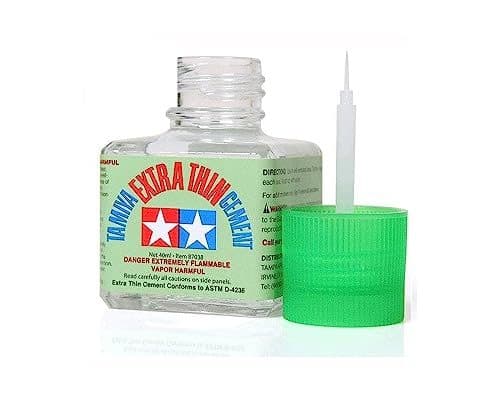
24. Tamiya Extra Thin Cement (87038)
~$7 on Amazon
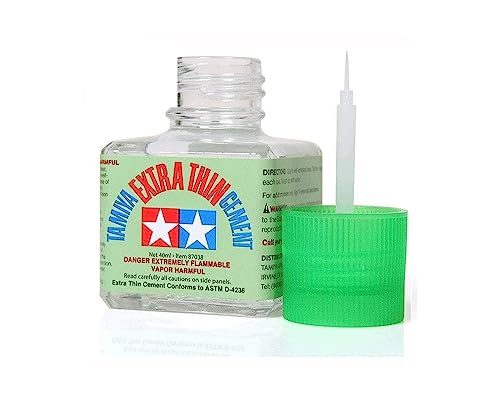
The gold standard for plastic model cement. The thin brush applicator draws cement along joints through capillary action, creating clean, strong bonds without the mess of thicker cements. Every armor modeler has a bottle of this on their workbench.
Best for: Every builder. This is non-negotiable for cement-assembly plastic kits.
Tamiya Extra Thin Cement works differently from the thick white glue many people associate with model building. Instead of applying glue to a part and pressing it together, you hold the parts in position and touch the brush to the seam. Capillary action draws the ultra-thin solvent into the joint, welding the styrene plastic together at a molecular level. The result is a bond stronger than the surrounding plastic, with no visible residue when applied correctly.
The technique takes one or two attempts to learn: hold parts together, touch brush to seam, let physics do the work. Once you get it, you will never go back to thick cement. The only real downside is the solvent evaporates quickly, so you need to work with reasonable speed once the bottle is open. Keep the green cap on between joins, and a single bottle will last through multiple builds. At $7, this is the single most cost-effective upgrade to your modeling workflow.
25. Tamiya Panel Line Accent Color - Brown (87132)
~$7 on Amazon
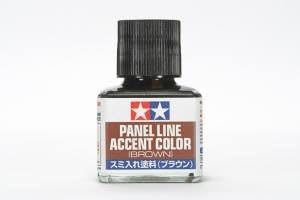
Panel line washing is the single highest-impact finishing technique in armor modeling. Touch the brush to a recessed line, and capillary action draws the dark wash along the detail, creating shadow and depth instantly. Brown is the most versatile color for olive drab, sand, and dunkelgelb schemes.
Best for: Any builder who wants their model to look dramatically better in 30 minutes of work
Panel line accent works on the same capillary principle as Tamiya's cement. Touch the fine brush tip to a recessed panel line, hinge line, or bolt head, and the enamel-based wash flows along the detail automatically. After a few minutes of drying time, wipe the excess away with a cotton swab dampened with enamel thinner (or lighter fluid in a pinch). What remains is dark pigment sitting in the recessed details, creating shadow and depth that makes the model look like a completely different build.
Brown is the most versatile shade for armor models. It works well on olive drab, dunkelgelb (German dark yellow), sand, and most green camouflage schemes. For very dark vehicles (black or dark gray), the black variant is a better choice. The trade-off is that this is an enamel product, so you need enamel thinner for cleanup and it will damage bare plastic if left to pool. Always apply over a sealed surface, either a clear coat or your base paint layer. One bottle lasts through a dozen builds easily.
26. Tamiya Weathering Master Set A (Sand, Light Sand, Mud)
~$10 on Amazon
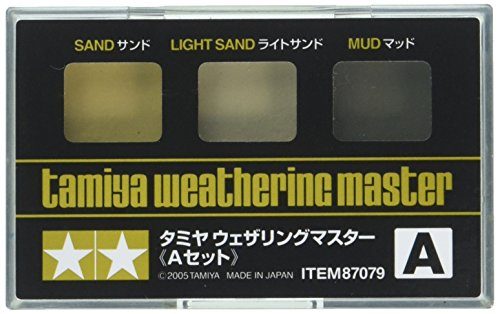
Dry pigment palettes applied with the included sponge applicator. No thinners, no mixing, almost impossible to overdo. Set A covers sand and mud effects, which are the most commonly needed weathering effects for armor models.
Best for: Beginners learning weathering or experienced builders who want quick, controlled dust and dirt effects
Weathering Master palettes look like makeup compacts, and they work on a similar principle. Rub the sponge applicator across the dry pigment and dab it onto your model's surface. The pigment adheres to the clear coat or matte paint underneath, building up gradually. If you add too much, wipe it off and start over. This forgiving, no-commitment approach makes Weathering Masters the safest way to learn weathering.
Set A includes sand, light sand, and mud, which are the three most useful colors for armor. Dust the lower hull and running gear with mud, blend sand across the fenders and hull sides for a field-deployed look, and use light sand on upper surfaces to simulate sun-bleached paint. The results are subtle and realistic, which is exactly what you want. The trade-off is durability: without a sealing coat, the pigments can rub off with handling. A light spray of matte clear coat locks everything in place. At $10 for three colors and an applicator, this is the most cost-effective weathering tool available.
27. Tamiya Surface Primer Gray (87042)
~$12 on Amazon
Primer is the invisible foundation of every good paint job. Tamiya's gray spray primer goes on thin and even, provides a uniform surface for paint to grip, and reveals any seam lines or imperfections you missed during assembly. One can covers 8-10 armor models.
Best for: Every builder who plans to paint their model (which should be everyone)
Skipping primer is the most common beginner mistake in model painting. Without primer, paint does not adhere evenly, colors appear different on different plastic colors (gray vs. dark green sprues), and the finish chips easily with handling. Tamiya's gray primer solves all three problems in a single light coat. Gray is the most versatile primer color because it works under both light and dark finishes without shifting the topcoat's appearance.
Application is straightforward: hold the can 8-10 inches from the model, spray in short passes, and let it dry for 30 minutes. One can lasts through 8-10 armor models with typical coverage. The primer also serves as a quality-control step. Under the uniform gray surface, any gaps, seam lines, or sanding marks you missed become immediately visible, giving you one last chance to fix them before committing paint. The downside is that spray cans produce more overspray than an airbrush and should only be used in a well-ventilated area or outdoors. For indoor spraying, a simple spray booth with a vent fan eliminates the issue.
How to Choose Your First Tank Kit
Scale: 1/35 vs. 1/48 vs. 1/72
1/35 is the dominant armor modeling scale worldwide. At this size, a Sherman measures roughly 7 inches long and an Abrams stretches to about 11 inches. The vast majority of aftermarket upgrades (photo-etch, resin, metal barrels, individual tracks) are manufactured in 1/35, and nearly every major manufacturer produces their premium armor kits in this scale. If you only build in one scale, make it 1/35.
1/48 sits in between and is growing in popularity. Tamiya has released several modern armor kits in this scale, and the smaller size means faster builds and less shelf space. Aftermarket support is limited compared to 1/35, but the kits are self-contained and produce satisfying results.
1/72 is the smallest common armor scale. Kits are quick, cheap, and take up minimal space. Detail is reduced, but modern 1/72 kits from companies like Revell and Dragon have improved dramatically. This scale appeals to wargamers and collectors who want to build entire formations.
Skill Level: What to Expect
Beginner kits (40-170 parts): Snap-fit or simple cement assembly. Belt or rubber-band tracks. Can be completed in 4-8 hours. No special tools beyond basic cutters and a knife.
Intermediate kits (200-400 parts): Link-and-length or individual tracks. More detailed exteriors, optional parts, and multiple marking options. Expect 12-25 hours of build time. Basic tools plus cement, primer, and paint are needed.
Advanced kits (500-1,000+ parts): Full interior kits, photoetch, workable tracks, and complex sub-assemblies. Build times range from 40 to 120+ hours. Requires a full tool set, airbrush (recommended), and experience with multiple painting and weathering techniques.
Tamiya vs. Meng vs. Rye Field Model
Tamiya prioritizes build experience. Their kits go together with minimal fuss, instructions are the clearest in the industry, and the engineering eliminates most fit issues before they start. Trade-off: surface detail can be less refined than newer competitors, and some toolings are decades old.
Meng balances detail with usability. Their modern armor kits (Abrams, Leopard 2, T-72) offer sharper molding than Tamiya and include workable individual tracks. Instructions have improved but still lag behind Tamiya's clarity. Best for intermediate builders stepping up.
Rye Field Model (RFM) targets the advanced builder. Their full-interior kits are the most detailed armor kits on the market, with part counts that can exceed 1,000. Fit is good but assumes modeling experience. Best for builders who want competition-level results and are willing to invest the time.
Essential Tools for Armor Modeling
Before you open your first kit, make sure you have these basics on hand. Nothing kills the enjoyment of a new hobby faster than stopping mid-build because you are missing a critical tool.
Minimum starter kit ($20-$30): Side cutters, hobby knife with #11 blades, tweezers. The Tamiya Basic Set or BXQINLENX set covers this.
For painting ($20-$40 additional): Tamiya spray primer, 2-3 colors of spray paint or bottled acrylics, and a few cheap brushes for detail work.
For finishing ($15-$25 additional): Tamiya Panel Line Accent (brown), Weathering Master Set A, and a can of matte clear coat to seal everything.
Nice to have eventually: Pin vise with drill bits, sanding sticks in multiple grits, putty for gap-filling, and (when you are ready) an airbrush setup.
Comparison Table: All 21 Kits
| Kit | Price | Scale | Parts | Skill Level | Era |
|---|---|---|---|---|---|
| Meng WWT Sherman | ~$18 | Snap-Fit | ~40 | Beginner | WW2 |
| Meng WWT Panzer III | ~$18 | Snap-Fit | ~40 | Beginner | WW2 |
| Tamiya 1/48 M1A2 Abrams | ~$33 | 1/48 | ~130 | Beginner-Int. | Modern |
| Tamiya Panzer IV Ausf.D | ~$23 | 1/35 | ~150 | Beginner | WW2 |
| Tamiya Panther Ausf.G | ~$22 | 1/35 | ~170 | Beginner | WW2 |
| Tamiya T-34/76 1943 | ~$26 | 1/35 | ~150 | Intermediate | WW2 |
| Tamiya M4A3E8 Sherman | ~$44 | 1/35 | ~200+ | Intermediate | WW2 |
| Tamiya Tiger I Early | ~$45 | 1/35 | ~200 | Intermediate | WW2 |
| Tamiya King Tiger | ~$43 | 1/35 | ~200 | Intermediate | WW2 |
| Tamiya Churchill Mk.VII | ~$43 | 1/35 | ~200 | Intermediate | WW2 |
| Tamiya T-55A | ~$55 | 1/35 | ~250 | Intermediate | Cold War |
| Tamiya M1A2 Abrams | ~$48 | 1/35 | ~300 | Intermediate | Modern |
| Tamiya Leopard 2 A6 | ~$52 | 1/35 | ~300 | Intermediate | Modern |
| Meng M1A2 TUSK | ~$72 | 1/35 | ~600+ | Int.-Advanced | Modern |
| Meng Leopard 2 A7 | ~$76 | 1/35 | ~500+ | Int.-Advanced | Modern |
| Meng T-72B1 | ~$72 | 1/35 | ~500+ | Int.-Advanced | Cold War |
| Takom T-14 Armata | ~$60 | 1/35 | ~400+ | Int.-Advanced | Modern |
| RFM Tiger I w/ Interior | ~$85 | 1/35 | 1,000+ | Advanced | WW2 |
| RFM Panther G w/ Interior | ~$60 | 1/35 | 800+ | Advanced | WW2 |
| RFM Sherman w/ Interior | ~$80 | 1/35 | 900+ | Advanced | WW2 |
| Academy Merkava Mk.IV LIC | ~$48 | 1/35 | ~400+ | Int.-Advanced | Modern |
Represent Your Favorite Military Machines
Our A-10 Warthog and SR-71 Blackbird shirts are built for military enthusiasts. Premium cotton, accurate artwork, and designs that actually look good.
Related Guides
If you enjoyed this guide, check out our other modeling and gift content:
- Best WW2 Model Kits: 85+ Aircraft, Tanks & Ships - A comprehensive look at model kits across all WW2 branches, including aircraft, ships, and vehicles.
- Father's Day Gifts for Military Enthusiasts - Model kits, books, apparel, and more for the military history buff in your life.
- World War II Hub - Our complete collection of WW2 articles, covering the vehicles, battles, and technology that shaped the war.
Frequently Asked Questions
What is the best tank model kit for a complete beginner?
For absolute beginners who have never built a model, the Meng World War Toons Sherman (around $18) is the easiest entry point. It snaps together without glue, comes pre-colored, and assembles in under an hour. For beginners ready for a "real" model kit with cement and paint, the Tamiya 1/35 Panther Ausf.G ($22) offers excellent fit, low part count, and a price that makes it easy to replace if something goes wrong during your first attempt at painting or cement application.
Do I need an airbrush to build tank model kits?
No. An airbrush produces the smoothest base coats and most realistic camouflage patterns, but spray cans from Tamiya and Mr. Hobby work well for single-color schemes like US Olive Drab, German Dunkelgelb, or NATO Green. Many competition-winning armor models have been painted entirely with rattle cans. Brush painting is also viable with thinned acrylics applied in multiple light coats. An airbrush becomes worth the investment when you want to paint multi-color camouflage or achieve subtle color modulation effects. Budget around $100-$150 for a decent starter airbrush and compressor setup.
What is the best scale for tank model kits?
1/35 is the most popular and widely supported scale for armor modeling. It offers the best balance of detail, size, and aftermarket support. Nearly all photo-etch sets, resin upgrades, metal barrels, and individual track links are produced for 1/35. A 1/35 Sherman measures about 7 inches long, while an Abrams is around 11 inches. For builders with limited space or budget, 1/48 offers a good compromise with faster builds and smaller finished models. 1/72 is best for wargamers and collectors who want to build entire formations.
Tamiya vs. Meng vs. Rye Field Model - what is the difference?
Tamiya prioritizes build experience above all else. Their kits fit together with minimal fuss, and their instructions are the clearest in the industry. The trade-off is that surface detail can be less refined than newer competitors. Meng offers sharper molding and more modern tooling, with workable individual tracks on most kits. Their instructions are good but not quite at Tamiya's level. Rye Field Model (RFM) targets advanced builders with highly detailed kits, including full-interior options for popular WW2 subjects. Part counts are high, and the kits assume prior modeling experience. Short version: Tamiya for reliability, Meng for detail at a moderate skill requirement, RFM for maximum detail and complexity.
How long does a tank model kit take to build?
Build time varies with complexity and your approach. A snap-fit Meng WWT kit takes under an hour. A basic Tamiya 1/35 kit with belt tracks (like the Panther Ausf.G) can be assembled in 6-10 hours and painted in another 4-6 hours. Intermediate kits with individual tracks and detailed painting run 20-35 hours. Advanced full-interior kits from RFM can take 80-120 hours spread over several weeks or months. Most modelers work in sessions of 1-3 hours, making a typical intermediate 1/35 kit a project that spans 3-5 weekends from box to display shelf.
What paints should I use for tank model kits?
For spray cans, Tamiya's AS and TS series include colors matched to military vehicles: TS-28 Olive Drab, TS-3 Dark Yellow (Dunkelgelb), TS-61 NATO Green, and TS-46 Sand. For brush or airbrush painting, Tamiya acrylics and Vallejo Model Color are the two most popular lines. Vallejo's range is enormous and includes specific military color sets for most nations and eras. Start with a spray can base coat, then use bottled acrylics for detail painting. Add a panel line wash and weathering pigments to finish. These three steps (base coat, wash, weathering) produce results that look good from any viewing distance.
Are full-interior tank kits worth the extra cost?
Full-interior kits are worth it for experienced builders who want a showpiece model displayed with open hatches. The interior adds educational value, since you can see exactly how the crew compartment, gun breech, ammunition stowage, and engine are arranged inside the real vehicle. The RFM Tiger I with interior ($85) is the standard-bearer for this category. However, full-interior kits require careful build planning (the interior must be painted before the hull closes), significantly more time (80-120 hours vs. 20-35 for a standard kit), and experience with painting techniques that may be hidden from view. If you are building your first few kits, spend the extra money on tools, paint, and supplies instead. Come back to interior kits once you have 5-10 standard builds behind you.
What is the best Sherman, Tiger, or Abrams kit?
Best Sherman: Tamiya M4A3E8 Easy Eight ($44) for intermediate builders, or RFM Sherman with interior ($80) for advanced. Best Tiger I: Tamiya Tiger I Early ($45) for a reliable build, or RFM Tiger I with interior ($85) for maximum detail. Best Abrams: Tamiya M1A2 ($48) for a clean, straightforward build, or Meng M1A2 TUSK ($72) for the fully equipped urban warfare configuration with sharper detail. In all three cases, Tamiya offers the smoother build experience while the competing brand delivers more detail at the cost of build time and complexity.