
Airshows move fast. A Thunderbird formation pass takes roughly four seconds from entry to exit. A Heritage Flight banking turn puts a P-51 Mustang alongside an F-35 for maybe six seconds before they split. If your binoculars cannot keep up with that speed, cannot resolve the rivets on a B-52's wing, or cannot hold steady enough at 10x magnification while you are standing in a crowd, you are going to miss the best moments of the day.
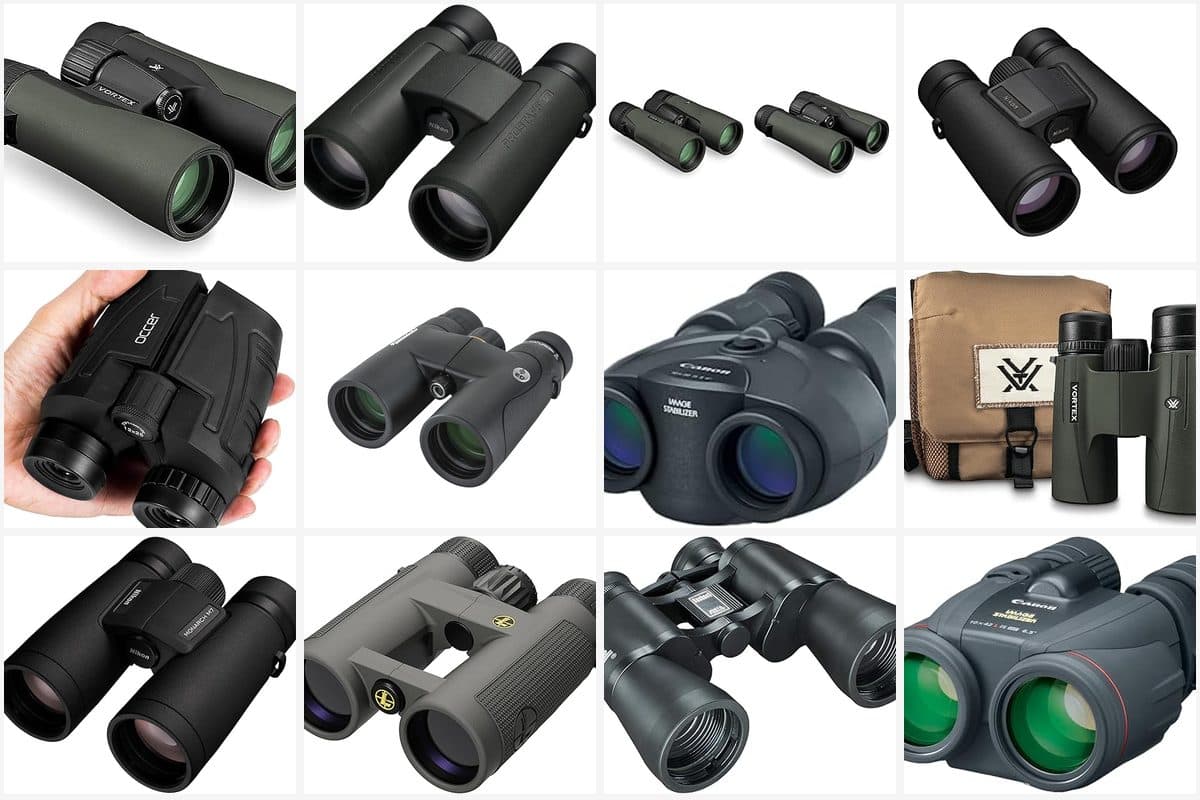
This guide covers 20 binoculars across five categories, from a $30 compact that fits in a cargo pocket to a $1,200 Canon with optical image stabilization that eliminates hand shake entirely. Every pick has been evaluated against verified reviews, aviation community recommendations, and the specific demands of tracking fast-moving aircraft against bright sky backgrounds. No department store junk, no overpriced marketing exercises.
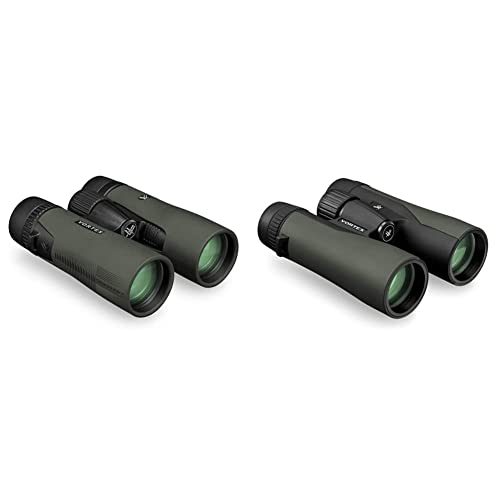
Vortex Diamondback HD 10x42
~$185


Nikon Monarch M5 10x42
$275 on Amazon
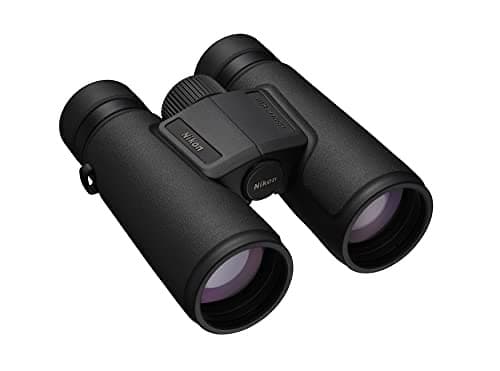
ED (Extra-low Dispersion) glass eliminates the purple fringing you see in cheaper optics when pointing toward bright sky. Dielectric prism coating maximizes light transmission. Close focus down to 8.2 feet means these pull double duty on static displays, letting you read instrument panels through cockpit glass.
8x vs 10x: Which Magnification for Airshows?
This is the single most debated question in the plane-spotting community, and the answer depends entirely on what kind of viewing you do most.
8x magnification delivers a wider field of view, typically around 380-430 feet at 1,000 yards. That wider view makes it far easier to acquire a fast-moving aircraft and track it across the sky without losing it. Hand shake is less noticeable at 8x, which matters enormously during a full day of airshow viewing when fatigue sets in after hours of holding binoculars to your face. For general airshow use where jets are making passes at moderate distance, 8x is the safer choice.
10x magnification pulls aircraft roughly 25% closer, which translates to noticeably more detail on cockpit markings, panel lines, and ordnance pylons. The trade-off is a narrower field of view (around 340-370 feet at 1,000 yards) and amplified hand shake that becomes a real problem after two or three hours of continuous use. If you are primarily spotting aircraft at cruise altitude or watching from farther back at an airshow, 10x is worth the narrower view.
The practical recommendation: Start with 8x42 if this is your first serious pair. The wider field of view forgives sloppy tracking technique, the lower magnification hides hand tremor, and 42mm objective lenses let in enough light for all-day use without being too heavy. Move to 10x once you have developed the muscle memory to acquire targets quickly, or if you find yourself consistently wanting more reach.
Why Image Stabilization Changes Everything
Standard binoculars at 10x magnification amplify every micro-movement of your hands by a factor of ten. Your heartbeat, breathing rhythm, and the slight tremor that develops after holding any weight at arm's length for extended periods all translate into a jittery, unsteady image. Most people can hold 8x relatively steady. Fewer can hold 10x steady for long periods. Almost nobody can hold 12x or higher without a tripod.
Image-stabilized (IS) binoculars use gyroscopic sensors and compensating lens elements to counteract hand movement in real time. The effect is dramatic. Engage the IS button on a Canon 10x30 and the image snaps to attention like someone bolted your binoculars to a concrete pillar. Details that were lost in the jitter suddenly resolve: tail numbers, squadron markings, the seams on an F-22's radar-absorbent coating.
The downside is cost. Canon's cheapest IS binoculars start around $475, and the premium L-series models push past $1,200. They also require batteries (typically AA cells), adding weight and a potential failure point. But for dedicated plane spotters who want maximum detail without lugging a tripod, IS binoculars are the single biggest upgrade available.
Budget Tier ($30-90) - Solid Optics Without the Premium Price
These five binoculars will not match the optical clarity of a $300+ pair, but every one of them delivers enough performance for casual airshow attendance and airport perimeter spotting. If you attend two or three shows a year and do not want to spend your mortgage payment on glass, start here.
1. Occer 12x25 Compact Binoculars
~$30 on Amazon
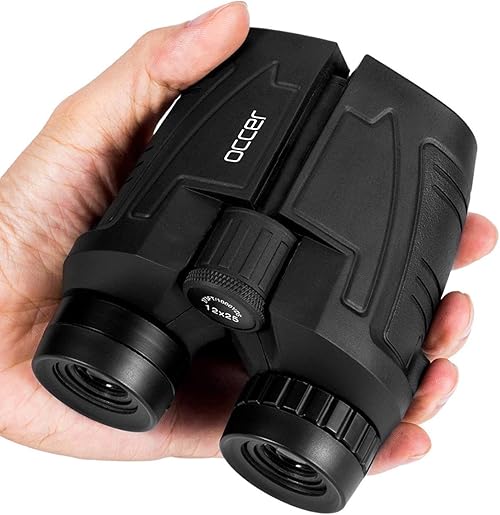
At $30, these compact Occer binoculars have no business being as popular as they are. Over 80,000 Amazon reviews with a 4.5-star average suggest that a lot of people are perfectly happy with budget glass for occasional use. Pocket-sized and lightweight enough to forget you are carrying them.
Best for: First-timers, kids, backup pair
The 12x magnification looks great on paper, but it creates real problems for airshow tracking. That narrow field of view (273 feet at 1,000 yards) makes acquiring a fast jet mid-pass extremely difficult, and hand shake at 12x is noticeable even for steady-handed spotters. The 25mm objective lenses also limit light gathering, so image brightness drops off noticeably compared to full-size 42mm or 50mm binoculars. Where these shine is as a throw-in-your-bag pair that you do not worry about dropping in a parking lot. The twist-up eyecups work well with glasses, the compact size fits in a jacket pocket, and the price means you can hand them to your kids without anxiety. Just understand that you are trading optical performance for portability and price.
2. SkyGenius 10x50 Full-Size Binoculars
~$35 on Amazon
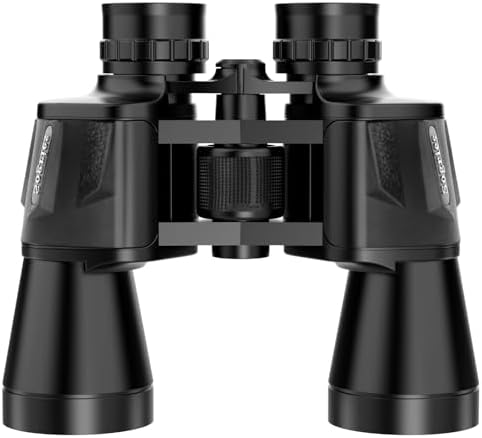
Full-size 50mm objectives at a price that barely registers. The SkyGenius pulls in a surprising amount of light for the money, and the 10x magnification offers a good balance of reach and field of view. Sold over 30,000 units on Amazon with consistent 4.3-star ratings.
Best for: Budget full-size option, low-light viewing
Those large 50mm objectives are a double-edged sword. On the positive side, they gather substantially more light than compact 25mm lenses, producing a brighter image that holds up better during early morning or late afternoon airshow slots. On the negative side, 1.76 pounds of binocular hanging from your neck for eight hours at an airshow will wear you down. The weight also amplifies hand shake at 10x, making extended viewing sessions tiring. Optical quality is acceptable but noticeably softer at the edges of the field of view compared to mid-range options. Chromatic aberration (color fringing around high-contrast edges like aircraft silhouettes against bright sky) is present and visible. For $35, though, you get a legitimate full-size binocular that will survive several seasons of airshow duty. Pack a harness strap and accept the edge softness.
3. Gosky 10x42 Roof Prism Binoculars
~$55 on Amazon
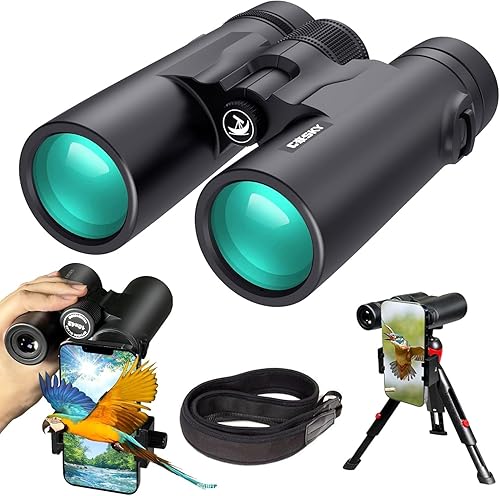
Roof prism design at a porro prism price. The Gosky 10x42 offers the slimmer, more compact form factor of premium binoculars while keeping the cost under $60. Waterproof and fog-proof with nitrogen purging, which you will not find on most sub-$100 competitors.
Best for: All-weather airshow use, phone digiscoping
Gosky includes a phone adapter in the box, which is a nice touch for airshow attendees who want to snap quick digiscoped photos through the eyepiece. Results will not match a DSLR with a 600mm lens, but you can capture recognizable shots of static displays and slow passes. The nitrogen-purged, O-ring sealed body is a legitimate advantage over other sub-$60 binoculars, many of which will fog internally the first time you move from an air-conditioned car into humid summer air at an airshow. The weakness here is eye relief. At only 14mm, eyeglass wearers will struggle to see the full field of view, and the twist-up eyecups are stiffer than they should be. Optical sharpness drops off in the outer 20% of the image, and the focus wheel feels gritty compared to anything from Vortex or Nikon. Still, for $55, you are getting waterproofing and a roof prism design that would have cost three times as much a decade ago.
4. Nikon Aculon A211 8x42
~$80 on Amazon
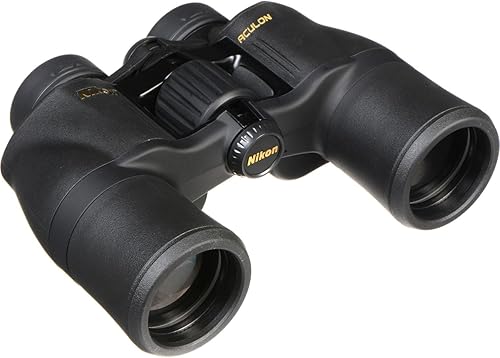
Nikon's entry-level binocular proves that a major optics brand can deliver at $80. Porro prism design gives you slightly better depth perception than roof prisms at this price point, and the multi-coated lenses produce a brighter, more contrasty image than anything else under $100.
Best for: First serious pair, reliability over features
That 420-foot field of view at 1,000 yards is among the widest in this entire guide, making the Aculon A211 one of the easiest binoculars to use for airshow tracking. You pick up incoming aircraft faster and hold them in the frame more easily during high-speed passes. The 8x magnification keeps hand shake manageable through long viewing sessions, and Nikon's multi-coated optics deliver color accuracy and contrast that budget Chinese brands simply cannot match at this price. The porro prism design is the main drawback. It makes the binocular wider and slightly heavier than modern roof prism designs, and the body is not waterproof. If rain rolls in at your airshow, these need to go back in the case. The rubber armoring also feels thin compared to Vortex products in the same range. For $80, though, you are buying Nikon glass with a Nikon warranty, and that combination is hard to argue with for a first pair.
5. Bushnell Falcon 10x50
~$45 on Amazon
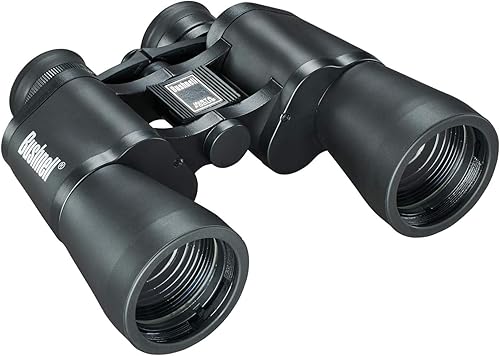
Bushnell has been building optics since 1948, and the Falcon represents their most affordable entry point. Large 50mm objectives paired with 10x magnification deliver a bright image with decent reach. A no-frills workhorse that has been in production for years.
Best for: Dawn/dusk spotting, large exit pupil viewing
Bushnell's Falcon earns its spot through one specific advantage: a 5mm exit pupil (50mm objective divided by 10x magnification) that delivers a bright image even in fading light. Early morning arrivals and twilight finales at airshows benefit from that extra light-gathering ability. The InstaFocus lever on top allows single-finger focusing, which some spotters prefer over a traditional center wheel because it allows faster adjustments when switching between aircraft at different distances. On the downside, 1.88 pounds is heavy for extended handheld use, and the 300-foot field of view is the narrowest among the budget picks. The porro prism body is wide and not waterproof. Chromatic aberration is noticeable when tracking bright metallic aircraft against an overcast sky. The Falcon is not trying to compete with mid-range optics on sharpness or edge clarity. It is a $45 binocular that outperforms its price through solid light gathering and a proven design.
Mid-Range Tier ($100-230) - Where Quality Jumps Significantly
Moving into the $100-$230 range represents the biggest single quality jump in binocular pricing. You gain fully multi-coated optics, phase-corrected roof prisms, proper waterproofing, better eye relief for glasses wearers, and manufacturer warranties that actually mean something. For regular airshow attendees and dedicated plane spotters, this is the sweet spot.
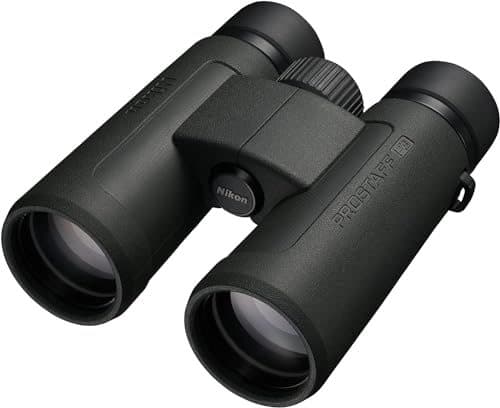
6. Nikon Prostaff P3 8x42
~$115 on Amazon
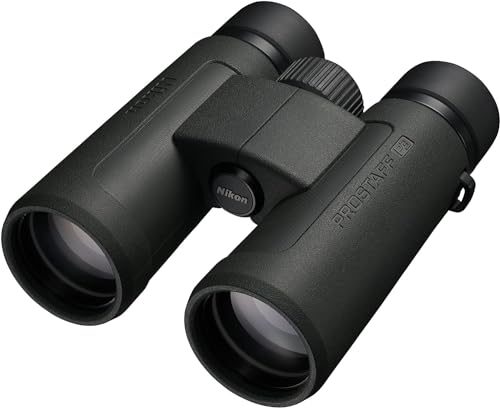
Nikon's mid-range Prostaff line has been a birding and spotting staple for years. The P3 refresh brings fully multi-coated lenses and a roof prism design that addresses every weakness of the cheaper Aculon. Waterproof, fog-proof, and built to last through years of regular field use.
Best for: Stepping up from budget glass, all-weather reliability
At 1.28 pounds, the Prostaff P3 is noticeably lighter than the budget porro prism options, and the difference matters during a six-hour airshow day. The roof prism design is slimmer in the hand, easier to grip one-handed, and seals properly against moisture. Nikon's fully multi-coated optics deliver a visible step up in contrast and color fidelity over the Aculon, particularly when tracking dark-painted aircraft against a bright sky background where cheaper glass washes out detail. The field of view at 398 feet is generous for 8x. Where the P3 falls short of the Vortex options priced just above it is in edge sharpness. The outer 25% of the field shows noticeable softening, which matters less for airshow use (your subject is usually center-frame) but is worth noting. The focus wheel is smooth but lacks the precise, dampened feel of the Crossfire HD. Still, Nikon's warranty and optical heritage make this a safe buy at $115.
7. Vortex Crossfire HD 8x42
~$140 on Amazon
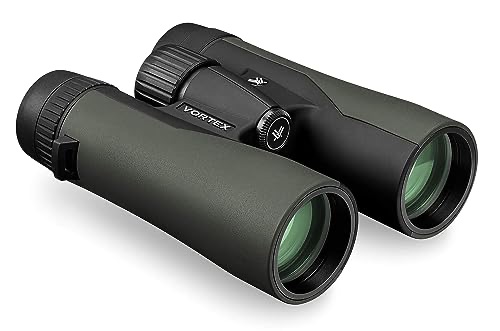
Ask any birding or plane-spotting forum for a binocular recommendation under $200, and the Crossfire HD will appear in the first three responses. Vortex's HD glass, unconditional lifetime warranty, and build quality at this price point have made it the default recommendation for a reason.
Best for: Best all-around airshow binocular for most people
Vortex's unconditional lifetime VIP warranty is the industry benchmark: no receipt needed, no questions asked, covers any damage including accidental drops. That alone separates the Crossfire from every competitor at this price. The HD glass elements reduce chromatic aberration to near-invisible levels, meaning those bright aluminum-skinned aircraft against a white sky will not show the purple fringing that plagues cheaper binoculars. Color accuracy is excellent, focus is smooth with just the right amount of resistance, and the rubber armor absorbs impacts without adding excessive bulk. The weaknesses are minor but real. Eye relief at 15.3mm is adequate for most glasses wearers but tight for those with thick frames. The lens caps are flimsy and will probably get lost within the first month. And while the optical quality is very good for $140, a side-by-side comparison with the Diamondback HD reveals the gap in edge sharpness and low-light performance. For anyone buying their first real pair of binoculars for airshows, though, this is the pick.
8. Celestron Nature DX ED 8x42
~$140 on Amazon
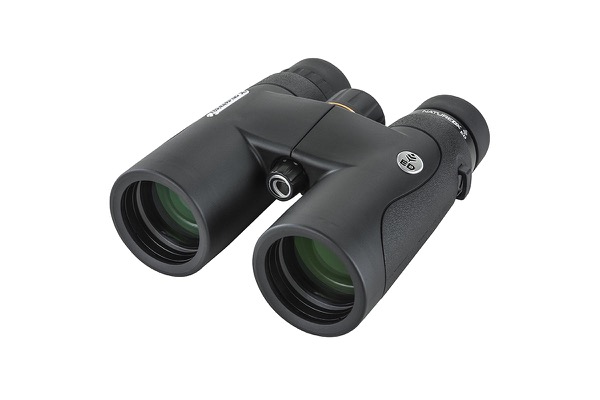
Celestron packed extra-low dispersion (ED) glass into a $140 binocular, and it makes a measurable difference in chromatic aberration control. Birders have adopted the Nature DX ED as a go-to recommendation, and everything that makes it work for bird tracking translates directly to plane spotting.
Best for: Minimizing color fringing on high-contrast subjects
ED (extra-low dispersion) glass is the same technology that high-end camera lenses use to eliminate chromatic aberration. In binoculars, it means sharper color transitions and less of that purple-green fringe around backlit subjects. For airshow viewing, the practical benefit shows up when tracking silver or white aircraft against a bright sky, exactly the conditions where cheap glass falls apart. Celestron's implementation at this price is competitive with the Vortex Crossfire HD, and some reviewers give the Nature DX ED a slight edge in color accuracy. The trade-off is the warranty. Celestron offers a limited lifetime warranty, but it is not the unconditional, no-fault coverage that Vortex provides. If you drop them off a bleacher at an airshow, Celestron may charge for repairs. The focus wheel is also slightly looser than ideal, with less tactile feedback than the Vortex. At 1.38 pounds and with solid waterproofing, though, these are a legitimate alternative to the Crossfire HD if you prioritize color purity over warranty coverage.
9. Vortex Diamondback HD 10x42
~$185 on Amazon
Step up from the Crossfire HD and the difference is immediately visible. Better edge sharpness, improved low-light performance, and ArmorTek exterior lens coatings that resist oil and dirt. The Diamondback HD at 10x42 is the most popular configuration among serious plane spotters on a budget.
Best for: Dedicated plane spotters wanting more reach and detail
Where the Crossfire HD is the safe, do-everything recommendation, the Diamondback HD at 10x42 is the optic for people who know they want more magnification and are willing to accept a narrower field of view (314 feet vs. 393 feet at 1,000 yards) to get it. That extra 2x pulls aircraft visibly closer, resolving details like intake geometry, weapons stations, and squadron markings that are harder to pick out at 8x. ArmorTek coatings on the external lenses are a practical feature for airshow use, resisting the fingerprints, sunscreen residue, and dust that accumulate during a day on the tarmac. Low-light performance improves over the Crossfire thanks to better dielectric coatings on the prisms. The same unconditional VIP warranty applies. The downside of 10x becomes apparent after three or four hours of continuous use: hand shake is more visible than at 8x, and the narrower field makes picking up incoming aircraft slightly harder. If you have steady hands and prioritize detail over ease of acquisition, this is the mid-range champion. If you are unsure, the 8x42 Crossfire HD is the safer pick.
10. Nikon Monarch M5 8x42
~$215 on Amazon
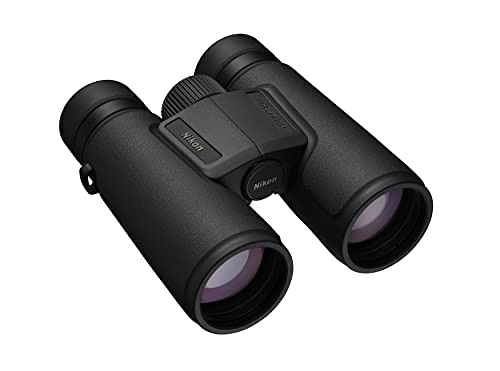
Nikon's Monarch line sits between their entry-level Prostaff and premium Monarch HG series. ED glass, dielectric high-reflectance multilayer prism coatings, and Nikon's decades of optical engineering expertise deliver a binocular that competes directly with the Vortex Diamondback HD.
Best for: Nikon loyalists, premium feel at mid-range price
At 1.32 pounds, the Monarch M5 is the lightest 8x42 in the mid-range tier, and that weight savings adds up during long airshow days. Nikon's ED glass controls chromatic aberration well, and the dielectric prism coatings push light transmission numbers into the mid-90% range, meaning brighter images with more accurate colors. Build quality feels a tier above the Prostaff P3, with a more refined focus mechanism and thicker rubber armoring. The central hinge tension is adjustable and holds the interpupillary distance setting firmly once set. Where the Monarch M5 loses ground to the Vortex Diamondback HD is in warranty terms. Nikon's limited lifetime warranty requires proof of purchase and does not cover accidental damage, which matters when you are using optics in crowded outdoor environments. The 330-foot field of view is also narrower than the Crossfire HD and Prostaff P3, both of which are cheaper. You are paying a premium for build quality, light weight, and Nikon's optical tuning over raw field-of-view width.
Premium Tier ($300-400) - Serious Glass for Serious Spotters
Premium binoculars separate themselves from mid-range glass through better coatings, tighter quality control, superior mechanical construction, and optical designs that maintain sharpness from center to edge. The difference between a $185 pair and a $325 pair is less dramatic than the jump from $80 to $185, but dedicated spotters who use binoculars weekly will notice and appreciate the upgrade.
11. Vortex Viper HD 8x42
~$325 on Amazon
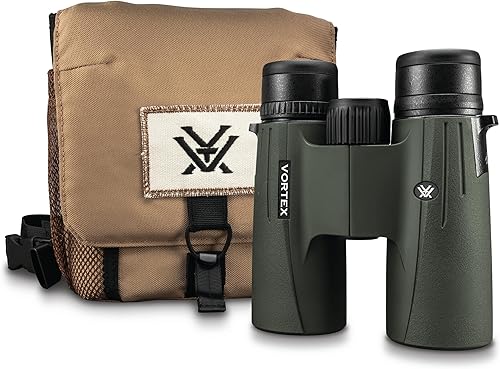
Vortex's Viper line is where their optical engineering hits full stride. HD glass, XR fully multi-coated lenses, and dielectric prism coatings produce an image that is visibly sharper, brighter, and more color-accurate than the Diamondback. This is the binocular that experienced spotters upgrade to and stop searching.
Best for: Experienced spotters wanting long-term, buy-once optics
Side by side with the Diamondback HD, the Viper shows its advantage most clearly in edge-to-edge sharpness. Where the Diamondback softens in the outer 15-20% of the field, the Viper holds detail almost to the edges. For airshow use, this means you do not need to keep the aircraft perfectly centered to get a sharp view, which makes panning across a formation flight noticeably more pleasant. Low-light performance is a step up as well, with dielectric prism coatings reflecting over 97% of incoming light compared to roughly 92-93% in the Diamondback. The ArmorTek coatings carry over from the lower tier. Vortex's VIP warranty still applies. The weakness is subtle: at 1.50 pounds, the Viper is slightly heavier than the Diamondback, and the retail price of $325 puts it uncomfortably close to the image-stabilized Canon 10x30 IS II at $475. That proximity raises the question of whether the money is better spent on stabilization technology rather than incremental improvements in optical quality. For people who already own the Diamondback and want better glass, the Viper delivers. For first-time buyers with $325 to spend, saving another $150 for the Canon IS may be the smarter play.
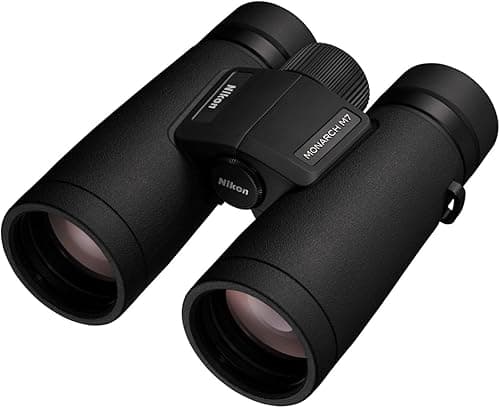
12. Nikon Monarch M7 10x42
~$375 on Amazon
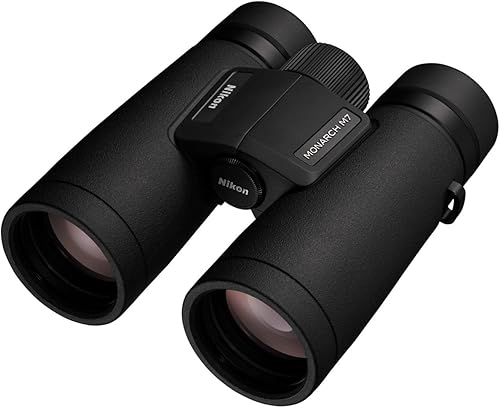
Nikon's M7 represents the top of their non-flagship binocular line. Premium ED glass, phase-corrected prisms, and a wide-angle optical design that pushes the field of view beyond what most 10x binoculars can achieve. Built for serious field use with a focus on optical excellence.
Best for: Maximum detail at 10x with wide-angle view
Most 10x42 binoculars deliver a field of view between 300-340 feet at 1,000 yards. The Monarch M7 pushes to 369 feet, which partially closes the gap with 8x binoculars and makes target acquisition meaningfully easier. That extra width comes from Nikon's wide-angle eyepiece design, which maintains sharpness across more of the field than competing 10x designs. At 1.39 pounds, it is lighter than many 8x42 binoculars, making it one of the most comfortable 10x options for extended airshow days. The ED glass controls chromatic aberration well at 10x, where color fringing becomes more visible than at lower magnifications. Where the M7 falls short is in value. At $375, you are $190 more than the Vortex Diamondback HD 10x42, and the optical improvement, while real, may not justify nearly doubling the price for most users. Nikon's warranty is also less comprehensive than Vortex's VIP program. Competitive pressure from Vortex has pushed Nikon to deliver excellent optics here, but the warranty gap makes this a harder recommendation unless you specifically prefer Nikon's color rendering and ergonomics.
13. Leupold BX-4 Pro Guide HD
~$325 on Amazon
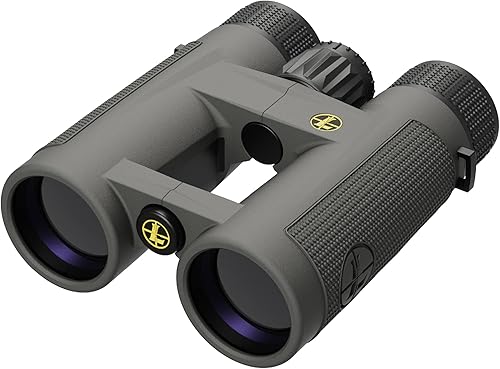
Leupold is an American optics manufacturer with deep roots in hunting and tactical scopes. Their BX-4 Pro Guide HD translates that rifle scope expertise into a binocular with excellent clarity, rugged construction, and a lifetime guarantee backed by their Oregon service center.
Best for: American-made quality, extreme durability
Leupold's BX-4 competes directly with the Vortex Viper HD and brings a slightly different optical character. Leupold tends to tune for a slightly warmer color balance than Vortex, which some users prefer for natural scenes. The twilight light management system performs well during dawn and dusk viewing, pulling usable brightness from conditions where cheaper glass shows only dark shapes. Build quality is tank-like, with a magnesium alloy chassis that feels more rigid than any polymer-bodied competitor. Leupold's lifetime guarantee covers defects and workmanship issues comprehensively. The weaknesses center on field of view and availability. At 371 feet, the BX-4 gives up nearly 40 feet of width compared to the Vortex Viper HD, which matters for tracking fast-moving airshow performers. Leupold also has a smaller retail footprint for binoculars than Vortex or Nikon, making hands-on comparison harder before purchase. Fewer aviation-community reviews exist compared to the Vortex alternatives, so you are relying more on hunting community feedback. For spotters who value build rigidity, warmer color tuning, and American manufacturing heritage, the BX-4 earns its price.
Image-Stabilized Tier ($475-1,200) - The Endgame for Plane Spotters
If you have ever wished you could bolt your binoculars to a tripod without actually carrying a tripod, image-stabilized binoculars are the answer. Canon dominates this category almost entirely, with optical stabilization technology refined over decades of camera lens development. The price premium is significant, but for dedicated plane spotters, IS binoculars deliver a fundamentally different viewing experience.
14. Canon 10x30 IS II
~$475 on Amazon
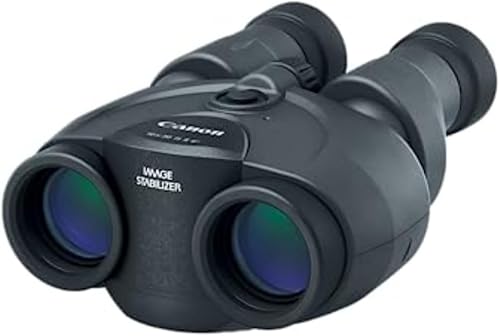
Press the IS button and the image locks into place like magic. Canon's optical stabilization eliminates the hand shake that makes 10x binoculars tiring to use, revealing detail that standard binoculars simply cannot resolve during handheld viewing. This is the single most recommended binocular in the plane-spotting community, full stop.
Best for: Plane spotters wanting maximum detail without a tripod
The Canon 10x30 IS II is not the sharpest binocular at this price in terms of raw optical quality. A Vortex Viper HD will likely resolve more detail in a static side-by-side comparison on a test chart. But binoculars are not used on test charts. They are used handheld, often while standing, often after hours of use, and in those real-world conditions the Canon's image stabilization delivers a dramatically steadier, more detailed view than any unstabilized binocular can manage. Tail numbers that are a blurry guess at 10x without IS become clearly readable. Panel lines resolve. Cockpit details emerge. The stabilization is not perfect at eliminating all movement, but it reduces shake by roughly 90%, turning a jittery view into a gently floating one. Trade-offs exist. The 30mm objectives gather less light than 42mm alternatives, so the image is noticeably dimmer in low light. Battery life lasts around 9-12 hours of IS use on two AA cells, which means bringing spares for multi-day airshow events. The Porro II prism design makes the body wider than modern roof prism binoculars. And $475 is a lot of money. But for the specific task of tracking aircraft and reading markings, nothing else in this price range competes.
15. Canon 10x42L IS WP
~$1,200 on Amazon
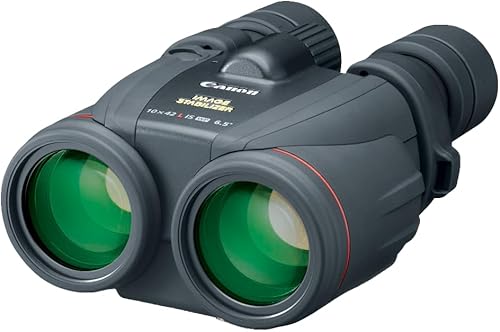
Canon's flagship. The L-series designation borrows from their professional camera lens line, signaling premium optics, weather sealing, and build quality designed for professional use. Everything the 10x30 IS II does, the 10x42L does better, with larger objectives, waterproofing, and superior glass.
Best for: Professional spotters, aviation photographers, no-compromise users
The jump from $475 to $1,200 buys three things: larger 42mm objectives that gather significantly more light, full waterproofing (the 10x30 IS II is not weather-sealed), and optical quality that matches or exceeds non-stabilized binoculars costing $600+. Low-light performance is dramatically better than the 10x30, making this the choice for dawn takeoffs, twilight arrivals, and overcast airshow days where the smaller Canon struggles with brightness. The IS system is the same fundamental technology, and it works just as well here. Waterproofing means you do not need to panic when afternoon thunderstorms roll through a summer airshow. The primary downside is weight. At 2.64 pounds, the 10x42L is nearly double the weight of the 10x30, and it is noticeably heavier than most non-stabilized 10x42 binoculars. That weight combined with the $1,200 price tag means this is a purchase for people who already know they want the best IS binocular available and are not going to blink at the cost. For everyone else, the 10x30 IS II delivers 85% of the experience at 40% of the price, and that math is hard to argue with.
Monoculars - One Eye, Less Weight
Monoculars sacrifice binocular depth perception and the comfortable two-eye viewing experience for dramatically reduced weight and size. For airshow use, where your subjects are at distances where binocular depth perception provides no benefit anyway, a good monocular can be a smart alternative, particularly as a secondary optic you keep in a pocket for quick looks.
16. Gosky 12x55 HD Monocular
~$40 on Amazon
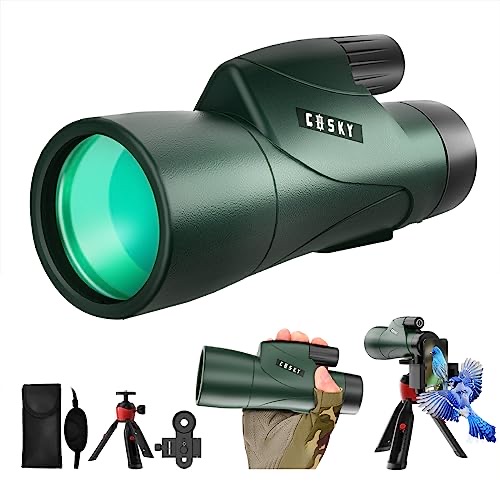
Gosky's 12x55 monocular packs serious magnification into a single barrel that fits in a cargo pocket. The included smartphone adapter lets you shoot quick digiscoped video of airshow passes, and the 55mm objective gathers enough light to keep the image bright despite the high magnification.
Best for: Pocketable magnification, quick phone video capture
Twelve times magnification through a single barrel with a 55mm objective is an unusual combination that works better than you might expect. The large objective keeps the exit pupil at 4.6mm, which is bright enough for most daytime conditions. At under a pound, you can toss this in a bag alongside your primary binoculars and barely notice the extra weight. The phone adapter makes it popular for social media, though do not expect DSLR-quality results. Where the Gosky monocular falls short is in sustained viewing comfort. Using one eye for extended periods causes fatigue faster than binocular viewing, and 12x magnification amplifies hand shake dramatically without a second barrel to help stabilize your grip. The optical quality is acceptable for $40 but shows noticeable chromatic aberration and edge softness compared to any proper binocular in the mid-range tier. Think of this as a quick-look tool rather than a primary airshow optic, and it delivers solid value.
17. Vortex Solo 10x36
~$110 on Amazon
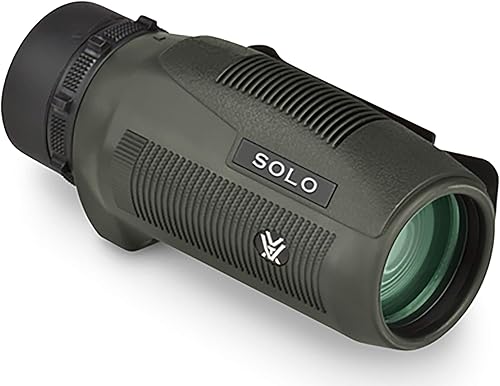
Vortex brings their optical quality and VIP warranty to the monocular format. Fully multi-coated optics, waterproof construction, and rubber armor make the Solo a substantial step up from budget monoculars. Lighter and more compact than any binocular, this slots in perfectly as a secondary optic.
Best for: High-quality secondary optic, travel-friendly spotting
Optical quality in the Solo is noticeably better than what Gosky and other budget monocular brands deliver. Chromatic aberration is better controlled, center sharpness is higher, and the fully multi-coated optics produce a brighter image with better contrast. At 0.68 pounds and roughly the size of a Red Bull can, it disappears into a jacket pocket or belt pouch. Vortex's unconditional VIP warranty applies, making this a low-risk purchase. The 36mm objective at 10x produces a 3.6mm exit pupil, which is adequate in bright conditions but noticeably dimmer than a 42mm or 50mm binocular when clouds roll in. The fundamental weakness of any monocular remains: one-eye viewing is less comfortable for sustained use, you lose the natural stabilization that comes from gripping a binocular with both hands, and extended sessions cause eye fatigue. The Solo works best as a complement to a primary pair of binoculars rather than a replacement for them. Keep it in your pocket for quick looks when your main glass is in the case.
Essential Accessories
The right accessories make a bigger difference to your airshow viewing experience than most people expect. A proper harness eliminates neck pain, a lens pen keeps your optics clean without scratching coatings, and a phone adapter opens up basic digiscoping. Three essentials that cost less than $50 combined.
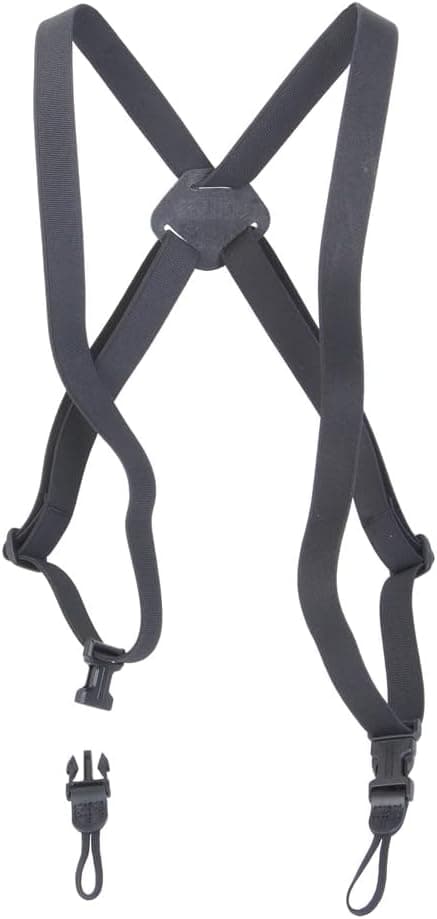
18. OP/TECH Bino/Cam Harness
~$22 on Amazon
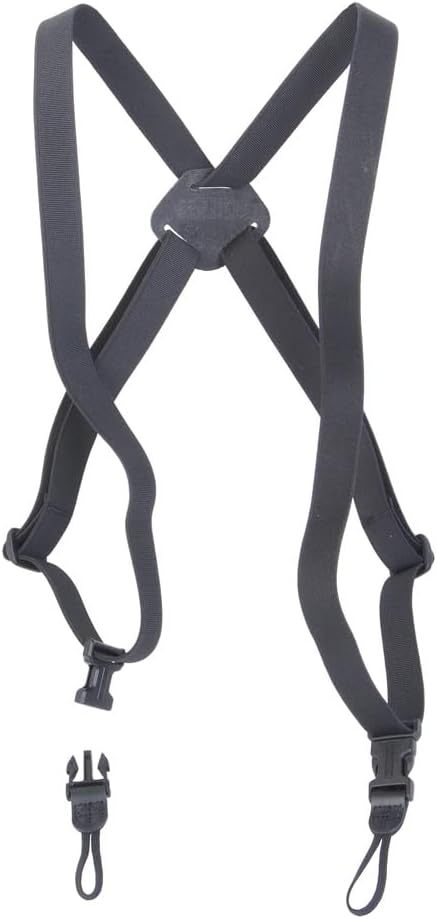
Replace the factory neck strap immediately. The OP/TECH harness distributes binocular weight across both shoulders and your back instead of hanging everything from your neck vertebrae. After six hours at an airshow, the difference between a neck strap and a harness is the difference between comfort and a chiropractic appointment.
Best for: Anyone using binoculars for more than 30 minutes
Every binocular in this guide ships with a basic neck strap, and every one of those straps is inadequate for all-day use. A 1.5-pound binocular hanging from a thin strap concentrates all that weight on the back of your neck, and after several hours it creates genuine discomfort. The OP/TECH harness runs over both shoulders and across the upper back, distributing weight like a backpack. Quick-disconnect connectors let you detach the binoculars for cleaning or hand them off quickly. The neoprene material is comfortable against skin on hot days. The main criticism is that the binoculars sit slightly lower on your chest than with a traditional neck strap, adding a fraction of a second to your pickup time. Some users also find the harness looks bulky under a tight jacket. For airshow use where you are standing outdoors in warm weather, neither issue matters. At $22, this is the highest-impact-per-dollar accessory in this entire guide.
19. Nikon Lens Pen
~$9 on Amazon
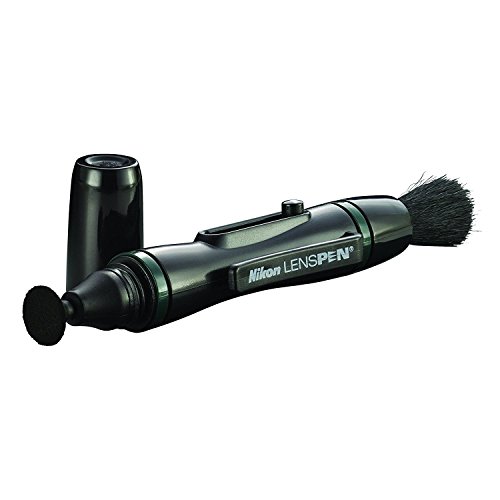
A retractable brush on one end and a carbon-compound cleaning tip on the other. The Nikon Lens Pen removes dust, fingerprints, and smudges from coated optics without scratching or leaving residue. Compact enough to clip into a shirt pocket and carry everywhere your binoculars go.
Best for: Field cleaning without liquid solutions or cloths
Airshows are dusty, sunny, and full of sunscreen-covered fingers grabbing for binoculars. Within an hour of use, your eyepiece lenses will have fingerprints, and the objectives will collect dust. Wiping coated optics with a shirt or paper towel risks scratching the multi-coated surfaces that you paid a premium for. The Nikon Lens Pen solves this properly. Brush off loose particles first with the retractable brush, then use the carbon-compound cleaning tip to lift oils and smudges without liquid. The cleaning compound replenishes automatically from a reservoir in the cap. One pen lasts roughly 500 cleanings. The only downside is that it cannot handle heavy contamination like dried salt spray or insect residue, which requires proper wet cleaning with lens solution and microfiber. For day-to-day airshow maintenance between thorough cleanings, though, it is the most practical field tool available. Buy two and keep one in your binocular case and one in your pocket.
20. Gosky Universal Phone Adapter
~$17 on Amazon
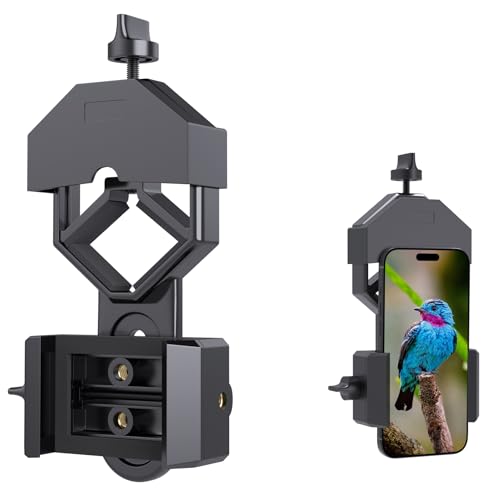
Clamp your smartphone to your binocular eyepiece and capture photos or video through the optics. Results will not rival a proper camera setup, but for social media clips of airshow passes and quick reference photos of static displays, digiscoping through binoculars is surprisingly effective.
Best for: Quick social media content, documenting static displays
Digiscoping through binoculars is never going to match a dedicated camera with a long telephoto lens. Alignment is fiddly, vignetting (the dark circular border around the image) is always present to some degree, and exposure can be tricky when your phone's auto-exposure tries to meter through an optical system it was not designed for. That said, a $17 adapter clamped to a $140 pair of binoculars produces surprisingly recognizable photos and videos of airshow performers, especially during slower passes and static displays. The Gosky adapter uses a metal clamping mechanism that fits eyepieces from 28mm to 47mm in diameter, covering nearly every binocular on the market. Setup takes about 30 seconds once you have practiced it. The weakness is speed. By the time you mount your phone, align it with the eyepiece, and open the camera app, any fast-moving aircraft has long since passed. This is a tool for anticipated shots and static subjects, not for snap-shooting a Thunderbird solo pass. Keep expectations realistic and it delivers decent value for $17.
Comparison Table
| Binocular | Mag/Obj | Weight | FOV (ft/1000yd) | Price | Best For |
|---|---|---|---|---|---|
| Occer 12x25 | 12x25 | 0.55 lb | 273 | ~$30 | Ultra-budget compact |
| SkyGenius 10x50 | 10x50 | 1.76 lb | 367 | ~$35 | Budget full-size |
| Gosky 10x42 | 10x42 | 1.54 lb | 307 | ~$55 | Budget waterproof |
| Bushnell Falcon 10x50 | 10x50 | 1.88 lb | 300 | ~$45 | Dawn/dusk budget |
| Nikon Aculon A211 | 8x42 | 1.65 lb | 420 | ~$80 | Wide-view budget |
| Nikon Prostaff P3 | 8x42 | 1.28 lb | 398 | ~$115 | Entry mid-range |
| Vortex Crossfire HD ⭐ | 8x42 | 1.44 lb | 393 | ~$140 | Best overall value |
| Celestron Nature DX ED | 8x42 | 1.38 lb | 388 | ~$140 | Best ED under $150 |
| Vortex Diamondback HD ⭐ | 10x42 | 1.44 lb | 314 | ~$185 | Best mid-range |
| Nikon Monarch M5 | 8x42 | 1.32 lb | 330 | ~$215 | Lightest mid-range |
| Vortex Viper HD | 8x42 | 1.50 lb | 409 | ~$325 | Premium all-rounder |
| Nikon Monarch M7 | 10x42 | 1.39 lb | 369 | ~$375 | Premium 10x wide-angle |
| Leupold BX-4 Pro Guide HD | 8x42 | 1.48 lb | 371 | ~$325 | Premium lightweight |
| Canon 10x30 IS II ⭐ | 10x30 | 1.32 lb | 315 | ~$475 | Best image-stabilized |
| Canon 10x42L IS WP | 10x42 | 2.64 lb | 315 | ~$1,200 | No-compromise IS |
| Gosky 12x55 Mono | 12x55 | 0.98 lb | 360 | ~$40 | Budget monocular |
| Vortex Solo 10x36 | 10x36 | 0.68 lb | 325 | ~$110 | Premium monocular |
How to Choose: Quick Decision Guide
You attend 1-2 airshows a year and want something decent: Vortex Crossfire HD 8x42 ($140). Best balance of price, quality, and warranty. You will not outgrow it for years.
You are on a tight budget and need something now: Nikon Aculon A211 8x42 ($80). Widest field of view in the budget tier, Nikon brand quality, and good enough optics to enjoy any airshow.
You want maximum detail and have steady hands: Vortex Diamondback HD 10x42 ($185). The extra magnification resolves markings and details that 8x cannot, and the ArmorTek coatings handle real-world field conditions.
You want the absolute best handheld viewing experience: Canon 10x30 IS II ($475). Image stabilization eliminates the variable that limits every other binocular on this list. Nothing else resolves handheld detail as well.
You need a pocketable secondary optic: Vortex Solo 10x36 ($110). Quality optics in a package that fits in a cargo pocket, backed by Vortex's warranty.
You are buying for a kid or as a loaner pair: Occer 12x25 ($30). Cheap enough that losing or dropping them is not a financial event.
Frequently Asked Questions
What magnification is best for airshows?
8x is the best starting point for most airshow attendees. The wider field of view makes it easier to find and track fast-moving aircraft, and hand shake is less of a problem during long viewing sessions. Move to 10x if you prioritize detail over ease of tracking, or if you primarily spot aircraft at higher altitudes where extra reach matters. Anything above 10x requires a tripod or image stabilization for comfortable extended use.
Are image-stabilized binoculars worth the extra cost?
For dedicated plane spotters, yes. Image stabilization eliminates the hand shake that limits detail resolution at 10x and above. The Canon 10x30 IS II at $475 delivers a steadier, more detailed view than unstabilized binoculars costing twice as much. The trade-off is battery dependency and higher weight. For casual airshow attendees who go once or twice a year, the extra cost is harder to justify, and a Vortex Crossfire HD at $140 will serve well.
Do I need waterproof binoculars for airshows?
Not strictly required, but strongly recommended. Summer airshows frequently see afternoon thunderstorms, and humidity changes between air-conditioned cars and outdoor tarmac can cause internal fogging in non-sealed binoculars. Waterproof, nitrogen-purged binoculars prevent both problems. Every option in the mid-range tier and above includes waterproofing. In the budget tier, the Gosky 10x42 is the only waterproof option.
What size objective lens should I choose?
42mm is the sweet spot for airshow binoculars. Large enough to gather plenty of light for all-day viewing, compact enough to carry comfortably. 50mm objectives gather more light (better for dawn/dusk) but add weight. 25-30mm compacts save weight but produce dimmer images, especially on overcast days. For a primary airshow binocular, stick with 42mm unless you have a specific reason to go larger or smaller.
Can I use binoculars with eyeglasses?
Yes, but eye relief matters. Eye relief is the distance between the eyepiece lens and the point where you see the full field of view. Glasses wearers need at least 15mm of eye relief, ideally 16mm or more, because their eyes sit farther from the eyepiece. Most binoculars in the mid-range tier and above offer adequate eye relief with twist-down eyecups. Budget models vary, so check specifications before buying.
Should I buy a monocular instead of binoculars?
Only as a secondary optic, not as a replacement. Monoculars are lighter, more compact, and cheaper, but single-eye viewing causes fatigue faster and provides less stable image viewing than two-eye observation. A monocular works well as a pocket backup for quick looks, while your primary binoculars handle extended viewing. If you can only carry one optic, choose binoculars.
How do I clean binocular lenses without scratching them?
Start by blowing off loose dust and particles with a blower bulb or canned air. Never wipe a dusty lens, as particles will scratch the coatings. Use a lens pen (like the Nikon Lens Pen) for fingerprints and light smudges. For heavier contamination, use lens cleaning solution on a microfiber cloth, wiping in gentle circular motions from center to edge. Never use paper towels, tissues, or shirt fabric on coated optics.
What is the best binocular harness for all-day airshow use?
The OP/TECH Bino/Cam Harness ($22) is the most popular option and distributes weight across both shoulders instead of concentrating it on your neck. For binoculars over 1.5 pounds, a harness makes a dramatic difference in comfort during multi-hour viewing sessions. Quick-disconnect connectors let you detach the binoculars when needed. Replace the factory neck strap on day one.
Related Guides
Planning your complete airshow kit? Check out our Airshow Essentials Gear Guide for sunscreen, seating, ear protection, and everything else you need for a comfortable day on the flight line. Pair your binoculars with one of our recommended aviation radio scanners to listen to pilot communications during demonstrations. And if you are shopping for someone who loves military aviation, our Father's Day Gifts for Military Enthusiasts guide has more picks across every budget.