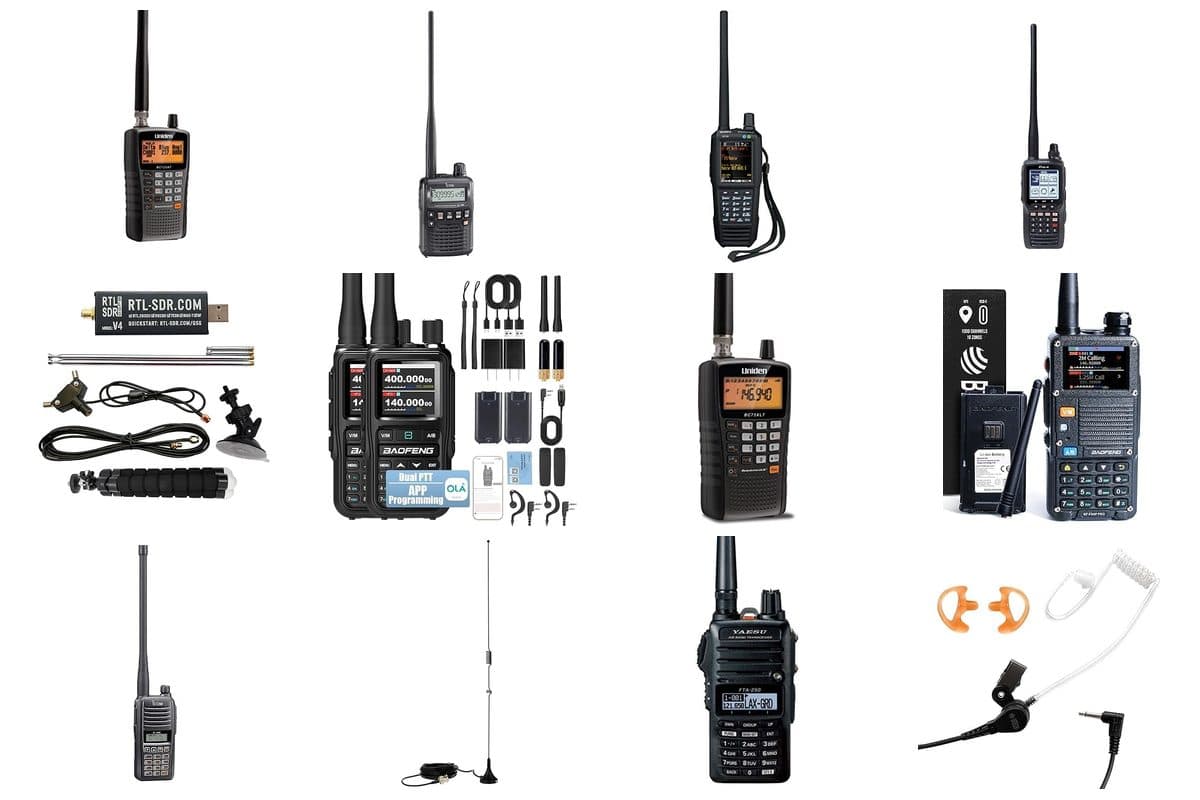

Aviation scanners let you hear every word between pilots and air traffic control, from routine approach clearances to Blue Angels demo coordination on UHF military frequencies. This guide covers 17 products from $8 adapters to a $700 flagship SDR scanner, organized by budget and use case. Unlike most scanner guides, we separate listen-only scanners from pilot transceivers, because those are fundamentally different tools for different people. If you are heading to an airshow this summer, planning to monitor your local airport from home, or just curious what ATC chatter sounds like, there is a pick here that fits.
For more aviation and military gear, check out our airshow essentials gear guide and Father's Day gifts for military enthusiasts.
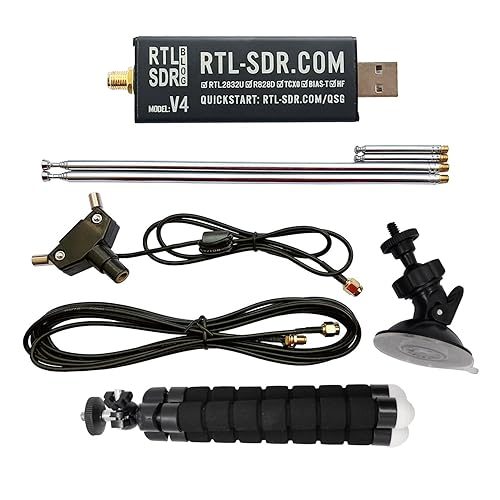
RTL-SDR Blog V4 Kit
~$40


What Will You Actually Hear on an Aviation Scanner?
Before spending any money, it helps to know exactly what comes through the speaker. Aviation radio uses AM modulation on VHF frequencies (118-136 MHz for civil) and UHF frequencies (225-400 MHz for military). Here is what you will pick up on each channel type:
- Tower controls aircraft on the runway and in the immediate airspace. Short, rapid-fire exchanges during busy periods.
- Ground handles taxiing aircraft between gates and runways. Lots of taxi instructions and hold-short commands.
- Approach/Departure manages aircraft climbing out or descending into the airport's airspace. Altitude assignments, heading vectors, speed restrictions.
- Center (ARTCC) handles high-altitude en route traffic. Longer, calmer exchanges than tower or approach.
- ATIS is an automated weather and runway information broadcast that updates hourly. Good for testing that your scanner is working.
- UNICOM (122.800 MHz) is used at uncontrolled airports where pilots self-announce positions.
A typical tower exchange sounds like this: "November 4-5-2 Bravo Charlie, cleared to land runway two-seven left, wind two-four-zero at one-two." That is the controller clearing a Cessna to land. Once you hear a few of these, the cadence becomes surprisingly easy to follow.
Why military UHF matters for airshows: Demo teams like the Blue Angels and Thunderbirds coordinate on UHF frequencies between 225-400 MHz. A scanner that only covers civil VHF (118-136 MHz) will pick up the announcer's ground coordination but miss the actual pilot-to-pilot chatter during maneuvers. If hearing "smoke on, pull" from a Thunderbird pilot is the goal, you need military UHF coverage.
Scanner vs. transceiver: A scanner is receive-only. You listen, period. A transceiver can both receive and transmit, but transmitting on aviation frequencies without proper FAA certification and a station license is a federal crime. For 99% of airshow attendees and plane spotters, a listen-only scanner is the right tool. Transceivers in this guide are listed for pilots who need a backup radio and want airshow monitoring as a bonus.
Legality: Listening to aviation frequencies is 100% legal in the United States under the Electronic Communications Privacy Act. You may listen to any unencrypted radio transmission. You may not transmit, and you may not use intercepted communications for unlawful purposes. Canada, the UK, and most of Europe have similar provisions allowing receive-only monitoring.
Best Budget Aviation Scanners Under $100
Four options for getting started without a major investment. The RTL-SDR requires a laptop but gives you a visual spectrum display. The Baofeng radios add aviation receive as a secondary feature. The Uniden BC75XLT is the first "real" dedicated scanner on the list.
RTL-SDR Blog V4 with Dipole Antenna Kit
~$40 on Amazon
See the entire aviation band at once on a spectrum waterfall display. Under $40 for the dongle plus dipole antenna. Requires a laptop and free software like SDR# or GQRX. This is the cheapest way to find out if aviation monitoring is your thing before investing in dedicated hardware.
Best for: Tech-savvy beginners and ADS-B enthusiasts who want visual spectrum analysis
Software-defined radio flips the traditional scanner concept on its head. Instead of tuning to one frequency at a time, the V4 dongle streams raw radio data to your laptop, and software decodes it. The waterfall display shows signal activity across the entire aviation band simultaneously, so you can visually spot active frequencies and click on them. For ADS-B tracking (the data that feeds FlightRadar24), this same dongle with the right software turns into a complete aircraft tracking station.
The trade-off is obvious: you need a laptop, a USB port, and 20-30 minutes of software setup. Walking around an airshow with a laptop open is not practical. This works best for home monitoring, car-based plane spotting near an airport, or pre-airshow frequency hunting from the parking lot. If the software side appeals to you, the RTL-SDR subreddit (r/RTLSDR) has extensive setup guides. If you want something you can turn on and use immediately, skip to the Uniden BC75XLT below.
Baofeng UV-5R Mini
~$40 on Amazon
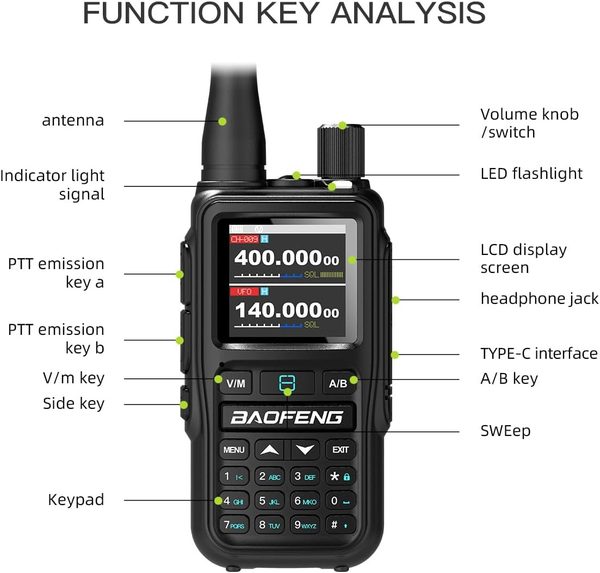
Pocket-sized radio with aviation AM band receive (108-136 MHz) plus VHF/UHF ham capability. USB-C charging and Bluetooth app programming make setup easier than older Baofeng models. 999 memory channels give you plenty of room for aviation, ham, and public safety frequencies.
Best for: Casual airshow attendees testing the hobby cheaply
Baofeng radios are everywhere in the ham radio world, and the UV-5R Mini adds aviation AM receive that earlier models lacked. USB-C charging is a welcome upgrade over the proprietary cradle chargers on older Baofengs, and Bluetooth app programming means you can set up channels from your phone instead of fumbling with the keypad. At $40, the barrier to entry is about as low as it gets for a standalone handheld.
Aviation receive sensitivity on the UV-5R Mini is noticeably worse than any dedicated scanner on this list. You will hear strong local tower signals clearly, but weaker approach and center frequencies may be scratchy or absent. There is no military UHF band coverage (225-380 MHz), so Thunderbirds and Blue Angels chatter is off the table. The stock 4-inch rubber duck antenna limits range further. If aviation monitoring is a secondary use behind ham radio, this works fine. If aviation is the primary goal, spend another $45 on the Uniden BC75XLT.
Uniden BC75XLT
~$85 on Amazon
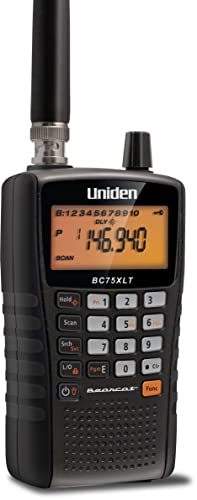
300 channels, Close Call RF Capture for automatic signal detection, NOAA weather alerts, and runs on 2 AA batteries you can find at any gas station. This is the first real dedicated scanner from a trusted brand at a price that does not require much deliberation.
Best for: Beginners who want a dedicated scanner without spending $150+
Close Call RF Capture is the feature that makes this scanner approachable for beginners. Turn it on, and the BC75XLT automatically detects and tunes to the strongest nearby signal. At an airshow, this means it will find active tower and ground frequencies without you programming anything. Pair that with NOAA weather alerts and 300 programmable channels, and you have a scanner that handles aviation, weather, and general public safety monitoring out of the box.
Where the BC75XLT falls short is military UHF. Its frequency range has gaps that exclude the 225-380 MHz band where demo teams operate. If Blue Angels coordination is what you are after, you need to step up to the BC125AT or SR30C. The 300-channel limit (vs. 500 on the BC125AT) and lack of alpha-tagging mean you will be scrolling through numbered channels instead of named ones. Manual-only programming is tedious for setting up dozens of aviation frequencies. The Uniden USB-1 programming cable works with this model and is practically mandatory if you plan to load more than a handful of channels.
Baofeng BF-F8HP PRO
~$90 on Amazon
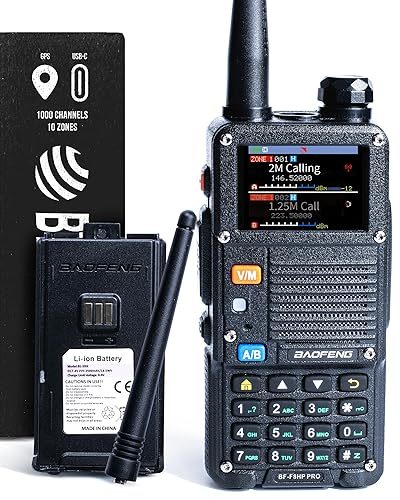
10W tri-band transceiver with aviation AM receive, built-in GPS, IP54 water resistance, USB-C charging, and 1,000 memory channels. More features packed into a $90 radio than some $200 scanners offer, though aviation monitoring is a secondary function here.
Best for: Ham operators who want airband listening as a bonus feature
On paper, this radio's spec sheet reads like it should cost twice as much. Built-in GPS for location tagging, IP54 water and dust resistance, 10W output on ham bands, USB-C for charging, and 1,000 memory channels. For ham operators who attend airshows as a secondary hobby, having aviation AM receive built into their everyday radio eliminates the need to carry a second device.
Aviation sensitivity trails dedicated scanners by a meaningful margin. The BF-F8HP PRO is a ham radio first and an aviation receiver second, and the performance reflects that priority. No military UHF coverage means no demo team monitoring. As a newer product, long-term reliability data is limited. Transmitting on any frequency requires the appropriate license, and Baofeng's wide-open transmit capability has drawn FCC attention in the past. For aviation-first users, the Uniden BC75XLT at a similar price will outperform this on airband reception every time.
Best Mid-Range Aviation Scanners ($100-$200)
This is where aviation scanners get serious. All three products in this tier cover military UHF frequencies, offer 500+ channels, and come from established scanner manufacturers with decades of receiver engineering behind them. For most airshow attendees, one of these three is the sweet spot.
Uniden SR30C
~$117 on Amazon
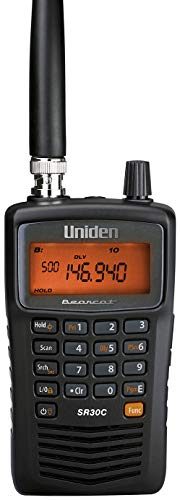
500 channels with alpha-tagging, Close Call RF Capture, and coverage spanning both civil VHF and military UHF (225-380 MHz). A current-production Uniden handheld with a compact modern design that fits easily in a shirt pocket.
Best for: Airshow attendees who want military band coverage in a compact, current-production scanner
At $117, the SR30C hits an interesting price point between the BC75XLT and BC125AT. You get the same 500-channel capacity and military UHF coverage as the BC125AT, plus Close Call automatic signal detection and alpha-tagging for naming your channels. The form factor is slimmer and more modern than the BC125AT, which matters if you are carrying it in a pocket for six hours at an airshow.
Analog-only reception means no P25 or DMR digital modes, which limits its usefulness outside aviation (most police and fire departments have gone digital). Compared to the BC125AT, the SR30C lacks PC programmability through an official USB cable, making manual channel entry the primary option. For $43 more, the BC125AT adds PC programming support and has a vastly larger community of users sharing frequency lists and setup guides. If the compact size and lower price appeal to you, the SR30C is a solid choice. If community support and programmability matter more, save for the BC125AT.
Uniden BC125AT
~$160 on Amazon
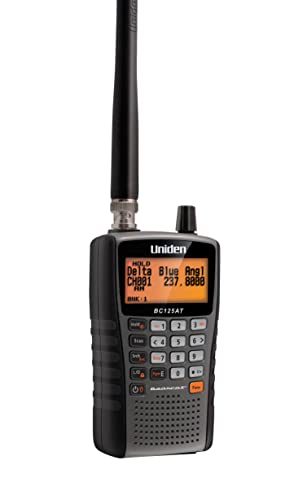
Over 9,000 Amazon reviews and the most recommended aviation scanner in forum threads, buying guides, and hobbyist communities for good reason. 500 alpha-tagged channels covering civil VHF and military UHF (225-380 MHz), PC programmable via USB cable, and Close Call automatic signal detection that finds active frequencies for you.
Best for: Airshow attendees who want to hear Blue Angels, Thunderbirds, and military demo teams
There is a reason the BC125AT shows up in every "what scanner should I bring to the airshow" thread: it covers the right frequencies, it is easy to program, and 9,000+ buyers have validated that it works. Military UHF coverage (225-380 MHz) means you hear the Thunderbirds calling their formations on 294.700 and 322.300 MHz, and the Blue Angels on 382.500 and 384.400 MHz. Alpha-tagging lets you name channels ("BLUE ANG 1" instead of "CH 047"), and Close Call automatically detects and tunes to strong nearby signals when you do not know which frequency is active.
Two immediate upgrades are worth budgeting for. First, the stock rubber duck antenna is mediocre, and a $15-20 replacement antenna will noticeably improve reception range. Second, hand-programming 500 channels through the keypad is a tedious process that the Uniden USB-1 cable ($28) eliminates entirely. The BC125AT is analog-only, so it will not decode P25 digital signals, and it has no weather sealing. For pure aviation monitoring at airshows, none of those limitations matter. This is the scanner to beat at any price under $200.
Icom IC-R6
~$190 on Amazon
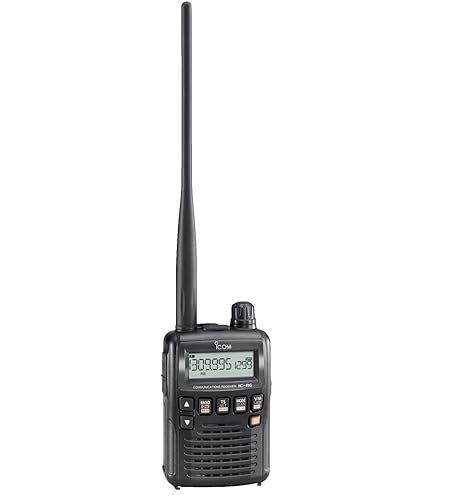
Wideband receiver covering 100 kHz to 1.3 GHz with 1,300 memory channels and a scan speed of 100 channels per second. The Air Band Special version ships pre-programmed with aviation frequencies. At 7 ounces, it practically disappears in a jacket pocket. Icom's receiver sensitivity is measurably superior to Uniden on weak signals from distant aircraft.
Best for: Serious plane spotters who prioritize sensitivity and scan speed
Icom builds commercial and military-grade communications equipment, and the IC-R6 benefits from that engineering pedigree. Its receiver front-end pulls in weak signals that the BC125AT misses, which matters when you are trying to hear approach control from 30 miles away or military aircraft at altitude. Scanning 100 channels per second means the IC-R6 checks its entire memory bank faster than any Uniden handheld, reducing the chance of missing a brief transmission. The 100 kHz to 1.3 GHz range covers everything from longwave through UHF military, HF shortwave, VHF marine, and amateur radio.
This is a receive-only device with no transmit capability, which is exactly what most aviation enthusiasts need. The downside is availability: Icom has been gradually phasing out the IC-R6, and stock fluctuates. The display is tiny by modern standards, and manual programming without the optional CS-R6 software and cable is an exercise in patience. No Close Call equivalent exists, so you need to know your frequencies ahead of time. For airport monitoring and plane spotting where sensitivity matters more than convenience features, the IC-R6 remains the benchmark in its price range.
Best Premium Aviation Scanners and Transceivers ($200-$700)
Premium territory splits into two categories: pilot transceivers (Yaesu and Icom aviation radios that can transmit) and the Uniden SDS100 (the most advanced scanner you can buy). Pilots shopping for a backup radio should look at the Yaesu and Icom options. Scanner enthusiasts who want the absolute best receive performance should jump straight to the SDS100.
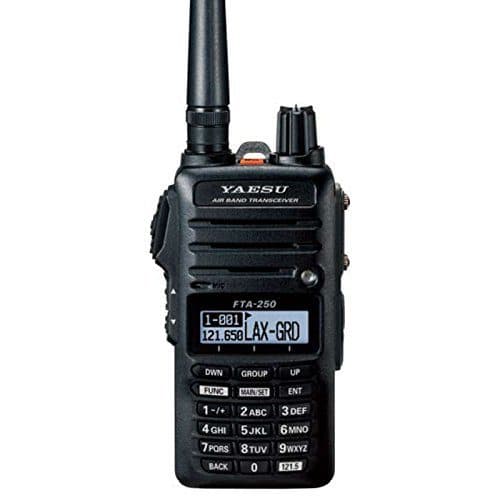
Yaesu FTA-250L
~$240 on Amazon
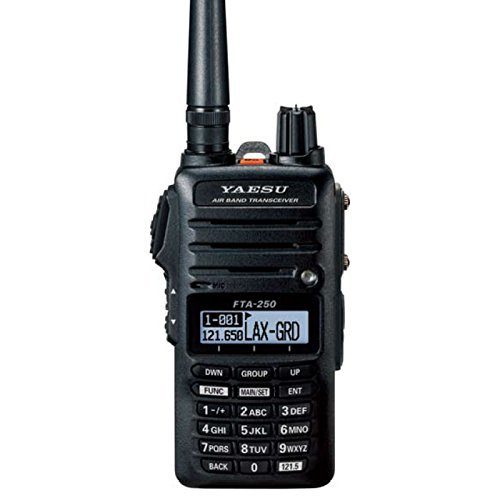
Aviation VHF transceiver covering 118-136 MHz with 5W output and MIL-STD-810 military-grade construction. Built for student pilots needing a backup COM radio who also want to use it for airshow and airport monitoring. COM-only design keeps the cost below NAV/COM models.
Best for: Student pilots who need a backup COM radio
Yaesu's entry-level aviation transceiver passes MIL-STD-810 testing for shock, vibration, humidity, and temperature extremes. The 5W output reaches ATC from the ground or air, and the lithium-ion battery eliminates the AA battery runs that scanner users deal with. For student pilots in training, carrying a backup handheld COM radio is a common recommendation from flight instructors, and the FTA-250L fills that role at the lowest price in Yaesu's aviation lineup.
For listen-only airshow use, this radio is harder to justify. It covers only 118-136 MHz, which means no military UHF, no weather bands, no public safety, and no ham. A BC125AT at $160 covers vastly more spectrum and costs $80 less. You are paying for transmit capability that listen-only users legally cannot use. If you are a pilot or student pilot, the FTA-250L makes sense as a dual-purpose tool. If you are purely an enthusiast listener, your money goes further with a dedicated scanner.
Yaesu FTA-550L
~$360 on Amazon
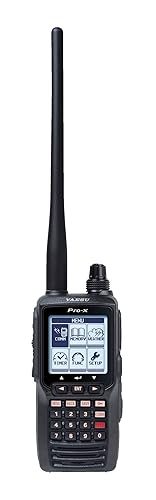
Professional aviation transceiver with both NAV and COM capability. VOR and ILS localizer displays provide navigation backup. 200 memory channels, MIL-STD-810F rated, IPX5 water resistant. 800 mW audio output cuts through cockpit noise and airshow crowds.
Best for: Pilots wanting a full-featured backup radio with navigation capability
Adding NAV capability transforms this from a backup COM radio into a legitimate emergency navigation tool. The VOR receiver and ILS localizer display let a pilot navigate to and shoot an instrument approach using only this handheld, which is the kind of redundancy that matters when your panel avionics fail at 3,000 feet in IMC. 800 mW audio output is louder than most handhelds, and IPX5 water resistance means rain on the ramp will not kill it.
Programming channels through the onboard interface requires patience and a steady hand on tiny buttons. No military UHF monitoring, so airshow demo team frequencies are off limits. At $360, listen-only users should look elsewhere, as a BC125AT plus accessories covers more frequencies for half the price. But for pilots who want COM, NAV, and airshow listening in a single rugged package, the FTA-550L is the most popular choice in its category for good reason.
Yaesu FTA-750L
~$460 on Amazon
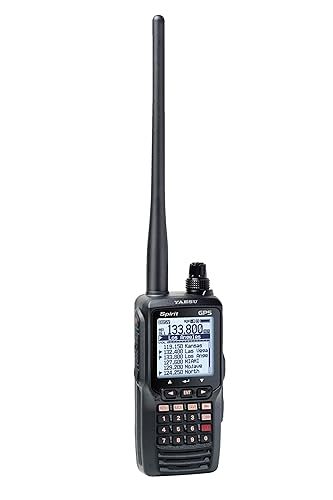
Everything in the FTA-550L plus a 66-channel WAAS GPS with waypoint navigation, compass display, and bearing/distance readouts. This is the most capable aviation handheld Yaesu makes, combining NAV, COM, and GPS into one device that fits in a flight bag pocket.
Best for: Pilots who want the ultimate backup radio with GPS navigation
GPS adds situational awareness that the FTA-550L lacks. Waypoint navigation with bearing, distance, and ground speed means you can navigate to an airport without any other equipment. WAAS correction provides GPS accuracy to within 3 meters, and the 66-channel receiver acquires satellites quickly even after a cold start. For VFR pilots who fly in remote areas where a panel GPS failure could be disorienting, this is genuine peace of mind in a 12-ounce package.
At $460, the FTA-750L is $100 more than the FTA-550L, and the GPS is the only functional difference. Listen-only users gain nothing from the GPS, NAV, or COM features, making this a poor value for pure aviation monitoring. It is also the heaviest Yaesu option, which adds up during a long day at an airshow. For pilots, the decision between the FTA-550L and FTA-750L comes down to whether built-in GPS backup justifies the $100 premium. For everyone else, the BC125AT or IC-R6 covers more spectrum for less money.
Icom IC-A16
~$479 on Amazon
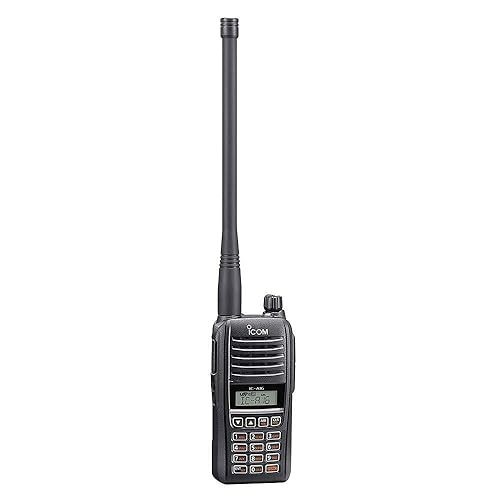
6W output (20% more than any Yaesu handheld), IP67 waterproofing (fully submersible to 1 meter for 30 minutes), 17-hour battery life on a single charge, and 1,500 mW audio that is louder than anything else on this list. MIL-STD-810G rated. The 121.5 MHz emergency key provides one-button access to the guard frequency. Backed by a 3-year warranty.
Best for: Pilots who prioritize waterproofing, durability, and battery life above all else
Icom builds the IC-A16 to survive conditions that would destroy consumer electronics. IP67 means it handles full submersion, not just rain. MIL-STD-810G covers a broader range of environmental tests than the 810F spec on Yaesu models. 17-hour battery life means multi-day use between charges, and 6W output provides the strongest signal of any handheld aviation radio, which matters for reaching ATC from the ground in an emergency. The 121.5 MHz emergency button is a thoughtful safety feature that requires no menu navigation during a high-stress situation.
What you do not get for $479 is any NAV capability. No VOR, no ILS, no GPS. The FTA-550L at $360 includes NAV, and the FTA-750L at $460 adds GPS on top of that. Paying $479 for COM-only seems steep when Yaesu offers more features for less. Icom's counter-argument is build quality and audio performance, and on those two dimensions, the IC-A16 is clearly superior. For seaplane pilots, float operators, or anyone who regularly gets their gear wet, the IP67 rating alone may justify the price. For dry-climate GA pilots, the Yaesu options offer better value.
Uniden SDS100
~$700 on Amazon
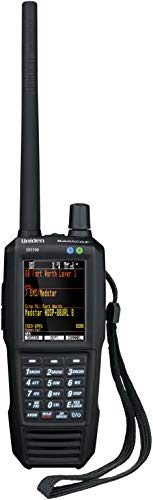
True I/Q SDR technology delivers the best digital decode performance available in any handheld scanner. Covers 25-1300 MHz with the HomePatrol database: enter your zip code and it programs itself. Users on RadioReference report reliable aircraft reception at 150-250+ miles. P25 Phase I/II, DMR, and NXDN digital modes. JIS4 water resistant with GPS location awareness.
Best for: Scanner enthusiasts who want the absolute best receiver technology in a handheld
I/Q (in-phase/quadrature) SDR processing captures the raw radio signal digitally and decodes it in software, producing cleaner audio and better weak-signal performance than traditional superheterodyne receivers. In practical terms, the SDS100 hears aircraft that the BC125AT cannot, decodes digital P25 signals from public safety agencies, and covers a frequency range wide enough to monitor virtually everything on the radio spectrum. The HomePatrol database eliminates programming entirely for common use: enter your location, select "Aviation" and "Military" categories, and the scanner auto-configures.
At $700, this is extreme overkill for someone who only wants to hear tower chatter at the local airshow. The learning curve is steep, firmware updates require a Windows PC, and some advanced features like ProVoice and EDACS decoding require a paid subscription. The menu system is dense, and casual users may find themselves lost in settings they do not understand. Battery life is shorter than simpler scanners due to the processing demands of SDR decoding. If aviation monitoring is your only use case, a BC125AT at $160 covers 80% of the same territory. If you want one scanner that does everything, from aviation to police to fire to military to ham to marine, and does it better than anything else, the SDS100 is where you end up.
Must-Have Aviation Scanner Accessories
A scanner is only as good as the antenna connected to it and the accessories supporting it. These five products cost less than $30 each and will make a bigger difference in your listening experience than spending an extra $100 on a fancier scanner.
Tram 1089-BNC Mini-Magnet Antenna
~$17 on Amazon
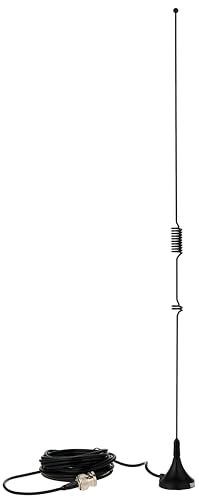
A $17 magnet-mount antenna on a car roof or metal surface will improve your reception more than upgrading to a scanner that costs twice as much. 16.5-inch whip with 10-foot RG174 cable and BNC connector covers both VHF and UHF aviation bands.
Best for: Home monitoring or car-based plane spotting near airports
Most scanner owners never realize that the stock rubber duck antenna is the single biggest bottleneck in their setup. It is a compromise designed for portability, not performance. A magnet-mount antenna on a metal surface (car roof, filing cabinet, cookie sheet) provides a proper ground plane that dramatically improves signal capture. Users routinely report hearing approach and center frequencies they could not pick up at all with the stock antenna.
The limitation is portability. You need a metal surface for the magnet, and 10 feet of RG174 cable tethers you to whatever that surface is. RG174 is thin cable with higher signal loss than thicker RG58, so longer runs are not ideal. For walking around an airshow, the stock antenna or the Radtel replacement antenna below is more practical. For monitoring from home or a parked car at the airport viewing area, the Tram 1089 is the single highest-impact upgrade you can make for under $20.
Radtel Aviation Antenna
~$13 on Amazon
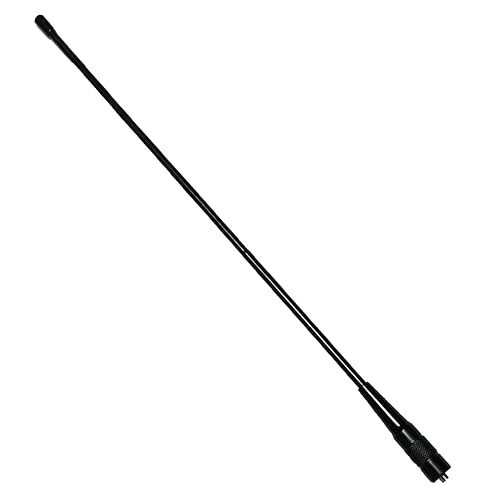
Aviation-specific replacement antenna tuned for 108-136 MHz with an SMA-Female connector that fits Baofeng radios directly. At 15 inches, it provides significantly better airband reception than the stock 4-inch rubber duck that ships with most budget radios.
Best for: Baofeng UV-5R Mini or BF-F8HP PRO owners who want better airband range
Antenna tuning matters. A 15-inch whip cut specifically for the 108-136 MHz aviation band will outperform a general-purpose 4-inch rubber duck on airband frequencies every time. The gain difference is substantial enough that a $40 Baofeng with this antenna will hear tower frequencies better than the same radio with the stock antenna. SMA-Female threading matches Baofeng, Radtel, and most Chinese-made handhelds directly.
Because this antenna is optimized for VHF airband, it will actually degrade performance on UHF military frequencies (225-380 MHz). Antenna physics is a zero-sum game at these lengths. If you use a Baofeng primarily for ham radio on UHF, swapping to this antenna will weaken those signals. SMA-F does not fit Uniden scanners (which use BNC), so you will need the SMA to BNC adapter below if you want to cross platforms. For $13, this is the easiest performance boost available for Baofeng owners heading to an airshow.
BTECH QHM01 Listen-Only Earpiece
~$10 on Amazon
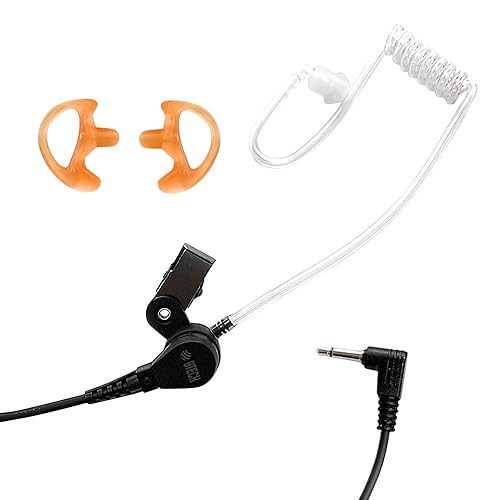
Acoustic tube earpiece that lets you hear scanner audio in noisy airshow environments without holding the radio to your ear. 3.5mm jack fits any scanner or radio on this list. Includes earmolds and earbuds. Under $10, and arguably the most useful accessory on this page.
Best for: Every single person who brings a scanner to an airshow
Airshows are loud. Jet engines at close range produce 130+ dB, and even prop aircraft generate enough noise to make a scanner's built-in speaker useless beyond arm's length. An earpiece solves this completely. The acoustic tube design routes audio through a flexible tube to an earmold that sits in your ear canal, delivering clear audio even when a C-17 is doing a low pass 200 feet overhead.
Audio quality through the acoustic tube is adequate for voice communications but will not impress anyone used to earbuds or IEMs. Single-ear only, which is actually a safety advantage at airshows since you can still hear announcements and your surroundings with the other ear. The acoustic tube can kink if you stuff it carelessly into a pocket, so route it inside your shirt collar. At $10, there is no reason not to own one if you bring a scanner to any outdoor event.
Uniden USB-1 Programming Cable
~$28 on Amazon
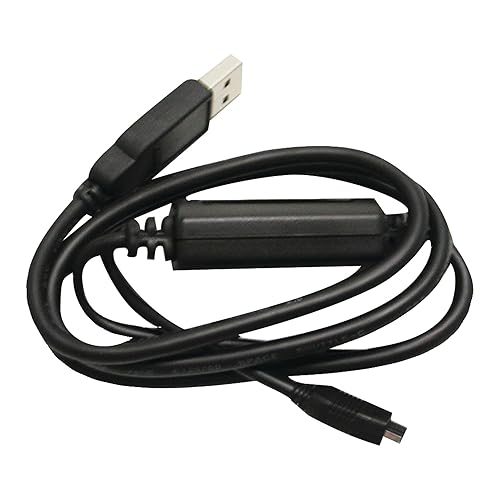
Makes programming your BC125AT or BC75XLT from a PC infinitely faster than manual keypad entry. Combined with Uniden's free programming software, you can set up hundreds of channels with names, frequencies, and delay settings in minutes instead of hours.
Best for: BC125AT or BC75XLT owners (practically mandatory)
Hand-programming a BC125AT through the keypad involves entering each frequency digit by digit, setting the modulation mode, adding alpha tags character by character, and repeating for every single channel. For 20 channels, it is tedious. For 200 channels, it is miserable. The USB-1 cable connects your scanner to a PC and lets Uniden's free software handle the heavy lifting. Import frequency lists from RadioReference.com, name all your channels, organize them into banks, and upload everything in one shot.
Official software is Windows-only, which is the main limitation. Third-party options like FreeSCAN and CHIRP provide Mac and Linux compatibility, though with a less polished interface. The cable itself is straightforward USB to proprietary scanner connector. If you own a BC125AT or BC75XLT and do not own this cable, you are making your life unnecessarily difficult. Buy it at the same time as the scanner.
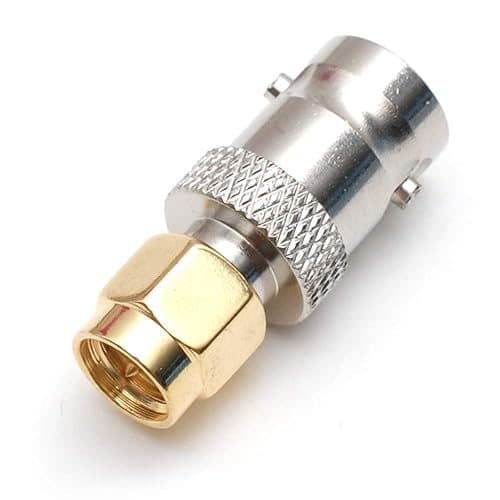
SMA to BNC Adapter
~$8 on Amazon
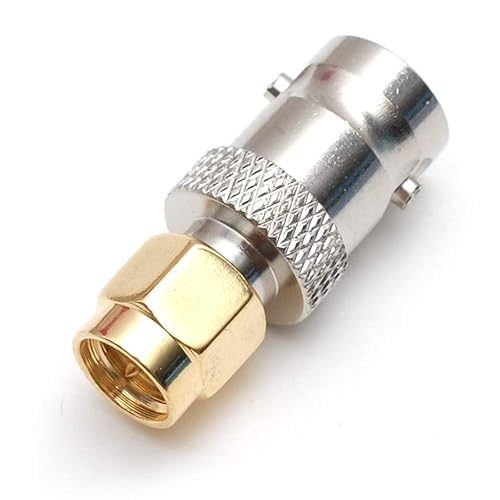
Lets you use BNC antennas (like the Tram 1089) on scanners with SMA connectors, or vice versa. Small, cheap, and essential if you own radios with different connector types and want to share antennas between them.
Best for: Anyone connecting mismatched antenna and scanner connectors
Scanner manufacturers cannot agree on an antenna connector standard. Uniden uses BNC, Baofeng uses SMA-Female, Icom varies by model. If you accumulate more than one radio and a couple of aftermarket antennas, you will inevitably need an adapter. This SMA-Male to BNC-Female adapter handles the most common mismatch.
Every adapter introduces a tiny amount of signal loss, but at these frequencies and cable lengths, the loss is negligible compared to the gain from using a better antenna in the first place. Keep one of these in your scanner bag so you are never stuck with the wrong connector at an airshow. At $8, it is the cheapest insurance on this list.
The Antenna Is More Important Than the Scanner
This is the single most overlooked fact in aviation scanning: a $100 scanner paired with a $17 magnet-mount antenna will consistently outperform a $400 scanner using its stock rubber duck. The stock antennas shipped with handheld scanners are 3-5 inch compromises designed for pocket portability, not signal capture. They work for strong nearby signals (a tower 2 miles away) but struggle with weaker signals (approach control at 30 miles, en route aircraft at altitude).
Why the difference is so large comes down to physics. A longer antenna tuned to the target frequency range captures more signal energy. A ground plane (the metal surface under a magnet-mount antenna) reflects signal toward the antenna element, effectively doubling its capture area. Height above obstructions matters enormously at VHF and UHF frequencies, where signals travel in straight lines. A magnet-mount antenna on a car roof clears nearby heads, chairs, and buildings that absorb or block signals at ground level.
The practical upgrade path looks like this: Start with whatever antenna comes with your scanner and learn the basics. When you want better range, add the Radtel aviation antenna ($13) for walking around airshows, as it triples the effective length of a Baofeng's stock antenna. For home monitoring or car-based spotting, add the Tram 1089 magnet mount ($17) and stick it on any metal surface. These two antennas together cost less than $30 and represent the highest-value upgrade available in the hobby.
Aviation Frequency Quick Reference
Program these frequencies before your next airshow or airport visit. All aviation communications use AM modulation. Civil frequencies are VHF (any scanner covers these), while military demo team frequencies are UHF (requires a scanner with 225-400 MHz coverage).
| Frequency (MHz) | Use | Band |
|---|---|---|
| 121.500 | Emergency / Guard (all aircraft monitor this) | VHF |
| 122.750 | Common air-to-air communications | VHF |
| 122.800 | Common UNICOM (uncontrolled airports) | VHF |
| 122.900 | Common MULTICOM | VHF |
| 123.025 | Helicopter air-to-air | VHF |
| 123.450 | Common airshow coordination | VHF |
| ATIS (varies) | Automated weather/runway info (airport-specific) | VHF |
| 243.000 | Military emergency / Guard | UHF |
| 294.700 | Thunderbirds primary | UHF |
| 322.300 | Thunderbirds secondary | UHF |
| 382.500 | Blue Angels primary | UHF |
| 384.400 | Blue Angels secondary | UHF |
Finding your local frequencies: Go to RadioReference.com, search for your state and county, then look under the "Aviation" section. Every controlled airport's tower, ground, approach, and ATIS frequencies are listed. For airshow-specific frequencies, check the event's official program or the RadioReference airshow forum, where attendees share discovered frequencies before and during events.
Digital Companion Tools for Aviation Monitoring
A physical scanner tells you what pilots are saying. These free digital tools show you what is happening visually, creating a complete picture when used together.
- LiveATC.net - Free streaming of ATC audio from thousands of airports worldwide. Useful for previewing what your local airport sounds like before buying a scanner, and for monitoring airports outside your scanner's range.
- FlightRadar24 / ADS-B Exchange - Real-time aircraft tracking on a map. When you hear a callsign on the scanner, pull it up on FlightRadar24 to see exactly what aircraft it is, where it is going, altitude, speed, and aircraft type.
- RadioReference.com - The most comprehensive frequency database available. Every airport, every agency, every trunked radio system. This is where you find the frequencies to program into your scanner.
The combination is powerful: hear a callsign on the scanner, look it up on FlightRadar24, and know instantly that the voice you are hearing belongs to a Delta 737 descending through 8,000 feet on approach to runway 27L. At airshows, track the demo team's positioning on ADS-B while listening to their coordination frequency for a complete behind-the-scenes experience.
Aviation Scanner Comparison Table
| Scanner | Price | Freq Range | Mil UHF | Channels | Battery | Weight | Best For |
|---|---|---|---|---|---|---|---|
| RTL-SDR V4 | ~$40 | 500 kHz - 1.7 GHz | Yes | N/A (software) | USB powered | 1 oz | Tech-savvy beginners |
| Baofeng UV-5R Mini | ~$40 | 108-136 MHz AM | No | 999 | Li-Ion (USB-C) | ~5 oz | Casual listeners |
| Uniden BC75XLT | ~$85 | 25-512 MHz | No | 300 | 2x AA | ~7 oz | Entry-level scanner |
| Baofeng BF-F8HP PRO | ~$90 | 108-136 MHz AM | No | 1,000 | Li-Ion (USB-C) | ~9 oz | Ham + airband |
| Uniden SR30C | ~$117 | 25-512 MHz | Yes | 500 | 2x AA / NiMH | ~7 oz | Compact military band |
| Uniden BC125AT | ~$160 | 25-512 MHz | Yes | 500 | 2x AA / NiMH | ~7 oz | Airshows (best value) |
| Icom IC-R6 | ~$190 | 100 kHz - 1.3 GHz | Yes | 1,300 | 2x AA / NiMH | 7 oz | Serious plane spotters |
| Yaesu FTA-250L | ~$240 | 118-136 MHz | No | 200 | Li-Ion | ~10 oz | Student pilots |
| Yaesu FTA-550L | ~$360 | NAV + COM | No | 200 | Li-Ion | ~11 oz | Pilots (NAV backup) |
| Yaesu FTA-750L | ~$460 | NAV + COM + GPS | No | 200 | Li-Ion | ~12 oz | Pilots (GPS backup) |
| Icom IC-A16 | ~$479 | 118-137 MHz | No | 200 | Li-Ion | ~11 oz | Waterproof COM |
| Uniden SDS100 | ~$700 | 25-1300 MHz | Yes | Unlimited* | Li-Ion | ~14 oz | Everything (flagship) |
Aviation Scanner FAQ
What is the best aviation scanner for airshows?
The Uniden BC125AT (~$160) is the most recommended airshow scanner. It covers both civil VHF (118-136 MHz) and military UHF (225-380 MHz), which means you hear tower communications and demo team coordination from the Blue Angels and Thunderbirds. 500 alpha-tagged channels, PC programmability, and Close Call automatic signal detection make it practical to use all day. Over 9,000 Amazon reviews back it up.
Do I need a digital scanner for aviation monitoring?
No. Aviation voice communications use analog AM modulation, and this is not changing anytime soon. Every scanner on this list can receive analog AM. Digital scanners like the Uniden SDS100 add the ability to decode P25, DMR, and other digital modes used by police and fire departments, but that capability is irrelevant for aviation-only monitoring. An analog scanner like the BC125AT handles 100% of aviation voice traffic.
Can I listen to military aircraft on a scanner?
Yes, but you need a scanner that covers UHF frequencies from 225-400 MHz. Budget scanners that only cover VHF will miss military communications entirely. The Uniden BC125AT, Uniden SR30C, Icom IC-R6, and Uniden SDS100 all include military UHF coverage. The Baofeng radios and Uniden BC75XLT do not. Military aircraft sometimes use encrypted communications, which no consumer scanner can decode, but unencrypted tactical and coordination frequencies (including demo team channels) are fully receivable. Our ranking of the 50 best military aircraft covers many of the platforms you will hear on these frequencies.
Is it legal to listen to aviation frequencies in the United States?
Yes. Listening to any unencrypted radio transmission is fully legal in the United States under the Electronic Communications Privacy Act. You may listen to aviation, military, police, fire, marine, and amateur radio frequencies without any license or permit. What is illegal is transmitting on aviation frequencies without proper FAA certification, using intercepted communications for criminal purposes, or jamming frequencies. Simply listening with a scanner requires no license.
What is the difference between a scanner and a transceiver?
A scanner is receive-only. You can listen but cannot transmit. A transceiver can both receive and transmit. For aviation monitoring at airshows or airports, a scanner is all you need and is the appropriate tool. Transceivers like the Yaesu FTA-550L and Icom IC-A16 are designed for pilots who need to communicate with ATC. Transmitting on aviation frequencies without proper certification is a federal offense that carries serious penalties. If you are not a pilot, buy a scanner.
Should I get an RTL-SDR dongle instead of a dedicated scanner?
It depends on how you plan to use it. An RTL-SDR dongle (~$40) covers a wider frequency range, provides a visual spectrum waterfall display, and costs less than any dedicated scanner. But it requires a laptop, software installation, and some technical knowledge to set up. You cannot walk around an airshow with a laptop. For home monitoring, ADS-B tracking, or experimenting with radio, the RTL-SDR is hard to beat. For grab-and-go portability at events, a dedicated handheld scanner wins.
What antenna should I upgrade to for better aviation reception?
For walking around airshows with a Baofeng radio, the Radtel aviation antenna ($13) is the best portable upgrade. For home or car-based monitoring with a Uniden scanner, the Tram 1089 magnet-mount antenna ($17) provides the biggest performance improvement. Both cost under $20 and will make a more noticeable difference in reception than spending an extra $100 on a better scanner. Read the antenna section above for the full explanation of why antennas matter more than most people realize.
How do I find frequencies for my local airport or airshow?
Go to RadioReference.com, search for your state and county, and look under the Aviation section. Every controlled airport's tower, ground, approach, departure, and ATIS frequencies are listed. For airshow-specific frequencies, check the RadioReference airshow forum where attendees share discovered frequencies. You can also check the frequency reference table above for common national frequencies that work everywhere, like 121.500 (emergency), 122.800 (UNICOM), and demo team UHF channels.
How far away can I hear aircraft on a scanner?
Range depends on your antenna, the aircraft's altitude, and terrain. With a stock rubber duck antenna, expect reliable reception within 15-30 miles for aircraft at altitude and 3-5 miles for ground communications. A magnet-mount antenna on a car roof extends that to 40-80 miles for airborne aircraft. Users with the Uniden SDS100 and external antennas report hearing aircraft beyond 150 miles. Higher altitude aircraft are always easier to hear because VHF and UHF signals travel in straight lines, and altitude provides line-of-sight over the Earth's curvature.
Can I use a scanner to listen to airline pilots talking to each other?
Pilots on the same airline sometimes use a company frequency for operational coordination, and these are receivable on a scanner. However, most inter-crew communication happens on intercom systems within the cockpit, which do not transmit over radio. What you will primarily hear is pilot-to-ATC communications: clearances, altitude assignments, position reports, weather requests, and approach instructions. That said, pilots occasionally chat with ATC about weather conditions, turbulence reports, and traffic, and those exchanges can be surprisingly interesting to listen to.
Community Resources for Aviation Scanner Enthusiasts
- RadioReference.com - The most comprehensive frequency database online. Airport frequencies, trunked system information, airshow frequency threads, and active forums where experienced scanner users answer questions.
- LiveATC.net - Free streaming ATC audio from airports worldwide. Listen before you buy to hear what aviation monitoring actually sounds like. Also useful for monitoring airports outside your scanner's physical range.
- r/RTLSDR - Active subreddit for software-defined radio enthusiasts. Setup guides, antenna projects, ADS-B tracking tutorials, and troubleshooting help for the RTL-SDR platform.
- r/aviation - General aviation community with frequent airshow threads, plane spotting photo posts, and scanner discussions during major airshow weekends.
Final Recommendations
For most airshow attendees and plane spotters, the Uniden BC125AT at $160 is the right answer. It covers civil and military frequencies, has the largest community support base, and works well out of the box with a simple antenna upgrade. Pair it with the USB-1 programming cable ($28) and the BTECH earpiece ($10), and your total investment is under $200 for a complete airshow listening setup.
If budget is tight, the RTL-SDR V4 kit ($40) lets you explore the entire radio spectrum for the price of a restaurant dinner. You need a laptop and some patience with software, but there is no cheaper way to find out if aviation monitoring appeals to you.
For serious plane spotters who want the best weak-signal performance, the Icom IC-R6 ($190) has the most sensitive receiver in a handheld package. And for scanner enthusiasts with no budget limits, the Uniden SDS100 ($700) is the best handheld scanner available, period.
Whatever you choose, remember that the antenna matters more than the scanner. A $17 Tram magnet-mount on any of these radios will improve your experience more than doubling your scanner budget. Start with the scanner, add an earpiece and antenna, and you are ready for airshow season. For more gear recommendations, see our airshow essentials guide and military gift guide.