Skip to content
April 23:The Zeebrugge Raid108yr ago

Why Submarines Listen Instead of Look, and How Sound Bends Underwater to Help Them

Nathan Cole · · 11 min read
Save
Share:
USS Virginia (SSN 774) moored at Naval Submarine Base New London in Groton, Connecticut
Nathan Cole
Nathan Cole

Naval Warfare & Maritime Systems Analyst

Nathan Cole covers naval warfare, maritime strategy, and the ships and submarines that project power across the world's oceans. His work focuses on fleet architecture, carrier operations, and how navies adapt to threats from missiles, drones, and undersea warfare.

A submarine's most important weapon has never been a torpedo. It's listening. Every modern submarine is essentially a mobile acoustic sensor platform that also happens to carry weapons. The ability to detect other vessels, while remaining undetected yourself, determines who wins undersea engagements long before anyone opens a torpedo tube. Everything about submarine design, tactics, and technology flows from this single reality: in the ocean, sound is the only sense that works at useful distances.

Light fades to nothing within a few hundred feet of the surface. Radar signals attenuate almost instantly in seawater. Radio waves cannot penetrate more than a few dozen feet below the surface at usable frequencies. But sound waves travel roughly 4.5 times faster in water than in air, and under the right conditions, low-frequency sounds can propagate thousands of miles through the ocean. This makes acoustics the dominant medium of undersea warfare, and sonar the technology that exploits it.

Active Sonar: The Ping That Gives You Away

Active sonar is what most people picture when they think of submarine detection: a loud ping radiating outward from a transducer, bouncing off a target, and returning as an echo that reveals the target's bearing, range, and sometimes speed. It's simple physics, the same principle as echolocation used by bats and dolphins.

Active sonar works. It provides precise range and bearing information that passive sonar cannot easily deliver. Against quiet targets in cluttered acoustic environments (like shallow coastal waters with complex bottom topography), active sonar may be the only reliable detection method. Surface ships routinely use active sonar during anti-submarine warfare (ASW) operations because surface ships are already acoustically loud. The noise of their engines, propellers, and hull movement through the water means they have little acoustic stealth to protect.

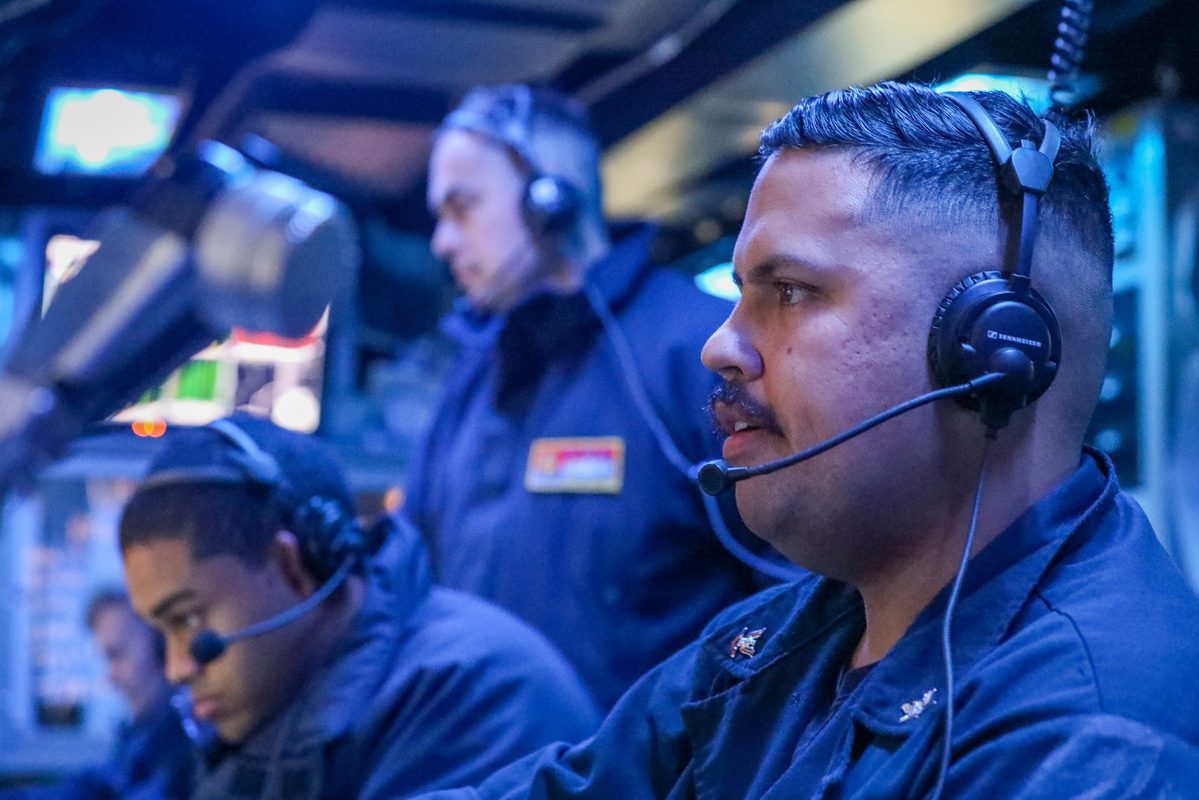
Sonar technician monitoring displays in the main sonar room aboard a guided-missile destroyer during anti-submarine warfare exercise
A sonar technician monitors displays in the main sonar room aboard USS Benfold during a bilateral anti-submarine warfare exercise. Surface ships routinely use active sonar because they lack the acoustic stealth that submarines rely on (U.S. Navy photo).

For a submarine, however, active sonar is usually a weapon of last resort. The problem is fundamental: the ping that you transmit is audible at much greater distances than the returning echo. When a submarine goes active, every passive sonar in the ocean hears it, and the listening platform now knows exactly where the submarine is, even if it didn't before. It's the acoustic equivalent of turning on a flashlight in a dark room full of people who are looking for you. You might see something useful, but everyone else in the room now sees you.

This is why submarine commanders spend the vast majority of their time listening rather than pinging. The tactical imperative of remaining hidden almost always outweighs the benefit of precise active sonar data. A submarine that maintains acoustic silence and detects its adversary passively holds an enormous tactical advantage: it knows where the target is, but the target doesn't know it's being tracked.

Passive Sonar: The Art of Listening

Passive sonar doesn't transmit anything. It simply listens to the sounds propagating through the water and uses sophisticated signal processing to identify, classify, and track contacts. Every vessel in the ocean produces noise (from machinery, propellers, hull flow, and onboard equipment), and that noise radiates outward as a unique acoustic signature.

The challenge of passive sonar is separating the signal you want from the enormous background noise of the ocean. The sea is not quiet. Waves, marine life, seismic activity, shipping traffic, rain, and even ice formation all generate sound. A skilled sonar team and advanced signal processing algorithms must filter through this ambient noise to detect the faint acoustic traces of a submarine, which might be as subtle as the hum of a specific cooling pump operating at a known frequency or the blade rate of a particular propeller design.

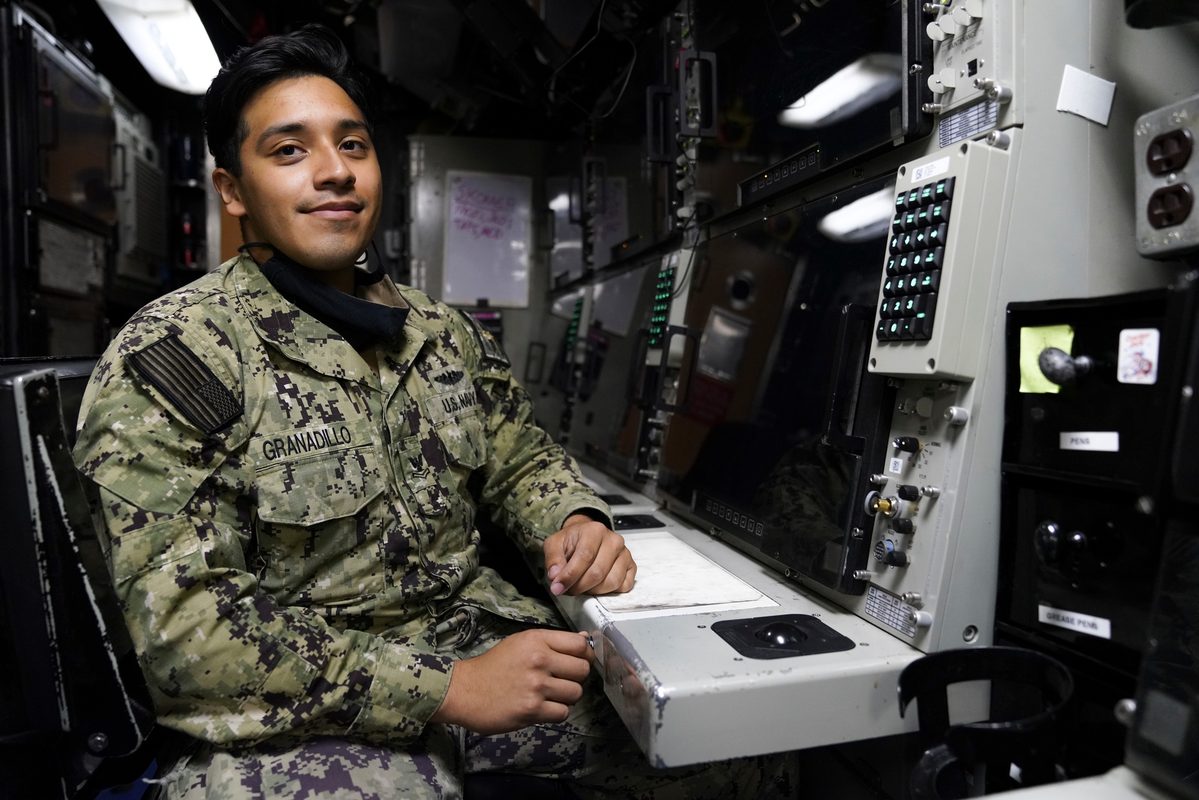
Sonar technician aboard a Los Angeles-class fast-attack submarine seated at sonar station with display equipment
A sonar technician aboard the Los Angeles-class submarine USS Key West (SSN 722). Submarine sonar operators spend years developing the ability to identify contacts from their acoustic signatures, a skill that remains critical despite advances in automated signal processing (U.S. Navy photo).

Modern submarines carry multiple passive sonar arrays to maximize their listening capability. The Virginia class, the U.S. Navy's current production attack submarine, uses the AN/BQQ-10 sonar processing system, which integrates inputs from several different arrays. The bow-mounted Large Aperture Bow (LAB) array replaces the traditional spherical sonar dome used on earlier submarines with a set of large, flat hydrophone panels mounted in a horseshoe pattern around the bow. These panels provide excellent medium and high-frequency detection performance and wide-area coverage across the submarine's forward hemisphere.

Along the sides of the hull, wide-aperture arrays (WAAs) consist of three large hydrophone panels on each side of the submarine. The WAAs are particularly effective at determining the range to a contact, a task that is traditionally very difficult with passive sonar, which excels at determining bearing but struggles with range. The WAA accomplishes this by measuring tiny differences in the time it takes a sound to arrive at different panels along the hull, allowing the fire control system to calculate range through triangulation.

The Towed Array: Listening From a Mile Behind

Perhaps the most important sonar system on a modern submarine is the one that's not even attached to the hull. Towed array sonar consists of a long cable, typically hundreds of meters long, packed with hydrophones and streamed behind the submarine through the water. The TB-29A thin-line towed array used on Virginia-class submarines is designed for long-range, low-frequency detection, using the frequencies that propagate farthest through the ocean and are most useful for detecting other submarines at extreme distances.

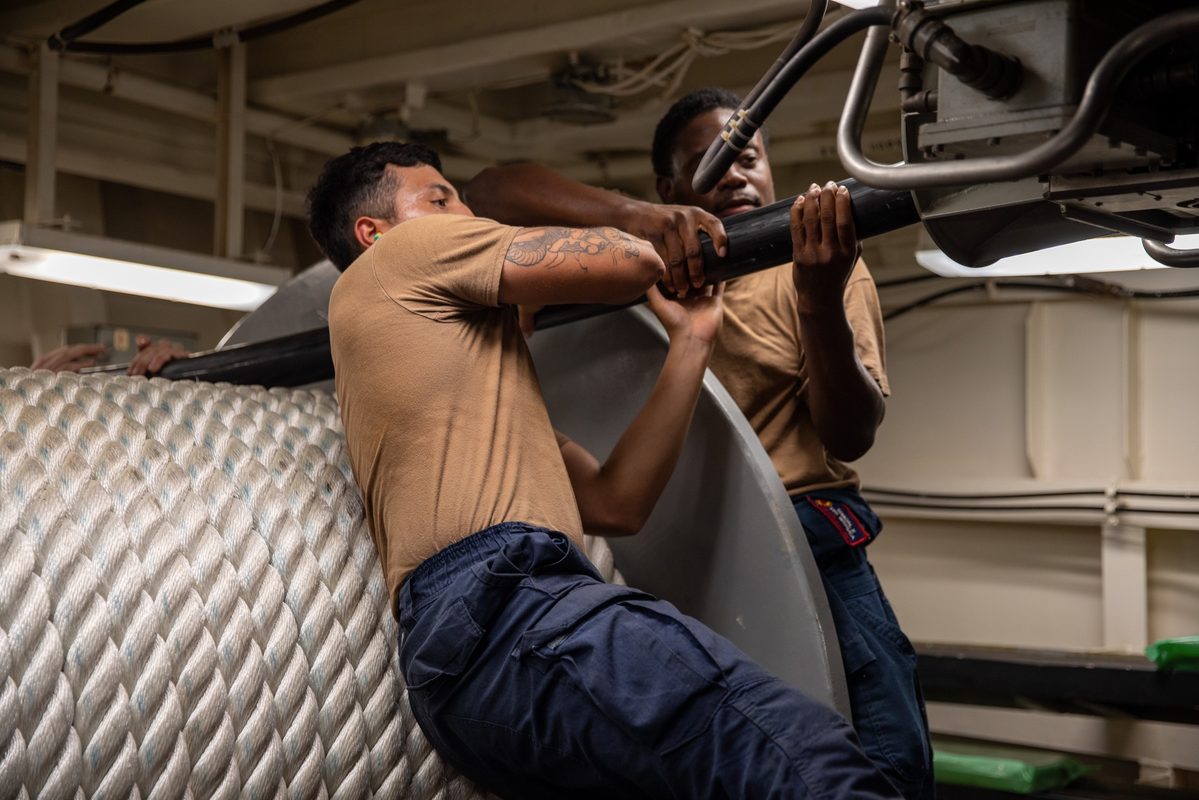
Sailors deploying a multi-functional towed array sonar from the stern of a Navy destroyer in the Mediterranean Sea
Sailors deploy a multi-functional towed array from USS Cole (DDG 67) in the Mediterranean Sea. Towed arrays, long cables packed with hydrophones, are the primary long-range detection tool in anti-submarine warfare, used by both submarines and surface ships (U.S. Navy photo).

Towed arrays offer several advantages over hull-mounted systems. First, the array is physically separated from the submarine's own machinery noise. No matter how quiet a submarine is, its reactor coolant pumps, ventilation systems, and other machinery still generate some acoustic energy. By towing the hydrophone array a significant distance behind the boat, the sonar system listens from a position where the submarine's own noise is greatly attenuated. Second, the long physical aperture of the towed array provides much better resolution at low frequencies than a hull-mounted array of practical size could achieve. The longer the array, the better its ability to resolve closely spaced contacts and determine precise bearings.

The drawback of towed arrays is operational. A submarine streaming a towed array cannot maneuver aggressively. Sharp turns can foul the cable, and high speeds generate flow noise that degrades the array's performance. This means a submarine conducting a long-range search with its towed array is typically moving slowly and steadily, which limits its tactical flexibility. Recovering and redeploying a towed array also takes time, creating vulnerability during transitions between search and attack profiles.

How Sound Moves Through the Ocean: Thermoclines and the SOFAR Channel

Understanding sonar performance requires understanding how sound behaves in seawater, and seawater is not a uniform medium. Sound speed in the ocean varies with temperature, salinity, and pressure. Temperature has the largest effect near the surface, and pressure dominates at depth. This variation creates a complex, layered acoustic environment where sound waves bend, refract, bounce, and sometimes travel extraordinary distances.

The thermocline is the most tactically significant feature of this acoustic environment. In most oceans, the water near the surface is warmed by the sun, creating a mixed layer of relatively uniform temperature. Below this surface layer, the temperature drops sharply with depth. This transition zone is the thermocline. Because sound speed decreases as temperature drops, sound waves passing through the thermocline bend downward, away from the surface.

This bending effect creates an acoustic shadow zone below the thermocline. A submarine sitting below the thermocline is partially shielded from sonar located above it, because sound waves from the surface refract away before reaching the submarine's depth. Submarine commanders have exploited this phenomenon since World War II, diving below the thermocline to hide from surface ship sonar. The depth and strength of the thermocline vary by season, latitude, and local oceanographic conditions, making water temperature profiles (typically measured by expendable bathythermograph (XBT) probes dropped from the submarine) critical tactical intelligence.

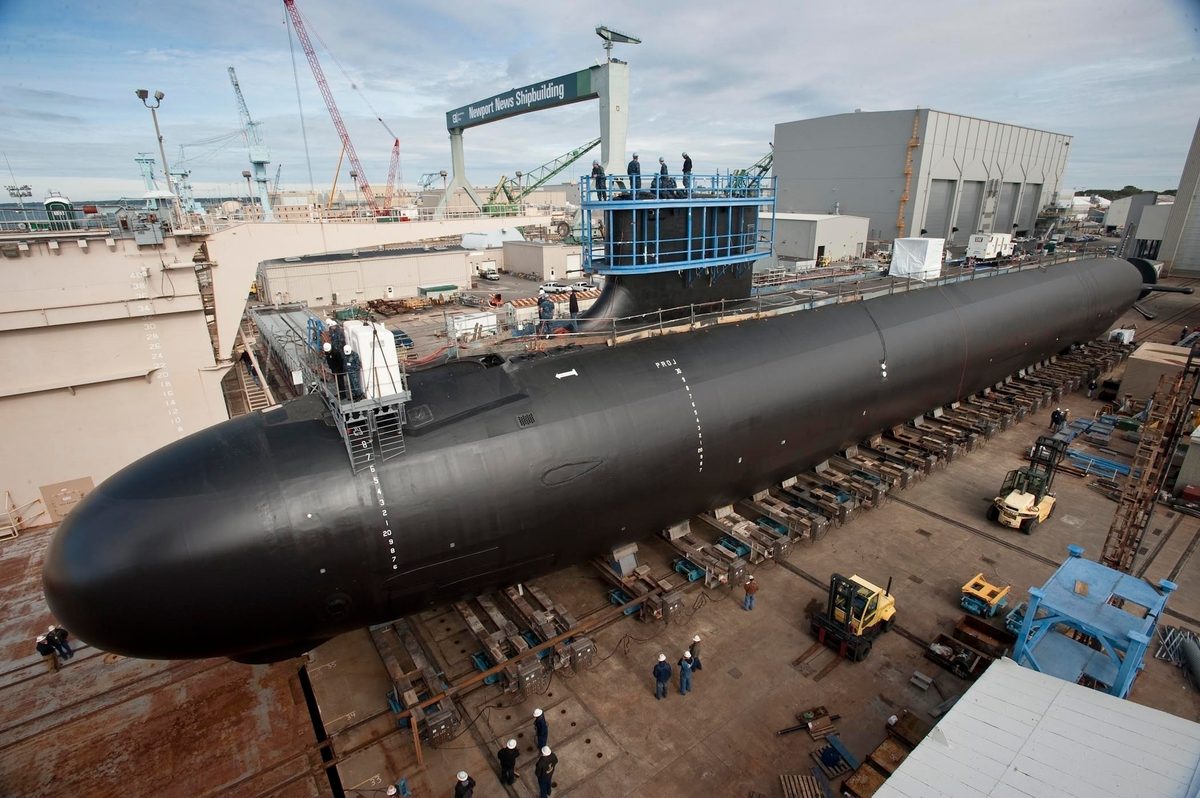
Virginia-class attack submarine Minnesota (SSN 783) under construction at Newport News Shipbuilding, showing the massive hull and bow section
A Virginia-class attack submarine under construction at Newport News Shipbuilding. The distinctive bow section houses the Large Aperture Bow sonar array, the submarine's primary passive listening system (U.S. Navy photo).

At much greater depths, the relationship reverses. Below roughly 1,000 meters, temperature stabilizes near a few degrees Celsius, and increasing water pressure causes sound speed to increase with depth. This creates a minimum sound speed zone, typically between 600 and 1,200 meters depth depending on location, known as the Sound Fixing and Ranging (SOFAR) channel, or deep sound channel.

The SOFAR channel acts as a natural acoustic waveguide. Sound waves that enter this channel at shallow angles are continuously refracted back toward the axis of minimum sound speed, trapping them in a layer where they can propagate for thousands of miles with remarkably little energy loss. During World War II, researchers discovered that low-frequency sounds generated in the SOFAR channel could be detected across entire ocean basins. The U.S. Navy later exploited this property with the Sound Surveillance System (SOSUS), a network of bottom-mounted hydrophone arrays positioned to listen in the SOFAR channel for Soviet submarine transits during the Cold War.

Convergence Zones: Sonar's Long Arm

One of the most useful and counterintuitive phenomena in ocean acoustics is the convergence zone. In deep water, sound waves that refract downward from the surface eventually curve back upward due to the increasing sound speed at depth. When these upward-curving rays reach the surface, they converge in a narrow annular region at a predictable distance from the source, typically around 30 to 35 nautical miles in the North Atlantic, depending on oceanographic conditions.

This creates a detection geometry where a submarine might hear nothing at 20 miles but detect a clear contact at 33 miles. A second convergence zone appears at roughly double that distance (60-70 nautical miles), and in some conditions, a third convergence zone is detectable beyond 90 miles. Skilled submarine operators plan their search patterns around these convergence zones, positioning themselves at ranges where the acoustic energy naturally focuses rather than wasting time searching the shadow zones in between.

The interplay between thermoclines, convergence zones, the SOFAR channel, and surface duct effects creates an acoustic environment that changes constantly with weather, season, geography, and time of day. The same two submarines in the same relative positions might detect each other easily in winter (when surface cooling deepens the mixed layer and weakens the thermocline) but lose each other completely in summer (when a strong, shallow thermocline creates a deep shadow zone). This is why submarine warfare has always been described as a cat-and-mouse game, and why the ocean itself is the biggest variable in every engagement.

The Future of Submarine Sonar

Modern sonar development focuses on several key areas. Signal processing algorithms powered by machine learning are improving the ability to detect extremely quiet submarines in noisy environments. Distributed acoustic sensing, which uses networks of unmanned underwater vehicles and fixed seabed sensors rather than relying solely on a submarine's onboard arrays, promises to expand the acoustic search area beyond what any single platform can achieve. And new materials and transducer designs are pushing the performance boundaries of both hull-mounted and towed arrays.

But the fundamental physics haven't changed. Sound is still the only sense that works at useful distances underwater. Passive listening is still the primary tool. And the ocean's acoustic environment (temperature profiles, salinity gradients, bottom topography, ambient noise) still determines what any sonar system can and cannot detect. The technology has advanced enormously since the first hydrophones were lowered into the water during World War I, but the basic challenge remains the same: hear them before they hear you, and never let them hear you at all.

Share this article

Share:

Recommended

Ace of The Skies: Can You Identify These Military Aircraft Throughout The Years?
Test Yourself

Ace of The Skies: Can You Identify These Military Aircraft Throughout The Years?

Can you identify these aircraft?

Take the Quiz

On This Day in Military History

April 7

Sinking of the Battleship Yamato (1945)

Aircraft from U.S. Task Force 58 sank the Japanese battleship Yamato, the largest and most heavily armed battleship ever built, during a desperate one-way suicide mission toward Okinawa. Hit by at least 10 torpedoes and 7 bombs, Yamato capsized and exploded, killing 2,498 of her 2,700 crew.

1862, Battle of Shiloh Concludes: Union Counterattack

2003, Second Thunder Run Seizes Central Baghdad

See all 11 events on April 7

Get Military News & History in Your Inbox

Join thousands of readers receiving our weekly digest of military technology, history, and analysis.

Test Your Knowledge