
90+ WW2 model kits from $9 accessories to $580 museum-grade showpieces. American, British, German, Soviet, and Japanese forces. Aircraft, tanks, vehicles, ships, artillery, and diorama sets at every skill level. Includes 1/32 fighters, 1/16 armor, 1/32 heavy bombers, and 1/200 capital ships for serious collectors. No filler picks.
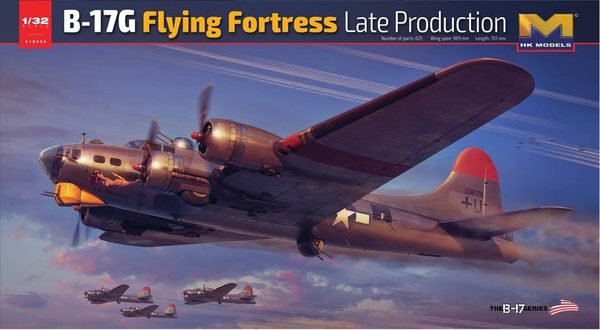
HK Models B-17G (1/32)
~$350


Trumpeter USS Indianapolis CA-35 (1/350)
$81 on Amazon
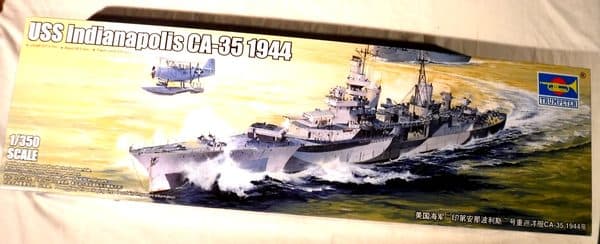
The Portland-class heavy cruiser that delivered atomic bomb components to Tinian, then was torpedoed four days later. Of 1,195 crew, only 316 survived after four days in the open ocean. 24 reviews at 4.7 stars. Over 400 parts.
American Aircraft
American aircraft won air superiority in every theater from 1943 onward. The long-range P-51 Mustang escorted bombers deep into Germany while the F6F Hellcat swept Japanese fighters from Pacific skies. These kits cover the fighters and bombers that dominated the air war, from beginner-friendly Tamiya builds to advanced multi-hundred-part projects.
Eduard 82102 P-51D Mustang ProfiPACK (1/48)
~$45 on Amazon
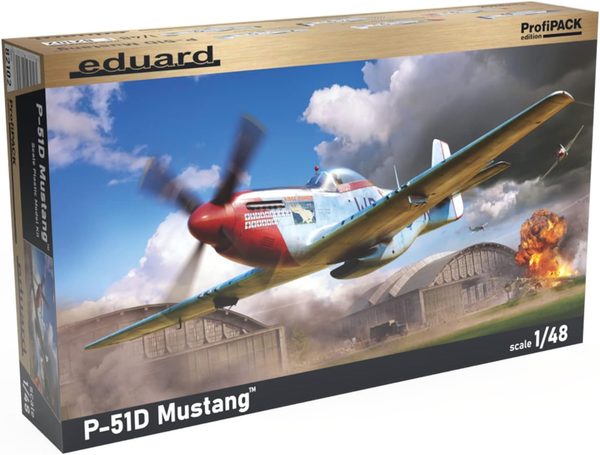
Eduard's 2019 ProfiPACK tooling raised the bar for 1/48 Mustangs. Crisply recessed panel lines, pre-painted photoetch cockpit details, and canopy masks included in the box. On Scalemates, it consistently ranks as the top-rated P-51D across all scales.
Best for: Intermediate-to-advanced builders ready to work with photoetch and CA glue
The P-51 Mustang is the most recognized American fighter of WW2, and Eduard's ProfiPACK edition matches the subject. The 2019 tooling has crisply recessed panel lines, a cockpit with pre-painted photoetch instrument panels and seat harnesses, and canopy masks that simplify painting the greenhouse framing. Surface detail is consistent across every panel, rivet line, and access hatch.
What sets this apart from the Tamiya P-51D is the included extras. The ProfiPACK box gives you photoetch parts for the cockpit, wheel wells, and radiator intake, plus painting masks for the canopy and wheels. Tamiya charges extra for aftermarket equivalents that do not integrate as cleanly. Eduard's engineering also captures the subtle compound curves of the Mustang's laminar-flow wing more accurately than competing kits. The trade-off is complexity. Eduard's instructions move quickly and assume you know how to handle photoetch with CA glue. If this is your first kit, start with the Tamiya version below. But if you have a few builds behind you and want the best possible Mustang for your display shelf, this is it.
Tamiya P-51D Mustang (1/48)
~$28 on Amazon
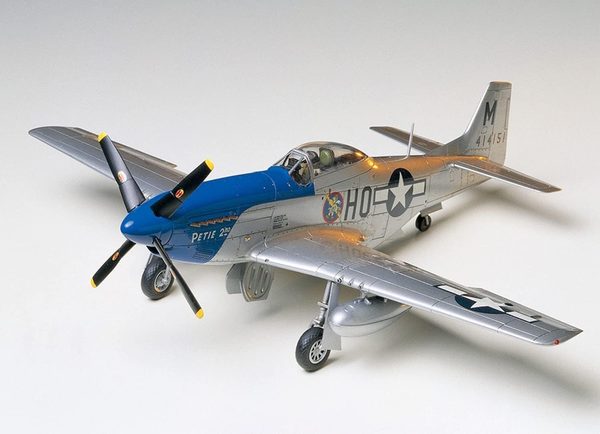
Hobby shops have been handing this kit to first-time aircraft builders for over a decade. Around 90 parts, Tamiya's trademark tight fit, and 308 verified reviews at 4.6 stars.
Best for: First-time aircraft builders or anyone who wants a clean, frustration-free Mustang build
Over 300 verified Amazon reviews and a 4.6-star rating after more than a decade on the market tell the story. Tamiya's P-51D Mustang is the kit hobby shops hand to someone building their first airplane. Parts fit with virtually no gap-filling required, instructions are clear, and the roughly 90-part count means you can finish it in a weekend without feeling rushed.
The cockpit is well-detailed for the part count: a nicely molded seat, instrument panel with raised detail, and a seated pilot figure. Landing gear is sturdy enough to hold the finished model without sagging, which is not something every 1/48 kit can claim. Tamiya includes markings for two aircraft: a natural metal finish "Big Beautiful Doll" and an olive-drab scheme, giving you options whether you want to try bare metal painting or stick with simpler camouflage. Is it as detailed as the Eduard ProfiPACK? No. Panel lines are softer, the cockpit lacks photoetch, and the wing root joint does not capture the Mustang's curves quite as precisely. But at roughly half the price and a fraction of the build complexity, this is the Mustang for everyone who is not yet ready for Eduard's level. Plenty of experienced builders keep one in the stash for a relaxing, low-pressure weekend project.
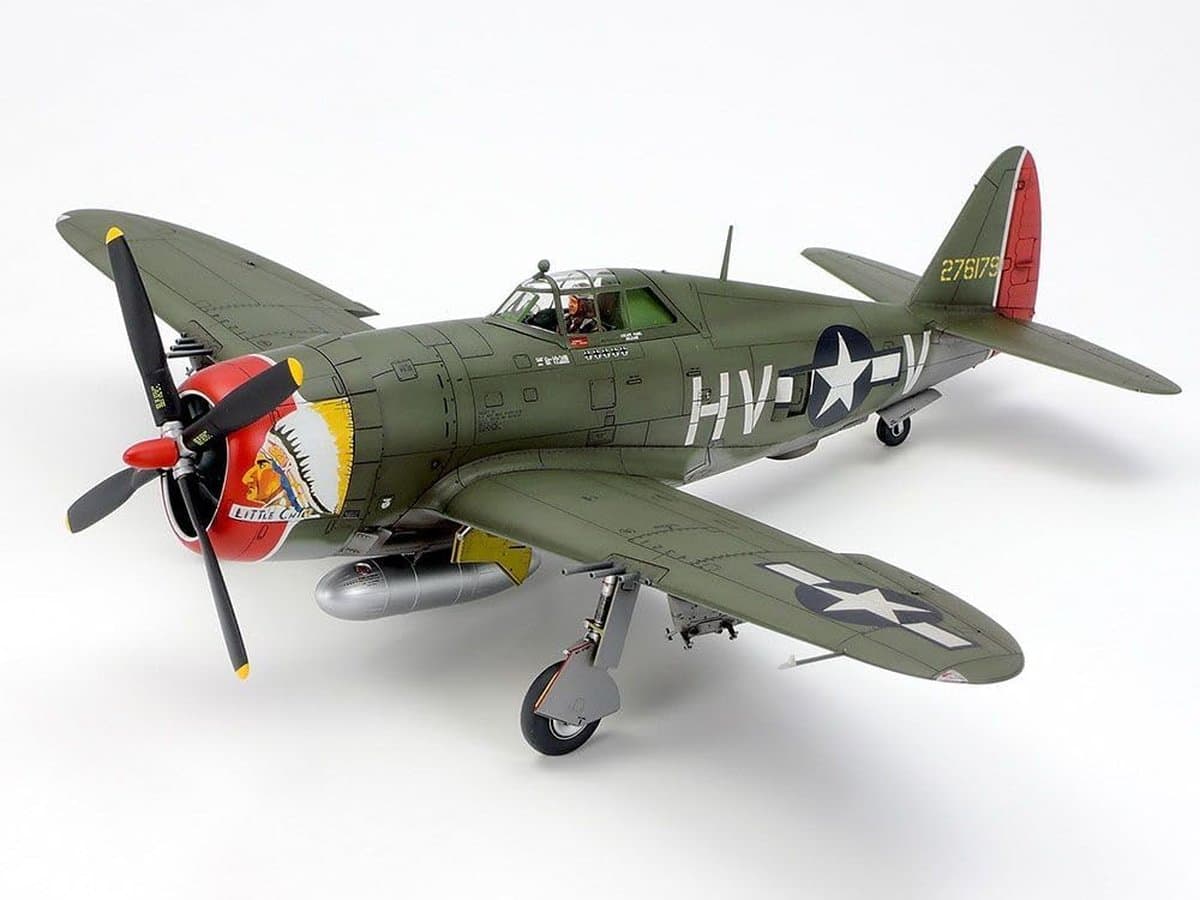
Tamiya P-47D Thunderbolt Bubbletop (1/48)
~$30 on Amazon
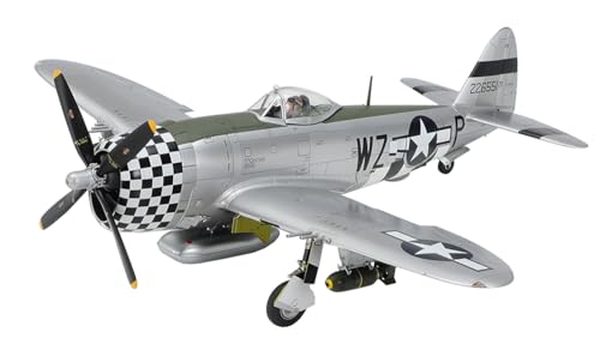
At around 130 parts, this hits the sweet spot between simplicity and detail. 206 reviews at 4.6 stars. Frequently recommended on r/modelmakers as the single best "pure enjoyment" WW2 aircraft build.
Best for: Builders who want the most satisfying, low-frustration WW2 fighter build available
The P-47 Thunderbolt was the heaviest single-engine fighter of WW2, a seven-ton machine that could absorb hits that would destroy any other fighter and still bring its pilot home. Tamiya's 1/48 bubbletop version captures the Jug's barrel-chested silhouette perfectly, and experienced builders on r/modelmakers frequently call it "the most fun build in my stash."
The cockpit includes a well-appointed tub with sidewall detail, a multi-part instrument panel, and a pilot figure. The engine cowling fits with zero seam work. The bubbletop canopy is crystal clear with no distortion, and the landing gear is robust and well-engineered. Tamiya includes eight underwing rockets and two bomb options for a fully loaded ground-attack configuration. One thing to know: the kit does not include any photoetch or masking, so if you want to dress up the cockpit, that is an aftermarket purchase. But for a build where every part clicks into place and the finished product looks great with minimal effort, this delivers.
Tamiya F4U Corsair Birdcage (1/48)
~$29 on Amazon
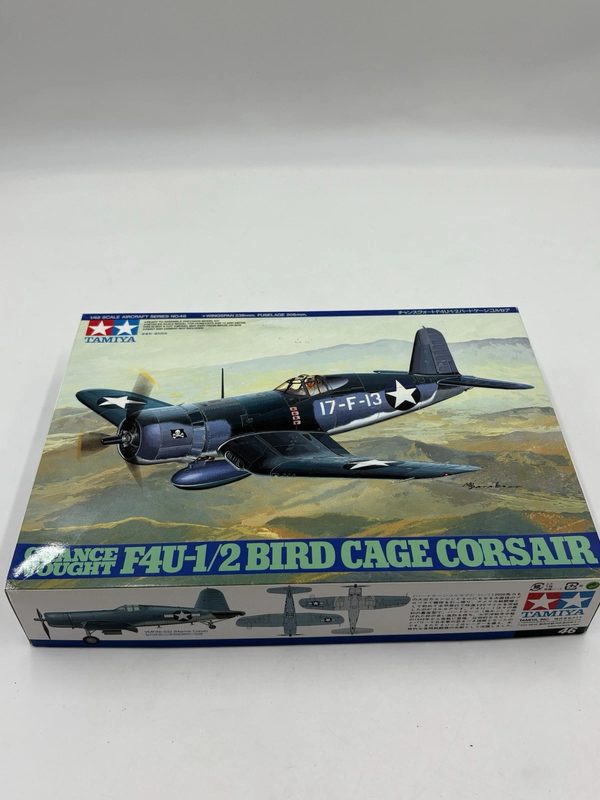
That inverted gull wing was not for looks. The massive Pratt & Whitney R-2800 engine demanded a huge propeller, and the cranked wing kept the landing gear short enough for carrier ops. Tamiya nails the complex geometry. 162 reviews at 4.6 stars.
Best for: Pacific Theater enthusiasts and builders who love distinctive aircraft shapes
The F4U Corsair achieved an 11:1 kill ratio in the Pacific, one of the most lopsided records of any WW2 fighter. Its inverted gull wing solved an engineering problem: the massive R-2800 engine required an equally large propeller, and the cranked wing kept the gear short enough for carrier landings. Tamiya's 1/48 rendition captures every angle of that distinctive shape.
This is the early birdcage canopy variant with the framed greenhouse cockpit that Marines flew from Guadalcanal onward. Each wing panel is a single piece with crisply recessed panel lines, and the gull-wing break fits cleanly at the fuselage join. The cockpit has a nicely molded instrument panel and sidewall equipment. The Corsair's tri-color Navy scheme (sea blue upper, intermediate blue mid, white lower) makes this a solid painting project for practicing masking and color transitions. One downside: Tamiya's decal selection is limited to two markings, though the aftermarket community offers extensive options for specific squadrons and aces.
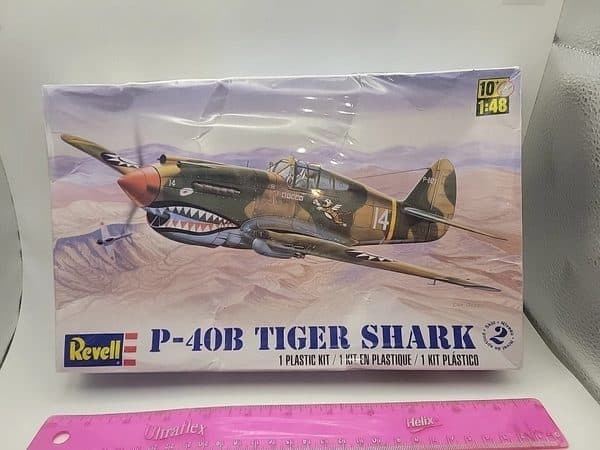
Revell P-40B Tiger Shark (1/48)
~$36 on Amazon
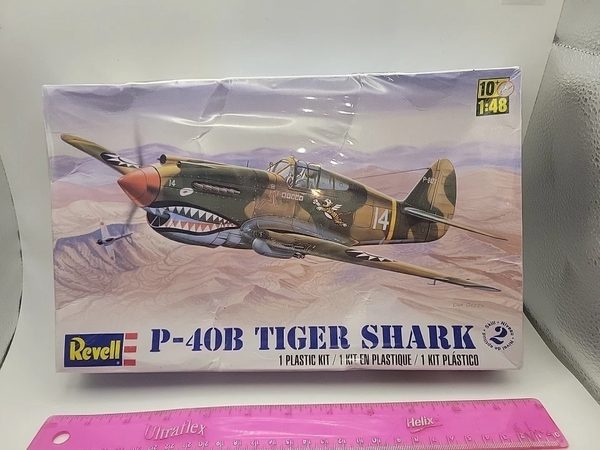
The P-40 was America's front-line fighter when the war started, and that shark-mouth nose art is one of the most recognized military images ever painted on an airplane. Tamiya has never produced a P-40 in 1/48, making Revell's kit the go-to option.
Best for: Flying Tigers fans and early-war Pacific/CBI Theater collections
By the numbers, the P-40 Warhawk was not the best fighter of WW2. It was slower than the Bf 109, less maneuverable than the Zero, and outclimbed by nearly everything it faced. But it was tough, available in quantity, and in the hands of the American Volunteer Group in China, it compiled a 20:1 kill ratio using tactics tailored to its strengths. The shark-mouth nose art of the Flying Tigers is one of the most recognized military images in history, and this Revell kit includes those markings.
Because Tamiya has never produced a P-40 in 1/48 scale, Revell's P-40B is the default choice. The molding is solid modern Revell quality with recessed panel lines, a reasonably detailed cockpit, and clear canopy parts. Fit requires more attention than Tamiya kits; expect some light sanding at the fuselage seam and possibly a thin line of putty, but nothing that should stop an intermediate builder. For the best results, pick up aftermarket decals from Wolfpack or Techmod, which offer additional AVG aircraft with historically accurate individual markings. A panel line wash and some exhaust staining around the cowling make a big visual difference on this subject.
Tamiya F6F Hellcat (1/48)
~$31 on Amazon
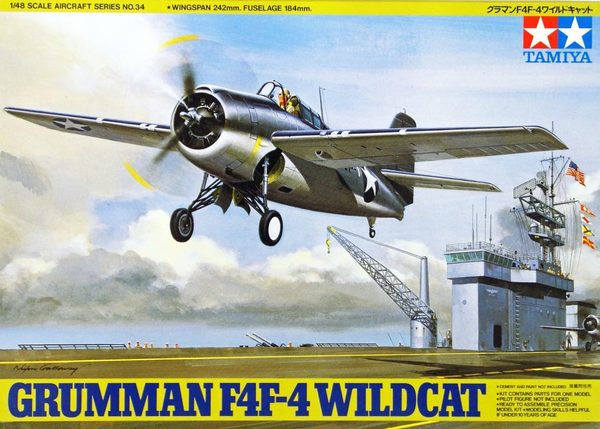
From its combat debut in September 1943 to the Japanese surrender, the Hellcat compiled a 19:1 kill ratio and produced more aces than any other American fighter. Tamiya's kit sits at 4.8 stars across 63 reviews, one of the highest ratings in this guide.
Best for: Pacific Theater builders and carrier aviation enthusiasts
If the P-51 Mustang won the air war over Europe, the F6F Hellcat won it over the Pacific. Grumman engineers studied a captured A6M2 Zero and designed an aircraft that could outperform it in every category except low-speed maneuverability. The result was a carrier fighter that broke the back of Japanese naval aviation, accounting for 5,223 confirmed kills in just two years of combat.
Tamiya's 1/48 Hellcat builds into a stocky, purposeful-looking fighter with clean lines and tight fit. The folding wing option is a standout feature: you can display it with wings spread for flight or folded for carrier deck parking. The cockpit includes a well-detailed tub and instrument panel, and the wide-track landing gear captures the stance that made the Hellcat one of the easiest Navy fighters to land on a carrier. The lower review count compared to the Mustang and Thunderbolt reflects the Hellcat's smaller public profile, not any weakness in the kit. If you are building a Pacific carrier air group alongside the SBD Dauntless and F4U Corsair, the Hellcat is the centerpiece. One caveat: at around 120 parts, the detail level is good but not exceptional, so cockpit detail enthusiasts may want to add an aftermarket set.
HK Models B-17G Flying Fortress (1/48)
~$90 on Amazon
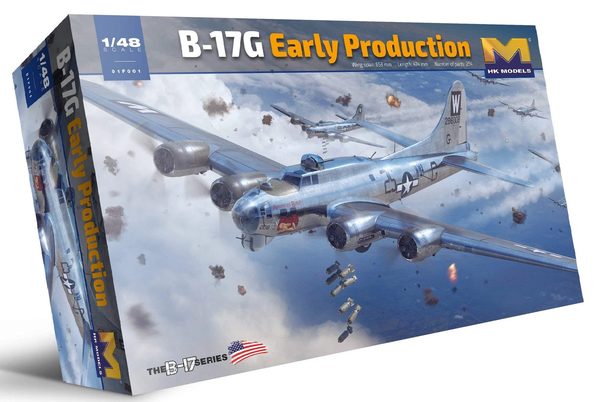
The first B-17 kit with a complete interior from nose to tail: bombardier station, cockpit, radio room, bomb bay, waist gunner positions, and tail gunner. 400+ parts, over two feet of finished wingspan at 1/48 scale. This is the premium bomber build.
Best for: Advanced builders who want the ultimate American bomber kit
The B-17 Flying Fortress is one of the most storied aircraft in military history. The Eighth Air Force's daylight bombing campaign over Germany cost more American aircrew lives than the entire Marine Corps lost in the Pacific, and the B-17 was at the center of it. HK Models' 1/48 B-17G is the kit that finally gives this aircraft the detail it warrants, and reviews on Scalemates and modeling forums consistently place it at the top for B-17s in any scale.
Every crew station is detailed enough to be visible through the many windows and gun positions, and the bomb bay doors can be displayed open to reveal internal racks. The four Wright Cyclone engines are well-detailed and benefit from aftermarket ignition wire sets. At 400+ parts, this is firmly an advanced build. The clear parts are extensive and require careful masking for dozens of individual greenhouse panels. Plan for several weeks of construction and serious shelf space. At around $90 it is not cheap, and some builders report the clear parts need extra care during cleanup to avoid hazing. But for a B-17 that you can actually see inside, nothing else comes close.
Revell B-25J Mitchell (1/48)
~$35 on Amazon
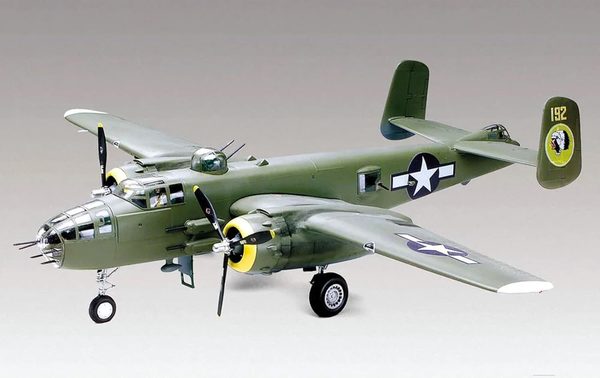
Over 1,100 verified Amazon reviews at 4.5 stars make this one of the most purchased military model kits on the platform. The B-25 Mitchell carried out the Doolittle Raid, the first strike on the Japanese home islands.
Best for: Intermediate builders who want a famous bomber with broad community support
On April 18, 1942, sixteen B-25 Mitchells launched from the carrier USS Hornet and struck Tokyo, an operation so audacious that Japanese military leaders thought it was impossible. The Doolittle Raid did minimal physical damage but delivered an enormous psychological blow, and the B-25 became one of the most famous aircraft of the war. Revell's 1/48 B-25J lets you build one, and those 1,100+ verified reviews confirm it delivers consistently.
The J model is the late-war Mitchell with both a glass nose for the bombardier and a solid eight-gun strafer nose option included. The twin Wright Cyclone engines are well-detailed, and the finished model is large enough to look good on a shelf but manageable for an intermediate builder. Revell's Mitchell does require more cleanup than a Tamiya kit. Expect some flash on smaller parts and a fuselage seam that benefits from careful sanding and a thin layer of putty. At around $35 for a 1/48 twin-engine bomber, the value is hard to beat. The aftermarket community has extensive decal sets for everything from Doolittle Raiders to Pacific strafers with custom nose art.
Revell B-24D Liberator (1/48)
~$107 on Amazon
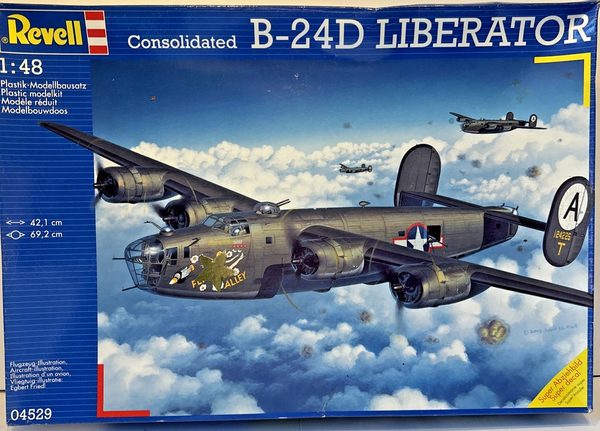
More B-24 Liberators were built than any other American military aircraft: 18,482 total, serving in every theater of the war. Revell's 1/48 kit has 300+ parts, a fully detailed bomb bay, and the Liberator's distinctive Davis high-aspect-ratio wing. 86 reviews at 4.6 stars.
Best for: Advanced builders and heavy bomber collectors who want more than just a B-17
The B-24 has always lived in the B-17's shadow in popular culture, but the production numbers tell a different story. More Liberators were built than any other American military aircraft, and they served everywhere: strategic bombing over Germany, anti-submarine patrols in the Atlantic, supply runs over the Himalayas, and island-hopping across the Pacific.
Revell's 1/48 B-24D captures the Liberator's distinctive Davis wing and twin-tail empennage with over 300 parts. The deep bomb bay is fully detailed and can be displayed open, and the cockpit features multi-part instrument panels and crew seats. At 1/48 scale, the finished model spans over 27 inches, so plan your shelf space before you start. The kit's premium price reflects its size and part count. Experienced builders report good fit for a kit of this complexity, though the wing-to-fuselage joint benefits from dry-fitting and careful alignment. If you already have a B-17 and want the other half of the American heavy bomber pair, this is the natural companion.
Academy B-29A Superfortress (1/48)
~$69 on Amazon
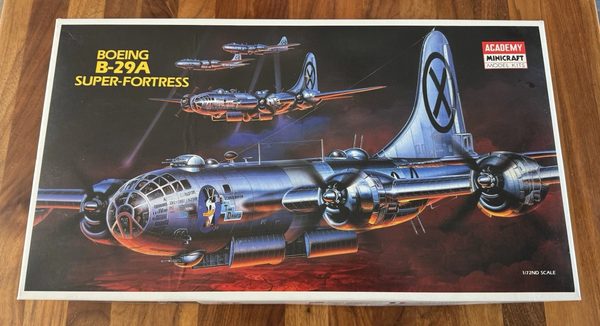
The most technologically advanced aircraft of WW2: pressurized compartments, remote-controlled gun turrets, and fire-control computers. Academy's 1/48 kit builds into a 35-inch model, the largest in this guide by a wide margin.
Best for: Advanced builders who want the aircraft that ended the war and have the shelf space for it
The B-29 Superfortress cost more to develop than any other weapon system of the war, including the atomic bomb it eventually carried. Pressurized crew compartments, remote-controlled gun turrets, and analog fire-control computers made it a generation ahead of every other bomber in service. On August 6, 1945, "Enola Gay" dropped Little Boy on Hiroshima. Three days later, "Bockscar" dropped Fat Man on Nagasaki. The war was over within a week.
Academy's 1/48 B-29A is one of very few kits of this aircraft in any scale, and at 1/48 it builds into a 35-inch model. That is the largest kit in this guide and demands dedicated display space. The kit features the distinctive glazed nose, remote turret positions, and the sleek high-altitude bomber profile. With 250+ parts, the build is firmly advanced territory. Multiple clear sections require careful masking, and the sheer size means paint coverage takes patience. Academy's engineering is solid but not quite at Tamiya's level; some builders report minor fit issues at the wing roots that are easily fixed with putty. For anyone completing the progression from B-17 to B-24 to B-29, this is the capstone.
Revell SBD Dauntless (1/48)
~$22 on Amazon
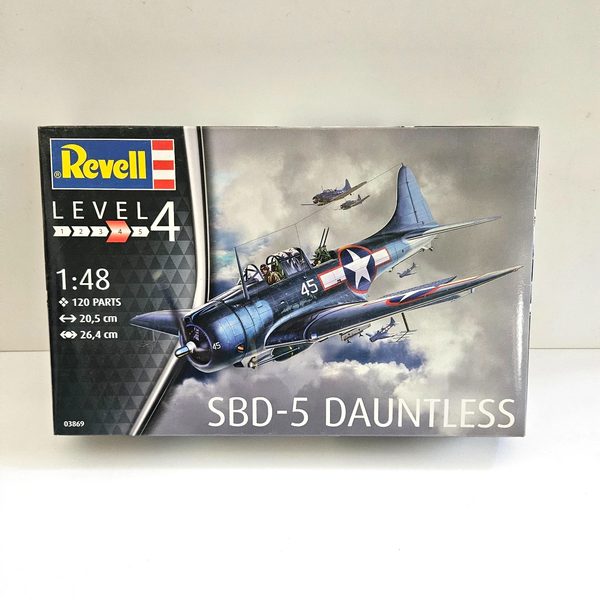
At around $22, this is one of the best values in the guide. Five minutes of dive bombing at Midway sank three Japanese carriers and changed the course of the Pacific war. 765 reviews at 4.6 stars.
Best for: Pacific War enthusiasts and anyone building a Midway diorama or carrier air group
On June 4, 1942, SBD Dauntless dive bombers from USS Enterprise and USS Yorktown caught the Japanese carrier striking force with flight decks full of armed and fueled aircraft. In roughly five minutes, three carriers (Akagi, Kaga, and Soryu) were mortally hit. Hiryu followed hours later. The Battle of Midway was the turning point of the Pacific war, and the SBD delivered it. No other single aircraft type can claim a more decisive five minutes of combat.
Revell's 1/48 Dauntless captures the SBD's distinctive perforated dive brakes, the two-seat tandem cockpit, and the fixed landing gear that earned it the "Slow But Deadly" nickname. The rear gunner position is detailed enough to display with the canopy open, and the kit includes a 500-pound bomb on the centerline displacement trapeze that swung the bomb clear of the propeller arc during a dive. For builders assembling a Midway carrier air group, the Dauntless pairs with a Tamiya F4F Wildcat for the actual Midway timeframe or the F6F Hellcat for later-war scenarios. The two-tone Blue Gray over Light Gray scheme is straightforward, and the large surfaces take washes and weathering well. One limitation: Revell's molding shows its age with some soft detail, so aftermarket options help if you want a contest-level finish. At this price, you can afford to build several for a formation display.
American Tanks & Armor
American armor ranged from the nimble M5 Stuart light tank to the heavy M26 Pershing that finally matched German Panthers and Tigers. The M4 Sherman was outgunned by most German heavy armor but won through sheer production volume and mechanical reliability. These kits cover every major American armored vehicle of the war, from light reconnaissance tanks to purpose-built tank destroyers.
Tamiya M4A3E8 Sherman "Easy Eight" (1/35)
~$45 on Amazon
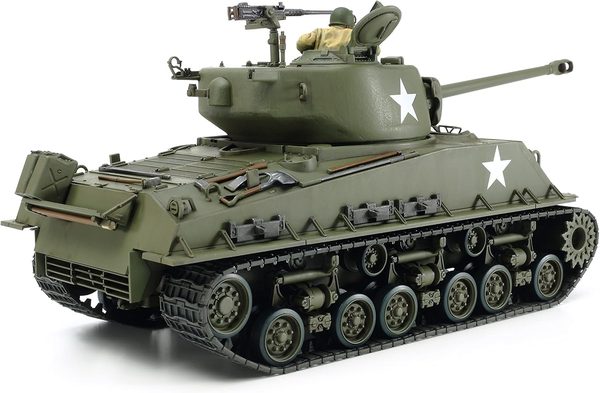
Tamiya's newest Sherman tooling with over 1,500 verified reviews and a 4.7-star rating. The Easy Eight was the final wartime Sherman variant, fielding HVSS suspension and a 76mm high-velocity gun from the Ardennes through the drive into Germany.
Best for: Anyone building their first tank kit or wanting the best 1/35 Sherman currently in production
The M4 Sherman won the war for the Western Allies not because it was the best tank on the field, but because American factories produced 49,234 of them. The M4A3E8 "Easy Eight" was the ultimate wartime evolution: horizontal volute spring suspension for a smoother ride over rough terrain, the high-velocity 76mm gun that could finally challenge Panther frontal armor at range, and wet ammunition storage that cut the risk of catastrophic brew-ups. By early 1945, Easy Eights were replacing older 75mm Shermans across frontline units.
Tamiya's 2015 tooling is the best Sherman kit on the market by a clear margin. The slide-molded turret comes as a single piece with no visible seam line, which saves hours of filling and sanding that older kits demand. Hull details include accurate casting texture on the frontal plate, individual tool clamps, and a well-rendered engine deck. The roughly 160-part count sits in a productive range: enough to look convincing, few enough to finish in a weekend. One weakness worth knowing: the rubber-band style tracks are easy to install and look fine at arm's length, but they lack the realism of individual link tracks. Aftermarket sets from Friulmodel and MasterClub fix that if it bothers you. This kit pairs well with the Tamiya Panther or Tiger from the best tank model kits guide for a Western Front diorama.
Tamiya M26 Pershing (1/35)
~$45 on Amazon
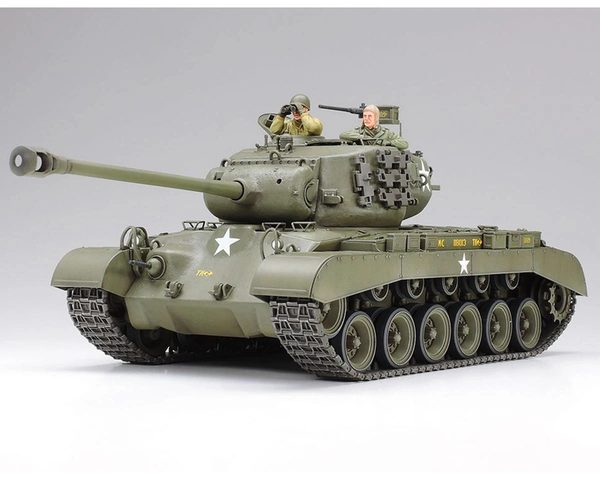
America's answer to the Tiger and Panther. Armed with a 90mm gun and heavy armor, the Pershing finally gave US tankers a vehicle that could match German heavies head-on. 250 reviews at 4.6 stars, and the kit includes six crew figures.
Best for: Late-war armor enthusiasts and builders who want the American counterpart to German heavy tanks
For most of the war, American tankers engaged Tigers and Panthers in Shermans that could not penetrate their frontal armor at combat range. The M26 Pershing changed that. Its 90mm gun could defeat Panther glacis plate at 1,000 yards, and its own armor could stop the 75mm KwK 42. Pershings arrived in Europe in February 1945, too late for most of the war but in time for serious fighting in the Rhineland and at the Remagen bridgehead. Only about 200 saw combat before VE Day.
This kit builds to around 200 parts with the tight tolerances Tamiya is known for. The real selling point is the six included crew figures: a commander in the turret hatch, a loader, a driver, and three infantrymen riding the engine deck. These add life to the finished model and are well-sculpted for injection-molded figures. The turret features a realistic cast mantlet and accurate 90mm barrel with muzzle brake. One drawback: the hull lacks interior detail, so you will want to keep hatches closed unless you plan aftermarket work. The large, flat surfaces on the hull and turret take weathering products well. A pin wash in the panel lines, mud on the running gear, and dust on the upper hull will give this kit a field-worn look quickly.
Tamiya M5A1 Stuart (1/35)
~$29 on Amazon
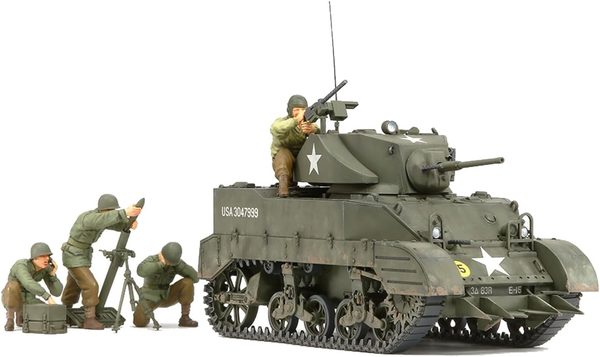
At roughly 130 parts, this is a fast, rewarding build that mirrors the tank it represents. 528 reviews at 4.7 stars. The M5A1 Stuart served in both the Pacific and European theaters as a reconnaissance and infantry support vehicle.
Best for: Beginners and builders who want a satisfying armor project they can finish in one session
The M5A1 Stuart scouted ahead of Sherman columns, screened flanks, and provided infantry support where heavier armor was unavailable or unnecessary. It could hit 36 mph on roads, faster than most WW2 tanks, and twin Cadillac V8 engines made it far easier to maintain than the temperamental radial engines in earlier Stuart variants. In the Pacific, where Japanese armor was thin, the Stuart often served as the primary assault vehicle.
Tamiya's 1/35 M5A1 is one of their newer armor releases, and the tooling quality reflects that. Parts fit together cleanly without filler or excessive sanding. Most builders report finishing basic construction in a single long session. The kit includes an open commander's hatch with a well-detailed interior visible through the opening, and the turret traverses on the completed model. The trade-off for that low part count is that some details, like the rear engine grilles, are simplified compared to what you would get from a more complex kit like the Academy version. At under $30, you can pick up the M5A1 and the Willys Jeep from this guide and build a complete American reconnaissance patrol for less than the cost of one premium tank kit.
Tamiya M3 Stuart (1/35)
~$38 on Amazon
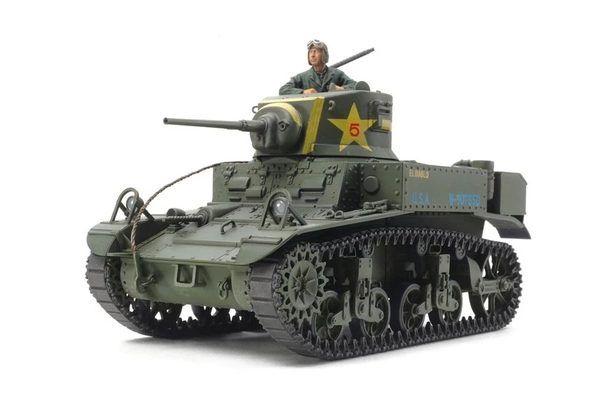
The early-war light tank that saw action before the US even entered the conflict. British forces used M3 Stuarts at Operation Crusader in November 1941, nicknaming them "Honey" for their reliability. 166 reviews at 4.7 stars.
Best for: Early-war enthusiasts and builders who want a companion piece to the M5A1 showing the evolution of American light armor
British forces were the first to take the M3 Stuart into combat, fielding it at Operation Crusader in North Africa in November 1941, weeks before Pearl Harbor. They called it the "Honey" for its smooth ride and mechanical dependability. Once America joined the war, the M3 served across every theater: North Africa, Italy, the Pacific islands, Burma, and China. It was outgunned by nearly every Axis tank it faced, but speed, reliability, and sheer availability made it indispensable during the critical early years when better armor was not yet in production.
Tamiya's 1/35 M3 Stuart captures the early variant's distinctive riveted hull construction and Continental radial engine compartment. The kit features a nicely detailed commander's cupola and hull machine gun sponsons unique to the M3 variant. One build consideration: the individual track links provide a more realistic look than rubber-band tracks, but they require real patience to assemble, especially if you have not worked with individual links before. Budget extra time for that step. The riveted M3 hull contrasts sharply with the welded M5A1 hull, and the two kits display well side by side to show how American light tank design evolved during the war. For a North Africa diorama, pair the M3 with Tamiya's British infantry figures and some desert terrain.
Tamiya M18 Hellcat (1/35)
~$45 on Amazon
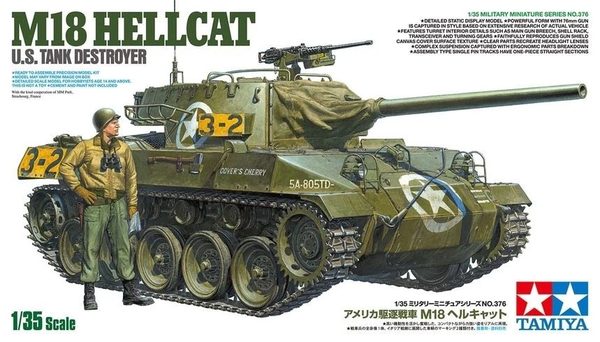
At 55 mph on roads, no other tracked armored vehicle in the war came close to the M18 Hellcat's top speed. It paired that mobility with the same 76mm gun used on late-model Shermans, built around hit-and-run tactics against heavier German armor. 243 reviews at 4.6 stars.
Best for: Tank destroyer enthusiasts and builders who appreciate unconventional armor doctrine
The M18 Hellcat was American tank destroyer doctrine in physical form: speed over armor. At 55 mph on roads, it outran every other tracked vehicle in the war by a wide margin, and it carried the same 76mm gun fitted to late-model Shermans. Crews would race into a flanking position, hit the enemy where armor was thinnest, and relocate before return fire arrived. During the Battle of the Bulge, Hellcat units from the 705th Tank Destroyer Battalion used exactly these tactics to help slow the German advance at Bastogne.
Tamiya's 1/35 kit captures the Hellcat's lean, low-slung profile: the open-topped turret, shallow hull, and wide tracks that made its speed possible. The open turret is a gift for detailers because you can add the gun breech, ammunition racks, and crew figures without any of it hiding behind hatches. A crew figure manning the .50 caliber machine gun on the turret ring comes included. The main weakness here is that the hull underside has minimal detail, so if you plan to display the model on an angled diorama base, you will want aftermarket suspension parts. The M18's paper-thin armor (half-inch to one-inch of steel) left crews vulnerable to everything from AT guns to heavy machine gun fire, which makes it a compelling diorama subject with a built-in story of calculated risk.
Tamiya M10 Wolverine (1/35)
~$41 on Amazon
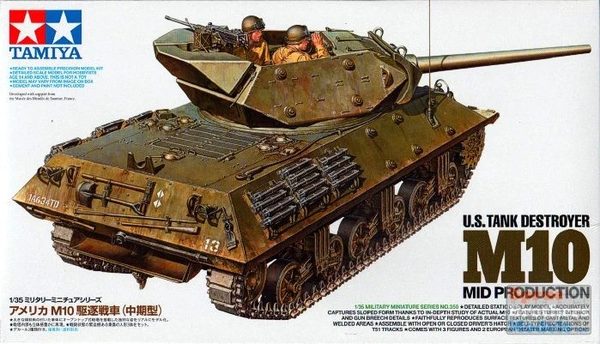
Built on the Sherman chassis but carrying a hard-hitting 3-inch M7 gun, the M10 was the most widely produced American tank destroyer of the war, with over 6,700 built. 242 reviews at 4.6 stars.
Best for: Intermediate builders looking to round out an American tank destroyer collection alongside the M18 Hellcat
Over 6,700 M10s rolled off production lines, making it the most numerous American tank destroyer of the war. It mated the reliable Sherman hull to a new open-topped turret mounting the 3-inch M7 gun, which could defeat Panzer IVs and early Tigers at normal combat ranges. The open turret was a deliberate design choice, not a shortcut. Tank destroyer doctrine demanded maximum situational awareness for ambush tactics, and a turret roof would have blocked the commander's sightlines. The trade-off was obvious: the crew was exposed to artillery fragments and air attack.
Tamiya's newer-tooling M10 showcases the distinctive pentagonal turret and sloped hull armor that set the Wolverine apart from the Sherman it was derived from. The open turret interior includes the gun breech, recoil guard, and turret basket. The massive counterweight at the turret rear, a thick steel plate that balanced the heavy gun, gives the M10 its unique visual profile. One area where the kit falls short: the included decal sheet is limited, offering only basic US markings. If you want unit-specific markings for a particular battalion or theater, aftermarket decals from Archer or Star Decals will be necessary. The M10 saw its first combat at El Guettar in Tunisia in March 1943 and served continuously through VE Day, so it fits naturally into North Africa, Italy, or Northwest Europe dioramas.
Tamiya M41 Walker Bulldog (1/35)
~$21 on Amazon
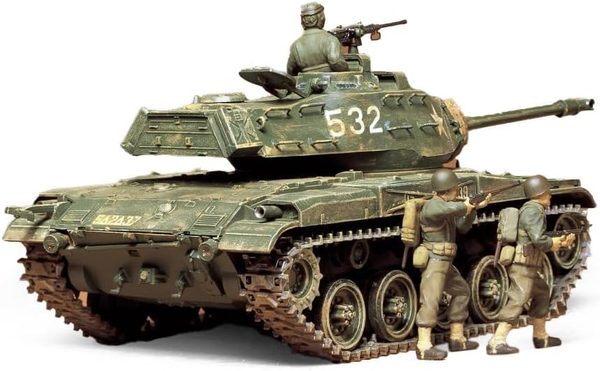
Technically a Korea/Vietnam-era vehicle, but at $21 with 1,400+ reviews and a 4.7-star average, this is one of the best entry points into armor modeling on Amazon. Roughly 120 parts, pure beginner territory.
Best for: Budget-conscious builders and anyone looking for a low-risk first armor kit before tackling WW2-specific tanks
The M41 Walker Bulldog entered service in 1951 as the M24 Chaffee's replacement and saw action in Korea and Vietnam. It earns a spot in this guide purely on value: at $21 with 1,400+ verified reviews averaging 4.7 stars, it is one of the single best-selling military model kits on Amazon. For someone considering whether scale modeling is worth their time, this is the lowest-cost way to find out.
This is an older Tamiya tooling, and it shows in places. Surface detail is softer than their recent releases, and the fit, while still clean, lacks the precision snap of kits like the M5A1 Stuart. Motorized versions exist with a battery-powered drive system, though most modelers prefer the standard static build. The roughly 120-part count means construction goes quickly and without frustration. At $21, this costs about the same as a fast-food meal for two and provides hours of building time plus a finished display piece. Build this first, and if you enjoy it, move up to the Sherman or Pershing from this guide. Experienced builders can keep one in the stash as a quick palette-cleanser between longer projects.
American Vehicles & Support
American logistics won the war as surely as American firepower. The Willys Jeep moved everything and everyone, the M3 Scout Car carried troops into contact under fire, and the LCVP Higgins Boat delivered the first assault waves onto every contested beach from Normandy to Iwo Jima.
Tamiya Willys Jeep (1/35)
~$22 on Amazon
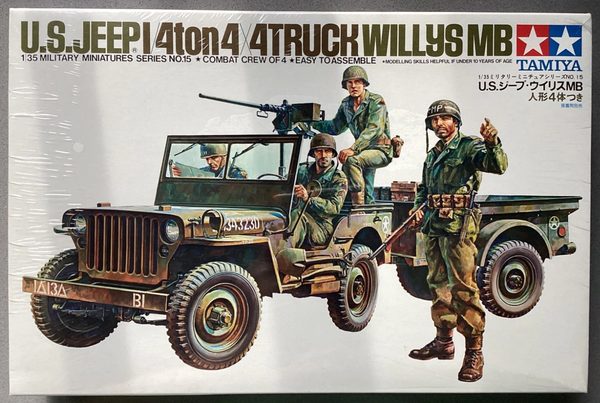
Over 640,000 were built during WW2, and the Willys Jeep served in every role from reconnaissance to ambulance to machine gun platform. One of the most popular model kits on Amazon with 1,500+ reviews at 4.7 stars. Includes a driver figure.
Best for: Absolute beginners, diorama builders, and anyone who wants a quick build they can finish in one sitting
Eisenhower listed the Jeep alongside the C-47 transport, the bazooka, and the atomic bomb as the four tools that won the war. Over 640,000 Willys MB and Ford GPW Jeeps rolled out of factories, serving in every theater and every role: reconnaissance, ambulance, wire-layer, machine gun platform, and the universal runabout that moved officers, NCOs, and dispatches across entire continents. The vehicle was so successful that its name became the generic term for a whole class of transport.
Tamiya's 1/35 Willys Jeep earns its 1,500+ reviews by doing everything right at a small scale. Roughly 100 parts mean you can finish it in a single sitting. The included driver figure adds immediate visual interest. Detail is solid for the scale: folding windshield, spare tire, jerry cans, shovel, and axe are all present and cleanly molded. The soft-top canvas cover is a separate piece, so you choose between an open or covered display. Where the kit shows its age is in the slightly thick windshield frame and simplified dashboard, both easy fixes with basic scratch-building if they bother you. At around $22, this is the kit hobby shops worldwide recommend as a first build, and for good reason. It pairs naturally with nearly every other vehicle and figure set in any WW2 collection.
Tamiya M3A1 Scout Car (1/35)
~$39 on Amazon
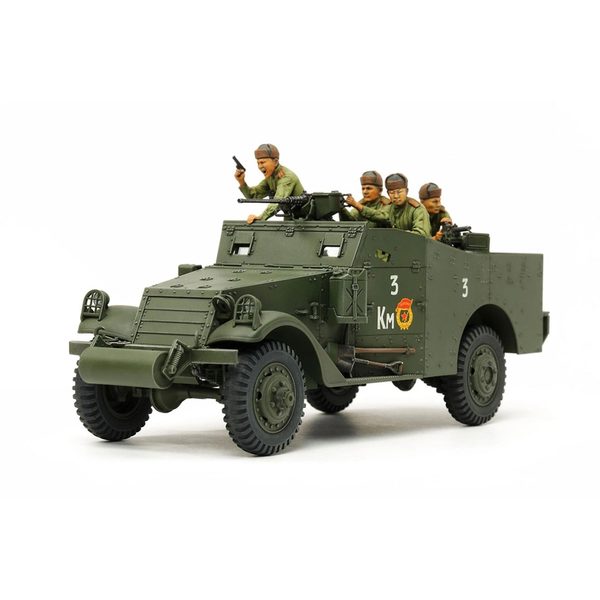
Over 20,000 M3A1 Scout Cars were built and served with every major Allied army, from American forces to the Soviets through Lend-Lease. Tamiya's 2018 tooling delivers crisp detail throughout the open-topped interior. 77 reviews at 4.7 stars.
Best for: Intermediate builders who want something different from tanks and aircraft
The White M3A1 Scout Car filled the armored personnel carrier role before the half-track took over. Over 20,000 were built, and they served with American, British, Commonwealth, Soviet (Lend-Lease), and Free French forces. The open-topped armored body stopped small arms fire and shell fragments while carrying up to eight soldiers plus a driver and co-driver. Mounted .50 caliber and .30 caliber machine guns on a skate rail running around the interior gave the crew real firepower for a vehicle of its size.
Tamiya's 2018 tooling shows throughout this kit. The open interior is fully detailed with bench seats, equipment stowage, ammunition boxes, and the distinctive skate-rail machine gun mount. The multi-piece hood opens to show a simplified engine representation. At 77 reviews, the sample size is smaller than the tanks in this guide, but the 4.7-star average reflects consistent builder satisfaction. One limitation: no figures are included, so you will need to source infantry separately. Tamiya, MiniArt, and Dragon all produce 1/35 US infantry sets that fit inside the fighting compartment. Add a Willys Jeep leading the way and a Sherman bringing up the rear and you have a complete American column for a Normandy or North Africa scene.
LCVP Higgins Boat with US Infantry (1/35)
~$69 on Amazon
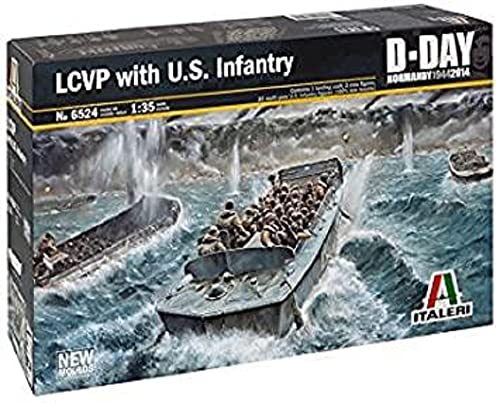
Eisenhower said Andrew Higgins was "the man who won the war for us," and this is the boat Higgins built. Italeri's 1/35 kit includes US infantry figures charging out of the dropped bow ramp. 173 reviews at 4.6 stars.
Best for: D-Day enthusiasts and diorama builders creating a beach assault scene
Over 23,000 LCVPs were built during WW2, and they delivered the first wave of assault troops onto every contested beach in every theater. Without Andrew Higgins' flat-bottomed plywood design and its revolutionary bow ramp, there is no Normandy, no Iwo Jima, no island-hopping campaign across the Pacific. Eisenhower himself credited Higgins as "the man who won the war for us." The LCVP carried 36 troops or a Jeep and 12 men, running them from transport ships to the shore under fire.
Italeri's 1/35 LCVP comes with US infantry figures that transform it from a boat model into an instant diorama centerpiece. The ramp is poseable: display it closed for the tense run toward shore, or dropped for the moment soldiers pour out into the surf. Hull detail captures the distinctive Higgins plywood planking and steel protective armor at the bow. The weak point is the figures themselves, which are noticeably softer in detail than Tamiya or Dragon infantry sets. Replacing them with better aftermarket figures is a worthwhile upgrade. For the full D-Day treatment, pair this with a sand-and-debris base, Czech hedgehog obstacles (available from several aftermarket companies), and additional infantry from other manufacturers.
American Ships
The US Navy grew from a peacetime fleet into the largest naval force in history during WW2. Carrier task forces decided the Pacific war, destroyer screens kept those carriers alive, and battleships delivered the final shore bombardments before Japan's surrender. These kits cover the Navy's most significant classes from that era.
Tamiya 1/350 USS Enterprise CV-6
~$171 on Amazon
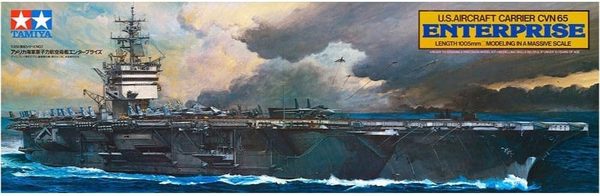
CV-6 earned 20 battle stars, more than any other US warship in WW2. She fought at Midway, the Philippine Sea, Leyte Gulf, and a dozen other engagements. The Japanese claimed to have sunk her so many times that her crew nicknamed her "The Grey Ghost." 421 reviews at 4.6 stars.
Best for: Advanced builders who want the ultimate Pacific Theater naval display piece
USS Enterprise (CV-6) fought from the opening days of the Pacific war to the final operations off Japan, earning 20 battle stars along the way. Radio Tokyo claimed to have sunk her on multiple occasions, which earned the carrier her nickname: "The Grey Ghost." She was present at Midway, the Eastern Solomons, Santa Cruz, the Philippine Sea, Leyte Gulf, and Okinawa. No other American carrier matched that combat record.
Tamiya's 1/350 Enterprise stretches over two feet long when complete and includes miniature SBD Dauntless dive bombers, TBF Avenger torpedo bombers, and F6F Hellcat fighters for the flight deck. The flight deck has accurately scribed plank lines, and the island superstructure captures the Yorktown-class profile well. With 500+ parts, plan for weeks of construction time, not days. One frustration builders consistently mention: the aircraft are tiny at this scale and fiddly to assemble, so steady hands and fine-point tweezers are essential. Aftermarket support is extensive. Pontos, Gold Medal Models, and others produce wooden deck overlays, turned brass gun barrels, and photoetch railings that can push this from a strong kit build into competition territory.
Tamiya 1/350 USS Missouri
~$122 on Amazon
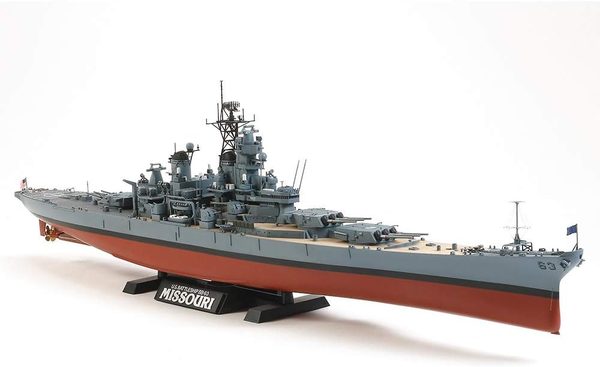
On September 2, 1945, Japanese officials signed the Instrument of Surrender on Missouri's deck in Tokyo Bay. Iowa-class, nine 16-inch guns in three triple turrets, roughly 30 inches long at 1/350 scale. 291 reviews at 4.5 stars.
Best for: Battleship enthusiasts and builders who want the ship that ended WW2
USS Missouri (BB-63) is the most historically significant American battleship, though not for her combat record. She bombarded Iwo Jima and Okinawa and screened the fast carrier task forces through the war's final year, but what makes her unique happened on September 2, 1945. In Tokyo Bay, with over 250 Allied ships assembled in the harbor, Japanese Foreign Minister Mamoru Shigemitsu signed the Instrument of Surrender on her deck. Today, Missouri is preserved as a museum ship at Pearl Harbor, anchored within sight of the USS Arizona Memorial.
Tamiya's 1/350 Missouri builds to roughly 30 inches long and demands its own shelf or display case. The nine 16-inch guns in three triple turrets dominate the model, and the 450+ parts capture the superstructure, anti-aircraft battery, and graceful hull lines of the Iowa class. The well-molded 40mm Bofors and 20mm Oerlikon mounts lining the superstructure are a highlight. Where the kit shows its age is in the simplified radar arrays and slightly chunky railing detail, both areas where aftermarket photoetch makes a visible difference. Pontos and other manufacturers produce comprehensive detail-up sets with wooden decks, turned brass barrels for every gun, and photoetch railings that can turn the out-of-box build into a competition piece. Even straight from the box, this is a serious display model that rewards patient assembly.
Tamiya Fletcher-Class Destroyer (1/700)
~$30 on Amazon
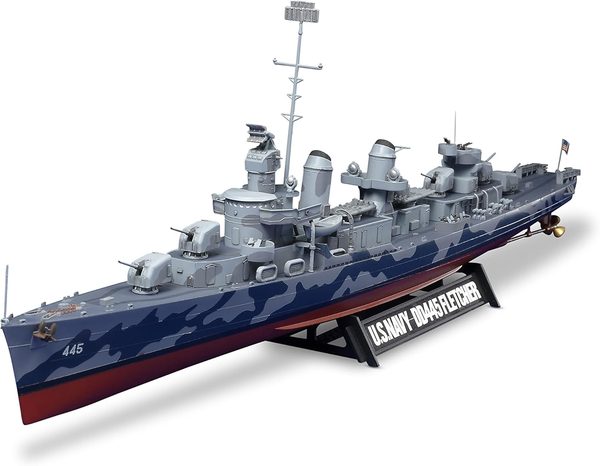
175 Fletcher-class destroyers were built, the most numerous destroyer class in naval history. They served in every major Pacific engagement from Guadalcanal through the final operations against Japan. 548 reviews at 4.5 stars at a $30 price point.
Best for: Ship builders who want a manageable, affordable naval build or task force escorts to display alongside larger carriers and battleships
The Fletcher class formed the backbone of the US Navy's destroyer force in the Pacific. 175 were built, and they did everything: screened carriers from submarines, bombarded shore positions, escorted convoys, fought surface actions at night, and pulled downed aviators out of the water. Nineteen were lost in combat, a number that reflects both the intensity of Pacific naval warfare and how many of these ships were in the thick of it.
At 1/700 scale, the finished model is roughly seven inches long, which makes it affordable at $30 and practical to buy in multiples for recreating a destroyer screen around a carrier or battleship model. Tamiya captures the class's five 5-inch gun mounts, torpedo tubes, and depth charge racks well at this scale. The trade-off of 1/700 is that small details like life rafts and 20mm guns are simplified, and the molded-on railing looks thick compared to photoetch alternatives from Gold Medal Models or Tom's Modelworks. Those aftermarket sets add railings, radar arrays, and platform details that dramatically improve the finished look. Two or three Fletchers alongside the Enterprise or Missouri create a convincing task force display that takes up the same shelf space as a single 1/350 carrier.
BMC Higgins Boat LCVP (1/32)
~$16 on Amazon
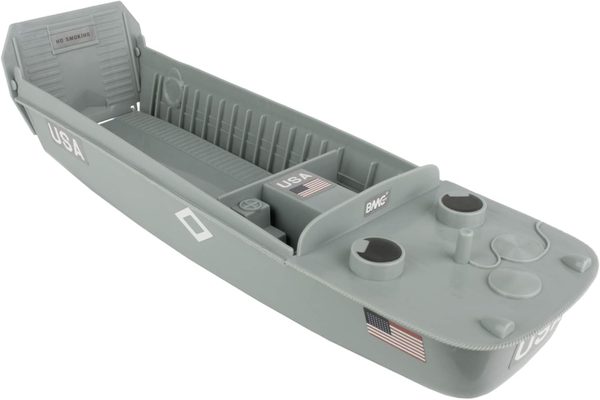
A pre-assembled, ready-to-display Higgins Boat at $16. No glue or paint required, though it responds well to both. The bow ramp opens and closes, and the 1/32 scale is compatible with standard 54mm toy soldiers. 460 reviews at 4.7 stars.
Best for: Young collectors, diorama beginners, and anyone who wants a D-Day landing craft without a complex build
Not every model needs to be a 400-part expert project. BMC's 1/32 Higgins Boat arrives pre-assembled and ready for display. The bow ramp opens and closes, the hull is durable enough for handling, and 1/32 scale matches standard 54mm toy soldiers and figures for quick beach-assault displays. At around $16, this is one of the most affordable items in this guide and one of the most popular. Teachers use it for classroom demonstrations about the Normandy invasion, and wargamers pair it with 1/32 infantry for tabletop scenarios.
The obvious trade-off here is detail. Surface texture is smooth and toy-like compared to the Italeri 1/35 LCVP, and there are no crew figures included. Experienced modelers who have picked one up to customize report that paint, weathering, and wash products can transform it into a surprisingly convincing piece, but it takes work to get there. For a complete budget D-Day scene, pair it with BMC or Conte Collectibles 1/32 D-Day infantry figures and a painted base representing the Normandy sand. The entire setup can cost under $40. If you want the full modeling experience with a Higgins Boat, look at the Italeri 1/35 LCVP with infantry figures elsewhere in this guide.
British Forces
British kits offer modeling subjects that look and feel nothing like their American counterparts. Where US aircraft favor clean, industrial sheet-metal construction, British designs like the Spitfire's elliptical wing and the Mosquito's bonded-plywood fuselage demand different finishing approaches. British tanks followed a split doctrine (infantry tanks for survivability, cruiser tanks for speed) that produced wildly different hull shapes within the same army. For modelers, this means nine kits that each present distinct challenges: fabric-covered control surfaces on aircraft, cast turret textures on Churchills, and riveted plate construction on Cromwells. The variety within a single nation's output is unmatched.
Revell Spitfire Mk.IXC (1/32)
~$52 on Amazon
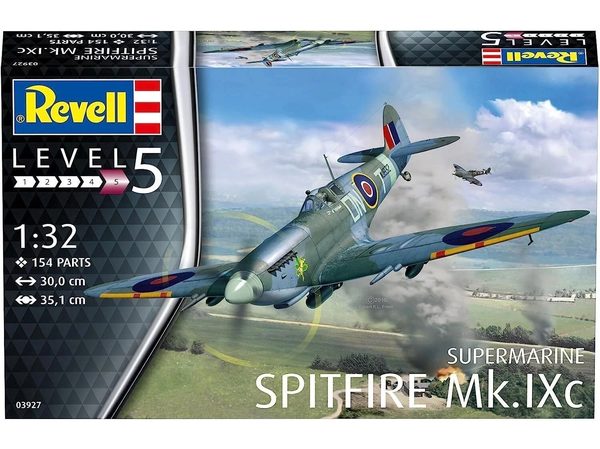
The mid-war Spitfire variant that countered the Fw 190 threat, built to 1/32 scale with a 14-inch wingspan. 762 reviews at 4.6 stars. Revell's best WW2 fighter kit by a wide margin.
Best for: Intermediate-to-advanced builders who want a large, detailed Spitfire with room for serious finishing work
When the Focke-Wulf Fw 190 appeared in 1941, it outclassed every Spitfire variant in RAF service. The Mk.IX was the emergency response: a Mk.V airframe fitted with the two-stage supercharged Merlin 61, which boosted top speed by nearly 40 mph. It restored parity within months and became the most-produced Spitfire variant, flying from D-Day through the liberation of Western Europe. This is the Spitfire that actually mattered most to the air war's outcome.
Revell's 1/32 kit renders the Mk.IXC with options for clipped or standard wingtips, four-cannon armament, and the intercooler intake beneath the nose. At this scale, the elliptical wing planform spans roughly 14 inches, large enough to appreciate the subtle compound curves that make the Spitfire so difficult to replicate accurately. Surface detail is crisply recessed, and the cockpit rewards careful painting. The 762 reviews at 4.6 stars reflect a kit that assembles predictably. Expect to add aftermarket seat harnesses and an instrument panel decal for best results at this scale, since the kit cockpit, while adequate, leaves visible detail gaps when you can peer into a half-inch-wide opening. The canopy is clear with minimal distortion, and the landing gear supports the finished weight without sagging.
Airfix Spitfire Starter Set (1/48)
~$47 on Amazon
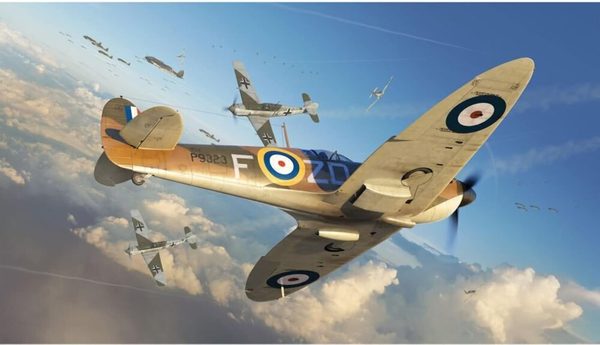
Everything in one box: paint, glue, brush, and a properly-tooled 1/48 Spitfire. The entry point that has started more modeling careers than any other kit in the hobby.
Best for: First-time builders or gift buyers who want a complete, self-contained modeling experience with zero additional purchases
Airfix has been producing Spitfire kits since 1955. This modern starter set includes acrylic paints in correct RAF colors, poly cement, a brush, and step-by-step instructions. The 1/48 kit uses current-generation tooling with finely recessed panel lines and a cleanly detailed cockpit, a major improvement over the soft, shallow detail of older Airfix molds. The included paints are functional but basic; experienced modelers will replace them with better acrylics and swap the tube glue for liquid cement. For someone building their first model, though, everything in the box works well enough to produce a recognizable Spitfire. The Spitfire is one of the 50 best military aircraft ever built, and this is the lowest-friction way to build one.
This is the gift for someone who mentioned building models as a kid. It eliminates every barrier: no hunting for paint colors, no confusion about glue types, no separate supply runs. Open it and start building. The one trade-off is price. At $47, this costs more than buying the kit and supplies separately if you already have a hobby stash. You are paying a convenience premium. But for the target buyer, that premium is worth it. The Spitfire subject ensures the finished product is recognizable and display-worthy even with rough brush-painting.
Tamiya Mosquito FB Mk.VI (1/48)
~$38 on Amazon
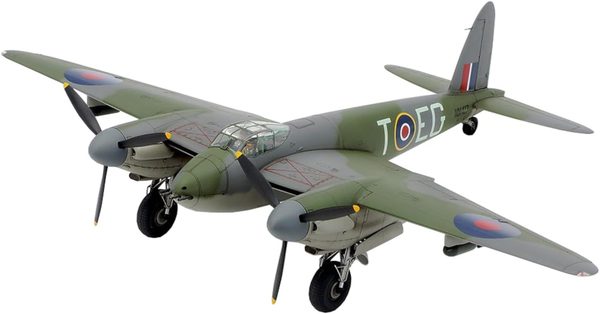
Britain's plywood multirole aircraft in 1/48 from Tamiya, with their trademark precision fit. 323 reviews at 4.6 stars. Fighter-bomber variant with four 20mm cannons and underwing ordnance.
Best for: Intermediate builders who want a twin-engine subject that assembles cleanly and paints easily thanks to the real aircraft's smooth wooden skin
Built primarily from laminated birch and balsa at a time when every other nation used all-metal construction, the de Havilland Mosquito was faster than most contemporary fighters, carried 4,000 pounds of bombs to Berlin, and filled more operational roles than any other WW2 aircraft: fighter, bomber, pathfinder, photo-reconnaissance, night fighter, and anti-shipping strike. The FB Mk.VI was the fighter-bomber variant, armed with four 20mm Hispano cannons in the nose and underwing racks for rockets or bombs.
Tamiya's kit at roughly 200 parts delivers their typical near-zero-gap assembly. The twin Merlin nacelles align precisely with the wing, and the clear nose transparency has minimal distortion. The 323 reviews at 4.6 stars confirm consistent build quality. One real advantage for painters: the Mosquito's wooden construction meant smooth, painted surfaces without rivet lines, so a clean coat of RAF camouflage looks correct without subtle rivet work. The cockpit seats pilot and navigator side by side, giving the interior more visual interest than single-seat fighters. The trade-off is that Tamiya's price-per-part ratio runs higher than competitors, and at 1/48 the twin-engine wingspan takes up meaningful shelf space. If you have built a few single-engine kits and want a larger, more complex subject without fighting bad fit, this is a logical next step.
Airfix Lancaster B III (1/72)
~$48 on Amazon
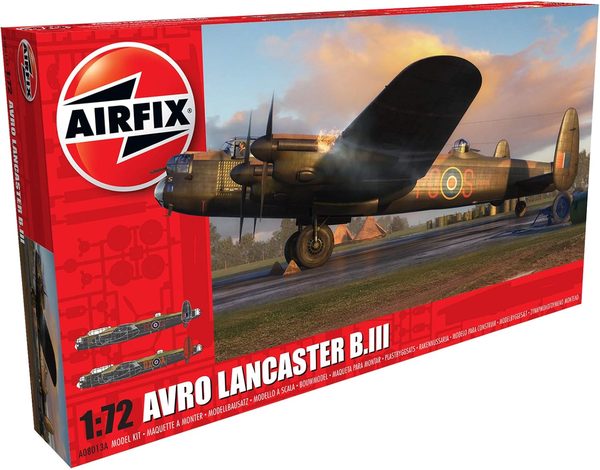
Airfix's current-generation Lancaster at 1/72, the scale that keeps a 102-foot wingspan manageable. 509 reviews at 4.6 stars. Roughly 17-inch finished wingspan.
Best for: Intermediate builders who want the RAF's primary heavy bomber without the two-foot-plus wingspan of a 1/48 version
RAF Bomber Command's primary heavy bomber carried more tonnage farther than any other Allied type, including the 22,000-pound Grand Slam that no other aircraft could lift. Lancasters flew over 156,000 sorties and dropped more than 600,000 tons of bombs. They attacked the Ruhr dams, sank the Tirpitz, and hammered German industry nightly from 1942 onward. More than half of all Lancasters built were lost in combat, a loss rate that reflects the brutal reality of the night bombing campaign.
At 1/72, Airfix keeps the Lancaster's 102-foot wingspan at roughly 17 inches, large enough to convey the bomber's scale without requiring a dedicated shelf. The approximately 250 parts include a bomb bay that opens or closes, rotating dorsal and rear turrets, and nicely molded Merlin nacelles. Surface detail uses finely recessed panel lines and fabric-effect control surfaces on the current tooling. Decal options cover some famous airframes including ED888 "Mike Squared," which completed 140 operational sorties. The weak point is the clear turret parts, which can be thick and benefit from careful polishing. Pair this with the Tamiya Mosquito for a complete Bomber Command display.
Hasegawa Typhoon Mk.IB (1/48)
~$35 on Amazon
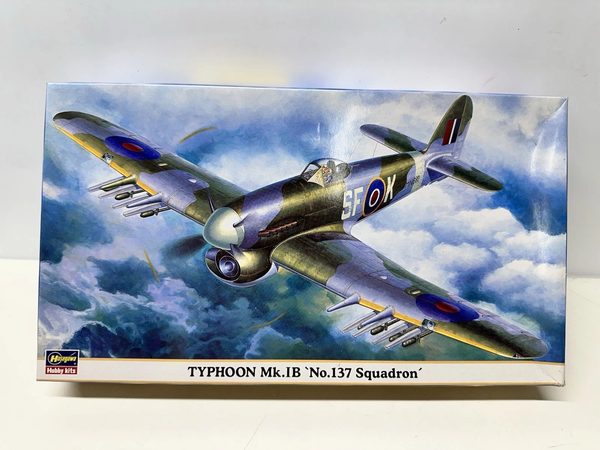
Hasegawa's 1/48 rocket-armed Typhoon, the ground-attack aircraft that defined the Normandy breakout. A visually dramatic build that stands apart from the Spitfires and Mustangs in most collections.
Best for: Intermediate builders interested in ground-attack aircraft and the Normandy campaign
The Hawker Typhoon failed as an interceptor. It was too slow at altitude, suffered chronic Napier Sabre engine failures, and killed pilots through structural tail failures. The RAF salvaged the program by re-roling it as a low-level attack platform armed with eight RP-3 rockets. In Normandy, rocket-armed Typhoons struck German armor, transport, and strongpoints across the bocage. At the Falaise Gap, where remnants of two German armies were caught in the open, Typhoon squadrons turned the roads into wreckage.
Hasegawa captures the Mk.IB with its distinctive chin radiator, thick wing, and the massive Sabre engine's cowling. At around 120 parts, this builds quickly for a 1/48 fighter. The rockets, bomb racks, and black-and-white invasion stripes create a visually striking finished model. Hasegawa's strength is accurate shapes and fine panel lines; the trade-off versus Tamiya is that fit requires slightly more patience, with some seams needing filler along the fuselage join. The Typhoon also works as a conversation piece: most visitors will not recognize it immediately, which opens the door to explaining one of the war's most underappreciated aircraft. Pair it with the Tamiya Sherman or Churchill for a Normandy campaign display.
Tamiya Churchill Mk.VII (1/35)
~$33 on Amazon
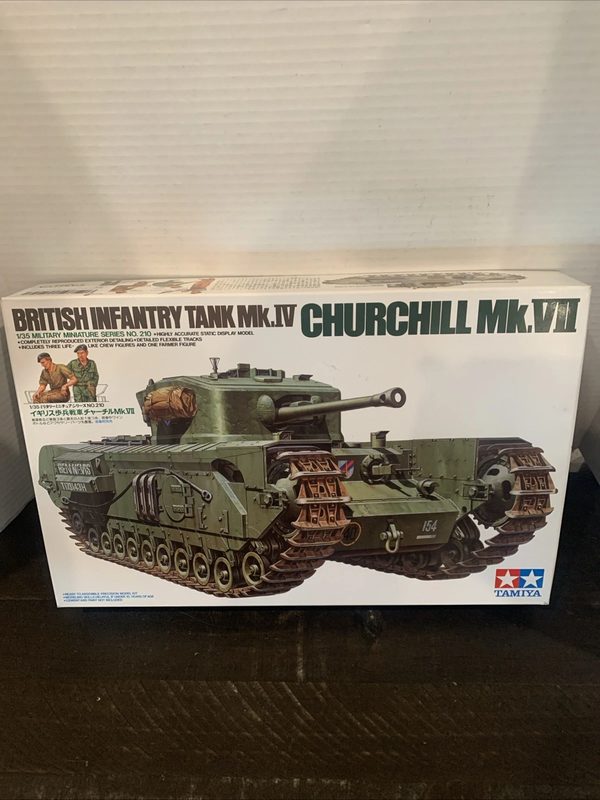
Tamiya's heavily armored infantry tank, the vehicle that led assault groups onto D-Day beaches and fought through the hedgerow country beyond. 635 reviews at 4.7 stars.
Best for: Intermediate builders who want a distinctively British tank with Tamiya's precision fit and an unusual silhouette
Slow, thick-skinned, and purpose-built to support infantry across broken ground, the Churchill followed a completely different design philosophy from every other major tank of the war. Its armor made it nearly impervious to most German anti-tank weapons at typical combat ranges, and its ability to climb 60-degree slopes earned it a reputation for going places no other tank could reach. On D-Day, specialized Churchills (flails, bridges, fascines) led the beach assaults as "Hobart's Funnies," while standard gun tanks fought through the bocage where survivability mattered more than speed.
Tamiya's Mk.VII is the late-war variant with uprated armor and the 75mm gun, the version that served from Normandy through VE Day. The 635 reviews at 4.7 stars reflect a mature, well-proven kit. Parts fit together with Tamiya's typical precision, and the workable link-and-length tracks assemble without the tedium of individual links. The Churchill's long, low hull with its wrap-around track run produces a silhouette unlike any Sherman, Panther, or Tiger on the shelf. At around $33, this is strong value for a Tamiya 1/35 kit. The one limitation is the turret interior: it is not visible, so detail-obsessed builders who want open hatches showing internal components will need aftermarket sets. The external detail, bolt heads, casting texture, tool stowage, needs no supplementation.
Tamiya Cromwell Mk.IV (1/35)
~$37 on Amazon
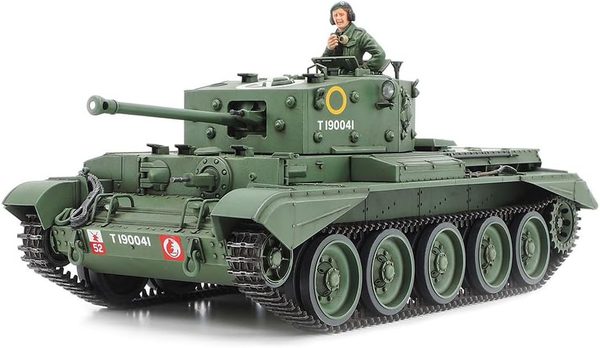
Britain's fastest WW2 tank, powered by a detuned Rolls-Royce Merlin engine and capable of 40 mph on roads. 314 reviews at 4.6 stars. Led the Normandy breakout.
Best for: Intermediate builders who want a fast, aggressive-looking cruiser tank to complement heavier British armor
Where the Churchill absorbed punishment, the Cromwell delivered speed. Its Rolls-Royce Meteor engine (a detuned Merlin, the same powerplant family that flew the Spitfire) pushed it to 40 mph on roads, making it the fastest British tank of the war. Cromwells equipped the armored reconnaissance regiments that led the breakout from Normandy, racing ahead to seize bridges, sever supply routes, and exploit gaps before the Germans could react. The Cromwell's weakness was its armor: adequate against light weapons but vulnerable to 75mm and 88mm fire at ranges where the Churchill shrugged off hits.
Tamiya's 1/35 Cromwell Mk.IV captures the boxy, riveted hull with sharp surface detail. The 314 reviews at 4.6 stars confirm reliable assembly. At roughly 160 parts, it builds slightly faster than the Churchill, and the flat-panel hull design makes it one of the best candidates in this guide for practicing weathering: mud, dust, and chipping effects read clearly on those large, uninterrupted armor plates. Build it alongside the Churchill to illustrate the two halves of British armored doctrine in Normandy. The Churchill went where fighting was heaviest; the Cromwell went where speed decided the outcome. The Cromwell also pairs naturally with the Hasegawa Typhoon, since both were essential to the breakout operations.
Tamiya Matilda (1/35)
~$43 on Amazon
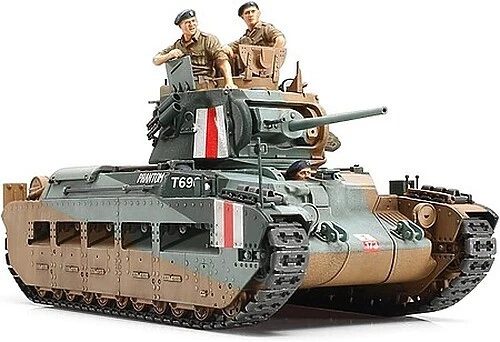
The early-war infantry tank that shrugged off every Italian anti-tank round in North Africa. 294 reviews at 4.7 stars, one of the highest-rated British armor kits available.
Best for: Intermediate builders interested in the North Africa campaign and early-war British armor design
During Operation Compass in 1940-41, the Matilda II's 78mm frontal armor proved impervious to every Italian anti-tank weapon in the Western Desert. At the Battle of Sidi Barrani, Matildas absorbed repeated hits without penetration while rolling through defensive positions. Italian gunners reportedly abandoned their weapons when they realized nothing in their arsenal could stop the slow-moving British tanks. The Matilda's fatal limitation was its 2-pounder gun: adequate against Italian armor but useless against the heavier German tanks that arrived with the Afrika Korps in 1941.
Tamiya's 1/35 kit renders the Matilda's unusual profile: a compact hull with full side skirts covering the suspension, a small cast turret with the 2-pounder, and markings for multiple North African units. The 294 reviews at 4.7 stars put it among the highest-rated British armor kits on Amazon. The roughly 170 parts include a turret interior visible through the open hatch, adding display interest that most tank kits lack. The desert sand finish is one of the simplest and most attractive paint schemes in WW2 armor modeling, a single base color with dust and sun-fading effects. Build the Matilda, Churchill, and Cromwell together to trace how British tank doctrine shifted across the war from the infantry-tank concept through the cruiser compromise.
Tamiya British Comet A34 (1/35)
~$44 on Amazon
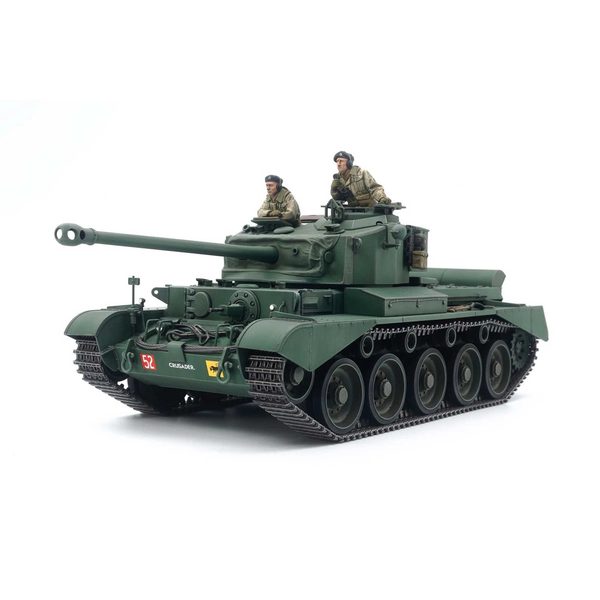
Britain's best WW2 tank, combining a high-velocity 77mm gun with adequate armor and reliable mobility. Arrived in late 1944. 147 reviews at 4.8 stars, among the highest-rated armor kits on Amazon.
Best for: Intermediate builders who want Tamiya's most modern British armor tooling and a tank that could finally trade blows with Panthers
Armed with a 77mm gun derived from the 17-pounder (the only British weapon that reliably penetrated Panther and Tiger armor), the Comet was the first British tank to combine adequate firepower, protection, speed, and mechanical reliability in one hull. It entered service with the 11th Armoured Division in late 1944 and proved effective against everything the Wehrmacht fielded in the war's final months. The Comet's limitation was timing: had it arrived 12 months earlier, it could have saved British tank crews from years of fighting in undergunned Cromwells and Shermans.
This is a relatively recent Tamiya release, and the 4.8-star average across 147 reviews reflects their latest manufacturing standards. Fit is effectively seamless, surface detail includes realistic weld beads and casting texture, and the suspension components align without adjustment. The turret's distinctive mantlet shape and the hull's clean proportions produce a model that looks purposeful and modern compared to the earlier British tanks in this guide. At around $44, the price is fair for current Tamiya tooling, though the lower review count means less community build-log reference material than older kits like the Panther or Tiger. If you have already built the Matilda, Churchill, and Cromwell, the Comet completes the chronological progression of British tank design.
German Aircraft
Luftwaffe aircraft dominate modeling popularity for one simple reason: variety. The Bf 109 went through more visual transformations across its variants than any other fighter, the Fw 190 introduced a radial-engine silhouette to the European air war, and the Me 262 brought jet propulsion to a propeller-driven conflict. For modelers, German aircraft also offer the most complex and visually interesting paint schemes of the war. RLM-standard camouflage involved hard-edged upper surfaces with hand-sprayed fuselage mottling, giving each finished model a unique character that Allied schemes rarely match. These five kits span the full range, from a $13 Stuka to Tamiya's jet-age Me 262.
Tamiya Fw 190 A-8 (1/48)
~$32 on Amazon
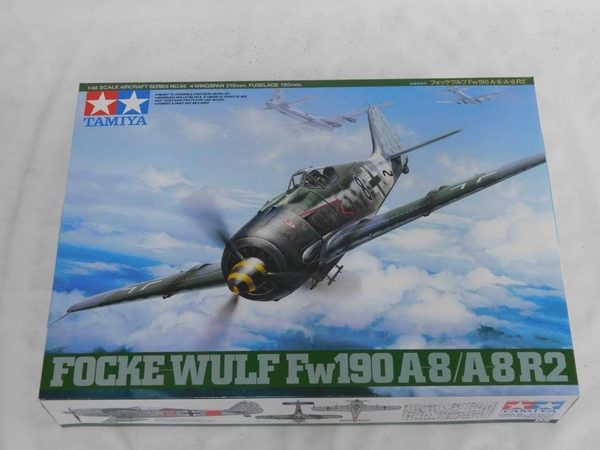
Tamiya's take on Kurt Tank's radial-engine fighter, the aircraft that forced Britain to rush the Spitfire Mk.IX into service. Around 95 parts at $32, one of the best price-to-quality ratios in 1/48 WW2 aircraft.
Best for: Intermediate builders who want a Luftwaffe fighter with Tamiya fit quality at an accessible price
Kurt Tank's Fw 190 entered service in 1941 and immediately outperformed every Spitfire variant then in RAF service, superior in speed, roll rate, and firepower. The wide-track landing gear and BMW 801 radial engine gave it rugged ground-handling characteristics that the narrow-geared Bf 109 could never match, which is why the Fw 190 became the Luftwaffe's primary ground-attack fighter in addition to its air superiority role. The A-8 was the late-war "universal" variant, armed with four 20mm cannons and two machine guns.
At roughly 95 parts, this is a quick build. The cockpit includes a detailed instrument panel, armored headrest, and seat, while the BMW 801 is partially visible through the cowling. Fit is pure Tamiya: minimal seam work, precise alignment, and no surprises during assembly. The one drawback is the kit's age; this is older Tamiya tooling, and while the fit remains excellent, some details like the exhaust stacks are simplified compared to newer releases from Eduard or Zvezda. At around $32, though, the value is hard to beat. The RLM paint schemes, mottled fuselage sides over hard-edged wing camouflage, are more complex and visually rewarding than typical Allied finishes. Pair with the Eduard Bf 109 for a complete Luftwaffe fighter shelf.
Academy Ju 87 Stuka (1/48)
~$13 on Amazon
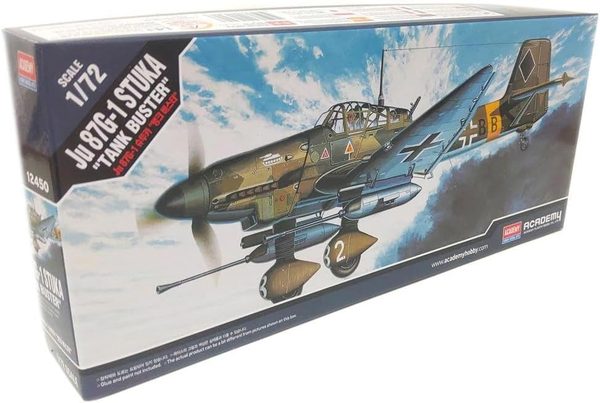
The most recognizable dive bomber ever built, priced at roughly $13. Academy delivers a legitimate 1/48 scale model at a cost that barely registers.
Best for: Budget-conscious builders and beginners who want a distinctive Luftwaffe subject without financial risk
Fixed landing gear, inverted gull wing, and the "Jericho Trumpet" siren that screamed during near-vertical dives made the Ju 87 the terrifying audio-visual signature of blitzkrieg. In the early campaigns across Poland, France, and the Mediterranean, the Stuka delivered precision bombing that shattered defensive positions. Its vulnerability to fighters eventually forced it into a secondary role, but in the opening years of the war, few weapons had a greater psychological impact.
Academy's kit delivers this subject at around $13, a price point where you might expect toy-grade quality. What you actually get is a solid 1/48 build with approximately 100 parts, the correct cranked-wing profile, spatted fixed landing gear, and the bomb-crutch mechanism that swung ordnance clear of the propeller. This is not Tamiya-level engineering: expect some fit gaps at wing roots and a cockpit that benefits from aftermarket upgrades. But as a practice kit or a second build, the math is compelling. Buy two, build the first from the box to learn, then detail the second with better paint and aftermarket decals. Even with extras, you stay under $40 for two finished Stukas.
Tamiya Me 262A-1a (1/48)
~$42 on Amazon
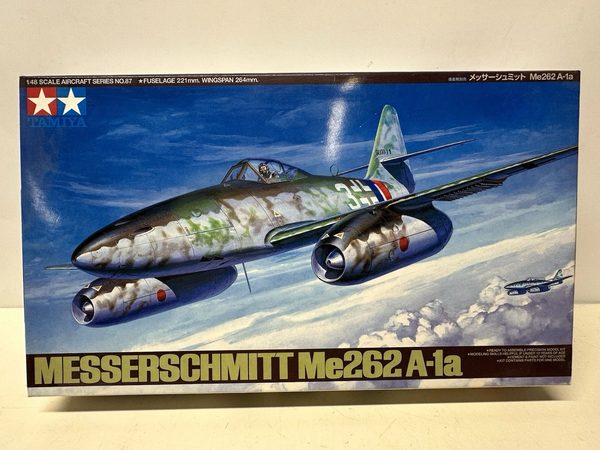
Tamiya's 1/48 rendering of the world's first operational jet fighter. Swept wings, underslung Jumo 004 nacelles, and a profile that looks more 1950s than 1944. Roughly 130 parts.
Best for: Intermediate builders who want the aircraft that bridged WW2 and the jet age, plus a visually unique addition to any collection
Over 100 mph faster than any Allied piston fighter when it entered combat in mid-1944, the Me 262 carried four 30mm MK 108 cannons that could tear a B-17 apart in a single firing pass. Only the Jumo 004 engines' 25-hour service life, chronic fuel shortages, and Hitler's insistence on diverting production to the bomber role prevented the Schwalbe from inflicting far heavier losses on Allied bomber formations.
Tamiya captures the A-1a fighter variant with its shark-like fuselage, moderately swept wings, and underwing engine nacelles. The roughly 130 parts include a cockpit with the distinctive triangular instrument panel, and the nacelles show enough internal detail to look convincing through the open intakes. The long fuselage halves join cleanly, and the tricycle landing gear is sturdy. The weakness is the engine exhaust area, where Tamiya simplified the Jumo 004's complex rear section. Aftermarket resin exhausts (around $8-12) are a worthwhile upgrade for builders who want accuracy there. The late-war Luftwaffe paint schemes, often hastily applied with unusual mottling and heavy weathering, make for particularly interesting finishing work. On a shelf full of propeller-driven fighters, the Me 262 is the model everyone reaches for first.
ICM Ju 88A-14 (1/48)
~$75 on Amazon
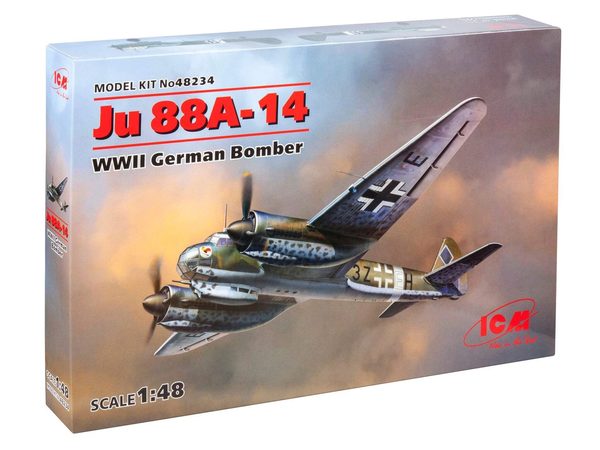
ICM's highly detailed 1/48 Ju 88, the Luftwaffe's do-everything twin-engine workhorse. Around 250 parts with a complex glazed nose that tests advanced building skills. Bomber, night fighter, torpedo striker, reconnaissance platform.
Best for: Advanced builders who want a detailed, challenging twin-engine subject with accurate surface detail from a respected Ukrainian manufacturer
Conceived as a fast bomber, the Ju 88 evolved to fill virtually every combat role the Luftwaffe needed: night fighter, torpedo bomber, reconnaissance aircraft, heavy fighter, and even a piloted missile in the Mistel composite program. Over 15,000 were built, serving on every front from the first day of the war to the last. The Ju 88's performance never dominated any single role, but its adaptability made it indispensable across all of them.
ICM's approximately 250 parts include a highly detailed glazed nose with internal framing, a full bomb bay, defensive gun positions, and Jumo 211 engines with their distinctive annular radiators. Surface detail is sharp and dimensionally accurate. At around $75, this is the most expensive aircraft kit in this section, and the build complexity matches the price. The glazed nose requires careful construction and precise masking; the extensive greenhouse framing is one of the hardest tasks in twin-engine WW2 bomber modeling. Expect to spend hours on masking tape work alone. ICM's fit is good but not Tamiya-smooth, so plan on test-fitting subassemblies before committing to glue. The payoff is a finished model that few collections include, making it a genuine standout alongside the more common 109s and 190s.
Eduard Bf 109G-6 ProfiPACK (1/48)
eBay Only
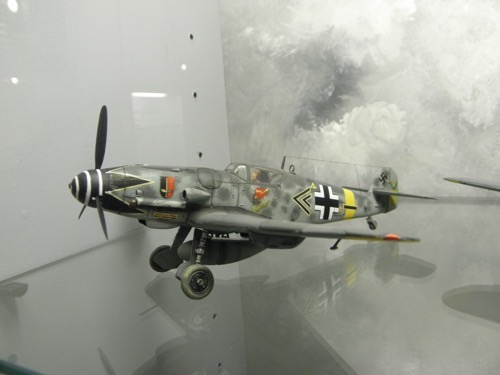
Eduard's ProfiPACK Bf 109G-6 with pre-painted photoetch, canopy masks, and panel lines verified against original Messerschmitt drawings. The most-produced fighter variant of the most-produced fighter in history. eBay only.
Best for: Intermediate-to-advanced builders who want the most accurate Bf 109 available in 1/48 scale and do not mind sourcing from eBay
Over 34,000 Bf 109s were built from 1937 through 1945, more than any other fighter aircraft in history. The G-6 "Gustav" was the most-produced variant, featuring the DB 605 engine and options for underwing 20mm cannon gondolas. In the hands of pilots like Erich Hartmann (352 victories), Gerhard Barkhorn (301), and Gunther Rall (275), it compiled an aerial record that will almost certainly never be equaled.
Eduard's ProfiPACK edition features their trademark crisp panel lines, airframe dimensions checked against original technical drawings, and the box includes pre-painted photoetch for the cockpit, harnesses, and external details, plus canopy masks that simplify painting. Engineering is precise: fuselage halves align cleanly, the wing root joint is tight, and small components like exhaust stacks and antenna mast are finely molded. The trade-off is availability. Eduard runs limited production batches, and this kit cycles in and out of stock unpredictably. It is not on Amazon; the eBay link searches for the specific kit number (82113). If you find one at retail price, buy it immediately. Secondary-market sellers typically charge a 30-50% premium once a batch sells out.
German Tanks & Armor
German armor is the single most popular subject category in military modeling, and it is not close. Tamiya's Panther, Tiger, and Panzer IV kits have occupied Amazon's best-seller lists for decades, and the reason goes beyond wartime reputation. These tanks have distinctive, angular silhouettes that photograph well and display dramatically. Their three-tone late-war camouflage schemes (dark yellow, olive green, red-brown) are among the most visually complex and rewarding finishes in the hobby. And the sheer number of surviving reference photos, walkaround galleries, and museum examples means builders have more documentation for German armor than for any other nation's vehicles. That said, do not confuse modeling popularity with battlefield superiority: the Panther's transmission broke down constantly, and fewer than 1,400 Tigers were built versus over 49,000 Shermans.
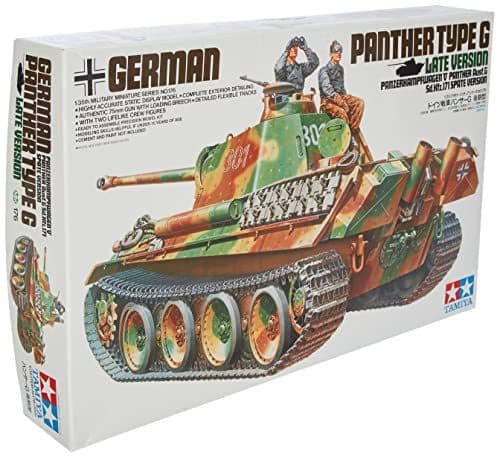
Tamiya Panther Ausf.A (1/35)
~$25 on Amazon
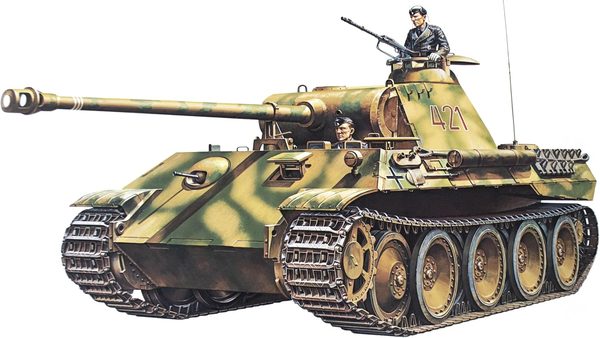
The single best-selling WW2 tank model on Amazon, with over 2,000 reviews at 4.6 stars and a $25 price that makes it the default first armor kit. Sloped armor, long-barreled 75mm, and a silhouette that influenced postwar tank design worldwide.
Best for: Everyone. Beginners get a forgiving build with near-zero fit issues; experienced builders get a proven canvas for camouflage, weathering, and detailing experiments.
Germany designed the Panther after encountering the T-34 in 1941, borrowing its sloped-armor concept and scaling it up with a long-barreled 75mm KwK 42 that could penetrate any Allied tank at combat range. Well-sloped frontal armor defeated the US 75mm and Soviet 76mm guns, and a road speed of 34 mph made it faster than most medium tanks in service. The design's influence on postwar tanks is well documented. Its operational weakness was the final drive and transmission, which failed with frustrating regularity under the Panther's 45-ton weight, leaving significant numbers broken down before they ever reached the front line.
Over 2,000 reviews at 4.6 stars and a $25 price point explain why this kit has been the default first armor recommendation for decades. The approximately 150 parts fit with near-zero gaps, the link-and-length tracks look convincing without individual-link tedium, and the overall proportions are accurate. The Panther's large, flat armor panels also make it one of the best kits in this guide for learning finishing techniques: airbrushed three-tone camouflage, oil-paint dot filtering, pigment mud effects, and paint chipping all read well on these surfaces. Many experienced modelers have built this Panther three or four times, applying new techniques each time. At $25, that kind of repeat building is financially painless.
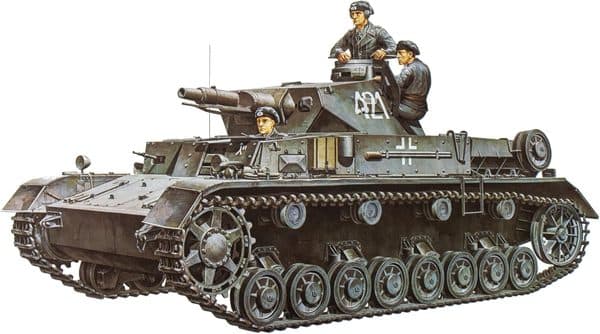
Tamiya Panzer IV Ausf.D (1/35)
~$28 on Amazon
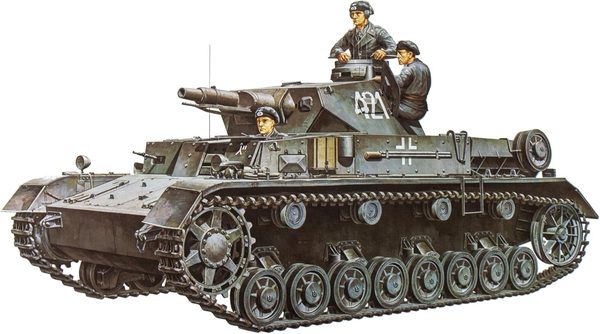
The only German tank in production for the entire war, from Poland in 1939 to Berlin in 1945. This early-war Ausf.D variant with the short 75mm gun has earned 1,500+ reviews at 4.7 stars.
Best for: Beginner-to-intermediate builders who want an early-war German tank with the simplest possible paint scheme
While the Tiger and Panther attract more attention, the Panzer IV was the tank that actually fought in every campaign from the first shots in Poland through the final collapse. No other German tank stayed in continuous production for the entire war. The Ausf.D carries the short-barreled 75mm designed for infantry support rather than anti-tank combat, a doctrinal choice that was violently corrected after encountering the T-34 on the Eastern Front.
Tamiya's kit has earned over 1,500 reviews at an exceptional 4.7-star average. The approximately 140 parts build into a compact model that captures the Panzer IV's flat-sided hull, turret basket, and stubby gun. The early-war Panzer grey finish is one of the simplest schemes in WW2 armor: a single base color with minimal camouflage, ideal for a first German tank build. The downside of the Ausf.D is that the short gun looks less visually dramatic than the long-barreled late-war variants. For builders who want the more aggressive look, Tamiya also makes the Ausf.H and J. Better yet, build both to show how the same chassis evolved from infantry-support weapon into a dedicated tank killer. At around $28, the Ausf.D is affordable enough to pair with the Panther for a two-kit German armor project.
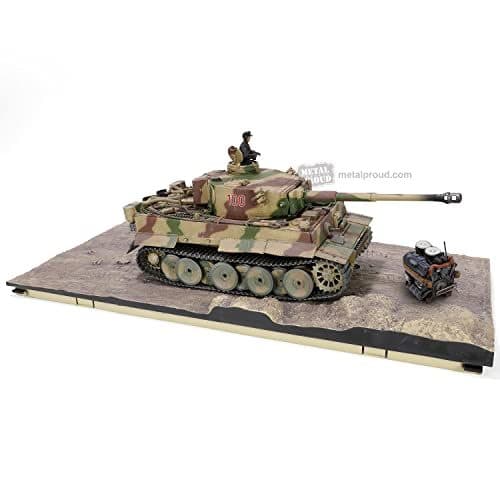
Tamiya Tiger I Early (1/35)
~$43 on Amazon
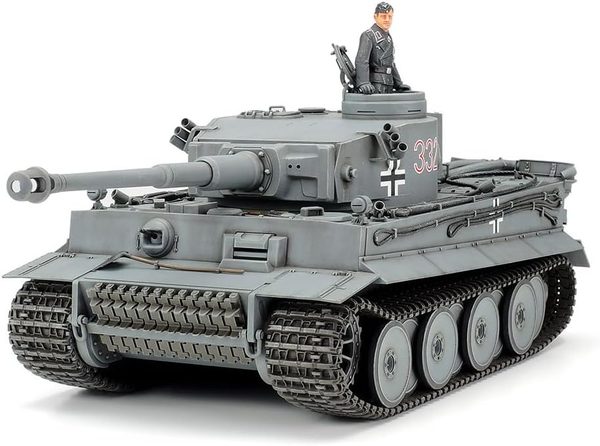
The most famous WW2 tank, with an 88mm gun derived from the Flak 36 and 100mm frontal armor that stopped nearly everything the Allies fired at it. 805 reviews at 4.7 stars. Tamiya's early production variant.
Best for: Intermediate builders who want the single most recognized WW2 tank and do not mind assembling individual track links
The Tiger I's 88mm KwK 36 could destroy any Allied tank at ranges where return fire simply bounced off its 100mm frontal plate. At Villers-Bocage, a single Tiger commanded by Michael Wittmann knocked out over a dozen British vehicles in minutes. Its reputation was so extreme that Allied tankers developed "Tiger Fear," reporting every German tank they encountered as a Tiger. The reality was more nuanced: only 1,347 were built, they consumed enormous quantities of fuel and spare parts, and the 57-ton weight made them too heavy for many bridges and roads.
Tamiya's early production variant includes the Feifel air cleaners, drum-style commander's cupola, and S-mine launchers on the hull corners. The 805 reviews at 4.7 stars make this one of the most proven WW2 armor kits ever released. The approximately 180 parts assemble cleanly, and the Tiger's boxy hull makes for straightforward construction. The one significant difference from the Panther and Panzer IV: this kit uses individual track links rather than Tamiya's easier link-and-length system. Expect to spend a full evening just on the tracks. The payoff is more realistic sag and drape in the final result. At around $43, the Tiger costs more than the Panther and Panzer IV, reflecting its larger size. For builders who want a full-interior option, Rye Field Model (RFM) produces one showing every shell in the ammo racks, but at three times the price and ten times the build hours.
German Vehicles & Artillery
The Wehrmacht's armored divisions ran on far more than tanks. Panzergrenadiers rode into battle in Hanomag halftracks, reconnaissance units probed ahead in SdKfz 222 armored cars, and the ubiquitous Kubelwagen appeared at every level from divisional headquarters to forward supply dumps. For modelers, these vehicles serve a critical purpose that tanks cannot: they populate dioramas. An isolated Panther on a shelf tells one story; a Panther alongside a Hanomag full of infantry, a Kubelwagen at a crossroads checkpoint, and a Pak 40 in a concealed position tells a complete one. These seven kits range from $13 to $35, making them easy to collect in quantity.
Tamiya Hanomag SdKfz 251/1 (1/35)
~$23 on Amazon
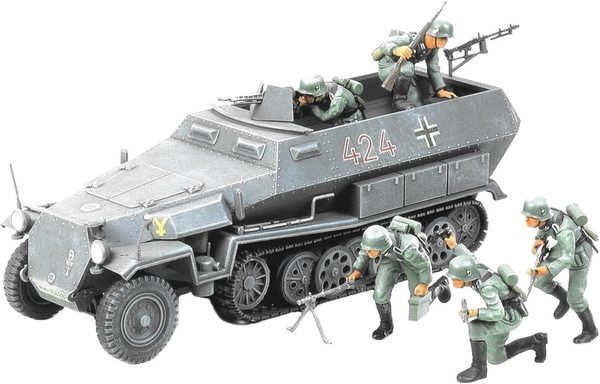
The armored halftrack that carried Panzergrenadiers alongside the Panzers, and one of the most purchased military kits in the world. 1,900+ reviews at 4.6 stars. Open-topped fighting compartment invites figure placement and interior detailing.
Best for: Beginner-to-intermediate builders who want a versatile diorama centerpiece or a companion to German tank builds
Blitzkrieg required infantry that could keep pace with tanks across rough terrain under fire. The SdKfz 251 provided that: armored protection against small arms and shell fragments, tracked rear-drive mobility, and an open fighting compartment that allowed rapid dismount or fire from inside the vehicle. Over 15,000 were built in dozens of variants, from basic troop carriers to rocket launchers to mobile command posts.
Tamiya's kit has earned over 1,900 reviews at 4.6 stars, making it one of the most successful military model kits ever released. The approximately 120 parts build quickly: the hull assembles cleanly, the halftrack running gear is well-engineered, and the open top means the fully visible interior is worth detailing. At around $23, this is exceptional value. The Hanomag's limitation as a standalone model is that it looks somewhat bare without figures. The open compartment practically demands a squad of infantry loading up, a radio operator, or at minimum some stowage items. Budget for a Tamiya figure set ($10-15) to bring it to life. The SdKfz 251 served in every theater, so it works in Eastern Front whitewash, North African sand, or Normandy hedge camouflage.
Tamiya SdKfz 222 (1/35)
~$35 on Amazon
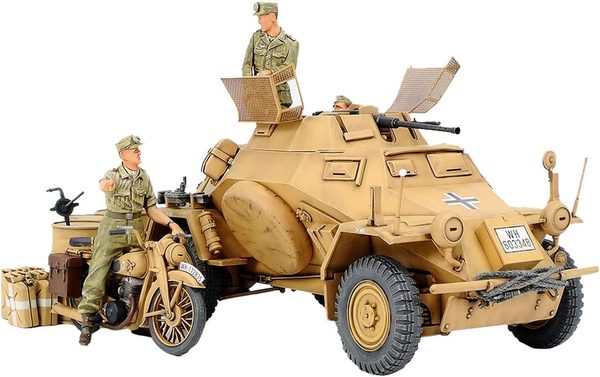
Tamiya's compact four-wheeled armored car with its distinctive anti-grenade mesh turret and three included Afrika Korps crew figures. 472 reviews at 4.6 stars. North Africa variant.
Best for: Intermediate builders who want a compact reconnaissance vehicle with included figures for an immediate diorama-ready build
The SdKfz 222 was the Wehrmacht's standard light reconnaissance vehicle, armed with a 20mm autocannon and coaxial machine gun in an open-topped turret covered by a wire mesh anti-grenade screen. It probed ahead of the main force across every theater from France to North Africa to the Eastern Front. Tamiya depicts the North Africa variant with desert-specific equipment and markings.
At roughly 150 parts, this kit offers something different from the tanks and halftracks that fill most German armor collections. The three included Afrika Korps figures (driver, commander, gunner) are a welcome bonus that eliminates the usual separate figure purchase. The small finished footprint means the 222 fits into dioramas alongside larger vehicles without competing for attention, and the open turret with its mesh screen provides a visual focal point. The downside is that the mesh screen is molded in solid plastic rather than actual mesh; photoetch replacement screens (available from Eduard and others for a few dollars) are a significant visual upgrade. The North Africa desert sand finish, with dust and sun-fading effects, is one of the most forgiving and attractive weathering approaches in the hobby. Pair with the Tamiya Matilda for an early-war desert encounter.
Tamiya Kubelwagen (1/35)
~$21 on Amazon
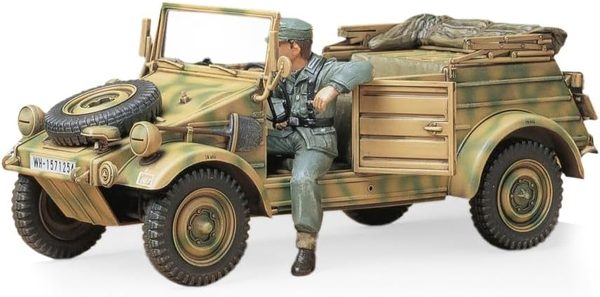
Ferdinand Porsche's military VW Beetle adaptation, produced in over 50,000 examples. 507 reviews at 4.6 stars. Roughly 80 parts, buildable in a single evening, at around $21.
Best for: Beginners who want a fast, affordable build or experienced modelers who need diorama accessories in quantity
The Kubelwagen's air-cooled flat-four engine needed no radiator, a major advantage in both the North African desert and the Russian winter. The lightweight body could be lifted out of ditches by its four-man crew, and the torsion bar suspension handled rough ground better than its modest specifications suggested. Over 50,000 were built, and they served in roles ranging from staff cars to field ambulances to signals vehicles. Its limitation was the complete lack of armor: unlike the Jeep, the Kubelwagen offered zero protection from anything.
At around $21 and 80 parts, this is a kit you can start after dinner and have ready for paint before bed. The 507 reviews at 4.6 stars confirm it delivers Tamiya quality at the lowest price tier. The fold-down canvas top, detailed dashboard, and bucket seats capture the vehicle's functional simplicity. The Kubelwagen's real value is as a diorama multiplier: every German military scene benefits from one or two parked nearby, whether it is a command post, an airfield, or a vehicle park behind the lines. At this price, buying three or four is no stretch. They pair with the Schwimmwagen for a matched VW military set, or scatter them through any German-theater diorama for instant authenticity.
Tamiya Schwimmwagen (1/35)
~$22 on Amazon
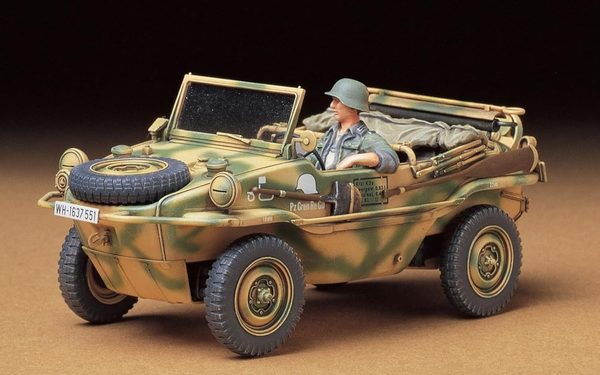
The amphibious Volkswagen, the most mass-produced amphibious car in history at over 15,000 built. 320 reviews at 4.8 stars, one of the highest-rated kits in this entire guide. Around 80 parts.
Best for: Beginners who want a unique, conversation-starting model or builders collecting the full VW military vehicle family
A Volkswagen-based four-wheel-drive amphibious car that could drive to a river, lower its rear propeller, cross the water, retract the propeller, and continue on land. Over 15,000 were built, making it the most mass-produced amphibious car in history. It served primarily with reconnaissance units on the Eastern Front, where Russia's dense river network made amphibious capability a practical asset rather than a gimmick. The trade-off was cramped seating for only four soldiers and a hull that offered no ballistic protection.
The 4.8-star average across 320 reviews makes this one of the highest-rated kits in the entire guide. At roughly 80 parts, it builds as quickly as the Kubelwagen and produces a compact model that generates questions from everyone who sees it. The boat-shaped hull, fold-down rear propeller, and portal axles create a silhouette unlike anything else on a display shelf. At around $22, this is an easy add-on purchase alongside any other German kit. Eastern Front finishing options include mud-caked lower hulls and whitewash winter camouflage over dark yellow, both of which suit the Schwimmwagen's utilitarian shape. Pair it with the Kubelwagen for a matched set that tells the story of wartime German automotive ingenuity at its most creative and eccentric.
Tamiya Kettenkraftrad (1/35)
~$17 on Amazon
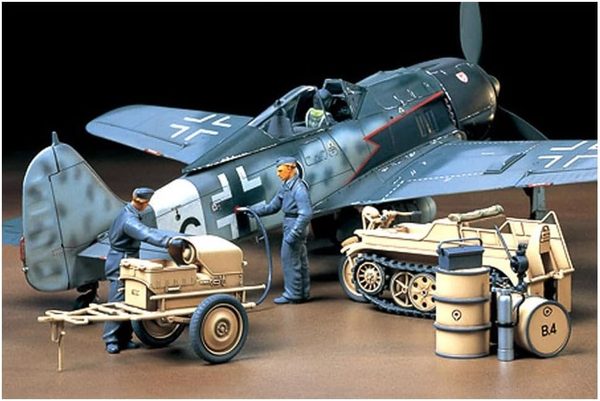
Half motorcycle, half tracked vehicle, and the strangest mass-produced military vehicle of the war. 182 reviews at 4.6 stars. Around 60 parts at $17, buildable in a single evening.
Best for: Beginners who want a quick, cheap build or collectors who want the most unusual WW2 vehicle available in kit form
A motorcycle front end grafted onto a miniature tracked chassis, the Kettenkraftrad looks like a fabrication but was a real production vehicle built in quantity. Originally designed for Fallschirmjager (paratroopers) to tow light weapons after airborne drops, it proved so capable in difficult terrain that regular army units adopted it widely. It navigated trails too narrow for halftracks and towed loads far heavier than its 1.5-ton weight suggested. The limitation was obvious: one crew member, minimal cargo capacity, and zero protection from anything.
Tamiya captures this oddity in just 60 parts, the fastest build in this guide. At around $17, it is also among the cheapest. The 182 reviews at 4.6 stars confirm Tamiya quality at a budget price. The kit includes a seated driver figure and a supply trailer, both of which add display interest to an already eye-catching subject. The Kettenkraftrad works as a conversation starter in any collection (non-modelers are fascinated by it) and as a diorama accessory that fits into tight spaces. Place one next to an Me 262 on a forest airstrip or towing supplies along a muddy road behind a Panzer column. At $17, there is no financial reason not to add it to your next order as an impulse buy.
Tamiya 88mm Flak 36/37 (1/35)
~$32 on Amazon
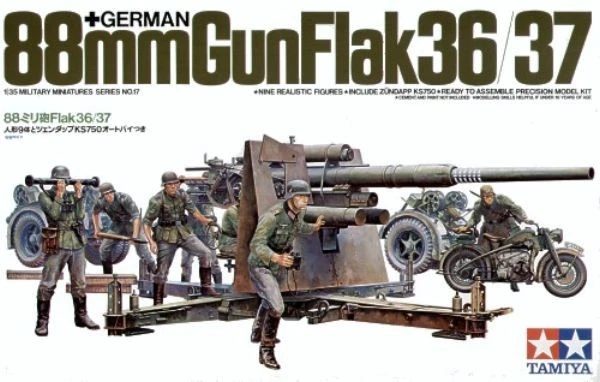
The dual-purpose gun that terrorized Allied tanks and bombers alike. Designed as anti-aircraft, pressed into the anti-tank role where it could destroy any Allied vehicle at extreme range. 1,000+ reviews at 4.7 stars.
Best for: Intermediate builders who want a centerpiece diorama subject with mechanical complexity and included crew figures
Designed as a heavy anti-aircraft gun, the 88mm Flak 36/37 gained its fearsome anti-armor reputation when Rommel deployed it against British tanks in North Africa, destroying vehicles at ranges well beyond their own guns' reach. The 88's success in the ground role directly influenced the Tiger I's main armament: the KwK 36 was essentially a tank-mounted derivative. As anti-aircraft defense, the 88 remained effective against high-altitude bombers throughout the war. Its vulnerability was setup time; deploying the cruciform platform took minutes, during which the crew was exposed and the gun was useless.
Tamiya's kit has earned over 1,000 reviews at 4.7 stars. The approximately 200 parts build into an imposing model with a barrel nearly five inches long at 1/35 scale. The kit includes the cruciform firing platform, recoil mechanism, elevating gear, shield, transport limbers, and crew figures. The mechanical complexity, elevation mechanisms, traverse gear, sighting equipment, ammunition storage, gives the finished model visual depth from every angle. Build it in a North African anti-tank position with sand-colored finish and DAK crew, or in a late-war anti-aircraft role with the barrel aimed skyward. Pair with the Tiger I to display the family lineage between the gun and the tank it inspired.
Tamiya 75mm Pak 40 (1/35)
~$13 on Amazon
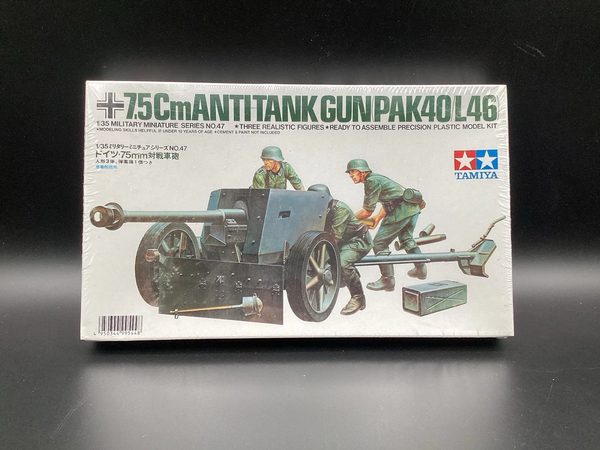
Germany's standard anti-tank gun from 1942 onward, responsible for more Allied tank kills than any other German weapon. 1,300+ reviews at 4.7 stars. Around $13, possibly the best dollar-for-dollar value in military modeling.
Best for: Budget builders and diorama enthusiasts who want a complete model with crew figures for the price of a fast-food meal
Over 20,000 Pak 40s were produced from mid-1942 through the war's end, and they deployed in massive numbers on every front. The 75mm gun could defeat a Sherman's frontal armor at normal combat ranges and remained dangerous to every Allied tank except the heaviest types like the IS-2 and Churchill. Its low, easily concealed profile made well-sited Pak 40 batteries capable of stopping armored advances entirely. The crew's vulnerability was the gun's 1,425 kg weight; repositioning it without a towing vehicle was backbreaking work.
At around $13, this may be the single best value in the entire guide. Over 1,300 reviews at 4.7 stars across years of production prove the kit's consistency. The approximately 80 parts build quickly into a model that includes the gun, split-trail carriage, shield, and crew figures. For less than the cost of lunch, you get a finished Tamiya military model with everything needed for a complete diorama vignette. The Pak 40 is also the perfect "palate cleanser" between major projects: when you have spent months on a 500-part Tiger build and need the satisfaction of completing something, this delivers a finished model in a single afternoon. Buy several and distribute them through your collection; at this price, quantity is practical.
Soviet Forces
The Eastern Front consumed more men and material than every other WW2 theater combined. The Soviet Union produced over 57,000 T-34 tanks and more than 36,000 IL-2 Sturmoviks, numbers that dwarfed every other nation's output. Yet Soviet subjects remain underrepresented on hobby shop shelves. Western kit makers focused on Allied and German hardware for decades, leaving the Eastern Front poorly covered until Tamiya filled several key gaps. These three kits cover the most historically significant Soviet vehicles available on Amazon today.
Tamiya T-34/76 1943 (1/35)
~$28 on Amazon
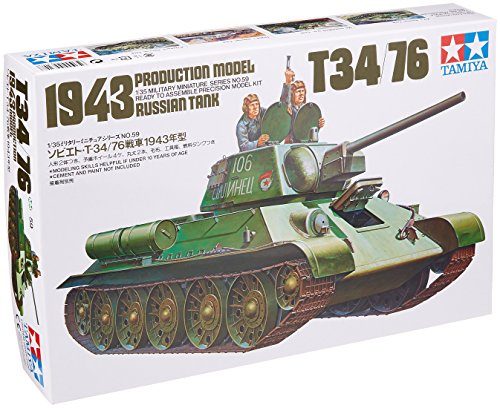
Tamiya's take on the tank that forced Germany to redesign its entire armored fleet after 1941. 980 reviews at 4.7 stars. Roughly 130 parts at a price point that undercuts most 1/35 armor kits.
Best for: Beginner-to-intermediate builders looking for an affordable, well-engineered Soviet armor subject
When the T-34 first rolled into combat in the summer of 1941, German anti-tank crews discovered their standard 37mm rounds bouncing off its sloped armor plates. The 60-degree glacis plate deflected shots that would have punched through the flat-sided Panzer III and IV. Wide 480mm tracks gave it mobility in mud and snow that left narrow-tracked German tanks bogged down. Its 76mm F-34 gun outranged German tank armament at the time, and the V-2 diesel engine ran on fuel less likely to ignite than the gasoline powerplants used by every other major combatant. Germany's Panther program was a direct response to this single vehicle.
Tamiya's kit depicts the 1943 production model with the hexagonal turret, the most recognizable early T-34 variant. Fit quality is typical Tamiya, meaning minimal seam cleanup and parts that align without forcing. The Christie suspension with its large road wheels is cleanly rendered, and the low, wide silhouette comes together accurately. One drawback: the kit lacks individual track links, using rubber band tracks instead, which look flat under close inspection. Aftermarket link-and-length tracks from Friulmodel or MasterClub fix this for around $20.
Painting is straightforward. Soviet 4BO green as a single base coat, white tactical numbers, and an optional slogan on the turret. That simplicity makes it a strong first armor kit. Experienced builders can layer winter whitewash, chipped paint, and caked mud for a vehicle that looked like it survived three months on the Kursk salient. Build it alongside the Tamiya Panther to display the most consequential armored rivalry of the war.
Tamiya T-34/85 (1/48)
~$27 on Amazon
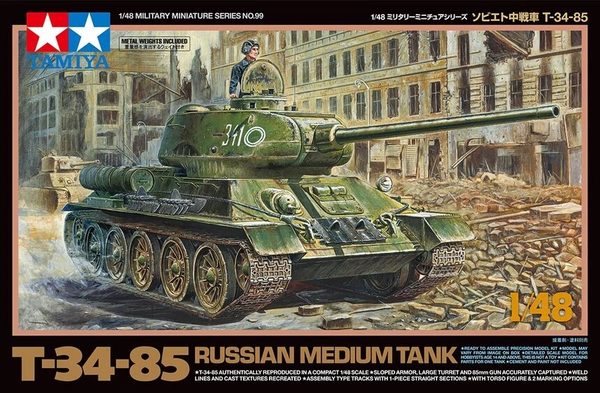
The upgraded T-34 with its larger turret and 85mm gun, the version that spearheaded every Soviet offensive from mid-1944 through Berlin. 133 reviews at 4.7 stars in compact 1/48 scale.
Best for: Beginner-to-intermediate builders who want a later-war Soviet tank without a large shelf footprint
By 1943, the original T-34/76 was struggling. Improved German armor and widespread deployment of the 75mm PaK 40 anti-tank gun made the 76mm gun insufficient at typical engagement ranges. The fix was a new, larger turret housing the 85mm D-5T gun, which could penetrate a Panzer IV's frontal plate at 1,000 meters and threaten Panthers at closer ranges. The T-34/85 entered service in early 1944 and became the standard Soviet medium tank for the rest of the war, serving in front-line roles with Soviet allies into the 1960s.
Tamiya's 1/48 version is a newer tooling, and the 133 reviews at 4.7 stars reflect clean engineering. At 1/48, the finished model occupies roughly half the shelf space of a 1/35 kit, which matters if you are building multiple vehicles. The approximately 120 parts snap together with Tamiya's usual precision. The larger three-piece cast turret and longer 85mm barrel give it a noticeably heavier profile than the T-34/76. One limitation of 1/48 armor kits in general: fewer aftermarket options exist compared to the massive 1/35 ecosystem, so what you see in the box is mostly what you get.
Pair this with the 1/48 Tamiya Sherman for a late-war Allied armor comparison. The smaller parts count means you can finish this kit in a single long session, making it a good candidate for wargaming collections or quick weekend builds. Late-war Soviet factory finishes varied from clean dark green to rough primer-over-bare-metal, giving you plenty of latitude with weathering.
Tamiya IL-2 Sturmovik (1/48)
~$56 on Amazon
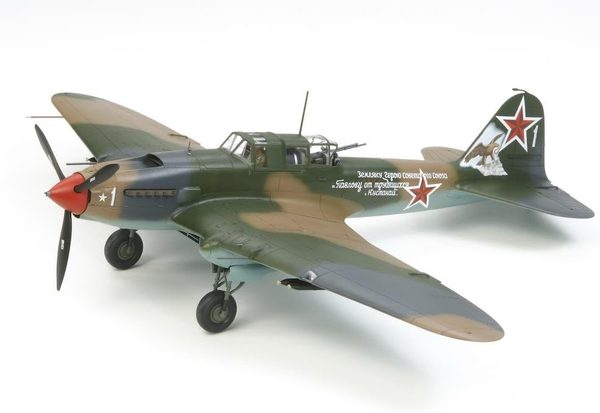
Over 36,000 built, making it the most produced military aircraft in history. The armored cockpit tub, integrated into the airframe structure with steel plating up to 12mm thick, earned it the nickname "flying tank." 102 reviews at 4.6 stars.
Best for: Intermediate builders who want an Eastern Front ground-attack aircraft that stands apart from the usual fighter-dominated shelf
Stalin reportedly told factory managers that the IL-2 was "as essential to the Red Army as air and bread." Production numbers back that up: 36,183 airframes, more than any other military aircraft ever built. The IL-2's defining feature was its armored cockpit tub, not bolted-on plates but structural steel integrated into the fuselage, protecting the pilot with up to 12mm of plating. German soldiers called it "Schwarzer Tod" (Black Death) after enduring its 23mm cannon, bombs, and RS-82 rocket attacks during low-level passes.
Tamiya's 1/48 kit is the strongest available injection-molded IL-2. The approximately 150 parts include the armored fuselage, wing-mounted VYa cannons, and underwing rockets. With 102 reviews at 4.6 stars, fit quality meets Tamiya's usual standard. The IL-2's unusual profile, with its armored nose flowing into the cockpit, mid-mounted wings, and the rear gunner's exposed position on the two-seat variant, produces a model that looks nothing like the fighters filling most collections. One weakness: the cockpit interior is simplified compared to what Tamiya provides in their fighter kits, so detail-focused builders may want to add aftermarket resin.
Soviet VVS camouflage schemes are clean and forgiving to apply: dark green and black upper surfaces over light blue undersides. The IL-2 remains one of the most undermodeled aircraft relative to its historical significance. While Spitfires and Mustangs crowd every display case, the plane produced in greater numbers than all of them combined rarely shows up. Build this alongside the T-34 for the two machines that, more than any others, powered the Soviet war effort.
Japanese Forces
Imperial Japan's offensive power centered on its carrier fleet: the six-carrier Kido Butai that struck Pearl Harbor, swept through Southeast Asia, and was shattered at Midway six months later. Japanese aircraft engineering prioritized range and agility over pilot protection, producing fighters like the Zero that outperformed every Allied opponent in 1941 and 1942 but became death traps once the Allies learned to avoid turning fights. And the Yamato, at 65,000 tons with nine 18.1-inch guns, remains the largest battleship any nation ever built. These kits cover the key Japanese subjects available on Amazon.
Tamiya A6M5 Zero (1/48)
~$43 on Amazon
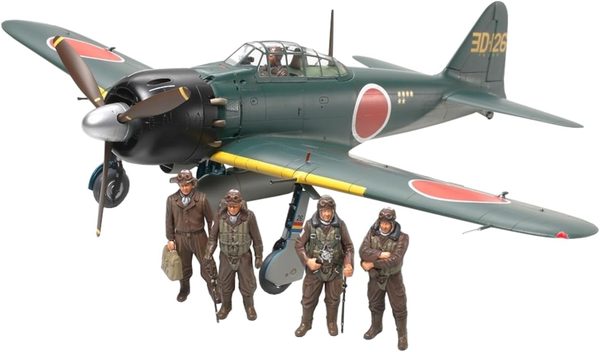
The fighter that swept the Pacific in the war's first year, outclimbing and out-turning every Allied aircraft it faced. 293 reviews at 4.6 stars. About 100 parts for a clean, quick build.
Best for: Intermediate builders who want the most important Pacific War fighter in a well-proven kit
When the A6M Zero appeared over Pearl Harbor and the Philippines in December 1941, Allied pilots encountered a fighter that could outclimb, out-turn, and outrange anything they had. Designer Jiro Horikoshi achieved that performance through a ruthless weight-reduction philosophy: no armor behind the pilot's seat, no self-sealing fuel tanks, and structural members shaved to minimum gauge. A skilled Zero pilot was nearly untouchable in a turning fight. But a single burst of .50-caliber fire could ignite the unprotected fuel cells or kill the unshielded pilot, a vulnerability the Allies exploited once they abandoned dogfighting tactics in favor of high-speed slashing attacks.
Tamiya's A6M5 captures the Model 52, the most-produced variant, with its clipped wingtips and individual exhaust thrust stacks that added a few knots over earlier models. At 293 reviews and 4.6 stars, this is a mature kit with a long track record. The approximately 100 parts go together quickly. The Zero's clean elliptical wings and long fuselage produce an elegant finished profile. One shortcoming: Tamiya molded the wing cannon barrels as part of the wing halves rather than as separate inserts, which makes them look slightly soft compared to aftermarket replacements.
Japanese Imperial Navy color schemes create a distinctive finished model: overall Hairyokushoku (gray-green) with red Hinomaru roundels on a clean, lightly weathered airframe. The Zero pairs naturally with the Tamiya Corsair or Hellcat for an adversary display. The thin aluminum skin showed exhaust staining and wear prominently in service, giving weathering enthusiasts plenty to work with. Field-applied camouflage varied widely between units, so reference photos for your chosen marking scheme are worth checking before you paint.
Tamiya 1/350 Yamato (1/350)
~$93 on Amazon
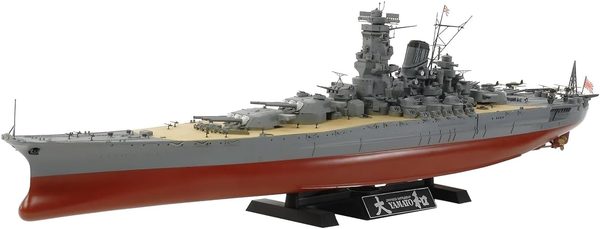
At 65,000 tons with nine 18.1-inch guns, the Yamato was the heaviest and most heavily armed battleship ever constructed. Over 700 parts build into a model roughly 30 inches long. A multi-week commitment for experienced builders.
Best for: Advanced builders who want a flagship naval project with an enormous aftermarket support ecosystem
Each of the Yamato's three main turrets weighed more than a destroyer. Her 410mm belt armor was the thickest ever fitted to a warship. She was engineered to engage and defeat any two opposing battleships simultaneously. Yet she was sunk by 386 aircraft from Task Force 58 in April 1945, absorbing an estimated ten torpedo and seven bomb hits before capsizing. The Yamato's career is the clearest proof that carriers had rendered battleships obsolete: the most powerful surface combatant ever built never fought the decisive gun engagement she was designed for.
Tamiya's 1/350 kit depicts the 1945 configuration with the massively expanded anti-aircraft battery, over 150 25mm guns added in a last attempt to provide self-defense against air attack. The nine 18.1-inch guns in their triple turrets dominate the model, and the pagoda-style superstructure is rendered with good detail for injection plastic. At $93 and 700+ parts, this is a significant investment in both money and time. The hull shape with its distinctive bulbous bow is accurately captured. One challenge builders frequently note: the anti-aircraft tubs are repetitive and tedious, with dozens of nearly identical small assemblies that test your patience.
The aftermarket ecosystem for this kit is extensive. Pontos, Fujimi, and several Asian manufacturers produce wooden decks, turned brass gun barrels, photoetch railings, and hundreds of supplementary parts. A fully detailed Yamato with aftermarket can exceed $300 in total cost and take months to complete. Even built straight from the box, the sheer size of the finished model commands attention. Display it alongside the Tamiya Missouri for a comparison of the two largest battleships from opposing navies.
Hasegawa IJN Akagi (1/700)
~$42 on Amazon
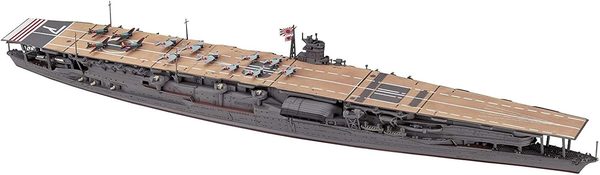
Flagship of Vice Admiral Nagumo's Kido Butai, the carrier that launched the first wave against Pearl Harbor. 84 reviews at 4.6 stars. Hasegawa's 1/700 waterline kit builds into a roughly 15-inch model.
Best for: Intermediate builders who want the most historically significant Japanese carrier of the war
Originally laid down as an Amagi-class battlecruiser, Akagi was converted to a carrier under the Washington Naval Treaty and became the most experienced flattop in the Imperial Japanese Navy. Her air group launched the opening strikes against Pearl Harbor, hit Darwin, raided the Indian Ocean, and fought at Midway, where three SBD Dauntless bombs from USS Enterprise set her ablaze on June 4, 1942. She was scuttled by Japanese destroyers that evening. Akagi's loss, alongside Kaga, Soryu, and Hiryu in a single day, ended Japan's ability to conduct offensive carrier operations.
Hasegawa's 1/700 waterline kit captures the December 1941 configuration with the port-side island and the distinctive downward-angled funnel that directed exhaust away from the flight deck. The approximately 200 parts include molded-on flight deck aircraft, the island structure, and hull detail. Hasegawa is known for accurate hull and deck shapes, and the Akagi's lines look correct. One limitation: the molded-on aircraft lack individual detail, so builders wanting a populated flight deck may want to source aftermarket aircraft sets from Fujimi or Pit-Road.
At roughly 15 inches long, the finished model is large enough to appreciate the carrier's scale while fitting on a standard shelf. Pair with the Aoshima Soryu for a two-carrier Kido Butai display. Aftermarket wooden flight decks from multiple manufacturers are available for builders who want a more realistic deck surface than the kit's engraved plastic. The IJN gray hull with wooden-tone flight deck creates a clean, attractive color scheme.
Aoshima IJN Soryu (1/700)
~$41 on Amazon
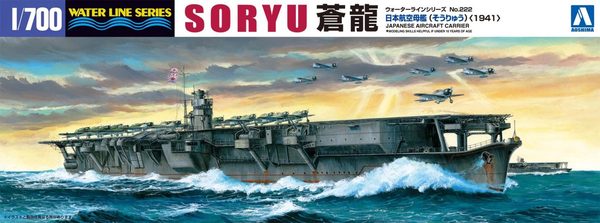
One of the four Japanese carriers destroyed at Midway on June 4, 1942. Aoshima's 1/700 waterline kit at roughly 180 parts, a clean intermediate build.
Best for: Intermediate builders who want a purpose-built Japanese fleet carrier to pair with the Akagi for a Midway display
Soryu was a purpose-built fleet carrier, faster and more modern than the converted Akagi, capable of over 34 knots. At Midway, SBD Dauntless dive bombers from USS Yorktown scored thirteen hits in approximately three minutes, turning her into a burning wreck. The loss of Soryu, Akagi, Kaga, and Hiryu in a single day, along with hundreds of irreplaceable veteran aircrew, ended Japan's offensive capability in the Pacific.
Aoshima's 1/700 waterline kit produces a sleek carrier that looks distinctly different from the converted-battlecruiser Akagi. The flight deck, island structure, and hull detail are cleanly molded, and the waterline format eliminates complex below-waterline hull construction. Small-scale aircraft are included for the flight deck. At this price point, the level of detail is reasonable but not exceptional; some builders note that Aoshima's molding is slightly softer than Hasegawa's, with less crisp panel lines on the hull sides.
At around $41, pairing this with the Akagi costs under $85 for two historically linked carriers. The 1/700 scale means both fit on a single shelf without crowding, and the visual contrast between a converted capital ship and a purpose-built carrier is immediately obvious. Adding a 1/700 Enterprise from Hasegawa completes the Midway story from both sides.
Submarines & Additional Ships
Submarine warfare shaped the outcome of WW2 on two oceans. German U-boats sank over 3,500 merchant ships and 175 Allied warships during the Battle of the Atlantic, nearly severing Britain's supply lines. In the Pacific, American submarines destroyed over 1,300 Japanese ships, more tonnage than the surface fleet and air forces combined, strangling Japan's resource-dependent island empire. These kits cover submarines and warships not featured in the American and Japanese sections above.
Revell U-Boat Type XXI with Interior (1/144)
~$42 on Amazon
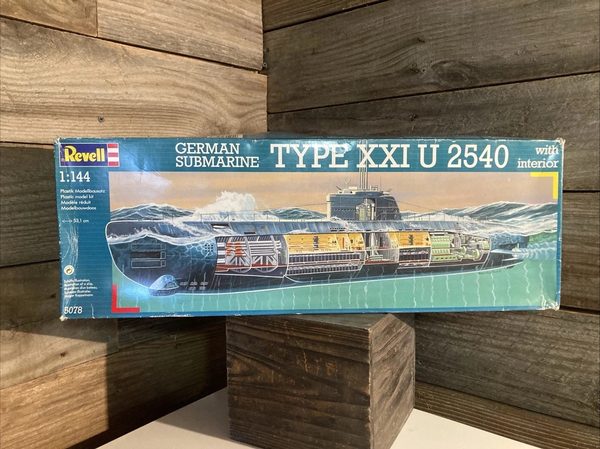
The Type XXI was the first submarine designed for sustained underwater operations rather than surface running with occasional dives. Cutaway hull sections reveal a full interior: torpedo room, control room, engine room, and crew quarters. 903 reviews at 4.4 stars.
Best for: Builders who want a submarine with visible interior detail that shows what life looked like below the surface
Conventional U-boats spent most of their time on the surface, diving only to attack or evade. The Type XXI inverted that concept. Its streamlined hull, triple-capacity battery banks, and snorkel system allowed it to outrun most convoy escorts at 17.2 knots submerged. A hydraulic torpedo-loading system could cycle eighteen torpedoes in under twenty minutes. The design arrived too late, only two boats completed operational patrols before the war ended, but every modern conventional submarine in the world descends from its hull form and engineering principles.
Revell's 1/144 kit is roughly 19 inches long when finished. The main selling point is the full interior visible through cutaway hull sections: torpedo racks, control room instruments, engine compartments, and crew bunks packed into a claustrophobic tube. The 903 reviews and 4.4-star average reflect steady builder satisfaction, though the rating sits below Tamiya's kits for a reason. Revell's parts fit requires more cleanup: expect visible seam lines on the hull halves and some sanding where the cutaway edges meet closed hull sections.
Construction demands planning. Interior compartments must be painted before the hull halves close over them, so you are working inside-out. Many builders treat the torpedo room, control room, and engine room as separate sub-assemblies, painting each fully before joining them. The effort pays off visually: the cutaway sections exist to showcase your interior paintwork. If you rush the interior, every viewer will notice through the open hull.
Tamiya Japanese Submarine I-400 (1/350)
~$49 on Amazon
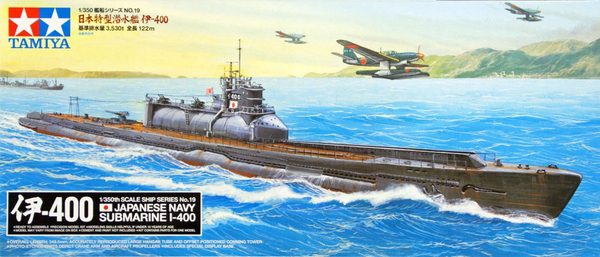
At 400 feet long, the I-400 was the largest submarine built during WW2, carrying three Aichi M6A Seiran floatplane bombers in a watertight hangar on the foredeck. 351 reviews at 4.5 stars.
Best for: Builders who want the most unusual submarine subject of the war, a vessel with no real equivalent before or since
The I-400 class displaced over 6,500 tons submerged, making them the world's largest submarines until USS Triton launched in 1959. A cylindrical hangar forward of the conning tower housed three folding-wing Aichi M6A Seiran floatplane bombers that could be assembled, fueled, and catapult-launched in under 45 minutes. Japan's original plan was to strike the Panama Canal locks. The mission was cancelled only because the war ended. These boats were effectively underwater aircraft carriers, a concept so far ahead of its time that the U.S. Navy scuttled the captured boats rather than risk the Soviets studying them.
Tamiya's 1/350 kit builds into a roughly 13-inch model. The approximately 200 parts include the distinctive bulged hangar fairing, the catapult rail, and three tiny Seiran aircraft. Tamiya's fit quality means the hull halves join cleanly, and the part count is manageable for intermediate builders. The model's unusual silhouette, wider and flatter than a conventional submarine because of the aircraft hangar, makes it immediately eye-catching on a shelf. One drawback: the Seiran aircraft at this scale are very small and fiddly, with parts that can easily be lost or broken during assembly.
Painting requires careful masking. The I-400's dark gray upper hull transitioning to lighter undersides needs a clean demarcation line. The three Seiran aircraft, though tiny, reward patience with a brush. At $49, this is an affordable entry into a unique subject that generates more questions from visitors than almost any other model you can build.
Trumpeter USS Indianapolis CA-35 (1/350)
~$81 on Amazon
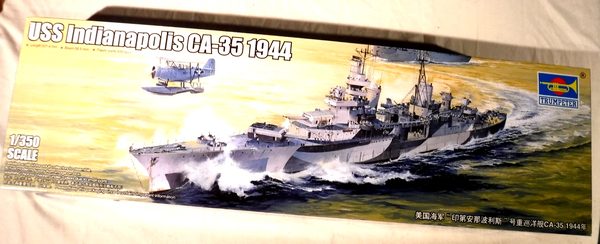
The Portland-class heavy cruiser that delivered atomic bomb components to Tinian, then was torpedoed four days later. Of 1,195 crew, only 316 survived after four days in the open ocean. 24 reviews at 4.7 stars. Over 400 parts.
Best for: Advanced builders drawn to one of the most significant single-ship stories of the Pacific War
On July 26, 1945, USS Indianapolis (CA-35) completed the most classified delivery mission of the war: enriched uranium and components for the Little Boy bomb, transported to Tinian Island. The crew had no idea what they carried. Four days later, two torpedoes from the Japanese submarine I-58 struck the cruiser in the Philippine Sea. She sank in twelve minutes. Roughly 900 men made it into the water alive. Over the next four days, exposure, dehydration, saltwater ingestion, and shark predation killed the majority. When rescue aircraft finally spotted survivors on August 2, only 316 men remained alive.
Trumpeter's 1/350 kit renders a Portland-class heavy cruiser with triple turrets, floatplane catapults, and the graceful hull lines typical of 1930s treaty-era design. The 400+ parts produce a model approximately 16 inches long, with detailed superstructure and the wartime-added anti-aircraft fit. At 24 reviews, this is a lower-volume kit than the Tamiya offerings on this list, which means fewer community build guides are available online. Trumpeter's fit is generally good but not at Tamiya's level; expect some dry-fitting and minor adjustments, particularly around the superstructure assemblies.
This is an advanced build. Photoetch railings, multi-part turrets, and detailed boat davits require steady hands and patience. The payoff is a model whose story spans the most secret delivery mission, the worst naval disaster involving a single ship, and one of the most controversial courts-martial in U.S. Navy history. Captain McVay was court-martialed for failing to zigzag, a conviction that Congress overturned in 2000 after decades of advocacy by survivors and their families.
Diorama & Accessories
A tank on a shelf is a model. A tank with infantry crouching behind its hull, supply crates lashed to the engine deck, and spent shell casings on the ground is a scene that tells a story. These figure sets and accessory kits provide the human element and environmental detail that turn standalone vehicle builds into convincing vignettes. They also work as detail additions to individual models, adding the field-worn clutter that real combat vehicles accumulated within days of reaching the front.
Tamiya Allied Vehicle Accessories (1/35)
~$14 on Amazon
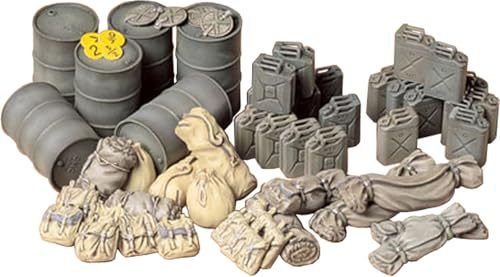
Jerry cans, oil drums, wooden crates, rolled tarps, helmets, and field gear, all the stowage that real combat vehicles accumulated in the field. Over 1,000 reviews at 4.7 stars. Under $15.
Best for: Any builder with a 1/35 Allied vehicle who wants it to look like it has spent time in a combat zone
Tamiya's Allied Vehicle Accessories set is the most universally useful accessory kit in 1/35 armor modeling, and 1,000+ reviews at 4.7 stars reflect that. The sprues include both Allied and captured German-style Jerry cans, 55-gallon oil drums, wooden supply crates, rolled canvas tarps, backpacks, helmets, canteens, and assorted field equipment. Most items are single-piece moldings that need only a base coat and a wash to look convincing.
The practical value here is hard to overstate. Scatter two Jerry cans and a rolled tarp across your Sherman's engine deck, and it immediately reads as a vehicle that has been in Normandy for weeks rather than one fresh from a factory. Stack crates and drums on a diorama base for an instant supply dump. The only real limitation is quantity: one set gets you enough stowage for maybe two vehicles, so most builders end up buying multiples. At $14, buying two or three sets is still cheaper than a single aftermarket resin stowage pack.
Tamiya US Infantry Assault (1/35)
~$14 on Amazon
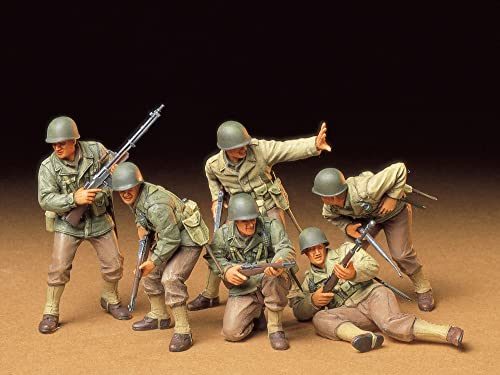
Six US soldiers in dynamic combat poses: advancing, firing, throwing grenades. Sculpted in late-war European Theater equipment with M1 helmets, M1943 jackets, and web gear. 158 reviews at 4.5 stars.
Best for: Any 1/35 American armor diorama or adding crew figures alongside Sherman and half-track builds
A Sherman on its own shows engineering. A Sherman with GIs crouching behind the hull while another waves the squad forward tells a story about people. Tamiya's US Infantry Assault set provides six soldiers in combat poses designed to work alongside 1/35 vehicle kits. The sculpting captures M1 helmets, M1943 field jackets, and web gear appropriate to the 1944-45 European Theater. Poses include soldiers advancing with rifles, a BAR gunner firing from the hip, and a soldier mid-throw with a grenade.
At 158 reviews and 4.5 stars, these are a solid choice, though Tamiya's newer German infantry set (see below) has noticeably sharper face detail that shows the age gap between toolings. For beginners, figures are simpler to assemble than vehicles since each figure is only a few parts. Painting flesh tones and OD uniforms takes practice; start with a dark base coat and build up through lighter shades, letting the sculpted folds and creases guide your highlights. At $14, pick up a set for every American vehicle in your collection.
Tamiya German Infantry 1943-45 (1/35)
~$18 on Amazon
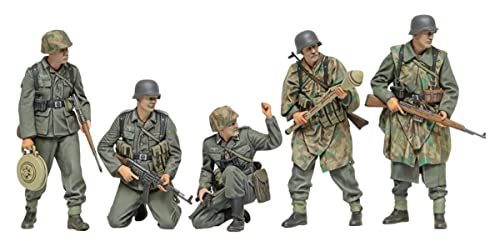
Five late-war German soldiers using Tamiya's newest sculpting process. Noticeably sharper face detail than older figure sets, with equipment and weapons accurate to the 1943-1945 period. 168 reviews at 4.8 stars.
Best for: Late-war German armor dioramas, especially alongside Tiger I, Panther, and King Tiger builds
Tamiya's 4.8-star rating from 168 reviews makes this the highest-rated figure set on this list, and the quality justifies it. These five soldiers wear field-gray uniforms, Y-straps, bread bags, and Stahlhelm helmets with equipment appropriate to 1943-1945: StG 44 assault rifles and Panzerfaust anti-tank weapons that immediately identify them as late-war troops. The faces are where the improvement over older Tamiya sets is most visible, with individually sculpted expressions showing tension and fatigue rather than the generic features of earlier toolings.
The poses work naturally alongside heavy armor: a soldier crouching to reload, another scanning forward, a third directing movement. If you are building any late-war German diorama, these are the infantry figures to pair with it. The sculpting quality approaches what premium aftermarket figure makers like Alpine or Warriors charge $15-20 per single figure for, and you get five figures here for $18. One trade-off: with only five poses in the box, a larger diorama will need two sets, and duplicate figures become obvious unless you modify the poses with careful cutting and repositioning.
Tamiya German Infantry Weapons Set (1/35)
~$9 on Amazon
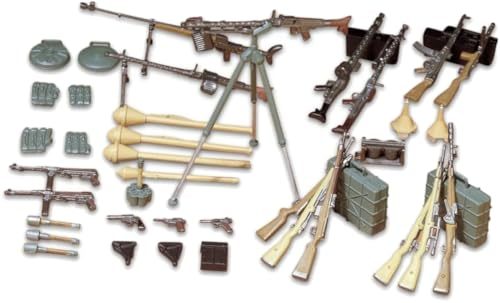
Two sprues packed with MG42s, Panzerfausts, Kar98k rifles, MP40s, stick grenades, ammunition boxes, binoculars, map cases, mess tins, canteens, and entrenching tools. Under $10. 434 reviews at 4.4 stars.
Best for: Supplementing any German vehicle or infantry diorama with scattered equipment and additional weapons
For under $10, this set delivers more useful detail parts per dollar than anything else on this list. Two small sprues contain the full inventory of a late-war Wehrmacht squad: MG42 machine guns with bipods, disposable Panzerfaust launchers, Kar98k rifles, MP40 submachine guns, stick grenades, ammunition boxes, binoculars, map cases, bread bags, mess tins, canteens, and entrenching tools. Individual items are small but crisply molded.
Every convincing diorama needs scattered gear: a Panzerfaust leaning against a wall, ammunition boxes stacked near a machine gun position, rifles propped against a halftrack. These details separate a model sitting on a base from a scene that feels inhabited. The set also supplements figure kits when you want specific weapons or extra gear on belts and packs. At 434 reviews and 4.4 stars, the slightly lower rating compared to Tamiya's figure sets reflects that some of the smaller parts (canteens, mess tins) have visible mold lines that need cleanup. At this price, that is an easy trade-off to accept.
Beginner's Corner: Your First Model Kit
If you have never built a model kit, the sheer variety of scales, manufacturers, and skill levels can be paralyzing. These kits are chosen specifically to minimize that friction: low part counts, forgiving fit tolerance, familiar subjects, and in some cases everything you need included in the box. The goal is a finished model on your shelf and the motivation to build a second one. The Meng World War Toons series deserves special attention: these cartoon-style "egg tanks" snap together without glue, look good without paint, and cost under $25. They are the lowest-commitment entry point in the hobby.
If you want a more traditional first build, the Airfix Spitfire Starter Set in our British Forces section is an outstanding choice, it includes paint, glue, and a brush, so you don't need to buy anything else. And the Tamiya Willys Jeep in our American Vehicles section is the perfect first serious 1/35 kit, low part count, bulletproof Tamiya fit, and a universally recognizable subject.
Airfix Vickers Wellington Gift Set (1/72)
~$55 on Amazon
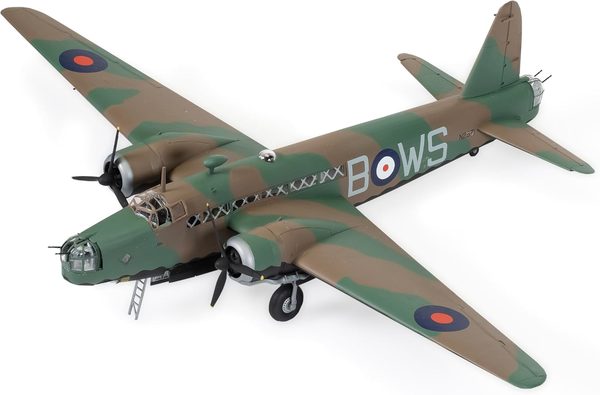
A complete box with kit, Humbrol paints matched to the color scheme, poly cement, and a brush. No separate purchases needed. The Wellington builds into an 11-inch-wingspan twin-engine bomber at 1/72. 1,039 reviews at 4.6 stars.
Best for: Absolute beginners and gift-givers who want a ready-to-build package with zero additional purchases
Over a thousand builders have reviewed this kit at 4.6 stars, and the reason is simple: you open the box and start building. Paints, cement, brush, and instructions are all included. No separate hobby shop trip, no guessing which paint numbers match which parts. For someone who has never touched a model kit, that elimination of friction is worth more than any engineering refinement.
The Vickers Wellington is a smart subject choice for a first build. At 1/72, the twin-engine bomber is large enough to feel substantial (roughly 11-inch wingspan) without overwhelming a beginner with hundreds of parts. The Wellington's geodetic lattice fuselage structure, designed by Barnes Wallis, gives the finished model a distinctive ribbed appearance unlike any other aircraft. The kit uses modern Airfix tooling with decent fit and clear instructions. One honest caveat: the included Humbrol paints are small pots that dry out quickly once opened, so plan to use them within a few weeks of starting the build. For anyone buying a gift for someone interested in WW2 or aviation, this is the safest choice on this list.
Meng World War Toons Tiger I (Chibi)
~$21 on Amazon
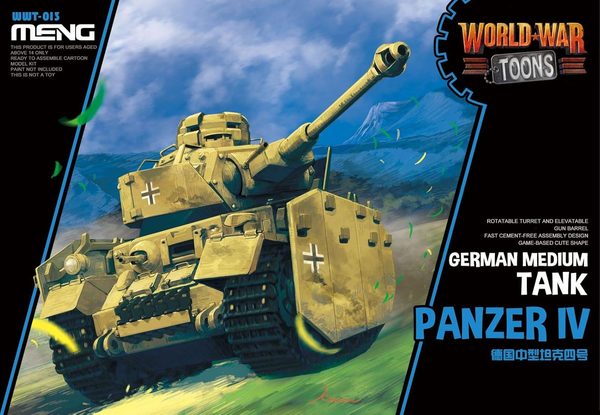
A cartoon-style "egg tank" Tiger I that snaps together without glue and looks presentable without paint. Pre-colored plastic, roughly 30-minute build time for an adult. Designed for ages 8 and up. 38 reviews at 4.5 stars.
Best for: Children, complete beginners, and experienced builders who want a low-pressure palette cleanser between serious projects
Meng's World War Toons series takes WW2 tanks and renders them in chibi (super-deformed) proportions: stubby hulls, oversized tracks, and rounded edges that look like they belong in an animated film. Every part snaps into place without cement. Pre-colored plastic means the finished model looks clean straight from the box. An eight-year-old can complete this in an afternoon. Experienced modelers buy them as weekend stress relievers between multi-week builds.
The Tiger I version captures the boxy, angular hull and flat turret sides in a chunky, recognizable cartoon form. Build time is minimal. No sanding, no filling, no paint mixing. At $21, the financial risk is essentially zero. The trade-off is obvious: this is not a scale model. There is no historical accuracy, no fine surface detail, no serious modeling challenge. It exists to be fun, and it delivers on that promise. Many builders who try one end up collecting the entire series. If you paint it, washes and weathering produce surprisingly good results on the exaggerated shapes.
Meng World War Toons King Tiger (Chibi)
~$25 on Amazon
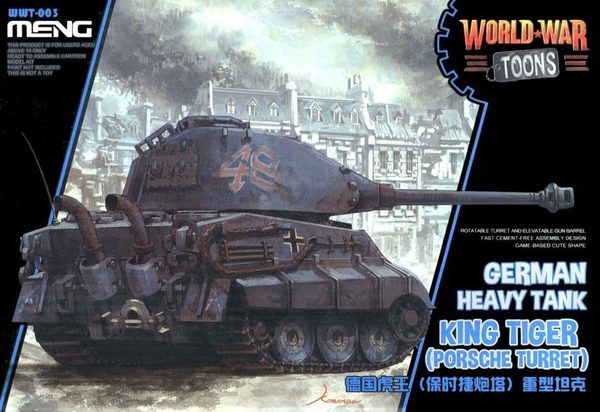
The most popular World War Toons kit, with 112 reviews at 4.7 stars. The King Tiger's curved turret and sloped hull translate well into the chibi style. Snap-fit, no glue, no paint needed.
Best for: The single lowest-risk recommendation for someone who has never built any model kit before
With 112 reviews at 4.7 stars, this is the highest-rated kit in the World War Toons line. The King Tiger's Henschel turret and dramatically sloped hull armor, all curves and flowing lines, translate into the chibi format better than the boxy Tiger I. The proportions feel more natural in cartoon form, which may explain the higher rating and review count.
Construction is identical to the Tiger I version: snap-fit, pre-colored plastic, no tools beyond your hands. The King Tiger has a few more parts and is slightly larger, but the build remains equally straightforward. At $25, it costs $4 more than the Tiger I. The trade-off is the same as every Toons kit: zero modeling challenge, zero historical detail, maximum accessibility. Pair it with the Tiger I for under $50 and you have two immediately recognizable tanks that work as desk toys, kids' shelf displays, or conversation starters. They also make reliable gifts for history-interested kids who are not ready for cement, paint, and 200-part sprues.
Premium & Collector Builds ($75 to $600+)
Everything above sits in the standard scales: 1/48 aircraft and 1/35 armor. Below this line, the scale jumps up and so does every other variable. 1/32 fighters have magnetic engine cowlings and movable control surfaces with cockpit detail matched to maintenance manuals. 1/16 tanks stand taller than a shoebox and include full crew compartments. Build times stretch from weekends into months. Prices run from $90 to over $600. These kits are not quick and they are not forgiving of sloppy technique. But for builders who have completed several kits from the sections above and want a project that pushes their skills, this is where those projects live.
1/32 Scale Fighters ($90 to $220)
Jumping from 1/48 to 1/32 changes the modeling experience fundamentally. Cockpit sidewalls that were blank plastic at 1/48 have individual switches and placards at 1/32. Wheel wells show hydraulic lines and structural ribbing. Engine detail is fully rendered rather than suggested. Tamiya's 1/32 aircraft kits are widely used by competition builders and feature magnetic engine cowlings, poseable control surfaces, and panel line detail matched to actual aircraft technical drawings. The quality is high, but so is the price, and mistakes at this scale are harder to hide.
Tamiya P-51D Mustang (1/32)
~$180 on Amazon
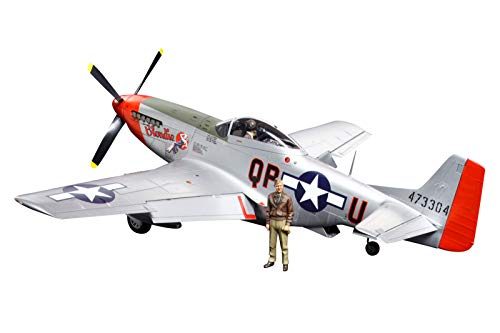
Multiple modeling publications and community polls have named this the finest plastic model aircraft kit ever produced. Magnetic cowlings reveal a fully detailed Packard Merlin V-1650 engine. Three canopy options, two tail types, movable control surfaces, and Tamiya's legendary fit.
Best for: Experienced builders who want the ultimate P-51 Mustang display piece
If there is a single kit that represents the peak of injection-molded plastic modeling, this is the one most experienced builders would name. Tamiya's 1/32 P-51D Mustang is the product of decades of engineering refinement. The magnetic cowlings click into place over a Packard Merlin V-1650-7 engine that is detailed down to individual wiring looms and exhaust manifold runners. Remove the cowlings, and you have a museum-quality engine display. Leave them on, and the seamless join is invisible.
The kit offers three canopy types (Malcolm hood, blown bubble, and Dallas canopy), two tail configurations, and all control surfaces (ailerons, elevators, rudder, flaps) can be posed in any position. The cockpit includes a fully detailed instrument panel, seat with separate harness straps, and sidewall placards. 17 parts trees in light gray, 3 clear trees, and 2 photoetch frets. The finished model spans 354mm (14 inches) wingtip to wingtip. At this scale, a P-51 commands a display shelf like nothing in 1/48 can match.
Tamiya Spitfire Mk.IXc (1/32)
~$165 on Amazon
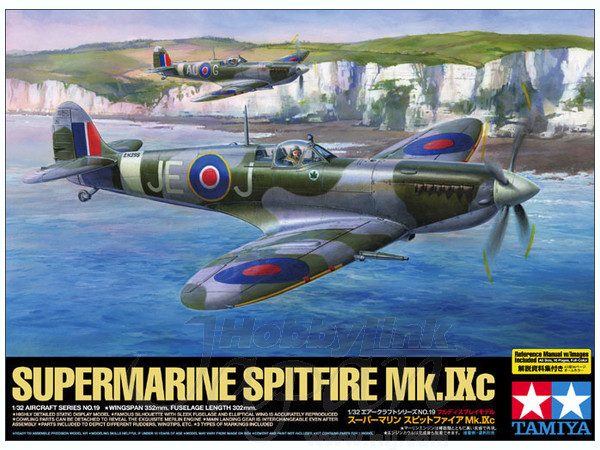
Widely called "the best Spitfire kit in any scale." Magnetic engine cowlings reveal a detailed Merlin 60-series engine. Movable ailerons, elevators, rudder, and flaps. 22 parts trees, photoetch frets, and two pilot figures included.
Best for: British aircraft enthusiasts and competition builders
The Spitfire is the most beautiful fighter aircraft ever designed, and Tamiya's 1/32 kit captures every curve of its elliptical wing with engineering precision that borders on art. The 0.4mm-thin magnetic engine cowlings lift off to reveal a complete Merlin 60-series engine, from the supercharger intake to individual cylinder banks. Three marking options cover RAF, RCAF, and Free French Air Force Spitfires.
Like all Tamiya 1/32 fighters, every control surface is poseable. You can display the Spitfire with flaps down in a landing configuration, ailerons deflected in a banking turn, or everything neutral for a clean profile. Two pilot figures (seated and standing) are included, along with photoetch seatbelt detail and a display stand. The fit is pure Tamiya: parts align with almost no filling or sanding required. Builders consistently rate this alongside the 1/32 P-51D as one of the two best fighter kits ever made.
Tamiya F4U-1D Corsair (1/32)
~$185 on Amazon
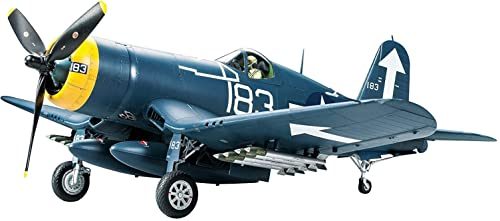
The Corsair's iconic inverted gull wings can be built extended or folded for carrier storage. Includes both parked and airborne display options with a flight stand. Two marking options: Navy VF-84 and Marines VMF-351.
Best for: Builders who want the best Corsair available, with folding wing option
The F4U Corsair has one of the most distinctive silhouettes in aviation history, and Tamiya's 1/32 rendition captures every angle of those cranked gull wings. The wings can be built fully extended or folded upward in the carrier storage position, giving you two completely different display options from one kit. A flight stand is included for airborne display, letting you show the Corsair in a banking turn with gear retracted.
The detail standard matches Tamiya's other 1/32 fighters: magnetic cowlings over a detailed R-2800 Double Wasp radial engine, photoetch parts, poseable control surfaces, and two marking options covering both Navy (VF-84 "Wolf Gang") and Marine Corps (VMF-351) squadrons. The cockpit includes the distinctive raised pilot position that gave Corsair pilots their excellent forward visibility. Seated and standing pilot figures are included. At 1/32, the Corsair's massive 12.5-meter wingspan translates to nearly 400mm (15.7 inches) tip to tip when built with wings extended.
Tamiya A6M5 Zero (1/32)
~$128 on Amazon
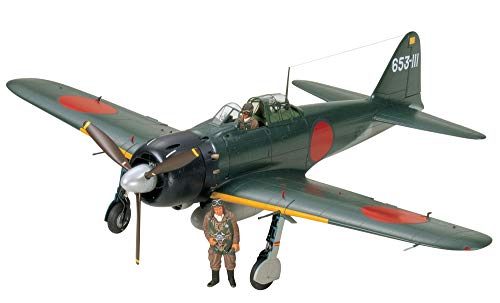
The most accurate Zero ever produced in any scale. Hinged cowling panels, detailed Sakae 21 engine, retractable landing gear with oleo struts, and metal 20mm cannon barrels. Three marking options including the famous Tainan Air Group.
Best for: Pacific theater enthusiasts and Japanese aircraft collectors
The A6M Zero was Japan's most important fighter of the war, and Tamiya (a Japanese company) clearly took personal pride in getting this one right. The 1/32 Zero features hinged cowling panels that open to show the Nakajima Sakae 21 engine, with individual cylinder cooling fins and exhaust collector ring detail that would be invisible at 1/48. The retractable landing gear includes functional oleo struts, and the 20mm wing cannons are turned metal barrels rather than plastic.
Three marking options cover some of the most famous Zero units: the Tainan Air Group (Saburo Sakai's unit), the 261st Air Group, and a Kamikaze unit. The cockpit is fully detailed with the distinctive Type 98 reflector gunsight, instrument panel, and the remarkably spartan interior that reflects how the Zero sacrificed everything for performance. At $128, this is the most affordable of Tamiya's 1/32 fighters, making it an excellent entry point into large-scale aircraft modeling.
Revell Me 262 A-1/A-2 (1/32)
~$65 on Amazon
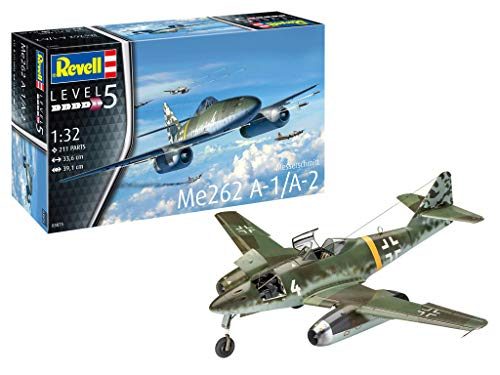
The world's first operational jet fighter in impressive 1/32 scale. Detailed Jumo 004 jet engines, retractable landing gear, and two build options (fighter A-1 or bomber A-2). Outstanding value for a 1/32 kit.
Best for: German aviation fans who want a large-scale jet at a reasonable price
The Me 262 changed aviation forever. As the first operational jet fighter, it arrived too late to change the outcome of the war but proved that the future of air combat belonged to jet propulsion. Revell's 1/32 kit captures both the A-1 fighter variant (with four 30mm MK 108 nose cannons) and the A-2 bomber variant (with bomb pylons) in one box, letting you choose which version to build.
At around $65, this is exceptional value for 1/32 scale. You are getting a large, detailed kit at roughly one-third the price of Tamiya's 1/32 fighters. The Jumo 004 jet engines are fully detailed, the landing gear is retractable, and the cockpit captures the spartan late-war German instrument layout. The fit is good (not Tamiya-perfect, but far from problematic), and the finished model makes a striking display piece. The Me 262's sleek lines and underslung engine nacelles look even more dramatic at 1/32 than they do at smaller scales.
1/32 Scale Bombers ($300 to $600+)
These are the largest injection-molded aircraft kits ever produced. A 1/32 B-17 or Lancaster spans over a meter (3.3 feet) wingtip to wingtip. They require dedicated shelf space, months of build time, and a budget to match. But nothing else in the hobby comes close to the impact of a completed 1/32 heavy bomber on display.
HK Models B-17G Flying Fortress (1/32)
~$350 on Amazon
One meter wingspan when completed. 577 parts rendering every turret, bomb bay, crew position, and defensive gun station of the B-17G. This is the kit that serious bomber builders plan their year around.
Best for: Experienced builders who want the ultimate bomber display piece
There is no way to adequately prepare someone for the size of a 1/32 B-17G. At one meter (3.3 feet) wingtip to wingtip, the completed model is larger than most coffee tables are wide. HK Models, a relatively young Hong Kong manufacturer, stunned the modeling world when they announced this kit, and the finished product lives up to the ambition. Every crew position is represented: the bombardier's station in the chin turret, the pilot and co-pilot seats, the top turret, the radio room, both waist gun positions, the ball turret, and the tail gunner's cramped compartment.
The 577 parts build into a model that is essentially a museum piece. The Wright R-1820 Cyclone engines are fully detailed, the bomb bay opens to reveal a rack of 500-pound bombs, and the defensive armament includes all thirteen .50 caliber machine guns that gave the Flying Fortress its name. This is a project measured in months, not weekends. Most builders set up a dedicated workspace just for this kit. But the result is something that stops people in their tracks when they see it on display. Nothing else in the hobby has this kind of physical presence.
Border Model Lancaster B.Mk.I/III with Full Interior (1/32)
~$580 on Amazon
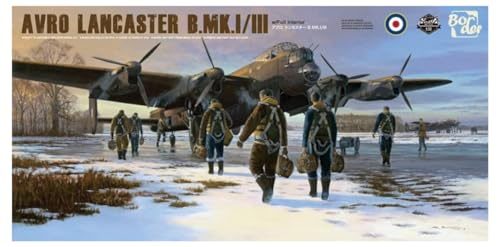
The most expensive mainstream WW2 model kit on the market, and arguably the most impressive. A complete interior from nose to tail, removable outboard wing sections for display, and four detailed Rolls-Royce Merlin engines. 97cm (38 inches) wingspan.
Best for: The builder who wants the single most ambitious WW2 aircraft kit available
Border Model's 1/32 Avro Lancaster is the Everest of WW2 model building. At around $580, it is the most expensive mainstream kit on this entire list, and the reason is simple: it contains a complete interior from the bomb aimer's position in the nose through the pilot's station, navigator's table, wireless operator's compartment, mid-upper turret, and all the way back to the rear turret. The outboard wing sections are removable for cutaway display, letting viewers peer into the fuselage and see every crew station.
The four Rolls-Royce Merlin XX engines are individually detailed, and the bomb bay opens to reveal the payload. At 97cm (38 inches) wingspan and 66cm (26 inches) long, this is a model that demands its own display case. The build will take experienced modelers several months and consume significant shelf space during construction. HK Models also makes a 1/32 Lancaster at a lower price point (~$330), but without the full interior. If you want the interior cutaway experience, Border Model is the only option. This is the kind of kit that modelers build once in their lifetime and display for decades.
1/16 Scale Armor ($250 to $500)
At 1/16, a Tiger I is over 21 inches long and nearly a foot tall. These are not shelf models. They are furniture. Trumpeter dominates this scale with full-interior tanks that include individually molded crew stations, working suspension, and part counts over 1,800. Building one is a months-long commitment, but the result is a model that looks like a museum miniature rather than a hobby kit.
Trumpeter King Tiger with Henschel & Porsche Turrets (1/16)
~$300 on Amazon
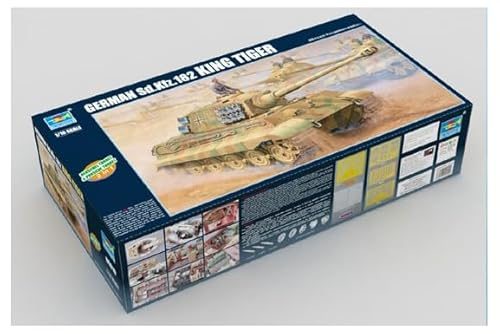
1,850+ parts including BOTH Henschel and Porsche turrets in one box. Full interior with crew stations, working suspension, and a metal KwK 43 88mm gun barrel. Two complete tanks in one kit.
Best for: Armor enthusiasts who want the largest and most detailed Tiger available
The King Tiger (Tiger II) was the heaviest and most powerfully armed tank to see combat in WW2, and Trumpeter's 1/16 kit renders it at a scale where you can practically climb inside. The box includes both the early Porsche turret (rounded, used on the first 50 vehicles) and the production Henschel turret (angular, used on all subsequent vehicles), meaning you have the parts for two completely different versions. The 1,850+ parts include a complete interior: driver's station, radio operator's position, turret fighting compartment with the massive KwK 43 L/71 88mm gun breech, and ammunition storage racks.
The suspension is functional, with torsion bars and overlapping road wheels that move as they did on the real vehicle. The 88mm main gun barrel is turned metal for precise scale accuracy. Four photoetch sheets provide the fine detail (grilles, mesh, tool clamps) that injection molding cannot replicate. The finished model measures approximately 26 inches long and weighs several pounds. This is a multi-month project that rewards patience, planning, and a very large display case.
Trumpeter Panther G Late Version (1/16)
~$320 on Amazon
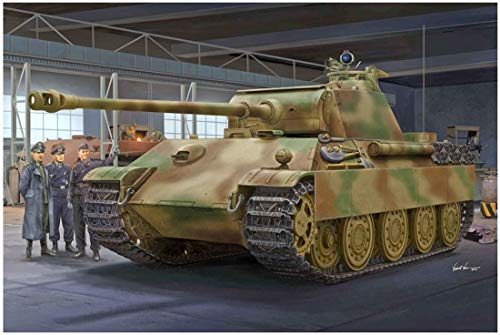
2,300+ parts, the highest part count of any kit on this list. Full interior, individual track links, and photoetch detail throughout. Many tank historians consider the Panther the best overall tank design of WW2.
Best for: The ultimate Panther build for experienced armor modelers
At 2,300+ parts, the Trumpeter 1/16 Panther G holds the record for the highest part count of any kit on this page. The Panther is a fascinating subject for modelers because many tank historians consider it the best overall tank design to emerge from WW2, combining a powerful 75mm KwK 42 L/70 gun, excellent sloped armor (directly influenced by encounters with the Soviet T-34), and good mobility. It was more effective ton-for-ton than the heavier Tiger, though mechanical reliability plagued early production.
The full interior includes the driver's compartment, turret basket with gun breech, commander's cupola, and engine bay with the Maybach HL 230 engine. Individual track links (each a separate part) create the most realistic track appearance possible, but assembling over 200 individual links requires patience and a good track-assembly jig. The finished model measures 553mm (21.8 inches) long and 213mm (8.4 inches) wide. At this size, details like weld seams, tool clamps, and zimmerit anti-magnetic coating paste become visible to the naked eye. This is the armor equivalent of the HK Models 1/32 B-17: a project that defines a year of modeling.
1/200 Scale Warships ($240 to $370)
At 1/200 scale, a Bismarck or Iowa-class battleship is over four feet long. These are the largest ship kits commonly available. Trumpeter produces the best options at this scale, with kits featuring 1,500+ parts, metal gun barrels, photoetch railings, and anchor chains. Each one is a serious commitment of space, time, and resources. But for naval history enthusiasts, there is nothing else that captures the sheer mass and complexity of a WW2 capital ship.
Trumpeter USS Arizona BB-39 (1/200)
~$275 on Amazon
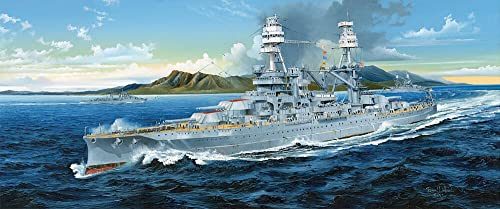
The USS Arizona in her December 7, 1941 configuration. 1,048 parts across 34 sprues, 4 photoetch sheets, metal gun barrels, and two Vought Kingfisher floatplanes. Full hull or waterline display options. Over 3.5 feet long when complete.
Best for: Pearl Harbor history enthusiasts and large-scale naval builders
The USS Arizona (BB-39) needs no introduction. Lost at Pearl Harbor on December 7, 1941, with 1,177 of her crew, she remains the most emotionally resonant warship in American history. Her hull still rests on the bottom of Pearl Harbor beneath the white memorial that 1.8 million people visit each year. Trumpeter's 1/200 kit renders her in her final configuration: as she appeared on the morning of the attack, with her distinctive cage masts, tripod foremast, and twelve 14-inch guns in four triple turrets.
The 1,048 parts build into a model over 3.5 feet long. Four photoetch sheets provide railings, ladders, and radar antennae that would be impossible to mold in plastic. Metal gun barrels give the main battery and secondary armament the precision that plastic cannot match. Two Vought OS2U Kingfisher floatplanes sit on the stern catapults. You can build her as a full-hull display model or in waterline configuration for a diorama. For many builders, this is not just a model. It is a memorial.
Trumpeter Bismarck 1941 (1/200)
~$290 on Amazon
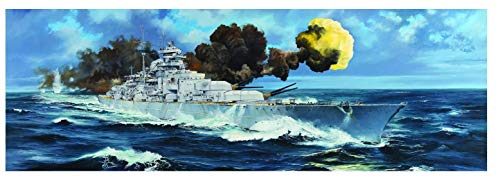
1,700+ parts across 45 sprues. Nearly 50 inches long when complete. Metal gun barrels, anchor chain, propeller shafts, and photoetch railings throughout. Four Ar 196 floatplanes included. The largest Bismarck kit available.
Best for: Naval history enthusiasts who want the largest Bismarck available
The Bismarck was the most famous (and feared) warship of the European theater. Her brief but dramatic career, sinking HMS Hood in a single salvo and then being hunted across the Atlantic by the entire Royal Navy, reads like a thriller novel. Trumpeter's 1/200 kit renders her in her May 1941 configuration: the North Atlantic pursuit that ended with her sinking on May 27.
At nearly 50 inches (127cm) long, this is a model that requires serious display space. The 1,700+ parts across 45 sprues include metal gun barrels for the eight 38cm (15-inch) main guns and twelve 15cm secondary guns, metal anchor chain, metal propeller shafts, and photoetch handrails, ladders, and radar equipment. Four Arado Ar 196 floatplanes sit on the midships catapult. The hull is split at the waterline, allowing either full-hull or waterline display. The sheer mass of the finished model, combined with the quality of Trumpeter's molding, creates something that commands attention from across a room.
Premium 1/35 Armor ($55 to $220)
Not every premium build requires a new scale. These 1/35 kits offer expert-level detail, full interiors, and competition-grade accuracy while staying compatible with the most popular armor modeling scale.
Dragon Tiger I Initial Production Smart Kit (1/35)
~$74 on Amazon
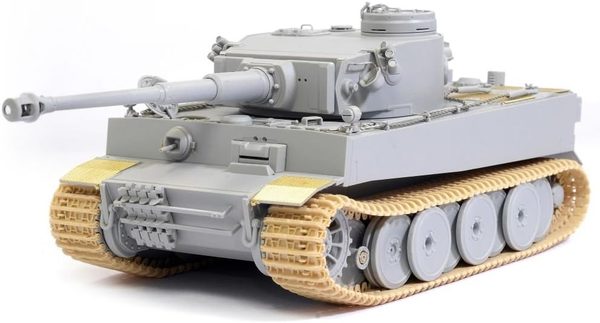
Dragon's "Smart Kit" line pushes 1/35 armor detail further than any competitor. This early-production Tiger I features weld seams, Feifel air filters, and surface detail that makes Tamiya's Tiger look like a toy. 5.0 stars, expert builders love this kit.
Best for: Experienced builders who want the most accurate and detailed Tiger I kit available
If the Tamiya Tiger I is the kit that makes you fall in love with 1/35 armor, the Dragon Smart Kit Tiger I is what you build five years later when your skills have caught up to your ambitions. Dragon Models (based in Hong Kong) has spent decades pushing the boundaries of injection-molded detail, and their "Smart Kit" line represents the current apex of what is possible in 1/35 scale plastic. The 600+ parts include surface detail so fine you need magnification to fully appreciate it: weld beads along hull seams, individual bolt heads on the turret, tool clamp detail, and the distinctive Feifel air filter drums on the rear hull that mark this as an early-production Tiger.
The 5.0-star rating is not an accident. This is a kit that inspires devotion among the builders who complete it. But "complete" is the operative word. With 600+ parts, many of them small and requiring precise placement. This is firmly expert territory. The instructions are complex, the parts are sometimes fragile, and Dragon's engineering philosophy prioritizes accuracy over ease of assembly. Where Tamiya designs kits so that parts almost fall into the correct position, Dragon expects you to know what you are doing. Dry-fit everything. Use references. Take your time. The reward is a Tiger I that makes Tamiya's excellent kit look slightly simplified by comparison, because it is.
Rye Field Model Tiger I (1/35)
~$55 on Amazon
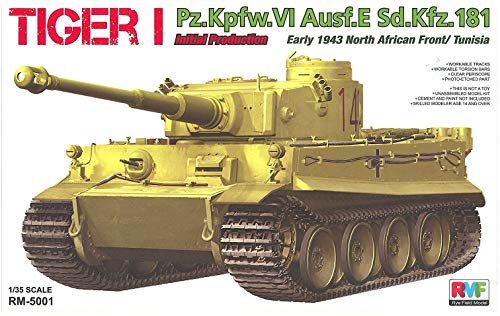
Workable individual track links that articulate like the real thing, an optional full interior, and engineering that represents the cutting edge of modern kit design. Rye Field Model has revolutionized 1/35 armor modeling.
Best for: Advanced builders who want workable tracks and modern engineering without Dragon-level difficulty
Rye Field Model (RFM) is the most exciting thing to happen to 1/35 armor in the last decade. This relatively new Chinese manufacturer has taken the precision of Dragon, the buildability of Tamiya, and added innovations that neither company has matched, most notably their workable individual track links. Each link is a separate injection-molded piece that clips together and actually articulates around the drive sprocket and idler wheel, just like real tank tracks. The result is tracks that sag naturally under gravity and drape over terrain in dioramas with absolute realism.
The Tiger I is one of RFM's flagship kits, and it sits in a sweet spot between Tamiya's beginner-friendly approach and Dragon's expert-only complexity. The 500+ parts include the workable track links (which alone account for hundreds of pieces), detailed hull and turret with crisp surface texture, and an optional full interior that transforms the model into a cutaway display piece. The fit is excellent, not quite Tamiya-level effortless, but far more cooperative than Dragon. For builders who have completed a Tamiya Tiger and want the next challenge, the RFM Tiger I is the natural progression. The workable tracks alone are worth the purchase, once you have built with individual links, rubber band tracks never feel right again.
Revell U-Boat Type VII C/41 Platinum Edition (1/72)
~$220 on Amazon
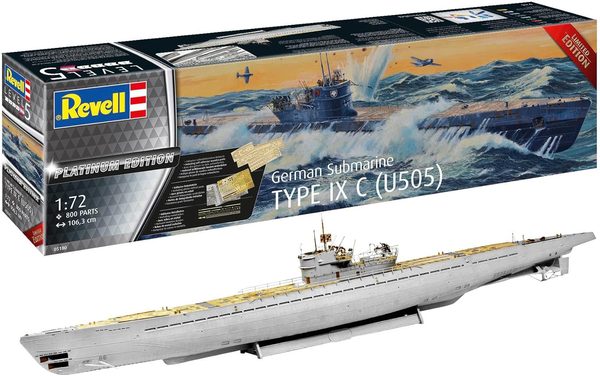
The most detailed submarine kit available anywhere. Full interior visible through cutaway hull sections. At 1/72 scale, the finished model is nearly three feet long. 4.9-star rating from builders who call it the finest submarine kit ever produced.
Best for: Expert builders who want the ultimate submarine display piece
This is the submarine kit. The one that serious submarine modelers dream about. Revell's Platinum Edition Type VII C/41 U-boat takes the already-excellent 1/72 U-boat kit and elevates it with a complete interior, photoetched metal parts, and detail that borders on the obsessive. At 1/72 scale, the finished model is nearly three feet long. This is not a shelf model. It is a centerpiece. Every compartment of the submarine is represented: the bow torpedo room with its six tubes and reload torpedoes, the officers' quarters, the control room with its periscope column and hydroplane wheels, the diesel engine room, the electric motor room, and the aft torpedo room. You can see it all through the cutaway hull sections.
The 4.9-star rating from verified builders speaks for itself. This is as close to universal praise as a complex model kit can receive. The 500+ parts include the photoetched railings, periscope detail, and deck fittings that bring the exterior to life, while the interior parts build into a genuine cross-section of a Type VII's claustrophobic working spaces. The price reflects the size, complexity, and premium materials (photoetch is expensive to produce), and the build time will be measured in months rather than weeks. This is the kind of project that experienced modelers plan their calendar around. If you want one submarine model and you want it to be the best. This is the only choice.
Trumpeter USS Intrepid CV-11 (1/350)
~$226 on Amazon
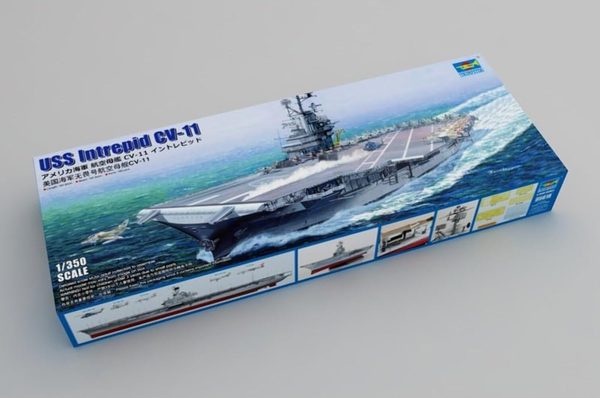
Premium carrier kit of the USS Intrepid, now a museum ship in New York City. At 1/350 scale, this Essex-class carrier builds into a model over two feet long. 5.0-star rating. Over 800 parts of pure naval detail.
Best for: Expert naval modelers who want a museum-quality carrier display piece
The USS Intrepid (CV-11) has one of the most remarkable service records of any warship in history. Commissioned in 1943 as an Essex-class carrier, she survived five kamikaze strikes and one torpedo hit in the Pacific, earned the nickname "The Fighting I," served in the Cold War, recovered astronauts from space missions (including Scott Carpenter's Mercury flight), and today sits at Pier 86 on the Hudson River in Manhattan as the centerpiece of the Intrepid Sea, Air & Space Museum. If you have ever visited the museum and walked her flight deck, this kit lets you build what you saw.
Trumpeter's 1/350 kit is a premium rendering of this Essex-class carrier, with 800+ parts that build into a model over two feet long. The 5.0-star rating reflects the quality of Trumpeter's naval engineering, the flight deck detail, island structure, catapult equipment, and anti-aircraft armament are all crisply molded and accurate. The kit includes small-scale aircraft for the flight deck, which brings the model to life and gives it the busy, operational appearance of a carrier preparing for flight operations. At $226. This is the most expensive kit on this list, but for builders who want the ultimate carrier display piece, especially one with the emotional connection of being a museum ship you can actually visit, the Intrepid is worth every dollar.
Essential Tools & Supplies
You can build a great model with surprisingly few tools. The four items below cover 90% of what you need for any kit on this list: cutters to remove parts from sprues, a knife for cleanup, cement to bond parts, paint for color, and a mat to protect your table. If you are just starting out, the Tamiya Basic Tool Set is the single best investment you can make: it includes professional-quality side cutters, a hobby knife, files, and tweezers in one box for about $30. Add cement, paint, and a cutting mat, and you are ready to build anything from a beginner Meng Toons kit to an expert Dragon Smart Kit.
Tamiya Basic Tool Set
~$30 on Amazon
Everything a modeler needs to get started: sharp side cutters, a precision hobby knife, needle files, and fine-point tweezers. Tamiya quality at a reasonable price.
Best for: Every builder, beginners and experienced modelers alike
The Tamiya Basic Tool Set is the standard recommendation across every modeling forum, subreddit, and YouTube channel for good reason: it provides professional-quality tools at a price that does not punish beginners. The side cutters are sharp enough to cut parts cleanly from sprues without crushing them (cheap cutters leave stress marks and white spots on colored plastic). The hobby knife handles detail cleanup, trimming mold lines, scraping seams, and cutting decals. The needle files smooth surfaces after cutting. The tweezers handle small parts and decal placement. These four tools cover every operation you will perform on 95% of model kits.
A note on quality: cheap tools from dollar stores or no-name Amazon brands will make your first build frustrating and your results worse. Dull side cutters crush plastic. Wobbly knife handles slip. Coarse files gouge surfaces. The Tamiya set costs more than the cheapest alternatives, but the difference in your building experience is enormous. Think of it as a one-time investment, these tools will last years with basic care. If you are buying a gift set for someone, add this tool set to the package and they will have everything they need from day one.
Vallejo Model Air Basic Colors Set
~$29 on Amazon
Sixteen essential colors in dropper bottles, airbrush-ready but also works with a brush. Water-based acrylic formula means easy cleanup and low odor. The best starter paint set for military modeling.
Best for: Any builder who needs a comprehensive paint set for military subjects
Paint is where models come to life, and Vallejo Model Air is the paint system that the modeling community has increasingly rallied around over the past decade. The 16-color basic set includes the core colors you need for WW2 military modeling: olive drab, dark yellow (German dunkelgelb), several grays, black, white, and the earth tones used for weathering and groundwork. The dropper bottles are vastly superior to the traditional screw-top jars used by Tamiya and Humbrol. You dispense exactly how much paint you need without opening a pot (which dries out your paint) or dealing with spills.
The "Model Air" formulation is designed for airbrush use, with pigments ground finer and a pre-thinned consistency, but it works perfectly well with a brush too. The water-based acrylic formula means you clean brushes with water (not chemical thinners), there is minimal odor, and you can paint in a room without ventilation concerns. For WW2 subjects specifically, Vallejo also sells dedicated color sets matched to specific nations (German, American, British, Soviet), but this basic set covers enough ground to paint any kit on this list. Start here, then add specific colors as your projects demand them.
Tamiya Extra Thin Cement
~$10 on Amazon
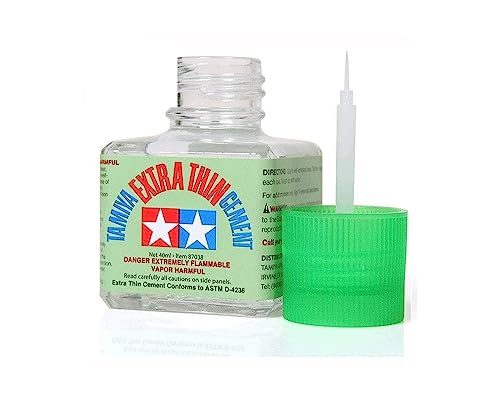
The gold standard of plastic model cement. The extra-thin formula wicks into joints by capillary action, hold two parts together, touch the brush to the seam, and the cement draws itself in. Clean, precise, and virtually invisible.
Best for: Every plastic model kit build, the single most essential consumable in the hobby
If you build one plastic model kit in your life. You will use this cement. Tamiya Extra Thin is not glue in the traditional sense. It is a solvent that melts the surface of polystyrene plastic and welds the parts together at a molecular level. The result is a bond that is actually stronger than the surrounding plastic. The "extra thin" formulation is the key: it is so fluid that it works by capillary action. You hold two parts together, touch the built-in brush applicator to the joint, and the cement wicks into the seam automatically. No squeezing, no mess, no visible residue.
This capillary-action technique is cleaner and more precise than applying thick cement to one part and then pressing the other part onto it (which is how most beginners start). It also means you can position parts perfectly before committing, hold them in place, verify alignment, then touch the brush to the seam. If you make a mistake, the thin formula evaporates quickly without leaving the damage that thick cement causes. At around $10, a bottle lasts through multiple kits. It is, without exaggeration, the single most essential supply in the hobby. Buy it with your first kit and you will never use anything else.
OLFA Self-Healing Cutting Mat (A3)
~$84 on Amazon
A professional-quality self-healing cutting mat that protects your table and provides a clean, flat workspace. The printed grid helps with alignment and measurement. OLFA is the brand that invented the snap-off blade, they know cutting surfaces.
Best for: Protecting your work surface and providing a professional modeling workspace
A cutting mat is one of those things you do not think you need until you slice through a decal sheet and into your dining room table. The OLFA A3 mat is the professional standard: large enough to work on comfortably (roughly 17 x 12 inches), tough enough to absorb thousands of knife cuts without deteriorating, and printed with a metric and imperial grid that is useful for measuring parts and aligning components. The self-healing surface closes up after cuts, maintaining a smooth work surface that will not catch your knife on previous cut marks.
OLFA is the Japanese company that invented the snap-off utility blade in 1956, and they have been making cutting tools and surfaces ever since. Their mats are noticeably better than cheap alternatives: the self-healing compound is denser, the grid printing is more precise, and the mat lies flat without curling at the edges. At $84. It is the most expensive "tool" on this list, but it is also the one you will use for every single build for the next decade. If the OLFA is outside your budget, any A3-size self-healing mat will serve, just avoid the ultra-cheap ones that curl, stain, and stop healing after a few months. Your table will thank you.
Gear Up with Military Machine
Show your military machine appreciation with our aviation tees and hoodies, designed for enthusiasts who know their aircraft.
P-51 Mustang Tee · A-10 Warthog Tee · SR-71 Blackbird Tee · A-10 American Flag Tee · Shark Nose Art Tee · T-38 Talon Tee · F-22 Raptor Hoodie · C-130 Hercules Hoodie
Head-to-Head: Kit Comparison Tables
Sometimes you know what subject you want to build but there are multiple kits competing for your money. These comparison tables put the top options side by side so you can make the right choice for your skill level, budget, and goals.
Tiger I Kits Compared
| Kit | Brand | Scale | Skill Level | Best For |
|---|---|---|---|---|
| Tiger I Early (35216) | Tamiya | 1/35 | Intermediate | Best for beginners wanting a Tiger |
| Tiger I w/ Workable Tracks | Rye Field Model | 1/35 | Advanced | Best detail and workable tracks |
| Tiger I Initial Smart Kit | Dragon | 1/35 | Expert | Best accuracy, hardest build |
P-51D Mustang Kits Compared
| Kit | Brand | Scale | Skill Level | Best For |
|---|---|---|---|---|
| P-51D (61040) | Tamiya | 1/48 | Beginner-Intermediate | Best value, easiest build |
| P-51D ProfiPACK (82102) | Eduard | 1/48 | Intermediate-Advanced | Best detail, includes photoetch |
| P-51D Mustang | Revell | 1/48 | Intermediate | Budget option with decent detail |
Sherman Tank Kits Compared
| Kit | Brand | Scale | Skill Level | Best For |
|---|---|---|---|---|
| M4A3E8 "Easy Eight" (35346) | Tamiya | 1/35 | Beginner-Intermediate | Best overall Sherman |
| M4 Sherman Early (35190) | Tamiya | 1/35 | Beginner | Older tooling, lower price |
| M4A3 76W HVSS (Full Interior) | Rye Field Model | 1/35 | Expert | Full interior, premium build |
Community Resources
The scale modeling community is one of the friendliest and most helpful hobbyist communities on the internet. Whether you need advice on your first build, want to show off a finished project, or are looking for reference photos of a specific vehicle variant, these resources will connect you with builders at every skill level.
Reddit: The r/modelmakers subreddit has over 500,000 members and is the most active online modeling community. Posts range from first-time builders asking basic questions to competition-level modelers showcasing museum-quality work. The community is famously welcoming to beginners, post your first build and you will get genuine encouragement and constructive feedback. r/scalemodels is a smaller but equally friendly alternative.
Forums: For deeper technical discussions, the traditional forums remain invaluable. FineScale Modeler is backed by the leading US modeling magazine and has decades of archived build threads. Britmodeller is the largest UK-based forum with outstanding WW2 coverage. KitMaker Network hosts multiple specialized forums for armor, aircraft, ships, and figures, if you want expert-level advice on a specific subject. This is where to find it.
Database: Scalemates.com is the most comprehensive database of every model kit ever produced. Search by subject, scale, brand, or kit number to find every version of a kit, read builder reviews, compare prices across retailers, and discover aftermarket accessories. If you want to know every P-51 kit ever made in 1/48, Scalemates has the answer. It is the single most useful reference tool in the hobby.
YouTube: Three channels stand out for WW2 modeling. Plasmo produces beautifully filmed, relaxing build videos with millions of views. Watching him build is both educational and meditative. Night Shift covers advanced techniques like chipping, weathering, and realistic finishes with clear explanations. Quick Kits focuses on beginner-friendly content: kit reviews, tool guides, and step-by-step builds that assume no prior knowledge.
Reference: Osprey Publishing produces hundreds of campaign histories and technical guides with detailed color illustrations of vehicles, aircraft, and uniforms. Their "New Vanguard" series (vehicles and ships) and "Aircraft of the Aces" series are particularly useful for modelers who want to paint a specific unit or historical variant. Many experienced builders keep a shelf of Osprey books alongside their reference photos.
Reference: Scale, Brand & Skill Guides
Before you scroll through 80+ kits, take five minutes to understand three things: scale, brands, and skill levels. Getting these right will save you from buying a kit that is too big for your shelf, too complex for your experience, or from a manufacturer whose engineering will frustrate you. If you already know your way around a sprue, skip ahead to whichever nation interests you.
Scale Guide
Scale determines how big the finished model will be, how much detail you can expect, and roughly how many parts are in the box. Here are the five scales you will encounter in this guide:
1/72 is the smallest common scale. A Spitfire builds out to about six inches long. Kits are affordable, often under $15, and build quickly, sometimes in a single afternoon. This is the practical choice if you want to collect a whole squadron or line up opposing forces on a shelf without running out of room. Airfix and Zvezda dominate this scale with consistently good modern toolings. The trade-off is detail: panel lines are finer, cockpit parts are tiny, and photoetch upgrades are almost mandatory for competition builds.
1/48 is the sweet spot for aircraft. That same Spitfire is now about nine inches, large enough to show off a detailed cockpit and painted pilot figure, small enough to fit on a bookshelf. This scale has the widest selection of WW2 aircraft kits from the most manufacturers. Eduard and Tamiya produce their best work here, and the aftermarket support (decals, resin parts, photoetch) is enormous. Most of the aircraft in this guide are 1/48.
1/35 is the dominant scale for armor and military vehicles. A Sherman tank builds out to roughly seven inches long. This is where the hobby's biggest manufacturers (Tamiya, Dragon, Rye Field Model, and Meng) compete head to head with increasingly sophisticated engineering. Workable track links, full interior options, individual tool clamps: 1/35 armor has more variety and more innovation than any other segment of the hobby. If you are building tanks, half-tracks, jeeps, or artillery. This is the scale.
1/350 is the standard for large warships. A fleet carrier at this scale is roughly two and a half feet long. Tamiya and Trumpeter produce the most popular 1/350 kits, and the aftermarket scene (wooden decks, turned brass barrels, railings, aircraft sets) can turn a good kit into a museum piece. These are big builds. Plan for weeks of construction time and a display case.
1/700 is the waterline ship scale, where models sit at the waterline as if floating. Ships are roughly one foot long, making them far more manageable than 1/350. This scale works well if you want to build an entire task force or recreate a specific engagement. Pit-Road and Fujimi offer some of the best 1/700 kits, alongside Tamiya's excellent waterline series.
Brand Guide
Not all model kit manufacturers are equal. Some excel at engineering and fit. Others offer the widest selection. A few charge premium prices for premium results. Here is what you need to know about every brand you will encounter in this guide:
Tamiya is the gold standard for fit and engineering. Their parts go together with a precision that borders on watchmaking. If you are unsure which brand to buy, buy Tamiya. Their 1/35 armor and 1/48 aircraft are consistently the best-engineered kits on the market, and they are priced reasonably, most fall between $25 and $60. The one downside is that some of their older toolings (1990s and earlier) lack the detail of more modern competitors. When we note "new tooling" in this guide, it means the kit was designed or significantly updated in the last decade.
Eduard produces the finest 1/48 aircraft kits available. Their ProfiPACK editions include photoetch details (pre-painted metal parts for instrument panels, harnesses, and control surfaces) plus canopy masks for clean paint lines. The fit is excellent and the surface detail is the crispest in 1/48. Eduard kits assume you know what you are doing, instructions are detailed but move fast, and the photoetch requires patience and CA glue. Worth every dollar for intermediate-to-advanced builders.
Airfix is the best beginner brand in the hobby. Their Starter Sets include cement, a brush, and acrylic paints right in the box, everything you need except a hobby knife. Over the past decade, Airfix has re-tooled dozens of classic subjects with modern CAD engineering, and the results compete with kits costing twice as much. Their 1/72 kits are the entry point for thousands of new builders every year.
Revell is the workhorse brand with the widest range of subjects. Quality varies, some kits are excellent modern toolings, others are re-boxed molds from the 1970s. For WW2, Revell's strength is large American bombers: their B-17G, B-25J, and B-24D are solid builds at reasonable prices. Check the copyright date on the box (or Scalemates) to avoid the oldest molds.
Dragon produces premium 1/35 armor with extraordinary detail. Their "Smart Kit" line represents their best work, hundreds of individual parts, slide-molded turrets, and detail that matches the real vehicle's technical manuals. Dragon kits are expert-level. Expect 400+ parts, complex track assembly, and instructions that require careful study. The results are worth the effort.
Rye Field Model (RFM) is a modern Chinese manufacturer that has earned serious respect in the armor community. Their Tigers, Panthers, and Shermans feature workable individual track links, optional full interiors, and engineering that rivals Tamiya. They are particularly strong on German heavy armor. If you want to build a Tiger I or Panther with a visible interior, RFM is the first brand to consider.
Meng is another modern Chinese manufacturer producing kits across multiple scales and subjects. Their "World War Toons" series, egg-shaped cartoon tanks and aircraft, are excellent beginner kits for kids and adults who want a relaxed build. Their serious 1/35 line rivals Tamiya on engineering and often surpasses it on detail. Meng's Sherman, Panther, and Mark V kits are all top-tier.
Trumpeter produces large-scale ships and unusual subjects that other manufacturers ignore. Their 1/350 carriers, cruisers, and destroyers fill gaps in the market. Quality is variable, some kits have excellent detail, others have fit issues that require putty and patience. Research the specific kit on Scalemates before buying.
Hasegawa is a Japanese manufacturer that excels at Japanese WW2 aircraft subjects. Their A6M Zero, Ki-61 Tony, and N1K Shiden are the best available versions of those subjects. Panel lines are recessed, fit is good (though not quite Tamiya-level), and the subjects are often unavailable from anyone else. Essential for Pacific Theater collections.
Skill Level Guide
Every kit in this guide is tagged with a skill level. Here is what each level means in practical terms, not marketing terms, but real-world expectations for what you will need and what you will encounter.
Beginner (your first kit) means under 100 parts, simple construction, and minimal painting required. Kits at this level include Airfix Starter Sets (which come with paint, glue, and a brush), the Tamiya 1/35 Willys Jeep, and Meng's World War Toons cartoon tanks. What you need: a basic tool set (hobby knife, sprue cutters, sandpaper), the included or entry-level cement and paint, and patience. Do not worry about perfection. Your first three builds are about learning how plastic cement works, how to remove parts from sprues cleanly, and how to follow instructions. A beginner kit should take a weekend.
Intermediate (5+ builds under your belt) means 100 to 300 parts with more complex assembly sequences. Most Tamiya 1/35 tanks and 1/48 aircraft fall here. You will encounter multi-part assemblies that require dry-fitting before gluing, small parts that need tweezers, and enough surface area that brush painting starts to show its limitations. What you need: proper sprue cutters (not nail clippers), liquid plastic cement, a basic acrylic paint set with several brush sizes, and steady hands. An intermediate kit takes one to three weeks depending on how much detail painting you do.
Advanced (20+ builds) means 300 or more parts with photoetch metal, complex track assembly, and subjects that demand accurate paint schemes. Eduard ProfiPACK aircraft, Dragon Smart Kit armor, and HK Models bombers live here. Instructions assume you understand sub-assemblies, know how to handle photoetch with CA glue, and have weathering techniques in your repertoire. What you need: an airbrush and compressor, photoetch bending tools, a range of weathering products (washes, pigments, oils), and ideally reference books or walk-around photos for the specific vehicle. Advanced kits take weeks to months.
Expert (100+ builds) means you are building for competition or display-case perfection. Full-interior tank builds where every round in the ammo rack is painted. 1/350 carriers with individual aircraft, rigging, and railings. Scratch-built modifications using sheet styrene and wire. RFM full interior Tigers, Trumpeter 1/200 ships, and large-scale diorama builds with groundwork and multiple vehicles. What you need: years of experience, a complete workshop, an airbrush you know intimately, and the willingness to spend months on a single project. These are not kits. They are commitments.
Frequently Asked Questions
What scale should I start with?
For aircraft, 1/48 is the sweet spot: large enough to see detail without magnification, small enough that a fighter fits on a standard shelf. Tamiya and Eduard both have excellent 1/48 ranges. For tanks and vehicles, 1/35 is the dominant scale with the widest selection of kits, aftermarket parts, and figure sets. For ships, 1/350 is the standard for detailed builds (1/700 if you want multiple ships in less space). If you want the absolute easiest first build, the Meng World War Toons chibi kits bypass the scale question entirely. They are designed purely for fun.
Do I need an airbrush?
No. You can build excellent models with just brush painting. Many competition-winning models are brush-painted. An airbrush gives you smoother base coats and easier camouflage patterns, but it also requires a compressor ($80-200), an airbrush ($30-150), a spray booth or ventilation setup, and time to learn the technique. Start with brush painting using Vallejo or Tamiya acrylics. If you find yourself wanting smoother finishes after several builds, then invest in an airbrush setup. The Vallejo Model Air set on this list works with both brushes and airbrushes, so your paint investment carries over either way.
What's the best glue for plastic model kits?
Tamiya Extra Thin Cement. It works by capillary action, hold two parts together, touch the brush to the seam, and the cement draws itself into the joint. The result is a clean, strong, nearly invisible bond. For clear parts (canopies, windscreens), use white glue (PVA) instead, solvent cement can fog clear plastic. For photoetch metal parts, use cyanoacrylate (super glue). But for 95% of your building, Tamiya Extra Thin is the only cement you need. We cover it in detail in the Essential Tools section.
How long does a typical kit take to build?
It varies enormously by kit complexity and your pace. A simple snap-fit Meng Toons kit can be finished in 2-3 hours. A standard Tamiya 1/48 aircraft (like the P-51D) takes most builders 15-25 hours spread over a week or two. A complex 1/35 tank with full painting and weathering takes 30-50 hours over several weeks. Premium kits like the Dragon Smart Kit Tiger or the Revell U-Boat Platinum Edition can take 100+ hours over several months. There is no rush, modeling is a hobby, not a deadline. Many builders work on multiple kits simultaneously, switching between them as the mood strikes.
Are Tamiya kits worth the extra money?
Yes, especially for your first several builds. Tamiya kits cost 20-40% more than comparable Revell or Academy kits, but the difference in fit and engineering is immediately apparent. Parts align precisely, seams are minimal, and the instructions are clear and logical. This means less frustration, less putty and sanding, and a better finished result, all of which matter enormously when you are learning the hobby. As your skills improve. You will learn to work around the fit issues in cheaper kits, but Tamiya's engineering removes obstacles that beginners should not have to fight. Think of the premium as paying for a better learning experience.
What's the difference between Tamiya and Eduard?
Tamiya optimizes for buildability: their kits go together smoothly with minimal fuss, and the instructions guide you through every step. Eduard optimizes for detail: their kits include photoetched metal parts, detailed cockpit placards, and surface panel lines that are finer and more accurate than Tamiya's. The tradeoff is that Eduard kits demand more skill: photoetch parts are fragile, the fit requires more attention, and some assembly steps assume experience. For your first five kits, Tamiya is the better choice. Once you are comfortable with basic construction and want to push your detail game, Eduard's ProfiPACK line is the natural next step.
Can I build a model kit with my kids?
Absolutely, and it is one of the best uses of scale modeling. For children under 10, the Meng World War Toons series is purpose-built: snap-fit construction, no glue required, pre-colored plastic, and fun cartoon proportions that kids love. For children 10-14, the Airfix Starter Sets include everything needed and are designed for young builders. For teenagers, any Tamiya kit rated "Beginner" or "Intermediate" in this guide works well. The key is matching the kit complexity to the child's patience. A frustrated kid will not want to build another one. Start easier than you think necessary, celebrate the finished result, and let them choose the next kit themselves.
Where do I buy aftermarket parts?
Aftermarket parts (photoetch detail sets, resin replacement parts, turned metal gun barrels, and decal sheets) transform good kits into great ones. The best online retailers include Sprue Brothers, HobbyLink Japan (HLJ), and MegaHobby. For specific parts, search Scalemates.com, it lists every aftermarket accessory made for a given kit. Major aftermarket brands to know: Eduard (photoetch and masks), Voyager Model (photoetch for armor), Master (turned metal barrels), Archer Fine Transfers (dry transfer decals), and DEF Model (resin wheels and figures). Wait until you have a few builds under your belt before diving into aftermarket, learn the basics first.
How do I weather a model kit?
Weathering is the art of making a model look used, worn, and real instead of factory-fresh. Start simple with three techniques: panel line washes (thin dark paint that flows into recessed lines, adding definition and depth), dry brushing (loading a brush with paint, wiping most of it off, then dragging it across raised edges to highlight wear), and pigment powders (dust and mud effects applied to lower surfaces). Tamiya Panel Line Accent Color is the easiest wash product. Apply it along panel lines, wait for it to dry, then wipe excess away with enamel thinner. Start on a kit you do not care about and experiment freely. YouTube channels like Night Shift cover weathering techniques in outstanding detail.
What's the best first WW2 tank to build?
The Tamiya Tiger I Early Production (35216). It is the most iconic WW2 tank, Tamiya's engineering means it goes together without drama, the 1/35 scale provides satisfying size and detail, and the part count is manageable for a first armor build. It is the most recommended first tank kit on r/modelmakers, FineScale Modeler, and Britmodeller forums. The Tamiya M4A3E8 Sherman is an equally excellent alternative if you prefer American subjects. Both are in the $30-35 range.
What's the best first WW2 aircraft to build?
The Tamiya P-51D Mustang (61040) in 1/48 scale. It is the most recognizable Allied fighter. The kit is beautifully engineered with outstanding fit, and the part count is low enough that a beginner will not get overwhelmed. The silver/natural metal finish of many P-51Ds means you can practice bare-metal techniques or simply paint it olive drab for an earlier variant. If you want an absolute beginner experience with paint and glue included, the Airfix Spitfire Starter Set is the alternative, though the Tamiya Mustang is the better kit in terms of fit and detail.
How do I display finished models?
The simplest display is a wooden base with a nameplate. Hobby shops and Amazon sell pre-made display bases in standard sizes for both aircraft and armor. For aircraft, a clear acrylic rod mounted to a base creates a "flying" display that shows off the model from all angles. For armor, a small diorama base (a 6x6 inch piece of plywood with textured groundwork) adds enormous visual impact with minimal effort. For multiple models, IKEA's Detolf glass cabinet is the unofficial standard of the modeling community. It holds dozens of models in a dust-free environment with built-in lighting potential, and at around $70 it is the best value in model display furniture. Whatever you choose, keep models out of direct sunlight, UV exposure fades paint and yellows clear parts over time.