Skip to content
April 26:The Bombing of Guernica89yr ago

The F4U Corsair: The Bent-Wing Bird of the Pacific

Daniel Mercer · · 13 min read
Save
Share:
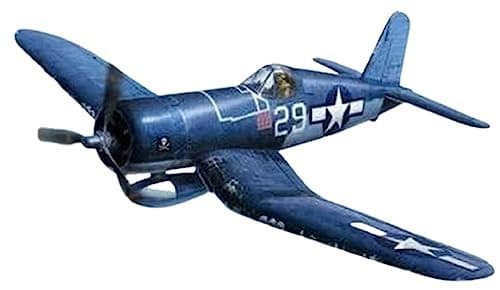
F4U Corsair fighter aircraft in flight showing its distinctive inverted gull wing design
Daniel Mercer
Daniel Mercer

Military History Editor

Daniel Mercer writes about military history with a focus on the 20th century, including World War II, the Cold War, and Vietnam. His work looks at how decisions made decades ago still influence doctrine, planning, and assumptions today.

On October 1, 1940, Chance Vought's XF4U-1 prototype became the first American fighter to exceed 400 mph in level flight. The aircraft's secret was brute force: a 2,000-horsepower Pratt & Whitney R-2800 Double Wasp, the most powerful radial engine available, driving the largest propeller ever fitted to a single-engine fighter. The engine was so big and the propeller so large that Vought's engineers had to design an inverted gull wing to keep the landing gear short enough for carrier operations while giving the propeller ground clearance. That distinctive bent wing made the Corsair instantly recognizable, and it would terrorize Japanese airfields and troop positions for the next five years. The Japanese called it Shi no Kuchibue, the Whistling Death, for the eerie sound the air made rushing through its wing-root oil cooler intakes during a diving attack.

The Biggest Engine on the Smallest Airplane

The F4U Corsair's design began with a simple premise: fit the most powerful engine available into the smallest practical airframe. Rex Beisel, Vought's chief engineer, selected the Pratt & Whitney R-2800 Double Wasp, an 18-cylinder, two-row radial engine that produced 2,000 horsepower in its initial variant and would exceed 2,400 horsepower in later models. The R-2800 was a monster, the same engine that powered the Republic P-47 Thunderbolt, an aircraft almost twice the Corsair's weight.

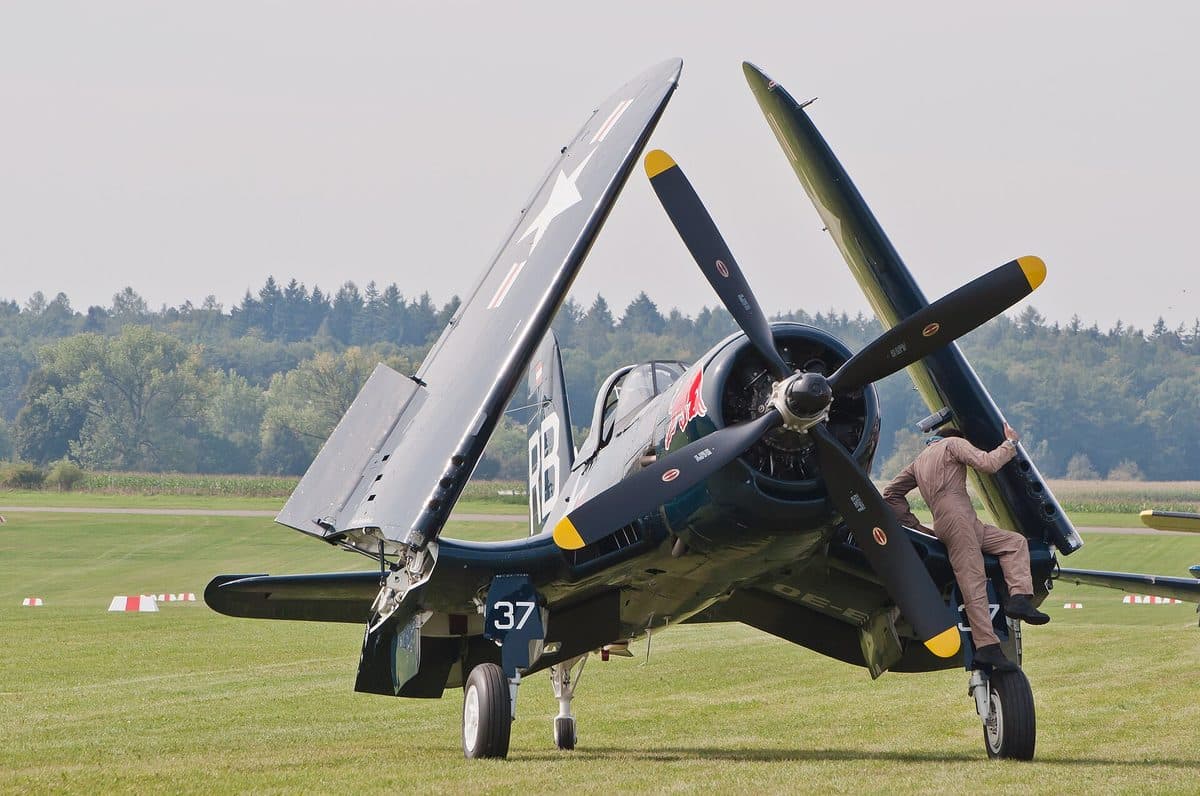
The massive engine required a propeller with a diameter of 13 feet 4 inches, the largest ever fitted to a single-seat fighter. A conventional straight wing would have required enormously long landing gear to give the propeller ground clearance, and long landing gear is heavy, structurally weak, and difficult to retract into a wing. Beisel's solution was the inverted gull wing: the wing angled downward from the fuselage before sweeping upward to the wingtip. This lowered the wing root, along with the landing gear attachment points, bringing the gear closer to the ground while maintaining propeller clearance. The gear was shorter, lighter, and stronger.

The gull wing also reduced drag at the wing-fuselage junction by meeting the fuselage at the optimal angle for minimizing aerodynamic interference. It was an elegant engineering solution that solved multiple problems at once, and it gave the Corsair the most distinctive silhouette of any American fighter.

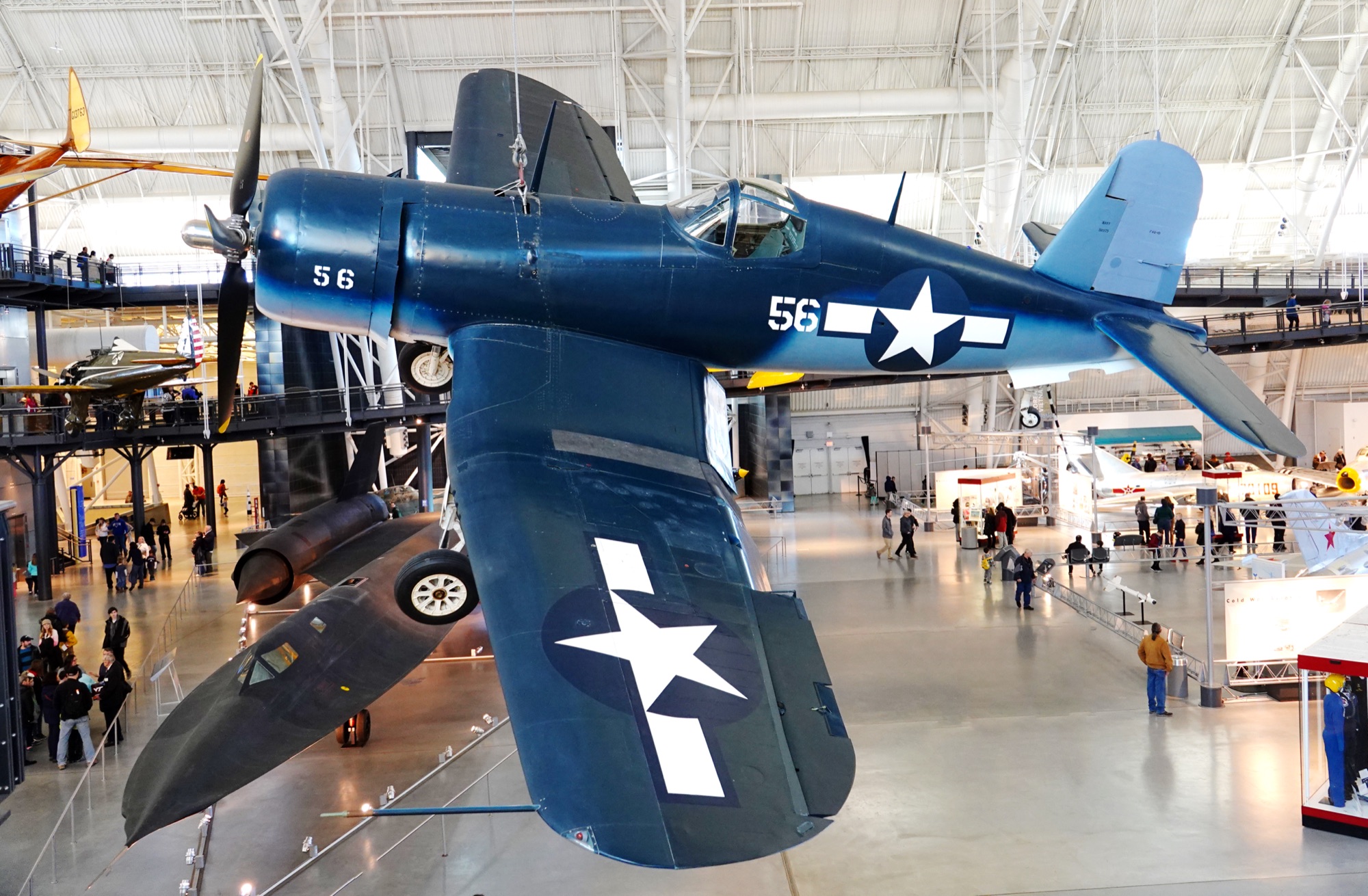
F4U Corsair on an aircraft carrier deck showing the inverted gull wing and large propeller that defined the design
The F4U Corsair's inverted gull wing was engineered to accommodate the largest propeller ever fitted to a single-seat fighter while keeping the landing gear short enough for carrier operations. The design became one of the most iconic silhouettes of World War II. (U.S. Navy)

Specifications

Powerplant Pratt & Whitney R-2800-8W Double Wasp (2,250 hp, F4U-1D)
Max Speed 446 mph (718 km/h) at 26,200 ft (F4U-4)
Range 1,015 mi (1,633 km)
Service Ceiling 41,500 ft (12,650 m)
Armament 6× .50 caliber M2 Browning machine guns
Ordnance Up to 4,000 lb of bombs or 8× 5-inch rockets
Crew 1
Built 12,571

Rejected by the Navy, Embraced by the Marines

The Corsair's path to combat was not straightforward. When the U.S. Navy evaluated the F4U for carrier operations in 1942, test pilots identified serious problems. The long nose and high engine cowling made forward visibility during carrier approach almost nonexistent. The pilot could not see the landing signal officer who guided aircraft onto the deck. The stiff landing gear caused the aircraft to bounce on touchdown, and the left wing could stall without warning at low approach speeds, causing a dangerous roll.

The Navy declared the Corsair unsuitable for carrier operations and diverted it to the Marine Corps, which flew it from land bases. The Marines did not care about carrier landings. They cared about speed, firepower, and range, and the Corsair had all three in abundance.

Marine Fighter Squadron VMF-124 took the F4U into combat for the first time on February 13, 1943, over Guadalcanal. The aircraft's performance was immediately apparent: it was faster than the Japanese Zero at every altitude, could outclimb it above 1,000 feet, and its six .50-caliber machine guns could shred the lightly built Japanese fighters. Unlike the slower F4F Wildcat it replaced, the Corsair did not need to rely on defensive tactics. It could chase down any Japanese aircraft in the theater.

The most famous Marine Corsair unit was VMF-214, the "Black Sheep," commanded by Major Gregory "Pappy" Boyington. Boyington scored 28 aerial victories, 22 of them in Corsairs, before being shot down and captured on January 3, 1944. He survived Japanese captivity and received the Medal of Honor.

The British Solve the Carrier Problem

While the U.S. Navy had rejected the Corsair for carrier use, the British Royal Navy's Fleet Air Arm needed every fighter it could get. The British received Corsairs under Lend-Lease and, characteristically, solved the carrier landing problems through technique rather than redesign. British pilots developed a curving approach, flying a continuous left turn toward the deck, keeping the carrier in sight through the side of the canopy rather than over the nose. This approach allowed the pilot to maintain visual contact with the deck throughout the landing.

The British also modified the landing gear oleo struts to reduce bouncing. With these changes, the Fleet Air Arm operated Corsairs from carriers successfully throughout 1944 and 1945. The U.S. Navy, observing the British success, reversed its earlier rejection and began carrier operations with the Corsair in late 1944. The F4U-1D and subsequent variants incorporated modifications that further improved carrier suitability, and the Corsair became a mainstay of Navy carrier air groups for the final year of the Pacific war.

The Kill Ratio

The Corsair's air-to-air combat record was extraordinary. In U.S. Marine and Navy service, Corsair pilots claimed 2,140 aerial victories against 189 losses, a kill ratio of approximately 11.3 to 1. This was the best kill ratio of any American fighter in the Pacific theater and one of the best of any fighter in the entire war.

The Corsair's advantages over Japanese fighters were substantial. It was 100 mph faster than the Zero, could dive away from any engagement it didn't want to fight, and could absorb battle damage that would have destroyed lighter Japanese aircraft. The R-2800 engine was famously rugged. Corsairs frequently returned to base with cylinders shot out, oil lines severed, and cowling panels blown away. The aircraft could take hits and keep flying in a way that the fragile, unarmored Japanese fighters could not.

Ground Attack and Close Air Support

As Japanese air opposition diminished in 1944 and 1945, the Corsair increasingly served as a fighter-bomber. The aircraft's ability to carry 4,000 pounds of bombs or eight 5-inch high-velocity aircraft rockets (HVARs) made it a devastating ground attack platform. Marine Corsairs provided close air support during the island-hopping campaigns at Peleliu, Iwo Jima, and Okinawa, often delivering ordnance within yards of friendly positions.

The Corsair's speed and ruggedness made it more survivable in the ground attack role than dedicated light bombers. It could deliver its ordnance, strafe with its six machine guns, and escape the target area before anti-aircraft gunners could react. Marine pilots developed tactics for coordinating Corsair strikes with infantry advances that became the foundation of modern close air support doctrine.

Korea: The Corsair's Last War

The F4U Corsair was still fighting when the Korean War began in June 1950, a remarkable testament to the aircraft's fundamental soundness. Marine and Navy Corsairs flew thousands of close air support missions over Korea, delivering napalm, bombs, and rockets against North Korean and Chinese positions. The AU-1, a dedicated ground attack variant with additional armor plating and simplified low-altitude engine performance, entered service specifically for the Korean theater.

At the Chosin Reservoir in December 1950, Marine Corsairs provided the close air support that helped prevent the destruction of surrounded Marine and Army forces by Chinese forces. The Corsairs flew in brutal winter conditions, delivering ordnance dangerously close to friendly lines because the Chinese attacks pressed so near to American positions.

The Corsair even scored the last confirmed air-to-air kill by a piston-engine fighter against another piston-engine aircraft, though the age of jet combat was rapidly making propeller-driven fighters obsolete for air superiority. The last F4U Corsairs were retired from frontline U.S. service in 1953.

Production and Legacy

A total of 12,571 Corsairs were built between 1942 and 1953 by Vought, Goodyear (which produced the identical FG-1), and Brewster (F3A, though Brewster's aircraft were considered inferior in quality). The Corsair's production run of 11 years was the longest of any American piston-engine fighter, a reflection of the basic design's excellence and adaptability.

Several nations continued to operate Corsairs well into the 1960s. The French Navy flew Corsairs in Indochina and during the Suez Crisis. Honduras operated Corsairs until 1969, and they saw combat in the brief "Football War" between Honduras and El Salvador, possibly the last combat action by Corsairs.

The P-38 Lightning had the range, the P-51 Mustang had the glamour, and the Spitfire had the legend. But the F4U Corsair had something none of them could match: it was the most effective carrier-based fighter of the war, the best-performing American fighter in the Pacific by kill ratio, and the last piston-engine fighter to see combat in American service. The bent-wing bird earned every bit of its reputation, with the whistle of death announcing its arrival.

Share this article

Share:

Recommended

Ace of The Skies: Can You Identify These Military Aircraft Throughout The Years?
Test Yourself

Ace of The Skies: Can You Identify These Military Aircraft Throughout The Years?

Can you identify these aircraft?

Take the Quiz

On This Day in Military History

March 17

British Evacuation of Boston (1776)

British General William Howe ordered the evacuation of approximately 11,000 troops and over 1,000 Loyalist civilians from Boston, ending an 11-month siege, the first major American victory of the Revolutionary War. The evacuation was precipitated by George Washington's daring overnight fortification of Dorchester Heights on March 4-5 using cannons that Colonel Henry Knox had hauled 300 miles overland from Fort Ticonderoga. The British fleet sailed for Halifax, Nova Scotia, leaving behind significant quantities of artillery and supplies.

1862, McClellan's Peninsula Campaign Embarkation Begins

1942, MacArthur Arrives in Australia: "I Shall Return"

2003, Bush Issues 48-Hour Ultimatum to Saddam Hussein

See all 10 events on March 17

Get Military News & History in Your Inbox

Join thousands of readers receiving our weekly digest of military technology, history, and analysis.

Test Your Knowledge