Skip to content
April 25:The Gallipoli Landings, ANZAC Day111yr ago

The P-38 Lightning: The Fork-Tailed Devil

Daniel Mercer · · 13 min read
Save
Share:
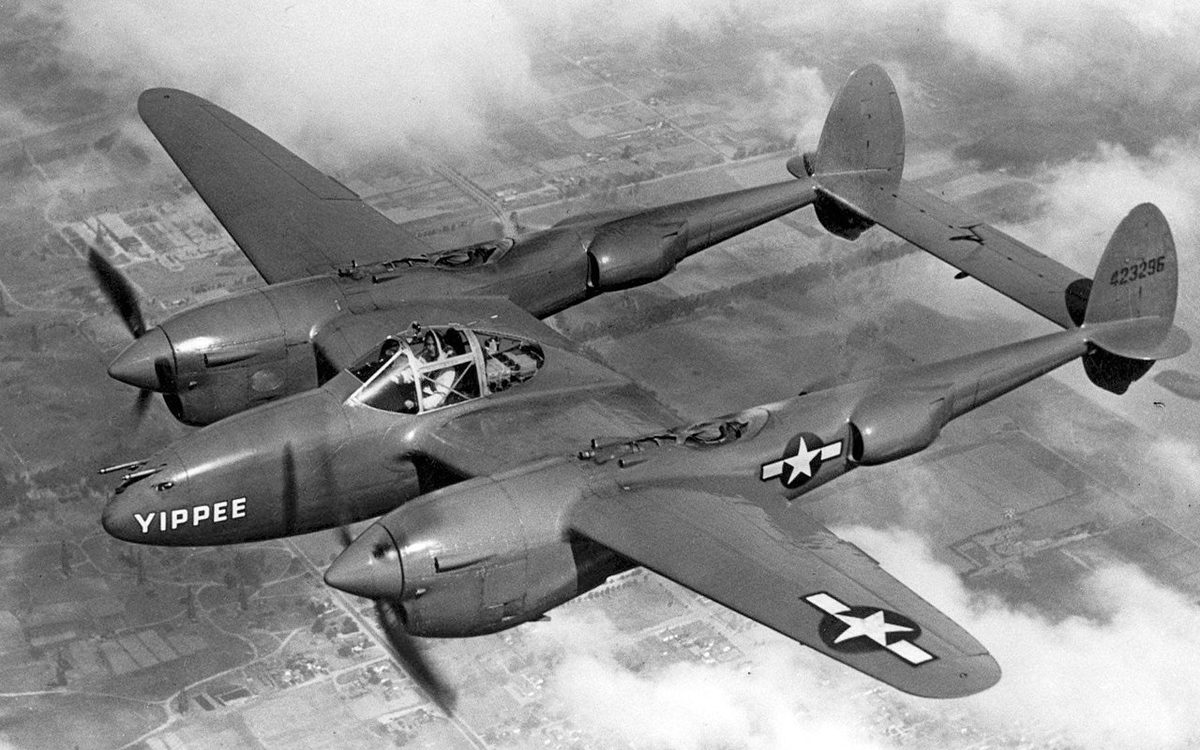
P-38 Lightning fighter aircraft in flight showing its distinctive twin-boom twin-engine design
Daniel Mercer
Daniel Mercer

Military History Editor

Daniel Mercer writes about military history with a focus on the 20th century, including World War II, the Cold War, and Vietnam. His work looks at how decisions made decades ago still influence doctrine, planning, and assumptions today.

When Lockheed engineer Clarence "Kelly" Johnson drew up the P-38 in 1937, he produced one of the most radical fighter designs in aviation history. The U.S. Army Air Corps wanted a high-altitude interceptor that could reach 360 mph and climb to 20,000 feet in six minutes, performance requirements that no existing single-engine design could meet. Johnson's solution was to put two engines on a central nacelle, extend them rearward into twin booms carrying the tail assembly, and concentrate all the armament in the nose. The result was an aircraft that looked like nothing else in the sky and flew like nothing else either. The P-38 Lightning would become one of the most important American fighters of World War II, the only fighter in production on December 7, 1941 that was still in production on V-J Day.

Kelly Johnson's Radical Design

The twin-boom layout was not merely aesthetic. It solved several engineering problems simultaneously. Two Allison V-1710 liquid-cooled engines provided the power needed for high-altitude performance, and placing them in nacelles on the wing, rather than in a conventional fuselage, freed the central pod for the pilot and, critically, for armament. Unlike every other American fighter of the era, the P-38's guns were concentrated in the nose rather than spread across the wings.

This nose-mounted arrangement was a significant tactical advantage. Wing-mounted guns on fighters like the P-47 Thunderbolt and P-51 Mustang had to be harmonized, angled inward so their fire converged at a set range, typically 250 to 300 yards. At any other range, the bullets diverged and accuracy suffered. The P-38's nose guns fired in a parallel stream directly ahead of the aircraft. Whether the target was at 100 yards or 500 yards, the bullets hit where the pilot aimed. This made the P-38 a devastatingly accurate gun platform.

The standard armament was one Hispano AN/M2 20mm cannon and four Browning M2 .50-caliber machine guns, all grouped tightly in the nose. The combined weight of fire, one explosive cannon shell and four heavy machine gun rounds converging on the same point, could destroy any aircraft with a short burst. Pilots who flew the P-38 consistently remarked on how easy it was to hit targets compared to fighters with wing-mounted guns.

Johnson also incorporated features that were uncommon for the era: tricycle landing gear (giving the pilot better ground visibility and easier handling on the ground), counter-rotating propellers (which eliminated torque effects that made single-engine fighters tricky on takeoff), and turbo-supercharged engines that maintained performance at high altitudes where naturally aspirated engines lost power.

Performance

The P-38 was fast. The definitive P-38J and P-38L models could reach approximately 414 mph at 25,000 feet, competitive with the best single-engine fighters of the period. But speed was not the Lightning's greatest asset. Its combination of range, climb rate, and high-altitude performance made it uniquely capable for missions that no other American fighter could perform.

Range was the P-38's trump card, particularly in the Pacific Theater. With internal fuel and drop tanks, the P-38 could fly combat missions exceeding 1,100 miles, far beyond what the P-47 or P-51 could manage in the early war years. In the vast distances of the Pacific, where targets and airfields were separated by hundreds of miles of open ocean, this range was not a luxury. It was a survival requirement. A fighter that could not reach the target area, fight, and return was useless. The P-38 could.

The aircraft's service ceiling exceeded 44,000 feet, and its turbocharged Allison engines, unlike the mechanically supercharged Merlins in the P-51, maintained their rated power at extreme altitudes. This made the P-38 an effective high-altitude interceptor, though its primary combat role evolved toward long-range escort and ground attack as the war progressed.

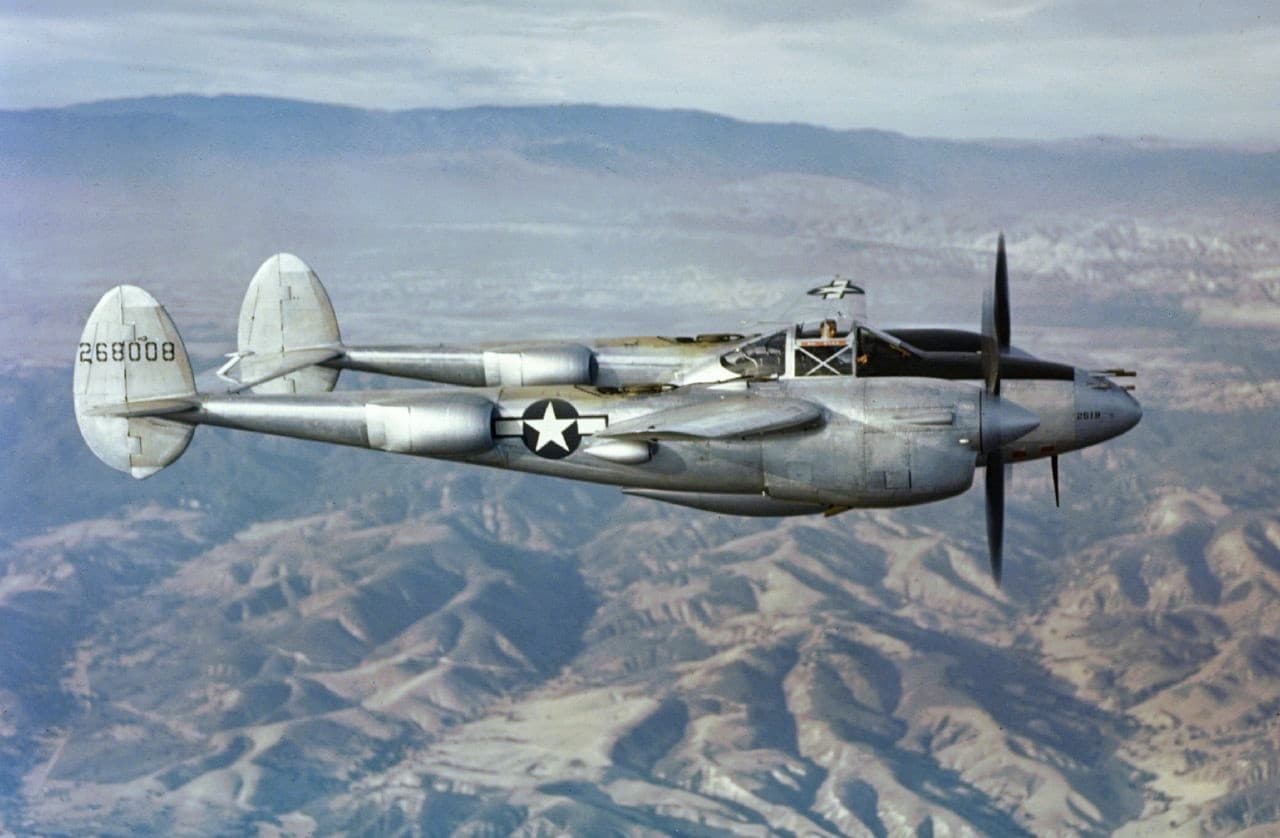
P-38 Lightning in flight during World War II showing the distinctive twin-boom silhouette and counter-rotating propellers
The P-38 Lightning's twin-boom design was immediately recognizable, and unmistakable from the ground. The Luftwaffe named it "the Fork-Tailed Devil" because of this distinctive silhouette. (U.S. Army Air Forces)

The Pacific: Where the P-38 Dominated

The P-38 found its natural environment in the Pacific Theater. The war against Japan was fought across enormous distances, with island chains separated by thousands of miles of ocean and airfields often primitive and widely dispersed. The P-38's long range, twin-engine reliability over water, and heavy firepower made it the premier American fighter in the Pacific from 1942 through 1945.

America's two highest-scoring aces of World War II both flew P-38s exclusively. Major Richard Bong scored 40 confirmed aerial victories in the Southwest Pacific, making him the top American ace of all time, a record that still stands. Major Thomas McGuire scored 38 victories, the second-highest total for any American pilot. Both flew with the 5th Air Force under General George Kenney, who recognized the P-38's potential and employed it aggressively against Japanese air power.

Bong's combat technique illustrated the P-38's strengths. He rarely engaged in extended turning dogfights, since the P-38's large size and wing loading made it less maneuverable than the lighter Japanese fighters it faced. Instead, Bong used the Lightning's speed and climb rate to execute diving attacks from altitude, using the concentrated nose armament to destroy targets in a single firing pass before zooming back up to altitude. This boom-and-zoom tactic leveraged every advantage the P-38 offered and negated the Japanese fighters' superior agility.

The twin-engine configuration also provided a psychological comfort factor for pilots flying long overwater missions. If one engine failed, the P-38 could still fly on the other, a critical advantage when the alternative was ditching in shark-infested waters hundreds of miles from the nearest friendly base. Several P-38 pilots survived engine failures over the Pacific that would have been fatal in a single-engine fighter.

The Yamamoto Mission

The P-38 carried out what is arguably the most famous targeted aerial mission in military history. On April 18, 1943, eighteen P-38G Lightnings from the 339th Fighter Squadron flew a precisely timed intercept mission over Bougainville Island to shoot down Admiral Isoroku Yamamoto, the architect of the Pearl Harbor attack and commander of the Japanese Combined Fleet.

American codebreakers had intercepted and decoded a message detailing Yamamoto's inspection tour itinerary, including his exact arrival time at Bougainville. The mission required the P-38s to fly over 400 miles at extreme low altitude, wave-top height to avoid radar detection, navigating entirely by compass and clock over open ocean, arriving at exactly the right place and time to intercept Yamamoto's transport aircraft.

The mission succeeded. The P-38s intercepted two Mitsubishi G4M "Betty" bombers carrying Yamamoto and his staff, escorted by six Zero fighters. Lieutenant Rex Barber and Captain Thomas Lanphier engaged the bombers, sending Yamamoto's aircraft crashing into the jungle. The admiral was killed. It was the longest fighter intercept mission of the war at the time, and only the P-38 had the range to fly it.

The European Theater: A More Complicated Story

The P-38's record in Europe was more mixed. The aircraft arrived in the Mediterranean and European theaters in late 1942 and fought throughout the North African, Italian, and Western European campaigns. It served effectively as a fighter-bomber, using its heavy armament and ability to carry bombs and rockets for ground attack missions. The P-38 also flew long-range escort missions deep into German-held territory before the P-51 Mustang took over that role in 1944.

But the European environment exposed the P-38's weaknesses. At high altitude in the cold air over northern Europe, the Allison engines suffered from reliability problems, coolant leaks, supercharger failures, and issues with fuel distribution that could cause engines to quit without warning. The cockpit was notoriously cold, with inadequate heating that left pilots shivering at altitude. And the aircraft's size made it less maneuverable in the turning fights that European air combat often demanded, particularly against the agile Bf 109 and Fw 190.

The most serious problem was compressibility. In high-speed dives, the P-38 could approach the speed of sound locally over its wing surfaces, causing shock waves that locked the flight controls and made it impossible for the pilot to pull out. Several P-38 pilots died in compressibility-related dive accidents before Lockheed developed dive recovery flaps, small surfaces under the wings that disrupted the shock wave and restored control authority. These were incorporated into the P-38J-25 and all subsequent variants, largely solving the problem.

Despite these issues, the P-38 remained an effective multi-role platform in Europe. Its ability to carry heavy bomb loads, up to 4,000 pounds on later variants, made it a potent ground attack aircraft. And its distinctive twin-boom silhouette was so recognizable that it was one of the few Allied fighters that friendly ground troops could reliably identify, reducing the risk of friendly fire incidents during close air support missions.

Reconnaissance: The Unarmed Lightning

One of the P-38's most important, and least celebrated, roles was photographic reconnaissance. The F-5 variant replaced the nose armament with cameras, and the aircraft's speed, range, and high-altitude performance made it an ideal reconnaissance platform. F-5 Lightnings photographed targets across every theater of the war, providing the intelligence that shaped bombing campaigns and invasion plans.

Antoine de Saint-Exupéry, the French author of The Little Prince, flew F-5 reconnaissance missions over southern France with the Free French Air Force. He disappeared on July 31, 1944, during a reconnaissance flight from Corsica, his aircraft was never found during the war. Wreckage identified as his P-38 was recovered from the Mediterranean Sea in 2003.

Production and Variants

Lockheed produced 10,037 P-38s across all variants, from the initial P-38 through the definitive P-38L. The aircraft was built at Lockheed's Burbank, California plant, with a second production line at a Lockheed-operated government facility in Nashville. Major production variants included the P-38F (first fully combat-capable model), P-38G, P-38H (improved engines), P-38J (redesigned engine nacelles with chin-mounted intercoolers, increased fuel capacity), and P-38L (the most-produced variant, with 3,923 built).

A two-seat night fighter variant, the P-38M, was produced in small numbers late in the war. It carried an AN/APS-6 radar in a pod under the nose and a radar operator in a raised seat behind the pilot. Only a handful saw combat before the war ended.

Legacy

The P-38 Lightning occupies a unique place in World War II aviation history. It was not the best dogfighter, the P-51 Mustang and Spitfire hold those claims. It was not the toughest, the P-47 Thunderbolt could absorb punishment that would have destroyed a P-38. But no other fighter combined long range, heavy firepower, versatility, and high-altitude performance the way the Lightning did.

In the Pacific, it was simply the best American fighter available for much of the war, the aircraft that Bong and McGuire rode to the top of the scoring lists, and the only fighter that could reach Yamamoto over Bougainville. In Europe, it was a workhorse that fought through adversity and adapted to roles its designers never imagined. And across both theaters, the F-5 reconnaissance variant provided the eyes that let Allied commanders see the battlefield.

Kelly Johnson went on to found Lockheed's legendary Skunk Works, producing the U-2, SR-71 Blackbird, and F-117 stealth fighter. But the P-38 was where it all started, a radical design that broke the rules and proved that unconventional thinking could produce extraordinary results. The Fork-Tailed Devil earned its name through performance, not reputation, and it remains one of the most distinctive and effective fighters ever built.

Share this article

Share:

Recommended

Ace of The Skies: Can You Identify These Military Aircraft Throughout The Years?
Test Yourself

Ace of The Skies: Can You Identify These Military Aircraft Throughout The Years?

Can you identify these aircraft?

Take the Quiz

On This Day in Military History

March 16

The My Lai Massacre (1968)

American soldiers of Charlie Company, 1st Battalion, 20th Infantry Regiment murdered between 347 and 504 unarmed Vietnamese civilians, including women, children, and elderly, in the hamlet of My Lai. The massacre was stopped only when helicopter pilot Warrant Officer Hugh Thompson Jr. landed between the soldiers and surviving villagers. The atrocity was covered up for over a year and became the defining symbol of the moral costs of the Vietnam War.

1802, United States Military Academy Established at West Point

1935, Hitler Announces German Rearmament, Violating the Treaty of Versailles

1926, Robert Goddard Launches the World's First Liquid-Fueled Rocket

See all 10 events on March 16

Get Military News & History in Your Inbox

Join thousands of readers receiving our weekly digest of military technology, history, and analysis.

Test Your Knowledge