Skip to content
April 29:Liberation of Dachau Concentration Camp81yr ago

The P-47 Thunderbolt: The Juggernaut of WWII

Daniel Mercer · · 13 min read
Save
Share:
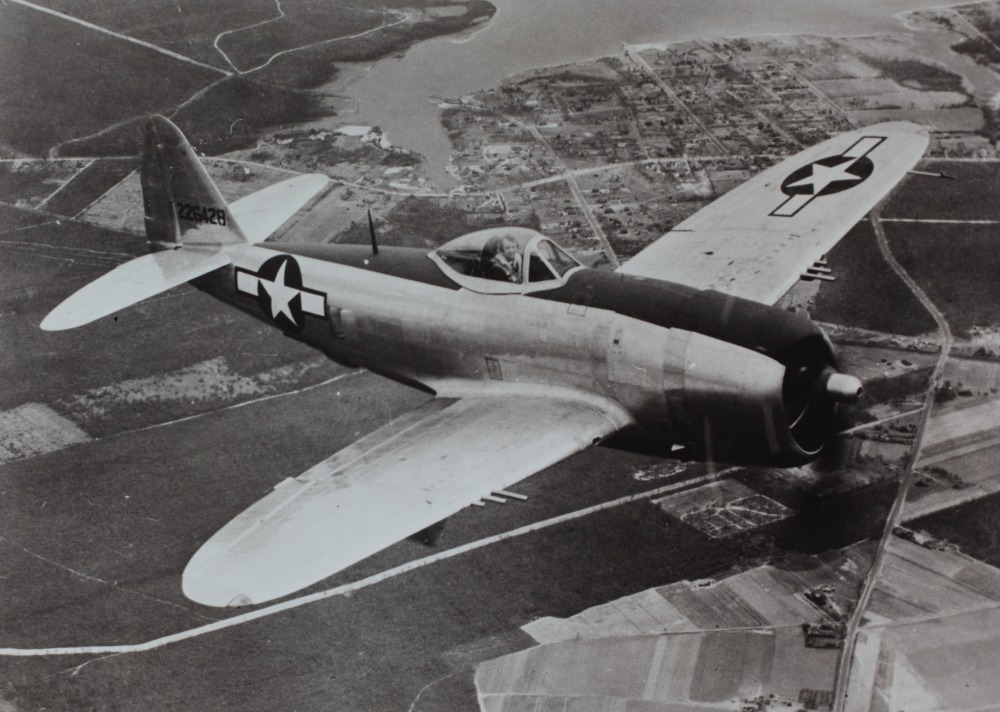
P-47 Thunderbolt fighter aircraft in flight showing its massive radial engine cowling and distinctive profile
Daniel Mercer
Daniel Mercer

Military History Editor

Daniel Mercer writes about military history with a focus on the 20th century, including World War II, the Cold War, and Vietnam. His work looks at how decisions made decades ago still influence doctrine, planning, and assumptions today.

Republic Aviation's P-47 Thunderbolt was not a graceful aircraft. It was enormous, the heaviest single-engine fighter to see combat in World War II, weighing over 17,500 pounds fully loaded. It was fat, with a barrel-shaped fuselage wrapped around a massive Pratt & Whitney R-2800 Double Wasp radial engine and its elaborate turbocharger ducting. Pilots who transitioned from sleek Spitfires or nimble P-40s took one look at the P-47 and wondered how it could possibly fight. Then they flew it, and they understood. The Thunderbolt could dive faster than anything in the sky, absorb punishment that would have destroyed any other fighter, and deliver a weight of fire that tore targets apart. It was a blunt instrument, but it was the most effective blunt instrument the Army Air Forces ever built.

Why the Jug Was So Big

The P-47's size was not an accident of poor design, it was the inevitable consequence of the requirements it was built to meet. The Army Air Forces wanted a fighter that could perform at high altitude, and high-altitude performance required a turbosupercharger. Designer Alexander Kartveli, a Georgian-born aeronautical engineer at Republic Aviation, chose the General Electric turbocharger, a system that used exhaust gases from the engine to spin a turbine, which compressed intake air to maintain engine power at altitude.

The problem was the plumbing. The turbocharger was mounted in the rear fuselage, behind the cockpit. Exhaust gases from the R-2800 engine in the nose had to be ducted back through the entire length of the aircraft to reach the turbocharger, and compressed air had to be piped forward to the engine's carburetor. This elaborate ducting, plus the turbocharger itself, plus the intercooler required to prevent the compressed air from overheating, all had to fit inside the fuselage. The result was an aircraft with an enormous fuselage, roughly the diameter of a medium bomber.

But the turbocharger worked brilliantly. At 30,000 feet, where naturally aspirated engines gasped for thin air, the P-47's R-2800 still produced 2,000 horsepower. The Thunderbolt was one of the fastest aircraft at high altitude, and its performance barely degraded as it climbed, a critical advantage in the high-altitude air war over Europe.

Eight Guns and a Lot of Ammunition

The P-47 carried eight Browning M2 .50-caliber machine guns, four in each wing, with a total of 3,400 rounds of ammunition. This was the heaviest gun battery of any single-engine fighter in the war. A one-second burst from all eight guns sent approximately 120 rounds downrange, creating a wall of metal that could shred an enemy aircraft, tear apart a locomotive, or disable a tank.

The .50-caliber Browning was not the most powerful aircraft weapon of the war, the German MK 108 30mm cannon or the British Hispano 20mm were more destructive per round. But the M2's combination of range, accuracy, rate of fire, and ammunition capacity made eight of them devastatingly effective in practice. P-47 pilots had enough ammunition for extended engagements without worrying about running dry, and the M2's flat trajectory made accurate shooting possible at ranges where cannons had already lost their effectiveness.

For ground attack, the P-47 added external stores: up to 2,500 pounds of bombs (two 1,000-pound bombs and one 500-pound bomb, or three 500-pound bombs) and ten 5-inch HVAR rockets. Combined with the eight machine guns, this made the Thunderbolt one of the most lethal ground attack platforms of the war.

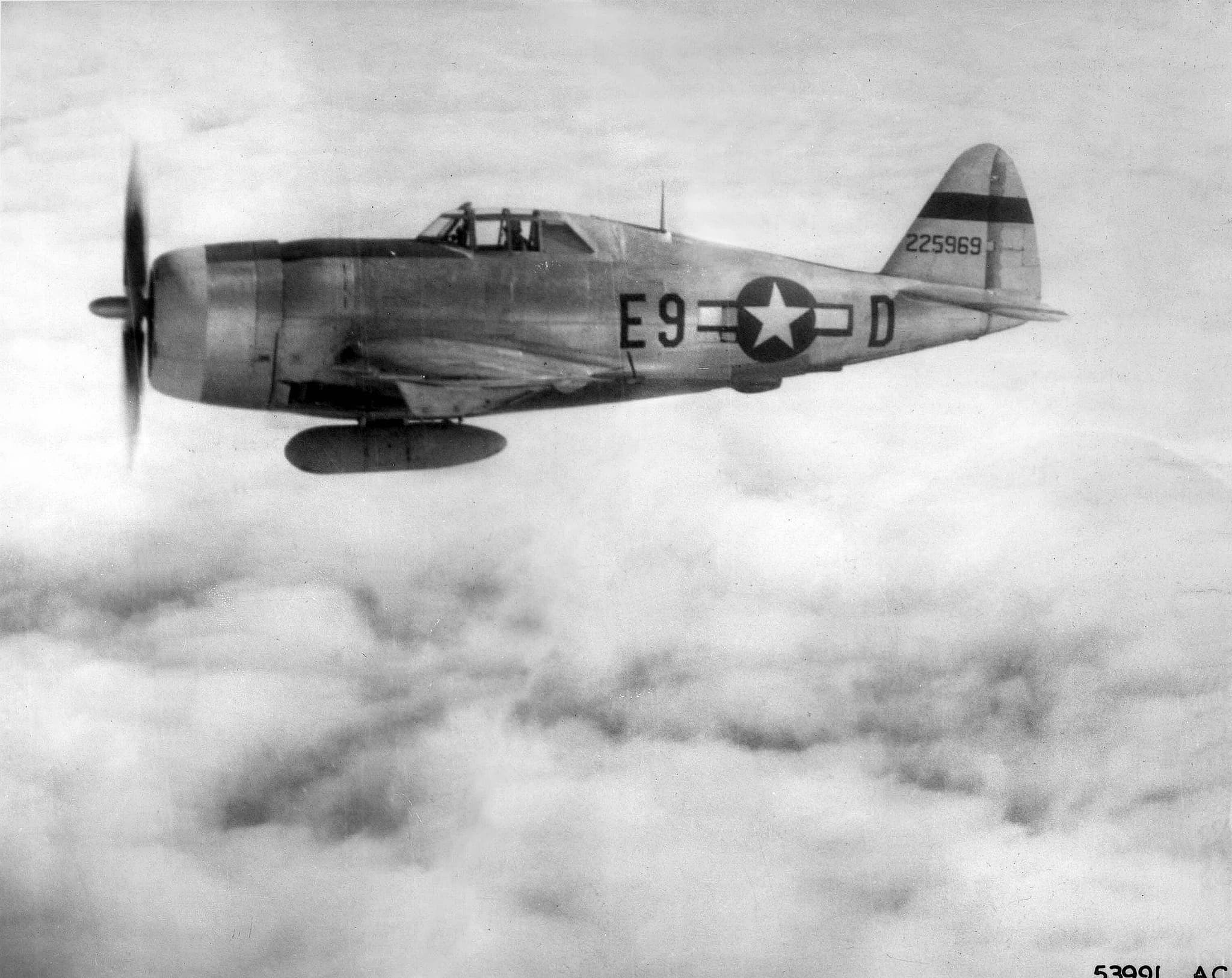
P-47 Thunderbolt in flight showing its massive profile and eight-gun wing armament during World War II
The P-47's massive profile earned it the nickname "Jug", short for Juggernaut. Its enormous R-2800 engine and elaborate turbocharger system created a fighter that was heavy but devastatingly fast in a dive. (U.S. Army Air Forces)

The Toughest Fighter in the Sky

The P-47's greatest advantage over its contemporaries was its ability to survive damage that would have destroyed any other fighter. The air-cooled radial engine was the key. Liquid-cooled engines like the Merlin (P-51, Spitfire) and Allison (P-38, P-40) were excellent performers, but a single bullet through a coolant line would cause the engine to overheat and seize within minutes. The R-2800's air-cooled cylinders had no coolant to leak. Individual cylinders could be shot away, and the engine would keep running on the remaining ones.

The stories of P-47 toughness became legendary. Thunderbolts returned to base with cylinders shot off the engine, entire wing panels missing, control surfaces shredded, and fuselages riddled with holes. Robert S. Johnson, the second-ranking American ace in Europe with 27 victories, was attacked by an Fw 190 whose pilot, apparently frustrated that the P-47 would not go down, actually flew alongside and stared at the damage in apparent disbelief before breaking away. Johnson's P-47 was so badly damaged that the gun charging handles had been shot away and the canopy was jammed shut by warped metal, but the aircraft flew home.

This ruggedness was not just reassuring for pilots, it had tactical implications. A fighter that could survive battle damage was a fighter that came back to fight again. Attrition, not any single engagement, determined who won the air war. The P-47's survival rate meant the Army Air Forces kept more trained pilots and more aircraft in the fight over time.

From Escort to Ground Attack

The P-47 initially served as the primary escort fighter for Eighth Air Force bomber formations over Europe. The 56th Fighter Group, known as "Zemke's Wolfpack" after its commander, Colonel Hubert Zemke, became one of the most successful fighter units of the war, producing aces like Johnson, Francis "Gabby" Gabreski (28 victories, top American ace in Europe), and Walker Mahurin.

But the P-47's limited range, even with drop tanks, it could not escort bombers to the deepest targets in Germany, led to its gradual replacement in the escort role by the longer-ranged P-51 Mustang beginning in early 1944. Rather than being retired, the Thunderbolt was redirected to the role where it truly excelled: ground attack.

The P-47 proved devastating in the close air support and interdiction roles. Its combination of heavy firepower, bomb-carrying capacity, rocket armament, and resistance to ground fire made it the most effective tactical fighter-bomber on the Western Front. Thunderbolts destroyed thousands of German vehicles, locomotives, rail cars, and defensive positions during the Normandy campaign and the subsequent advance across France and into Germany.

The IX Tactical Air Command, equipped primarily with P-47s, provided the close air support that accompanied Patton's Third Army across France. German soldiers learned to fear the distinctive silhouette of the Thunderbolt, which seemed to appear over every road, bridge, and rail junction at the worst possible moments. The P-47's ruggedness was particularly valuable in the ground attack role, light flak and small arms fire that would have forced other fighters to break off merely dented the Thunderbolt's thick hide.

Production and Variants

Republic Aviation produced 15,686 P-47s, making it the most-produced American fighter of World War II. The early P-47B and C models had the distinctive "razorback" fuselage, with a high spine behind the cockpit that limited rearward visibility. From the P-47D-25 onward, Republic switched to a bubble canopy that provided 360-degree visibility, a critical improvement for both air combat and ground attack awareness.

The final production variant, the P-47N, was specifically designed for the Pacific Theater. It featured a larger wing with squared-off tips, increased internal fuel capacity, and provisions for additional external tanks, extending its range to over 2,000 miles. The P-47N arrived in the Pacific too late to see extensive combat, but it demonstrated that the Thunderbolt's basic design could be adapted for long-range operations.

Legacy

The P-47 Thunderbolt was not the most glamorous American fighter of World War II, that distinction belongs to the P-51 Mustang. It was not the most innovative, the P-38 Lightning holds that claim. But the Thunderbolt was arguably the most practically useful fighter the Army Air Forces fielded. It could fight at altitude, attack targets on the ground, survive damage that would destroy any competitor, and carry a weapons load that rivaled dedicated attack aircraft.

Republic Aviation's lineage continued through the Cold War: the F-84 Thunderjet, F-84F Thunderstreak, and the massive F-105 Thunderchief, which earned its own "Thud" nickname in Vietnam, all carried the company's tradition of building big, tough, heavily armed aircraft. The philosophy that Alexander Kartveli built into the P-47, that a fighter should be able to give and take punishment in equal measure, defined Republic's identity for decades.

The Jug earned its nickname honestly. It was not elegant or refined. It was a juggernaut, a 17,500-pound hammer that the Army Air Forces brought down on the Axis powers from 30,000 feet to treetop level. More P-47s were built than any other American fighter, and the pilots who flew them trusted the Thunderbolt with something no specification sheet can measure: their lives.

Share this article

Share:

Recommended

Ace of The Skies: Can You Identify These Military Aircraft Throughout The Years?
Test Yourself

Ace of The Skies: Can You Identify These Military Aircraft Throughout The Years?

Can you identify these aircraft?

Take the Quiz

On This Day in Military History

March 20

Napoleon Returns to Paris, The Hundred Days Begin (1815)

After escaping exile on the island of Elba, Napoleon Bonaparte entered Paris with a growing army as King Louis XVIII fled the city. Marshal Ney, sent to arrest Napoleon, had instead joined him with 6,000 men. Napoleon's return marked the beginning of the "Hundred Days," during which he reconstituted the French Empire before his final defeat at the Battle of Waterloo on June 18, 1815. The return triggered the War of the Seventh Coalition, in which Austria, Prussia, Russia, and Britain each pledged 150,000 troops to end the Napoleonic era.

1922, USS Langley Commissioned, America's First Aircraft Carrier

1943, Battle of the Mareth Line Begins in Tunisia

1995, Tokyo Subway Sarin Attack

See all 10 events on March 20

Get Military News & History in Your Inbox

Join thousands of readers receiving our weekly digest of military technology, history, and analysis.

Test Your Knowledge