Skip to content
April 19:Battles of Lexington and Concord251yr ago

The B-17 Flying Fortress: The Bomber That Could Take the Punishment

Daniel Mercer · · 14 min read
Save
Share:
B-17 Flying Fortress heavy bomber in flight showing its distinctive profile and defensive gun turrets
Daniel Mercer
Daniel Mercer

Military History Editor

Daniel Mercer writes about military history with a focus on the 20th century, including World War II, the Cold War, and Vietnam. His work looks at how decisions made decades ago still influence doctrine, planning, and assumptions today.

The Boeing B-17 Flying Fortress earned its name the old-fashioned way: by refusing to die. No other aircraft of World War II compiled a survival record as extraordinary as the B-17. Fortresses returned to English bases with entire sections of tail shot away. They returned with three of four engines dead. They returned with landing gear blown off, bomb bay doors jammed open, and so many flak holes that ground crews could see daylight through the fuselage. One famous B-17G returned from a mission over Germany with the entire nose section blown away by a direct flak hit — the bombardier and navigator killed instantly — while the pilot flew the open-fronted aircraft 300 miles back to England and landed it. The B-17 was the aircraft that American bomber crews trusted with their lives, and time after time, it justified that trust.

The First Flying Fortress

The B-17 was born from a 1934 Army Air Corps competition for a multi-engine bomber. Most manufacturers interpreted "multi-engine" as meaning two engines. Boeing's design team, led by E. Gifford Emery and Edward Curtis Wells, gambled on four engines — a configuration that provided not only greater power and range but also the redundancy to survive the loss of one or even two engines. The Model 299 prototype first flew on July 28, 1935, and impressed observers with its size, speed, and the unprecedented number of defensive gun positions that bristled from its fuselage. A reporter for the Seattle Daily Times described it as a "flying fortress" — and Boeing, recognizing the marketing value, trademarked the name.

The B-17's development was not without setbacks. The Model 299 prototype crashed on October 30, 1935, when a crew member failed to release the gust locks on the control surfaces before takeoff. The crash nearly killed the program — the Army ordered the Douglas B-18 Bolo instead. But a small number of B-17s were ordered for service testing, and their performance eventually won over skeptics. By the time the United States entered World War II, the B-17 was in production and the Eighth Air Force was being organized around it.

The Defensive Fortress
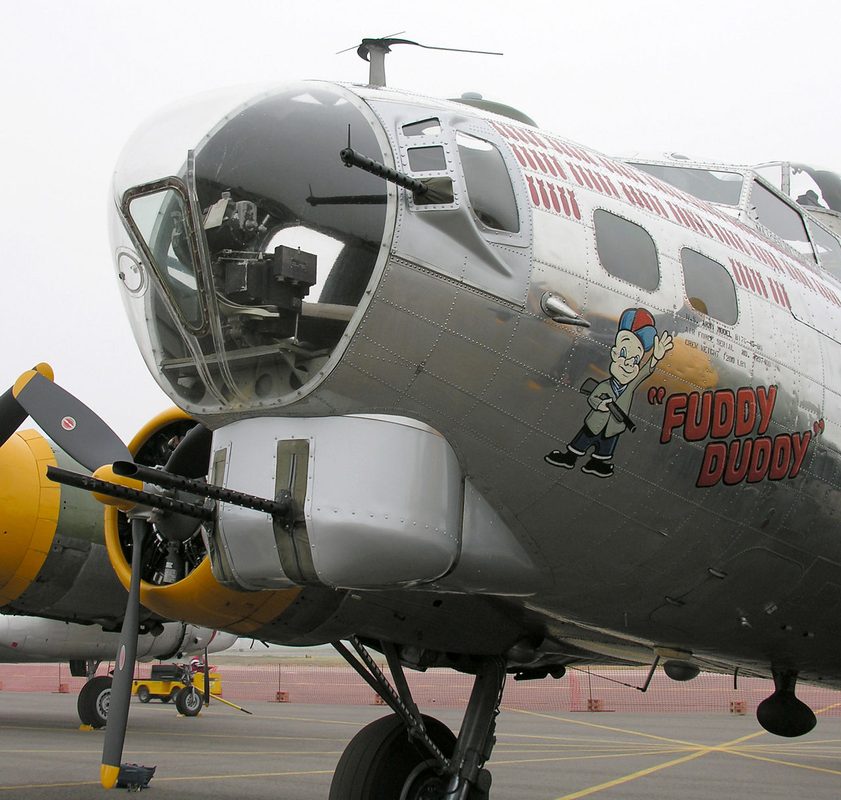
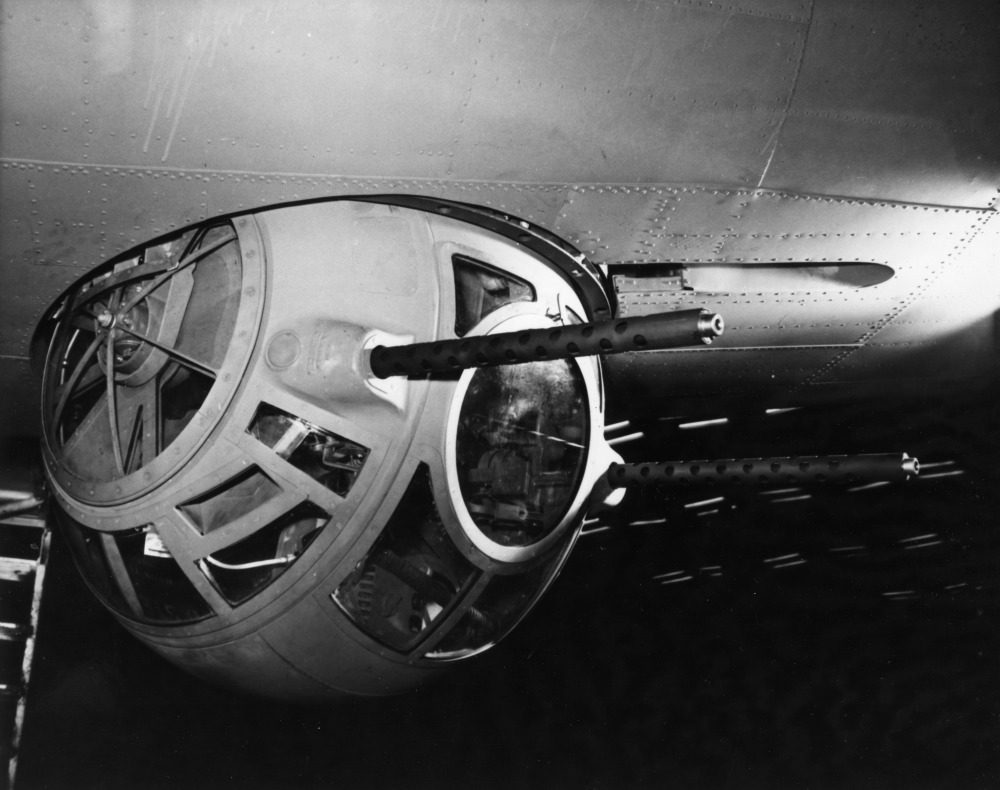
B-17G nose showing the chin turret with twin .50 caliber machine guns
B-17G nose section showing the Bendix chin turret — the defining feature of the G variant. (USAAF photo via Wikimedia Commons)

The B-17's defensive armament evolved dramatically through the war. Early models — the B-17C and D — carried five .50-caliber and one .30-caliber machine guns in manually operated positions, with significant blind spots that German fighter pilots quickly exploited. The B-17E, which entered production in 1941, added a tail gun position and a Sperry ball turret under the belly — addressing the two most dangerous attack angles. The definitive B-17G, which comprised the majority of production, carried thirteen .50-caliber machine guns: twin guns in the chin turret, top turret, ball turret, and tail position, plus single guns in each waist position and each cheek position.

The name "Flying Fortress" implied that a formation of B-17s could defend itself against fighter attack through the concentrated firepower of its many gun positions. The doctrine of self-defending bomber formations was central to the Army Air Forces' daylight bombing strategy — the belief that tight formations of heavily armed bombers could fight their way to targets without fighter escort. The logic seemed sound: a combat box of 18-21 B-17s could bring over 200 .50-caliber machine guns to bear against attacking fighters from virtually any angle.

The reality was brutally different. German fighter pilots quickly developed tactics that exploited the limitations of the B-17's defensive armament. Head-on attacks — approaching the bomber from directly in front — were particularly effective. The closing speed was so high that the bomber gunners had only a few seconds to track and fire, while the fighters' forward-firing cannon and machine guns were concentrated in a devastating cone of fire. The Fw 190 and Bf 109 pilots who specialized in head-on attacks destroyed B-17s by the score.

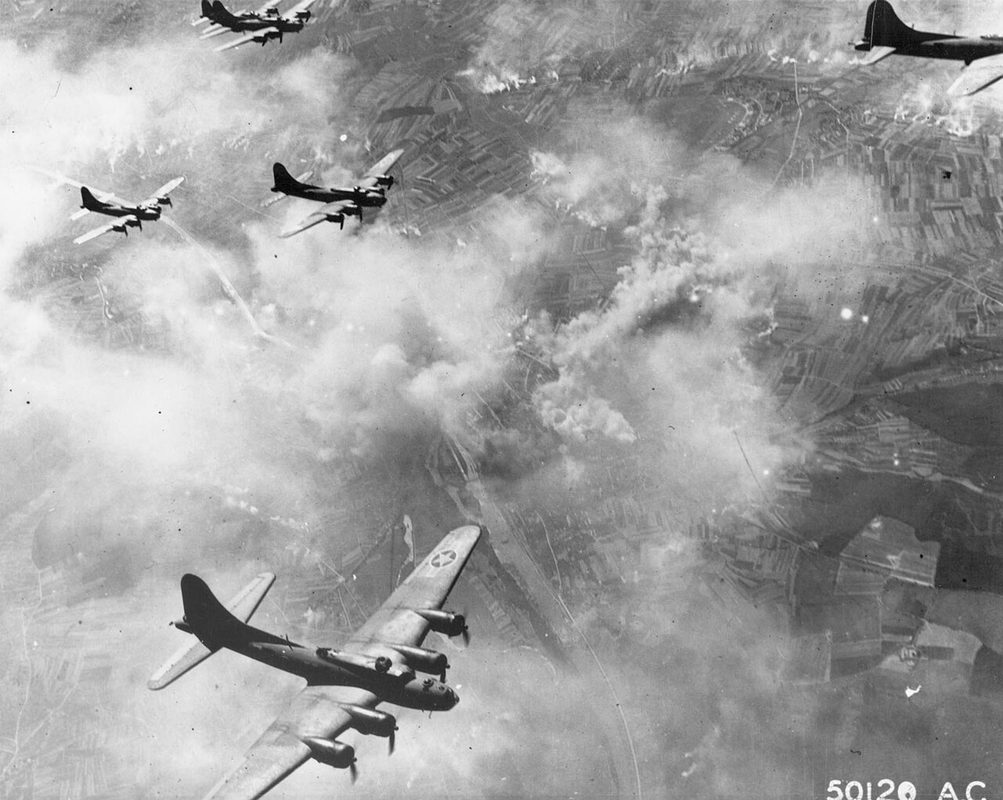
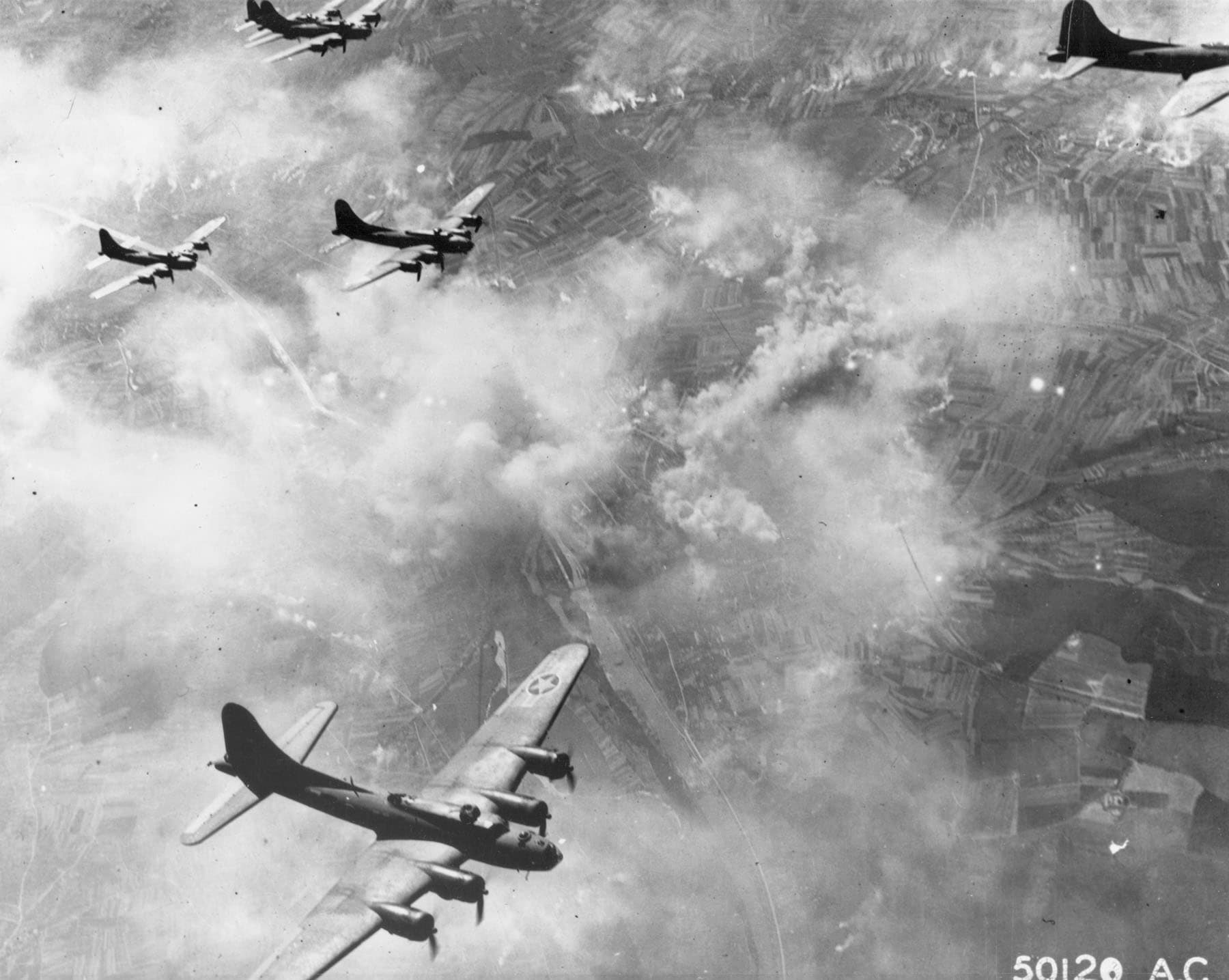
B-17 Flying Fortress bombers in combat box formation over Germany during WWII
B-17 Flying Fortresses in combat box formation — the tight defensive grouping designed to concentrate firepower against fighter attack. (USAAF photo via Wikimedia Commons)

Schweinfurt-Regensburg: The Crucible

The doctrine of the self-defending bomber was tested to destruction on August 17, 1943, when the Eighth Air Force launched 376 B-17s in a double strike against ball bearing factories at Schweinfurt and the Messerschmitt factory at Regensburg. The mission — one of the deepest penetrations into Germany attempted to that date — exceeded the range of available Allied fighters, leaving the bombers unescorted for the most dangerous portion of the mission.

The German fighter force responded with devastating effectiveness. The Schweinfurt force lost 36 B-17s out of 230 — a 15.6% loss rate. The Regensburg force lost 24 out of 146. Total losses for the day: 60 B-17s and approximately 600 aircrew killed, captured, or missing. Dozens more aircraft returned so badly damaged they were written off. The loss rate was unsustainable. If every mission cost 15% of the force, the Eighth Air Force would be destroyed in seven missions.

A second strike on Schweinfurt on October 14, 1943 — "Black Thursday" — cost another 60 B-17s out of 291 dispatched (20.6% loss rate) and forced the Eighth Air Force to temporarily suspend deep penetration missions into Germany. The doctrine of the self-defending bomber had been decisively disproved. The B-17 formations could not survive sustained fighter opposition without escort. The solution — long-range P-51 Mustang escorts — arrived in early 1944 and transformed the air war.

The Toughest Airplane Ever Built

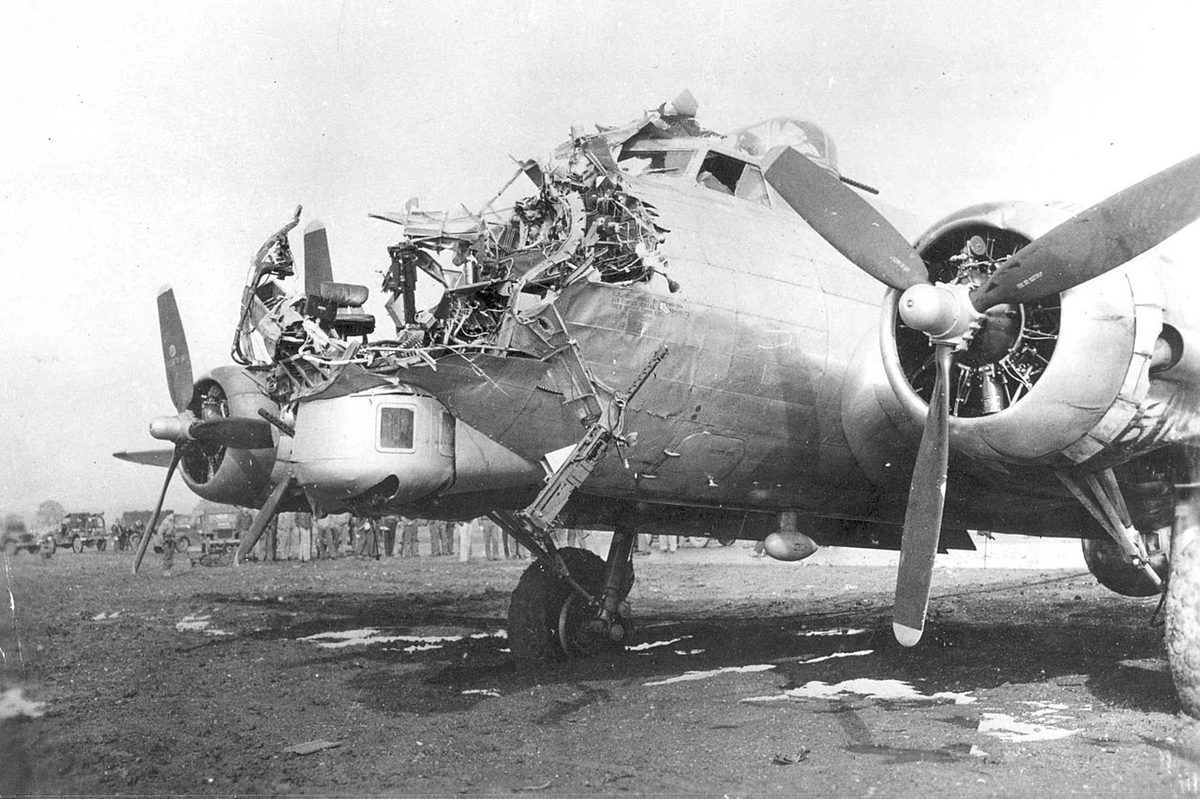
B-17 bomber with severe battle damage to the nose and fuselage demonstrating its legendary toughness
A battle-damaged B-17 that made it home — damage that would have destroyed lesser aircraft. (USAAF photo via Wikimedia Commons)

What the B-17 could survive was extraordinary. The aircraft's construction — a combination of aluminum alloy skin over a framework of aluminum spars, ribs, and stringers — proved remarkably resilient to battle damage. Unlike the Lancaster, which had a single main spar in each wing (if the spar was cut, the wing failed), the B-17's wing used multiple spars and stringers that distributed loads across the structure. Damage that would cause structural failure in other aircraft was absorbed and distributed by the B-17's redundant structure.

The survival stories are legendary. "All American," a B-17F of the 97th Bomb Group, was nearly cut in half by a collision with an Bf 109 over Tunis in February 1943. The German fighter struck the B-17's tail section, severing everything except a narrow strip of skin and the tail control cables. The tail gunner could see open sky through the gap. The aircraft held together, and pilot Lieutenant Kendrick Bragg flew it back to base and landed it. The tail section separated from the fuselage on rollout.

"Ye Olde Pub," a B-17F piloted by Lieutenant Charlie Brown, was so badly damaged over Bremen in December 1943 that a German Bf 109 pilot — Franz Stigler — pulled alongside, saw the carnage inside the aircraft, and chose not to fire. The tail gunner was dead, the other gunners wounded, and the aircraft was so shot up that Stigler later said he couldn't believe it was still flying. Brown brought the aircraft back to England. The story of Brown and Stigler — who became friends decades later — became one of the most remarkable tales of the air war.

The Norden Bombsight

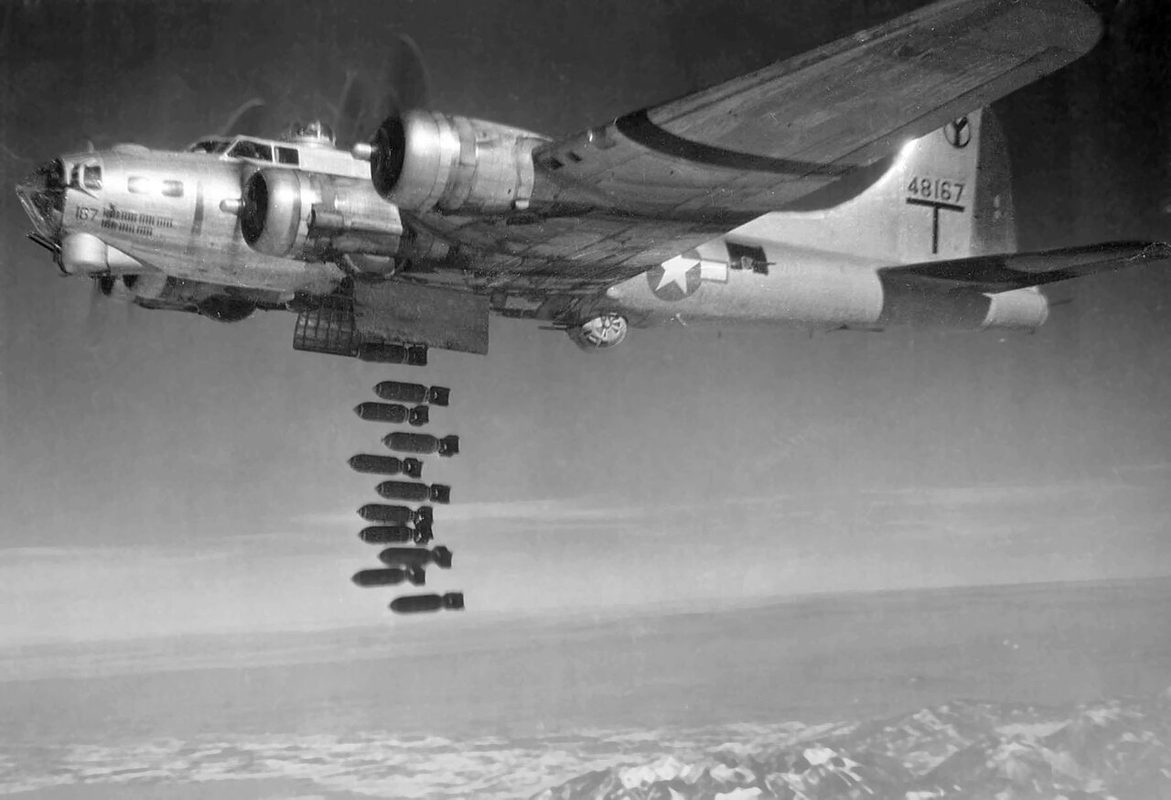
B-17G releasing bombs from its open bomb bay over a target
B-17G releasing its bomb load over a target in Germany. (USAAF photo via Wikimedia Commons)

The B-17's bombing accuracy was supposed to be its decisive advantage. The Norden bombsight — a sophisticated analog computer that calculated bomb release points based on altitude, airspeed, wind conditions, and the bombsight's own gyroscopic stabilization — was the most closely guarded secret in the American military. Bombardiers took an oath to defend the bombsight with their lives, and every Norden sight was equipped with a small thermite charge that would destroy it if the aircraft was shot down over enemy territory.

In theory, the Norden bombsight could place a bomb in a 100-foot circle from 20,000 feet. In practice, accuracy was far worse. Cloud cover, haze, smoke from burning targets, evasive maneuvering to avoid flak, and the stress of combat all degraded bombing accuracy. A study of Eighth Air Force bombing results found that only about 20% of bombs fell within 1,000 feet of the aiming point — a far cry from the "pickle barrel" precision the Norden was supposed to deliver. The gap between theoretical and actual accuracy meant that the daylight precision bombing campaign often produced results not dramatically different from the RAF's nighttime area bombing.

The Men Inside

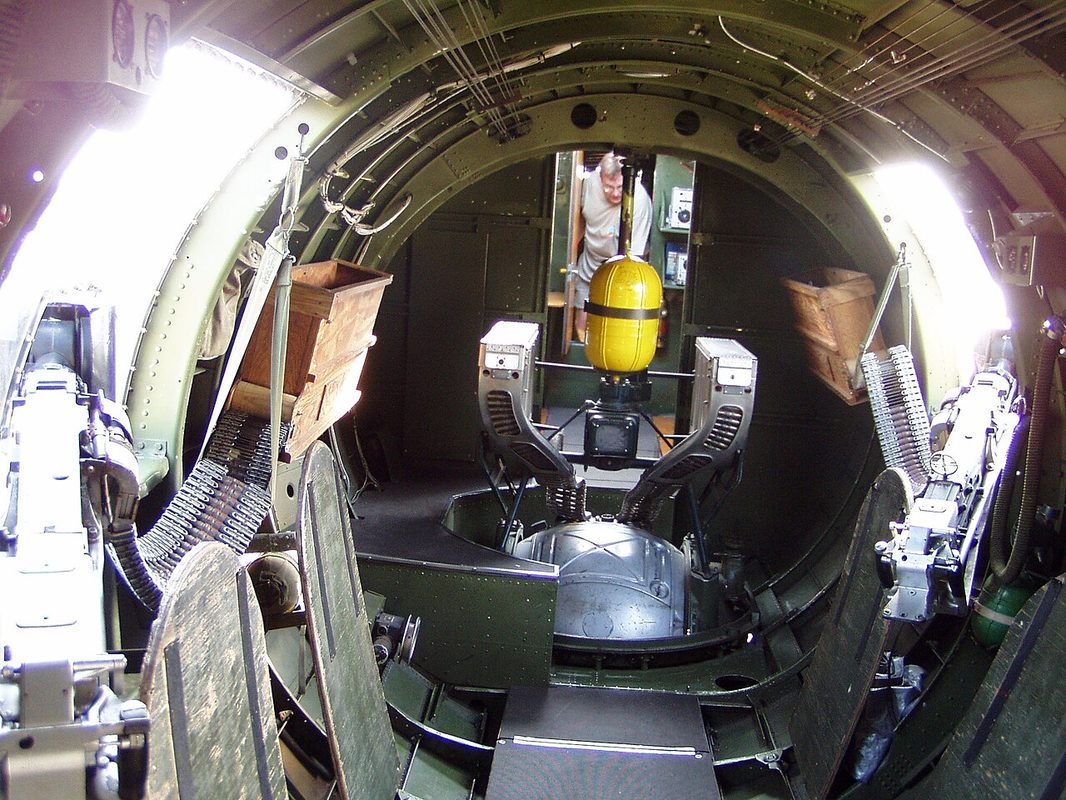
B-17 waist gunner position showing .50 caliber machine gun mount
A B-17 waist gunner at his .50 caliber machine gun position. (USAAF photo via Wikimedia Commons)

A B-17 crew consisted of ten men: pilot, copilot, navigator, bombardier, flight engineer (who also manned the top turret), radio operator, ball turret gunner, two waist gunners, and tail gunner. They flew at altitudes of 20,000 to 30,000 feet in unpressurized, unheated aircraft, where temperatures routinely reached -40 degrees. Frostbite was a constant hazard — touching exposed metal at altitude caused instant freezing of skin. Oxygen masks were essential above 10,000 feet, and a failure of the oxygen system could cause hypoxia and death within minutes.

Sperry ball turret mounted on the belly of a B-17 bomber
The Sperry ball turret — the most exposed and claustrophobic position on the B-17. (USAAF photo via Wikimedia Commons)
The ball turret — a Sperry-designed sphere suspended from the belly of the aircraft — was the most claustrophobic and exposed position. The gunner entered the turret from inside the aircraft, curled into a fetal position with his head between his knees, and rotated the turret using hand and foot controls. He had no parachute — there was no room for one inside the turret. If the aircraft was going down, the ball turret gunner had to be rotated to the entry position and pull himself up into the fuselage to grab his parachute. If the turret's rotation mechanism was damaged, or if the fuselage above was on fire, the ball turret gunner was trapped.

Production

Boeing, Douglas, and Lockheed (through its Vega subsidiary) produced 12,731 B-17s — making it the second-most-produced heavy bomber of the war after the Consolidated B-24 Liberator. The B-17G — the chin-turret-equipped definitive variant — accounted for 8,680 of that total. At peak production, the three manufacturers were delivering B-17s at a combined rate of approximately 16 per day.

Of those 12,731 aircraft, approximately 4,735 were lost in combat — a 37% combat loss rate. The Eighth Air Force alone lost 4,145 B-17s in the European Theater. These numbers represent not just aircraft but approximately 47,000 airmen killed and thousands more captured.

Legacy

The B-17 Flying Fortress is the most iconic bomber in aviation history — more than the B-52, more than the B-29, more than any other aircraft. It represents the daylight bombing campaign against Nazi Germany in the popular imagination — the tight formations over the flak fields, the desperate fighter attacks, the long crawl home with dead and wounded aboard, the survival stories that defy belief.

The B-17 was not the best heavy bomber of the war by any objective measure. The Lancaster carried twice the bomb load. The B-29 was more technologically advanced. The B-24 had longer range and was produced in greater numbers. But the B-17 had something none of them had: it brought its crews home when no other aircraft would have. It absorbed punishment that should have destroyed it and kept flying. And in doing so, it earned a place in the hearts of the men who flew it — and in the history of the war — that no specification comparison can capture.

Share this article

Share:

Recommended

Ace of The Skies: Can You Identify These Military Aircraft Throughout The Years?
Test Yourself

Ace of The Skies: Can You Identify These Military Aircraft Throughout The Years?

Can you identify these aircraft?

Take the Quiz

On This Day in Military History

March 26

Battle of Iwo Jima Declared Secure (1945)

After 36 days of the most brutal fighting in the Pacific War, the island of Iwo Jima was officially declared secure. The Marines had expected a five-day battle; Kuribayashi's revolutionary defense-in-depth using 11 miles of interconnected tunnels turned it into a nightmare. The battle cost 6,821 American dead and 19,217 wounded. Of approximately 21,000 Japanese defenders, only 216 were taken prisoner. Fleet Admiral Nimitz declared: "Among the Americans who served on Iwo Jima, uncommon valor was a common virtue."

1862Battle of Glorieta Pass Begins — "The Gettysburg of the West"

1917First Battle of Gaza — A Victory Thrown Away

1979Egypt-Israel Peace Treaty Signed at the White House

See all 10 events on March 26

Get Military News & History in Your Inbox

Join thousands of readers receiving our weekly digest of military technology, history, and analysis.

Test Your Knowledge