Skip to content
May 2:The Fall of Berlin: Soviet Forces Capture the Nazi Capital81yr ago

The Avro Lancaster: The Bomber That Won the Night War

Daniel Mercer · · 14 min read
Save
Share:
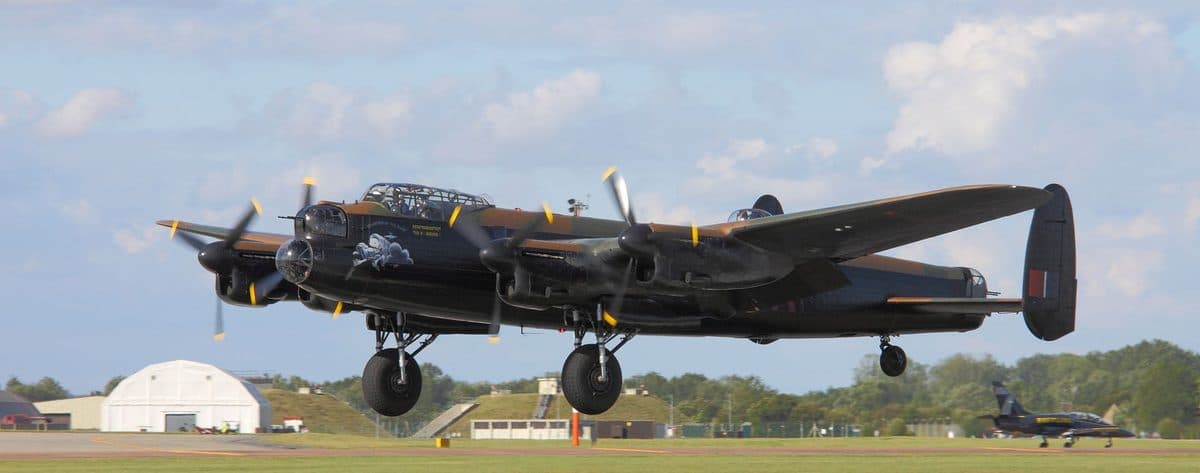
Avro Lancaster heavy bomber in flight showing its four Merlin engines and distinctive twin-tail configuration
Daniel Mercer
Daniel Mercer

Military History Editor

Daniel Mercer writes about military history with a focus on the 20th century, including World War II, the Cold War, and Vietnam. His work looks at how decisions made decades ago still influence doctrine, planning, and assumptions today.

The Avro Lancaster was not the most glamorous aircraft of World War II. It was not the fastest, the most heavily armed, or the most technologically advanced. What the Lancaster had was a bomb bay. A 33-foot, unobstructed bomb bay that could swallow ordnance that no other aircraft in the world could carry. While the American B-17 Flying Fortress carried 6,000 pounds of bombs to a target, the Lancaster routinely hauled 14,000 pounds, and with modifications, it carried Barnes Wallis's 12,000-pound Tallboy and the staggering 22,000-pound Grand Slam earthquake bombs. The Lancaster dropped 681,645 tons of bombs during the war, two-thirds of Bomber Command's entire total. No other aircraft contributed more to the strategic bombing campaign that helped break the industrial spine of Nazi Germany.

Born From Failure
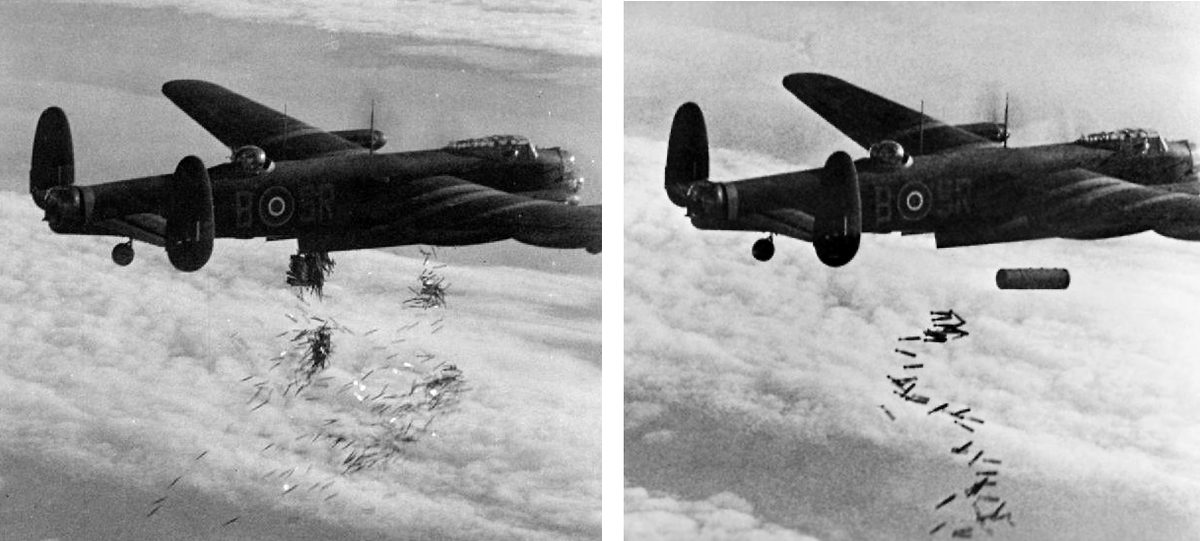
Avro Lancaster bomber dropping bombs over Duisburg during a WWII raid
An Avro Lancaster over Duisburg during a bombing raid. (RAF/IWM photo via Wikimedia Commons)

The Lancaster's origins lay in one of the worst bombers of the war: the Avro Manchester. The Manchester was a twin-engine heavy bomber powered by two Rolls-Royce Vulture engines, a 24-cylinder X-configuration design that proved catastrophically unreliable. The Vulture suffered chronic crankshaft failures, bearing collapses, and cooling problems. Manchesters were being lost to engine failure at a rate that made them almost as dangerous to their own crews as to the enemy. By 1941, it was clear the Manchester was a failure, and the Vulture engine program was cancelled.
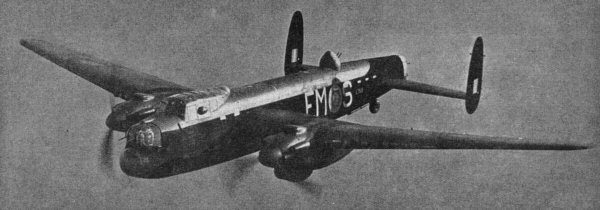
Avro Manchester twin-engine bomber in flight, the failed predecessor to the Lancaster
The Avro Manchester, the twin-engine failure whose airframe became the Lancaster. (RAF/IWM photo via Wikimedia Commons)

But Avro's chief designer, Roy Chadwick, saw that the Manchester's airframe was fundamentally sound, the problem was the engines. His solution was elegant: stretch the Manchester's wing from 80 to 102 feet and replace the two unreliable Vultures with four proven Rolls-Royce Merlin engines. The Merlin was the most reliable aero engine in British service, powering the Spitfire, Hurricane, and Mosquito. Four Merlins provided more total power than two Vultures while offering the redundancy of having four independent engines, the loss of one Merlin was survivable, while the loss of one Vulture on a Manchester was usually fatal.

The resulting aircraft, initially designated the Manchester III before being renamed the Lancaster, first flew on January 9, 1941. The transformation was remarkable. The Lancaster handled beautifully, climbed well, and cruised at speeds that exceeded the Manchester's maximum. Most importantly, it could carry an enormous bomb load to targets deep inside Germany. RAF Bomber Command had found its weapon.

The Bomb Bay That Won the War

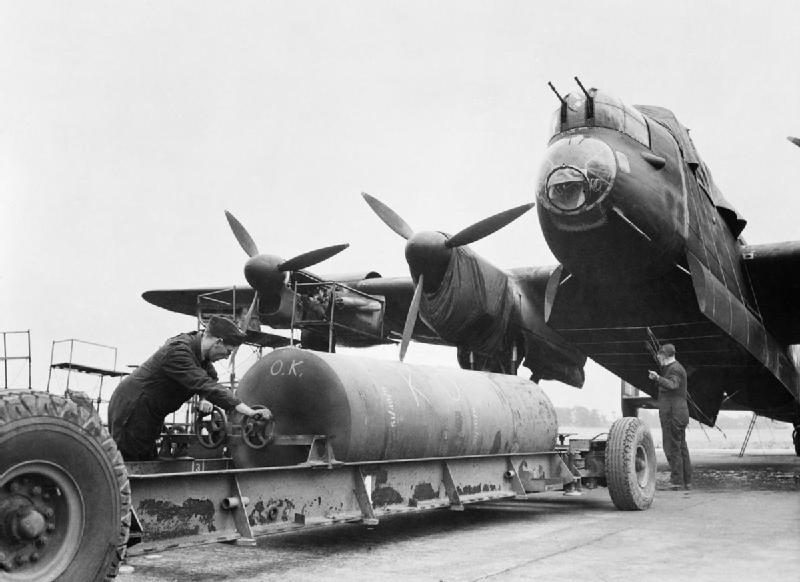
Ground crew loading a 8,000-pound Cookie bomb into a Lancaster's massive unobstructed bomb bay
Ground crew loading ordnance into a Lancaster's cavernous 33-foot bomb bay. (RAF/IWM photo via Wikimedia Commons)

The Lancaster's defining feature was its bomb bay. At 33 feet long and completely unobstructed by internal structural members, it was the largest bomb bay of any operational heavy bomber in the war. The B-17's bomb bay was divided into two sections by a structural beam, limiting both the size of individual bombs and the total load. The B-24 Liberator had roller-shutter bomb bay doors that added weight and complexity. The Lancaster's bomb bay was simply cavernous, a clean, open space that could accept virtually any combination of ordnance.

Standard loads included fourteen 1,000-pound bombs, or a single 4,000-pound "Cookie" blast bomb surrounded by incendiaries, or a mix of high-explosive and incendiary bombs tailored to the target. The Cookie, officially the HC 4,000 lb, was a thin-cased blast bomb designed to blow the roofs off buildings, allowing the incendiaries that followed to set the interiors alight. The combination of blast bombs and incendiaries was the foundation of Bomber Command's area bombing strategy, and the Lancaster's ability to carry a Cookie plus a full load of incendiaries made it the ideal platform for that strategy.

As the war progressed, the bomb bay was modified to carry progressively larger weapons. The 8,000-pound and 12,000-pound versions of the Cookie followed.

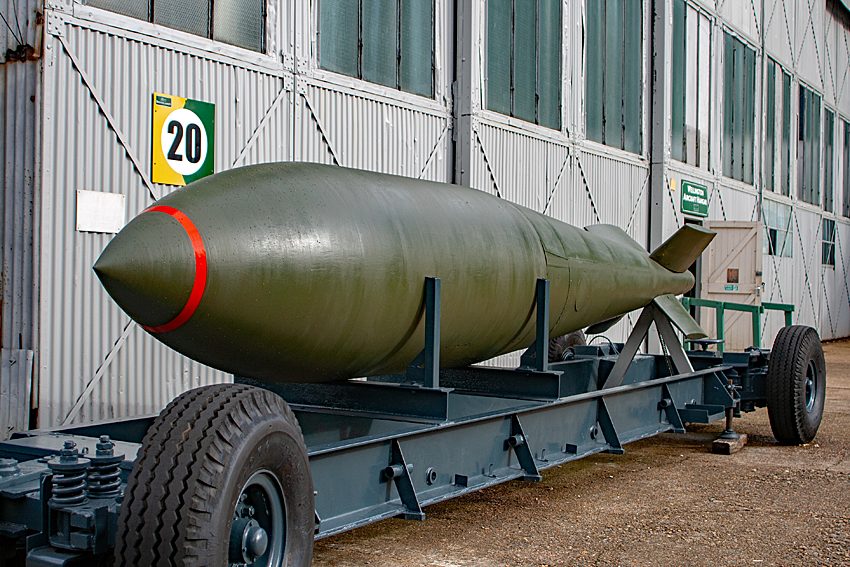
Tallboy earthquake bomb designed by Barnes Wallis for precision strikes on hardened targets
The 12,000-pound Tallboy earthquake bomb designed by Barnes Wallis. (RAF/IWM photo via Wikimedia Commons)
Then came Barnes Wallis's precision weapons: the Tallboy (12,000 pounds) and the Grand Slam (22,000 pounds), both designed to penetrate deep underground before detonating, creating earthquake-like effects that could collapse tunnels, destroy hardened structures, and wreck bridges and viaducts beyond repair. No other operational bomber in the world could carry these weapons. The Lancaster was the only delivery system.

The Night Offensive

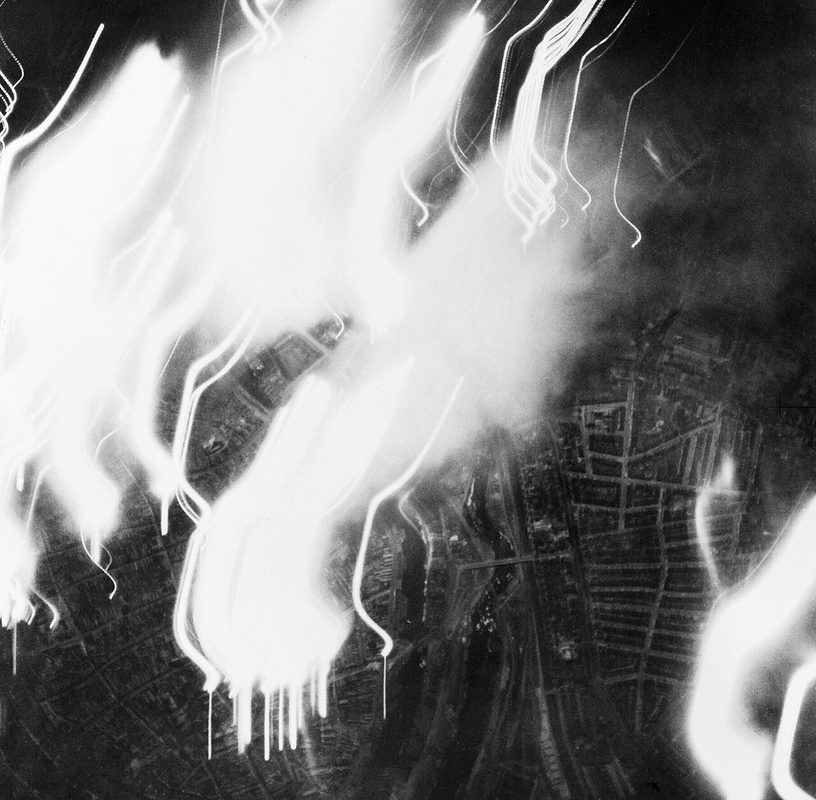
Aerial photograph of an RAF night bombing raid showing fires and target markers
Aerial photograph of an RAF night bombing raid, fires and target markers illuminate the ground below. (RAF/IWM photo via Wikimedia Commons)

The Lancaster was designed for night operations. While the American Eighth Air Force flew daylight precision bombing missions, suffering terrible losses in the process, RAF Bomber Command operated at night, when darkness provided a measure of protection against fighters and anti-aircraft guns. Night bombing was inherently less accurate than daylight bombing, which is why Bomber Command adopted area bombing, targeting entire urban-industrial areas rather than specific factories.

A typical Lancaster mission followed a carefully choreographed sequence. Pathfinder aircraft, often de Havilland Mosquitoes, would arrive over the target first, dropping colored marker flares to illuminate the aiming point. The Main Force Lancasters would then bomb on the markers, dropping their loads in concentrated waves designed to overwhelm the fire services and create conflagrations that merged into firestorms.

The bomber stream, hundreds of Lancasters flying a narrow corridor to concentrate the attack in time and overwhelm the German night fighter defenses, could stretch for miles across the night sky. The crews flew in darkness, navigating by dead reckoning, radio aids, and the glow of burning cities ahead. German night fighters, primarily Bf 110s and Ju 88s equipped with radar, hunted the bomber stream, picking off aircraft from below using upward-firing Schräge Musik cannon that the Lancaster crews couldn't see coming.

The Dambusters

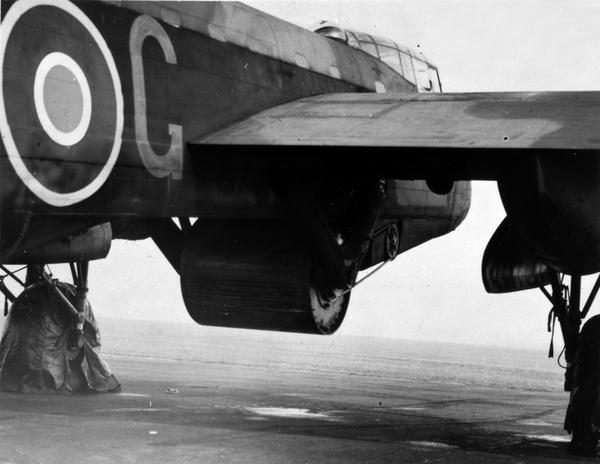
Upkeep bouncing bomb mounted under a Lancaster for the Dambusters raid on German dams
The Upkeep bouncing bomb mounted under a specially modified Lancaster for the Dambusters raid. (RAF/IWM photo via Wikimedia Commons)

The most famous Lancaster mission was Operation Chastise, the Dambusters raid of May 16-17, 1943. Nineteen specially modified Lancasters of 617 Squadron, led by Wing Commander Guy Gibson, attacked the Möhne, Eder, and Sorpe dams in the Ruhr Valley using Barnes Wallis's "Upkeep" bouncing bomb, a cylindrical weapon that was spun backwards at 500 rpm before release, causing it to skip across the surface of the reservoir like a stone, bounce over the torpedo nets protecting the dam face, sink against the wall, and detonate at depth.

The mission was extraordinarily dangerous. The Lancasters had to fly at exactly 60 feet above the water, at night, at a precise speed of 230 mph, releasing the Upkeep bomb at a specific distance from the dam face. Spotlights mounted under the aircraft projected converging beams onto the water surface; when the two spots merged into one, the aircraft was at the correct altitude. The bomb aimer used a simple wooden sight to judge the release distance.

The Möhne and Eder dams were breached, releasing millions of tons of water that flooded the Ruhr valley, destroying infrastructure, farmland, and killing an estimated 1,600 people, including over 1,000 Allied prisoners of war and forced laborers. Eight of the nineteen Lancasters were shot down, and 53 of the 133 aircrew were killed. Gibson was awarded the Victoria Cross.

The strategic impact of the Dambusters raid was debatable, the Germans repaired both dams within months. But the propaganda value was immense, and 617 Squadron went on to become Bomber Command's precision bombing specialists, using Tallboy and Grand Slam bombs to destroy targets that conventional bombing couldn't touch.

Sinking the Tirpitz

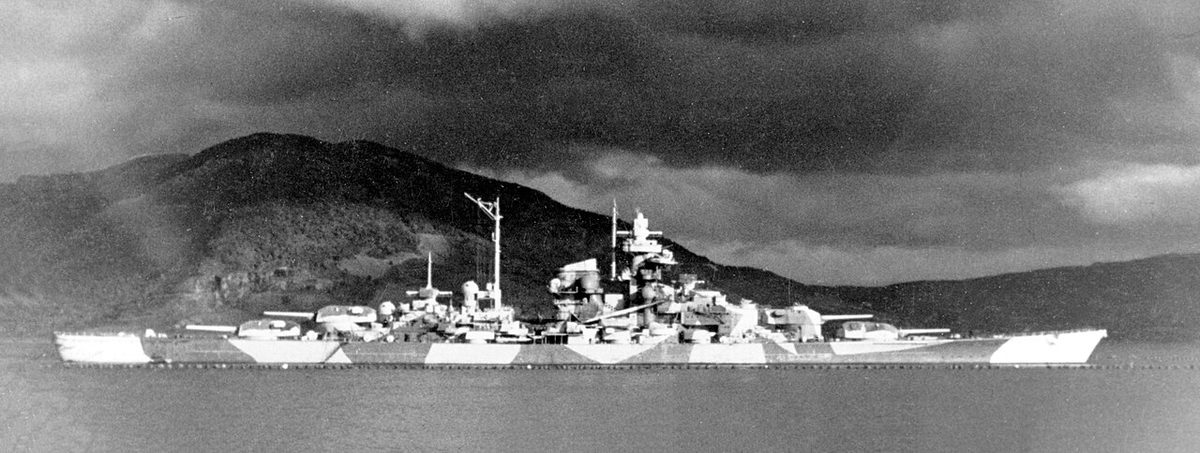
German battleship Tirpitz in Altafjord, Norway, before Lancaster bombers sank it with Tallboy bombs
The German battleship Tirpitz in a Norwegian fjord, sunk by 617 Squadron Lancasters carrying Tallboy bombs. (RAF/IWM photo via Wikimedia Commons)

617 Squadron's greatest precision achievement came on November 12, 1944, when 31 Lancasters attacked the German battleship Tirpitz in Tromsø fjord, Norway. The Tirpitz, sister ship of the Bismarck, had been a menace to Allied convoys for years, tying down significant Royal Navy forces simply by existing. Previous attacks by carrier aircraft, midget submarines, and conventional bombers had damaged but not destroyed her.

The Lancasters carried 12,000-pound Tallboy bombs. At least two Tallboys scored direct hits, and several near-misses detonated beneath the ship's hull, ripping open the bottom. The Tirpitz capsized and sank, killing approximately 1,000 of her crew. It was the largest warship ever sunk by aerial bombing alone, and it demonstrated what the Lancaster could achieve with precision weapons, even against the most hardened targets.

The Cost

The Lancaster's combat record came at an appalling human cost. RAF Bomber Command suffered 55,573 killed during the war, a fatality rate of 44.4%, higher than any other branch of British service. The Lancaster loss rate averaged approximately 2.2% per sortie, meaning that for every 100 Lancasters that took off, roughly two would not return. Over a standard 30-mission tour, a Lancaster crew's odds of survival were approximately one in two. Many crews didn't make it past their first ten missions.

Of 7,377 Lancasters built, 3,349 were lost on operations, 45.4% of all production. The aircraft that returned often came back with dead or wounded crew members, battle damage that required weeks of repair, and crews psychologically shattered by what they had experienced. The cheerful public image of Bomber Command masked a grinding war of attrition that consumed young men at a rate that tested the limits of what a society could sustain.

The moral dimension of the bombing campaign, particularly the area bombing of German cities, culminating in the firestorm that destroyed Dresden in February 1945, remained controversial long after the war. Winston Churchill himself distanced himself from Bomber Command after the war, and Air Chief Marshal Sir Arthur "Bomber" Harris, who directed the campaign, was the only major British military commander not to receive a peerage. The Lancaster crews who risked everything received no campaign medal specific to their service. Recognition came slowly: a Bomber Command memorial was not unveiled in London until 2012.

Production and Variants

Avro produced 7,377 Lancasters between 1941 and 1946, making it one of the most-produced heavy bombers of the war. The B Mk I, powered by four Packard-built Merlin engines, was the most common variant, accounting for the majority of production. The B Mk III used Packard Merlin 28 or 38 engines and was externally identical to the Mk I. The B Mk X was the Canadian-built variant, produced by Victory Aircraft in Malton, Ontario.

Specialized variants included the B Mk I (Special), modified to carry the Tallboy and Grand Slam bombs. These aircraft had their bomb bay doors removed, mid-upper turrets deleted to save weight, and structural reinforcements to handle the enormous mass of the earthquake bombs. A fully loaded Grand Slam Lancaster weighed over 72,000 pounds, more than 36 tons, pushing the aircraft to its absolute structural limits on every takeoff.

Legacy

The Avro Lancaster was the most important heavy bomber of the European war. It carried more bombs, more often, to more targets than any other aircraft in Bomber Command's inventory. It delivered weapons that no other bomber could carry, against targets that no other bomber could destroy. The B-52 Stratofortress and B-29 Superfortress may claim greater fame, but in the specific context of the European bombing campaign, the Lancaster was the decisive weapon.

Only two Lancasters remain in airworthy condition today, one operated by the RAF's Battle of Britain Memorial Flight, and one by the Canadian Warplane Heritage Museum. When they fly, they carry a weight that no bomb load can match: the memory of the 55,573 Bomber Command airmen who did not come home. The Lancaster was a magnificent aircraft and a terrible weapon, and the men who flew it paid a price that history is still reckoning with.

Share this article

Share:

Recommended

Ace of The Skies: Can You Identify These Military Aircraft Throughout The Years?
Test Yourself

Ace of The Skies: Can You Identify These Military Aircraft Throughout The Years?

Can you identify these aircraft?

Take the Quiz

On This Day in Military History

March 23

Reagan Announces the Strategic Defense Initiative (1983)

President Ronald Reagan proposed the Strategic Defense Initiative (SDI), a space-based missile defense system designed to make nuclear weapons "impotent and obsolete." Dubbed "Star Wars" by critics, the program represented a fundamental shift away from the doctrine of Mutual Assured Destruction. While SDI never achieved its full technical ambitions, it forced the Soviet Union into an arms race it could not sustain, contributing to the economic pressures that helped end the Cold War.

1775, Patrick Henry: "Give Me Liberty or Give Me Death"

1862, First Battle of Kernstown, Stonewall Jackson's Only Defeat

1943, Battle of El Guettar, First U.S. Victory Over German Armor

See all 10 events on March 23

Get Military News & History in Your Inbox

Join thousands of readers receiving our weekly digest of military technology, history, and analysis.

Test Your Knowledge