Skip to content
April 19:Battles of Lexington and Concord251yr ago

Chuck Yeager and the X-1: The Pilot and Machine That Broke the Sound Barrier

Daniel Mercer · · 11 min read
Save
Share:
Bell X-1 Glamorous Glennis rocket-powered research aircraft in flight over the Mojave Desert
Daniel Mercer
Daniel Mercer

Military History Editor

Daniel Mercer writes about military history with a focus on the 20th century, including World War II, the Cold War, and Vietnam. His work looks at how decisions made decades ago still influence doctrine, planning, and assumptions today.

By the autumn of 1947, the sound barrier had earned a reputation as a wall that killed anyone who tried to break through it. Pilots who pushed their fighters too fast in steep dives encountered violent shaking, reversed controls, and structural failure — their aircraft literally shaking apart as shockwaves formed on the wings. Engineers spoke of "compressibility" as though it were an immutable physical law. Test pilots called it "the demon in the air." The British had lost Geoffrey de Havilland Jr. when his DH 108 Swallow disintegrated at Mach 0.9 over the Thames Estuary in September 1946. The American solution was to build a rocket-powered aircraft shaped like a bullet and find a pilot willing to ride it past the speed of sound. The aircraft was the Bell X-1. The pilot was a 24-year-old captain from West Virginia named Chuck Yeager.

The Problem

During World War II, pilots of high-speed fighters — P-38 Lightnings, Spitfires, Typhoons — discovered that as their aircraft approached transonic speeds in steep dives, the rules of aerodynamics seemed to change. Shockwaves formed on wing surfaces and control surfaces, creating violent buffeting. Elevators became ineffective or reversed — a pull on the stick would push the nose down instead of up. Aircraft that dove too steeply sometimes shattered mid-air. Squadron Leader Anthony Martindale's Spitfire Mk XI reached Mach 0.92 in April 1944 — the propeller ripped off, the aircraft pulled out so violently it bent the wings upward and knocked him unconscious. He survived. Others did not.

The death of Geoffrey de Havilland Jr. in 1946 crystallized the fear. His tailless swept-wing DH 108 disintegrated at approximately Mach 0.88 as shockwaves cracked the wing spars and induced fatal pitching oscillations. The British government effectively abandoned manned supersonic research after his death, ceding the race to the Americans. The prevailing belief — shared by many engineers and most pilots — was that Mach 1 represented a physical barrier that no aircraft could survive.
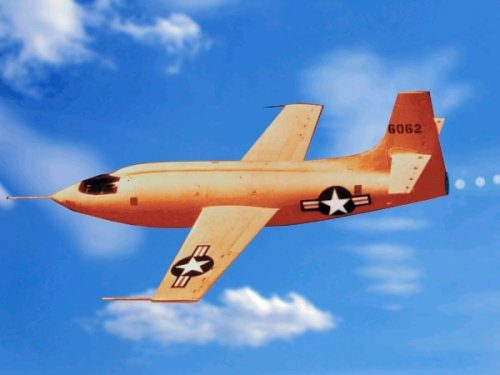
Bell X-1 Glamorous Glennis in iconic orange paint in flight
The Bell X-1 "Glamorous Glennis" — the bullet-shaped rocket plane that broke the sound barrier. (NASA/NACA photo)

The Machine

Bell Aircraft designed the X-1 around a simple insight: a .50-caliber bullet is stable in supersonic flight. If a bullet could do it, so could an aircraft shaped like one. The X-1's fuselage was a bullet — an ogive nose, a circular cross-section, 30 feet 11 inches long. The wings were thin and straight, with a 28-foot wingspan. Bell deliberately avoided swept wings, even though German wartime research had shown their high-speed advantages, because straight wings were better understood and would produce cleaner aerodynamic data.

Power came from the Reaction Motors XLR11-RM-3, a four-chamber liquid-fueled rocket engine producing 6,000 pounds of thrust. Each chamber could be individually ignited or shut down, giving the pilot thrust adjustments in 1,500-pound increments. The engine burned a mixture of ethyl alcohol and water — 293 gallons — with 311 gallons of liquid oxygen as the oxidizer, all pressurized by nitrogen at 1,500 PSI. The X-1 weighed 6,850 pounds empty and 14,750 pounds fully loaded.

The aircraft's most important innovation was invisible: an all-moving tailplane. Instead of using a conventional hinged elevator on a fixed horizontal stabilizer — which lost effectiveness in transonic flight as shockwaves blanked the control surface — the entire horizontal stabilizer pivoted as a single unit. This gave the pilot control authority through the transonic region where conventional controls failed. The all-moving tailplane would become standard on virtually every supersonic fighter that followed — the F-100, the F-104, the F-4, the F-14, the F-15, the F-16. The X-1 invented it.

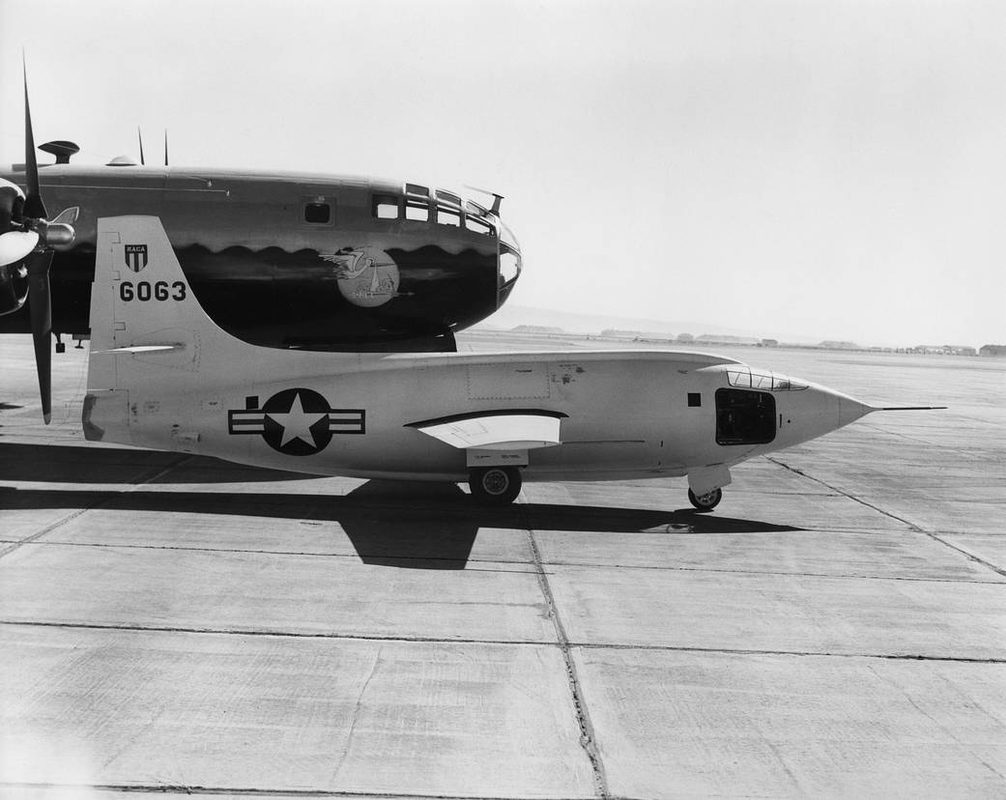
Bell X-1 mounted under the B-29 Superfortress mothership on the ground before a flight
The Bell X-1 mounted under its B-29 Superfortress mothership before a test flight. (NASA/NACA photo)

The X-1 could not take off under its own power. Its rocket engine burned fuel too quickly for a ground takeoff to be practical. Instead, the aircraft was carried aloft in the bomb bay of a modified B-29 Superfortress and drop-launched at approximately 25,000 feet. After the powered flight, it glided to a dead-stick landing on the dry lakebed at Muroc Army Air Field in the Mojave Desert — now Edwards Air Force Base.

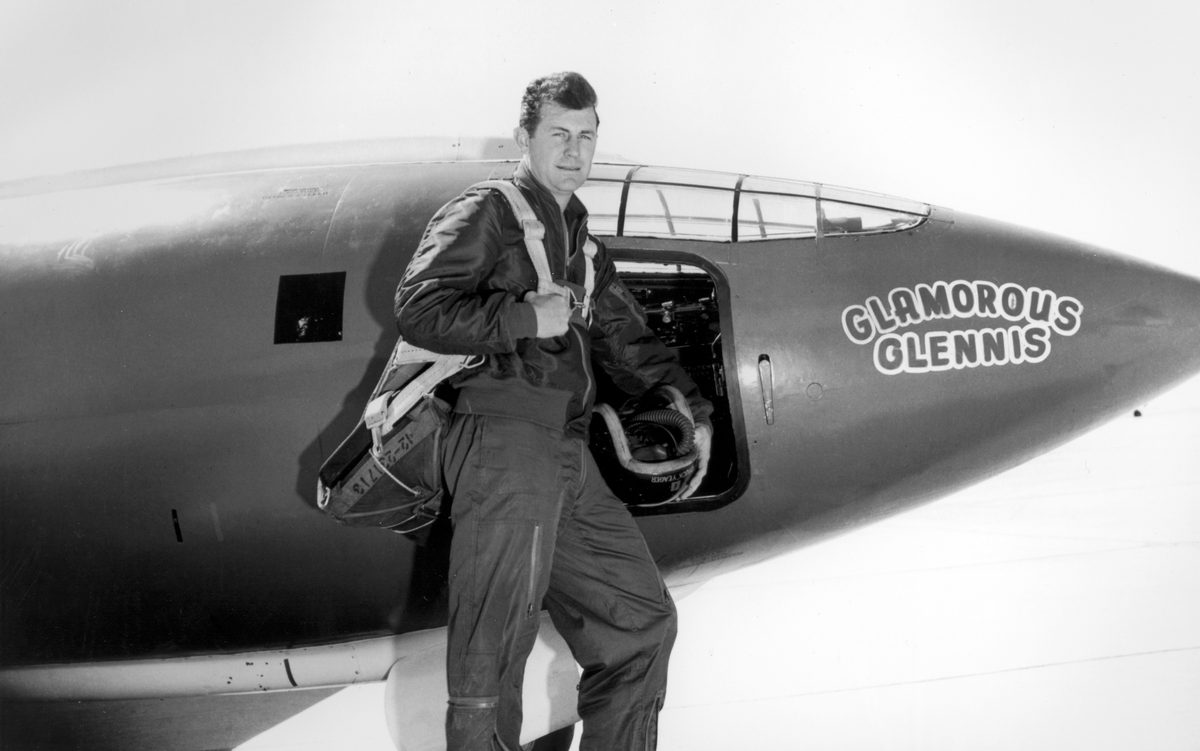
Chuck Yeager standing next to the Bell X-1 Glamorous Glennis
Captain Chuck Yeager beside the Bell X-1 "Glamorous Glennis." (NASA/NACA photo)

The Pilot

Charles Elwood Yeager was born on February 13, 1923, in Hamlin, West Virginia. He enlisted in the Army Air Corps in September 1941, trained initially as an aircraft mechanic, and applied for flight training in 1942 under a new program that accepted enlisted men without college degrees. He earned his wings in March 1943 and was assigned to fly P-51 Mustangs on the Western Front.

On his eighth combat mission, March 5, 1944, Yeager was shot down over France. He evaded capture with help from the French Resistance, escaped through Spain, and returned to England. On October 12, 1944, he became an "ace in a day" — shooting down five enemy aircraft in a single mission, including two Me 262 jets. He finished the war with 11.5 aerial victories and a reputation for exceptional eyesight, preternatural calm under pressure, and a rare ability to translate the subjective "feel" of an aircraft into precise technical data for engineers.

Colonel Albert Boyd handpicked Yeager for test pilot duty in January 1946. When Bell's civilian test pilot, Chalmers "Slick" Goodlin, demanded $150,000 — roughly $2 million in today's money — to attempt the sound barrier flight, the Army Air Forces chose the 24-year-old Yeager instead. He would do it for his regular captain's pay: $283 per month.

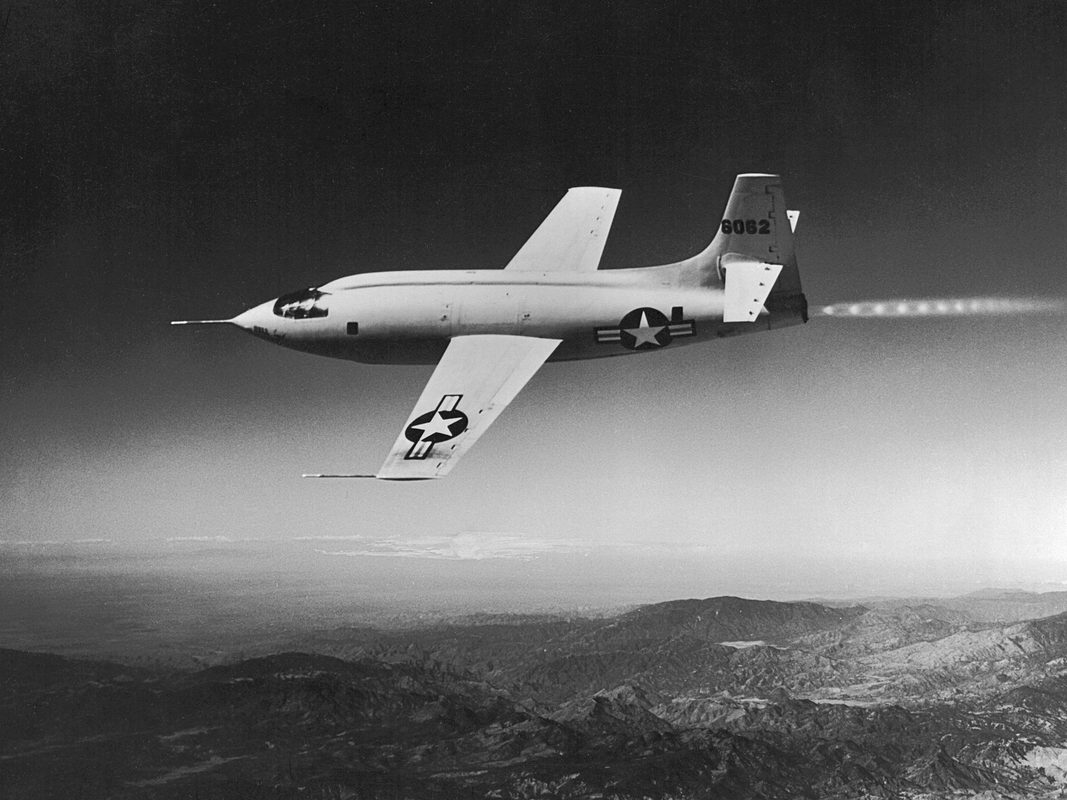
Bell X-1 in flight with rocket exhaust visible during a high-speed test run
The Bell X-1 in flight during a high-speed test run over the Mojave Desert. (NASA/NACA photo)

The Flight

Two nights before the scheduled flight, Yeager went horseback riding with his wife Glennis near their home at Muroc. The horse clipped a fence post and threw him. He broke two ribs on his right side. Fearing he would be pulled from the mission, he told no one on the program except fellow project pilot Jack Ridley and secretly visited a civilian doctor in the town of Rosamond, who taped his ribs.

The broken ribs created an immediate problem. To seal the X-1's cockpit hatch, the pilot had to pull a heavy lever down with his right arm — exactly the motion that two broken ribs made impossible. Ridley solved it by sawing off the end of a broom handle and fashioning a 10-inch lever extension. Yeager would use the broomstick to pull the hatch closed.

On the morning of October 14, 1947, the B-29 mothership carried the X-1 — painted orange and christened "Glamorous Glennis" after Yeager's wife — to 25,000 feet over Muroc. At approximately 10:26 AM, the X-1 dropped from the bomb bay. Yeager fired the four rocket chambers sequentially and climbed steeply, accelerating through the transonic region. The buffeting that had terrified pilots and killed engineers' confidence grew intense — and then, as the aircraft passed through Mach 1, it stopped. The ride smoothed out. The Mach needle jumped off the scale.

At approximately 43,000 feet, Chuck Yeager reached Mach 1.06 — roughly 700 miles per hour. A sonic boom rolled across the Mojave Desert floor, the first ever produced by a piloted aircraft in level flight. Ground crew heard the thunderclap and did not know what it was. The powered portion of the flight lasted about 14 minutes. Then Yeager glided the X-1 down to the lakebed and landed.

The sound barrier was not a wall. It was a door.

The Secret

The entire X-1 program was conducted under strict military secrecy. Yeager and all personnel were forbidden from discussing the achievement. The news was not publicly announced until June 10, 1948 — nearly eight months after the flight — when Aviation Week magazine broke the story, reportedly to the irritation of the Air Force. The delay was partly strategic: the newly independent U.S. Air Force wanted to fully exploit the data before the Soviet Union learned that supersonic flight was achievable.

What Came After

Yeager was not finished. On December 12, 1953, he flew the improved Bell X-1A to Mach 2.44 — 1,621 miles per hour — at 74,700 feet. Immediately after reaching peak speed, the aircraft entered a violent, uncontrolled tumble caused by inertia coupling, a phenomenon poorly understood at the time. Yeager dropped 51,000 feet in less than a minute before recovering at 29,000 feet. Fellow test pilot Scott Crossfield called it "the fastest and wildest airplane ride in history" and said "probably no other pilot could have come through that experience alive."

In 1962, Yeager became the first commandant of the USAF Aerospace Research Pilot School at Edwards. Thirty-seven of his graduates were selected for the space program, and 26 earned astronaut wings on Gemini, Apollo, and Space Shuttle missions. In December 1963, during a zoom climb in a rocket-augmented NF-104A, the aircraft entered a flat spin at extreme altitude. Yeager ejected after falling approximately 95,000 feet. The rocket-powered ejection seat broke his helmet faceplate, and his emergency oxygen caught fire, causing severe facial burns. He returned to flight status.

He commanded fighter wings in Germany and Southeast Asia, was promoted to brigadier general in 1969, and retired in 1975. He died on December 7, 2020, at the age of 97.

Legacy

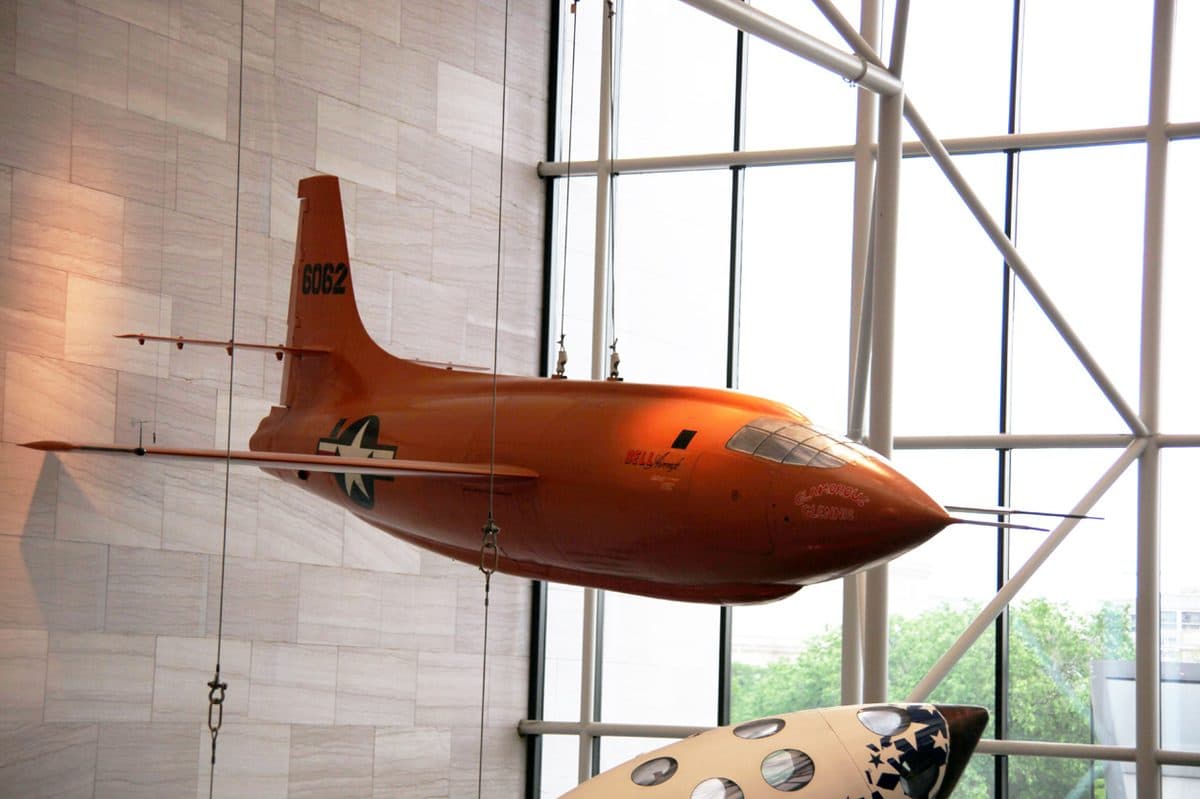
The original X-1 — serial number 46-062, "Glamorous Glennis" — hangs in the Smithsonian National Air and Space Museum's Milestones of Flight gallery, alongside the Wright Flyer and the Spirit of St. Louis. Muroc Army Air Field was renamed Edwards Air Force Base in 1949 and became the epicenter of American flight testing. The X-1 program led directly to the X-2, the X-3, the X-5, and ultimately the X-15, which would reach Mach 6.7 and the edge of space.

The all-moving tailplane that the X-1 pioneered became standard on every supersonic fighter built since. The data gathered on transonic aerodynamics informed the design of the F-100 Super Sabre — the first operational supersonic fighter — and every fast jet that followed. Within a decade of Yeager's flight, both the United States and the Soviet Union were fielding supersonic fighters as routine operational aircraft.

But the X-1's greatest contribution was not aerodynamic. It was psychological. For years, the sound barrier had been treated as an immutable physical limit — a wall that destroyed any aircraft that hit it. Yeager proved it was not a wall at all. The transition through Mach 1 was smooth. The buffeting stopped. The ride got quieter. The barrier that had killed pilots, grounded programs, and consumed the fears of an entire generation of engineers turned out to be a region of turbulence with calm air on the other side.

A 24-year-old captain with two broken ribs, a broomstick, and a rocket plane shaped like a bullet flew through it — and opened the door to everything that came after.

Share this article

Share:

Recommended

Ace of The Skies: Can You Identify These Military Aircraft Throughout The Years?
Test Yourself

Ace of The Skies: Can You Identify These Military Aircraft Throughout The Years?

Can you identify these aircraft?

Take the Quiz

On This Day in Military History

March 30

Easter Offensive Begins (1972)

North Vietnam launched the Easter Offensive, a massive conventional invasion of South Vietnam with 14 divisions and hundreds of tanks, the largest military operation since the Chinese intervention in Korea.

1814Battle of Paris

1856Treaty of Paris Ends the Crimean War

1941Rommel Launches First North Africa Offensive

See all 10 events on March 30

Get Military News & History in Your Inbox

Join thousands of readers receiving our weekly digest of military technology, history, and analysis.

Test Your Knowledge