Skip to content
April 21:Battle of San Jacinto190yr ago

The Saab Draken: Sweden's Double-Delta Interceptor

Daniel Mercer · · 11 min read
Save
Share:
Saab J 35 Draken interceptor in flight showing its distinctive double-delta wing configuration
Daniel Mercer
Daniel Mercer

Military History Editor

Daniel Mercer writes about military history with a focus on the 20th century, including World War II, the Cold War, and Vietnam. His work looks at how decisions made decades ago still influence doctrine, planning, and assumptions today.

Sweden does not join alliances. During the Cold War, it stood between NATO and the Warsaw Pact, officially neutral but geographically exposed — Soviet bombers crossing the Baltic could reach Stockholm in minutes. Swedish defense doctrine assumed that in the opening hours of a war, the major air bases would be destroyed. What the Flygvapnet needed was a fighter fast enough to intercept Soviet bombers at Mach 2, agile enough to dogfight if cornered, and rugged enough to operate from 500-meter strips of public highway cut through the Swedish forests. The aircraft Saab built to meet that requirement — the J 35 Draken — used a wing configuration so radical that the company had to build a subscale prototype just to prove it would fly.
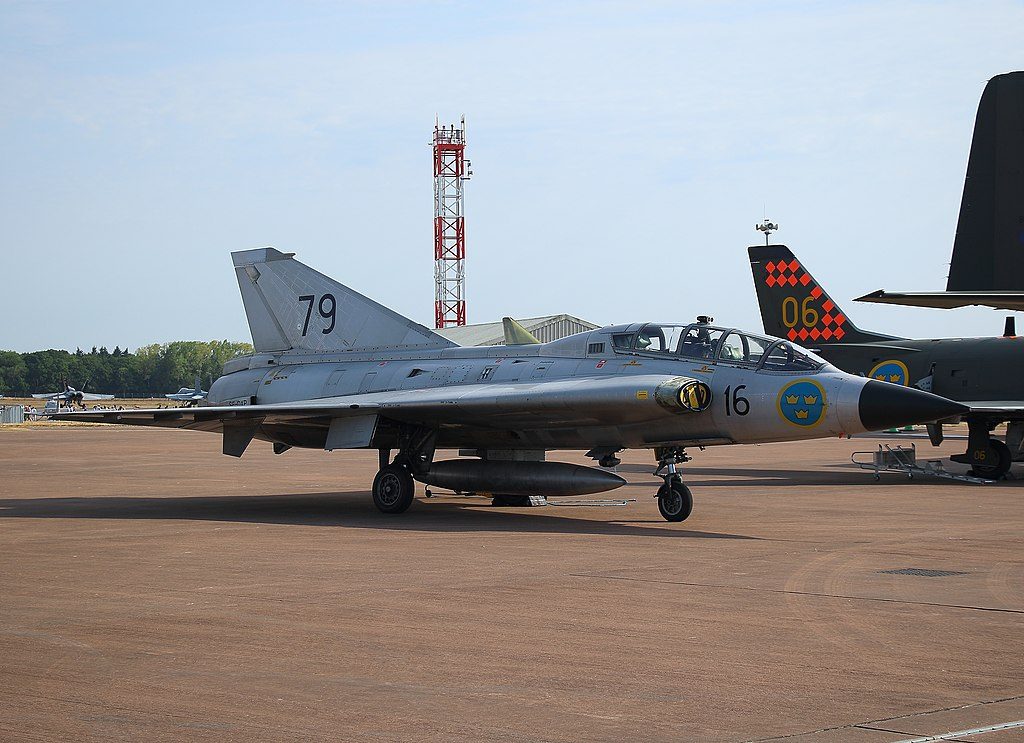
Saab J 35 Draken on the ground at an airshow showing Swedish Air Force markings
A Saab J 35 Draken in Swedish Air Force markings — one of the Cold War's most innovative interceptors. (Photo via Wikimedia Commons)

A Wing That Had Never Been Tried

In the autumn of 1949, Saab project manager Erik Bratt began studies for a fighter that could replace both the Saab 29 Tunnan and the Saab 32 Lansen. The Swedish Air Force wanted an interceptor capable of reaching Mach 1.4 — later revised upward to Mach 2 — with the ability to take off and land on short, austere runways. No conventional wing design could satisfy both demands simultaneously. A pure delta wing offered excellent high-speed performance but required long takeoff rolls and had poor low-speed handling. A straight or moderately swept wing worked well at low speeds but created too much drag to reach Mach 2.

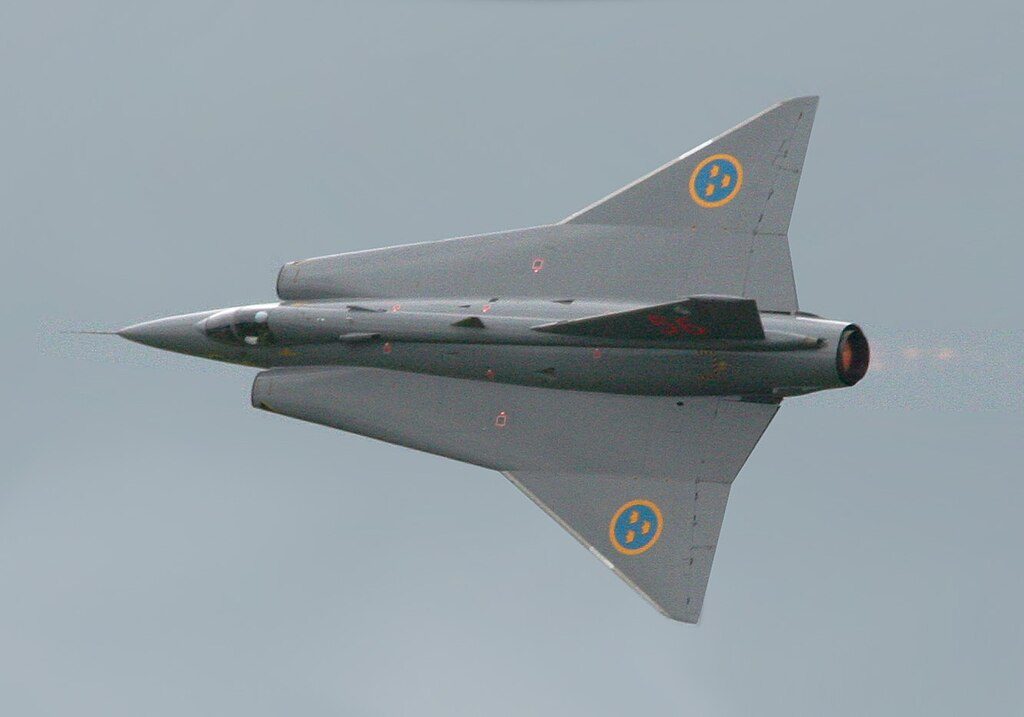
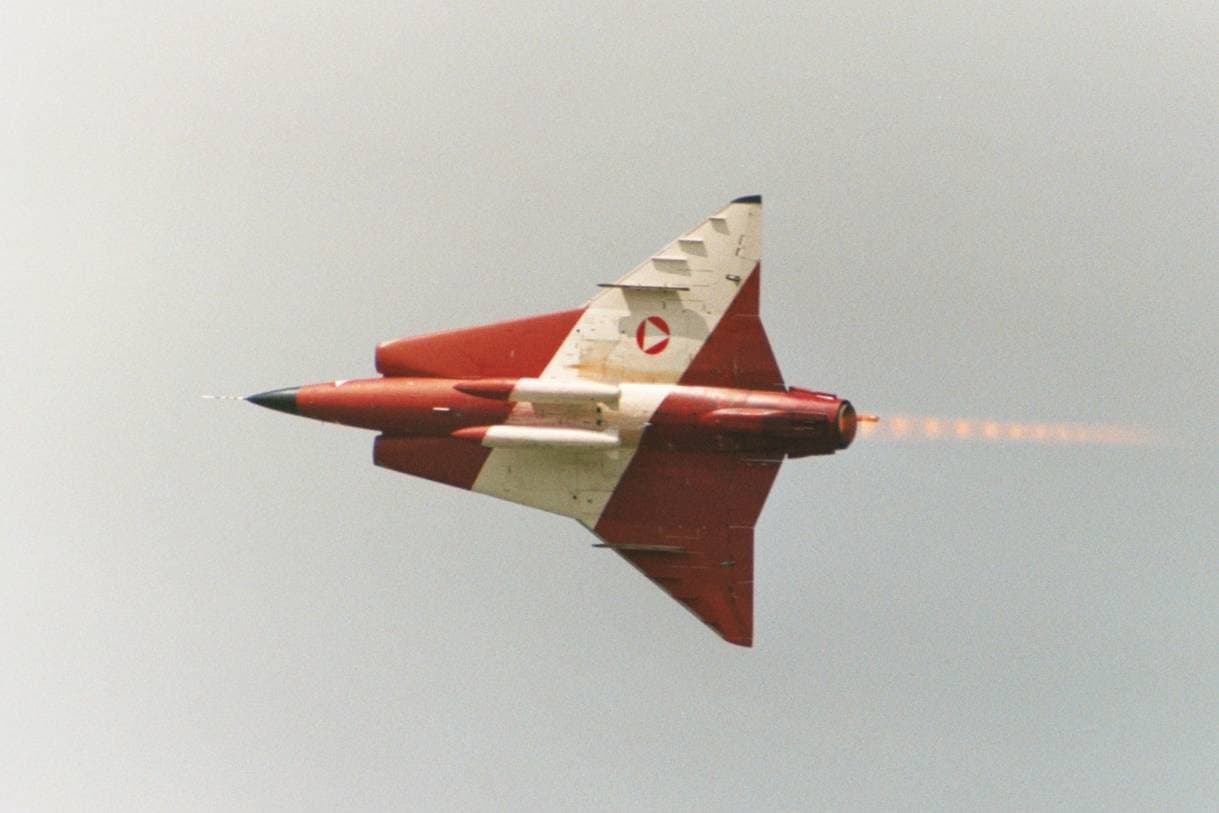
Bratt's team devised a solution that had never been used on a production aircraft: the double-delta wing. The inner section was swept at 80 degrees — nearly parallel to the fuselage — while the outer section was swept at 57 to 60 degrees. The sharply swept inner wing housed the weapons bays, fuel tanks, landing gear, and engine intakes within its thick root section, while the less-swept outer wing provided the lift and control authority needed for short-field takeoffs, low-speed approaches, and tight maneuvering. The combination produced an aircraft that was compact, structurally efficient, and aerodynamically versatile across the entire flight envelope.

Saab Draken viewed from below in flight showing its distinctive double-delta wing planform
The Draken's revolutionary double-delta wing planform — the sharply swept inner section and less-swept outer wing are clearly visible. (Photo via Wikimedia Commons)

The concept was so unproven that Saab built the Saab 210 Lilldraken — "Little Dragon" — an approximately 70-percent-scale research aircraft to validate the double-delta planform. The Lilldraken first flew on January 21, 1952, over Stockholm and completed 887 sorties over three years of testing before Saab committed to full-scale production. The data from those flights confirmed what Bratt's team had calculated: the double-delta worked.

The Dragon Takes Flight

The first full-scale Draken prototype flew on October 25, 1955, initially without afterburner. The production J 35A entered frontline service with the Swedish Air Force on March 8, 1960 — making the Draken the first truly supersonic combat aircraft deployed in Western Europe. On January 14, 1960, test pilot Erik Dahlstrom pushed the J 35B prototype past Mach 2 in level flight, confirming that Sweden's small, neutral air force now operated one of the fastest fighters in the world.

Power came from the Volvo Flygmotor RM6C, a license-built version of the Rolls-Royce Avon 300 series turbojet. With afterburner, the RM6C produced 78.4 kilonewtons of thrust — roughly 17,600 pounds — enough to push the 10,500-kilogram aircraft past Mach 2 at altitude. The engine gave the Draken a service ceiling above 15,000 meters and a range of approximately 1,200 kilometers on internal fuel.

Armed for Interception

The Draken's primary mission was intercepting Soviet bombers before they could reach Swedish airspace. Early variants carried two 30mm ADEN M-55 cannons and could mount unguided rockets on external hardpoints. As the type evolved, missile armament became the focus. The definitive J 35F — the most-produced variant at 230 aircraft — carried the Rb 27, a Swedish-designated Hughes Falcon missile with semi-active radar homing, and the Rb 28, an infrared-homing Falcon variant. Later upgrades added the Rb 24, a license-produced version of the AIM-9 Sidewinder that gave the Draken a modern heat-seeking capability.

The weapons were integrated with Sweden's STRIL 60 air defense system — a ground-controlled intercept network that could data-link target information directly to the Draken's fire control system. A pilot scrambling from a highway strip could receive intercept vectors and missile lock-on parameters while still climbing, reducing the time from wheels-up to weapons employment to minutes.

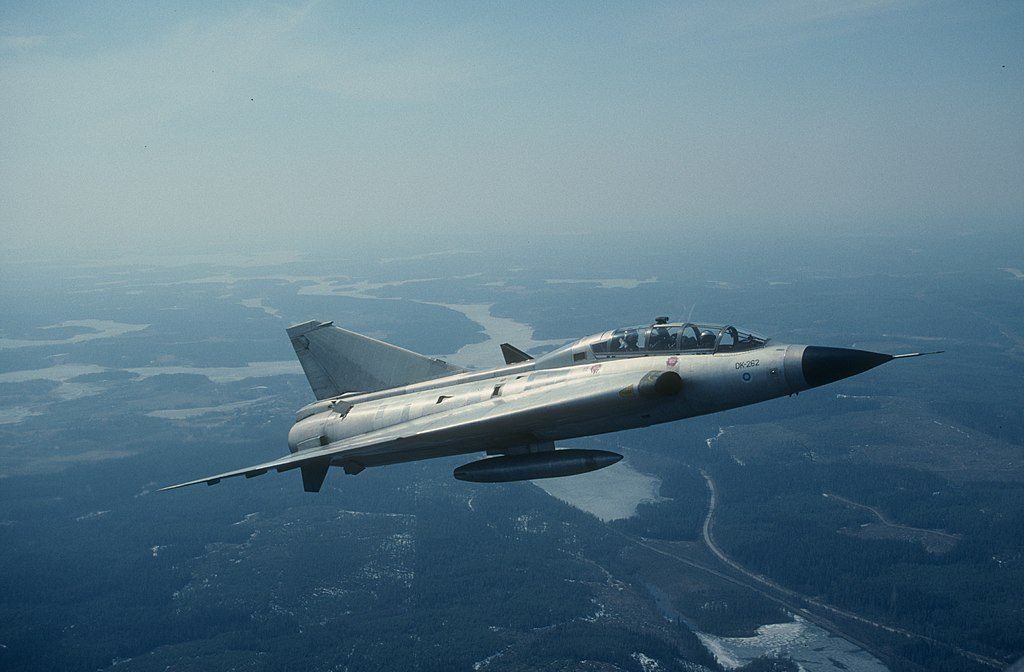
Two-seat Saab Draken variant in flight over Swedish landscape
A two-seat Saab Draken variant in flight over the Swedish landscape. (Photo via Wikimedia Commons)

Built for the Roads

No feature of the Draken better reflected Swedish strategic thinking than its ability to operate from public highways. The Bas 60 dispersed airfield system created approximately 70 small wartime air bases throughout Sweden, including specially prepared straight sections of highway reinforced to handle jet aircraft. The concept assumed Soviet first strikes would crater the main runways at permanent air bases. The Flygvapnet's response was to scatter its fighters across the country, hiding them in forest clearings and launching them from road strips as short as 500 meters.

The Draken was designed around this requirement. Its takeoff and landing roll was approximately 500 meters — short enough for a highway section between two curves. The nose gear included a mudguard for rough-field operations. A braking parachute deployed from the tail base on landing. The aircraft was designed for rapid turnaround by conscript ground crews with minimal specialized equipment — fuel, rearm, and launch again in minutes, then disperse before the next strike arrived.

This dispersed basing philosophy became a defining feature of Swedish fighter design. It continued through the Saab 37 Viggen and remains central to the JAS 39 Gripen today. The Draken established the template.

The First Cobra

In the early 1960s, Swedish test pilots Bengt Olow and Ceylon Utterborn discovered something unexpected during stall recovery training. The Draken's tailless double-delta configuration made it susceptible to deep stalls — a dangerous condition where the aircraft pitches nose-up to extreme angles of attack and refuses to recover. While practicing recoveries, the pilots found they could deliberately enter a controlled super stall, pitching the nose past 90 degrees while maintaining forward flight, then rapidly negating the angle of attack to resume normal flight. The aircraft essentially stood on its tail and used itself as an air brake.

The Swedes called this maneuver kort parad — "short parry," a fencing term. The rest of the world would not see it until 1989, when Viktor Pugachev performed it publicly in a Sukhoi Su-27 at the Paris Air Show. Western media named it "Pugachev's Cobra." But the Draken had been doing it roughly 25 years earlier. The Saab J 35 Draken was the first aircraft known to perform the cobra maneuver — a quarter-century before it became a symbol of Russian supermaneuverability.

Variants and Evolution

Over two decades of production — from 1955 to 1974 — Saab built 651 Drakens across multiple variants. The J 35A was the initial production model with two ADEN cannons and the RM6B engine. The J 35B added data-link integration with the STRIL 60 air defense network and a collision-course radar. The J 35D introduced the more powerful RM6C engine and additional fuel capacity. The J 35F, the definitive interceptor variant, carried Falcon missiles and improved avionics. The final Swedish variant, the J 35J, was an upgraded F-model with modernized electronics and additional weapon pylons — 66 aircraft were converted.

Beyond the fighter variants, Saab produced the S 35E, an unarmed reconnaissance model with five cameras in the nose, and the SK 35C, a two-seat trainer converted from J 35A airframes.

Export Success

The Draken found buyers beyond Sweden — unusual for a Swedish military aircraft in the Cold War era. Denmark was the first export customer, receiving 20 single-seat F-35 fighters, 20 RF-35 reconnaissance variants, and six TF-35 two-seat trainers starting in 1970. Finland acquired the Saab 35XS — export fighters assembled under license by Valmet from Saab-supplied kits — along with second-hand Swedish airframes. Austria received refurbished J 35OE models starting in 1987, becoming the last military operator of the type.

The Draken was never used in combat by any operator. Its entire career was spent preparing for a war that never came — which, for a defensive interceptor built by a neutral nation, was exactly the point.

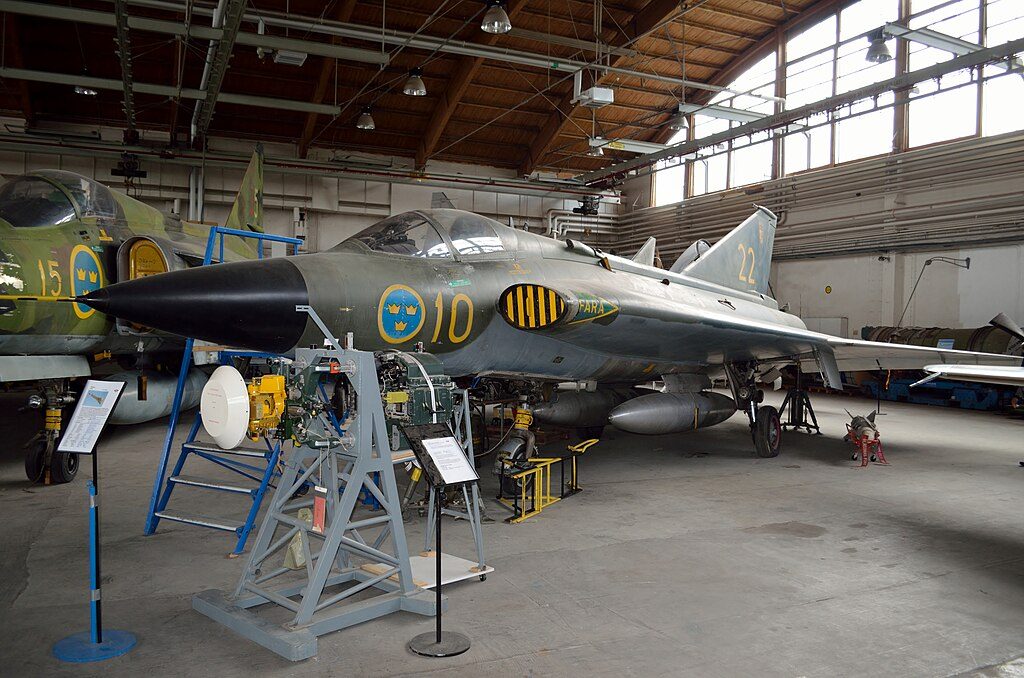
Saab Draken in museum display with Swedish Air Force markings
A preserved Saab Draken on display — a testament to Sweden's Cold War aviation innovation. (Photo via Wikimedia Commons)

Retirement and Legacy

Sweden retired its last Drakens between 1998 and 1999, replacing them with the Viggen and eventually the Gripen. Denmark retired its fleet in 1993 in favor of F-16 Fighting Falcons. Finland flew its Drakens until 2000, replacing them with F/A-18 Hornets. Austria was the final military operator, retiring its J 35OEs in 2005 when the Eurofighter Typhoon arrived.

The Draken's legacy is not measured in combat kills — it has none. It is measured in what it proved: that a small, neutral nation could design and build a world-class supersonic interceptor that matched or exceeded the performance of aircraft produced by the superpowers. The double-delta wing, first validated on the Lilldraken in 1952 and refined across 651 production aircraft, influenced wing design for decades. The dispersed basing concept that the Draken pioneered remains a cornerstone of Swedish defense strategy. And the cobra maneuver that the Draken performed in obscurity during the 1960s would not enter the global aviation vocabulary for another quarter-century.

Sweden built the Draken to defend itself alone, against an enemy that outnumbered it in every category. The aircraft it produced was fast, innovative, and quietly revolutionary — much like the country that designed it.

Share this article

Share:

Recommended

Ace of The Skies: Can You Identify These Military Aircraft Throughout The Years?
Test Yourself

Ace of The Skies: Can You Identify These Military Aircraft Throughout The Years?

Can you identify these aircraft?

Take the Quiz

On This Day in Military History

March 30

Easter Offensive Begins (1972)

North Vietnam launched the Easter Offensive, a massive conventional invasion of South Vietnam with 14 divisions and hundreds of tanks, the largest military operation since the Chinese intervention in Korea.

1814Battle of Paris

1856Treaty of Paris Ends the Crimean War

1941Rommel Launches First North Africa Offensive

See all 10 events on March 30

Get Military News & History in Your Inbox

Join thousands of readers receiving our weekly digest of military technology, history, and analysis.

Test Your Knowledge