Michael Trent covers military aircraft, weapons systems, and defense technology with an emphasis on cost, maintenance, and real-world performance. He focuses less on specifications and more on how systems hold up once they are deployed, maintained, and operated at scale.
In the summer of 2006, twelve F-22 Raptors deployed to Joint Pacific Alaska Range Complex for Northern Edge, one of the largest joint exercises the U.S. military conducts. Over the course of the first week, those twelve jets flew against a combined force of F-15s, F-16s, and F/A-18s representing a near-peer adversary. The final tally for week one: 144 kills to zero losses. By the end of the exercise, the number had climbed to 241-2, and the two "losses" were F-15C Eagles flying alongside the Raptors, not the F-22s themselves.
That is not a typo. That is not propaganda. That is what happens when fifth-generation stealth, supercruise, and sensor fusion collide with legacy fighter tactics.
A year later at Red Flag 07-2, the story repeated: 108-0 against aggressor F-15s and F-16s flown by some of the best pilots in the Air Force. At a separate Weapons System Evaluation Program (WSEP) event, a mixed package of four F-15s and four F-22s achieved a 41-1 record against fourteen Red Air fighters, the single loss, again, belonging to an Eagle.
These numbers demand explanation. Not because they seem inflated, but because the gap is so enormous that it reveals something fundamental about how modern air combat actually works. The F-22 doesn't just outfight other aircraft. It operates in an entirely different paradigm.
Stealth Isn't Invisibility, It's Information Dominance
According to open-source assessments, the F-22's estimated radar cross-section sits somewhere between 0.0001 and 0.001 square meters, roughly the radar return of a marble to a steel ball bearing. To put that in operational terms: by the time an adversary's radar can detect a Raptor, the Raptor has already detected, tracked, and engaged that adversary multiple times over.
But stealth alone doesn't explain the widely reported 241-2 kill ratio. What stealth actually provides is something more subtle and more decisive than mere concealment. It gives the Raptor's pilot total control over the terms of engagement. They decide when the fight starts, at what range, from what angle, and whether it happens at all.
As Lt. Col. Tolliver, a veteran Raptor pilot, reportedly said after Northern Edge: "They couldn't see us. That's what makes the F-22 special."
The implication of that statement runs deeper than it sounds. In a beyond-visual-range engagement, the side that detects first, shoots first. The side that shoots first almost always wins. The F-22 compresses the entire kill chain into a sequence that's over before the adversary knows it has begun.
The Missile Physics Nobody Talks About
Here's the underrated insight that separates the Raptor from everything else in the sky: missile energy at launch.
The F-22 routinely operates at 50,000 feet and above, well above the ceiling of most fourth-generation fighters, which top out around 40,000-45,000 feet in combat configuration. Its twin F119-PW-100 engines, each producing 35,000 pounds of thrust, allow it to supercruise at Mach 1.5 or higher without afterburner. That combination of altitude and speed fundamentally changes the physics of air-to-air missile employment.
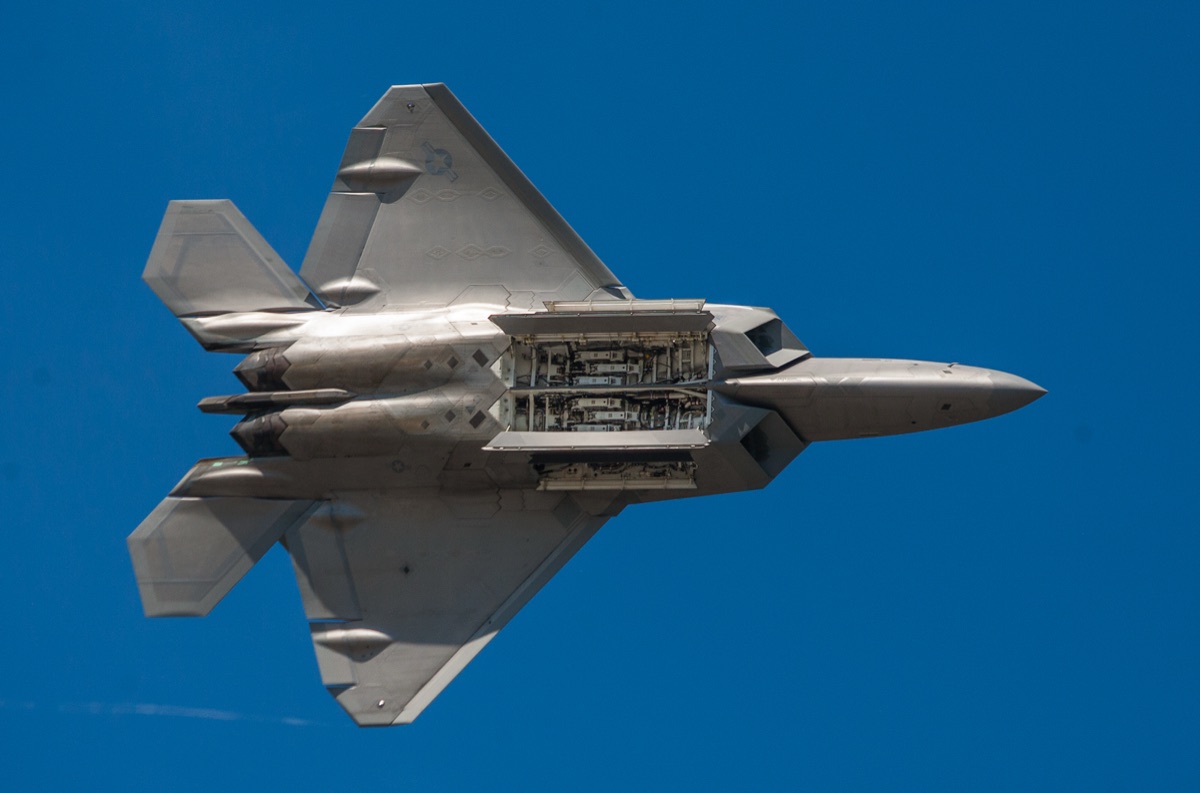
The F-22 carries six AIM-120 AMRAAM missiles and two AIM-9 Sidewinders internally. The internal carriage eliminates radar-reflective external pylons while protecting weapons from aerodynamic drag.
An AIM-120 AMRAAM launched from a Raptor at Mach 1.5 and 50,000 feet starts its flight with dramatically more kinetic energy than the same missile launched from an F-16 at Mach 0.9 and 30,000 feet. The thinner air at altitude means less drag. The higher launch speed gives the missile a head start it never surrenders. The result is that the Raptor's AMRAAMs have substantially greater effective range and arrive at their targets with significantly more energy, meaning the target has less time to react and fewer options for evasion.
This is a compounding advantage. The Raptor fires from farther away, which means the adversary has even less warning. The missile arrives faster, which means defensive maneuvers are less effective. And because the Raptor can engage from beyond the adversary's own missile envelope, it can fire, assess the result, and fire again before ever entering danger.
At Northern Edge, this is exactly what happened. Raptor pilots described engagements where they prosecuted multiple targets in sequence, with none of the adversaries detecting the F-22 before missile impact. In the exercise's largest single engagement, F-22s achieved an 83-1 ratio against 103 adversary aircraft that had been regenerated (allowed to "respawn" after being killed) to keep the scenario running.
The Sensor Fusion Advantage
The F-22 carries the AN/APG-77 active electronically scanned array radar, one of the most capable fighter radars ever built. But the real advantage isn't the radar alone, it's how the radar works in concert with the ALR-94 passive electronic warfare suite.
The ALR-94 is one of the most sensitive radar warning receivers ever installed on a fighter. It can detect, classify, and geolocate enemy radar emissions at ranges exceeding the APG-77's own detection range. This means the Raptor can often build a targeting picture without ever turning on its own radar, operating entirely in passive mode while the adversary broadcasts its position with every sweep of its antenna.
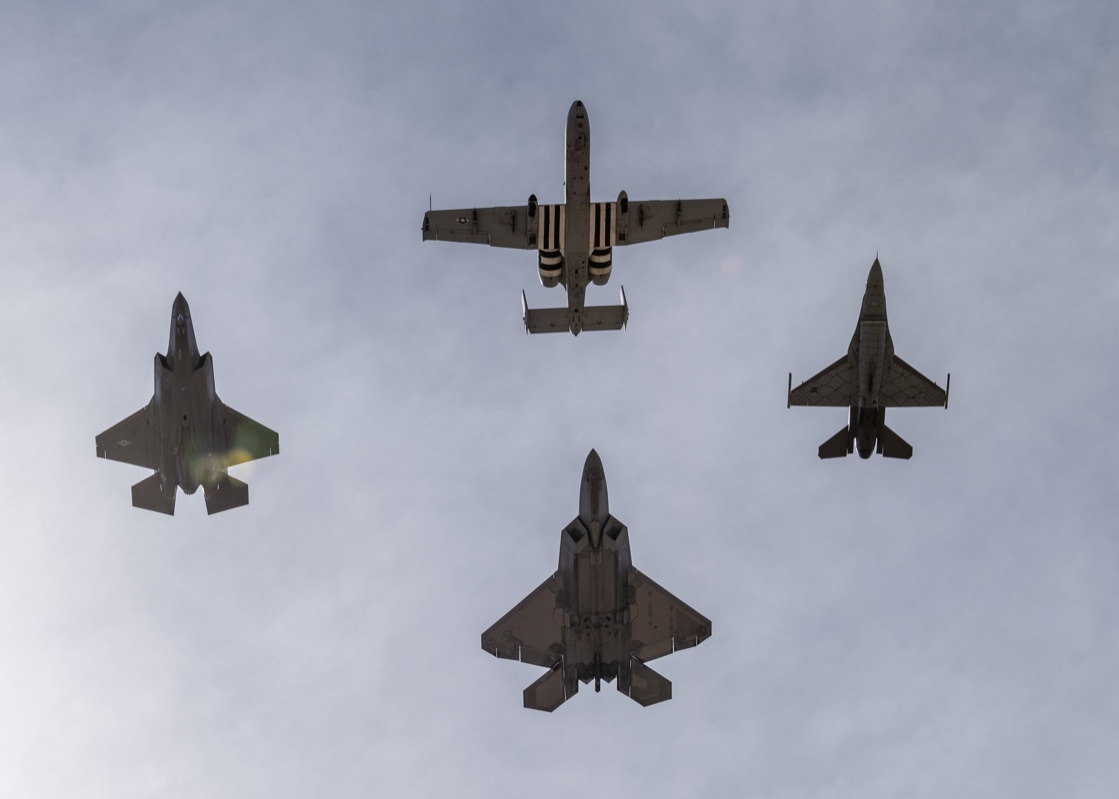
A heritage formation featuring the F-35A, A-10, F-22, and F-16. The Raptor's ability to share its sensor picture with legacy aircraft transforms the entire formation's effectiveness.
The Raptor's onboard processors fuse inputs from the APG-77, ALR-94, and other sensors into a single integrated picture displayed to the pilot. There's no toggling between radar screens and EW displays. The pilot sees one picture of the battlespace, with threats identified, tracked, and prioritized. This reduces cognitive workload at exactly the moment when decisional speed matters most.
One detail from Northern Edge illustrates this perfectly. After expending their weapons, F-22 pilots didn't return to base. They stayed in the fight, operating as forward air controllers, using their superior sensor picture to direct fourth-generation fighters to targets those aircraft couldn't detect on their own. The Raptor's sensors turned legacy aircraft into dramatically more effective platforms simply by sharing what they could see.
The Combat Record: Bombs, Balloons, and Deterrence
For all its air-to-air dominance, the F-22's actual combat history is almost entirely air-to-ground. The Raptor first saw combat on September 22, 2014, flying strike missions over Syria as part of Operation Inherent Resolve against ISIS. Over the course of the campaign, F-22s flew 204 sorties, dropping 270 precision-guided munitions against approximately 60 target locations.
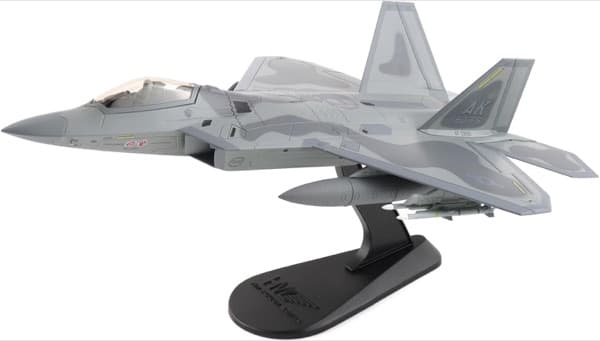
A compact desk-sized F-22 with the 1st Fighter Wing paint scheme. Die-cast metal body with a plastic display stand included. Around 4 inches nose to tail at 1:145 scale.
The 94th Fighter Squadron alone logged 590 flights and 4,600 combat hours over Syria. But the most telling statistic from their deployment isn't about bombs dropped, it's about fights prevented. During their rotation, the 94th deterred 587 enemy aircraft from entering contested airspace. Not engaged. Not shot down. Deterred. Aircraft from various nations operating in the Syrian theater simply chose not to challenge airspace where F-22s were known to be present.
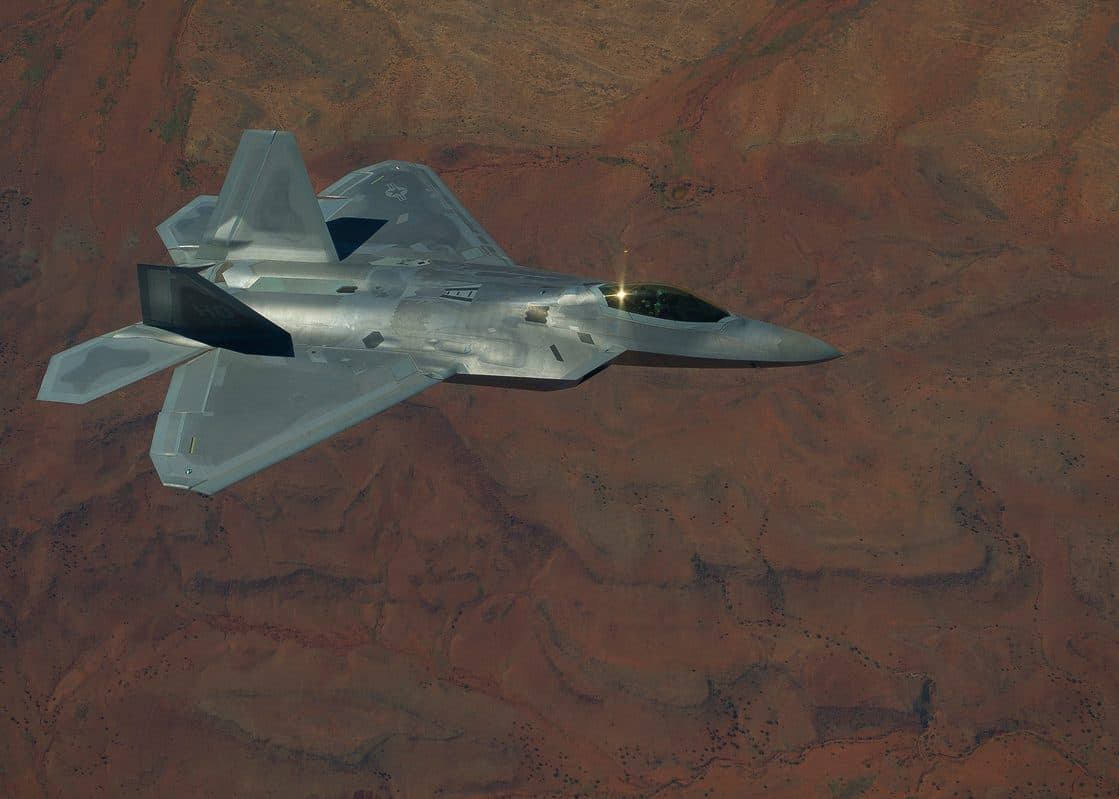
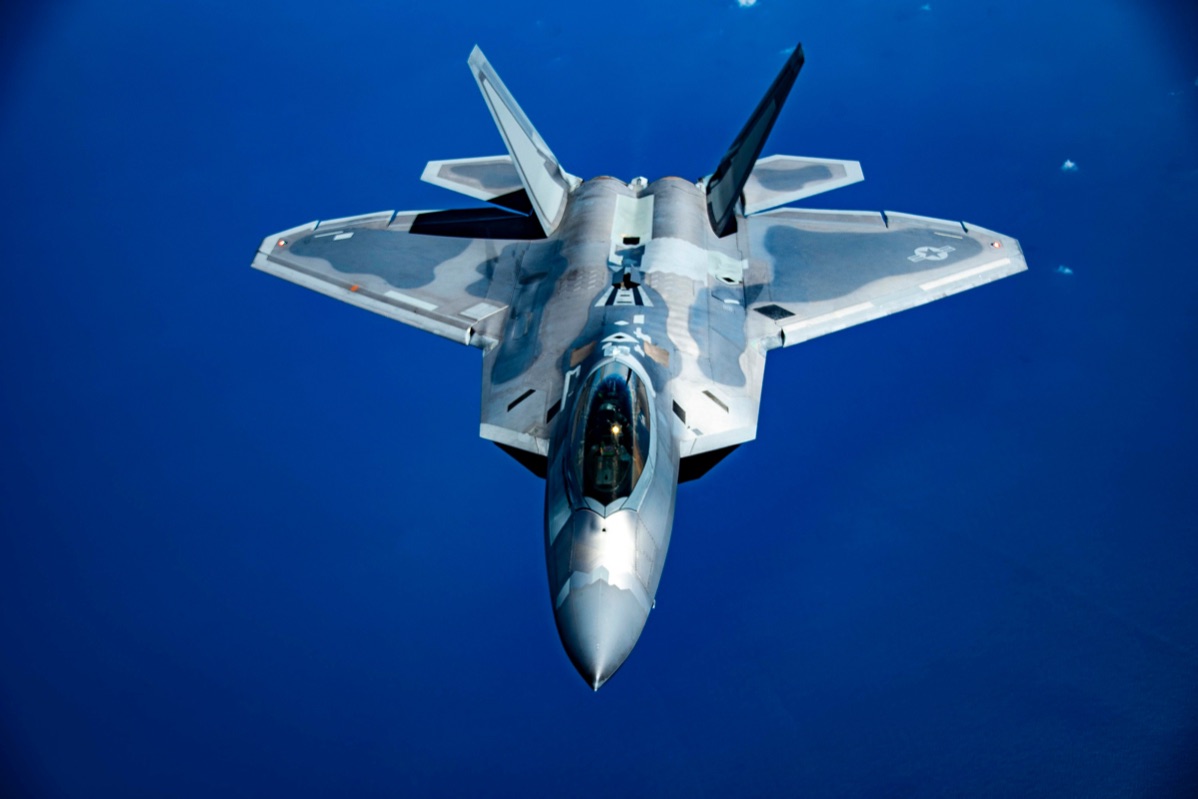
Aerial refueling extends the F-22's operational reach, allowing sustained presence in contested airspace. During Operation Inherent Resolve, tanker support enabled Raptors to maintain long combat patrols over Syria.
The Raptor's only air-to-air kill came on February 4, 2023, and the target was a Chinese high-altitude surveillance balloon drifting over the continental United States. An F-22 from the 1st Fighter Wing fired a single AIM-9X Sidewinder at 58,000 feet, making it the highest known air-to-air engagement in history. The irony of the most lethal air superiority fighter ever built scoring its first kill against an unmanned balloon was not lost on anyone.
But that irony carries a deeper truth. The F-22 has never shot down a manned aircraft because no manned aircraft has been willing to fight it. That is not a failure of opportunity. That is deterrence working exactly as designed.
What the Kill Ratio Doesn't Tell You
Intellectual honesty demands acknowledging what those 241-2 and 108-0 ratios leave out. These exercises were designed to test the Raptor in its optimal scenario: beyond-visual-range engagements where stealth, supercruise, and sensor range determine the outcome before the merge. That's a legitimate test, BVR is how most future air combat will be fought, but it's not the complete picture.
In dissimilar air combat training against Eurofighter Typhoons, the Raptor's dominance has not been absolute. In within-visual-range (WVR) engagements, the close-in turning fight where stealth matters less and aerodynamic performance matters more, Typhoon pilots have scored simulated kills against F-22s. The Typhoon is an exceptional WVR platform with a high thrust-to-weight ratio and advanced helmet-mounted cueing systems.
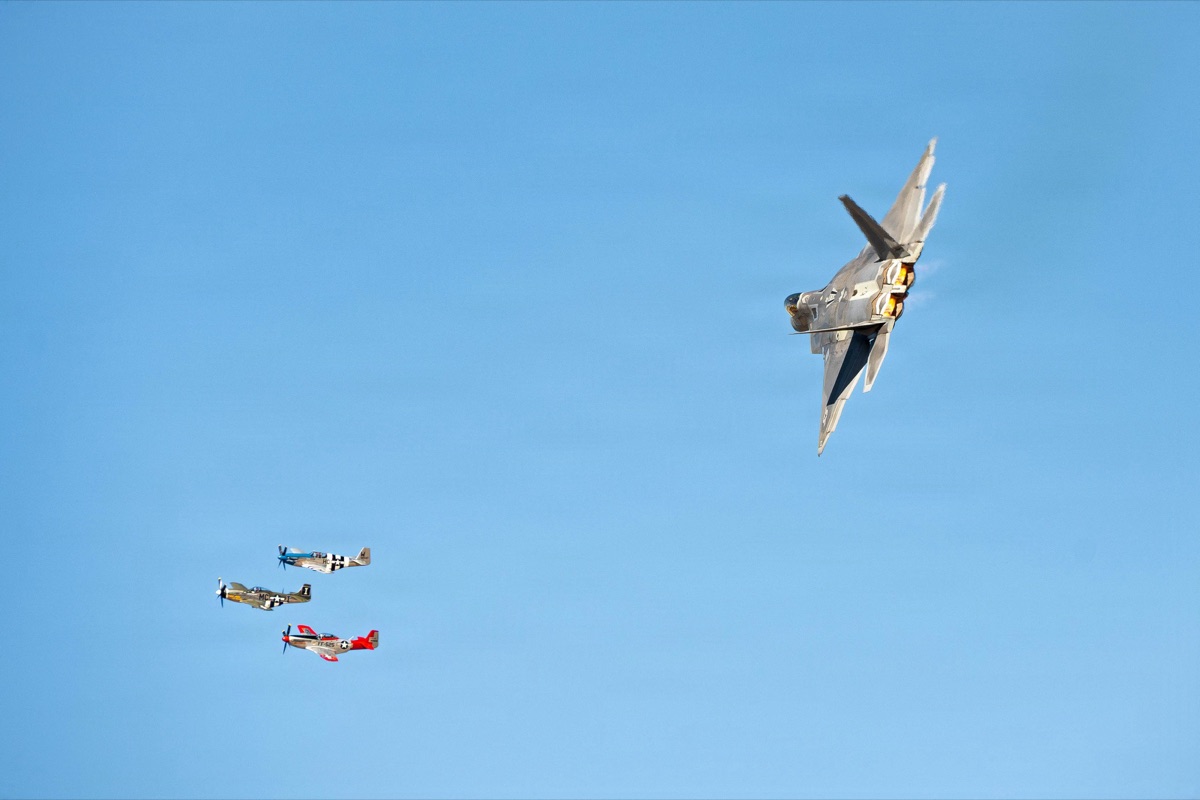
An F-22 demonstrates its thrust-vectoring agility during a heritage flight with P-51 Mustangs. The Raptor's 2D thrust vectoring nozzles enable post-stall maneuvering that exceeds any fourth-generation fighter's capabilities in close combat.
But here's the critical context: those WVR kills only happen when the Raptor allows the fight to reach the merge. In a real engagement, the F-22 pilot would have engaged the Typhoon at 40-plus miles with AMRAAMs and never allowed a close-in fight to develop. The Raptor's dominance isn't just about winning any given fight, it's about controlling which fights happen. And that's a distinction that transforms a very good kill ratio into an absurd one.
The F-22 also carries the M61A2 Vulcan 20mm cannon with 480 rounds, and its two-dimensional thrust vectoring nozzles give it post-stall maneuvering capability that exceeds any fourth-generation aircraft. If forced into a knife fight, the Raptor is formidable. But the entire tactical philosophy of the aircraft is built on ensuring that knife fight never happens.
The U.S. Air Force operates just 187 F-22 Raptors, far fewer than the 381 originally planned. The fleet was capped in 2011 when Secretary of Defense Robert Gates halted production, partly because the F-22 had no peer adversary at the time and the F-35 program was expected to fulfill the multirole requirement. Each Raptor cost approximately $150 million, making it one of the most expensive fighter programs in history.
With the production line cold and Lockheed Martin tooling long since dismantled, those 187 jets are irreplaceable. The Next Generation Air Dominance (NGAD) program was intended to eventually succeed the Raptor, but its future remains uncertain as the Air Force weighs cost and capability tradeoffs. For now, the F-22 remains the only operational fifth-generation air superiority fighter in the world.
That small fleet punches absurdly above its weight. The Raptor's performance at Northern Edge, Red Flag, and in operational deployments demonstrates that quantity has limits when the qualitative gap is this extreme. Twelve jets producing a 241-2 ratio against a mixed force of the best fourth-generation fighters on the planet isn't just a good result. It's the kind of asymmetry that rewrites doctrine.
The Deterrence Paradox
The F-22 Raptor may be the most effective weapon that never gets used for its intended purpose. It was designed to dominate air-to-air combat against the best fighters any adversary could build. In exercises, it has proven that capability so thoroughly that the question isn't whether it can win, but whether anyone will show up to fight.
The 587 aircraft deterred during a single squadron's Syrian deployment tell the real story. The F-22's most valuable contribution to national defense isn't the kills it scores, it's the fights it prevents. Every adversary pilot who chooses not to challenge a Raptor, every air force planner who adjusts their strategy around the possibility of F-22 presence, every engagement that doesn't happen because the outcome is already known, that is the Raptor's true kill ratio. Not 241-2. Not 108-0. It's infinity-to-zero.
The most lethal fighter ever built has never fought another fighter. And that, more than any exercise statistic, is the measure of its dominance.