Marcus Webb writes about military ground vehicles, armored platforms, and the logistics of land warfare. His work covers everything from MRAPs and infantry carriers to the training pipelines that keep ground forces operational in contested environments.
On July 11, 2022, six GPS-guided rockets slammed into a Russian ammunition depot near Nova Kakhovka in southern Ukraine. The resulting explosion was so massive that it overloaded the sensors on NASA's VIIRS satellite, a system designed to image volcanic eruptions and wildfire fronts. Between 52 and 200 Russian troops were killed, including Major General Nasbulin. The weapon responsible was a system that, just weeks earlier, most people outside professional artillery circles had never heard of: the M142 High Mobility Artillery Rocket System, better known as HIMARS.
That single strike encapsulated everything that makes HIMARS lethal. Precision guidance that puts warheads within 10 meters of the aim point. A wheeled platform fast enough to vanish before counter-battery fire arrives. And a logistics footprint light enough to fly into theater on a C-130 Hercules, no strategic airlift queue required. In the months that followed, HIMARS would reshape the entire operational calculus of the war in Ukraine, force Russia to fundamentally reorganize its logistics network, and trigger a global scramble by allied nations to acquire launchers of their own.
This is the story of how a relatively modest rocket artillery system became the most consequential ground weapon of the 21st century, and how its next-generation munitions are about to make it even more dangerous.
What HIMARS Actually Is
At its core, HIMARS is a remarkably simple concept: take the firepower of a multiple-launch rocket system and put it on a truck. Built by Lockheed Martin, the M142 mounts a single six-round rocket pod on the back of a standard Family of Medium Tactical Vehicles (FMTV) 5-ton truck with a 6x6 drivetrain. The entire system weighs roughly 16,000 pounds, about the same as a loaded dump truck. A crew of three operates it. Top road speed is 85 km/h, and it can cover 483 kilometers on a single tank of fuel.
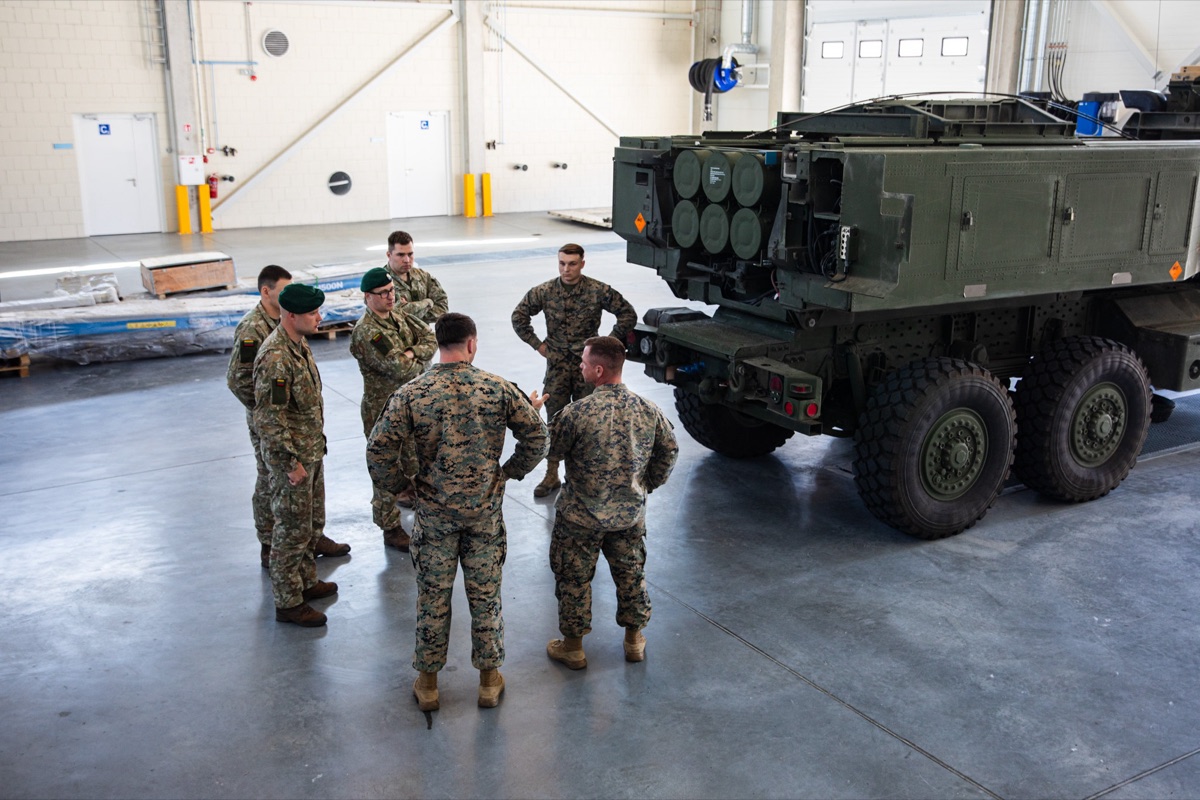
Marines and Lithuanian soldiers inspect a HIMARS launcher during a reload demonstration. The self-loading crane system allows crews to swap rocket pods without external support equipment, a critical advantage for sustained operations.
That single pod can carry six Guided Multiple Launch Rocket System (GMLRS) rockets, one Army Tactical Missile System (ATACMS) ballistic missile, or two of the newer Precision Strike Missiles (PrSM). A self-loading crane on the launcher allows the crew to swap pods without any external support equipment, pull up a resupply truck, crane off the spent pod, crane on a fresh one, and you are back in the fight.
The cost sits around $5.1 to $5.3 million per launcher. That sounds expensive until you consider what it replaces: the M270 Multiple Launch Rocket System, a tracked vehicle weighing 27 tons that carries two pods (12 rockets) but requires a C-5 Galaxy or C-17 Globemaster for airlift. HIMARS trades half the rocket capacity for a platform that can self-deploy on highways, fit inside a C-130, and keep up with wheeled convoys. For expeditionary operations, getting firepower where it needs to be, fast, that tradeoff is decisive.
Specification
M142 HIMARS
M270 MLRS
Mobility
Wheeled (6x6 FMTV)
Tracked (Bradley chassis)
Weight
~16,000 lb (7.3 tons)
~60,000 lb (27 tons)
Rocket Pods
1 pod (6 rockets)
2 pods (12 rockets)
Max Road Speed
85 km/h
64 km/h
Crew
3
3
C-130 Transportable
Yes
No (requires C-5/C-17)
Unit Cost
~$5.1–5.3M
~$5.8M
The Guidance System That Changes Everything
Raw firepower is only half the equation. What separates HIMARS from older rocket artillery, the kind that saturates a grid square and hopes for the best, is precision. The GMLRS rocket uses a dual-mode guidance system combining GPS satellite navigation with an inertial navigation system (INS). Under ideal conditions, the GPS receiver steers the rocket to a circular error probable (CEP) of under 10 meters. That means half of all rockets land within a 10-meter radius of the aim point at ranges up to 70 kilometers.
But here is the detail that matters most in a contested electromagnetic environment: the INS fallback. If GPS signals are jammed or spoofed, and Russia has invested heavily in electronic warfare systems designed to do exactly that, the rocket's ring laser gyroscopes and accelerometers continue tracking position and velocity independently. The CEP degrades somewhat without GPS correction, but the rocket still lands close enough to destroy point targets like ammunition depots, command posts, and bridge spans. This dual-mode architecture makes GMLRS far more resistant to electronic countermeasures than systems that rely on GPS alone.
The Extended Range GMLRS (ER-GMLRS) pushes the reach out to approximately 150 kilometers with the same guidance package. ATACMS, the larger ballistic missile, reaches 300 kilometers. And PrSM, the weapon that is about to transform HIMARS from a tactical asset into a strategic one, exceeds 500 kilometers, with future increments targeting ranges beyond 1,000 kilometers.
Before Ukraine: The Quiet Professional
HIMARS entered U.S. Army service in 2005 and saw its first combat deployments in Iraq and Afghanistan. It was effective but unglamorous, a fire support asset that artillerymen loved and everyone else ignored. The system performed exactly as designed: delivering precise fires at ranges that kept launchers well behind the front lines, destroying targets that would have required air strikes or massed conventional artillery in previous conflicts.
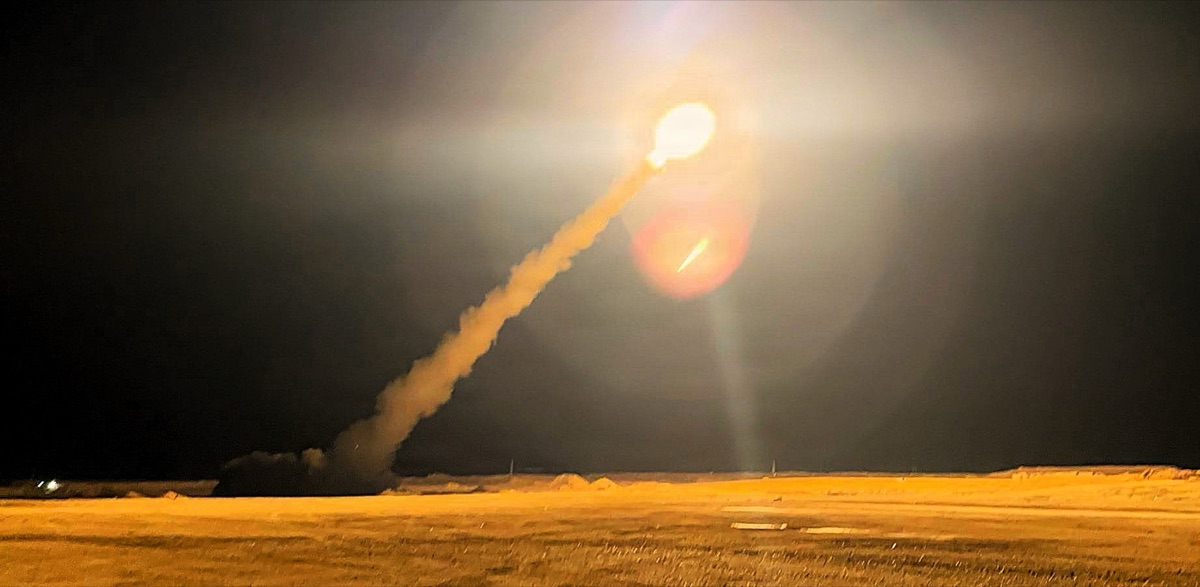
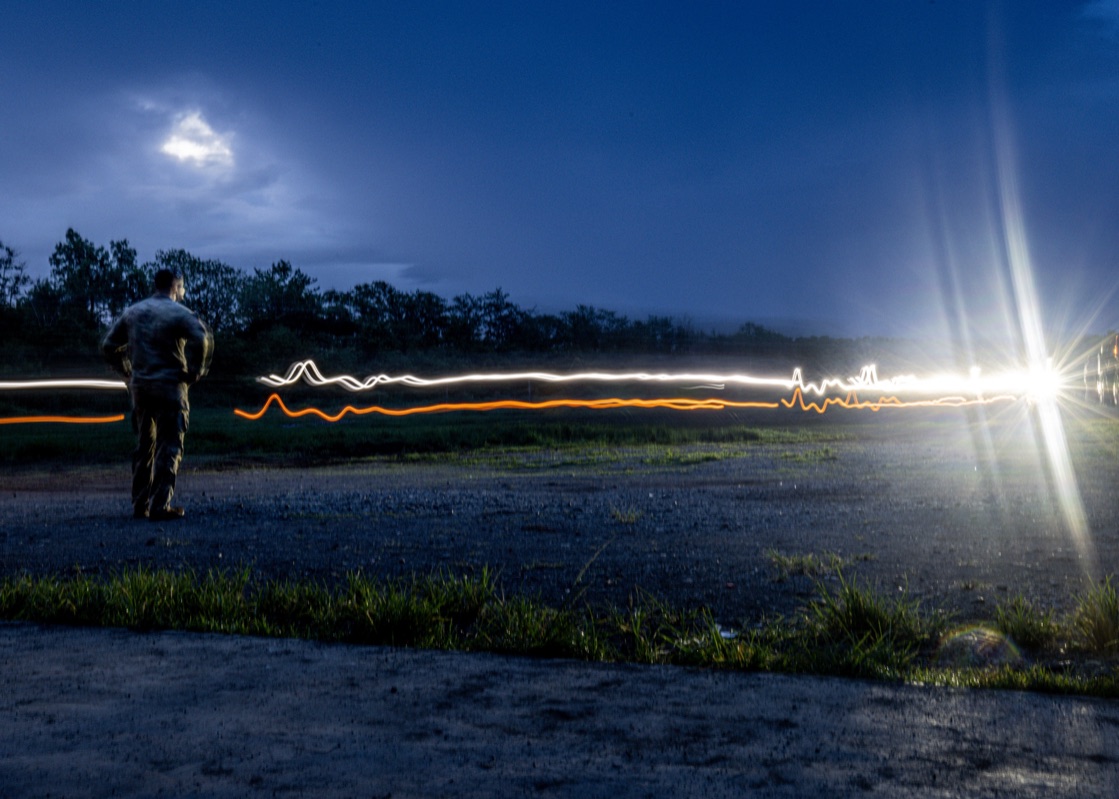
A HIMARS crew conducts night fire operations. The system's ability to fire accurately in total darkness, thanks to GPS/INS guidance, gives it a significant advantage over unguided rocket systems that depend on forward observers and daylight.
One engagement stands out from this period. In 2018, a HIMARS strike in Musa Qala, Afghanistan killed approximately 50 Taliban fighters in a single engagement. It demonstrated the system's capability clearly enough, but in the context of a counterinsurgency campaign where air power dominated the precision strike role, HIMARS remained an insider's weapon. Artillery officers knew what it could do. Almost nobody else did.
A rattle-can primer that gives paint something to grip. Gray is the most versatile color for military subjects, and the 180ml can will prime 8-10 models in 1/72 or 3-4 in 1/48 scale.
That anonymity ended on a summer night in southern Ukraine.
Ukraine: The Proving Ground
The first four HIMARS launchers arrived in Ukraine in late June 2022, roughly four months after Russia's full-scale invasion. At the time, the front lines had largely stabilized after Russia's initial offensive stalled, and Ukrainian forces were struggling with a critical asymmetry: Russian artillery outnumbered Ukrainian guns by as much as 10-to-1 in some sectors, and Moscow's logistics chain was feeding thousands of shells per day to batteries positioned behind dense air defense networks that made air strikes risky.
HIMARS changed the equation almost overnight. Within the first few weeks, Ukrainian crews destroyed more than 50 Russian ammunition depots, the carefully stacked mountains of shells and rockets that fueled Russia's artillery advantage. Each depot destroyed did not just eliminate the munitions inside; it forced every remaining depot to disperse, moving hundreds of kilometers further behind the front lines. That increased transit time, reduced the volume of shells reaching Russian guns, and degraded the artillery barrage that had been Moscow's primary tactical advantage.
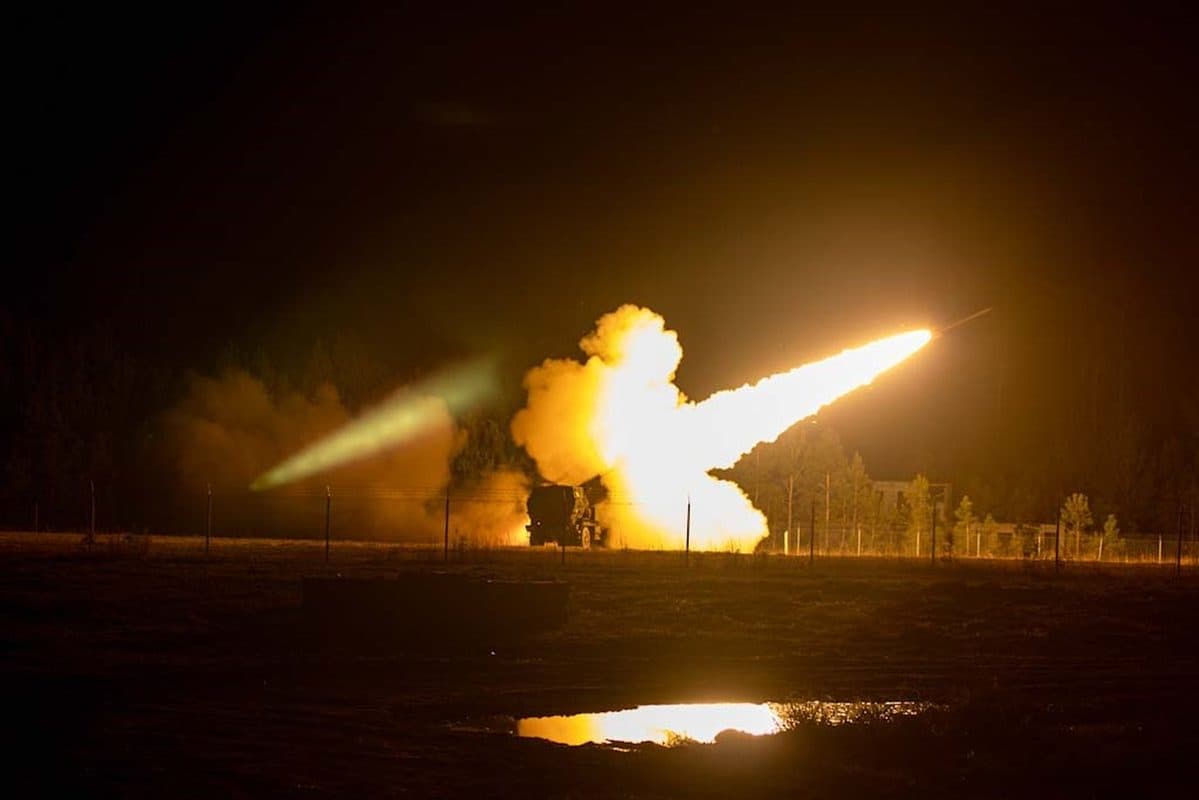
A HIMARS launcher fires at night, the rocket's exhaust flame illuminating the launch site. Ukrainian crews learned to fire and displace within minutes, earning the system its fearsome reputation among Russian forces.
The Nova Kakhovka strike in July was the most spectacular single engagement, but the Kherson bridge campaign demonstrated HIMARS at its most strategically decisive. Ukrainian crews systematically targeted the Antonivskiy Bridge, the primary road crossing over the Dnieper River that sustained Russian forces occupying the city of Kherson. Over a series of strikes, HIMARS crews fired 12 GMLRS rockets at the bridge, landing 11 of them directly on the span. Each hit punched through the road surface, and while the bridge's steel superstructure remained standing, it became impassable to heavy vehicles.
When Russia attempted repairs or switched to pontoon crossings, those were struck as well. The cumulative effect was devastating: Russian forces west of the Dnieper were effectively cut off from resupply. Ammunition, food, fuel, and reinforcements could no longer cross in sufficient volume. This logistical strangulation, achieved by a handful of launchers firing precision rockets from 70 kilometers away, set the conditions for Ukraine's Kherson counteroffensive, which liberated the city on November 11, 2022.
Russian military bloggers coined the phrase "HIMARS o'clock" to describe the nightly precision strikes that had become a terrifying constant. The meme spoke to a deeper tactical reality: Russian forces had no reliable way to stop the attacks.
Shoot-and-Scoot: Why Russia Could Not Kill Them
Of the 36 HIMARS launchers eventually delivered to Ukraine through 2025, only four were confirmed destroyed, a survival rate that stunned military analysts. The explanation lies in the system's fundamental tactical cycle: shoot-and-scoot.
Eight tools for $14: side cutters, hobby knife, tweezers, files, and a ruler. Not Tamiya quality, but perfectly functional for getting started. Thousands of positive reviews confirm these tools handle beginner and intermediate builds without issue.
The sequence works like this. A HIMARS crew receives a fire mission with target coordinates. The driver positions the vehicle, and the launcher elevates and aligns, the entire process from halt to ready-to-fire takes approximately 16 seconds. The crew launches a full six-rocket salvo in under 60 seconds. Then the launcher drops to travel position, and the truck accelerates to highway speed, displacing from the firing position at 85 km/h.
The best Ukrainian crews compressed the entire cycle, from receiving the fire mission to launching the last rocket, to roughly three minutes. Russian counter-battery radar could detect the launch signatures and calculate the firing position, but retaliatory fire typically required at least 90 seconds to arrive after detection. By that time, the HIMARS was already hundreds of meters away and accelerating. The rockets hit empty ground.
This is not a new concept. Shoot-and-scoot has been artillery doctrine since counter-battery radar became common. But HIMARS executes it better than almost any other system because of its wheeled mobility. A tracked M270 can displace from a firing position, but not at 85 km/h on a paved road. A towed howitzer can fire and move, but not without hooking up to a truck first. HIMARS combines the firepower to destroy a hardened target with the road speed to vanish before the enemy can respond. That combination is extraordinarily difficult to counter.
The Global Scramble
Ukraine's HIMARS campaign triggered the most dramatic surge in demand for a single weapons system since the Stinger missile became famous in 1980s Afghanistan. More than 750 launchers have been delivered worldwide, and Lockheed Martin has doubled production from 48 units per year to 96, with plans to increase further.
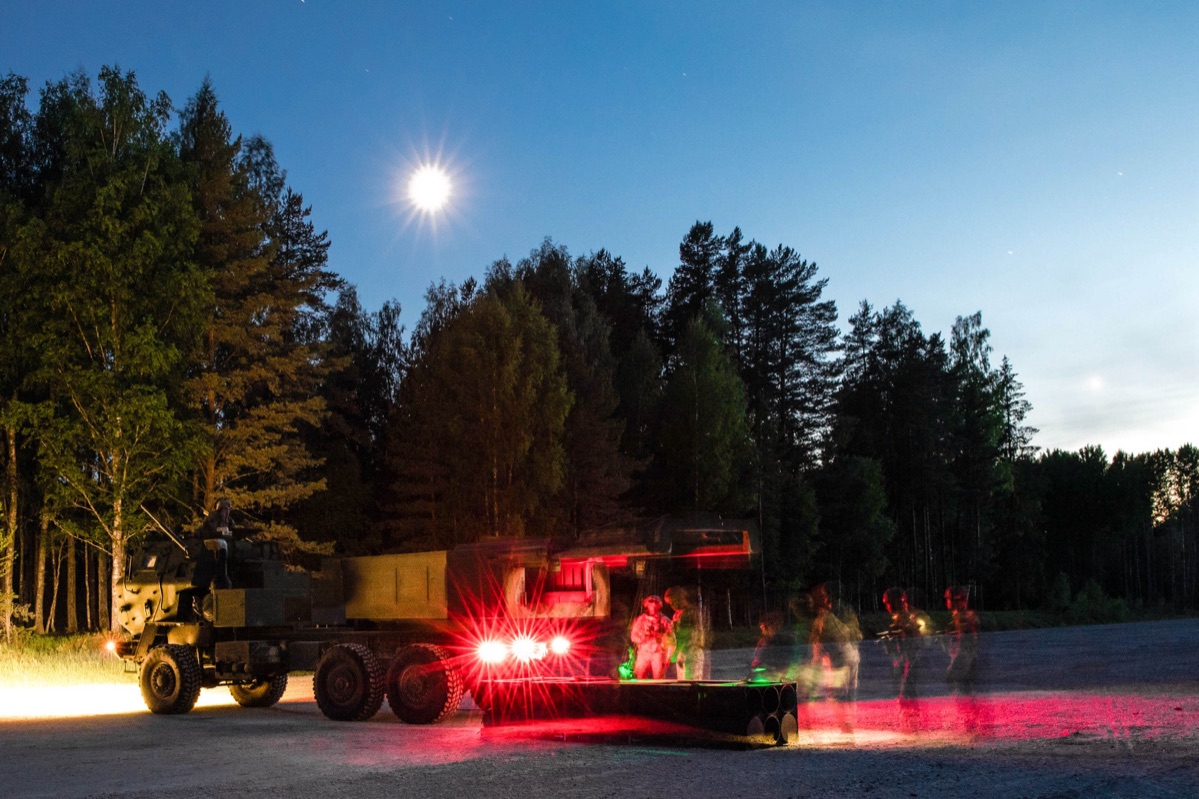
HIMARS launchers staged at a military installation during a combined exercise in the Philippines. The system's rapid deployability has made it a centerpiece of U.S. force posture across the Indo-Pacific.
The orders tell the story. Poland has committed to 500 HIMARS launchers, the largest single order and a reflection of Warsaw's proximity to Russia and its determination to build a credible deterrent. Australia has ordered 90 total, integrating HIMARS into its ground forces as a key component of its northern defense strategy. Taiwan has ordered 111 launchers, recognizing that HIMARS on the island's mountainous terrain would create the same kind of logistics nightmare for an amphibious invader that Ukrainian crews inflicted on Russian forces in Kherson.
Romania, Singapore, Jordan, and the United Arab Emirates already operate the system. Norway, Croatia, the Netherlands, Italy, Estonia, Latvia, and Lithuania are all in various stages of ordering or receiving launchers. The common thread across all these buyers is not geography or alliance membership, it is the recognition that precision rocket artillery, operated with shoot-and-scoot discipline, provides a cost-effective way to hold high-value targets at risk without requiring air superiority.
That last point matters enormously. Air strikes have been the Western way of war's default precision strike tool since 1991. But modern integrated air defense systems, Russian S-400s, Chinese HQ-9s, make air operations over contested airspace increasingly costly. HIMARS offers an alternative: ground-launched precision fires that do not require a pilot, do not need to penetrate enemy air defenses, and can be dispersed across dozens of firing positions that are individually difficult to find and destroy.
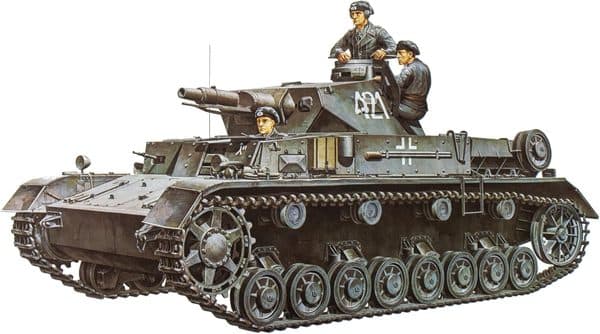
The Panzer IV was the workhorse of the German armored divisions, and Tamiya's 1/35 kit captures the Ausf. H variant with its characteristic Schurzen side skirts and long-barrel 75mm gun.
PrSM: From Tactical Weapon to Strategic Game-Changer
Everything described so far, the Ukraine campaign, the global buying spree, was accomplished primarily with GMLRS rockets at 70-kilometer range. The Precision Strike Missile is about to extend HIMARS into an entirely different category of weapon.
PrSM Increment 1, now entering production, delivers a range exceeding 500 kilometers, seven times the reach of standard GMLRS. Crucially, each HIMARS pod carries two PrSMs compared to one ATACMS, effectively doubling the deep-strike capacity per launcher. The missile uses GPS/INS guidance with a millimeter-wave seeker for terminal precision, enabling it to hit mobile targets like ships and relocatable command posts.
Increments 3 and 4, currently in development, aim for ranges beyond 1,000 kilometers and include an anti-ship seeker variant specifically designed for maritime strike in the Indo-Pacific. A HIMARS battery equipped with PrSM could, from a concealed position deep in allied territory, hold enemy naval vessels at risk across vast stretches of ocean, a capability previously reserved for aircraft, submarines, and dedicated anti-ship missile systems.
This transformation is profound. With GMLRS, HIMARS is a tactical weapon that destroys ammunition depots and bridges. With PrSM, it becomes a strategic fires platform capable of shaping an entire theater. The same $5 million launcher that proved itself in the fields of southern Ukraine could soon threaten targets at ranges that make it relevant to great-power competition in the Western Pacific.
The Machine That Rewrote the Rules
HIMARS did not become the most feared weapon on the modern battlefield because of any single technological breakthrough. Its rockets use guidance systems that have been available since the late 1990s. Its truck chassis is a standard military logistics vehicle. Its shoot-and-scoot tactics are older than most of its operators. What HIMARS did was combine proven technologies, precision guidance, wheeled mobility, modular rocket pods, and rapid reload, into a package optimized for the way modern wars are actually fought.
Ukraine demonstrated that wars between peer adversaries are won and lost on logistics. The side that can sustain ammunition flow to its guns wins; the side that cannot, loses. HIMARS gave Ukraine the ability to systematically dismantle Russian logistics with a handful of launchers operating from positions that Russia could not reliably target. That capability, validated in the most intense conventional war Europe has seen since 1945, is why every serious military on earth is now either buying HIMARS or developing something to match it.
The system that artillerymen quietly appreciated for nearly two decades has become the weapon that every allied army wants and every adversary fears. With PrSM extending its reach past 500 kilometers, and eventually beyond 1,000, the truck-mounted rocket launcher that reshaped a war is just getting started.